Ask ChatGPT

 The Two Matts
3 Sep 2026 · 47m · 18 chapters
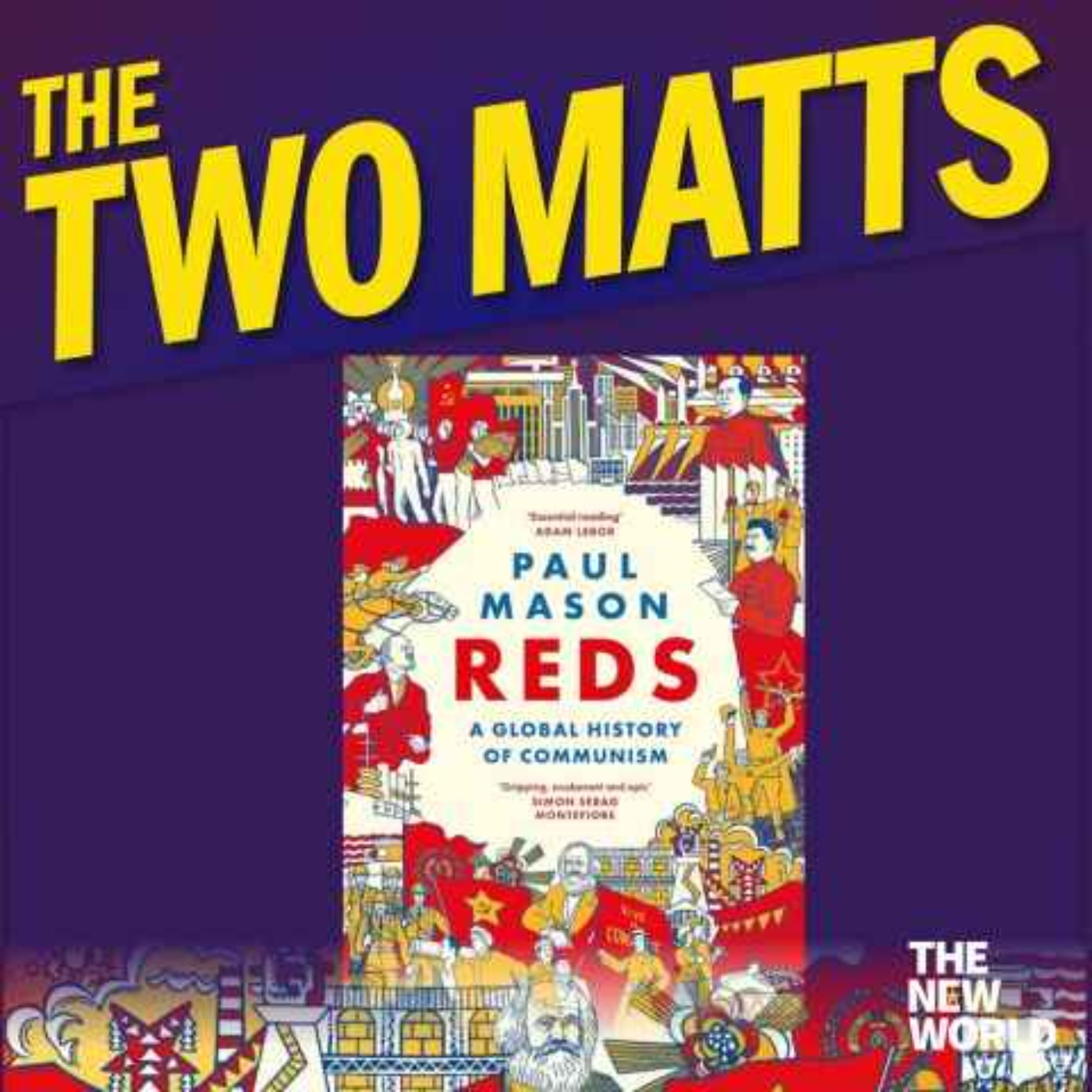
Paul Mason discusses his book Reds: a global history of communism—why communism appealed, how it evolved from early revolutionary blueprints to Leninism and Stalinism, and why China under Xi poses a major challenge to Western understandings of “communism.”
Paul Mason is a New World contributing editor/columnist and author of Reds. He grew up in a working-class Labour/trade-union environment near Wigan; his family included coal miners. He read Marx’s Communist Manifesto as a teenager and later studied/covered communism internationally (including multiple BBC visits to China).
Marxism is an Enlightenment-based “totalizing” progress narrative, but Marx is an “anomaly” compared with earlier communist traditions that favored planning and conspiratorial organization. Human-rights universalism is weak in Marxist theory. China’s rise is partly enabled by flourishing civil society since Deng, but Xi-era “orthodox Marxism” enforces thought control and restricts accurate history.
Lenin’s Geneva work tracing Pyotr Tuchachev; Babeuf’s “conspiracy of equals” and Blanqui’s cadre tradition; China’s censorship (e.g., “historical nihilism” prosecutions) and Shenzhen’s visible public dissent; Comintern founding in Shanghai (1921) with Chen Duxiu and Mao.
Written by AI. May contain mistakes.
Paul discusses his experiences with communism and its historical context.
“But I have to say, mate, it is absolutely, it wasn't what I was expecting.”
Discussion on the implications of current political systems and China's ambitions.
Paul shares his early encounters with communism and Marxism in education.
“And so that family were by no means left wing.”
Discussion on the totalizing nature of Marxism and its emotional appeal.
“It's all the best bits of it have been achieved.”
Exploration of how Marxism diverges from earlier forms of communism.
“And he says that what drew him about Marxism was its totalizing capacity, the fact that it was all consuming.”
Discussion on Gracchus Barbeuf's impact on revolutionary thought and organization.
“Now, the point I make in the book, there's two salient points here relevant to now.”
Explore the evolution of Marxism through historical figures and critiques.
“So Barber's ideas come into the world of Les Miserables, this is how we organise the revolution.”
Discuss the intrinsic human desire for hierarchy versus property.
“And it was this idea that the desire to live without hierarchy and property is actually innate to human beings.”
Analyze China's influence on global perceptions of communism today.
“ShipStation.com and use code AUDIO to try ShipStation free for 60 days.”
Discussing how different societies view China's growth and influence.
“well from pre-history through the french revolution through the soviet union and now into the world of Xi Jinping.”
Analyzing the implications and challenges of China's economic advancements.
“Yes, I think under Mao, Mao suppressed Chinese civil society.”
Exploring the consequences of suppressed historical narratives in China.
“But what you get, I mean, Chinese patents now are ahead of the US.”
Discussing how Marxism has been adapted to fit Chinese culture and politics.
“the one thing I would say about my book, it restores China, Chinese Marxism, to its rightful place, probably as the most significant outcome of this phenomena of communism in history.”
Examining the current threats and needed reforms for liberal democracy.
“Paul, obviously, personally, totally sympathetic to your idea that in the end, you know, society cannot prosper without history.”
Discussing the relationship between social democracy and class issues.
“What about extreme wealth expropriation?”
Explore the necessity of state intervention in defending democratic values against extremism.
“You'll see in Labour's, the current iteration of Labour, Andy Burnham, et cetera.”
Understand the importance of dialogue between political ideologies and self-criticism within the left.
“I mean, my book has had a good review in The Telegraph.”
Learn about a promotional offer for a free signed copy of 'REDS'.

Get the gist, explore an idea or ask about something said.
 Claude
On The Two Matts, what are the key points of this episode?
Searching your listeningAutomatic transcript. May contain errors.
0:00Hey, we're Nick and Jack, hosts of The Best One Yet. Behind every episode, there's research, email, spreadsheets, and our shared Google Doc, the Headline Hammer. With Google Workspace with Gemini, Google's AI is built right into the premium versions of tools we already use, like Gmail, Docs, and Sheets. No new tools or extra logins, just personalized AI for the way we work. That means less time on the work around the work and more time finding the stories worth talking about. Get AI tools for work. Upgrade to Google Workspace with Gemini at goo.gle slash workspace with Gemini. That's G-O-O dot G-L-E slash workspace with Gemini.
0:33When you're running a growing business, the right systems can unlock your full sales potential and make fulfilling every order effortless. Switch to ShipStation before peak season so you're prepped and ready before the rush hits. ShipStation connects Shopify, Amazon, TikTok Shop, and over 200 more marketplaces with one platform that does it all. You can manage orders, sync inventory, track returns, all automatically. Everything your operation needs, all in one place. Upgrade your shipping operations to stress-proof your biggest sales days and capture every bit of potential revenue. Go to ShipStation.com and use code AUDIO and get 30 days free.
1:29these people who you kill hello and happy Thursday everybody happy Thursday one and all this is the Two Mats podcast brought to you by the wonderful subscribers of the New World magazine with me Matt Kelly a bit croaky I've got a bit of a laryngitic throat if that's the correct way of saying that we are delighted to be here with Mr Paul Mason contributing editor columnist to the New World and pertinent to this conversation, author of an absolute blockbuster of the history of communism called Reds, which has received absolutely fabulous reviews and quite rightly so. Now, it's 500 odd pages and I'm a slow reader, so I haven't quite got to the end, although obviously I do not.
2:18I know how the story ends. No spoiler alerts. But I have to say, mate, it is absolutely, it wasn't what I was expecting. I was expecting something more polemical, I guess. But it's a true history and it's absolutely fascinating. Well, thank you for that. And thanks to both of you for inviting me and indeed for putting an excerpt in this week's edition of the magazine entitled Is the Future Communist? And the reason I wrote the book is because it might be. I mean, I went to Russia 17 days after the Soviet Union collapsed in the naive attempt to see whether there could be a kind of social democratic and anarchist left salvage from what was there.
3:05Answer very quickly became clear. No. But, you know, I looked at it then. People standing in the snow, selling their possessions, their war medals. And I knew that, you know, this is not coming back. people had had enough of it the actual leadership of the Soviet Union understood that there was no future in that system and like with fascism around the turn of the century I remember reading a lovely book by a Hungarian philosopher just basically saying totalitarianism is over the era is over and now we're staring at a future where China has set itself the goal of being the dominant power on the planet it set itself the goal of dominating 10 industrial sectors that don't exist yet confident that we can't replicate them so i'm talking about you know brain machine interfaces stuff like that and they think they are communists that wasn't true when i went to china for the bbc i've been six times to china lengthy visits great access to their leadership in uh in the 2000s and the early 2010s and they would just say to you look we're not communists we're social democrats it's just we haven't got enough money to have a welfare state give us time since 2012 2013 Xi Jinping has altered that he's reintroduced orthodox marxism and so 100 million people have to believe it and what I the reason I wrote this book and as you say it is by and large a straight history of the idea the impulse the political movement the regime the fall in Soviet Union and now China and the reason I wrote it is because I have this fear that if they do dominate the 21st century it's they who will not only get to write the definition of communism, so it doesn't matter whether us three think, oh this is not communist, they write the definitions and the scariest thing is they write the history books Paul can we step back a little bit you were born in lee near wigan um your grandfather pure andy burnham territory your granddad was a coal miner so you you've been surrounded by people of of the serious left all your life when was the first time that you started to think about communism and what what what what do you understand communism to be let's set out some definitions well let's let me just take you back to the biography because yes my my granddad was a coal miner my dad was a coal miner at the end of the war became a lorry driver uh you know so my family tree goes hat maker hat maker miner miner miner economics editor at the bbc and and and i know and my family gave me enough sort of moral courage to understand that's not about me that's about the post-war labor governments because i'm absolutely certain that somebody else in my family could have done what I do.
6:10And so that family were by no means left wing. They were social democrats, they were labourists, they were trade unionists. I mean, my dad went on a wild cut strike and occupied the Salford offices of the Transport and General Workers Union for not supporting it. But the first time I heard the word capitalism and communism was at grammar school. Because the Catholic priests who taught me were very, very categoric in introducing us to the ideas of Marxism because they wanted to beat them out I mean unfortunately physically in some senses beat them out of our skulls and so I'm sitting in a school library aged about 15 reading the communist manifesto and I've got the I've got the edition here because I went out and bought it to just for nostalgia's sake it's an edition with an intro by AJP Taylor, the historian, which basically says, look, this is all rubbish, you know, read it with care.
7:08It's all the best bits of it have been achieved. And it's all based on 19th century philosophy. But as I was reading it, the idea that something in history has to make a supreme sacrifice, the proletariat, destroy the system, and in the process, redeem humanity and destroy itself destroy its own culture because that's part of the story as well i'm sitting there thinking age 16 do you know what i've heard this story before somewhere else actually i hear it every time i go and kneel down on one of those hard pews in the in the catholic chapel and hear a sermon the idea of the redeemer the end of history um michel henry who's a French philosopher, a French Christian Marxist, a few years later wrote the definitive book about this.
8:03Henri says, the proletariat is Christ. Now, that was my introduction to it. And in the 1980s, as I saw the world my dad and I, the world my dad created, the world my mum created, the world I grew up in, attacked by Thatcherism, it became increasingly attractive to me that idea that uh look you know laborism isn't working ordinary trade unionism isn't working and like many people you know i was attracted to that aspect of marxism i've always been attracted to its theory of history the idea that history moves according to technological progress and that culture and politics are determined by that i Can I be really interesting, Paul, and obviously massive congratulations on the book.
8:52And what you just said really struck a chord with me because by chance, before I dived into your book, I'd been looking again at The God That Failed, the 1949 collection of essays that Richard Crossman edited about, you know, looking back on communism and its failures and so on. And the reason I mention it is because after what you just said is that there's one of the most interesting chapters. And it's by Arthur Kersler, a very important 20th century thinker, novelist and so on. And he says that what drew him about Marxism was its totalizing capacity, the fact that it was all consuming. And I think one of the things that comes out in your book brilliantly is that what Marx did, and I hope we can go back before Marx, but was he replaces the idea of divine providence with a kind of dialectical materialism, materialism which is a kind of um scientific version of teleology or divine providence and that that is an all-consuming idea it's not like social democracy or you know uh center right view it really isn't it it absorbs and consumes everything and therefore it has massive emotional appeal as well as you know social consequence yeah look we used to we used to say disparagingly you know that that marxism would become a religion especially in the soviet union Yeah.
10:13But actually, if you want to read Marx honestly, that's not an insult. No, exactly. Because Georg Hegel, who Marx basically takes, he takes Hegel's theory of change. And the dialectic. And he inverts it. So Hegel says history is the mind of God working its way towards freedom. Marx says history does nothing. It's individual people pursuing their own interests through classes, through property. But in a way, they too are working their way towards freedom. Now, one only has to, Marxists spend a lot of time saying Marxism is the negation of philosophy. It's a break with liberalism. I've come to the conclusion it's not.
10:59It's simply the end point of the Enlightenment's understanding of progress. Now, so that book you refer to, the Crossman book. um yes um the the totalizing as a totalizing theory you know it you know we in the age of complex systems and the age of uncertainty we're very wary of those theories and rightly so but you always have to say as well you know so is christianity and so is judaism and and the fact is that it's no mystery, should be, why Marxism took off, say, in the German labour movement, in the Yiddish-speaking labour movement of Eastern Europe, which was a huge thing, because it grafts so easily on to a belief system.
11:55Now, the point I make in the book, there's two salient points here relevant to now. The first is that Marx is the anomaly. the real tradition of communism goes back to the 18th century to the French Revolution to two figures who I foreground in this book Henri de Saint-Simon a French aristocrat who basically invented technocratic government and planning and François-Noël Barbeuf who was the first Gracchus Barbeuf first revolutionary communist an immensely interesting figure and so Saint-Simon writes the utopia, Barberth creates the conspiracy of equals, the way of achieving the utopia. 17 ,000 men under arms, ready to seize power, stopped at the last minute, a plan for undemocratic dictatorship to introduce the communist utopia.
12:54Is it fair to say that Barberth invents what we later acknowledge as the sort of revolutionary cadre? You know, most people associate that with Lenin. But reading your book, I thought, oh, wow, this really is the year zero. Absolutely. He invents the idea of the kind of vanguard party. Right. Also, you read the leaflets put out by Bobberth in 18, sorry, 1796. 1796, so it's during the directorate period of the French Revolution, after Robespierre, the leaflets that they put out are incredibly didactic. It's like reading a kind of sun editorial. These have been crafted so that the least literate people can understand them.
13:43Okay, so he gets executed. His colleague, Filippo Buonarroti, who was a descendant of Michelangelo Buonarroti, holds on to the archive for 30 years and he republishes it in 1828 in Belgium and by now a proletariat exists. So Barber's ideas come into the world of Les Miserables, this is how we organise the revolution. The key figure there is August Blanqui who was this really high profile our famous French revolutionary in the mid-19th century. He brings that idea into the era of the working class. Three attempts at revolution fail. And what does Marx do? Marx says, more or less the whole of Marxism in the mid-19th century is no to utopias, no to blueprints, and no to conspiracies.
14:40So Marx is the anomaly. As soon as Marx is gone, via a figure I point out again for the nerdy, Pyotr Tukachev, a minor Russian follower of Blanqui. He brings Blanqui into the Russian language and then sitting in Geneva round about 1901 to 1904 is Vladimir Lenin. And he sits there and I've discovered the source material for this. He sits there and he tells his followers, get every newspaper written by this Tukachev guy in Geneva, get everyone we study it all this is the blueprint so there's a direct lineage when people say lenin was a jacobin it's not metaphorical there's a direct lineage to that and i say marx is the anomaly from baberth to blanqui to lenin to stalin to mau is the tradition and does that help to sorry matt go on no no no mark you please please well all i can say that on marx i mean part of the you know an almost wearingly familiar line is is that Marxism has not yet been tried is that true I would say in a way yes because Marx what Marx himself said looking to his followers look if this is Marxism I'm not a Marxist but look there in the book I point out what I think are the anomalies and or rather the the weaknesses of Marx number one he das Kapital is with them throughout all three volumes with moral philosophical judgments values judgments based largely on a concept of virtue and justice that is entirely borrowed from Aristotle and yet throughout his life he used to laugh at the idea of moral philosophy because the argument is you know what what does Nancy and Oliver Twist need with a moral philosophy she has no choice um and and so first of all he taught his followers that moral philosophy is pointless and when the german working class said actually no we actually quite like the idea of morality and some of the german working class leaders said look we've got a quite good moral philosopher emmanuel kant let's just borrow some of that and graft it on at that point the leninists were saying no no no this is this is we can't there can't be a moral um so that's problem number one problem number two with marx is human rights very ambivalent on human rights and you can if you work really hard and find the right quotes you can find the theory of human rights but by and large the soviet union uh soviet philosophers said who said there's no theory of human rights there's no universalism in marx i think they're they're quite right and then the third thing is and again going back to the sources um so these are letters Marx wrote to Engels and others um I don't think he ever properly understood the utopian socialists he was trying to reject there's a an amazing figure called Etienne Cabet who was a really famous communist leader in the 1840s in Paris he was the the doyen of uh of French communism and he wrote a 500 word novel called Travels in Icaria, which describes exactly what a communist system should look like.
17:58Straight rivers, no bars, no brothels. You know, it's all, it's not much fun in Cabe's Icaria. Vital to the system, same as it is for Plato, as Karl Popper pointed out, same as it is for Thomas More, is total ideological unanimity. You cannot have this system without thought control, says Cabay, very clear, or a 50-year dictatorship to get there because the people are not educated enough. And that's an incredible warning. If you're Marx sitting in Paris in the 1840s, you're surrounded by Cabay following workers, surely it comes into your head. Well, this is all about thought control, linguistic uniformity.
18:42Cabay actually designs an artificial language in which deviation is impossible. So that's all, you know? So why didn't Marx engage with that? I'm not sure. I've been thinking this long and hard. I might be completely wrong here. I'm not sure he read it. And therefore, because there's no quotes from him in the whole Marx corpus. And I'm not sure he really understood the birth either because they didn't have probably full access to what we do. And so I think anybody who wants to be a Marxist today, I mean, historical materialism, the idea of being determines consciousness, all the rest. Fine. A more complex, systemic version of that.
19:23Fine. But really, when I go on TikTok and I'm not only seeing people swap Mark quotes, you know, it's what are the best five books by Stalin? What are the what are the best? What's Mao Zedong's greatest sayings? This is coming back. I mean, the people I met at university, you were quoting Mao, I thought were nuts then. But at least they had some contact with kind of there was a Maoist system. There were trade unions that could fight and occupy and the rest of it. If you're Gen Z and you're swapping these, I know we're three oldish blokes, but I really think the wisdom of our generation, having seen this thing in practice.
20:05I was born in the year that between 14 million and 44 million Chinese people died in a famine. And I knew nothing about it at the time. The one book about it, whose author I met when I was in Hong Kong, sorry, in Beijing, is banned. It's banned in China. So don't give me quotes from Chairman Mao. until you told me what you think about the 44 million Chinese people who he killed. Well, listen, I definitely want to spend a lot more time talking about China because that is the sort of looming elephant in the room, isn't it, that dominates this whole conversation. And we'll do that in the second half.
20:51But I just wanted to get this because it was one of the bits of the book that I found most fascinating. And it was this idea that the desire to live without hierarchy and property is actually innate to human beings. It sort of precedes all of the political thought and dogma that the philosophy that you've outlined. There's something intrinsic about human beings desire to live without hierarchy and property. Tell the listeners, please, where you get that data from. well i did a really deep dive into the anthropology and unfortunately in terms of space there's just not enough there's already 510 pages here plus index uh i i didn't have time uh there is a there is a chapter monquet waiting to be published about this so the idea of primitive communism is very fundamental to marxism the idea that we were once a propertyless society Now we are in the phase of property and hierarchy.
21:52And in the future, in the end of human prehistory, we will achieve a much higher form of abundance is basically the basic concept. Now, I think both the anthropological record and the kind of evolutionary biology shows that probably, as far as we know, from the ethnographic record, hunter-gatherer tribes in the upper Paleolithic, so before we get pottery before we get settlements were probably practicing altruism and sharing not because they didn't have enough stuff but because it was the only way in which a human band can function now unlike Marx and others and Engels in particular what we cannot assume is that where they had more abundance, so if they settled by a very abundant lake or river where there's fish every day and you can make little fish pens out of wood and reeds, it's probable once they're the surplus they probably also began to have class structures and the rudimentary ownership structures.
23:21There's always a male-female division of labour. Why do we know this? Because, you know, the Kalahari Bush people were idealised in the 50s, you know, man the hunter. We've got much more, we've got much better, including DNA evidence now, that the same thing happens among the most nomadic modern hunter-gatherers. So, you know, there was like a time and motion study done in costa rica of a remote tribe where modern remote tribe where that massive differences between the what the men were catching in hunting massive differences in the amount of meat but no genie coefficient whatsoever in the population they were simply sharing it out now okay i think we we could we can accept that and what it probably means is that we evolved that as a, we evolved it because where we came from were primates that have very hierarchical structures, you know, the raboon tribes, the chimpanzee bands.
24:26So, okay, I can accept that. But then you've got to say, well, but it's not our only impulse. If we have an impulse to share, we also have an impulse to stand out and be the tall poppy. And what happens in these societies is completely contrary to the Marxist assumption. What happens in many of the modern societies, and we have to assume that happened in prehistory in the upper Paleolithic, is that the way you keep altruism going as a social norm is through coercion. And so there's lots and lots of examples collected by modern anthropologists of how tribes coerce people who are trying to break the altruistic and the property free norms and it can go from ridicule ostracism right through to murder so i found that incredibly interesting because it partially invalidates the marxist understanding of what happens next because if we do get to a property free society and in my book post capitalism 11 years ago i i worked out a non-communist way of doing it uh based on it and abundance if we ever do get to that i fully expect it to be a society ribbon by hierarchy oppression and coercion and and in other words it's not unlawful that societies like you know polpot's cambodia or kim's uh north korea are so horrible because the fact that there are no classes of course there's classes there's an elite the fact there's no private property doesn't ever eradicate human will to power, I don't want to say like Nietzsche but there you are Fascinating, listen it's fascinating so far and the second half is going to be even more fascinating as we address the elephants in the room that is China, join us in a couple of moments
26:22Hey, we're Nick and Jack hosts of the best one yet behind every episode. There's research, email, spreadsheets, and our shared Google doc, the headline hammer with Google workspace with Gemini, Google's AI is built right into the premium versions of tools. We already use like Gmail docs and sheets, no new tools or extra logins, just personalized AI for the way we work. That means less time on the work around the work and more time finding the stories worth talking about. Get AI tools for work. Upgrade to Google workspace with Gemini at go. That's goo.gle slash workspace with Gemini.
27:20ShipStation.com and use code AUDIO to try ShipStation free for 60 days.
27:29Welcome back, dear listeners. We are with Paul Mason, New World contributing editor and columnist and author of Reds, which is the book of the moment, the history of communism. And Paul, within um within the book there is looming large throughout it is is china and um and you open this conversation by saying that your great fear was that china would would get to write the definitions of what communism is and would sort of validate this whole kind of philosophy that extends from well from pre-history through the french revolution through the soviet union and now into the world of Xi Jinping. Obviously, one phenomenon we're all familiar with is kids on social media looking at China from the West and saying, wow, not so bad.
28:21You know, look at how their shiny cities are and it looks like a place in growth. And it's not just kids, it's the global South as well is looking at China and saying, well, they're offering a better roadmap to a prosperous future than this shambolic, sclerotic, chaotic Western democracy. see um what why are they wrong what's what's the forget the moral answer what's what's the practical answer to why they're wrong to think that china is the future well they might not be wrong it's just that i i don't choose that future in in this sense but what do people in the global south say to you uh when when the west when we meet the west we get a lecture when we meet china we get a loan yeah no that loan comes with uh imperialistic consequences uh as sri lanka is finding out you know it's it's it's in hock to china um it says in hock to china as it was to imperial britain when britain owned uh sri lanka china now owns a huge naval port in sri lanka um and the the ultimate argument i would say is i i do not lament the rise of china i mean i just my personal preferences here having been to russia not long after communism um what was missing was a civil society you know people would just like they still whisper around their kitchen table and as for the idea of a pub or a raucous discussion in public unless you're completely drunk you know drinking or vodka out of a jam jar in the freezing cold you're not getting that in in in the Soviet system.
30:02China, very different. And for reasons we'll come to. Yes, I think under Mao, Mao suppressed Chinese civil society. But under Deng Xiaoping, something that Xi has not been able to reverse, Chinese civil society flourished. And so literally, I always remember my first visit to Shenzhen in 2003. Walking, so I just lost my mind, lost my you know communist fixer just headed off as a lone white guy uh westerner into a slum and just walked along and it was there's a there's a
30:44i just thought it was kind of teeming with life uh teeming with public disagreement teeming with public laughter, jokes, graffiti. You want false ID papers? Ring this number. Okay, so it is impossible to lament the rise of 1.78 billion people out of the penury that both their imperial system, the Qing dynasty, and our imperial system, imperialism, left them in. But what you get, I mean, Chinese patents now are ahead of the US. In security, there's an Australian institute called the Aspie Institute that studies security-related science. In 60 of the categories that they study, so I think stuff like sixth-generation telecoms or quantum computing, in 54 out of the 60 China leads technologically and it's got that and in some their leadership is so great that they could pull away so that the West can never catch up again it's it's impossible to lament the advance of science what I lament is the fact that they can never have an Einstein they can never have a Mozart they can never have a James Joyce why not?
32:09because there's no freedom of thought look that's the problem and when I say Einstein of course they can have Einstein the physicist they can't have Einstein the moral philosopher my book if it ever rocks up on a Chinese bookshelf by accident will be categorised as historical nihilism that's not just a judgment in China, it's a crime. People have gone to jail for historical nihilism. And I'll give you an example. You can go to jail for saying, look, as in our culture, we've got this thing SAS rogue heroes. So it kind of lionizes the SAS in the Second World War. They've got the same thing in the War of Liberation against the Japanese.
32:55Okay, some guy wrote an article, did these five people really manage to kill 500 Japanese soldiers in one day? um probably not jail um that's let alone questioning Mao questioning of course you're allowed to question the the uh cultural revolution because there are so many victims of it still alive but it is not possible to even write an accurate history I've got somewhere here among my books the latest official Chinese biography of Mao and it is much bigger than mine it is a chorizo it really is and it's been lauded by cambridge university press who published it in english as the the book with the greatest access to the sources uh i think it will be useful as a paperweight yeah yeah thousand pages of absolute rubbish it's just more boys on uh heroism now that's the problem if you can't have access to history if you can't have access to the truth about your own society and if you cannot write difference you're going to end up with a weird thing again it's Orwell you're going to end up with an official culture that is immured to difference and critique and then on the streets in downtown in Shenzhen slums people will be discussing and then sooner or later it's Marxism 101 isn't it sooner or later that base is going clash with that superstructure.
34:30So it's... the one thing I would say about my book, it restores China, Chinese Marxism, to its rightful place, probably as the most significant outcome of this phenomena of communism in history. The fateful moment is when a Dutch trade unionist called Henk Sneflit, who was later murdered by the Nazis and was a resistance fighter. In 1921, he turns up in Shanghai, books himself into a luxury hotel, and he says, right, I'm from the Comintern, the Communist International. Who have we got? And we've got a university professor, Chen Duk-xu, who publishes a magazine called The Communist in English letters.
35:20That's how westernized he was and you've got 12 other people including Mao Zedong and they sit in a room they form the communist party and within two decades Mao the most significant thinker I argue within two decades Mao has decided to sinicize marxism he has decided to that the russian version is not universal and that Marxism must be grafted onto what? Chinese culture, a 3000 year old plus culture is now to be grafted into Marxism and the fateful day in the end the fateful moment in the entire history is the moment of Chinese liberation 1949 where he says this country is now stood up and he unites the history of China and the history of Chinese resistance to imperialism with the idea of Chinese communism, whatever you think, as you know, I'm critical, whatever you think, that unlocked a history for the People's Republic of China that has been quite different to every other attempt to break free.
36:35And I don't I'm not a fanboy of this system, but I have to acknowledge its effectiveness. this. Paul, obviously, personally, totally sympathetic to your idea that in the end, you know, society cannot prosper without history. But if you look at the whole board, as your book does, it's interesting that, you know, you have three, it seems to me you have three massive surging forces in the world at the moment, but you've got the populist right, you've got for want of a better word wokery and then you've got authoritarian communism and what they all have in common and what explains a lot of their success is that they are in their different ways a approach to liberal democracy so i came away from your book thinking you know particularly on china is extremely important kind of manual for our times but what what is your kind of takeaway way on how you how you kind of bolster build improve liberal democracy or social democracy if you prefer to call it that to make it um have a better immune system so to speak and i know technology plays a big part of your answer so so the first thing is to acknowledge something that that e.p thompson edward thompson the historian marxist historian said in the 70s he said look I'm a Marxist.
37:56I think of Marxism as a tradition of critical reason. Now, if you look at, you know, a lot of wokery, a lot of decolonization theory, it is unreason. It's just a bunch of mumbo jumbo. And Simon Seaburg Montevideo has said it's like a religion. It's irrational. So I cling to this point that Taylor makes. But he says, look, if Marxism turns out to be wrong, I acknowledge that it's an extension of liberalism. It's rooted in the Enlightenment and rationalism. And if I have to retreat, I'm retreating to liberalism. And then he says, and if liberalism is defeated, I'm going to retreat to the good old Church of England.
38:35It's a quite amazing... But look, I think from what I've said in this call, I acknowledge that Marxism is rooted in Hegelian Christianity. Hegel's rooted in Aristotle. and and therefore i have no problem in saying that social democracy is an improvement on liberalism it is it is an attempt to utilize democracy universalism human rights the rule of law to achieve social justice and at a time when capitalism is in crisis because we're not talking about this capitalism is in terrible crisis we're speaking on a day when the british government's going to be paying five and a half percent to borrow money over 10 years whereas five years ago it was paying nothing that's the level of crisis um you know if you want to an example you want an idea of how bad that is imagine a pint of beer going from whatever it is now six quid to 36 quid it's yeah what would you do stop buying beer uh capitalism is sclerotic and in trouble okay so we have to we have to do stuff that's a lot more radical than we imagined that we had to and what I would like to do is pull liberals I know there are a lot of people self-define as liberals in the space of the new world magazine to to a position where transformative systemic change is not optional we've already learned it about climate change I think it's a liberal uh you know article of faith, now that we have to get off fossil fuels as fast as possible, look at Nepal, look at that tragic, that's given me nightmares, because I can imagine that happening, I can imagine the Thames, if the Thames was at its proper height, I'm sitting in a first floor window here, if the Thames barrier didn't exist, the water would be just outside my window, and we've learned about climate change, but what about all the other stuff, what about extreme poverty in the Western society?
40:42What about extreme wealth expropriation? Everyone is worried about Thames Water. Thames Water racked up 80 billion pounds worth of debt and paid out 80 billion pounds worth of dividends to its shareholders. And we're left with shit in the river.
41:07It's very interesting. because just to press the point, as I understand it, and I think it's an important point, I think a lot of people, and I think I'm guilty of this sometimes, would assume that in essentials, liberalism and social democracy are interchangeable terms, right? And I think from what I'm hearing from you is they're not. They're not the same. They're related, but they're not the same. Well, my social democracy, so the people who invented the word social democracy were the German working class who set up the Social Democratic Party. Marx and Engels sitting in London said I hate this, we hate this term we hate it but I love it because the word is democracy and the adjective is social that's the important thing for me and as you know from my writing in the New World I'm today in favour of a militant democracy so there's aspects of liberalism that have to adapt I don't want to live in a world where the AFD run Germany and where Tommy Robinson runs riot every summer in Britain are boosted by endless Russian telegram channels and disinformation so I want the state to be able to defend me from that.
42:22Karl Lowenstein I often quote who was a German American jurist in the 1930s wrote an article called Militant Democracy where he advocates the use of the state to suppress the far right i believe in that many liberals don't so that's one difference the other thing is class liberalism in particular in terms as defined by john rawle's you know sort of theories of justice is a is a little bit um blind to class it's kind of it is a calculus of uh what's the least worst thing we can do to everybody yes the invisible veil yeah where I would want to say work. You'll see in Labour's, the current iteration of Labour, Andy Burnham, et cetera.
43:08I think you'll see work come more to the fore as they come up with rationales to work out what to do about the welfare bill. I think they're rediscovering that that work is very important. And again, you know what? That, I'm sorry to, the Catholic lad is coming out here as you know that basically you know i know i know that the the the greek word for carpenter is actually uh it's actually kind of a mixture of architect and builder so when when we learn at school jesus was joseph was a carpenter um he might have been anything to be honest it was some kind of worked with his hands builder but the veneration of work that is there in christianity is something that again I think social democracy has built on and liberalism stepped back from and again it's no it's no accident I keep coming back to these parallels that that why did why was I allowed to read the communist manifesto at a religious secondary school because they wanted me to understand it and they wanted me to understand what was wrong with it and and standing behind them those priests didn't just have very sharp pieces of wood that it will hit you over the head with unfortunately, they had Rerum Novarum, the papal encyclical in the late 19th century that explained the
44:45nobility of work and its inclusiveness and the importance of social justice so when we reduce liberalism to a kind of Rawlsian, Western sort of John Stuart Mill to John Rawls type tradition. I think there's more in the Western tradition. Yes, I mean, Ronald Dworkin would make the distinction between procedural liberalism and substantive liberalism, and I think that's quite useful in terms of what you're talking about. I should probably engage more with liberalism, co-liberalism. I've been for three years engaged with... No, no, I mean, it's just interesting because it's obviously, I mean, the book is so powerful that you're left thinking, well, you know, now what?
45:30Which is always a sign of a good book. I'll tell you what, the other thing I wanted to do with it, not just because of all the Gen Z fanboys and girls who are just parroting Mao and Stalin, but also because of Marga and its obsessional anti-communism. I mean, my book has had a good review in The Telegraph. It's the reviewing by someone who's probably quite right wing. And it's in the Kirkus reviews, which is a big review site in America. It's been it's been compared to the Black Book of Communism, which is an anti-communist right wing book. Now, I have no problem with that. I'll tell you why. Because what I wanted to do was to create a corpus of knowledge with which the right and the left can engage on this.
46:19and the right need to just understand where it comes from and the left must always keep in mind what went wrong and why and I think a lot of people on the left don't think they don't think self-critically enough about what went wrong you know and they sit there in these little Leninist reenactment groups or even in Labour Party branches where basically you've got lots of ex-members of the swp blah blah blah sitting there with conceptions of what what can go right and what can go wrong and and and pontificating about how terrible the tories are they are and how terrible brexit is and how terrible and authoritarian spy cops were in the 1990s and yet running organizations that look like mini stalinist states i mean and you think to yourself hold on a minute has this not occurred to you that should you gain power you might want to sort of create some kind of self-control mechanisms because in these meetings you're ranting at each other and kind of censoring each other where do you think that comes from as i say it goes back to blanqui it goes back to tukachev it goes back to gracchus for birth right brilliant paul um i thoroughly enjoyed that uh conversation and and the book um i have to say and i hope some of those dots have been joined in this conversation but if you want to join all of the dots going back way back and so that's what it did for me was it made me it was one of those wonderful things ah that's how that fits together that's how the world has come to be as it is today and that I think is probably the most valuable thing we at the new world can do for anybody is explain how we got here and where we might be going so thank you so much for that the book like I say has been tremendously well reviewed it's called reds a global history of communism it's out now you can buy it or even better you can get a free signed copy uh when you subscribe to the new world if you're not a subscriber already and you can pick up that offer at the new world.co.uk forward slash two mats that's the number two m-a-t-t-s so you we're giving it away i don't how more communist we can be.
48:35How much more? We're totally repudiating any sense of property. All property is a subscription. Exactly. Absolutely. Exactly. So, Paul, thanks again. Thanks, Jim. Great book. And send in your comments, dear listeners, to 2MATS at TNEPublishing.com. That's the number two, M-A-T-T-S, at TNEPublishing.com. We will be back on Sunday with our Q &A episode. Thank you to Matt Withers for producing the show. Thanks, Matt. And until then, it's goodbye from me. Goodbye from him. Goodbye. Goodbye.
49:32of tools we already use, like Gmail, Docs, and Sheets. No new tools or extra logins, just personalized AI for the way we work. That means less time on the work around the work and more time finding the stories worth talking about. Get AI tools for work. Upgrade to Google Workspace with Gemini at goo.gle slash workspace with Gemini. That's goo.gle slash workspace with Gemini. Some travelers want the charm of an independent hotel. Others want the confidence of a trusted global brand. With Series by Marriott, you get both. Each property is uniquely connected to its destination, delivering local experiences and memorable stays, while being backed by the quality, reliability, and Marriott Bonvoy benefits travelers know and trust.
50:15Experience the destination without the compromise. Series by Marriott is part of Marriott Bonvoy. Book direct at Marriott.com or on the Marriott Bonvoy app. Still waiting in line? Again? That's time you'll never get back. save time and money with stamps.com over 4 million businesses have skipped the line with stamps.com join them to save up to 90 % off carrier rates from your computer or phone right now print postage for certified mail registered mail and packages in seconds then schedule a pickup right from your home or office for a limited time go to stamps.com and use code podcast for a free welcome gift taxes and fees apply
The Matts are joined by The New World contributing editor Paul Mason to discuss his blockbuster book Reds: A Global History Of Communism. We cover a lot of ground - from pre-historic society through the French Revolution to the USSR and finally modern day China, where the entire definition and history of Communism is being rewritten as we speak. Paul’s book has been receiving glowing reviews from outlets as diverse as the Daily Telegraph and The New World - find out why in this illuminating conversation.
And if you aren’t already a subscriber to The New World, you can get a free signed copy of Reds when you sign up at thenewworld.co.uk/2matts. Enjoy!
Produced by Matt Withers
Hosted on Acast. See acast.com/privacy for more information.