
 The Unfounders
15 Jun 2025 · 42m

 Add vo to ChatGPT or Claude to ask about everything you hear
vo listened to this episode to put together the overview and transcript, so there may be the odd mistake.
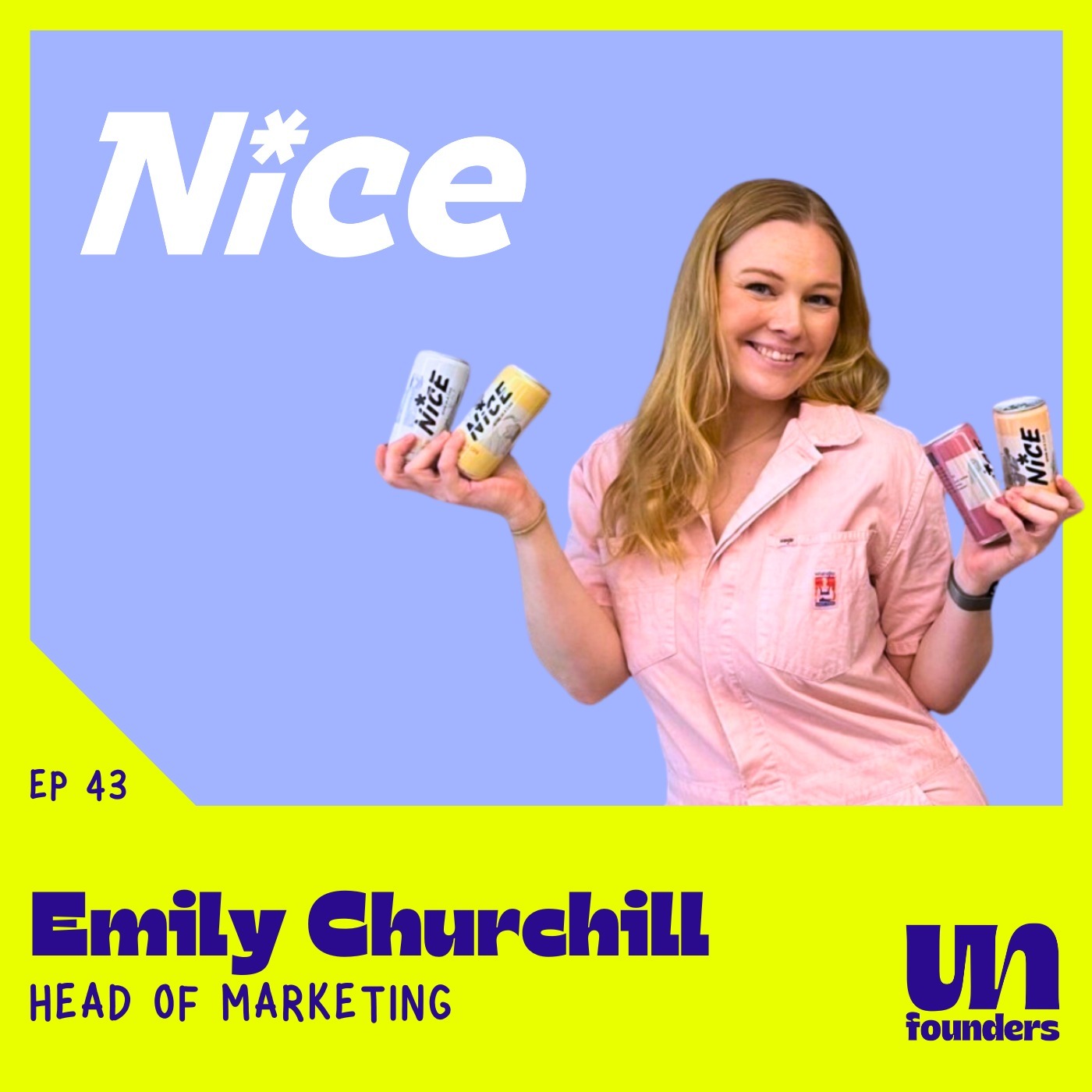
Episode topic: Emily Churchill, Head of Marketing at NICE Wine, explains how the challenger wine brand makes wine approachable via multiple formats (cans, bottles, bag-in-box, wine on tap, and low-alcohol “Sessions” at 3.4% ABV) and wins attention through “in-the-moment” retail and restaurant activations plus fast, culture-led TikTok stunts. She also covers team culture (12-person company; flexible schedules; ownership), her career path (drama degree → PR → Root Health → Calenio → NICE), and a failed campaign (“Cash Me If You Can” receipt-upload promo that didn’t catch).
Emily Churchill. Backgrounds: Head of Marketing at NICE Wine; previously 5.5 years in-house PR/brand marketing at Rude Health; then ~1.5 years at Calenio (non-alcoholic tropical spirits); earlier PR agency work after a Motorola commercial internship/experience.
NICE reduces wine intimidation and barrier to entry; marketing targets a 25–30 female skew but reaches a “mass middle” across ages due to distribution; flexible, trust-based culture improves output.
Co-op gondola end copy “We’ll save you getting lost in the wine aisle”; “Skip the wine list” wine-on-tap fonts; Travis Kelsey/Taylor Swift stunt (Vogue/Capital Radio coverage; 1M+ TikTok views; used a Sainsbury’s Local tie-in); pink wedding car launch for Asda; “three Sessions equals one wine” moderation messaging; Virgin Atlantic exclusive wine partner; “Cash Me If You Can” underperformed (about 1,000 entries).
0:00Hello, hello, hello and welcome back to episode number 43 of The Unfounders. Today I am joined by Emily Churchill who is the head of marketing at Nice Wine. Now Nice have really, really pioneered accessible wine. Starting in their canned formats, now going into bottles on draft, bag and box. They are making it non-pretentious, easy barrier to entry and it's delicious. It's a really strong brand, pink aesthetic. They are always out and about doing incredible marketing stunts. And I loved speaking to Emily around all of this, plus her time at Rude Health. She actually volunteered redundancy because she felt almost too comfortable.
0:35Loved the way things were going, but went, I need a new challenge. Joined Caleno, which is an incredible alcohol-free spirit. And then moved on to Nice when she saw the opportunity. I loved hearing about everything that happens with Nice with their team, how they trust each other, how they're really empowered to work around their schedules. There was so much in this and it's a shining example of how a challenger brand should work and you can see their success and availability everywhere. So if you haven't given a nice wine a try, give it a go. And without further ado, let's get on with the episode.
1:05I am so excited to announce that Mission Kitchen, London's home for food and drink entrepreneurs, are sponsoring the unfounders. If you're a chef, baker or food brand looking to grow, Mission Kitchen are the place to take it from kitchen table to the next level. I've been to the site in 9 arms multiple times and you can truly feel the energy and excitement in the room. They support a membership of more than 100 startup businesses, giving flexible access to commercial kitchen space, expert mentorship, and of course, a network of fantastic founders, which is truly invaluable. If you're ready to take your business to the next level, head on down and book a tour today at missionkitchen.org forward slash unfounders.
1:48Hello and welcome back to the unfounders. Today, I'm joined by the wonderful Emily. So Emily, can you let everyone know where you work, what your role is, and how long you've been there, please?
1:57Emily Churchill: Yeah, thank you so much for having me on. My name is Emily. I'm head of marketing at Nice. And my team and I look after end-to-end marketing here. So everything you see and everything you don't see, from brand to supporting our on-trade team and our off-trade team, to digital and social and even MPD and packaging. So a real varied, busy role. Amazing. And when you say nice, give us the spiel, like what is nice? Who are the founders? What's the story? I mean, I'm staring at a lovely bright pink jacket in the background. So anyone who's watching can see it and know what it is. But yeah, hopefully if you hear the word nice, people already know what I'm talking about.
2:33Emily Churchill: Yeah, well, my head is hiding some wine. But yeah, we're a wine company. We were founded in 2019 by Lucy Busk and Jeremy May. Fun fact, they actually decided to found the business together after only three times of meeting. I think they just realized they had massively complementary skills. They simplify it to us as Lucy likes to be the one that finds places to sell our wine, and Jeremy likes to be the one to make sure we have enough wine to sell. So they have really complementary skill sets. And the real reason they started the business is because they saw an opportunity to do things differently in wine to make it less intimidating, more approachable, and ultimately more fun.
3:14Emily Churchill: Wine as a category can tend to make you feel confused and alienated. Like you need to know a lot about wine to enjoy wine when that's really not true. And there was just space for a brand to kind of disrupt in multiple ways. We started in cans. And so that's probably what we're most recognized for. And that was just taking off in the US at the time. So I think Lucy was scrolling on Instagram and saw a can of wine and kind of mind exploded. You know, this is the idea. I posed it to Jeremy and that's what we launched with. But we now have wine in loads of different formats, everything from bag and box wine to wine in a bottle to our sessions, low alcohol wine.
3:52Emily Churchill: We even have wine on tap, which is in a lot of pubs and restaurants. So really any wine moment, we kind of cater for it now. And it's allowed us to gain distribution in so many different places. So I often get people coming up to me going, I saw you on this train or I was on the ferry to Isle of Wight Festival and I saw you or I was on a Virgin flight and I saw you. And it's amazing that our range of formats allows us to do that. So we're in grocery, we're in bars and restaurants, we're on planes, trains, ferries, we're in festivals, we're in cinemas. So yeah, it's really easy to find Nice out in the world, which I love.
4:30I remember when it first came to market and canned wine was a new concept. And nowadays it seems to really have exploded. It's become a bit more accepted. You've got all sorts of brands coming into the market. And one thing that Nice have done really well is that approachability and accessibility point. It's not snobby. It's just kind of, hey, we've got some white, some red, some rosé. Try them. And I think it was an execution in, was it Co-op or one of the retailers, where you'd taken over like the gondola end and it was just so nicely done. So I'd love to know your take on positioning and that kind of real doubling down on owning that.
5:03Emily Churchill: Yeah, I love that you called out that activation because I think that's a really great example of how we kind of position ourselves. We love to kind of speak to people in the moments that they don't need us in a really approachable, understandable way. So that gondola end was in East England Co-op. We had all of our formats on a gondola end. And the header just said, we'll save you getting lost in the wine aisle, which I think is such a powerful line of copy. We've got a great copywriter, Dante, that came up with that. And it was just perfect because it spoke to that moment where you're standing in the wine aisle.
5:37It's the busiest aisle in the supermarket.
5:40Emily Churchill: The amount of choice is unbelievable. And if we can be that brand that just pulls you out of that moment where you're scratching your head going, I kind of recognize that label. I think I like Amalbek. And we just pull that together and go, hey, we'll save you getting lost. Just try nice. That kind of pulls together our positioning in such a brilliant way. Another entree example I like to use is on our Wine on Tap fonts. It just says skip the wine list because that's another moment, you know, when you sit down at a restaurant and you're faced with a wine list that's eight pages long and has about 50 million Bordeaux's.
6:14Emily Churchill: And the names are seven or eight words long. and you just feel like you should know more than you do about what wine to choose and what the wine is going to taste like. So if we can just put a wine on tap font in a busy bar or restaurant that says, you know, skip the wine list, here you go. I feel that again, that speaks to the consumer, the wine confused consumer in the moment that they really need us. And so that's what we really try to do. And we try to be that brand that you can trust to kind of always be available, always speak to you in a way that feels like we get you and we get those moments and then always of course tastes nice no that's brilliant I think you guys must be really responsible for bringing people into the wine category because you've lowered the barrier to entry it's very much like a here's your white wine it's like it's gonna be nice but I remember first time having it I think it was at Neat Burger like a few years ago and I was just like great like it it's delicious wine in a can great and like now I will very much if I just fancy a glass of wine I will get a can of wine because it makes so much sense.
7:14And I think as you, I don't know if you have any category data or any kind of stats you could throw around because you must have like a younger demographic. In terms of that, like entry, I can imagine students or it must be really big because the brand aesthetic, the look, the feel, the way you guys absolutely dominate on TikTok and social media, it feels very kind of young, younger audience.
7:36Emily Churchill: No, absolutely. We do definitely skew younger, but what we found is, you know, there's this group of consumers, probably the kind of young first early wine adopters who are drawn to the kind of cheapest, easiest wine possible. And then there's this other total end of the scale that are looking for really fancy, expensive wines. But there's this whole middle market that kind of span age demographic that are just love wine, but want to feel, you know, that they have a wine brand that speaks to them. Although our marketing definitely kind kind of aims for that, you know, 30, 25 to 30 year old female skewed consumer.
8:16Emily Churchill: We really find that because of our distribution, we are a wine that can be enjoyed by everyone. And there's this whole mass middle market that really are looking for a brand like us. I love as a marketeer having a kind of bullseye consumer from a marketing perspective, but knowing that it's not just going to be like young females sitting in a park in Clapham Common that are going to be enjoying our wine you know we find people of all ages and all demographics loving nice yeah i think it's the that convenience factor of the fact that it was in in cans or now it's in boxes and on tap like it's from an operations perspective it just makes absolute sense and i think if you're if you're on a train there's nothing better than a cheeky can of wine or a can of beer well you sat there especially if it's a long journey you just want to like unwind and just chill it's just really good so if you're there in those places then people will be going okay i'll pick it up when it's in the supermarket and you seem to be everywhere so if people listening go oh they haven't haven't actually tried nice or heard of nice like where are you guys listed or where can people get hold of it to try it we are in quite a few supermarkets so you can find us in sainsbury's both sainsbury's locals and main estate stores you can find us in co-op wh smith travel asda and morrison's we're in loads of bars and restaurants today i'm going over to home slice we've got a big activation with them this summer so you can find us there and then also travel is a big area that we kind of sell into.
9:37Emily Churchill: So loads of train lines, ferries, planes. We are the exclusive wine partner for Virgin Atlantic Economy and Premium Economy. So everyone that flies, you know, that first wine of the holiday is nice, which I just love. It's the most amazing kind of sampling opportunity that can land in your lap as a marketeer that, you know, everyone when they're about to take off on holiday in that amazing mood, ask for a wine to kick it all off and it happens to be a can of nice. So I just love that. So yeah, we've built an incredible kind of web of distribution and that's all thanks to Lucy, especially. She's such an incredible sales person and she's built a team of salespeople that are just such hustlers and just don't take no for an answer and go out and win us some amazing accounts.
10:23Emily Churchill: I just also wanted to just quickly touch on something you said earlier because it's kind of in my brain. It was your, You mentioned you open a can kind of midweek when you don't want to open a bottle. And we found that as well. It's kind of something that maybe doesn't immediately come to mind. But the brilliance of cans, you know, four cans equals one bottle. Sometimes people do want a midweek drink on a Wednesday night, but they don't want to crack open a bottle and let the rest of the bottle go to waste while they wait for the weekend. And we found that kind of moderation play is starting to be something that we see on reviews left on Ocado or reviews left on Amazon.
10:59Emily Churchill: And it's just it's amazing to kind of hear that echo back from you as well. There's a lot to be said for a cheeky midweek drink, whether it's alcohol or non-alcohol. I mean, there's so many great non-alcoholic alternatives. Even, I mean, Momo Kombucha was on last week. I've been enjoying those. So I think a few things just to touch back on there. Like I had Shida and Harry from Virgin on the podcast a few months ago. And again, you can see how much that relationship with Nice is a great example of a partner who's doing things well. I think the convenience of how the cans fit in the trays and the trolleys on airlines and actually how they look, the quality, the consistency, the service that you guys provided.
11:38She was singing your praises. So it's amazing that partnership is still going strong. And as you mentioned about your army of amazing employees, the pink jumpsuits and the things that you guys do really well is that visibility. You can't escape at any events like bread and jam. Or if I see you in force, you just can't ignore it because it's this amazing aesthetic. I'd love to touch on a few of the team dynamics. How big is the team now? What is it the culture is like? How do you get together? Have you got an office? What's the vibe?
12:10Emily Churchill: Yeah, so we're a team of 12, which I think is smaller than people assume. And in marketing, we are two full time. So me and Amy Chain, who is a bit famous on TikTok now. She's the kind of star of a lot of our content. And then Lucy works part time in the marketing team. So we're a really small but entrepreneurial, hardworking and really amazing team. And yeah, we do have an office. Lucy and Jeremy have really created a culture of like ownership over your own work and trust. So we do work pretty flexibly. A lot of the team are in two, three days a week. Some are in more because they like to kind of be in the office full time.
12:49Emily Churchill: One of my colleagues lives in Bristol and comes in once a month. So it's really about having your work life work around your life. And I've always found that people work harder when they feel trusted and it's great. And then when we do all get together, it's amazing. And we try and come together for a kind of big quarterly or halfly meetings. I think before we started this call, we were talking about our summer party and our summer and Christmas parties are always really, really fun. So it's, yeah, it's an amazing culture. I've worked in a few businesses now and honestly, the team and the ways of working and the collaboration here and the creativity here is just amazing.
13:26Emily Churchill: We've got some really great perks that, again, just feel pretty like intuitive. And it's like, why haven't we done this at other businesses I've been at before? Like we finish at four on a Friday because, you know, there's nothing worse than sitting at your desk at five o 'clock on a Friday, watching the clock going. I've got all these plans this weekend. I just want to, you know, pop home before I go out or even just like start the weekend a bit early. And I love that. And this summer we're introducing a 12 o 'clock finishes on the last Friday of the three summer months. So there's a real appreciation that, you know, people will work hard when they feel like their whole life is supported.
14:03Emily Churchill: And Lucy and Jeremy are just brilliant at that. I think I'm pretty sure it was Spotify that did a big billboard that was like, we trust our employees. We don't treat them like children. And there seems to be this whole thing around businesses now trying to revert back and pulling people in. But from all the people I've spoken to, you can see the businesses that are thriving and doing things well. And the people who I speak to, like yourself, that are actually passionate about their jobs. are the ones that have this amazing balance that works for their work and life like some people love being in that nine to five office environment especially in early days in challenger it won't be nine to five but you're going to be in there together mucking down making it happen and you have those sprint periods but i think as the brand evolves and as you kind of get to a team of 12s having that flexibility and understanding people have schedules people have kids people have pets they want to go to the gym there's other things that come up and just being able to do them without having to sign things off or check in.
14:54And it's just that trust level really does allow you to just double down. So when you are working, you are even more efficient and getting things done. And you mentioned Amy, and I'd love to go back to TikTok and all the things that you guys have done because so many examples like Timothy Chalamet and Isla White Ferry for Isla White Festival. If you can share some of your favorites and how they've come about, like, is there a lot of planning and things or is it very responsive? or a bit of both?
15:23Emily Churchill: It's a bit of both. This is my favorite thing to talk about. So I'm really glad you brought it up. And Amy is such a superstar. It's her first proper job out of uni, which you just wouldn't know. She's so creative and intuitive and just really gets like what we're trying to do. So coming up with these things, you know, with her is just always so fun. My favorite things that we've done since I've been here. I mean, the first one that obviously springs to mind is our Travis Kelsey Taylor Swift stunt, which was last year. So that one came about in the pub as a lot of our good ideas do. And we just knew that Taylor Swift was going to be the moment of the summer and it was going to be what everyone was talking about.
16:05Emily Churchill: And we really wanted to see how we could jump on that cultural moment and kind of hijack it in a way. But I'm a big Swifty and I knew that you wouldn't be able to fool a Swifty. So what we landed on was instead of getting a kind of Taylor Swift look like, we decided to try and find a Travis Kelsey look like, who was her fairly new boyfriend at the time and who was going to be here on tour with her. And it just so happened that our wine director, Elliot, looked a little bit like Travis Kelsey. So what we did is on the morning of her first Wembley show in London last June, we just took him, one of our entree team, Callum, posing as his bodyguard and placed them in the Sainsbury's local next to Wembley and just snapped to them buying a couple cans of nice.
16:46Emily Churchill: And Amy went on her own TikTok instead of the brand's TikTok and just posed as a bystander and kind of captured the moment going, oh my gosh, I think I've just seen Travis Kelsey in Sainsbury's. And it blew up. TikTok got over a million views. It got picked up on Capital Radio. They were talking about how Travis Kelsey was buying canned wine for Taylor Swift. And it got picked up in Vogue because it then finally all came out that it was just a marketing stunt and Vogue called it one of their comfort things that they'd seen that week. So it was just amazing. And all it cost us was five quid for the two cans of nice that we bought from Sainsbury's locals.
17:27Emily Churchill: It just shows if you kind of know what the conversation is going to be kind of out in the world, and you think of a way that you can insert yourself into that, can happen. And that was just a brilliant example of it. I also love that it was like tied to a retailer. So like the subliminal message there is like, nice as canned wine is in Sainsbury's locals. And that is, as a marketeer, I always talk about like the big metric I always make sure I'm on top of is our rate of sale. Like ultimately our function is to help drive sales as well. And so that as a kind of the underpinning of that story, that nice is available in Sainsbury's locals was just perfect.
18:08Emily Churchill: I'll talk about one other kind of stunt that I loved last year. We had a spree of grocery launches last year into Asda, Morrison's, WH Smith Travel and Co-op, kind of one after the other. And the first one to land was Asda. And so it was pretty soon after I joined, we were basically tasked with thinking how we could launch each of those moments on social. And for Asda, we came up with the idea of getting a pink wedding car, trailing cans behind it, and putting a just launched sign and driving from our office to Asda in Clapham. And again, just a big kudos to Amy and how she works and how she thinks.
18:45Emily Churchill: Instead of looking at hiring pink cars for thousands of pounds for the day, she went on to Facebook groups in local areas to where she lived and just said, does anyone have a pink car? And we ended up finding almost a neighbor of hers that had this amazing pink wedding car for 200 quid for the day. They drove it around London for us, allowed us to put balloons on the wing mirrors, cans on the back. And it was just, again, this incredible example that you don't need a lot of money to kind of make amazing things happen. You just need a bit of creativity, a bit of hustle and a bit of an ability to think differently.
19:21Emily Churchill: And so that's when it comes to stunts and any type of marketing activation, we tend to follow the mantra of lead don't follow so it's always thinking of like how can we look at what's happening in the world and then think of a way to kind of do things a little bit differently they're all brilliant i mean your tiktoks and um social posts are just always really really on point and i think it's it's just social moments like with the timothy chalamet like signed can and hiding that and getting people excited there always seems to be like a buzz and it really captures that mood in that moment but as you said the fact that the taylor swift one drove people Sainsbury's and it's oh nice as in Sainsbury's it's so powerful when it's done right I think some people or some brands really try and over-engineer and overthink and almost spend too much time trying to plan the perfect one-o whereas you guys seem to just be like great this is a big moment let's get on it how do we do it okay let's try this oh it's worked we talk about quick wins a lot so it's like right how can we make this happen and make it successful as like quickly as possible and that often allows us to like spring into action and and think creatively so for for you where has that creativity come from like I'd love to dig back into your career going from school university college like whatever education you went through up to where you are now because I know you've worked at rude health and calenya and I saw on your linkedin you've even worked in motorola adverts gosh I can't believe you found that I really need to take that off my LinkedIn.
20:48Emily Churchill: Yeah. So I went to university and I actually did a drama degree thinking that I wanted to, you know, head for the bright stars of the West End or Hollywood or whatever it is. And pretty quickly after university, I figured out that wasn't right for me, but I knew I wanted a role that allowed me to be creative and to perform. And I think there's a lot of performing in a marketing role, which I love. So yeah, did a drama degree and then had that classic moment that everyone has when you leave university, where you think, what the hell am I going to do now? And I did a few little acting jobs. And one of them was landing a commercial with Motorola, which I don't even think are around anymore.
21:31So I think they got absorbed.
21:33Emily Churchill: Yeah, they did somewhere. So yeah, and that ended up being shot with a PR team. So it was a kind of YouTube video that they shot. And I remember running around London, filming this commercial with them going, what do you guys do for a job that you get to like run around London with me and doing this? And that was when I discovered PR. So immediately after that, I went home and looked up every PR internship that I could find and reached out to them all and pretty quickly managed to land just a really short stint in an agency called Lexus, totally unpaid, but just like got in, absorbed it. And that experience allowed me to land my first paid role, which was at a PR agency.
22:14Emily Churchill: The amazing thing about that PR agency was it was food and drink focused. So that really started my love of working in FMCG. But also, I think having a background in PR really gives you an incredible ability to do the things that we've just talked about, which is like news jacking and jumping on cultural moments. And I always tend to think now through that lens of like, what are people talking about and how can we get them to talk about us instead? And so that kind of foundation in PR was absolutely brilliant. PR, though, I found challenging because I was stretched across like nine or 10 different clients.
22:51Emily Churchill: And some I really, really cared about. Others I didn't care that much about. And I knew that I wanted to try and land an in-house role and join a brand that I cared a lot about. And Root Health, a job came up for Root Health in-house PR manager. And I kind of jumped at it, applied, landed the role. And I ended up being there for about five and a half years. My role there started just in PR, but as you'll appreciate with any small to medium-sized business, you don't stay doing one thing for very long. So I just started to absorb loads of different parts of marketing, transitioned into more of a brand management role.
23:27Emily Churchill: Yeah, just five and a half years flew by there. I learned so much. I learned how to do a lot on a really small budget. That's where a lot of my commercial foundation began. I had a brilliant manager there called Georgie who'd come from kind of a bigger blue chip business. So I feel like I, without doing the kind of bigger business thing, I absorbed a lot of that thinking. And yeah, I just had an amazing time there. And then, yeah, after five and a half years, I put my hand up for voluntary redundancy because I just thought if I don't leave, I never will. Because it was one of those jobs, you know, that you just, your best friends are there.
24:08Emily Churchill: You feel excited by every day. you feel comfortable and so I really kind of put my put my hand up and put my neck out a little bit without anything lined up and decided to to leave what made you decide that it sounds like to people listening be like well that's crazy like why would you from from something where you're loving it and it's you love the people the team the work you're doing what was it within you that made you go I need I'm too comfortable I need to change I think it it was exactly that I was like I think I love this because I know it so well. And it was that need to feel like I didn't know everything again, and to really start from the beginning and to kind of learn from new people and just us to gain a little bit more experience.
24:51Emily Churchill: So that was kind of the root into it for me was like, I don't think I'll leave on my own accord. I think I need to kind of take this opportunity that's been put in front of me where they were asking for volunteers. And, you know, I said it and then I regretted it. But looking back, I'm so glad that I did it because it just led to Calenio and then obviously on to NICE. So yes, after Root Health, I joined pretty quickly Calenio, who do non-alcoholic tropical spirits. And that was, I was there for about a year and a half. And that was another amazing, varied role. We did loads of sampling activations.
25:28Emily Churchill: I learned there to always beg for forgiveness and never for permission. I think over the summer of 2023, we handed out 100 ,000 cans of our RTD cocktails with zero permits, which maybe I shouldn't say on this podcast, but that was past me. But it just shows you, you need to kind of think outside the box and and think scrappily and just like go out and make it happen. So that was a really brilliant, fun place to work as well. And then ultimately it was just because I saw the job at Nice come up for a head of marketing role that I left Calenio because Nice had been a kind of one on my hit list for a really long time.
26:11Emily Churchill: I'm sure we'll get into all the amazing things about, well, we've already talked about all the amazing things about working here, but yeah, it was seeing this come up that made me think you know now's the time and yeah applied applied to this and only this and thankfully Lucy and Jeremy asked me to come on board in April last year I love that I think that both Rude Health and Caleno great brands Ellie and Caleno and what they've done and owning that sector of the alcohol-free spirits especially with like the revolution partnerships and all the things around that I think it's just so nicely done and they are absolutely delicious so I was saying to you before we joined like we actually met at ideas fest when it was in wickham in a random field and there was all these amazing entrepreneurs and we ended up having a really good time and seeing the activation truck in full force handing out the samples this big bright yellow beast it was amazing but i'd love to dig into like rude health when you're there within a company for five years obviously rude health had been growing from strength to strength in various different sectors from cereals or granolas to milks and all sorts.
27:14There was lots going on over the last few years. And I mean, I've got some rude health coconut milk in my fridge at the moment. So the brand is still absolutely thriving. But I'd love to know anything you learned from there that you've taken with you into your other roles and practices that they might have done well, that are kind of still with you.
27:31Emily Churchill: So much. They do the best alternative milks, hands down out there. I may be biased, but their coconut especially is absolutely delicious. Yeah, so much I learned at Root Health. One of the things that I always think about is as a marketing team, we started to adopt quite a single-minded strategy of associating ourselves with wild swimming and with swimming in general. We found this kind of amazing product truth and consumer truth that when people that are kind of mad enough to get up at the crack of dawn and go plunge themselves in a cold pool. We're kind of our kind of people. And then there was also this amazing moment for product afterwards.
28:10Emily Churchill: You know, you get out of a kind of wild swimming event and you're given a hot bowl of porridge and a hot almond latte. It just felt like the perfect kind of match made in heaven. So we really attached ourselves to these consumers and started kind of going to events for them and later started running our own events for them. And that really taught me that it's amazing when you find your kind of tribe or your group of people that you can speak to. And it can start small. You see a lot today with brands like attaching themselves to running clubs and things like that. And it's this kind of idea that if you build a community, they will then become your kind of spokespeople.
28:50Emily Churchill: And we really saw that happen with the wild swimming community at Root Health. So I think that was a really, really fun to travel all around the country, going to all the most amazing wild swimming spots and Lido's that the UK has to offer. But yeah, it also really served us in terms of word of mouth marketing and really adopting these swimmers as spokespeople. And you said earlier about Nice being on your hit list as a brand to watch or want to work for. What was it that stood out to Nice from you from an outsider perspective? And then from joining, did it live up to what you hoped it would? Yeah, well, obviously, the pink and the marketing tactics that they were using to gain attention, I just thought were so creative and fun.
29:37Emily Churchill: They were one of the brands that would always be, you know, passed around on the Slack channel at other jobs going, look what nice did. And I was like, I want to be kind of at the helm of that type of a business. So that was one. When I met Lucy and Jeremy, I also just immediately trusted them as founders. They are really smart, really hardworking people. And I just thought, you know, this is the place for me. I think they know how to grow a business and I want to be there while they're growing it. And yeah, just the product as well. I love wine. It just really, I'd worked obviously at Clenio, which is drinks marketing.
30:13Emily Churchill: I'd started to really fall in love with that. And especially like on-trade activation and that whole world had opened up to me. So being able to sidestep into an alcohol brand was really exciting for me. And yes, it's absolutely lived up to it. The amount of ownership and autonomy and freedom Amy, Lucy, and I have when it comes to marketing is just amazing. And it's great to have founders that are just such yes people and always kind of see the benefit of the type of content that we've talked about today where it's it's just fun and you just yeah it's it's really looked up to it i don't think i could pull off the pink jumpsuit although never say never but yeah as i said i think it's such a good brand aesthetic i mean like perfect ted with the green it's like nice really own that pink and that kind of pantone yeah and i think in the wine space as we already said about the accessibility and barrier to entry i'd love to understand around how you kind of market and position things like the session wine because when that came out i was like oh that's really interesting firstly it's gone from cans to bottles in like a different way but it's a lower abv and it was a different proposition i was like wow that's quite a sidestep like it's like nice thrive on doing things really differently like boxed wine on tap like the session wine all the stuff but in the snobby wine world it's like no it must be glass it must have a cork it must do that and you guys like we're gonna do everything other so i'd love to touch on um kind of how you get that messaging and and word out about all the different things and and the session wide i'm yet to try it but it really intrigues me yeah good yeah sessions i think came from that idea that you know we are a brand that embraces format and embraces having wines that kind of speak to all wine moments but there was this massive moderation moment that we weren't really, we didn't really have a product for.
32:10Emily Churchill: So Sessions came around to kind of fit into that slot and to fit that need. So our Sessions is a 3.4 % ABV wine. So it's a third basically of what a standard wine ABV would be. So the simple messaging that we like to say around it is that three Sessions equals one wine. So, you know, if you would go out and drink three glasses of wine, you'll probably have a sore head in the morning. You wouldn't be able to drive home. Whereas if you go out and have one or two sessions, you kind of wake up feeling fresh and you're able to enjoy more sessions versus a full strength wine. So that was kind of where it came from.
32:47Emily Churchill: And then, yeah, we just we love having the variety of formats and being that brand that you can trust that is always going to be there no matter what kind of where you are or what kind of format you are looking for. Our cans are great for, you know, picnics, parks, parties, barbecues, our boxes, the festival season's coming up. And we get told loads of people carry around our boxes of red wine with them at festivals because you don't need to chill it. It's three bottles in a box, so it'll last you, you know, you and your friends the whole weekend. And we just love hearing about how our different formats are kind of meeting all of these consumer needs and moments.
33:25Emily Churchill: And then, yeah, full strength bottles. We weren't in bottles for so long and we now have full strength bottles as well with Geronacato and Amazon and are on our website. And that was, I think there was a little bit of hesitation to going into bottles because it is the traditional wine format that you think of. But 90 % of the wine industry is bottled wine. So we were really excited to be able to launch something that hopefully looks and feels a little bit different than all the other traditional wines out there. so yeah we we really have something for everyone i feel like you've got a really good built-in circular economy of how people can try at different touch points and then go actually i enjoyed my can i'm gonna buy a box or oh it's on tap in this pub i'm gonna have it there actually i want to buy it when i'm at home so let's get a full bottle for the weekend it's all these little things it's kind of all adds to it and it's it's a great progress and growth of the business seeing where it started very much pioneering in cans i think it was the first can one I'd ever kind of seen or heard and to now have all the formats and the range and the availability that you guys do.
34:30Clearly things are going really well. I'd love to flip that now and talk about when things haven't gone so well. So whether in NICE or previous roles, I'd love to know a time when things didn't go to plan.
34:41Emily Churchill: Yeah, God, there's been so many because that is the world of working and I love failure. I really embrace it. I think you can learn a lot from it. One kind of campaign at Nice that springs to mind was last year, we called it Cash Me If You Can. And so the whole premise of it was we just launched into all of these supermarkets and we wanted to try and think of an idea that would help drive rate of sale across loads of different supermarkets. And at the time, there was this big trend emerging on TikTok that was that kind of video format where someone would go, you know, I'll walk a step a day for every follower that I gain.
35:19Emily Churchill: And people started kind of following and joining on these people's journeys. And all of a sudden, you know, it just spiraled and cannonballed and cannonballed. And so we were thinking, how can we adopt something like that in format, but that helps drive rate of sale? So we came up with this idea called cashmokey can, where we were going to put a pound in a prize pot for every can of wine sold across last summer. And the idea was that the more cans you buy, the more chances you have of winning this bigger pot of money that would grow and grow and grow. And we would kind of forecast how that was growing over the summer.
35:57Emily Churchill: All people had to do was upload their receipt and then their pound would be added to the prize pot. I think it was a really good idea in theory, but it was one of those things that just needs to catch. And it just never caught. I think we got up to about a thousand, which was good. But in our heads, we were like, it's going to get to 10 ,000. It's going to get to 20 ,000. And it'll be great. We can hand over this massive check for 20 ,000 pounds, knowing we've sold 20 ,000 extra cans of wine. But it just didn't end up having that kind of fire light moment. So, yeah, that was one. And we did it for a good few weeks.
36:33Emily Churchill: And then we kind of, I remember we kind of sat down and said, you know, either we keep pushing this and hope it has that moment. Or we draw a line under it now, pick a winner and put it to bed and move on. And we decided obviously to do the latter, which was 100 % the right call. And yeah, learned a lot from it. So never a bad thing. Do you think looking back, was it something around like the actual input from people? like people inherently are quite lazy. If you want to enter a prize, the ones where it's like, tick, enter, done. I'm like, great. I'll enter those. And it's like, I need this. I need that.
37:09You need to, you need to do this. It's like, how much, how much do I care? How much time have I got to do this?
37:14Emily Churchill: Yeah, it's a hundred percent that you need to eliminate any barrier possible for people to kind of get on board with something like that. And I think even just the simple mechanic of uploading your receipt was kind of, I see a lot of brands do it. And for some it's worked. I think bigger, bigger brands, you see the likes of kind of Cadbury's and bigger brands like that running mechanics like that in supermarkets with competitions. But I think for a brand of our size, we just needed more scale and more, yeah, more eyes on it from the very beginning for it to be able to take off in the way that it did so yeah didn't work out quite the way we wanted it to but luckily you had the the viral videos with the the taylor swift things and everything else going on which would be driving the rate of sale anyway and a few of the content pieces around cash me if you can did really really well um we got a couple like 20 000 view videos in there so it was it was fun content to make but yeah it didn't didn't quite work out just wary of time now final few questions for anyone who wants to get into the drinks world or the fmcg world what would your top advice be especially for marketing or marketeers what would your top tips be i always think say yes to to everything you know be the first person in the room that's going to put your hand up and say i'll do that and that's definitely got me far i also i love startups i love working in startups because you get breadth of experience not just depth of experience and i think if you're kind of someone that's still figuring out what may be part of marketing that you like.
38:51Emily Churchill: Working in a business like NICE at our size and scale is brilliant because you get to have your hand in all of the pies and you get that breadth. And then you can decide what part of it you like and what part of it plays to your strengths and then you can get depth in it. So yeah, always put your hand up, look for a nice varied role so you can learn. And yeah, don't be afraid to reach out to people. I've always found this community of FMCG is so helpful and friendly. And LinkedIn is great. There's loads of events going on all the time. I'm part of a few really good groups. Upworld is one I'm part of that's really brilliant.
39:31Emily Churchill: I'm part of a WhatsApp group called the Customer Marketing Collective, which is kind of loads of customer marketeers and brands of our size. And again, people are just always willing to help, which I love. So don't be afraid to reach out and ask for advice, ask for help if you're trying to get into a role like this. I love those. And I think the sentiment of the community is here to help each other. It's the same on the moment conversation. It's been the same in pretty much every conversation I've had. It's why I absolutely love being part of this world and this infrastructure. It's just brands and people want to help each other.
40:03I was at a Sainsbury's event yesterday and it was just great to speak to other brands in Frozen and kind of go, oh, yeah, this pain point. but this is exciting and this is going well and just having those moments to go okay we are in a similar boat and everyone goes through the same struggles and the same highs and lows so actually having that community around should be like has anyone come across this is so so powerful so having a good network is really really important definitely and for the question around music i would love to know what is the best song that represents your experience within the working world?
40:37Emily Churchill: This is such an interesting question. I think it changes all the time. But the one that I kept coming back to was anything could happen by Ellie Goulding, because honestly, anything can happen. And every day is totally different. You never know what's going to be kind of thrown at you. You never know what opportunities are going to come up. And I think stunts like the Travis Kelsey moment are pure examples of that. Like you can have an idea and then literally anything can happen. I love it. What a throwback. I haven't heard Ellie Golding's song for a while now. And if people want to connect with you or find more about NICE, where is the best place to do that?
41:16Emily Churchill: LinkedIn, definitely. But yeah, like I said, I'm part of a good few kind of WhatsApp groups and stuff. So I'm always available, happy to, you know, send a few WhatsApps back and forth. If anyone wants to pick up with me on there, just pop me a LinkedIn and yeah, we can connect. Brilliant. And if you haven't checked out their Instagram or their TikToks, go and check them out and watch some of these videos because they are incredible. If you haven't tried Nice yet, you definitely need to give it a try, especially as we near the summer seasons come with the nice weather, those picnics, those barbecues.
41:45Give it a try. 100%. Thank you so much for sharing all of this with the audience. It's been absolutely fantastic. I love what Nice are doing as hopefully it's come across. And I'm excited to see what the future holds.
41:57Emily Churchill: Thanks so much, Mitch. I've really enjoyed it. Thank you. And to everyone listening, thank you as always. And we will see you on the next episode. Goodbye.
In this weeks episode, I chat to Emily Churchill - Head of Marketing at Nice Wine.
She shares insights into the brand's innovative approach to the wine industry.
We discuss the company's mission to make wine more approachable and fun, the strategic positioning that has led to its widespread acceptance, and the creative marketing campaigns that have captured consumer attention.
Emily also reflects on her career journey, the importance of company culture, and the lessons learned from both successes and failures in marketing.
The discussion once again emphasises the significance of community, creativity, and adaptability in the fast-paced FMCG sector.
As always thanks to our fantastic sponsor Mission Kitchen!
If you're a chef, baker of food brand looking to grow, then head on over to book a tour at their site in Nine Elms, London today.
Also if you want to build a brand consumers love, you NEED to speak with my incredible new sponsor Against Ordinary - the masterminds behind my gorgeous new rebrand.
They also have a 5-Minute Brand Test to help you uncover what’s working, what’s holding you back, and where your untapped potential lies. Give the Brand Scorecard a go today!
Check out the ever growing Unfounders Song Selection playlist on Spotify.... it's WILD.
Ps - Have you got a guest you'd love to hear from? Submit a guest request form on our website here.
Intro by Free Flowin' from Uppbeat
Scan the code with your iPhone camera
Listen in the app.