
In short
UpFlip Podcast Episode Summary
Episode Title
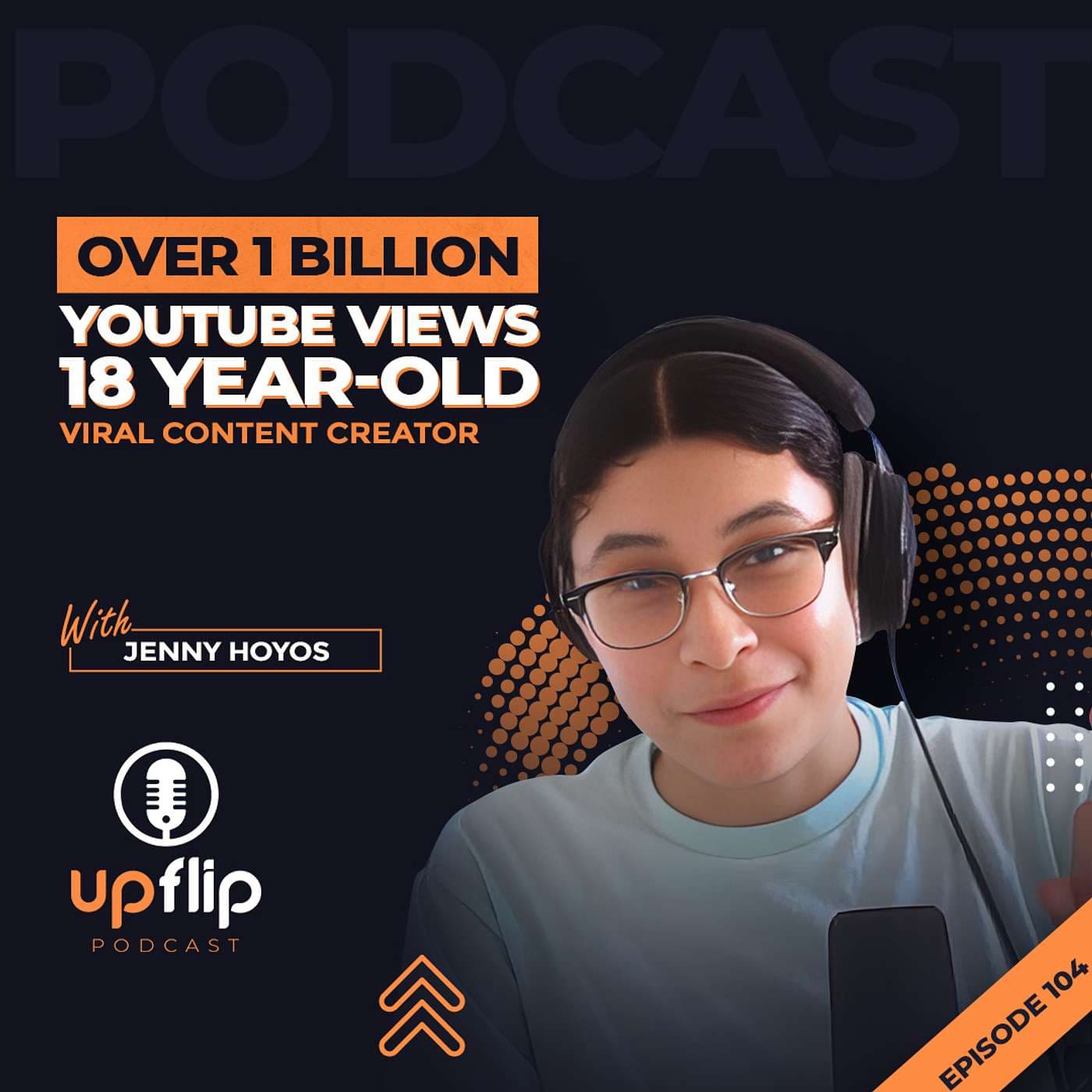
104. How This 18-Year-Old Makes Viral Content and Generates $20K/Month
Podcast Overview The UpFlip Podcast focuses on the behind-the-scenes aspects of building and running successful businesses, aiming to inspire and inform aspiring entrepreneurs. In episode 104, host Alex Freeman interviews Jenny Hoyos, an 18-year-old content creator who has turned her passion for creating videos into a lucrative business.
Guest Introduction
- Jenny Hoyos: A YouTuber with over 1.75 million subscribers and more than 1 billion views since launching her channel, *JennyHoyosLOL*, in 2021. She focuses on creating finance videos for kids, sharing life hacks and money management tips.
Key Takeaways
Jenny's Journey into Content Creation
- Early Inspiration: Jenny began creating videos at age 8, inspired by her family and a desire to be an entrepreneur.
- Niche Selection: She chose to create finance-related content for children, identifying a gap in the market (Blue Ocean Strategy) where such content was scarce.
Content Creation Strategy
- Market Research: Jenny emphasized the importance of researching topics and viewer interests through platforms like YouTube and reading comments.
- Target Audience: Identifying a specific audience avatar (kids interested in financial literacy) is crucial for content consistency and audience engagement.
Growth on YouTube
- Initial Struggles: Jenny experienced slow growth initially, taking a year to reach 1,000 subscribers, but then saw exponential growth to 1 million in the following year.
- Monetization: Jenny discussed her revenue streams, which included brand deals, ad revenue, and consulting services. She shared that monetization became significantly more profitable after reaching a larger audience.
Importance of Skills and Adaptation
- Skill Development: Jenny advocated for building skills in video editing, analytics, and storytelling before focusing on growth.
- Adapting to Trends: She noted the shift towards short-form content and how she has adapted her strategy to include YouTube Shorts.
Consulting and Business Insights
- Consulting Services: Jenny's experience in consulting has not only become a valuable revenue stream but also allowed her to rejuvenate her creativity.
- Legal Awareness: She emphasized the importance of understanding legalities in contracts, sharing personal experiences to illustrate the risks involved in agreements.
Personal Philosophy and Advice
- Health and Well-being: Jenny highlighted health as a priority that significantly impacts productivity and happiness.
- Passion over Profit: A key takeaway is the importance of following one’s passion rather than chasing money, which often leads to greater success.
- Viewer Satisfaction: The central theme for content creation should be viewer satisfaction, as it drives engagement and growth on platforms like YouTube.
Conclusion Jenny's journey illustrates the potential for young entrepreneurs to leverage creativity and digital platforms to create impactful content. Her insights provide valuable lessons on niche selection, audience engagement, and the importance of adaptability in a rapidly changing digital landscape.
Resources Mentioned
- [JennyHoyosLOL YouTube Channel](https://www.youtube.com/@JennyHoyosLOL)
- [UpFlip Academy](https://bit.ly/4ho1OPp)
- [How to Start a $45K/Month YouTube Channel](https://www.upflip.com/blog/how-to-start-a-youtube-channel)
- [UpFlip Podcast Episode 95](https://podfollow.com/upflip/episode/70b79f10ad4316f8dbf31addb61fd8ee1770895a/view)
Connect with UpFlip
- [YouTube](https://www.youtube.com/@TheUpFlipPodcast/)
- [Instagram](https://www.instagram.com/upflip/)
- [Facebook](https://www.facebook.com/upflipofficial)
- [Twitter](https://twitter.com/upflipofficial)
---
These notes summarize the key discussions and insights from the UpFlip Podcast episode with Jenny Hoyos, emphasizing important concepts for aspiring content creators and entrepreneurs.
Written by AI. May contain mistakes. Listen to the episode to check what was said.
Transcript
Automatic transcript. May contain errors.0:00Jenny Hoyos started making videos on YouTube when she was just eight years old. By the time she was a teenager, she knew she wanted to be an entrepreneur and YouTube was her way to do it. This is Alex Freeman and you're listening to the Upflip Podcast where we uncover how great businesses are built, how they're run behind the scenes, and how you can replicate their success. Today, we'll find out how Jenny Hoyos creates viral videos that grew her channel to more than 1.5 million subscribers. Jenny, welcome to the show. Thank you for having me. I'm glad to be here. Let's start off right in the origin story.
0:33Tell us about you and how you kind of got into YouTube at the age of eight. Yeah, so I'm Jenny Hoyos, a YouTuber and content creator who makes finance videos for kids. I started my channel because growing up, I've always dreamt of becoming a YouTuber. And if it wasn't a YouTuber, it was like an entrepreneur. I knew for sure I did not want to have a job. Like I knew I just couldn't imagine myself working. I knew I had to blend the two of becoming a YouTuber while also like targeting people who feel a similar way, which is why I'm making finance videos for kids to inspire them to either become entrepreneurs, at least be wise with their money.
1:07And I started at such a young age because I was literally born with YouTube. Actually, I was born in 2005 when YouTube was actually created. So it was just engraved into my childhood and my whole family was doing it. I had a bunch of cousins who were making videos. And yeah, I was really inspired and wanted to make similar videos to them as well. But here we are now. Let's start at the niche of money advice for kids, because I'm curious how you landed on that specific spot and then how you went about gaining the expertise to create the informative videos. So two reasons. So for one, if I wasn't a YouTuber, I knew I would want to be like a financial advisor or especially since like I'm actually graduating with a degree in finance next year.
1:49So like I knew that like if I wasn't a YouTuber, I would be this. So like for other people, I would say the same thing. If you know you weren't to be a content creator, what would you be? And it's like, maybe that's the content you should be making. So that was the first reason. The second thing is Blue Ocean Strategy, which is basically that there's a gap in the market where no one is making fun finance videos for kids. So now the viewers have no choice but to watch me because I'm the only one doing it. Let's kind of dive into that a little bit more because obviously there needs to be one. I love the advice of if you weren't making the content, what would you go do?
2:19That's like really kind of fantastic advice. But then obviously that needs to match up with some kind of market need. So how do you go about testing it to make sure that that actually is a need in the market? It's kind of hard to know if there's a need in the market. But I think for me, the easiest thing to do is literally just like searching it up the topic and seeing if there is some sort of interest there. and like reading comments. But also like I was honestly just making videos for my younger self. Like I said, like growing up, I knew I did not want a job. So it was like, let me target that 10 year old me.
2:50I love that. That makes a lot of sense because obviously sometimes the reason that there's not videos on that topic is because there's not actually a market for that topic, at least not to the extent that it can become a business or even like a fairly lucrative side hustle. So what advice might you offer for somebody if they find themselves in that situation, like then going to find a niche that maybe they could make some money in? Yeah, I think researching on YouTube is absolutely huge. Now I knew someone like Graham Stephan, for example, who does like very niche finance content still has like nearly 4 million subscribers.
3:23So I knew if I was to do something similar, but just like slightly broader, I would still at least be able to get the same amount. So if you're in a position where it's like no one else like is absolutely doing anything remotely close to what you're doing, I think it's just worth experimenting, but also thinking to yourself, if you actually personally know people that would actually watch your content, because I know I personally know a lot of people who are like a lot of kids, actually, who are into like saving money or like little side hustles. Like for me, my viewer is literally the kids in school who are like selling candy and snacks and stuff like that.
3:55So I already knew that I had my avatar. Can you talk more about developing that avatar and why that's important for somebody going into this? Totally. So if you don't have a specific avatar, then you're probably going to be all over the place with your content or even like with your business. Because if you don't know who you're talking to, who you're targeting, you're not going to stay consistent with your marketing or consistent with the way that you speak to the viewers. And that's like incredibly important because that's how you maintain a true fan base by having a specific avatar in mind.
4:25We'll dive into that a little bit further, a little bit later in this conversation. I want to back us up just a little bit to those early days for you. and I guess the early days of YouTube. When you first started making content, what content were you making when you first started? Yeah. So I did a very financial content when I first started. I actually used to copy like Graham Stephan. So I literally talked about like how to beat inflation or like talking about the S &P 500, like really specific niche finance things. But then I realized that like I'm just copying Graham Stephan and I realized like, oh, I need a blue ocean.
4:58So then around that time was like when I started to like slowly branch out from finance. So I went from like really finance into like day trading or like stocks in general or Bitcoin mining. And I guess you could say very financial side hustly type of content. What are the startup costs for someone getting into YouTube? I mean, how much did you spend to kind of get off the ground? And is it something that somebody can hop into without a cash outlay at the beginning? Yeah, I actually started with no money. Like I recorded my videos on my phone and I used a free editing software online. And in fact, like I didn't upgrade anything.
5:31Like I didn't even invest in my channel until I hit like 100 ,000 subscribers. So it's totally possible to like grow your YouTube channel with no money. You've mentioned a few times already that you always knew you didn't want to have a job. You know, some people might look at what you do day to day and say, but you do have a job. You are doing a job. I guess one, how do you describe what you do in terms of like for money that isn't as a job? And at what point did you realize, okay, great, I've done it. I now don't have to have a traditional job. Yeah. When I say I knew I didn't want a job, I knew I didn't want to have a boss.
6:05I think that was the key thing because I always liked working. Even before my YouTube channel, I was doing side hustles. I hated some of them. I hated doing it. You know what I mean? But it's just, it was the fact of having a boss and someone being above me and telling me what to do. I knew I didn't want that. But then secondarily to that, I also knew that I just wanted financial freedom. Honestly, the end of the day, the goal is just happiness and having fun. My biggest goal, like I don't even know what I want to be. I don't know where I see myself in 10 years from now, but all I hope is that I'm happy.
6:35Right. And with that said, some people might say what I'm doing is a job. And yes, it doesn't feel like a job. It doesn't feel like work. So not only am I my own boss, but it's actually fun and it's making me happy and it doesn't feel like work. What were some of those side hustles that you hated? What did you experiment with? Yeah, so I tried dropshipping for quite a bit. I did flipping like on OfferUp or eBay. I tried learning how to code, day trading, you know, anything stocks. I also did futures, crypto, options, video editing, which video editing was actually the most successful. And that's when I realized like, oh, shoot, like imagine if I went all in my own content.
7:13I've always had a knack for editing. Like I've done that side hustle since I was like probably started when I was like 13. Yeah. Let's talk about that moment of deciding to go all in with the YouTube channel. Like what were kind of the fears that were maybe holding you back from doing that? Yeah. So at the time I originally started my YouTube channel to document my journey and all these different businesses and side hustles that I was doing. So it was really weird when I had to, like, I knew I had to go all in and let go of all those other side hustles. It was really scary because it's like, you know, like being a YouTuber, you'd think and you'd be like, nah, like in three years, like it's not sustainable.
7:47It's not sustainable. I'm probably, you know, not going to have any money in three years from now or probably die out like most creators. And like, it was really scary. But I had the realization that if I treat YouTube like a business, then it will be sustainable and it will be a business. Like instead of treating YouTube, like being a YouTuber, I need to treat it like a media company, which is why now I'm not only a YouTuber, but I'm also trying to like help brands. I'm actually consulting for people. It's like figuring out like how to be an ultimate media company. And then once I thought of it that way, the switch and like going all in on YouTube made it so much more easier.
8:21What would you describe as kind of the biggest mistake that you made in your early content days? And what did you learn from it? The biggest mistake I've ever made was not learning legal stuff, not learning the importance of it, how to actually read contracts and not even having a lawyer. There's so many companies, brands, corporations, or people, they will try to manipulate you or trick you into things. And if you don't know legality stuff, you're going to run into problems, most likely. Where did you start to turn to for advice on how to avoid legal issues? Yes. So a couple of months ago, I actually saw like an ad, like on Instagram, and like I was the ad.
8:59I'm like, what the heck is this? I was like, so confused. I'm like, this is kind of weird. And it turns out like a couple of years ago before I was like 18, I actually like signed a contract that like I was going to do like this brand deal or something like that. But I didn't think it was going to be for ads or like for in perpetuity until I realized like, oh, shoot. Like because when I asked them to take it down, they told me that they can't do it. They own all the rights. They can make as much money as they want from it. It was like really scary. I'm like, there's no way because they basically like barely paid me for like a little gig that I did.
9:28But next thing you know, they're using my face on every ad. I was able to void the contract because it's illegal to sign a contract as someone under 18 years old without parental approval. So I was able to get that fixed. But then that's when I realized like, oh, shoot, this is just one instance. Imagine what could happen if I don't pay attention to this moving forward. On that same vein, what are some of those things that other content creators that you might say keep an eye out for these three things in contracts that are kind of commonly tried to be slipped in. Totally. So one, imperpetuity.
10:01Imperpetuity, in other words, basically means forever. The word forever should never be in a contract for the most part. And that's in any vein. It could be in perpetuity in any sense. In any sense, it should never be in perpetuity. So that's the number one thing. Next thing is usage rights. Now, similar to imperpetuity, usage rights could be slipped into there and you would think that you're doing just like regular brand deal. But next thing you know, they have usage rights to post it on their page, post it wherever they want, make money off of it, put it on TV, use it however they want because they have usage rights.
10:35But of course, if they're going to use usage rights, be sure to negotiate that and not have it in perpetuity, probably like one month, three months, 12 months, probably max. And then the next thing would also be exclusivity, which basically means you cannot work with any other brands except that brand. Now, there are some cases where brands will say like, oh, you can't work with our competitors, but sometimes there could be a slippage and they can put exclusivity for like any brand or for like too many competitors or something that can like mess up a deal for all other potential brands just because they put in exclusivity without you knowing.
11:07So again, similar to usage rights, be sure to actually charge them per month for that. Listeners, if you're thinking about starting a YouTube channel, make sure you check out the Upflip blog post on how to start a 45k a month YouTube channel, which is linked in the description below for more helpful tips. Jenny, I want to talk about growing a YouTube channel with you as obviously somebody who's been extremely successful at it. What's the most difficult part of starting a YouTube channel? And how did you overcome that particular challenge? The most difficult part is like not knowing what you're doing wrong and still getting like one view per video.
11:41Like the worst part is like every time you upload, no matter what, you're just always getting like 20 views max and you can't figure out like how to break through. But I think the biggest thing to remember is that it's going to be like that for a long time until one video just clicks. Because it took me one year to go from zero to 1 ,000 subscribers, but then the next year to go from 1 ,000 to 1 million because it's all exponential. Yeah, that exponentiality seems to be very, very important in kind of our algorithmically driven society as we are now. So what should somebody be doing to kind of get that first thousand followers on YouTube?
12:17The biggest thing as like, again, treat YouTube like a business. So if this is a business, the biggest thing is skills. So when you're starting off, just like be the best that you can possibly be in every aspect rather than like trying to blow up. Like in fact, I actually spent like three months just learning YouTube and building skills before I was actually creating content. So like I said, I was a video editor. So I was like building my skills doing that. And I knew when I wanted to focus on my channel, I had to improve my editing skills until like, I was as best I could be. And then from there, I was learning my Photoshop skills.
12:50I was learning my copywriting skills. I was learning how to read my analytics data. I was building as many skills as possible. So then once I popped, I can also sustain that. That's a really interesting point of being able to sustain once you get that initial pop. If someone is starting a YouTube channel with the ultimate goal of monetization, how quickly should they be looking to monetize? Or should they be building in, you know, it's going to take you, as an example, a year to kind of like build up the skill set that is going to make this sustainably monetizable? Or kind of what does that look like for someone who's first entering YouTube?
13:25As many things, I think if money is the first thing you're thinking about, it's probably going to fail. Because I think as long as you're like passionate and obsessive, it is going to work and the money is going to come. Like it sounds crazy because I was trying to make money on all these different side hustles. I was not trying to make money off of YouTube. But then ironically, YouTube was the one thing that actually worked the best because I was actually putting in my passion for it. If your goal is genuinely like to monetize early on, I wouldn't try to focus too much on the money and making money decisions.
13:56Rather, just like like you said, building the skills. And then once you have that audience and you know you're ready to monetize, then you flip the switch and monetize and the money will start like flowing in and rushing in like a river. That's exactly like what happened to my channel, similar to like 0 to 1 ,000 subscribers in one year, 1 ,000 to a million next year. Monetization was the same way. The money wasn't that great from the one to two years, because I've been doing this for like two and a half years. So it was like not that good from one to two years. But like these last six months has been like absolutely like just a river, like a flooding through, like the gates just opened.
14:29So I think it's like wise to think of it that way. What do those revenue numbers look like today? And like, what is, I mean, I guess wrapped into this question is like, what are the costs of producing a YouTube video for you now? And like, how does that translate into profit margins? As for the actual cost of the videos, they don't cost that much money, actually. Because like I make a lot of like budget content, I actually try to like mitigate how much I'm actually spending in the video. So it's actually accurate. And we're keeping that integrity of the channel of having fun with the budget. but I am investing in a team.
15:01All my money is going towards the team rather than the videos because the team is what's going to come up with the ideas, edit these videos, make these videos actually good, et cetera. So that's how I like to think of investing in my channel. Of course, it depends based on your niche. But as for revenue numbers, dang, I'll tell you the breakdown of probably the first month of January and then this last month. Because every month is different. So it's like, it's really hard to like, you know, like give an accurate number. But like the beginning of January this year, I probably made a thousand dollars from a brand deal.
15:36And then like probably like 2000 from AdRev. This is just like off the top of my head because I knew it wasn't that much. It was probably like$3 ,000 first month of January. Like this last month, I believe my revenue was$45 ,000. Wow. Yeah. And that was like more than half of like, I believe 70 % was consulting, 10 % was AdRev and then 20 % was brand money. I've got two follow-up questions to that one, but the first one I'm going to pose is as a budgeting content creator, how do you handle the inconsistent sizing of those revenue numbers in your overall life budget? How do you deal with those differences?
16:13It is so difficult. It's so difficult because people are like, oh my gosh, you made that much last month? Like, yeah, it's a lot of money, but imagine not making anything the rest of the year. So it's like, okay, when you think of it last day, it's actually not that much because like you didn't really make that much the rest of the year right it's very tough and honestly for that reason like I really like live below my means so there's multiple ways I see it so like as for personal life I still live with my parents so I don't have to like worry about that I also like don't have a car I also don't pay for car insurance that's why like I just don't drive like I just don't pay for anything except things that help my health the only thing I spend on is my health and that's probably like it's definitely a hundred percent it's like less than$1 ,000 a month.
16:55So I'm like, okay, I only need$1 ,000 a month to actually be healthy and like actually live my life, right? For the team, the way I like to see it is I want to have a 12 month emergency fund for me, a 12 month emergency fund for whichever employee that I want to have. And like, it's an emergency, not an emergency fund for their personal, but I mean, to like still have them as an employee. Like, do I have enough money to also cover 12 months of them working for me. Like, that's how I like to see it. So like, I'm a big saver, to be honest, it's probably like a problem. But yeah. And then the other thing I wanted to follow up on in there is mentioning that a good amount of that revenue came from consulting work.
17:32And that I think a lot of people, you know, look at content creators and are like, Oh, just get paid to make YouTube videos or TikToks. And it's like, No, I do this. And it also leads to these other things that are revenue generating. So like, how do you think about that in terms of the business? And what advice would you offer to somebody in terms of like, perhaps thinking a few steps down the road of like, okay, if this channel becomes successful, then that can lead to these opportunities. How do they start to think about the business in that way? I think there's a vast like range of content creators.
18:04There's some people who just want to be influencers or YouTubers who make videos, like you said, who will probably struggle to make a living, like literally pulling the views that I do, to be honest, which seems crazy because I think I recently hit like a billion views on short form content, which is actually insane. So I think the biggest thing is like, if you know, you don't just like you're okay, at least with not just being the influencer, like the person who's just making videos, then you really do have to like diversify and look at like other streams of incomes or different businesses that you can use as a content creator.
18:36The way I like to see it is like, you realize how many businesses or companies would be so happy if they had your size or like influence as like a big YouTuber or TikToker or whatever that may be. It's almost like use that to your advantage and then use that influence, but then make your product. And as you do that, obviously that can pull you in a lot of different directions. You mentioned that you're, you know, in school graduating with a finance degree, like what time management strategies are you employing to get everything done? Yeah. So first things first, I know I probably said like so many times health is wealth.
19:12Health is number one. So if you are healthy, if you sleep well, if you're eating good, you will have more energy. So that's like an instant productivity hack. Just eating good. Don't eat, for example, like you don't want your glucose levels to like spike too much. And then now you're going to get tired right after. So it's like you want to make sure that you're like treating your body very well and you're going to have so much more energy. So easily like that, you get an extra couple of hours in your days and much more energy. That's the number one thing. Number two thing is also understanding when you are most productive and least productive and making use of that.
19:44So for example, for me, I know my mornings are incredibly productive. So then it's during those times where I try to like work as soon as possible and get the most work done. But on the flip side, I know that in the afternoon-ish or like evening time, I'm not that creative. I'm not working that good. So then don't force it. Why would you work for three hours to get what would have been 10 minutes of work in the morning, right? It's during those times that you rejuvenate and then get back to work when you are productive again. So I think those two things are like hacks alone for like time management.
20:11And then secondarily, just also doing a to-do list and making sure you like basically like have like a good schedule put in place because I block out my days. So I already know like from the night before what my next day is going to look like. I've been putting off this question because I can't come up with a way to phrase it. That doesn't sound like I'm a United States Senator with no understanding of technology asking any of the technology executives a question. So I'm just going to go for it. How does somebody get more views on YouTube? Yeah, that's a good question. There's lots of things, but the number one thing is viewer satisfaction.
20:44If a viewer is satisfied, the video is going to get views in several ways. And one, YouTube's going to see that the viewer retention was high, that they watched the video all the way, and they're going to want to push it out more. Or on the flip side, if a person really liked a video, they're going to share it with their friends. There's going to be so many shares and the video is still going to get views anyway. So to get more views, the simple answer is make good videos, but more specifically that satisfy viewers. Viewer satisfaction is the number one thing. How do you analyze your videos after they've gone up, after you see those numbers and maybe you're looking and you're like, okay, they dropped off at three minutes.
21:18How then do you like look at that moment in the video and kind of do an analysis of what happened at that moment that maybe caused them to drop off? Yeah, it's very tough because there could be several reasons as to why people would have left in one spot. It could have been like, oh, maybe that wasn't funny. Maybe I was talking too slow. Maybe the music was too loud. Maybe the music was too quiet. And there's really like any answer you could probably come up with. So for that reason, the most important thing I think is to like also compare it to other videos. So it's like, you can say, for example, let's say, oh, maybe they left because the music stopped.
21:52Okay, now let's see if this is actually a valid hypothesis. So then we'll look at other videos and then we'll be like, oh shoot, every time that music stops, people are in fact leaving. So I think the biggest thing is like trying to isolate variables so you can determine whether that's actually what's happening. How much time do you spend doing that kind of analysis? Dang, I used to spend so much time doing it. I probably spent maybe two hours a day doing it. And then like at the end of the month, I'll do like one full day of like breaking it down. But now I actually have someone on the team who's doing all that and like creating like softwares and tools actually like do this for us.
Read the full transcript
22:30And that's like currently in the process. So now for me, now that we have like that in place, it's like little to no time, to be honest, probably like one hour a week. I meant to follow up on this a little bit earlier when you first mentioned your team. How big is your team? How many people are you working with now? And why are those kind of like the key positions in your opinion? Yes, it's a very lean team, actually. So I have one full time person who is a post production specialist. So basically, they edit all my videos, but then also analyze all the videos and do all the data stuff like I just mentioned.
23:01But we recently got a part time short form director who's helping like plan shorts or like storyboarding, but primarily also editing them. But, you know, they just started. And then also we have a couple of contractors. So, of course, a lawyer, very important. Also an ideation person. But again, that's just contracted and a thumbnail designer or graphic designer specialist, list, you can say. When did you start adding these team members? Like what point in your growth story did that kind of come in? Yeah, it came in at about half a million subscribers. That's when like I knew I'm like, I started like realizing how many bottlenecks I actually had.
23:38And I'm like, okay, time to hire a bunch of people. On that note, half a million subscribers, you just mentioned having hit a billion views and short form content, these kind of like massive numbers. How do you conceptualize the size of your audience? How do you deal with that kind of, I guess, level of popularity, level of celebrity? What does that land on you? I think it doesn't affect me because I am nowhere close to famous. It's crazy because it seems like a billion views is a lot of views, but then I actually have so many returning viewers. I actually have 30 million returning viewers every month.
24:13So when you put it that way, it's like, actually, it's just 30 million people watching me over and over again. There's still a lot of people, but then it's like, it's actually not that many. Maybe to me, though. Yeah, no, I watched a TikTok recently from John Green, who wrote Vault in Our Stars. And he was like, I wrote a book that was wildly successful beyond most authors' imaginations. And yet, nearly no one has read that book. And like that kind of like dichotomy of, you know, 30 million people is so many people that's bigger than almost every city in the United States, if not all of the cities in the United States.
24:43But yeah, when you think about it, then in terms of like, it's, you know, less than 10 % of the US population. So that means like nine out of 10 people haven't watched one of those videos. And so like, that's such an interesting spot to be in. And I'm just, I was just curious how you at such a young age, like deal with that kind of level or no level of notoriety. Yeah, you almost don't feel it. If you don't see it. It's kind of weird. So this is going to bring us to a section that we call our fan blitz questions. These come from our YouTube community and listeners, you can go to youtube.com slash upflip, join the community and pose questions to future podcast guests.
25:14Jenny, I've got five questions for you. We're going to try and get through in like a minute-ish. Are you ready? Oh, I am ready. All right. First question coming from Noel. Is it harder to build an audience when you focus on more popular, oversaturated topics? Yes, because there's a lot of competition and you're not in a blue ocean. Now Explains wants to know, interestingly, you sort of spoke to this a little bit already. Do you think music plays an important role in viral shorts? Totally plays such a big role. And the videos have more energy. Lamar Janal is asking similarly a U.S. Senator question here.
25:45How do I be viral with shorts in a self-development topic? Oof, I mean, it's a very broad question, but the simplest thing is, again, viewer satisfaction. And you can determine that just by looking at your retention graph over percentage. The graph matters more than percentage because graph shows when people leave as opposed to the total length. You can't make changes based on a percentage, but you can make changes based off of graphs. This one coming from Moodin Mohamed Youssef, who just started a YouTube shorts channel, is getting views but not subscribers. How do you make that conversion? The content might not be relatable enough for people to want to share, subscribe, or engage with it.
26:20So make it more relatable and more human-like. Last Blitz question here. If there was a movie made about your journey, what would the title be? The Not-So-Shortcut to Success. Ooh, that's a great title. Who plays you in the movie? Oh, I mean, hopefully myself. But if not me, I don't know, maybe Zendaya. A lot of people say I look like Zendaya, so. All right, all right. Neither one. That'll be great. Awesome. Those are our fan blitz questions. A quick ask to our listeners from our team before we continue. Our goal at UpFlip is to bring valuable and actionable business advice to as many entrepreneurs as possible, but we can't do it alone.
26:56Leaving a review is the best way to help us grow our reach and audience. If you're enjoying this video, take a second to rate and review it on your favorite podcast platform. We're grateful for all our listeners and everyone who helps us grow our podcast even further so we can keep bringing you the content you love. All right, Jenny, a few more kind of nuts and bolts questions about YouTube. First one being, what are your top do's and don'ts for creating content on YouTube with the hope that it goes viral? The first thing I think of is a bunch of don'ts. So I'm going to start with the don'ts. Don't be selfish.
27:27Make sure that you're giving value. There's actually a reason for the viewer to watch. Do find your blue ocean. Find a way to stand out and be different from the rest. Don't copy people, but do steal like an artist. I'm going to get into detail because that's a bit confusing, but you can definitely take inspiration from a lot of people and mix people. So like I said, I started by watching a lot of Graham Stephan. So I liked finance videos and that's how I got into finance. I also like how Mr. Beast gives back to people and how he's a generally nice person. I'm like, oh, let me have similar vibes as that.
27:57And then I took a bunch of other creators that I liked and I combined it to make my own style as opposed to just like copying Mr. Beast exactly like how a bunch of other people do it. Because yeah, it is definitely like I want to do it like so-and-so, but you can't do it exactly like so-and-so. You got to find the thing that you love about it. That's really great advice. How do things like the description, title, thumbnail, et cetera, the kind of like nuts and bolts of actually posting the video ultimately impacts its popularity? How important are those things for somebody to spend their time on?
28:25Yeah, so that's known as packaging. And packaging is the most, like, I don't know, actually, everything is like the most important thing, actually. So I don't want to say it's the most important thing, but like, think of it this way. If no one clicks on your video, no one's even going to watch it. If no one gets hooked into your video, no one's going to watch it. So it all starts with the idea and the way the idea is packaged. Like you see so many products, like, have you seen the pet rock? Like the product is literally a rock, but look at the packaging. It's a pet rock. And that's why it was successful.
28:55Wow. Yeah, that's true. You could just do a whole YouTube video about the pet rock probably. Are there any like unconventional strategies for titles and thumbnails that have worked for you that maybe people, if they just kind of like do a generic Google search of how best to package my YouTube video, they might not come across? Honestly, keep it simple. Like you want to say the most and the least amount of words. And that is like almost a given in like everything in YouTube, but try to say like as least as possible while like getting the message across and then like don't replicate the same information that's on the title on the thumbnail.
29:29Like if you say free on the title, you don't need to put the word free on the thumbnail because then that's just repetitive. You're going to do the most with the least. How did it feel when you got to a million YouTube subscribers? It felt so good. I don't know why, but it's crazy because like you didn't really feel anything at like 999 ,000, but like at 1 million, now you feel like you're a YouTuber, like you're officially a YouTuber. It's crazy. I don't know why. When did that happen and where are you at now? Yeah, so I hit a million subscribers about six months ago, and now I am at 1.7 million.
30:00And yeah. Yeah, I mean, there's that exponentiality that you were talking about earlier as well at play. Almost two years to get 1 million. It took two years to get 1 million. And then like six months later, I just got another million, basically. Yeah, the distance from one to 2 million, much shorter than the distance from zero to 1 million, even shorter to 5 million, I'm sure. So we'll keep an eye on that as that's coming for you. Yes, hopefully. Where else are you besides YouTube? What other social media platforms are you active on? And how does that kind of ultimately help the business as a whole?
30:32Yeah. So I'm on TikTok and Instagram as well. My primary focus is on YouTube. And then I cross post the same videos onto TikTok and Instagram. And as crazy as it sounds, it would seem like since you're not putting in any effort, nothing's going to come out of it. But it does help a lot with the business in the sense of like, I still have a presence on those platforms, even though I'm not investing that much time. So now brands, when they reach out to me, I have that option. I try to upcharge them onto those other platforms, essentially. Now, do you think it is obviously you stay mostly focused on YouTube with cross posting onto those other platforms?
31:03Do you think that is the best advice, whether or not they focus on YouTube or maybe focus on TikTok and then cross post or focus on Instagram and then cross post? Like, is that kind of the strategy you'd recommend for growing a following? If you have a lean team like me, then cross posting off of YouTube is probably most effective. And more specifically, make sure that you're creating for YouTube because YouTube actually has ad revenue and good ad revenue in place. And then I cross post to TikTok and Instagram because I do not get any ad revenue from those platforms, like literally zero. The only revenue I get from those platforms are brand deals.
31:38So for that reason, I focus on YouTube. And if a video is good, it's going to do well on all platforms. However, if you have a bigger team, which I actually do plan on hiring a social media specialist within a year's time who will help me not only just like blow up on YouTube, getting like a billion views, but also figure out how to be one of the biggest creators on these other platforms as well. It's a massively broad question I'm about to ask you. I'm curious how the YouTube landscape has changed since you started creating content and then like how you have adapted to those changes. Yeah. So when I started, short form content was not that big, actually.
32:15I was actually a long form creator at first, because when I first started, like shorts just got launched. I don't even think shorts were a thing when I first started. I kid you not, like they literally just got started on YouTube. So the landscape was very much like long form focused. But right now, like shorts is crushing it and YouTube is doubling down on shorts. And so am I. I was listening to a different podcast and they were talking about how the creator economy, like you're in some ways, like the algorithm is that boss that maybe doesn't exist in your mind. How are you keeping up with those potential changes that YouTube is making algorithmically?
32:50And like, what are you doing to think about those things? Or are you just focused on making the content that you know, your audience likes? I've actually heard someone say that the algorithm is your boss, but I like to see it as like the algorithm is a video game. It's just like, you know, like you're Mario and it's like, there's level one, level two, level three, level four, until you get to like Bowser's castle and like every level is changing. And it's like, that's what makes it fun. Cause otherwise it'd just be stale. So I almost don't see it as a bottleneck, but more so just a journey and fun.
33:18Cause this, again, I'm doing this to have fun. And I think it's fun that way, to be honest. And secondarily to that, the biggest thing is focusing on your audience, community avatar. If you make videos for people, then the algorithm will push it. Cause the algorithm is just trying to do what human behavior is doing. Your desire for doing the thing that is fun and then gamifying the algorithm in the way that you just did, I think is one of the things that I would say makes you such an effective content creator. What about you though? What are those kind of key personality traits or skills that you possess or learned perhaps that make you an effective content creator?
33:57Yeah, it's really funny that you mentioned that because like thinking about it now, my characteristics are I'm very obsessive. No matter what I like get into, I always become obsessed in everything. I can do it one time. Boom, I'm obsessed instantly. So it's like someone needs to be obsessive as well. So it's like that aspect, but also like the gamification. Like I used to play so many video games. I loved video games and now I play no video games because this is my video game. So it's like those two characteristics are huge. But also I believe that like understanding the importance of like business is so important for being not necessarily like a creative content creator, but a content creator who has longevity.
34:38Of those qualities, like do you think that those are things that people are innately born with or those things that if somebody has the desire to have fun, but maybe doesn't necessarily see the gamification or like understand that innately, is that something that they can go learn to then be successful? I think at the end of the day, it's all about passion. And I think, yes, you can learn to be passionate about something, but generally whatever you were just naturally born to be drawn to is what you should probably do. So if you weren't naturally drawn to wanting to be a content creator or an influencer, then maybe it isn't your thing.
35:16So it's like, I wouldn't force a passion in something just because people aren't making money in something, if that makes sense. You I think that there's such a move in our kind of wider society right now that everybody kind of feels like they have to be a content creator in some way. But obviously, there are ways to market your business that aren't going all in as a content creator, perhaps even just like partnering with content creators that exist in your niche to promote the business. But I think that that's a really important message to kind of get across is that like, sure, you probably need to understand it to a certain extent.
35:50But if that's not where you're drawn, do the thing that you're passionate about and then find other ways. With that in mind, I guess, if somebody is kind of in that position, what advice might you offer them of like how to start working with content creators and how to utilize social media and YouTube to promote their business without maybe having to go all in as a content creator themselves? Yeah, so there's two big forms of doing it in my head. And the first one would be UGC, which is user generated content, where you just hire creators to make content for you. So you'll have your social media page for your brand, but then you can pay influencers to create the content for you and then you post it onto your page.
36:31That's one way. And the other way is brand deals. Reach out to content creators who already have an existing audience. It will cost more since they are promoting it to their audience, but basically just pay them to promote it on their audience. So there's two ways. In my opinion, I think the better way would be to do UGC content and have your own social media and grow your social media following by outsourcing that to other influencers. I want to ask about brand deals and how you think about brand deals and how you think about, is this a company that I want to work with? Like, do you have a set of values that you're always making sure that you're adhering to as you kind of build the business and build the brand?
37:08Yeah. So when it comes to brand deals, the number one thing that I think about is like, why do I actually use the product? Am I using the product or will I use the product? If I know I am not going to use the product and it's just like a quick money grab, it's a personal thing. Like, I just don't want to do it. Like, I just feel guilty, you know? Any other kind of non-negotiables for you? Not really. I mean, when it comes to like rates and like what they're looking for, like for example, like if they want in perpetuity, like that's like an instant no, no matter what like, you know what I mean?
37:36But for the most part, that's about it. What do you think has been your smartest business move so far? And how did that ultimately lead you down the path to where you are now? The smartest business move I've ever made was doing consulting. It's actually like a really great like form of relaxation while still making like income. It's so crazy. For one, Let me explain what I mean by that. Creating content for yourself can get like really exhausting. Like being creative all the time can be mentally taxing. But consulting for other people can help rejuvenate that because I'm brainstorming ideas for other people and building that passion again.
38:15So then like now I'm like eager to do my work again. But then it's like crazy is the fact that like that's what actually like also generates the most income. So I think that was the smartest business move. It makes so much sense because it takes you back to that moment of that. I think all entrepreneurs can identify with of like, I have this idea and I'm really excited about it and I'm about to pour my life into it without the then pressures of necessarily executing on all of that. And so you kind of get to live in that fun space without the kind of like day to day grind of the, you know, one to two years before things start to turn a profit, all of that kind of stuff.
38:56Is that kind of what you're talking about? so someone actually reached out to me like on instagram they were like oh do you like do consulting calls or like something like this they told me like what they wanted or whatever and then i was like i was thinking in my head like no but let me think of like a number to charge them it's funny because like when i first started i like just started like at 100 and then i slowly just kept increasing the price until like i noticed people were saying no so that's kind of how it started where it was like i just had like one person reach out to me on instagram and then i started like, I still do it by word of mouth, actually.
39:25So most of my clients are all people like emailing me, asking me for help. And then like, once I help them, I just tell them, oh, tell your friends or like I get in contact with like other people that they may know. That makes a lot of sense. And I think that that's a story we hear from a lot of people who have gone into consulting and become consulting. It was that I have developed this expertise and then somebody wanted to ask me about it. And I realized, oh, my time is valuable. Maybe I should charge for it, which I think is a good lesson for kind of anybody as you're out there developing various expertise is that somebody is going to want that knowledge and there's multiple paths for you to help them and be helped yourself.
40:01So obviously, as you're making content, as you're going through things like it can become a close relationship with your audience where especially maybe they feel like they know you more than they do. I'm curious if there's ever been anything that you were nervous to post or share that you're ultimately grateful that you did put out there. I'm not sure. Like I'm a very open book. So like, I just don't do anything wrong. I don't have any secrets. So there's honestly nothing like I'm really like that scared to post about. So at no point do you kind of go, should I say this? You just kind of go for it.
40:32I just kind of go for it. And if I know there's something that I shouldn't say, let's say hypothetically, right? I have a lot of kids watching me. So curse words is a big no-go. So if that's a big no-go for the content, that's a no-go for me in real life as well. It might be a character flaw of me, but like my character in videos should be my character in real life. What's something that you do that has no inherent monetary value, but that brings you value in other ways? Health, literally taking care of my health, eating healthy. I can't stress it enough. Like it's crazy how important health is because like just like for a little bit of context, like growing up, even like since I was six years old, I used to get so sick.
41:12I'd be in like the doctors almost every day. I've missed so many school days. I just have so many health problems. So like if I'm not weary and like being like protective of myself, like I wouldn't even be able to work. So like health is the number one thing. What's your favorite memory looking back on your time making YouTube content? Why does that stand out for you? There's so many. There's so many. I think the most surreal moment to me was when I actually went to VidSummit in which literally anyone can go to any creator can go to VidSummit. But like actually going there and meeting my favorite creators and like some of them even knowing me was like just so surreal because it feels like, oh, these people that I look up to are actually like real humans.
41:54Like, I don't know. It's like I think that's the craziest thing that like just seeing that like these people who are like supposed to be your heroes are like actually real people and like you could be just like them. What else? I feel like there were a couple of memories there that maybe are worth sharing. I think the other biggest moment was just like one of my favorite videos I've ever filmed was this video where I cooked for strangers I went to my college, which was the first time I've ever been there because i'm an online student And then like I was like telling everyone like that i'm giving free tacos But all they have to do is pay for tips Then like I had like about like six people show up and I actually cooked in the community kitchen It was just like so much fun and it's like it's something that I know I would have never done if I wasn't a creator Like that's only a YouTuber thing, but it's like, I'm so happy I did that because that was so much fun.
42:41I went out of my comfort zone. It was incredibly embarrassing, but so much fun. I'm so glad that I did it. And that's what I really like about being a YouTuber. You go out of your comfort zone and do things that you want to do, but you're too scared to do. Such as I got like$100 worth of free stuff on my birthday. That's another iconic thing I did for you too. That's incredible. Yeah. What's your favorite failure? What's kind of the setback that you look back on that you're like, it kind of sucked at the time, but I'm really glad that happened. Honestly, nothing comes to mind. I truly believe that everything happens for a reason.
43:12And I do this exercise where every time something bad happens to me, I try to think of the good that could have came from that bad thing happening. So it's almost flipped my perception where when bad things happen, it doesn't feel bad anymore. It honestly feels like a good thing, you know? If you could pick the one thing that listeners take away from this interview, what would it be? Health is wealth. Literally, not only does health help you live longer, gives you more energy, more productivity. You're just a better human overall. You're happier. And also, yeah, just being happy. I think follow your passion.
43:46That's the biggest thing. What's your favorite business book and why? Yeah, Rich Dad, Poor Dad is my favorite book because when I read that, that is what flipped the switch for me. That's what made me want to be an entrepreneur and think like a business person. And it doesn't necessarily teach you like how to run a business, but it really helps me like understand the mentality behind it. But 48 Laws of Power is pretty good as well. Jenny, where can our listeners find out more about you, connect, follow all those good things? Yeah, feel free to check me out on YouTube as well as TikTok, Instagram, hopefully primarily YouTube.
44:17And if you want to book a consulting call with me, be sure to email me at team at Jenny Hoyos dot com. Listeners, that's going to do it for this episode of the Upflip podcast. you can find more advice for how to start a business the right way on the Upflip Hub, or check out podcast episode number 95 to find out how Bailey makes 60K a month in revenue selling digital products on Etsy. You'll find all the links in the show notes. We will see you next Monday. Jenny Hoyos, thank you so much for joining us. It was a great time. Had so much fun. Thank you.
From the publisher
Jenny Hoyos dreamed of making viral videos since she first started creating content at 8 years old. Now 18, she’s living that dream as a content creator whose YouTube shorts are some of the hottest trending now. She unveils her strategy for how to create viral YouTube shorts to generate buzz for any business in this interview.
Jenny’s channel, JennyHoyosLOL, has more than 1.75 million subscribers and over 1 billion views since she started it in 2021. Her videos share practical advice related to finances and life hacks that help people do more with their money - a hugely popular topic, based on the following she’s built sharing her advice.
Along with her YouTube channel, Jenny has a sizable following on Instagram and TikTok. She’s also monetized her social media channels with an online store and sponsorships, turning her content creation into her full-time business. In this episode, she’ll explain what makes videos go viral, how she’s grown such a massive following, and her advice for entrepreneurs who want to make better use of YouTube shorts to grow their business.
Resources
- https://bit.ly/4ho1OPp Start your own viral business with UpFlip Academy
- @JennyHoyosLOL - Check out Jenny’s content on her YouTube channel
- How to Start a $45K/Month YouTube channel - More YouTube creator insights on the UpFlip blog
- How She Makes $60K/Month on Etsy - UpFlip podcast episode 95
Ready to be your own boss without starting from scratch? Grab our FREE Franchise Guide and unlock the secrets of proven business models that have already created thousands of success stories.
Connect with UpFlip:
- On Youtube
- On Instagram
- On Facebook
- @UpFlipOfficial on Twitter
For more insights to start, build, or grow a business, check out the resources on UpFlip.com or head to the UpFlip YouTube channel to see more interviews with business owners and experts.
Thanks for listening!


