
In short
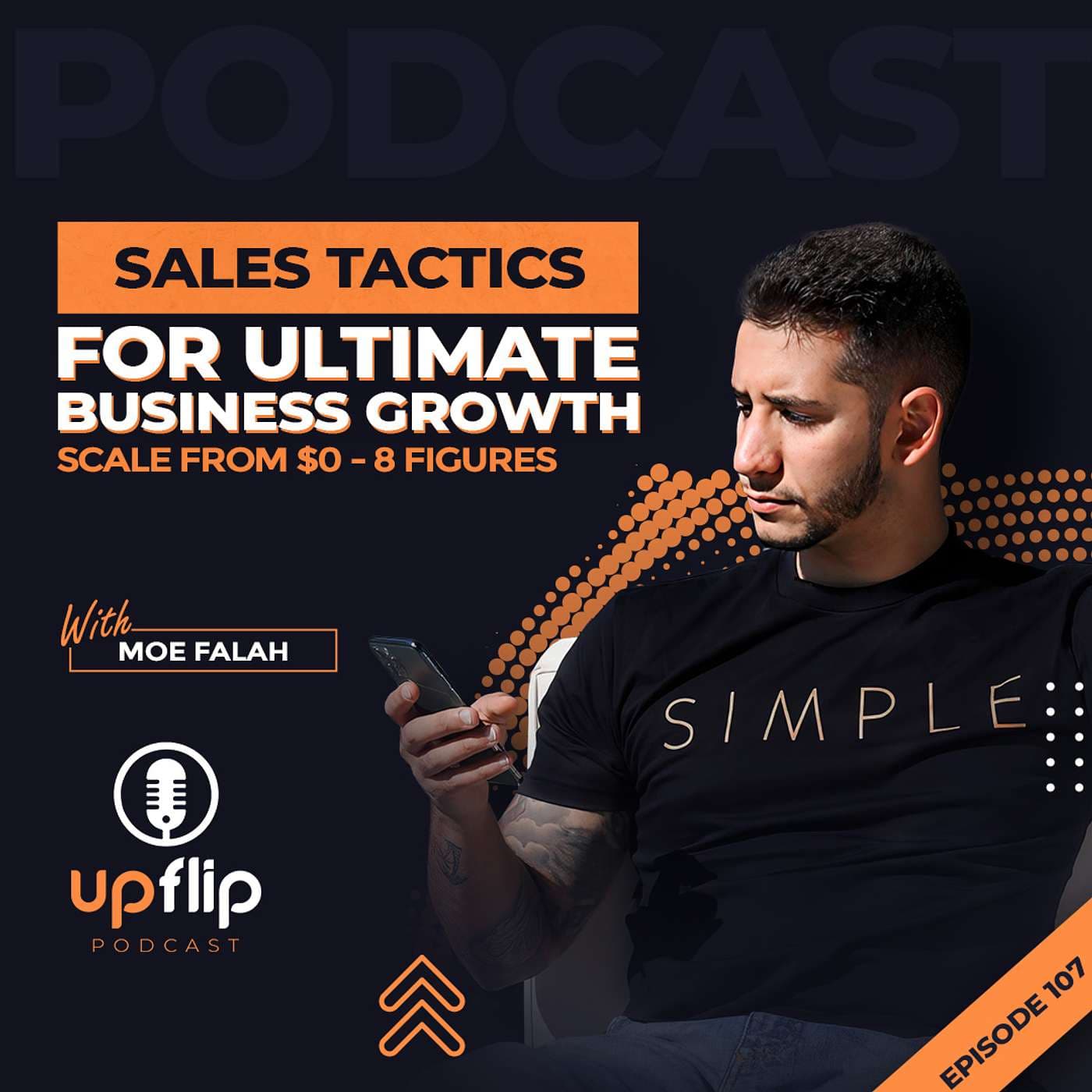
The UpFlip Podcast - Episode 107: Sales Tactics for Ultimate Business Growth
Podcast Overview
- Title: The UpFlip Podcast
- Description: The UpFlip podcast delves into how great businesses are built, run, and replicated. With a focus on practical advice and accessibility of knowledge, the podcast aims to inspire entrepreneurship in listeners.
Episode Summary
- Guest: Moe Falah, founder of Simple Solar and creator of the Scale Solar program.
- Main Topic: Sales strategies for rapid business growth in the solar industry.
- Key Achievement: Moe scaled Simple Solar to a successful 8-figure business within its first year, continuing to grow it significantly in the following years.
Key Takeaways
Moe Falah's Background
- Initial Experience: Started in sales in the window and roofing industry before discovering solar energy.
- Sales Passion: The realization that solar was an intuitive and beneficial product fueled his desire to sell it, leading to the foundation of Simple Solar.
Sales Philosophy and Strategies
- Sales Skills Development:
- Emphasizes the importance of understanding margins and the sales process from a young age.
- Highlighted the significance of mentorship and learning from experienced sales leaders.
- Building a High-Performing Sales Team:
- Selection Criteria: Focus on hiring coachable individuals who can adapt and grow.
- Team Culture: Reinforced the necessity of creating a strong team culture that values accountability and mutual support.
Challenges and Overcoming Setbacks
- Setbacks: Discussed personal challenges with team alignment and the importance of making tough personnel decisions for overall company health.
- Emotional Intelligence in Sales: Emphasized the necessity of understanding emotional dynamics in sales interactions.
Key Lessons on Scaling
- Operational Strength: The importance of having robust operational capabilities to support sales efforts.
- Building Relationships: The critical role of personal development and ensuring that team members feel valued and recognized.
- Vision Casting: Leaders must articulate a clear vision that encourages team members to invest in their growth and the company's success.
Insights on Company Exit
- Exit Strategy: Shared his experience of selling Simple Solar after recognizing the right moment based on intuition and opportunity.
- Regrets: Reflects on the importance of involving stronger partners and sharing equity to drive collective success.
Recommended Resources
- Books Mentioned:
- *The Road Less Stupid* by Keith Cunningham
- *Think and Grow Rich* by Napoleon Hill
Conclusion Moe Falah's journey showcases the intersection of effective sales tactics, strong team culture, and personal development in achieving rapid business growth. His insights provide a roadmap for entrepreneurs looking to scale their businesses effectively while navigating the complexities of sales and team dynamics.
Connections
- Moe Falah on Instagram: [@FalahtheLeader](https://www.instagram.com/falahtheleader/)
- UpFlip Academy: [Join Here](https://bit.ly/3YA8WAL)
- More Resources: [UpFlip Hub](https://www.upflip.com)
---
For additional insights from the UpFlip Podcast, check out Episode 101 on growing e-commerce businesses.
Written by AI. May contain mistakes. Listen to the episode to check what was said.
Transcript
Automatic transcript. May contain errors.0:00It only took one year for Simple Solar Solar to reach an impressive$25 million in revenue. And founder Mo Fala's sales skills were a big part of that fast growth. In 2023, he built on that success by founding Scale Solar, an organization that creates opportunities for salespeople in the solar industry. I'm Alex Freeman, and you're listening to the Upflip Podcast, where we uncover how great businesses are built, how they run behind the scenes, and how you can replicate their success. On today's episode, you'll learn how Mo developed a high-performing sales team that launched Simple Solar to the top of its industry, along with his tips for entrepreneurs and business owners to achieve the same level of excellence with their sales efforts.
0:39Mo, welcome to the show. Thanks for joining us. Yeah, thanks for having me, Alex. Excited to be here. So to get us started, tell us about your background in the solar industry and how you ended up starting your company. Yeah, so I got started in solar in late 2018. I was already working in sales doing windows and roofing in Miami. And I met a guy during one of my actual sales presentations, and he was wrapping up his solar presentation with the customer. And the guy pretty much said, hey, you know, your presentation is really good. You should consider solar. At the time I was like, yeah, like solar is just not it.
1:12The technology is not there. It's too expensive. It doesn't work. You know, just the objections that homeowners would typically say. And he gave me his card and said, you know, if anything changes, just give him a call back. So I called him back a couple months later. I was kind of wrapping up my position at that other company and he explained it to me. And I was like, wow, this is such a good product. You know, sometimes like I think one of the biggest things just to start off with like is when the offer makes so much sense it's hard not to sell it it's hard not to get passion behind it's hard not to be intentional and purposeful behind it so like you know finding that thing because as soon as I saw how solar worked it was a huge light bulb in my head I was like oh my god this is this is the thing this is like I've been trying to find so many different things to start and sell and get into.
1:57And then when I found solar, it was like, it was an absolute no brainer. And that passion towards delivering this product because of how much sense it made, I think is one of the biggest driving factors on what pushed me to go out and build the company that I built and scale it to the way that I was able to scale it. Now, I know you mentioned you were in a sales position before you started your company, but you've actually been selling long before that as well. Can you talk about your kind of early sales experience as a teenager? Yeah, for sure. As a teenager, The idea of working for salary or getting paid like, you know, as a job, it never really made sense to me.
2:33When I was always young, you know, they asked questions when you were in grade school. What do you want to be when you grow up? And for me, the answer was always rich and successful. That's what the answer was, right? It wasn't like, you know, go be a doctor, lawyer, nothing like that. It was rich and successful. And so the idea of like you go work X number of hours and you get paid X number of dollars, for some reason, that just didn't compute in my mind. Like it literally couldn't math out in my mind. It made no sense. But what really made sense to me was margin. It was you buy a product for$5, you sell it for$10, you make$5.
3:04How can you do that so many times over? And so when I was super young, dude, I was going around everywhere trying just to find products to buy for low and sell for high. And that was garage sales. That was discount locations at Walmart. That was friends who were trying to get rid of video games. And I would just pick them up for super, super low, throw it up on eBay, like anything where I could just make a margin that just made a lot more sense to me. And I didn't even know that, like in my head, like I didn't know that this was sales. I didn't know that that's like what a business is like. Nobody ever taught me that, but that's just what made sense to me.
3:38And so I stepped into so many different industries from early, early on selling roofing door to didn't even know what I was selling roofing door to door. But like the guy's like, hey, this insurance, there's this insurance thing. Go see if any of your neighbors want a new roof. And I started selling this without even knowing I'm selling this. I just thought I was offering a favor to my neighbors and getting paid for it. And then led to real estate sales, to car sales, to landscaping, to mowing lawns, to shoveling driveways, to HVAC, water systems. Like, I mean, anything really that like I could get my hands on where I felt like there could be a margin in this deal and anything that provided an opportunity where I could just go earn what I believed that I was worth rather than just like what somebody decided I was worth was the direction that I moved.
4:22And how did you go from kind of that, not even realizing what you were doing was sales to kind of further developing your skill set? Like, how did you start to improve or learn the process? So I met this guy when I was 22 years old and he was a friend of my brother's and he was probably like 29 at the time. And he was probably the most successful guy that I've ever met. You know, he was the late twenties. He had penthouse in Toronto. I'm originally from Toronto, Canada. So my family lived in Toronto. So he had penthouse in Toronto. He had G wagon, Audi RA, your beautiful girlfriend, like traveled all over the world.
4:58And it's like, it was the lifestyle that, you know, individuals seek, you know, the little kids, they see it on movies, the movie star lifestyle. And I was like, what the heck? And we were having a conversation one time and he said, he just said a very, very simple thing to me, he goes, the only way to get rich in this world is through sales. And later on, I started working for him. And a couple of years later, he then elaborated on that. He said, the only way to build wealth in this world is by building teams. So it first started on the only way to get rich in this world is through sales. And I've been selling for several years prior, but I didn't even know I was selling.
5:31And when he told me that, that's when I was like, okay, what's the sales thing? And I started to just literally go online, start researching, start learning all this stuff. And I found out that this thing that I've been doing for several years is an actual profession and I can actually develop my skills in this and start to get better. And so I didn't even know that this was like, it's almost like I was like naive to it or something, or just like, you know, wasn't willing to accept that what I was doing was this like non-unique thing. And so, yeah, I found out that this is the thing. And when somebody who's super successful that you'd like to emulate or have a similar lifestyle too, they say something to you, you know, my advice is listen, right?
6:07If somebody's in a place where you're not and you want to get there, there's probably a good chance that that person knows something that you don't know. What advice would you offer to somebody who maybe doesn't have a personal connection to somebody that's living the lifestyle they want to get to? How do you recommend that they go develop those sales skills, develop that relationship? You know, sometimes you can't get connected to the guy, but oftentimes it's very easy to get connected to people who are connected to them. And so, So you don't have to go learn from firsthand experience, right?
6:39Like I'm a big Grant Cardone fan. Like he's my mentor. He's the guy that I listen to. I emulate. You want to get connected with Grant. You're not going to get connected to Grant. But Grant's built systems and processes and all the things that are required to be able to have and replicate similar types of success that he has through his company. So who can you get connected with? You can reach out to people on his sales team. You can reach out to people that work for him. You can get connected to people that have been able to embody the skills and the belief systems. because I think it comes down to belief systems.
7:06If you can find people who are associated with people that are like that, you don't have to have direct access, right? Like direct access is fantastic, but if you can get secondhand access to people, then you're still gonna be able to drive your life in the direction that you wanna be able to drive it to. Let's take some of that secondhand access to Grant Cardone here and ask, what are a nugget or two of wisdom that you've been able to get from Grant that maybe helped you grow your business that could help one of our listeners? Yeah, this is absolutely fantastic. So in late 2021, there were people inside of my organization where I knew that they weren't good fits.
7:40I knew that culturally they weren't aligned, but I had emotional ties to individuals because when I first started my company, I just reached out to my personal network and said, hey, like I'm starting this thing. I want you to come along with me. And a lot of these people, you know, I've been friends with since high school. And so I knew I outgrew people and the alignment wasn't there anymore. But I had a difficult time as a business owner to differentiate between the logic of running the business and the emotion and the emotional ties that you have with your friends. And so I've had mentorship with Grant Cardone.
8:09And so in September of 2021, there was an internal revolt inside of my organization. And I went from 105 people to about 55 people overnight. So this guy who I knew was a cancer, but I didn't have the leadership skills at the time to be able to go past my emotions of terminating him. I let him stay in too long and he took about 50, 55 people with him and left when I started his own thing. So I called Grant the next day because I never experienced anything like this. And he says a few different things. So first nugget, he says, how many people are you at? And I said, 55. And he's like, OK, that's totally fine.
8:43He's like, you got to be willing to go down to five people if that means that you have the right people with you. You know, he talked about like the importance of making sure that everybody's on the same page. And he said, you know, while all these people have already left, he's like, use this as a time to go in and clean up your business. And so we actually cut an additional 15 people at that moment because we just went and we straight up asked them like, look, we know they're talking to you. We know they're trying to recruit you. You got to let us know, like, are you with us or is your attention like still thinking that there may be, you know, greener grass somewhere else?
9:12And there are several people who they weren't fully bought in. They weren't all in. And we just made the decision for them. And we just said, hey, like, that's okay. Like you're going to be successful wherever you go. But we have to make sure that as we go to rebuild this thing, that we have everybody aligned, everyone on the same page. We need everybody to be all in at this time. So we cut an additional 15 people. And the next thing that he said, he's like, because I think we lost like 55 or I think it was like right around 60 people. He said, good. He's like, one day you're going to lose 600 people.
9:39You know, he said, you know, I always talk about 10X, just go ahead and 10X your problems. Like if you have bigger problems and 10X your problems, the problem is you're too small. If you just, you grow your company and be thinking, how do I get to a point where I can lose 600 people one day? It's a whole bigger problem than losing 60 people if you put it into the frame of things. I want to kind of stay in this moment of when you lost those 60 or so employees and then you had to, you know, rebuild the team. Having gone through that, what would you now say are the keys to building an exceptional sales team with also retention in mind of those great salespeople?
10:12Yeah. You know, the biggest thing is, you know, they left because it was my fault. You know, I started to rest on my laurels, right? Like I already built the company at such a fast pace and I started to get really comfortable. And so I started to lean back and not give my people the things that they needed. So it was entirely my fault. Aside from me knowing certain people that shouldn't have been there that I should have terminated, you know, they ended up leaving because I wasn't present in the business. I wasn't like fully there. I wasn't doing the things that I used to do, right? The things that caused me to go super upstat in the first place and have the success that I was having, I just stopped repeating those actions.
10:46I started to get too comfortable. Ego really started to come in. I started to think I was too good for doing these jobs. And I just stopped doing the things that got me there in the first place. And so if I had continued doing that and still continued to be present and there and giving it my all, even if this person tried to go in and convince everybody to go with him, it wouldn't have landed well because I was there. I was giving people the thing that they needed. And I think the issue was, is I just started to chill out a little bit too hard. The next thing I would say in that is, you know, you have to always be finding ways to provide great opportunities to your people, right?
11:21Like when you run a sales organization, you know, your clients, it's not necessarily the homeowners that are, let's talk solar here, right? Your homeowners that buy the solar system from you, that's not essentially your client when it comes to running a sales organization. The client that you have to serve are your salespeople because your salespeople are the ones that are going to go out and bring all the revenue for you, right? Like one salesperson can bring you a hundred accounts in a year, and that will pay you as a business owner a hundred times over versus one homeowner, you're only going to get one source of revenue from that.
11:53So I think like the shift was how do we create incredible opportunities? And for the individuals that are in your business, that are leaders, the ones that are like out there, the quarterbacks, you know, I call them, I call them people who are quarterbacks on your team, people that are quarterbacks, you should find ways to get them tied into the business in a manner where they have such a great opportunity that they never want to leave. And one of the blocks that I had in my head, and I look at businesses having constraints, the constraint that I had in my head was I had some false beliefs regarding equity.
12:25I was hogging equity and I thought, no, I can't give anyone equity. It's my thing. It's my thing. And I didn't really understand that, sure, equity is important, but it's not really the most important thing. It's having an amazing team around you that you can share that with so that they can all be incentivized together to grow the business the way that the business needs to be grown. And my issue was, my constraint was this false belief that I had regarding equity and hogging it and not giving it to key players. And so some advice that I would have is if you have great people that are aligned with you that are pushing for the business to grow, like create plans to be able to get them tied into the business with you so that you can continue to scale it without having worry or concern that they may do something that could hurt you.
13:10So, you know, obviously on the topic of equity and commissions and all that stuff, money is one way to motivate and retain a sales team. What other things are you doing with your sales teams to keep them motivated and tied into the business? Yeah, I mean, recognition is probably more important than money. You know, people love to be recognized for the good work that they do. If you have somebody that, you know, is getting paid a ton, but they're not really getting recognized in the business and nobody's really giving them attention, nobody really cares, it's going to make them feel demotivated.
13:40I would say competition as well is huge, right? Like competition is, it's a prey drive. It's something that causes a person to want to go out and go after the hunt. So always creating great competitions. You know, a lot of people, I talk about this quite often and it comes from one of my favorite books and I don't know if you've read it before, but it's called The Road Less Stupid. It's by Keith Cunningham. one of the best books that I've ever read on business. And every chapter is independent. So you can pick it up and start from any chapter that you want. So find the thing inside of your business that you're struggling with.
14:09So The Road Less Stupid has a chapter in there called Culture is King. And in there, he describes that most people don't actually know what culture is. People think that culture in a business is the fun, the activities, the trips, the events, the yachts, the stuff like that, right? The things that are exciting and flashy. And what Keith says is people confuse oftentimes culture with perks. Those things that people see on the outside, those are perks of having a great culture. And he goes on to describe one of the best cultures on the planet is the Navy SEALs. And he talks about, he says, you know, the Navy SEALs aren't bringing their dog to work.
14:45The Navy SEALs have a great culture because they have accountability. They show up for each other. They know that if someone's down, they're going to be there to pick them up. They show up on time. They treat each other with respect. They do the job that needs to get done without excuses. They don't complain. They all accept responsibility. They know that they have a mission at hand and they all work together to be able to get that mission accomplished. And he says that in itself is what culture is. It's the way that we show up for each other. It's the standards that we hold inside of our business.
15:13And when I read that, it shifted my idea on how an organization needs to be run. And when we did that, we were able then to get everybody aligned with each other. We were able to get everybody on the same page and we were able to then have more fun inside of the business because we were adhering to a strict discipline and a really, really great standard that we held with each other. As I hear you kind of talk about this situation and then kind of the culture that you're working to build with the team, it strikes me that obviously the hiring process and bringing in somebody who is perhaps predisposed to the right personality traits to function in this kind of environment is a big part of the challenge.
15:50So I'm curious how this goes into hiring. And then I also will, my follow-up question that I'll give you now is how then do you train somebody into your culture after they've been hired? It depends on what you're hiring for as well. You know, when you're hiring for sales, it's a little bit different than when you're hiring people to build the business, whether it's operationally or from a marketing standpoint. I think one of the biggest mistakes that new founders or managers or CEOs do inside of their business is let's go operationally first. When it comes to operationally, if we're going to go simple, we're going to call it sales and operations.
16:22Operations will be everything that's not sales. And then sales will only be sales. When it comes to operationally, I think that new founders and new CEOs, what they struggle with is they don't hire people that are better than them. They end up hiring people where they then have to give themselves the job of managing that person. And that could be from either fear, not knowing who to look for, not wanting to pay the right amount of money to be able to find that right talent. And so when it comes to, you know, operational success and operational hiring, you as a business owner, you should feel that when you're doing the interview, you should feel like you're learning something.
16:58You should feel like that person is teaching you something that this person is like, wow, this person has skills that I don't have. That's what I need to be able to grow the business. And I think that you have to be ultra, ultra picky when it comes to hiring those people. You absolutely can't bring people in where you give them the job and then you're spending most of your time managing them because they're not doing the work the right way. You're concerned about, you know, when you have the right person on your team, you kind of know that you can just let them go and they're just going to go and build.
17:27But I think people oftentimes short themselves by choosing to hire the wrong people, whether they don't want to sit through 20 to 25 different interviews to find the right person. They'll go through one, two or three, think someone's a really good fit because they get along with them. There may be really great affinity. They're getting along and they're like, you know, I really like this person. And they look past, you know, yellow flags because they just really like the guy or girl. And so I think like sitting through more interviews, really, really being selective about who you're hiring. I think that's so, so important operationally.
17:59When it comes to sales and there's a philosophy and not just in sales, but in all of business, you only recruit to increase the average. Like the idea is like we need to increase the average. We don't want to bring people that are going to bring the average inside of our business down. So being super selective about people who are going to be in great relation with your culture, with what you've said. And one of the biggest mistakes that I made early on was I traded revenue for culture. Like I had people who I knew shouldn't have been in the business. They weren't good fits, but I was looking at the dollar signs.
18:29And when I looked at the dollar signs and I looked at the revenues, what happened was the culture just started to diminish. and people in my organization that were with me for long times, they would even approach me and they would say, hey, like these guys are not good for us. They're hurting what our company has been. And I ignored a lot of it because I was super focused on revenue. Like that was the big thing for me because I thought that was the indicator and marker that I was successful was like how much revenue was coming in. And it ended up hurting me because it caused people to see that, right?
18:56Like people can see true intentions. And so it required a big shift in what was important for me to be able to allow this thing to sustain and grow. And when it comes to salespeople and the predispositions that you mentioned, what I'd say is the biggest thing that you need to see in certain people is that they're coachable. Like coachability is so important. And in people being willing to appreciate and respect somebody who is in a higher position than them. So if you're not coachable, somebody can have any type of predisposition, anything that they've experienced before. People have to be willing to change and be willing to adapt.
19:28And the faster that you can adapt to new situations, new conditions, it's a sign of intelligence and it's a sign of survivability. I mean, even if you just go to one of the earliest talks about this, it's Darwin, right? What does Darwin say exactly? Yeah, I mean, it's the survival of the fittest. That's right. And that's coachability. Coachability is you're literally adapting to the environment and that's what's going to allow you to survive. And survive is not just like having a food to like survive is on a plane, right? There's people who are surviving at the lowest level. And those are the skid row, the people on the streets of Los Angeles, they're surviving at the lowest level.
20:05And then you have individuals that are surviving at the highest level, right? You got Elon, you've got Jeff, you've got all the greats. They're surviving at the highest level. So I think we should just change the definition of survival as like, oh, I'm just trying to survive. Think of survival more of like a gradient scale, right? Like there are different grades of survival. And then take a look at the simplest form of what Darwin says, right? The person who has the highest ability to adapt has the highest chance of survival. And so your ability to take in new information, adapt to different environments, adapt to different situations, adapt to new learnings, adapt to that is what's going to push you towards getting up to the next highest level.
20:42Reminder for our listeners that if you want to get more insights from an excellent sales professional, make sure to watch the Upflip YouTube episode 176, where Joshua Brown, the pressure washing pastor, shares how he used his door-to-door sales skills to achieve an incredible 73 % closing rate in his business. Mo, I want to talk a little bit about your history as a salesman. I know that at one point in your life, you had a sales position where you outsold your company's capabilities. Can you talk about that experience and what you maybe learned from it? So this is 2018. This is before I got into solar.
21:15So when I say, you know, my time in that windows and roofing company came to an end was because that company actually ended up going south. I started with this organization. And what a lot of people don't understand is that the importance of money management in a business. And just because you have a lot of sales doesn't mean that the business is going to succeed. And so I come into this business and I get trained by the manager. And within my second month, I'm the top producer in this organization by far, right? Like I'm 250 % better than the next best person. And I continue on this for quite, you know, several, several months, probably like eight, nine months.
21:49I'm on this trend of just being number one, number one, number one. And when you're selling so much and you're not fulfilling, like fulfillment is so important. Sales is one thing, but fulfillment is another. What happened was, was this company kept on putting out orders for equipment, for financing, for different products that are needed to be able to install and sell, right? I'm doing windows and roofing. And they start putting out all this money. But what was happening was I was selling so much at such a high frequency that they weren't keeping up with the actual fulfillment. And when jobs were getting complete and how they were paying their contractors, they were paying them on completion of the work rather than finance approval.
Read the full transcript
22:26So the way that the financing was working was the homeowners had to approve the final project before funding actually occurred to the company. And so the way that the company was paying out their contractors and their laborers was after completion versus setting it up to post funding. And so the fulfillment wasn't solid. They weren't doing, they were cutting corners. They were not really doing things the right way. And so what happened was there just ended up being this huge backlog of accounts that weren't getting funded. The company pretty much ran out of money, ran out of money, couldn't pay their creditors, excuse me, couldn't pay for their equipment, couldn't pay for the bills, couldn't pay for contractors to get back to go and fulfill the jobs.
23:01And they didn't want to because they're like, we already got paid for this. You know, they weren't interested in going back and actually completing the project the right way. So it turned into quite a disaster. And so after leaving that company, I lost right around$200 ,000 worth of commissions that were supposed to be paid. And unfortunately, my lifestyle was in the means of anticipating this money to be coming in. So that definitely put my back against the wall. And thankfully, everything worked out. I found solar and then just absolutely went all in on this thing. And yeah, it's a blessing and a curse.
23:30And when you look back in hindsight, you realize that the failures that you've experienced, they end up becoming some of your greatest learning lessons to show you what not to do in the future. What are some of your takeaways of like what not to do either for small business owners who need to maybe balance their sales efforts against their production capabilities, or even just for maybe a new salesperson and going into a company and kind of understanding what might be happening on the fulfillment side of their sale? I think something that's like really important is like when you have really strong operations and you have really strong fulfillment, it gives you the confidence to go out and recruit.
24:05There's some psychological thing that I found is that when my operations were super strong, when I had everything in place, the right staff, the right employees, the right onboarding, everything was just super, super sound. And we were actually, when we were overstaffed on our operations side and we could do more, it gave me crazy confidence to go out and recruit because it was like, I know that when I bring somebody in here, what I'm promoting, I'm actually going to be able to fulfill on. My big thing has been focused on actual like, I think recruiting is probably one of my biggest skills is sharing that vision and getting people to come in because I know that like when I promote something that I've actually built something that we can fulfill on the promote.
24:45And when you're not confident that you can fulfill on what you're promoting, you're not going to be able to promote with passion. People are going to be able to see right through you and you're not going to be able to get people to come on your mission. So I think like having the operational side, like really, really locked in and ensuring that you're doing things the right way will help you significantly when it comes to your ability to attract the right people, promote the right people, be excited about the work that you're doing. When it comes to salespeople coming into a new business, I think the biggest thing is, is like one understanding the learning curve that's going to happen.
25:16I think the first person I heard this from was maybe Jordan Belfort. You first come in and it's, you know, unconscious incompetence. I'm going to just make it very simple. You don't realize that you suck. And then it's conscious incompetence. You start realizing that you kind of suck. And then that's where most people quit. And most people usually quit in that. And this is learning and anything could be sales, business, whatever, any subject that you want. Yeah. At least in my business, I boiled it down. So it takes about like 21 days to start to kind of get to the next level, which is conscious competence, right?
25:43Like that's when you realize like, okay, I'm not, I'm not that bad, but I have to really think about what to do. It doesn't like come off the back of my hand. I don't have everything memorized. I'm really thinking about what I have to do to be able to be good. And then probably, you know, six months of being like really, really hard at something. And it's frequency. Frequency is the most important thing. The more frequent you are, you have to be frequent before you get great. So the more frequency you have, you then finally reach, you know, top level of learning and it's unconscious incompetence.
26:10You just know it, right? You just totally know it. So one, as a salesperson, give yourself enough time to go through that and understand that you're going to suck at first, but you just have to get through that suck phase. Like you just have to get through that phase of like, you know, it's going to be hard. It's going to be harder before it gets easier. And so I would also take a look at there's this graph. It's called the Dunning-Truger effect. And it's a really, really great graph. It shows why most people fail. And it's spelled D-U-N-N-I-N-G hyphen K-R-U-E-G-R Dunning-Truger effect. When you understand like what people go through and the mindset, how the mind thinks, when you start approaching new situations, new positions, and you can actually see this on a graph.
26:52And if it makes sense, you're like, oh, OK, so I know that I'm going to be experiencing these things. And because I know I'm going to be experiencing these things, I can be more logical and rational about it rather than being emotional about it. How translatable are these skills between industries? So if you are in sales, but you move between an industry, like how long do you need to spend doing research into the specific industry and products to be able to sell effectively? does it become a shorter timeline the longer you're kind of in sales generally? I would say so. Yeah. I mean, like once you know the communication cycle, once you know the sales cycle, once you know, you know, the prospect cycle, once you know the actual sales elements, you can go from industry to industry to industry and pick up on product knowledge ASAP.
27:38Like, you know, I think product knowledge is probably like 15 % of the equation and then 85 % of the equation is sales knowledge. Obviously, a big part of sales success is people skills kind of as a general statement. But I'm curious about, obviously, you're a very personable person. This has been, I mean, we don't have a longstanding relationship, but I feel like we've had a really successful conversation so far. What advice do you have for building better relationships with customers and or clients? So it's the person first, right? Like there's a saying and it's who, not how, right? And you can give somebody the playbook, the entire playbook.
28:14That's the how, but who is you. And if you're not the person, like you got to be that person. If you're not the person who's ready to actually go out and do it, then it doesn't matter how, what playbook you have, what secret code, it's not going to work. So I'm huge on personal development, right? Like even if you look at it, people skills, right? People. And then it's personal development. you're working on the person, which is you. And if you're a person and you're working on development and developing yourself, you're going to be a better person. And if you're a better person, then you're going to be able to relate better with other people because people want to work with better people.
28:51People are attracted to people who are better. That's why you look at all these influencers and you look at all these greats and all of that. People are attracted to them because they've done so much work on themselves. They've done so much development on themselves. So I think the best thing to be able to get better with other people, you got to put you first. Like that comes first. Get you right. Like get your butt into the gym. Get your health in order. Start reading. Attend events. There are free events everywhere. You don't have to go pay for every single mastermind or whatever. I personally advise in paying for that stuff.
29:23Like I don't like the idea of free coaching because where your money goes, your attention goes and it follows. And, you know, free stuff people just don't take seriously. So I advise like spend your money on getting into groups, spend your money on coaching, spend your money on developing yourself. Because when you put money, like money is an emotional tool, like money. People think money is a financial tool. Money is like really an emotional tool because like, you know, if you put 100 grand into, let's say, coaching, you're going to be really emotionally invested in making sure that you get your return on that.
29:51But if somebody comes and just says, hey, you know, hey, guys, we brought in, you know, a guest speaker today. People are going to be on their phones. They're going to be dangling around. They're not going to be like really taking seriously because it's, you know, when money gets associated with it, that's when you start taking things seriously. So I say your people skills develop as you develop, like you get better communicating with other people as you become somebody who's worthy of being communicated with. The work just has to be done. You just got to do it, do it, do it. Surround yourself in uncomfortable situations.
30:19Take the label off of if anyone here is like has ever said, oh, you know, you know, I'm an introvert. That's a label that you either place on yourself or somebody placed on you. I think it's an excuse to not go out and meet people and shake hands. And like, I don't believe in that whole entire, you know, introvert, extrovert thing. It's like, I think humans naturally want to be associated with other people. And some people just put on that label for themselves to, you know, get out of doing uncomfortable things. You know, if you're uncomfortable, the only way to stop being uncomfortable is just repetition.
30:49Only way you get past being uncomfortable. The first time, you know, my business, we built it off door to door. It was 100 % door-to-door sales. Every single year, we continued doing more and more and more and more. And everything was cold outreach. So the first time I ever knocked on a door, I was so nervous. I was scared as heck. I was like, oh my God, this is absolutely awful. I was like, what am I doing? But by the time I reached my door number 5 ,000, I was like, I can talk to absolutely anybody about anything at any time, no matter what, because it's just frequency that gets you out of the uncomfortable.
31:18How does somebody motivate themselves to knock on door one through even 99, we'll say, not even trying to get to door 5000 at this point? How do they get themselves to take the leap? I mean, I think having somebody with you is great. Like if you're starting a new position at a company, having somebody with you is like really, really great. And just like seeing them go out, but just don't have the expectation of actually succeeding. Right. It's the expectations that we set for ourselves that put the limits and the caps on us actually getting to execution. And the thing is, is like we don't want to fail.
31:50We're so scared of failing that we just sometimes don't even start. So if you go in on door number one with the expectation of, I'm going to go to this door, this is my first door ever to knock on, and I'm going to pause and the homeowner is going to look at me and I'm going to stutter and I have no idea what I'm going to say. And it's going to be really embarrassing. And I'm going to look like an absolute fool. And then he's going to close the door in my face and I'm going to go to the next one. Like if that's the expectation, rather than, you know, oh my God, I got to, I got to get the sale.
32:22I'm nervous. I'm this, If you just go in with a really low bar and a really low expectation, you're not going to be as scared to do it because you're not expecting greatness. You're expecting to go in and absolutely suck. The expectations that we set for ourselves have to be really realistic when it comes to the actual execution of the first stages of any type of business, any type of sale. So this is going to bring us to a portion of our show that we call our Fan Blitz Questions. These come from our YouTube community. Listeners, you can head over to youtube.com slash upflip. Join the community and pose questions to future podcast guests.
32:56Mo, I'm going to try to get through five questions in about a minute here. Are you ready? Let's do it. All right. First one coming from at I30SSFayus. Did you have prior knowledge of solar and its technologies and what's needed to make it into a company? No, absolutely not. None. Zero. At Chill Music Oasis, how were you able to scale? Was it investors or just growing sales numbers? Bootstrapping it, having really, really high belief, really high conviction, having an amazing product, and then being able to present that offer to other people to win alongside with you. I had no investors. It was strictly bootstrapped.
33:32At Zimway One asked, which sales avenue is working the best for you that brings you the most income? You know, the thing for me has been door-to-door. We've never spent a dollar on ads. In three years, we did over$120 million in sales and everything was 100 % door-to-door. So for me, it's just been door to door. I can't speak on other ones because I don't have experience in them. At Animtify asks, can I get into solar with no money and how? Absolutely. You can get into solar. We have a program that you can check out. There's a ton on YouTube. You can reach out to people in solar on Instagram. Solar is a great, great market to be an incredible industry, to be an ethical, honest, high commissions, really helping a lot of people.
34:10You just reach out, reach out. People would love to have you on their team if you're somebody who's hungry and driven. Last one here from Ashva Kuddin 5237. How do you top the competition with so many competitors? You focus on yourself, right? Like losers focus on winners and winners focus on winning, you know, focus on you. Don't focus on what other people are doing. Mo, just a few more questions for me. What's the biggest sales challenge that you faced in your company and how did you overcome it? The biggest sales challenge I would say is learning how to handle and work with the emotions of different personalities.
34:42This can be a very very emotional job for a lot of people. There are ups and downs, just like in any sales career. And being able to handle and understand the emotions of different personalities, not everybody is like you. Not everybody's wired like you. You're going to deal with a lot of different personalities. So being able to understand how other people think, how they operate, what are the things that they want? What are the concerns that they have? And being able to guide them through the ups and downs, because ups and downs are just going to happen. They're just a part of the game. You're going to have a sale that, you know, there's five, six,$7 ,000 on the back end of it.
35:16You're expecting it and something happens at the last minute and it goes south and you don't get that and you don't get what you expected. And, you know, maybe you have rent due or payments due. And it's like you as a business owner, your salespeople's problems are your problems. You have to like take on that responsibility and you have to guide them through the emotions that are associated with it. So I think like really like starting to understand people. I think that was like a challenge for me at first, because at first it was like, why isn't everybody thinking like how I think? Like, why can't everybody just muscle through it?
35:46Not everybody can just muscle through it. There are a whole range of different personalities. So for myself, that was like, as a business owner, probably one of my biggest challenges to start. As a salesperson, the biggest challenge, you know, it's so funny to say in solar, there's a lot of money. There's like an insane amount of money in solar. And the biggest challenge is like you make too much money that you get complacent and you kind of like when everything's paid for and you don't have any more payments due for anything at all. And you've got 80K, 100K, whatever in the bank account and you're 23 years old.
36:21It's hard to get motivated when you don't have to do work. So I think like the biggest sales challenge is like continuing to stay motivated to go out and do the work when you don't have to. Anybody can work when their back's against the wall. Anyone can go actually get the results when they need to get the results. But when someone doesn't need to at all and they can take off the next couple of months and not even be worried whatsoever, it's a little bit difficult. So what we've done is we really focus on helping our people invest. We really focus on helping people get into assets, get into real estate, get into things where we can keep their money low.
36:57Like these people come in and they're not poor, they're just cash broke. Because when you're cash broke, it's very easy to get into hustling. So we really help them allocate into investments. We show them how to work their money so that they can keep that drive on. They keep that hunger going and they can continue to produce. For solar, that's the challenge. Like there's so much money in the industry that people just get paid too much and then they get complacent. One of the things you mentioned in one of your FanBlitz questions answers is that you haven't spent money on marketing. So I'm just curious about the relationship between sales, marketing, and branding, how they're all ultimately related and what the differences are between them.
37:31So marketing is outreach. Marketing is reaching out to people, getting your message known, having people know about you. So that's what marketing is. It's establishing a line of communication. So marketing can be a billboard that's on the side of the highway. It could be you knocking on a door, picking up a phone call. You calling your mom to ask her to send you a hundred bucks because you're late on something. That's marketing. That's a cold call. Your mom was not expecting that call. You called her cold and you marketed that you needed money. You sold her on sending you a hundred bucks. So marketing is just outreach, getting known.
38:00Branding is what people think about you, what people say about you. It's when you're in a room and you're not in the room and how they're going to have a conversation about you. It's like what you're known for. It's what emotional impact you create on other people. Sales is the conviction and belief that you have of delivering the product. And the sale occurs when your beliefs and your conviction is greater than the customer's beliefs and the customer's conviction that they end up dropping their beliefs and they adopt your beliefs. So let me elaborate a little bit on that because I think once you understand this, this will help you significantly.
38:38Let's talk solar. You go inside of a home, the person has a belief that solar is probably not a good fit for them, but they're willing to entertain, but they've heard some things about it. And they have these beliefs that are like, no, not going to do it. Like this is, this isn't for me. You come in, your beliefs are so high and you believe so much that this is the right product for them. You share all your beliefs about solar, how it's going to work, how it's going to do this, how it's going to do this, how it's going to do this. And what happens is then when the customer ends up buying from you, what they did is they just dropped their beliefs that they had, and they've now adopted your beliefs.
39:10And so if your belief is so high and you convey the message properly and you adequately explain the benefits of the product to them, they'll drop their beliefs and they'll adopt your beliefs. And when you do that, that's when they buy. So you just have to get people to drop their pre-beliefs and adopt your beliefs. Sales is getting people to believe in you. If you get people to believe in you, that's what sales is. Because when people believe in you, they'll do what you say. They'll buy from you. They'll work with you. So belief is a really big thing. So you have to get sold first, right? The three things you got to get sold on to increase your belief levels is get sold on your product.
39:44I literally, this exercise we did inside of our business, we'd have everybody like once a month, write down your product, your company, and yourself. And why you, like why should people work with you? Why should people work with your company? And why should people buy your product? And you have to keep getting sold on that. Like the higher your degree of being sold on those items, the higher your conviction and belief in your ability to sell that product to other people. So you have to get sold. Yourself is the most important thing. If you're not sold on yourself, people aren't going to buy from you.
40:14So what are the things that you can do to get sold on yourself. Training, eating healthy, exercise, being ethical, being honest, like trusting yourself and having confidence in yourself will increase your conviction about yourself. I want to ask you about scaling, but to kind of set that up, I want to ask for some benchmarks like year one revenue to then year three revenue, et cetera, et cetera. Can you kind of give us some of those benchmarks we should have in mind so that we can understand how quickly you were able to scale a company and then we can kind of get into maybe how you did that? Yeah, for sure.
40:43So 2020 is when I started Simple Solar. 2020, it was myself and six others. These are people who I worked with at my previous company that I also recruited. So it was myself and six others. We sold 851 accounts, which led us to$28.5 million in total sales. In year two, we did about$62 million in total sales. And in year three, we did$71 million in total sales. And in year three, actually took the company to an exit. So we didn't mention that in this talk at all. But in 2022, Simple Solar was actually acquired. I sold the majority stake in the business. And as of yesterday, actually, I sold the remainder of my equity.
41:22So I 100 % stepped out of Simple Solar yesterday. So those are the kind of the big benchmarks of our business. On Inc. Magazine, we ranked as the 44th fastest growing company in the nation in 2022. Yeah, those are some of the major milestone benchmarks that we've hit. Great. I definitely want to ask you about the exit. And I will ask you about the exit after we talk about the scale. So talk to me about what are those steps to kind of scale sales that quickly in an organization? What were you doing as the leader of the organization and how are you working with your team to make it happen? The first thing is, is like you have to one, be the example.
41:55You got to show people what type of life they can have. The same thing that with that guy who was 29 years old when I was 21 years old, you know, I wanted to emulate him. I wanted to be like him because he had something that I didn't have. So one, like you got to be the example. You got to hold true to your word. When you say you're going to do something, you follow through with it. You got to set out and cast a big vision and show people how they're involved. You know how many people like think about their future and like write out their goal? More people spend time planning out their annual vacation than they do their life's design.
42:28And so it's like when you can show people, hey, these are the things that we're going to do. This is what the future looks like as we do it. This is what we're going to scale to. This is the responsibility that each of us have. These are the things that I'm going to do. These are the things that you're going to do. This is a very, very important piece right here. You as the business owner can't be the only person that's growing and scaling. The people that are inside of your business, they need to be growing themselves and they need to be scaling themselves personally to ensure that everybody's on the same mission.
42:54Otherwise, you're going to cause the business to slow down. So the big thing was like, be the example, hold true to your word, cast a huge vision, like a huge vision on what we're going to do, what that's going to mean for everybody, how they're involved. Get them to also work on themselves personally, to grow themselves personally, scale themselves personally. And the only way they can do that is if they see you as the business owner doing it yourself. And then just create great opportunities. Like when I say create big opportunities, like not only for them to succeed in the business and monetarily, you need to be putting them in rooms and in places that otherwise they wouldn't have thought of getting into.
43:31the amount of money that we invested in our people, in their education, in conferences, in seminars, in workshops, in guest speakers. It's crazy, right? But when you can just focus, it's who, not how. You get the right people in the business, you work on them, you develop the person, that person will go on to help you build and scale a big business. I think the biggest thing, we said this all the time, Simple Solar, it was a personal development company. And the vehicle of choice was solar. Like we focused on the person and if you can focus on building the person, they can go out and sell any product on the planet.
44:09Let's talk about the exit now. How did the decision come about that it was time to make the exit? How did the opportunity appear? Talk to me about the whole process. I was in Southern California, close to San Diego. I was at an event called Avengers as a real estate mastermind. And there was a guy that was on stage, but you guest speaker and his business was buying and selling and brokering businesses. It's so crazy. I'm just sitting there in the crowd. I'm listening to this guy and this guy's talking about selling businesses. And I just had a thought pop in my head, no idea where the thought came from, but it was just like, it's time to sell Simple Solar.
44:42That thought came in my head. And I'm somebody who like, when things come to me, I act on them. I don't question things. When the gut and the mind is like, hey, you should do this. I just tend to listen. I trust nature and I trust the universe more than I trust myself. And so when the universe starts telling you something, it's like, hey, listen to that. Listen to that intuition. Let your intuition guide you. Your intuition knows better than you do. And so literally that thought came to my head. I said, it's time to sell Simple Solar. And then I was like, all right, it's time to sell Simple Solar.
45:10I reached out to some advisors that I work with. They're really, really great people. And I said, hey, I think it's time for me to sell Simple Solar. And they reached out to a bunch of bankers. I pitched Simple Solar to many, many different groups of investors, private equity companies, strategics, got told no by a bunch of them. And then one guy was like, yeah, I'm interested. I like your story. I like what you've done. I think that we can do something here. So then the next day he hit me up and he was like, hey, can you come to Arizona tomorrow? I had other plans. Like that's why I wasn't able to go to Arizona, but I just responded.
45:41I was like, yeah, I'll be there. And that just took priority. You know, when opportunities in front of you and it's something that you want, you make it happen. You don't pass up, you execute. You don't let things get in the way. You always make things happen. You always put yourself there, right? Like one of the biggest rules for success is like showing up. It's like actually being there. If I didn't get into that room that next day, there's probably a good chance that the sale never happened. So yeah, I just went after it. And then it was like about nine months, the whole entire process to go from start to finish after going through all the business.
46:09But yeah, we got it done on October of 2022. Do you have any regrets about the business? I regret that I didn't bring on more partners. I tried to do everything by myself. I wasn't really trusting of people. And the reason why I wasn't trusting of other people is because I wasn't really trusting of myself. So I wish I brought on people who were better than me. I wish I paid more for other people. I hired a lot of coaches and mentors rather than allocating more money towards great people. I regret not passing out equity to great people earlier. It's so interesting for the scale and size that we built, Like I look back at it and I'm like, we could have done so much better.
46:47We could have done so much bigger. I think the big thing is like, I regret not bringing in more talent into the business. Mo, this has been just such a deeply, deeply insightful interview. And so this task I'm about to set for you is probably not going to be an overly easy one. But if you could pick the one thing that listeners are going to take away from this conversation, what would it be? Don't underestimate the importance of the people that you surround yourself with. the group that you're around is going to be the entire development of who you are. And I look back at my life. I do a lot of self-analysis.
47:24I do a lot of looking back into different areas of my life, early years, teenage years, et cetera. Every time I did something that was against my own moral code, something that I didn't agree with, that I didn't feel good about, it's because I was surrounded by the wrong people. And you will become a replica of the people that you surround yourself with, you will become that. There's nothing more to it. So if you're hanging around the wrong people, whether it's inside of work, outside of work, it's going to kill you. It's going to crush you. So be very discriminatory. You should discriminate against who you surround yourself with.
48:01And there are 8 billion people on the planet. Why do so many people stick to three or four people who aren't working on themselves, aren't bettering themselves, don't want to make their life better, super complacent, broke, poor. When I say poor, not just money, I'm talking about poor mindset. You should definitely discriminate who you surround yourself with because who you surround yourself is going to be, literally, it's the determinant of who you become. And so be ultra, ultra, ultra selective. Even if it means you're pushing away 95 % of the people that you're around, who are you going to put first?
48:35Are you going to put yourself first? Are you going to put others first? 30 years from now, 40 years from now, When you look back on your life, are you going to be happy that you chose people who didn't really support you or push you, but you're just so comfortable around them because you've known them for so long? What are you going to do? Look back on your life and be happy that you kept those people? Or are you going to regret the fact that you knew you should have been more, but you didn't have the courage to take the step and get yourself surrounded by the right people who are going to actually help you reach the potential that you can have for your life?
49:04That's not just friends. That's also in business. Be ultra selective about who you work with, too. You want to work with people who have ethics, who don't do people wrong, who are loyal to their partners, great to their families. Like you really, really want to make sure you have the right people around you in all areas of your life. And you've also made some great recommendations of various reading materials throughout this conversation. But I want to know what's your favorite business book and why? The Road Less Stupid is a really, really great business book. Just straight business. That book is incredible.
49:35I'm really big on Think and Grow Rich. I think that's the basic book of any salesperson or entrepreneurs thinking grow rich. Because that book isn't about getting rich, right? That book could be thinking, get fit, thinking, get married, thinking, have a family, thinking, whatever. And the formula works, right? And this isn't like law of attraction because a lot of people have law of attraction really confused. Law of attraction is actually, it's law of intention plus law of action will lead to attraction. And so you can't just like think and think and think and think and that things are just going to be attracted to you.
50:11It's thinking, putting the intention there, plus action, going after it. You just have to keep thinking about it, right? You just keep going after it as long as you keep thinking it. It will at some point attract into your life. So Thinking Grow Rich is one of the biggest helping books. I love all the Cardone books. Those are fantastic. But I think the biggest thing is like, if you can think super, super big and keep your thinking big, no matter how many struggles you face, don't lower the goal. Like increase the effort, increase the action, but never lower the target. So when you can keep thinking like that, I think you're going to have much better results.
50:43And those are a few really good ones that I like. Mo, where can people connect with you and learn more about what you're up to? Yeah, on Instagram, my last thing, Fala, F-A-L-A-H, the leader on YouTube. I have a small channel built and we're getting some things in order so that we can start putting more stuff out there, but it'll be at MoFala on YouTube. But those are the two primary places where I'm putting out most of my content. Feel free to reach out to me anytime. I'd love to answer any questions. Just let them know that you heard me on the Upflip podcast and anything you need, if you want to get into the space, if you want to get into the industry, you want recommendations of where to go, which companies to work for, anything like that, I'd be happy to provide add service and value to you and help you get plugged into the right place.
51:21That is going to do it for this episode of the Upflip Podcast. Listeners, you can find more advice for how to start a business the right way on the Upflip Hub. If you want to learn more about another fast-growing business, listen to podcast episode 101 to hear how Kaida Derrishi grew her e-commerce business to over$1 million in revenue in just 11 months. Mofala, thank you so much for joining us. Yeah, thanks, Alex. This was great.
51:48you
From the publisher
What’s the secret to fast business growth? Moe Falah knows the answer. He started Simple Solar in 2020, scaled it to an 8-figure business in its first year, and more than doubled that revenue in 2021. In this episode, he shares his strategies to quickly grow a home services business to massive sales.
While Moe’s success might seem to have come overnight, it wasn’t without its challenges. There are setbacks on anyone’s path to entrepreneurship, and Moe is no exception. He’ll share what problems he encountered and how he overcame them. Mentorship was a big key to his success. He’s worked with thought leaders such as Jordan Belfort and Grant Cardone, and in this episode he’ll pass along some of the pearls of wisdom he’s learned from these masters of business.
Today, Moe helps create more opportunities in the solar space through his Scale Solar program. We’ll hear how he sets his students up to earn 6-figure incomes every month, along with how that advice translates to businesses in other niches.
Resources
- https://bit.ly/3YA8WAL - Join UpFlip Academy Today
- @FalahtheLeader - Connect with Moe on Instagram
Ready to be your own boss without starting from scratch? Grab our FREE Franchise Guide and unlock the secrets of proven business models that have already created thousands of success stories.
Connect with UpFlip:
- On Youtube
- On Instagram
- On Facebook
- @UpFlipOfficial on Twitter
For more insights to start, build, or grow a business, check out the resources on UpFlip.com or head to the UpFlip YouTube channel to see more interviews with business owners and experts.
Thanks for listening!


