
In short
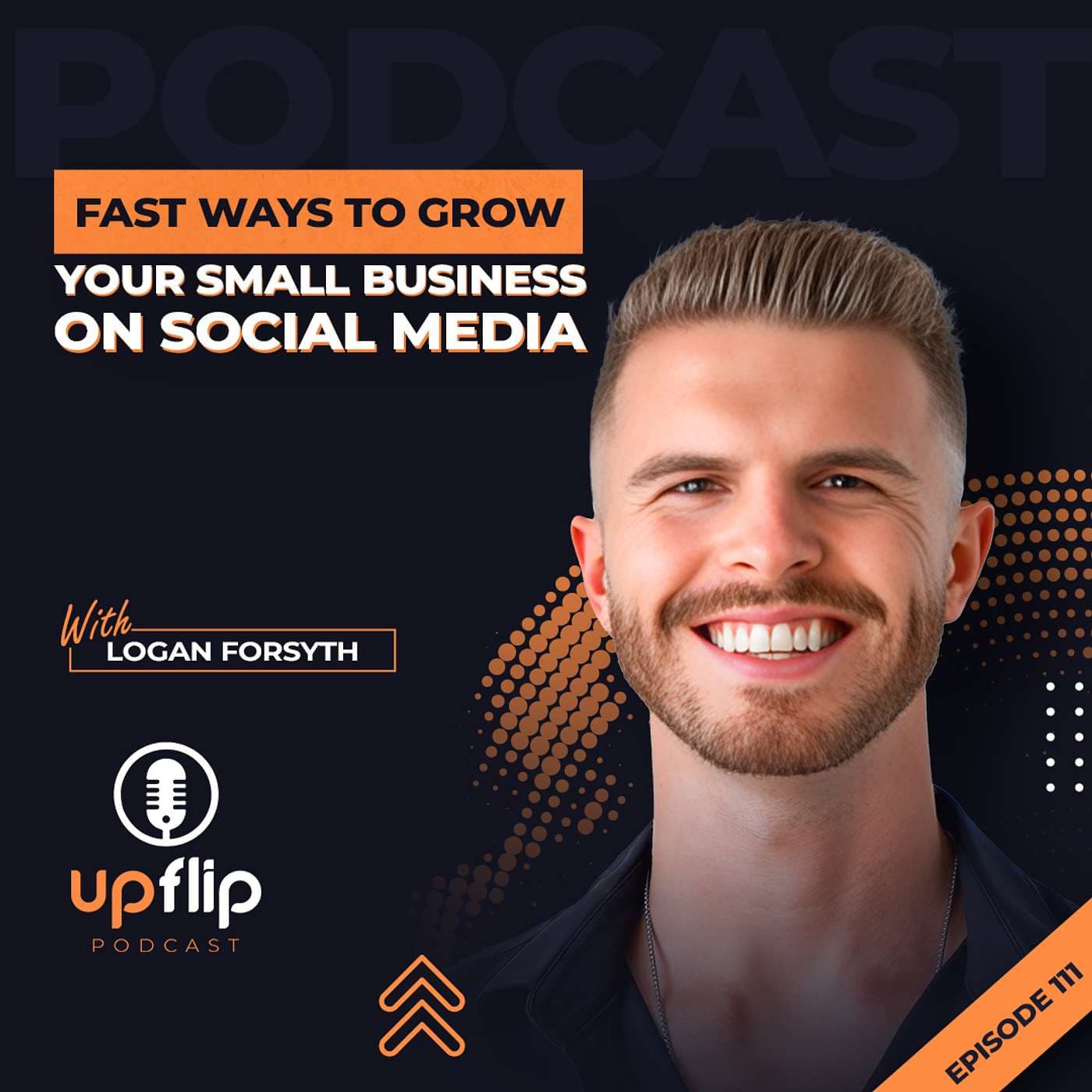
The UpFlip Podcast Episode 111: The Man That Can Make Anyone Go Viral
Podcast Overview The UpFlip Podcast explores the intricacies of building and scaling successful businesses, emphasizing the accessibility of entrepreneurship. With a considerable following on YouTube and a wealth of resources, UpFlip aims to share actionable insights and strategies for aspiring entrepreneurs.
Episode Summary In this episode, the host Alex interviews Logan Forsyth, founder of Media Scaling, who has mastered the art of generating organic views on social media. Logan discusses his journey into entrepreneurship, the importance of social media for businesses of all sizes, and how Media Scaling helps clients achieve viral success.
Key Takeaways
- Logan's Background:
- Started entrepreneurship young, washing cars and landscaping.
- Turned to online business after discovering social media and self-growth content at 18.
- Business Failures:
- Early ventures in SEO and e-commerce taught valuable lessons about marketing, audience targeting, and the importance of foundational business skills.
- Importance of Social Media:
- Social media can exponentially grow a business by reaching the right audience.
- Logan emphasizes that views should not just be vanity metrics; they should convert into sales.
- Media Scaling's Strategy:
- Focuses on high-volume posting of quality content to achieve substantial organic reach.
- Works primarily with personal brands and established content creators who already have significant material to repurpose.
- Content Creation Insights:
- Identifying target audience and tailoring content to meet their interests leads to better engagement.
- Effective hooks are crucial for viral content—both visual and auditory.
- Growth Strategies:
- Posting frequency matters; consistent posting of 3-6 times daily can yield better results.
- Avoiding friction in the content creation process leads to more consistent quality output.
- Reaction Content:
- Reacting to existing content can tap into pre-existing virality, creating community engagement.
- Team Building:
- Rapid growth from startup to nearly 60 employees highlighted challenges in hiring and maintaining company culture.
- Analyzing Growth Stalls:
- Data-driven analysis is vital; understanding which content performs best can inform future strategies.
Discussion Points
- The Role of Culture and Team Dynamics:
- Logan discusses the importance of a strong company culture and aligning team members with the company's vision.
- Challenges of Scaling:
- Rapid growth necessitates clear financial metrics and a scalable business model to manage increased operational demands.
- Future of Advertising:
- The episode concludes with reflections on how social media might redefine advertising strategies compared to traditional mediums like Super Bowl ads.
Resources Mentioned
- [UpFlip Academy](https://bit.ly/4hyyeqz)
- [Logan’s Website](http://go.mediascaling.com/secrets)
- Previous episodes for additional insights.
Conclusion In Episode 111, Logan Forsyth shares invaluable insights on leveraging social media for business growth, creating viral content, and the nuances of effective marketing strategies. His success story and practical advice serve as a guiding light for aspiring entrepreneurs seeking to maximize their potential in today's digital landscape.
For more information, visit [UpFlip.com](https://www.upflip.com) and connect on their [YouTube](https://www.youtube.com/@TheUpFlipPodcast/) and [social media channels](https://www.instagram.com/upflip/).
Written by AI. May contain mistakes. Listen to the episode to check what was said.
Transcript
Automatic transcript. May contain errors.0:28What's the truth about posting on social media? across all your social channels to gain the most momentum for your business. Be sure to listen to his secrets for gaining 1.1 billion views in only 10 months, what the best strategies are for posting, and what types of content get the most views. Logan also dives into his hiring strategies, business scaling techniques, and be sure to listen for our contest announcement that you do not want to miss. Logan, welcome to the show. Alex, thank you for having me on. It's a pleasure to be here. You've been an entrepreneur since high school. What gave you that drive to start your own business and how did that ultimately lead you to media scaling?
1:05Yeah, great question. I've always felt like it was just born in me and it's in my blood looking back on it in hindsight. When I was younger, I would wash cars. When I was 15, I started my first quote unquote landscaping business and we would print flyers and just pass them out, door knock in neighborhoods and just go to houses that needed their grass mowed and did that, made some good money through high school. But I have no one in my family and was not exposed to business in general or the concept of self-growth until I was exposed to that entire arena on social media when I was 18 and started following people who were talking about mindset and self-growth and development and business and reading books.
1:45I started investing and reading books and it just completely changed my life and lit a fire within me and hasn't stopped since. So long story short, I feel like it's always just been there. Let's talk about the failures because I think that there's often a lot more lessons in those failures before you get to the successful company. What were some of those mistakes that you think maybe led to those business failures? What did you learn from making those mistakes? So my first venture into online business was I came across someone named Alex Becker when I was 18. And at that time, he was teaching and talking about in his YouTube content how to create SEO pages for local businesses, rent them out, make passive income, and you get rich.
2:27So I started learning and investing into programs and content for that. Didn't really go anywhere. And then that led me down to just continuously investing in myself, finding other online programs and people who had made a lot of money in different areas and were teaching how they did it. And bought a program learning how to build e-com stores, do dropshipping, and make money online. and I created a store at that time selling phone cases and I was spending, give or take, like$100 per day in ads. Sometimes I would lose money, sometimes I would make money. Overall, it was break even. This was back in 2016 on Facebook when ad costs were just significantly cheaper and you could do so much more than you can now.
3:07And I just look back and think, man, if I knew what I was doing and I didn't have any retargeting set up, I wasn't capturing any emails, I had no text sequences going out, I had nothing, no order bumps, no upsells. There was so much that I could have done to really make a lot of money at that point. And so I think back on that and I'm like, man, that could have turned into a lot. So that's just one example out of many, many different failures and learning lessons, but that's part of the process. And when you're early on getting started in business, there's no one silver bullet. This is something Alex Hermozzi says I really like.
3:37Business is not one silver bullet. It's hundreds of golden BBs. And it comes down to stacking skills. You have to not only learn advertising, you have to learn just marketing in general, leadership, sales, building an organization, structuring things, recruitment. So you just continue to step into the process, build more and more skills. And over time, it starts to really come together. And obviously, views are great. It is great to have a piece of content get viewed a lot. But obviously for a lot of entrepreneurs and small business owners, they want to make sure that they're getting the right views, that they're getting an audience that is potentially going to buy their products and services, an audience that they can convert in some way.
4:14What strategies do you offer for identifying and targeting the right audience with your social media content? Definitely. So if you're just getting views for view's sake, that otherwise a lot of people refer to it as vanity metrics. So a big part of what we focus on is we don't want to just get you views, but we want to consistently get you more views in front of the right people. And you want to, again, workshop and identify what is your brand identity? Who are you talking to? What do you stand for? What is the client avatar you're speaking to? What are their frustrations? What are their motivations?
4:44Et cetera, et cetera. And once you identify that, just create your content for them, right? If you are a business owner, just poll your customers and find out what are their most common questions and then answer those questions in your content. And you can even speak to them specifically. Like with us, we work with a lot of personal brands, now more brands in general, creators, podcasts. So I could start a video and say, podcast, like call them out at the start. And again, the algorithm is so good and it knows so much about us that it's going to know based on what you're saying in the content, who to serve it to.
5:17And that's also a big part of why short form works so well. If you go and you look at the insights on all the short form content, if you post any reels on Instagram or any videos on TikTok, et cetera, you go to the insights, it'll show a portion of the reach that those videos get. And it'll show to non-followers, to for you page percentage, et cetera. So every single time you post, that post is getting pushed out to people who don't know you, they've never seen you before, they don't follow you. And it's a incredible opportunity that's getting in front of more new people, right? And the more times you post, the more at-bats you're giving yourself of going viral as well.
5:51It's contest time. And listeners, we have an exciting announcement and giveaway to share with you. In April, the Upflip membership site is launching, which will provide members with access to courses on everything from starting a vending machine business to running your own Google ads and everything in between. One lucky winner of our contest will receive free lifetime access to the site. You heard that right. Free lifetime access to the site where we'll be adding new content frequently. If you'd like to participate, please click the link in the show notes. The winner will be announced on March 18th.
6:25Can you give us the overview of like what Media Scaling is doing for your clients? What is the kind of central service the business is providing? So Media Scaling, we work with top personal brands, podcasts, creators, and we guarantee up to 150 million real organic views in the first 90 days of working with us. How that works is people have to fit a specific criteria for this. It's not like we can just take anyone who hasn't created any content before and generate 150 million views in 90 days. So we identify specific people who have a database of content. Ideally, we want to see 25 plus hours content already created.
6:59And then they're making 2 million plus in annual revenue. That shows us that they have proven acquisition systems, proven offers, and proven fulfillment to where if we come in and just amplify in 5, 10x what they're currently doing, the likelihood of them making a lot more money is very strong. And so if that's the case, they check those boxes. We'll come in and place essentially an entire media division as their team of full of editors, social media managers, a team lead, copywriter, et cetera, take all their long form content and repurpose it into a high volume of top quality short form clips and then post it out across a network of what we call secondary accounts.
7:34So examples would be like Tony Robbins clips, Tony Robbins reels, Tony Robbins talks, so on and so forth. And we're posting anywhere between 1 ,800 to 4 ,200 times per month per client. And when you do that level of posting volume with top quality content, you would definitely tap into a huge amount of reach, a huge amount of virality. And then we're taking all this new exposure and new audiences created, following it back to their main socials. And they experience hockey stick growth. It amplifies what they're currently doing, leads to a lot more impact, a lot more reach, building their brand further, and just overall more sales and becomes a very ROI-driven strategy on top of a very impact-driven strategy.
8:10Can you give me some more details about the secondary account network strategy? How did you start to set that up and how does it really work to grow the online presence of somebody if they're off on these other secondary accounts as opposed to the main account? Yeah. So social media really is a game of quality. And then if you can combine quality with quantity and do high volumes of just great quality content, that's where the massive results are created. So that's what we've been able to accomplish through this track record. At this point, we've generated more than 2.5 billion organic views through this process.
8:44Largely, Andrew Tate is a very polarizing figure, but he did pioneer this model and there's a lot to learn from it in the sense of this is how he went from widely unknown to the most Google person on the planet within about a five-month timeframe of having an army of affiliates create all these secondary accounts and just flood social media with his content. Logan, are there certain types of content that this strategy works best with? So this strategy works really great with what we call talking head content, which is when people are talking directly into the camera. It's usually motivational, inspirational, educational, podcast and interview content, Vlog content still works really great.
9:21And overall, it's just content that has people behind the camera seems to work incredibly great. But we're also starting to run this strategy with more brands as well. And there's a lot of different creative approaches here. A vision and where I wanna take this is we could absolutely come in and just take things to a whole nother level with let's say NBA teams or NFL teams or MLB teams to where they are already getting big view counts and we could 10X it, we could 50X it with this strategy by just taking all the highlights and the clips of all these entertainment sports and posting them out across content.
9:54So there's so many arenas, so many ways that you can approach this and do this. The only content I would say that we haven't developed a large degree of success with and built our model around yet is like animation-based content where there's not someone behind the screen. And then also like e-commerce, product-based content. We really specialize with people being in the content for the strategy. And how do you avoid making things feel really repetitive across the multiple accounts? What are you doing to kind of make sure that everything feels unique and different, especially when you're posting such a high volume of content?
10:25That comes down to the clients we work with having a large database. And the thing is that as long as it's not the same clips being posted over and over, and there's variation between the content, the repetitiveness doesn't really seem to matter in the sense when it comes to, I was talking about sports, like NFL. It's the same concept. People are playing football. It's the just different teams, different things happen every single week, but everyone's glued to the TV, right? So as long as it's not the same exact thing in the same exact clip over and over, and there's variation in the content, people are getting value from it, whether that's information-based or entertainment-based, this strategy still works incredibly well.
11:00Most of us follow large influencers on socials at this point, and we are a fan of that influencer and of that person. And it's always them behind the camera, but they're talking about different things and creating unique content. So same methodology applies with this strategy as well. As someone who has watched and created a lot of viral content, I'm curious, what are those qualities that make a piece of content primed for virality? I guess you maybe can't specifically answer, oh yeah, this is exactly why everything has gone viral. But what is setting up a piece to have the potential to go viral?
11:33There's art to it and there's science to it. And there still is a lottery system aspect in a way to where sometimes we'll see posts that go viral that we weren't expecting. Other times there's posts where we know it's gonna go viral and it goes viral. So what it comes down to is, again, having a really great hook. And the hook does not just need to be auditory, meaning what you're saying. It can also be the visual hook of just what's happening in the video, what's happening in the content. If you have a great hook, people see it and it makes them feel like, oh, shoot, like I have to watch the rest of this video.
12:02That's more often than not going to be a highly effective piece of content. Obviously, one of the ways that you primarily work is you take a lot of long form content and you kind of break it into some more short form pieces. When you're looking at the long form content, what are some of the things that kind of make you go, ah, yes, this is gonna be a great clip. Like how do you kind of view that as you're going through the long form content? So when you're repurposing long form to short form, one of the highest leverage aspects of that is the clip selection. If you choose a bad clip that has a bad hook and missing context, et cetera, it doesn't matter how good that edit is, it's not gonna perform.
12:36Versus if you choose a great clip with a great hook, a lot of value, no missing context, you're moving the filler pieces. And then especially if you add good editing on top, then that's the recipe for success. Another piece of content that works really well for you are reaction posts. And I certainly can anecdotally say that these work well because I certainly watch a lot of reaction content on my own social feeds. But can you explain what a reaction post is and maybe why they're so successful? Yeah. So reaction content is just that, is when someone is reacting to another piece of content. And in other words, I mean, look at news.
13:13News is largely just reacting to and reporting on things that have happened. So it's very similar in that aspect. Someone who does this incredibly well is Brett Cooper. She has grown insanely fast on YouTube, probably one of the fastest growing channels out there. She started like two and a half years ago, has already passed 4 million subscribers, I believe. And all of her content is reaction content. So if you want to understand and study what's working so well, go check her out and study what she's doing. But essentially, it's just choosing other content that's out there on social media that you come across, that you find interesting, that matches your brand, that you have some level of take or opinion on, and then just react to it in your own content.
13:52And you can do it in a variety of ways, but with us specifically, we also want to be strategic about what we're reacting to. and we can choose reaction videos that have already gone viral. Meaning minimum 1 million views are up. Some of these videos have gotten 50 million views. And so if that is in your content, you're tapping into that already proven virality. Always you wanna give credit to the original creator. So just have at least their social media username watermarked in the piece of content that you're reacting to and then make it your own. And you can have the hook, meaning the start of the video, just be the video playing itself that you're reacting to.
14:24You can also preface it, which Brett Cooper does a lot. So an example would be, let's say that you're watching Tony Robbins and he's talking about the two things that you can do that is going to transform your life. You preface that and be like, in this video, Tony Robbins breaks down the two things that you can do that are going to transform your life immediately. Let's check it out. And that could be the hook. And then you preface the video, you watch it together. You should make it interactive. You can pause as the video is playing and make comments as it's playing rather than watch it all the way through before saying anything.
14:52You can look at the comments and you can read comments that other people are saying. And overall, it's a very community-driven type of content that you can create. And also, my theory as well is it makes it more interactive, like we're in this together. People love watching movies together. They love watching TV shows together. It's kind of similar with reaction content to where you feel like you're watching it as the viewer with the creator together as well. What do you see other people getting wrong about social media and what should they be doing instead? Post more. That's a big one. There's a lot of people who have a belief that they can't post more than once per day per account.
15:30And it just could not be more wrong. We've tested extensively at this point of posting volume anywhere between posting one time per day per account up to posting 12 times per day per account. And we consistently see best results between three to six times per day per account. This can apply across platforms. But the big caveat is you need to have good quality. That's the thing is you can't polish a turd. So if you're creating crappy content and posting it everywhere, your results are not going to be good. So when you increase volume, you need to still have that quality component to it. And again, with high volume and high quality, you really tap into incredible results on social media.
16:05So remove the false belief that you can't post more than once a day and that it's going to overwhelm and spam your audience. It's not true. The algorithms have gotten so good. They know how to avoid that happening. When you're posting short form content, more often than not, most of the reach and views or also going to people who don't follow you. And so again, it's giving you more chances to get in front of more people and grow your following faster and not overwhelming your current follower base. So just post more content and keep quality there. So this is gonna bring us to a section of our show that we call our Fan Blitz Questions.
16:36These questions come from our YouTube community listeners. You can head over to youtube.com slash upflip and post questions to future podcast guests. I've got four questions here for you. Are you ready? Let's do it. All right, this first one comes from flowerchild2676. What social media platforms are best for artists they're currently using Instagram, but are there newer and better platforms they should be learning and using? We preach omnipresence. We want everyone to be on all platforms. And reason being is we specialize in short form content and there are some different variables like YouTube Shorts and Snapchat Spotlight.
17:12The short form content maxes out at 60 seconds. As of this date, Instagram and Facebook Reels max out at 90 seconds. but they are allowing accounts to post longer reels. I see that changing and having longer content available soon. And then across all other platforms, the length goes much higher. But long story short, we find best results with our short form content between 30 to 60 seconds. And then also just pictures as well. You can post that on all platforms. So you should post it on all platforms. Otherwise you're generating a fraction of the reach that you could if you were posting on all platforms.
17:43Every platform has different behaviors. Everyone has their own preferred platforms. So posting across platforms and being omnipresent also gets you in front of a lot of people who otherwise wouldn't see your content. And we have it happen all the time to where we'll have the same exact video. We post it on, let's say, Instagram. And it does average, maybe it gets 5 ,000 views, but then we post that same video on a YouTube channel or TikTok or wherever, and it gets 4 million views. And that's 4 million people that you missed out on reaching just because you weren't omnipresent posting across platforms.
18:16This next one is from Jam8284. What's the ratio of short form content to other content? And what's the view to customer acquisition ratio? Yeah, great question. It really just depends. We have some clients and their main focus is all on short form. We have other clients that do a lot of picture content on top of short form. We have clients that do a lot of long form, short form in pictures. There's really no one size fits all approach. And as long as you're consistently creating content and its quality and provides value, whether it's entertainment or information, you're going to get in front of more of the right people.
18:50And the biggest key word there is consistency. And to make this consistent, you have to remove friction. And so what I mean by that is it is a lot of friction if you're also doing the editing and you're doing the distribution, because that's a lot of additional work versus one, if you just outsource those layers, have the right systems for it, and you just focus on the production. But even on the production side, a lot of people add a lot of friction if everything that they do, they need to coordinate with the videographer and go to a different studio and coordinate with schedules, et cetera. So we recommend set up a studio, just put a camera on a tripod, have good lighting, have a decent backdrop and make it convenient to use when you're ready to record, you just press record.
19:28Last one here, Moustan Sir Mohamed Ally, how do I get organic social media views for a startup business page with no followers? Yeah. So it comes down to one, we have something, it's an incredible resource called our brand identity worksheet, you can get it. We have a free mini course in general at go.mediascaling.com forward slash secrets. And this brand identity worksheet, it's an incredible workshop to identify what your brand is. What do you stand for? Who are you talking to? What are their frustrations? What are their motivations, et cetera? And once you have that, it becomes the guiding light for your brand and the guiding light for your content.
20:05That would be step one. Step two, after you have that in place and you know what you stand for and who you're talking to, create content for them. And it's a big key. You want to have highly effective hooks in your content. The hook is really the first part of the video that hooks people in to want to watch the rest, right? And the length of the hook depends on the length of the video. A longer video, like let's say an hour, people will watch the first minute, minute and a half before deciding if they want to, you know, give an hour of their time versus short form, 60 seconds or less. The hook is really that first three to seven seconds.
20:36And so you want to use effective hooks. They're going to want people to watch the remainder of the video. It's arguably the most important part of creating highly effective content. We also have hundreds of viral hook frameworks included in 2 Billion View Secrets course that I mentioned earlier. And if you know exactly who you're talking to, you use great quality hooks, and you have good quality production, good quality editing, and you're posting consistently, you're posting across platforms, then you're already ahead of 99 % to people. I saw a stat, there's more than 240 million creators. If you're checking all those boxes, you're already in the top 0.05 % of that.
21:09And now time is your biggest asset. Just continue doing this with consistency. And I promise you will be shocked at the results that can come in within even the first six months, the first 12 months. Social media growth is not linear, it's exponential, meaning it compounds. And we see results jump from one month to the next, that'll go 5X, then 10X. It can be really, really insane growth when you tap into it and you do it right. As you've been growing the company, which obviously incredible growth in a very short amount of time, what's been the biggest challenge that you've faced as a company growing to the scale that you've grown to so far?
21:42The biggest challenge is team building. In the first 10 months, we went from starting the company to a team of just shy under 60 people. And with that, it comes down to hiring great people, having a big vision, tearing in layers of management, bringing great leaders into the company as well. And so team building has been the biggest challenge, but we persevered through it, I would say very well, and have a very clear plan of action ahead of us also to just continue improving in that arena. But that is the biggest challenge because we have a full team behind each client that we're working with and running this strategy to be able to produce this level of results.
22:19Nothing's done through software and AI. We're Not there yet. There's a lot of softwares out there, like Opus Clips, that the whole promise is it'll take your long form content, repurpose it in a short form content. It's definitely not there yet. It's not even close to being there, comparing it to an actual editor. The concept is incredible. Maybe it's there in two, three years. But as of now, we just run this whole process with a full team behind it. As you've been building out that team, what are some of those main skills or traits that you're looking for in applicants to bring into the team?
22:48It depends on the role. So we have a lot of editors on the team. We have a lot of social media managers. We call it our team lead is really the captain of the ship who leads the charge per client team. And then we have managers above that. We have a sales team that we built out. We just brought in a director of sales. We have our director of recruitment. We're currently hiring a director of operations. And so what we look for first and foremost is a culture fit that comes down to traits and that's not something that's trainable. That's just something of who you are or who you are not. So culture fit is not something that's trainable.
Read the full transcript
23:17And then depending on the position with our editors, we like to have a lot of experience coming into it, but we also have incredible training in place for all of our positions. We have an editor training program that can take our new editors who come on board from a level three to a level seven fast within two weeks. And then they get from level seven to level 10 just by putting in the reps and putting in the time. And then we have trainings like that that have been built out across each position for social media managers, for team lead, et cetera. But when it comes to the higher level positions of the who not how approach, let's identify the number one constraint in the company.
23:50And then how can we bring in someone with a high level of expertise to solve this constraint for us? We want not only culture fit, but a high level of experience to back it up. So an example would be with the director of operations that we're currently looking for and currently interviewing with. We are looking for someone who's a culture fit. They match our values. Our core values are greatness, integrity, and creativity. And so we ask questions based on our values to see if that aligns and matches with them. An example would be for the core value of greatness. We'll ask people, what is the proudest achievement that you've accomplished in your career?
24:24And we want to hear something that's great. If it's not a great achievement and a high level achievement, they're probably not a culture fit for us, right? And so we have different examples and questions that we've lined up for each of those values, but also on the experience side, like the director of operations, we're looking for someone who has experience working with an online service agency, and they've gone from that agency having a dozen clients to a thousand clients, and they know the path to get there, right? So it's a very specific criteria, and that's who we're looking for because we need someone who knows and understands that journey, and that's our criteria, right?
24:56If they don't fit that, then they're not going to be a fit for the role. Scaling up and hiring is such a difficult thing for a lot of entrepreneurs to handle. You know, there's certainly bringing on employee number two, three, maybe up to five is one thing, but then to go up to 60 as quickly as you all did, what advice do you have for other entrepreneurs who find themselves suddenly needing to scale their team that quickly? It comes down to one, you need to know your numbers and you need to have gross margins that are scalable on your products. What gross margins mean is your total revenue and since the total dollar amount of whatever it is that you're selling, and then you have direct costs to that.
25:34So for us, we have our done for you services and then directly tied to that, we have editors, we have social media managers, we pay our team lead, we have copywriter, data analyst, et cetera. And then all those direct costs taken out, that leaves you with your gross margin, your gross profit, right? And then everything else left over is what you have to scale the business and scale the company. So you have to know your gross margin and be strategic with it. That way you have the resources to scale and hire on the backend and bring in top-level management and directors and executives and just build a world-class team.
26:04And then it comes back to what I mentioned earlier of having an amazing vision. Think so big that it is extremely inspirational to everyone around you. They want to be a part of it. They want to join the movement and have purpose. And you want it to be an exciting place. Leila Hermosi has a great saying that stuck with me that the best who's, they care more about the mission, vision, and growth potential compared to the pay with the company. So we're very focused on that. And our job post, for example, and the interview process, we're really communicating the vision and what we're looking to accomplish, the mission behind it, the impact we're creating, and the right people get really pumped up about that and want to jump on board and just be a part of that movement as well.
26:44So that's been very, very helpful for us. If somebody gets started out and they maybe are experiencing a little bit of growth or they've had a little bit of growth and then it stalls that growth. If and when you run into that, how are you analyzing an account that isn't growing to maybe identify what the problem might be? I mean, data speaks more truth than anything else. So when we're posting all this content, a lot of it upfront, especially with new accounts, is we're experimenting, we're looking at the data, we're testing out different content styles, different edits, et cetera, and then we let the data speak.
27:16And so even if you're not growing like you want to, If you post consistently over 30 days, that's going to give you enough data points to where you're going to have some outlier post over others. Study the post that did well, study the hook, what did you talk about, and lean more into that. And more often than not, when you lean into what's working best and lean away from what's not working, you produce better results. Logan, if you could pick the one thing that listeners take away from this conversation, what would it be? Remove friction. That's going to be the biggest key. The more friction you add in your content creation process, the more difficult it becomes to be consistent with this.
27:49And the less you're gonna post, the less you're going to enjoy it. So the more you remove friction, the more enjoyable it becomes, the more consistent it becomes, the easier it becomes to do more volume, the more success you're gonna have. Logan, where can people connect with you and learn more about media scaling? Yeah, so you can check out mediascaling.com. It has a lot of information about us there. We also have our 2 Billion View Secrets free program. We really loaded this thing up with value. We have a lot of people who come to us who aren't necessarily the best fit yet for our done-for-you services.
28:19So we wanted to provide as much value as we possibly could to them to help them. And with the goal of them getting to the point to where maybe one day they are a fit for a done-for-you service. So you can check that out. It's on our website as well. It's also at go.mediascaling.com forward slash secrets. And then we preach omnipresence. So I'm across all socials. I finally launched my own personal brand about a little over a month ago and momentum is picking up. It's been going great so far. So find me on any platform at my name, Logan Forsyth. That was our conversation with Logan Forsyth of Media Scaling.
28:51One of the things that I really loved about it was his point about the Super Bowl advertising, that there's, you know, it tops out at about like 98 million views and the value that companies place on that view level. Because then if you can build out this social platform, if you can go get those 150 million views plus from a company like MediaScaling, from your own social pages, throughout that stuff, you can achieve$6 million plus worth of earned media via content that you're already producing and content that is going to be more niche to your audience than maybe something as wide as a Super Bowl commercial.
29:27It really shows you what the future of advertising might be and what is already here. So it's really interesting to talk to Logan about that. Looking forward to more conversations here on the UpFlip podcast. If you want to learn more about how to go viral, you can check out episode 104 of this podcast, where we talk to 18-year-old Jenny Hoyos, who creates viral YouTube shorts that have brought her over 1 billion views since 2021. Or if you just want more advice on how to start a business the right way, head over to the UpFlip hub. We'll see you next week. Logan Forsyth of Media Scaling, thank you so much for joining the show.
30:00Alex, thank you.
30:04Thank you.
From the publisher
Social media can make a significant impact when you start, grow, and scale your business. Big or small, all businesses can harness the power of social media. And if there’s one thing that our guest today does exceptionally well, it’s generating organic views. Logan Forsyth has generated over 2.5 billion ORGANIC views, attracting over 18 million new followers for his clients.
But you don’t have to hire a marketing agency to get results for your business. Logan gives his insights into how Media Scaling is able to take their clients to the next level, and it’s something you could implement this week to see major results. Logan shares the content that is most consistently going viral and how you can tap into it, without creating content of your own.
If you’d like to learn more about starting a business in a specific niche, or learn how to scale the business you already have, don’t miss out on our INCREDIBLE GIVEAWAY! We're giving away free lifetime access to our membership site that will feature courses on how to start and grow a business. This includes specific business niches like, vending machines, cleaning companies, pressure washing, etc. Additionally, you'll have access to other resources and courses for marketing techniques including Google ads, and a member portal where you'll have direct access to entrepreneurs who have succeeded.
Resources:
- Join UpFlip Academy: https://bit.ly/4hyyeqz
- Logan’s website: go.mediascaling.com/secrets
- Episode 104. How This 18 Year-Old Makes Viral Content and Generates $20K/Month
Ready to be your own boss without starting from scratch? Grab our FREE Franchise Guide and unlock the secrets of proven business models that have already created thousands of success stories.
Connect with UpFlip:
- On Youtube
- On Instagram
- On Facebook
- @UpFlipOfficial on Twitter
For more insights to start, build, or grow a business, check out the resources on UpFlip.com or head to the UpFlip YouTube channel to see more interviews with business owners and experts.
Thanks for listening!


