
In short
The UpFlip Podcast - Episode 115 Summary
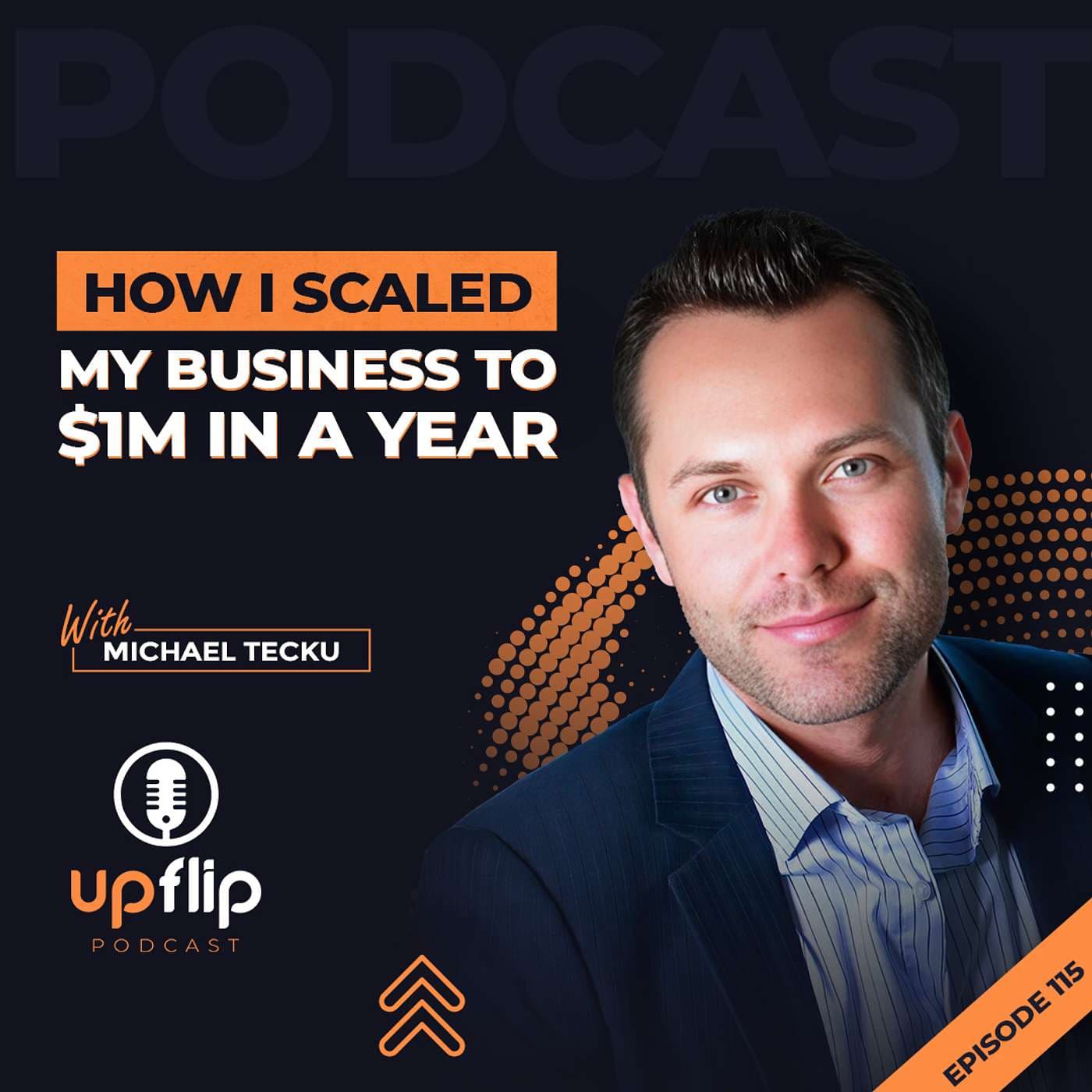
Episode Overview Title: 115. The Principles I Used to Scale My Business to $1M/Year Description: Michael Tecku shares insights on starting and scaling a business in the e-commerce space, specifically how he transitioned from being a top Amazon seller to launching a successful Shopify business.
---
Key Themes and Discussions
Defining Entrepreneurship
- Personal Journey: Michael initially did not identify as an entrepreneur, viewing businesspeople negatively. His perspective shifted after realizing he needed to change his approach to life and work.
- Entrepreneurial Identity: He defines entrepreneurs as individuals who take risks to add value, distinguishing between earning money and making money.
Starting a Business
- Initial Steps:
- Michael emphasizes the importance of problem-solving over merely selling products.
- Suggestion to initially start with a service-based business due to lower startup costs and competition.
Service vs. Product Businesses
- Service Business Recommendations:
- Lower risk and competition, potential for rapid growth.
- Examples include home services like insulation or cleaning, which often have high demand and low supply.
- Product Business Challenges:
- Significant startup capital (estimated at $25,000 to $50,000) is needed for product businesses.
- High failure rates for new products, especially in saturated markets.
Market Research and Validating Ideas
- Observational Strategies:
- Encourages entrepreneurs to pay attention to their environment for gaps in the market.
- Identifying businesses with waitlists or high demand can signal opportunity.
Platforms for Selling
- Amazon vs. Shopify:
- Amazon allows capturing existing demand, but offers limited control over listings and customer relationships.
- Shopify requires entrepreneurs to create demand and drive traffic, emphasizing the need for compelling marketing strategies.
Customer Acquisition
- Marketing Strategies:
- Importance of understanding customer acquisition costs, especially in a subscription model.
- Aligning product pricing with long-term customer value to ensure profitability.
Building a Business with Freedom
- Focus on Enjoyment:
- Michael believes entrepreneurship should feel effortless and align with personal interests.
- Encourages building processes and systems that support freedom and efficiency in business operations.
Building a Brand
- Brand vs. Product:
- Emphasizes the importance of branding as an extension of the company’s identity.
- Decisions should align with the luxury positioning of the brand, influencing product quality, customer experience, and overall business operations.
Continuous Learning and Team Building
- Skill Development:
- Advocates for building personal value through ongoing learning and skill acquisition.
- Suggests hiring only when demand is validated and manageable, maintaining a lean operation initially.
---
Resources Mentioned
- Podcast Episode 82: [How to Make $22M/Year with Ecommerce](https://open.spotify.com/episode/5FdKcNSuTosQnWr8UKuskd)
- Connect with Michael Tecku: [Momentum Shake](https://www.momentumshake.com/)
- The Unofficial Shopify Podcast: [Listen Here](https://unofficialshopifypodcast.com/)
---
Key Takeaways
- The journey of entrepreneurship involves a shift in identity and perspective.
- Start with service offerings to minimize risk and transition to products as you validate market demand.
- Build businesses that prioritize freedom, enjoyment, and personal growth over purely financial outcomes.
- Focus on branding as a reflection of your values and customer commitments.
- Continually evolve by learning and adapting, ensuring that your business process creates value for customers and yourself.
---
Conclusion In this episode, Michael Tecku provides a wealth of practical strategies for aspiring entrepreneurs looking to navigate the e-commerce landscape. His insights on identifying market opportunities, the importance of branding, and building a business with freedom in mind serve as a powerful guide for anyone on their entrepreneurial journey.
Written by AI. May contain mistakes. Listen to the episode to check what was said.
Transcript
Automatic transcript. May contain errors.0:28How do you start a business when money is tight? their success. Today, we're talking to e-commerce genius Michael Techu to get his strategies for starting a business, even if you have no clue where to begin or what to sell. Michael, thanks so much for joining us. Alex, it's a true pleasure to be here. I want to kind of start with defining what you feel an entrepreneur is, because you've said in the past that you've never identified as an entrepreneur. So like, what does it mean to you to be an entrepreneur who doesn't identify that way? And how has your perspective shifted on like the space you take up in the world?
1:00That's an amazing question. Who we are, our identity, I think that's the most important question in life. Up until I was 27, from when I was five years old, I was a singer-songwriter in a band. And I thought entrepreneurs and business people were boring accountants and or like jerks on Wall Street or something, right? I thought capitalism was for greedy people. And so I made music that was deeply personal to me and turned out nobody cared. And I had this realization around 27 that who I was was not working. And the bigger aha moment for me was I didn't know how to figure that out. And I didn't think I could honestly answer it because I was trying to pay bills.
1:41I had spent the last seven years out of college sleeping on people's couches, living off food stamps. And, you know, it was a beautiful and hard life. But I just knew that everything I was going to try to do moving forward was always going to be tainted. Like, oh, does this make money? Can I pay the rent? So I decided at that moment that I wanted to feel, what was it like to not have money be part of the equation, to make it meaningless? What would I do if I could do anything I wanted? So I decided to get free first. And that became my mantra. What an entrepreneur is to me is someone who takes risk and adds value.
2:16And that multiplication there is more than just two times two. It's exponential. So you can take money, you can earn money, or you can make money. and entrepreneurs make money. You're bringing something into the world that didn't exist and you're getting paid for it. I think it's just been a really incredible, incredible journey so far. Selling products online is obviously a big space, potentially, and definitely a spot that a lot of folks, you know, in the TikTok influencer entrepreneur space are like, oh, just start selling products online. But obviously as somebody who's done it, who was there kind of at the beginning of all of the things that would come from Amazon as an opportunity, if someone's starting out now and says, hey, I really want to get into this space.
2:56I want to start selling products online. But like, that's all they know is that they want to start selling products online. What should they do to figure out where to go from there? Well, I don't know that that's the best place to start. I kind of think all businesses are the same, right? You are trying to solve a problem and really you have to market it, you have to operate it, you have to follow through on that. And that could be a product or a service. But products, quite honestly, I don't have anything to sell. I don't have, you know, like a course to sell. So just to be honest with your listeners, I think starting a service company is way lower risk, way lower competition, both in numbers and in quality of competition.
3:31And you can be a big dog in your little area. The amount of advertising is way less. Just the startup costs in general, the likelihood of success is going to be tenfold. If you're going to start a product and you want to skip that wrong, you want to jump up, you want to go to the big leagues, you're going to need, I don't know, at least$25 ,000,$50 ,000 that you're okay losing, right? Because we made 20-something products and like 15 of them failed. And that was when it was easy. It's way harder now. And it's way more of a commodity. The difference between earning money and making money, right, is that you have to create some kind of new value or you have to be providing something that there's more demand than there is supply.
4:10so that is much more difficult now if you were to go on amazon you're going to see like 15 pages of the same product so unless you're coming out with a true innovation in that product space if you just want to be a yes and a one more thing it's going to be a real uphill climb i would start lower on that evolutionary ladder and start a service business that's honestly what i would do i mean if you want to get just look up any service product or company in your city try to get like your kitchen redone or insulation in your attic or your gutters cleaned, they're going to have a wait list. It'll be like 10 times more expensive than you think it is.
4:49And they're not going to do a very good job. So I would start that business and you could become a multimillionaire, I think, in like a matter of 12 months with probably like$10 ,000 startup capital. If I was starting over, I would make like an insulation for my roof. I got a quote for that last year. It was like$25 ,000 to have a guy blow insulation in my attic. And I was like, how long is this going to take you, man? And he's like, oh, like a day. I'm like, are you kidding? I did it myself. It costs$1 ,000 in material. And you know, like there's no skill involved. And I was like, what the hell?
5:18And he's like, yeah, I'm booked out for like four months. So I'm like, okay. That's what I'm looking for when I'm starting a business. A huge arbitrage of demand and supply. I care less about the product. How do you start doing that research? Obviously, you know, the insulation business in particular, You just kind of stumbled upon that because you needed it done. But like, how do you go about determining like, this is going to be a good service. This is going to be a good product. This is going to be a good X. Right. Well, I think that's just, there's an evolution for entrepreneurs, right? And the place I'm at right now is I make the thing I want to make that is solving my own issue.
5:51I'm following my own interest and curiosity and solving a problem for me and people like me. My current product took me three years of research and development and, you know, like a half a million dollars to get off the ground. That's not where you should start, right? And it's back to being a little bit more me-centric. In the beginning, you got to be other people-centric. You got to do jobs nobody else wants to do because that's where the opportunity is, right? Just start paying attention. I saw the photo booth company and we were at a wedding expo and we had like a line of like 75 brides all lined up and I was like, oh, there's demand here, right?
6:25So start noticing what people need. Pay attention to your friends and the people around you and where you see lines and backups and stuff. I wanted to get a pool put at my house. And I called up five pool companies and they all had one to two year waits. And they're like$100 ,000 a piece to put in a pool. It takes a weekend to put in a pool. And I was like, this is insane. I should start a pool company. I do that all the time. I see that. I'm like, I should start that company. Now I don't do that anymore because I don't care about money and I want to do something that lights me up. But if I'm starting out in the world, that's where I'm paying attention.
6:57If you're itching to dive deeper into the world of e-commerce and entrepreneurship, you're going to love what we're about to share. You know how we're all about practical advice and real-world business insights, right? Well, we found a kindred spirit in the unofficial Shopify podcast hosted by Kurt Elster, a seasoned Shopify partner and the brain behind EtherCycle. This isn't just another business podcast. It's a goldmine for anyone using or planning to use Shopify for their online store. It's a straightforward, no-nonsense podcast with real, actionable advice for starting, developing and managing your Shopify store.
7:29Check it out wherever you listen to podcasts. The link is in the show notes. So say somebody does kind of land in the they want to go either the products on front or like maybe something that's more like as a service online. What are kind of those platforms that they should be looking at? Obviously, Amazon is a marketplace for products, but it's not the only one. Where should they be looking? So there's two ways of kind of ideation. You can look at platforms, which is an incredible place to do it, because if you would go on Amazon and talk about products, you can look at what the top 100 things selling are, right?
7:59You can see exactly how much every single product is selling. And there are two, three million different products for sale, right? And you can see which have good reviews and bad reviews and where there's the opportunity to make something better. So you create the restriction of platform, and then you can find where there is a niche and opportunity. Otherwise, you can create a restriction on like location, like say your city or a service. If you want to just approach the world with infinite options, it's going to be overwhelming. So create the restraints, right? And create the restraints around figuring out where demand is at.
8:35So once you do that, so if you're going to be on Amazon, it's this amazing tool. You can see it all there. One of our companies was a pizza stone, right? And so there are 500 people selling pizza stones, and they're all basically the same. And I read through the reviews and I could see that everyone was complaining about their natural stones that absorb grease and they can't be cleaned and they get kind of gross. And so my insight was like, well, what if we cover this in a black ceramic? So it was already black and it was easy to clean and nobody else was doing it at the time. And we came out with that and it became the number one best-selling pizza stone for a couple of years, cracked a million bucks on that.
9:11And the reason I don't do Amazon anymore is because of that product as well. Right before we jump into why Michael doesn't recommend Amazon as the platform for those just getting started, I wanted to share an excellent resource from our YouTube channel. Check out the episode titled Making 65K a Day from a Simple Idea about how Max Tuning started his candy company Sour Strips and grew it to more than$2 million in monthly revenue. Let's dive into why you don't do Amazon anymore. What was the kind of the process there? because you were at one point, it's up 1 % salary on Amazon. It's a multifold thing.
9:45One, you don't have control. They're not your customers. So with the pizza stone, either a competitor or a customer sent in a complaint saying that their pizza stone caught on fire. That's impossible. It's a rock that goes in a 3000 degree oven to be made. But it was immediately taken down as a dangerous item. And the thing that was making, you know, $1.3 million a year just disappeared for like three months. And there was nothing we could do We didn't even know why. We had to, quote unquote, go figure out what the problem was. That's all they would tell us. Like, you have to tell us what the problem is.
10:17And so we just deduced after like looking through zillions of reviews that the pizza stone, quote unquote, catching on fire was the problem and that we would promise that these would be, you know, flame resistant pizza stones from now on. But when it came back, we never got the listing back to where it was and the product died. So all that hard work just disappeared and vanished. And so So I realized I don't really own this company. The platform owns it. And then the other part is our best-selling product was a floor mat, which is the most boring thing you can think of. But it's in like every major hotel and like millions of people's homes now.
10:50It was the best-selling for like four or five years. And we made a real innovation on that by being the first company to kind of nail the feel of it. At the time, they were all very commercial and they were hard and they were designed for people standing on it for eight hours a day. And my thought was, you're familiar with the Pepsi Coke challenge? Yeah, yeah, yeah, yeah. So people would do a blindfolded test and tell you which one they liked better. And people would always choose Pepsi. The problem with it was is that they would just take a single sip and Pepsi is sweeter. So they would instantly like that better.
11:20But if you drank a whole can of it, everyone would pick Coke. And that is sort of the difference between the mats that we made. I realized that most people stand on these mats for like 10 minutes to do the dishes or something, right? So I made ours really, really comfortable and made to just feel squishy and incredible. It wouldn't be great if you stood on it for like five hours a day. But we were the first to do that. And we had this huge advantage. We built this incredible moat of, I think now it's got like 30 or 40 ,000 five-star reviews. And it was ranked number one in every single keyword because no one was doing the thing that we were doing at the time.
11:50And then by the end, there was probably four or 500 people that had copied every single thing about what we were doing. And when we used to sell it for 70 bucks, and by the end, we were selling it for 38 with like 10 % margins. And we're like, okay, not a game I want to play anymore. So if not Amazon, is Shopify the new option or are there other places someone should look? I think it's a yes and. So it's a very different way of approaching business. With Shopify, you've got to create traffic. With Amazon, people every day go to the search bar and they type in pizza stone or antifatigue mat. Then you just have to win the battle of who's the best for that search term.
12:29With Shopify, nobody's searching for your product. You got to do interruption marketing. You got to do an ad on Instagram or Facebook. And it's got to be so compelling that people see it and like, I didn't even know I had this problem. This is amazing. Then they go to your website and then they decide to purchase it. That's going to change absolutely everything about what and how you're doing everything. And the math changes, right? Because you got to pay for traffic now. You have to pay for shipping. Many things will not work on Shopify that could work on Amazon. And it's going to be a price point thing.
12:58Like selling something under$100 on Shopify, probably not going to work. Selling a commodity on Shopify, probably not going to work because, you know, why would they do that when they could just go to Amazon and get it for 30 % less, right? You had mentioned a$25 ,000 to$50 ,000 that you're willing to lose if you want to get into the product game. Does this change those numbers as well? Yeah. I think you have to be coming up with something innovative and truly adding value to the marketplace to try to make money on your own website, right? On Amazon, you're capturing demand. You don't need to create it.
13:29So you can make something slightly different or you can make modest improvements and there can be hundreds of competitors and yours can stand out as the best because people are actively searching. It's just so different to try to create demand. You have to create curiosity and educate people. Just a very different journey. I don't think that's necessarily a place for someone to just know anything about business to start because that's just you have to learn so much. We all start knowing absolutely nothing. I was a musician. When we started the photo booth company, I didn't know anything about cameras or marketing or logistics or I didn't know anything about anything.
14:05But we have the ability to learn anything. And you just have to start from the bottom. And the difference between someone who has a job and an entrepreneur is that you have to spend your time creating an asset. And you do that by learning something, creating the thing, and then systemizing it. And most people don't do the systemizing part. They just keep doing the same thing. And that puts a ceiling on their growth because they get stuck in their business instead of adding more parts to it and growing it and creating that asset. So you can just do that same program, learn, create, systemize. Okay, I'm going to do this for marketing.
14:40Great. Now I've made a program for it or I've outsourced this and I'm going to move up to the next level. Like, okay, I'm going to get really good at product development or branding. And then once you've built that thing and you can move up, I'm going to get really good at sales now. And there's just you're stacking skills one after the other. I want to dive into some of those things a little bit more deeply. But first, I want to go to our Fan Blitz questions, which come from our YouTube community. Listeners, you can head over to youtube.com slash upflip and post questions to future podcast guests.
15:06Got five questions here that are kind of within the range of exactly what we've been talking about. So I want to get these in for these listeners. Michael, are you ready? Let's do it. All right. First one from Mayhead192 asking about can you force product market fit with great marketing or is that something that you can't do? You can do it for a very short term. You can fool some of the people some of the time, but you can't fool them all the time, right? Great products win, I think, every time. Great marketing is an incredible asset, but I like to think of your favorite dive restaurant or like, you know, I've been to some incredible restaurants.
15:37They don't even have a sign outside, but there's a line and it's because the food is incredible. And I've been to places that are, you know, tourist traps that do really, really well because people only come there once and they're like, and then they eventually go out of business, right? So you see that all the time, a bunch of hype, they don't follow through. And then the places that stick around for 20, 30, 40 years, you pass on to the next generation is because their lasagna is better. That's the business I think you want to create because you're making an asset. And I think it's way easier to make something amazing, have people love it, and then go tell everybody because that's what people want to do.
16:12It's really a gift. People love sharing something amazing with their friends. It gives them status and value. So that's what's happening with Momentum is we're not really doing much marketing. The product's incredible and people share it on Instagram. They share it with their friends. I think for every single person that we sell, they bring in, I think on average, like two or three more people. So it's this incredible flywheel. And that's the business that you want to build. This question is from Yuva, who's asking about customer acquisition strategy because, you know, paid marketing on Meta and Google is not cheap.
16:42There's a zillion ways to get customers, right? And if you have to acquire a customer, you want to do it in the most effortless, scalable way possible and then build around that. So my product and pricing has acquisition costs built into it. And if it couldn't support advertising on Meta, then it just wouldn't work. And I see that a ton. So right now we convert ads for about$30,$35 a customer. and that works because if I sell you this once and you love it, you keep buying it for months and months and months and then I make profit. So right now on the first order, we break even and if this was a one-time product, that is not a business, right?
17:22But because it's reoccurring, then it makes sense. So you have to keep that in mind when you're building your business. Like is one sale worth 10, 20 sales? And that's when the math starts to work. The reason I am strictly focusing on meta for ads is because I just want to learn one platform that can scale up to$10 ,000,$20 ,000,$50 ,000,$100 ,000 a day through that one thing. And if I try to spread myself on the other 80 ways to make money, I'm going to be just mediocre at all of them. So we are just doing that one thing, and we've made the math work on it. You've talked about finding out where that demand is, but Eureka 2637 is wondering if there's any software recommendations or like industry news type things that you could be using to kind of determine what products there is a demand for.
18:11It needs to be a Venn diagram of human demand that you are seeing in the marketplace, plus your own natural curiosity and expertise. The only way to really win this game is you got to care more than the competition about the product. You have to be able to be an expert at this thing, which means you have to have a natural inclination for it. One of the reasons we didn't do the mat company anymore is I was at the manufacturer and we were trying to make some new mats and we had like 30 of them laid out. and I was doing like Tai Chi on top of every mat with like 1 % differences in softness. And I just looked at the manufacturer like, did you ever think you'd know so much about mats?
18:50And we both kind of just like hung our shoulders and got depressed. And then like three weeks later, I decided to sell the company because I didn't want to be an expert at that, but I was. I knew everything there could possibly be about that and the experience of that. And that is how I was able to make a better product. So there has to be demand, but there has to be your drive and curiosity to carry you through the years of wanting to make this better and better and better and better. Because if you don't, someone else is going to do that. That's going to do it for our fan blitz questions. Again, those come from our YouTube community listeners.
19:21You can head to youtube.com slash upflip, post questions to future podcast guests. Michael, I'm curious about how brand factors into all of this, especially when you've moved off of the Amazon marketplace and are now trying to drive demand to your own website to make those sales. Like, is branding important or is it important to be product first? I think it's the same question we asked before is who are we? Brand is who your company is and it affects everything. And it's your way of communicating that to people. It's more important than anything because like for my company Momentum, I decided that this was a luxury product, that there would be nothing in the world that was better than this, a better value than this, more all in one.
20:07It was going to be the absolute best experience through and through. And so that affected every single decision that I made about building the product. I didn't care about how much it cost to make. I didn't care about how difficult, you know, certain things were. It's like, oh, what shipping company are we going to use? Well, the best. We're going to use FedEx. It's going to take two days. It doesn't matter if it costs more. What packaging are we going to use? Which one's the highest quality? So every decision is affected by your first decision about what this company stands for, who it is. And then when you communicate that, it has to be aligned as well.
20:39So if you go on my website, it converts at like 5 % and it does absolutely none of the top tips and tricks of marketers today. There's no pop-ups, there's no countdowns, there's no sales, there's like not floating testimonials, there's not a chatbot. I hate all that stuff. You hate all that stuff. Prada and every other luxury, you know, Rolex doesn't have that on their website. They make something beautiful and they're confident about it and they present it with design and just visual elements that scream this is the best and the best people in the world want this. That's how everything is approached and that's why the website converts so well is because it looks like a luxury product.
21:20It looks like someone that you could trust. It's my name and face is on the thing. Every other supplement in the world is just some faceless product. You have no idea who's behind it, right? So I want all of that in there because I'm trying to communicate quality and trust. And then I make the product to match that because my name's on it. And so it's got to be incredible. What advice do you have for building out a online store, an online business while simultaneously gaining freedom? Like, how has that process worked for you? I believe entrepreneurship should feel easy. It should be enjoyable.
21:53Like Superman wouldn't be spending his time trying to become a singer songwriter, right? because that's not his superpower. Flying for him, he doesn't have to try. Lifting a truck is easy. It's effortless. So I always want to lean into what feels effortless for me, what feels like my superpower. And by doing that, it means there's a lot of things that I can't do that feel like pushing a rock up a hill. So when I build a business, I'm really strict now that I'm going to be leaning into the things that naturally excite me, that feel effortless, that feel easy. And And by building it that way, I have a ton of time.
22:28I have a lot more freedom. And when I do work, it doesn't feel like work. So that's part of the identity thing, right? That affects everything that you do. In the beginning, I think the purpose is to get free. So you have more time to work on growing, becoming a higher value person, and then you can create better and better things. Every other company I've ever started is now gone, right? Everything has a life cycle and then dies. So if you're purely results orientated, you're waiting to get to the end to be happy, then you're going to just get there and realize that there's nothing, that there's only the end and you have to go start something else.
23:04So you have to become journey orientated, process orientated. And that means you make this company with the sole intention of I need to be free. So that means you're going to make better processes. You're going to make better systems. You're going to hire people that are competent. You're going to make a product that you don't have to beg people to buy, that people want to buy and that are going to like, it's going to naturally sell itself. So all those decisions are in alignment with you wanting to be free because you're going to enjoy this period of time. And in doing that, it's going to be a way more powerful, valuable company.
Read the full transcript
23:38I mean, one of the things that strikes me there is I then make the assumption that you're pretty quickly adding team members as you're building a company. How quickly are you adding on members to the team so that you can continue to lean into the things that excite you? As soon as it starts making money, I never get ahead on spending money. Because if you were to look at the things that destroy companies, there's a million ways to fail. But it's like a top 20 things and running out of money is number one, right? So staying incredibly lean for as long as possible is very important. And once the market has said like, hey, we want this thing, make more of it.
24:12and you have a supply issue, not a demand issue, then you can start hiring people to help you with supply. You can start hiring people to help you with customer service. So that's the systemized part. Once I have learned and created the thing, I understand it, then I replace myself because it's just not the most valuable thing I can be doing. The most valuable thing I can be doing is learning the next level and creating and building the asset that is the business, right? So I simultaneously try to replace myself very quickly, but stay very lean, which means I'm kind of following Elon's algorithm, right?
24:45The first step is to eliminate. The best part is no part. Do I need to be doing this thing at all? And the answer is probably no. So really focusing on what truly matters and getting rid of everything else. A good example of this was like at the photo booth company, we had a designer that would customize the photographs and the font and the colors for every person's wedding. And, you know, It was like back and forth. It would be like five hours for each wedding. And then one day I was like, well, what if we just had one font and it was black and white and we didn't offer customization? And we just told people that this is what it is.
25:18And nobody ever pushed back. Nobody ever asked to customize it moving forward. And we just eliminated that thing. Everyone was happy. And all of a sudden we didn't need to pay this person, you know, 40 hours a week to do design work. So I would really start cutting. In this most recent business, I had a Facebook advertising company and it was like$5 ,000 a month. And I didn't know anything about Facebook ads. And it just didn't make sense to me at the end of the day. Like I'd rather take that$5 ,000 and throw it at the ads themselves and learn the skill. And it turns out that's not really a job.
25:46It took me like a week to figure it out. And we were performing just as well. And I saved$5 ,000 a month. But I also improved my skill set. I became more valuable. The goal of all of this for me is how valuable can I become? That's where the true wealth is. Because like I said, all the companies disappear. Everything I've worked on will at some point vanish. But at the end of the day, I still have this mind that I'm building. So I want to keep making myself more and more valuable. If I lose the company I'm working on right now, the next company will be even bigger because I still have all the skill sets and wisdom and knowledge and experience.
26:19That's the true value. You can take everything from me. I'll have it all back. Michael, this has been absolutely incredible. Where can our listeners learn more about you or connect with you? You can email me at mike at momentumshake.com. I'm always happy to connect. I love talking with people and helping. If I can do that, I would love to help you. You can go to MomentumShake.com and you can try the world's highest quality longevity shake. Yeah, that's about it. That was our conversation with Michael Tecky. One of the things that I really loved about that conversation was the way in which he described the challenge of bringing a new product to market.
26:52And that can be a long-term goal, but that there are other ways in which to get into the business space. That if you look around, you see that there are demand for a lot of services, for example, that any business is going to be about finding that demand and meeting it where you and your interests lie. And I think that that's a really, really powerful message, especially in an age where e-commerce dominates a lot of our conversations. But listeners, if you're looking for more advice on how to start a business the right way, check out podcast episode 82, where Marshall Morris shares how he makes$22 million a year with his e-commerce business, iHeartDogs, another great example of someone seen in need where their interests lie and going out and making that business.
27:33I'm Alex Freeman. This is the Upload Podcast. Have a great week. I love it. Michael Tecky, thank you so much for joining us today. Alex, it was a true pleasure. Thank you for being such a great host.
From the publisher
How do you start a business when money is tight? Where do you find motivation when the odds are stacked against you? These are the questions asked by anyone who is beginning their entrepreneurial journey. Michael Tecku answers those questions today plus gives the inside scoop on starting and scaling a business from $0-$1M in under 12 months.
In the last year, Michael has pivoted away from Amazon (where he was a top 1% seller) to launch a $1M Shopify business. He’s an ecommerce genius and he dives into strategies for starting a business and scaling it quickly. Even if you have no clue where to begin or what to sell.
Resources:
- Podcast Episode 82: How to Make $22M/Year with Ecommerce
- Connect with Michael: https://www.momentumshake.com/
- The Unofficial Shopify Podcast: https://unofficialshopifypodcast.com/
Ready to be your own boss without starting from scratch? Grab our FREE Franchise Guide and unlock the secrets of proven business models that have already created thousands of success stories.
Connect with UpFlip:
- On Youtube
- On Instagram
- On Facebook
- @UpFlipOfficial on Twitter
For more insights to start, build, or grow a business, check out the resources on UpFlip.com or head to the UpFlip YouTube channel to see more interviews with business owners and experts.
Thanks for listening!


