
In short
UpFlip Podcast Episode Notes
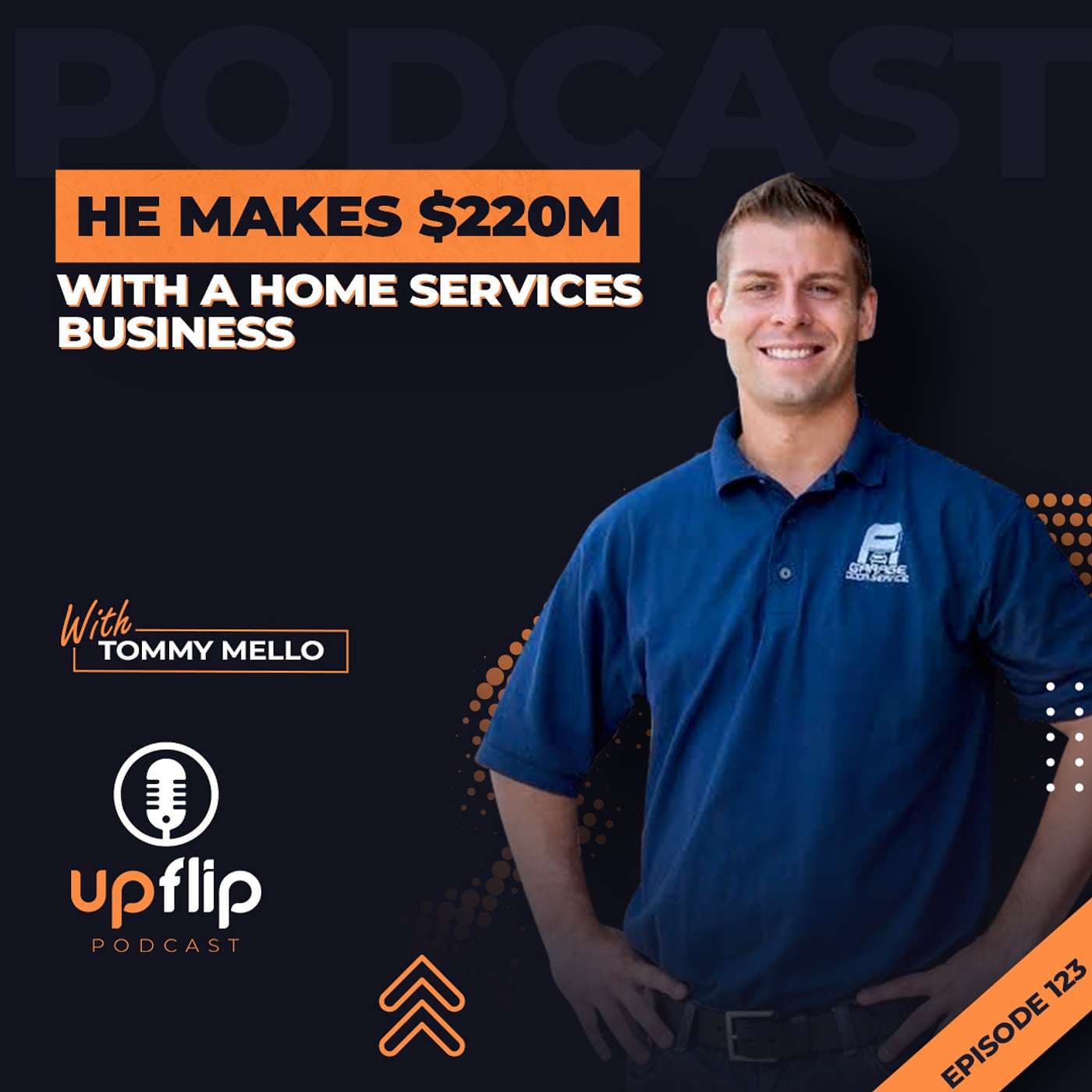
Episode Overview Podcast Title: The UpFlip Podcast Episode Title: 123. $220M from Home Services. THIS Is How I Did It.
Guest
Tommy Mello, CEO and Founder of A1 Garage Episode Description: Tommy Mello shares his journey from a college side gig to leading A1 Garage, a national powerhouse in the home services industry with a valuation of $220 million.
Key Takeaways
- Systems and Processes: Establish the right systems early and pivot quickly.
- Company Culture: Actively build your company culture; if left unchecked, it will form on its own.
- AI Implications: AI is more likely to impact creative jobs rather than roles in home services.
Guest Background
- Early Experience: Tommy started his entrepreneurial journey in college, engaging in various side gigs such as painting garage doors.
- Growth of A1 Garage: What began as a small operation has evolved into a company with 700 employees across 22 states and a worth of $220 million.
Business Development Insights
Initial Steps
- Starting from Scratch: Tommy's early days involved learning on the job, making numerous mistakes while trying to establish A1 Garage.
- Mentorship and Learning: Key mentors influenced his understanding of business systems, including reading foundational business books like *The E-Myth Revisited*.
Scaling the Business
- Growth Strategy: Tommy emphasizes the importance of having the right systems in place from the beginning to avoid complex pivots later.
- Equity for Employees: He introduced equity plans for his employees, fostering a sense of ownership and motivation among his team.
Marketing Strategies
- Google Optimization: Tommy focuses on mastering Google algorithms for marketing rather than relying on traditional methods like Yellow Pages.
- Data-Driven Decisions: He tracks key performance indicators (KPIs) meticulously to understand booking rates and conversion metrics.
Entrepreneurial Mindset
- Delayed Gratification: Tommy stresses the importance of working hard and building equity over time.
- Focus and Discipline: Staying focused on core business goals and resisting distractions is crucial for success.
Advice for Aspiring Entrepreneurs
- Market Ownership: Emphasize owning your local market before considering expansion.
- Networking and Relationships: Building strong relationships and maintaining a robust personal brand are essential for long-term success.
Call to Action Tommy invites aspiring entrepreneurs to visit his company and learn from his operational strategies. He emphasizes the importance of mentorship and sharing knowledge in the entrepreneurial community.
Resources Mentioned
- Books:
- *The E-Myth Revisited* by Michael Gerber
- *The Ultimate Sales Machine* by Chet Holmes
- *Rocket Fuel* by Gino Wickman and Mark Winters
- *The One Thing* by Gary Keller
- Websites:
- [A1 Garage](https://a1garage.com/)
- [UpFlip Academy](https://bit.ly/4hndyBM)
Conclusion Tommy Mello's story highlights the blend of hard work, strategic planning, and a commitment to employee welfare that has led to spectacular growth in the competitive home services industry. Through his insights, listeners can gain valuable lessons applicable to their entrepreneurial journeys.
Written by AI. May contain mistakes. Listen to the episode to check what was said.
Transcript
Automatic transcript. May contain errors.0:09Hey, Upflippers, we have a great show for you today. how they run behind the scenes and how you can replicate their success. And today we have a special guest in Tommy Mello on the show. He's the CEO and founder of A1 Garage, which is worth more than$220 million. They're in 22 states, have over 700 employees, and he's been named a top entrepreneur in Arizona under the age of 35. Tommy, welcome to the show. I'm super, super excited to have you on. Glad to be here. Let's rock this thing. You are bringing great energy and I always appreciate that. So this is going to be a great episode. But we're going to start in college.
0:41Let's go back to Tommy in college at the University of Arizona, and you get involved with painting and then fixing garage doors. How did you say, like, hey, I'm actually going to paint garage doors as like a college gig? Yeah, that's a great question. So I'm from Michigan. Originally, mom and dad got a divorce when I was seven. So only thing I knew how to do back then at that age was shovel, snow and mow lawns. So I've always been a hard worker. And I lived in this house and the rent was$700. Me and my other roommate paid$200 each, and the other guy paid$300 for the master. And Sean was, like, managing this garage door company.
1:15He goes, dude, I can't find a good painter. And I was like, garage doors break? I just kind of always made fun of him. And then he's like, listen, Tommy, you're a hustler, man. You work your butt off. I was bartending. I was flipping bow flexes. I was flipping cars. You name it, I was doing it. I sold shoes for women at Dillard's. I just always was doing jobs, working double shifts, whatever I had to do to, like, make a lot of money. The harder I worked, the more I made. But I didn't have a real business. But he's like, listen, would you consider painting garage doors if I got you$100 a door? You got to cover the paint.
1:43And I'm like, how many can you do a day? He's like, yeah, two or three. So I hired a painter to teach me this old man. He was a pro painter, had all those machines. So he taught me how to feather on the paint after three tries. I went to Home Depot, bought a Magnum 5, bought Speed Coat, which is a glitted. It was$12 a gallon. And I got to the point where I could paint 10 doors a day. So after it cost, I was making$8.50 a day. I drove a G20 Infinity, 96 G20 Infinity, put everything in the back so it was good on gas. I had a whole process. I do it Saturdays and Sundays, make about$1 ,700 profit.
2:14I was meeting up with these technicians. This is 2006 and 2005 and 2006. These guys were making like 80, 90 grand. This is before the housing crisis, right? This is when it was like the peak market in Phoenix and Vegas and everywhere. And so me and my other roommate decided to start a business. And we realized really quickly that it wasn't as easy as it looked. Got into the yellow book because it was like the last year they were actually meant something. And it was tough, man. We made every mistake you could think of. But now, you know, the business is actually worth$1.4 billion today. We're going to do north of$260 million in revenue.
2:48Wow. And really what it is is we're at 24 % profit. And when you look at that number, there's a multiple of that. It's called EBITDA. And so we're going to ride this thing up over$2 billion. And I always tell people in my playbook because they're like, oh, I'm going to get in the garage drawers. Then they do. There's no company that I think could outperform what we're doing. We're a technology company that happens to do garage doors. I mean, we're playing in a different league. We're like five moves ahead in chess, and these guys are just trying to get on the checkers board. I love that. Well, I want to add context, layer context onto this as well.
3:16How old were you when you started this business? Because obviously, first business, people are going to make a crap ton of mistakes. They don't even know what they don't know type of thing. But how old were you when you started this business and started to scale it? I formed the LLC when I was 23. I'm 41. It's almost two decades ago. And so you're making a ton of mistakes at the beginning here, but you are developing this playbook to actually scale it. And let's talk about that playbook. What have been like the two or three most important things within that playbook to like really grow A1? What we did was in 2008, I met this guy.
3:46I was his friend, but he was a CPA named Aaron. And he goes, he only worked with 10 clients. He was like, he fired all of his clients and only worked with like these massive, massive, massive, you know, multi, multi, multi millionaires, very wealthy, affluent clients. And I met him and he goes, why don't you come into my office? He goes, you know, I probably wouldn't even take you out as a client, but for some reason, I like you. Like, I feel like you got a lot of potential. Like, I see something in you that I don't see in a lot of people. And I think you're going straight to the top. Like, I really believe you'll be on a rocket ship.
4:13And so he handed me this book. He said, this is called The E-Myth Revisited. He goes, what's the last book you read? I was like, maybe To Kill a Mockingbird or Lord of the Flies. I don't know. It was an article. And so he handed me the book. I devoured this book. I like, I gave it back. I bought it for myself, too. It's like the Bible of home service or just business in general. Running like a franchise model. Michael Gerber, he was amazed. So he said, this is our red Bible. This is called The Ultimate Sales Machine by Chet Holmes. Read that overnight. Then I read The Richest Man in Babylon, and he got me reading every week, every day.
4:43That was the beginning. 2014, read a book called Rocket Fuel. Gino Wickman and Mark Winters. Figured out I needed an integrator. Hired Adam. My mom and stepdad work for me. Amazing people. This is 2010. They moved out to help the business. I separated from my partner, got a master's degree. 2014, got the right hand, the integrator, Adam Cronenberg. Went through five CRMs, finally pleaded to get with service type. They would not let any other industry on. I got ahold of the CEO, the founder, and Ara said, I'm going to take a chance on you like everybody else seems to take a chance on me. Like, I don't know why, but they take a chance.
5:15They take a calculated risk. And I told Ara, you bet on me, I'll have more technicians than all the other garage door companies combined. Give me a chance. And he believed me. He sent out 10 success managers, got on a service title. Then I started my podcast, The Home Service Expert. This guy named Al Levy came on, the seven-pound contractor. I got the book. And Al Levy, I was 17 million when he found me. And he said, there's no systems, there's no manuals, there's no standard operating procedures. You're running this business kind of blind. You're not making a lot of profit. He's like, let me help you.
5:44So we built the manuals, the standard operating procedures, the checklist. We put systems in place. And I stopped being a firefighter. and he comes to me one day, he gives me this black and white piece of paper. He goes, I took a picture of your truck. He goes, it's black and white. Tell me what you even do from this picture. It doesn't scream what you do. And I said, you're right. It's not very good, is it? And I had a lot of pride. And so I got to 40 million and I went to this guy, Dan Antonelli. He wrote a book, Branded Not Blanded. And I redid my logos and my website and made everything match.
6:13And my ticket average went through the roof. I was 40 million and I decided to rebrand. And people lined up to work for me. clients started knowing that I'm the best value, not the lowest price. Everything changed after I rebranded with KickCharge. And since then, I'm on Power BI. I'm using Rillo Voice. I'm using Chirp, all these technologies, this AI, this machine learning. Like I said, now I care so much more about the people that I work with because if I focus on them, I wrote the book Elevate, build a business that everybody wins. I feel like if I put them first and I focus on their dreams, my dreams come true as well.
6:47That's what I think with Spacebar Visuals as well, like my own agency is like you win if your people win. It's not like the other way around of like, I need to win first and then everyone else wins. It's like, no, my employees win and ultimately like our business wins. So I feel like it's putting their needs in front of like your needs almost to make sure like they're set up for success in the most ways. And I feel like a lot of synergy is there with like what you've done and like how you lead. There's this old story, you probably heard it. This guy shows up, he's got a pool company. His guys are putting in this pool and he pulls up with this brand new Ferrari and they go, man, that's a beautiful car, man.
7:18I wish I could have a Ferrari like that. He goes, listen, you work hard every day. You show up. You just put all in. You work when I need you to work. You pick up a weekend shift. You do everything I need you to do in one year. I'll have a new one. And that's what most owners think, man. You work hard for me. I'll get you to live great, but you're going to stay in the projects. You're going to be on section eight. You know, you're going to be struggling. I created a path for true wealth in this business. I got 25 technicians that are like my boys, my brothers that have equity in the company. And there's a chance for everybody to get equity in this business.
7:51Yeah. I'm curious. So when did you start doing that equity in place? Was this from like zero to 1 million? Was it after 25 million? Or like, when did you start to identify, like, if I'm going to scale this thing to the next level, like my employees need to have ownership in this as well. So everybody that I've ever met does equity after they do their first deal, when they get a sponsor, when they get a PE company, when they do a strategic partnership, it's easy to take this profit and say, I want to give you money. So you stay on, right? I did it pre-doing a deal. So I did it when I was 12 million of EBITDA, ran up past 27 million after I gave back.
8:22I wanted everybody rolling in the same direction. I wanted to have a stake in the outcome. I wanted the sprinting of my goals. And that's one mechanism to do it, but it's difficult. Like you need a great lawyer and I've got a plan through home service freedom that it's a 10th of what I paid, but it's expensive. And the way that it works is there's this threshold. Like let's say your company's worth 10 million today. The equity incentive program, if I gave you 1%, let's just say I gave you 1%, you're my CFO. And the business goes to 100 million. You'd make money on that 90 because the 10 automatically, like for tax reasons, belongs to like me.
8:53And then now you got to stake in the growth. So 1 % would be of$90 million is, you know,$900 ,000 if it got to 100 million. And I gave away over 20 % of the business to 25 people. And lots and lots of millionaires came out of the first deal. I should have 100 millionaires come out of the next deal. Dude, that has to be so rewarding as a business owner, as an entrepreneur to make so many millionaires, essentially. Some people are just like, I'm happy to pay people's paychecks, but to make someone actually a millionaire, I think is super interesting. And I want to hone a little bit more on how you scaled your business at each stage.
9:26So could you elaborate on some of the key marketing strategies that helped you guys become a national leader? Because some people listening are like, holy heck, I want to do this. How do I do this? But how should I market this? So can you talk about some of those key strategies that helped you scale at high level at like each stage, essentially? Yeah, well, I became infatuated with Google. Right after the yellow book failed, I learned there's four algorithms on Google now, pay per click, local service ads, the local GMB, Google My Business page or GBP. And then there's organic search. I'm obsessed with every single one of those things.
9:58I'm obsessed with review, user generated content. I'm obsessed with reputation management. I'm obsessed with figuring out the algorithm and feeding it what it needs. I've got this company my buddy started called PinParrot, PinParrot.com. And I started to work with him six weeks ago. And he pulls out of my CRM and posts this content automatically from service site and onto my page. And I've doubled the phone calls. Like I've doubled the calls from my GMBs. If you look at the pins of my rankings, it's spreading out. It's all green in the number one spot. Like these are the things. I'm the early adopter.
10:29I test things at A-B test. But Google's where you go for demand. You don't go to Facebook when your toilet doesn't work. You go Google plumbing, repair, whatever, your city. So I became obsessed with marketing. I'm a marketer. That's my number one thing. I'm a marketer, number one. Number two, I love sales. And then right equal to sales, I'm a leader. I'm a culture. I'm the glue. Like I'm the good cop in this company. And I've got the vision. And people are following that. So I think I A-B test. People say they tried Valpac. And they say it didn't work. But I went all in for years and figured out how to make it work.
10:59And like A-B tested hundreds of variations of different offers. And I still do that on a monthly basis. TV, radio, billboards. Once Google's doing its job and all four algorithms at the top, then you do TV, radio, billboards for brand awareness. And what happens from there is you get a higher click-through rate. You get more people searching your name. You get people. It's just this omni approach to being kind of everywhere. But a lot of people, what they do is they spray and pray. They're like, try this. We'll try that. And they get so much of this ego. Oh, yeah, people are talking about me on the radio.
11:29But nobody remembers who you are. You did it for two months. You didn't go all in. And they kind of sprinkle stuff around and they never really get focused. They don't have the KPIs. They need these four KPIs to win. What's your booking rate in the call center? What's your conversion rate? When I knock on your door, how many of those are you converting to sole jobs? What's your opportunity job average? And what is your cost per click, your cost per acquisition? You got those four KPIs. This is how I buy companies. This is how I build my budget. This is how I can fix any company on the planet with those four KPIs.
11:57And my numbers are down to a science. Like I know my booking rate down to the decimal. I know my conversion rate. We just did our meeting with Cortec, who's our sponsor, 99 pages of data looking at what's our turnover rate per market. How many guys can we hire? What's our capacity planning? How's every single source of our marketing working? In my call center, what's my booking rate? What's my average time to book? It was five minutes and 47 seconds. That's my booking to average time on the phone, like the data. I took advanced calculus. It's not crazy. I used to carry a TI-83 in my back pocket.
12:26Like it's all a formula. It tells me where to be working today. And a lot of people are like, as long as there's money in the account, I guess I'm doing good. I'm like, I'm a data guy. That's interesting. I feel like what I'm hearing from there is like, know your metrics, know those four KPIs and like live and die by those KPIs and always looking to improve them. When it comes to like the conversion rates, one, I'm curious, like, what are the numbers that you're looking for? People are like, yes, like those are the numbers I will live by. If Tommy's living by them, what are like good numbers for you?
12:53So on service, if I'm going to ring the doorbell, which I never do, I always say friends knock the door, strangers ring the doorbell. But on a service call, I'm getting more than 90%. We only consider over$100 a conversion. We put our conversion rate as over$100 because a service call is 39. So I'm looking for a 90%. We're at 94.3 % right now. I don't even want to walk away from that other 5%, but not everybody's our client. Not everybody's like make a deal, Charlie. So like we're marketing more to the affluent, the people that actually want to fix it the right way. They're not looking for a Band-Aid.
13:24And then in sales, for door sales, we're looking for 60 % plus. That's new sales, new equipment. And I always tell people, when you get far above 60%, raise your prices because you can't service everybody. So that's what we're attempting. We've got a whole eight-step process to make the customer satisfied, but it works every time to convert the client. And it ends up helping the client out and helping us. And we've got five green lights to convert service to sales. and we're at 73 % conversion on service to sales when we do transfer it to our product specialist. If it's a better opportunity for the customer to replace their door, we bring it up because there's some really beat up 15 year old doors that are falling apart.
14:00It's not worth fixing it. We love partnering with other podcasts and we have a great one for you. Are you in the home services industry and looking to elevate your sales game? Then you need to check out the Waste No Day podcast. This powerhouse podcast is specifically designed for professionals like you aiming to boost their sales. Each episode is packed with actual tips, industry insights, and sales training techniques from the top salespeople and trainers in the world that are easy to understand and implement. From mastering the art of the upsell to navigating customer objections and everything in between, Waste No Day has you covered.
14:31Tune in now to transform your approach into sales, exceed your goals, and take your business to the next level. Subscribe to Waste No Day today, wherever you get your podcasts, or use the link in our show notes and start turning those cold estimates into huge jobs. Let's talk a little bit more about like a small business owners looking to expand. What like key advice would you give to them that are wanting to expand like their operations geographically? Because you're in over 22 states, like you have done this successfully many times. You advise people, you've consulted people. How would you advise people to expand that are looking to expand?
15:01Well, everybody's like, I want to be like you, Tommy. And I'm like, well, I lived in an apartment for five years. I own the apartment complex. I drove a used salvage title Titan with 180 ,000 miles on it. I decided everyone will have a new truck before I get one. You know, it takes delayed gratification. I just want to tell people this isn't like you start a business. You're going to spend five years just to sweat equity. Like, it's not easy. Your chances of failure are over 90%. Your chances of getting over a million dollars are slim to none. So it's not for the faint at heart. But what I can tell you is as far as when you're trying to expand, own your own market.
15:33Own where you go to church. Own where you have friends. A lot of people, they don't have any market share and they decide to expand. If I could go back in time, I would have said when people say garage doors or if you do hot water heaters, like your name is like that's the hot water heater. That's the plumbing company, right? Like don't be small before you expand. Own the market. Figure out how to take lots of market share from where you live because it's harder when you're two hours away. That's the next advice. Pick your next market that's big, that's close, that you could drive to if something goes wrong.
16:01So I did Phoenix. Then I did Tucson. Then I did Milwaukee because I spent a lot of time there with my sister. She's six years older. So I'm like, I spent a lot of time in Phoenix. where's the next time I spent time with my niece and nephews is in Milwaukee. So I was flying out there all the time. It just made sense. But if I go back in time, I would have said own the market, be big, be the number one player in that market before you expand. So how did you identify like markets you want to go to? I know you just said like two hours away in Milwaukee as well. You had family there. You're spending time there.
16:28But was there actually, you're a data guy. Like what numbers were you looking at? Well, before it used to be, I wear a blindfold, go to a map and do pin the tail on the donkey. Now I'm like very, very analytical. I look at how many new home bills, what's the average credit score, what are the competitive analysis, what can I do on Google. We pull in 20 data streams to kind of identify like we're not going to a market unless we can get to 3 million of EBITDA. And we look at the competitive analysis and quite frankly, if there is competition there, it's better for us because we kick the competition's ass.
16:55There's a lot of private equity guys getting in, these white collar guys, these Ivy Leaguers. They do not know what they're doing when it comes to blue collar. They're great at numbers. They understand the right decisions to make, but they have no heart. They have no EQ. They have no passion. They don't know how to talk to somebody that didn't have a mother growing up or to have a father growing up. They don't know how to talk to somebody that never knew how to build a budget. So they kind of think that it just doesn't stink. And I don't believe that. Like, I know I am a blue collar guy. I was the guy fixing the garages for eight years.
17:21So that's the missing piece that everybody doesn't understand if they're super smart. Their just personalities suck. They care about themselves only. They're just trying to win. They're trying to get ahead in the rat race. They got to look out for other people. And that's why the smart guys getting into this, they don't stand a chance. and the blue collar guys, they got to learn some of these white collar ways of like using numbers, using data, looking at financials and you got to kind of mesh them both. I'm like a hybrid of both. Yeah, I feel like you have to like walk that line of being blue collar because this is like a blue collar business at the core of it.
17:49But like you also are using data like everywhere and like using technology where that leans a little bit more like white collar. So I think it's super important for any entrepreneur that's wanting to get started. Like you have to one, have EQ as what you talked about, but be able to walk on both sides of the line and be able to see both of those sides. It's going to be tough. Listen, if you guys think I'm going to do garage doors, we're on an island. There's HVAC companies. There's about 25 HVAC companies that are doing well over$100 million. The garage door companies that are doing great, they do commercial.
18:14Other than that, there's nobody doing what we're doing because it's a small average ticket. You've got to understand, we're taking 20 ,000 calls a month, running 16 ,000 opportunities. 16 ,000 a month. You get to the point where you could run. It's not easy to rebuild. If I could go back in time, I would have said, what has the biggest average ticket? Like flooring, HVAC, plumbing, electrical, roofing, solar. I want windows. I want to go after things with a massive average ticket because there's 500 competitors to the grocery store. It's like people are like, oh yeah, you don't know my industry.
18:41It's more competitive. I'm like, yeah, BS. It's all competitive. It's all tough. Money will find a way. Like Google pay-per-click. You know what to search because you know where people are spending money. Money kind of shows you where the money's going. If you see an ad in the Yellow Book and it's a big company, that ad's working. They have attribution. Success leaves clued. You see the number one guy on Angie's list? That dude's making money off of Angie's list. You see a guy posting a thousand ads a day on Craigslist, that guy figured out a way to make money off Craigslist. It all works. It just depends on your playbook.
19:09I feel like a lot of times what we do here at Spacebar Visuals is like we look at like what are our competitors doing? Because like we're in video production, like we're not the first mover in this industry by any means. But when we look at our competitors to see like what they're doing, we get a good idea of like, oh, like maybe they have done this successfully and we should consider doing this as well. So I feel like it's super important to like kind of evaluate like what the competitive landscape looks like. Like where are people spending money on Angie's List, Craig List and find ways to make it work for you as well?
19:35Well, the first thing I did, because I'm blowing up my social media too, I'm going to add millions and millions of followers. So I said, who's killing it? Gary Vaynerchuk's Alex Srimozy and Dan Martell. Dan Martell, you know, joined his group, paid him a lot of money. I'm one of six in this highest platform. He said, you got access to anything I need. So we're flying out there. We're building a whole content strategy. You know, Alex Srimozy just came out and said, I spent$3 million on my social team. $3 million. But the deal is, like, I've scattered all this out. Like, I've got the whole playbook.
Read the full transcript
20:03And yes, we're going to have 20 people just working on our content. 20. Wow. There's going to be two people just for YouTube, one for LinkedIn, one for X, which is Twitter, one for TikTok, one for Instagram. And then we're going to have two just doing outreach on social. Then we're going to have one just for the podcast and one for our Facebook group. And then you've got the content strategy. And you've got the production team. Like, right now, I've got five cameras pointed at me. I'm going all in. I don't go anything like, oh, yeah, let's just see what happens. Let's just test it. I'm like, dude, we're going to fail a little bit, but we're working with the guy that trained Mr.
20:32Beast. I mean, I'm going straight to the top because I'm not afraid to pay to get results. Like so many people are like, yeah, one day, one day. Today's day one. I'm the first guy to ask for help. I'm the first guy to pay up. I don't want discounts. I want value. I want to be better than you. I want you to train me so good. And I told Dan, I'm like, you might not want to train me this because I'm going to pass your ass up. And he's like, you're one of the only guys that I believe could do it. But he goes, you know, bring it on. He likes to challenge. So I've got great people around me. I pay up for great advice because it's so valuable.
21:01The difference between millionaires and billionaires, millionaires get up early. They take cold baths. They're in the sauna. They eat perfectly. They take in the right vitamins. You know, they're praying every day. They're good dads and moms. Billionaires, they're a little bit lazier. They just call the right person and they know they got the best Rolodex. They're like, this is the guy we need. They don't go, we're going to outwork you. They say we're going to outdelegate you. We're the best networkers. We pay for access. And that's the difference. Humbly, I'll say this, but I'll be a billionaire within two years.
21:27And guess what? I'll be way under 45. I'm ready to go. But how many lives can I change? The difference is, is like, I'm not going to go buy my own island. I'm going to change a lot of lives. And I'm in the blue collar industry. And guess what? AI is not replacing the guy changing out your furnace in the middle of the night. AI is taking out guys like you, videographers, no offense. AI is taking out things like lawyers. AI is taking out things. If I shot a sitcom today, AI could finish the whole series with after I shoot the first one. They're coming after everybody that's creative. AI is taking that down first.
21:53So like my stuff, there's going to be a lot more people in the trades because AI is not coming after us anytime soon. There's no robot going to walk into your house and fix stuff. I like that. And as we kind of wind down here, I want to ask, I think something that has been a big takeaway for me is your mindset. I feel like you are like a very confident person. You're like very, very sure of like what you want to do. And like, obviously you have the results to prove it. You've done this before type of thing. Talk to me about like your mindset, though, when it comes to like entrepreneurship and how you lead.
22:20I think it is super interesting. I think people need to develop this mindset. it's a muscle that needs to be built. So can you talk to us about that muscle that has been built for you with your mindset with entrepreneurship? Yeah. Well, the first thing is I focus on what I'm great at. I built an org charter originally and I found out things that I hated. I hated payroll. I hated being a CFO. I hated, you know, I think a lot of people right now are doing minimum wage jobs. I haven't looked at my email in years. I have somebody that handles that. I'm not doing minimum wage jobs anymore. I'm not doing$25 jobs.
22:47I'm not doing$100 jobs. I know how much I make per hour. The only reason I'm here is to lead and show up and like be a good guy, a great visionary. Like I'm here at work. Like I got my training center right across. Like I'm present. So I think it's important that I paint the vision. I'm the glue. I'm the guy that I lead from the front and I eat last. Right. So that's the first thing. The next thing is there's a great book by Gary Keller called The One Thing. I've got so focused on garage doors. Every once in a while, I'd kind of go out of my lane and I'd be like, I'm going to flip houses. I'm going to invest in a bar.
23:18I'm going to do this. And it's like, you got to shut everything out. You got to be so consistent and have discipline and delayed gratification. Stay on that road. Ignore everything else. Because people start making money from this one thing and then they pull it out and divest when putting it back in is how you compound it. And then once you have this money and it's hundreds of millions of dollars that grow into this tree or even$5 million, now you've got enough money to put it into other things and hire the right people and build. But these ideas that get you sidetracked, if you lose your focus, you lose everything, unless you can put people in charge of those things.
23:50So I became a really good delegator. I mean, I really believe if you're going to get into home service, you got to read the seven power contractor. And then the other thing is buy back your time by Dan Martel. I've got a full-time driver started. The full-time chef started. I've got two housekeepers and I'm not bragging about what I have. I just realized my time is more important than this stuff. Like I should not be mowing the lawn unless it's my favorite thing to do. I love walking my dogs, but I still have dog walkers. I walk them like the second walk. The thing for me is if you love doing something, do it.
24:16If you don't hire somebody else and do what you should be focused on, where do I make the best ROI? In my garage door company. Podcasting is fun for me. Like I get a lot out of this. Like it's fun. It's like my adventurous, my creative. I do this for me, but like A1 is my core. I'm the CEO of this company. And it's like, this is my story. It's A1, it's my family. And so many people, they just divest their time. They're not focused. They don't delegate well. They do things they shouldn't be doing that don't really bring an ROI. And it's unfortunate because it's not only about money, but you got to fiduciary responsibility to yourself to make as much profit as possible.
24:49You know, money is not the root of all evil. The love of money is the root of all evil. And as long as you're using money to grow your community and giving back to your people and helping your family accomplish dreams, then it's not a bad thing. But some people praise it and that's when it becomes evil. I love that. This has been really, really insightful. I love this conversation, but we're going to go to our last segment here of our fan blitz questions, which actually comes from our community. We have some really good questions here. I'm excited for you to get into these. So we have five. We'll start with the first one here.
25:15How do you know what systems to set up when going from 330K to 1 million? Yeah. So what you want to do is there's a whole team of technology people. You got to understand what are your goals? What's your vision? When do you want to sell? What does the business look like in 10 years? I mean, you got to understand the path where you're going and then reverse engineer what software you want to use. I think a lot of people are like, I'm not big enough for that yet. And I always fake it till I make it. Like, I'm not going to have to want to pivot softwares when I grow. It's harder to change as you grow.
25:43So you want to go on the right systems early on. And just even if you're too small, like figure out a way to get on it so you don't have to rebuild everything. Because people are like, yeah, once I get bigger, I'll figure that out. But really pretend that you're big. Walk in a room like you're the biggest deal. Walk in a room like you're a billionaire already. Pretend, like manifest this stuff. Don't start with these, yeah, one day I'll get on that. Man, it's hard to change once you grow. It's very easy to make these changes when the business is at its infancy stages. That's really good advice.
26:08If you were to start again in 2024, what would you do differently? I would have focused on the largest average ticket. I would start like the day one and make sure I have enough money. First of all, like a lot of people start with and granted the bank. Like when you're going to start a business, make sure you have great credit. Make sure you form your LLC, start to develop, go in there on purpose, start to develop your Don's and Bradstreet business credit and get branded correctly. Like I had no idea how much the brand mattered and the brand story and Donald Miller wrote the brand story. Having the right brand by Dan Antonelli with Kick Charge and having the right brand story and doing things intentional and not just kind of fly by night, not reading a book and saying, I'm going to go start an LLC and I'm just going to figure it out as I go.
26:50It's by design. You know, to get to a billion dollars, I needed 2 ,000 technicians. Now I only need 1 ,000 technicians doing a million dollars. So I've just reverse engineered what needs to happen each month for me to get there by 2026. It's mathematical. It's uncertainty. It's math. So I think going in intentional is a big deal too. And there's one thing nobody could ever take away from me. Google could change their algorithm. Angie's list could change. Craigslist, you know, Valpac could go out of business. No one's going to take away my relationships. I'm a networker. I shake a lot of hands.
27:18I smile at all the time. I'm talking on stages. My personal brand is part of it. If I could start today, it would be focused on my personal brand just as much as the business and network. Build a Rolodex. Know who to call for what when and pay up for it. Don't be cheap. Especially when you have friends that have skills that you don't, I always like will pay like a surplus for them just to keep that relationship and know that they're valued. Number three, I'm interested in because I was going to ask this earlier, but I knew this was a fan question. How do you avoid shiny object syndrome and just focus on garage doors?
27:44Yeah. So as an entrepreneur, we like to say yes a lot. We like to say, of course, we can handle that. If we put our minds to it, we can get it done. So a guy taught me this years ago is say we can still say yes, but say not now. I'm too busy focused on the one thing. So it's hard for us to say no. Like Gino Wickman would tell you, you just say no to everything. And he's kind of an introvert. He's a high C personality. I tend to just say, you know, that's a great idea. I'll put that on the docket. Like what Al Levy taught me is you got your top hundred list, you build that in the top 30, and then you go after your top five, their impact areas, what's going to impact and get the best results for the company to make the most amount of return culture.
28:18It's hard to put a dollar figure on culture, but that should be at the top of the list to make sure. Cause if you do not build your culture, it'll build itself and the culture is everything. But yeah, I would say you got to stay extra focused, man. You got to keep your head down. You got to keep reminding yourself what the plan is. And you got to have a written down plan. It's got to be written down. Like Harvard did a study. You're 12 times more likely to hit your goals when they're written down. We've always heard that when you really practice it. And you say, is this helping me to help the main goals that I'm driving?
28:43And it's so easy to get distracted, man. We all have ADHD when we're entrepreneurs. We all are these visionaries that think we can do everything. Keep your head down. Racehorses wear blinders for a reason. When you go to the Kentucky Derby, they're wearing blinders. They're the elite thoroughbreds, right? They wear blinders to focus on winning. Wear your blinders and focus on the plan you wrote down. If you could work on a celebrity's home, who would it be? I would go to Elon Musk because like there's nobody else to even talk to. I don't even care about anybody else. Like that's the one guy. He'll be the trillionaire of our time.
29:13What he's doing for humanity, the way his brain works in space and the stuff that I love, like I love what that guy represents. I know a lot of people don't right now and that's OK, but when anybody asks that, I'm like, not Jeff Bezos, not, you know, whoever it might be, not Warren Buffett. I'm going after that guy. And there will be a day I'm not ready for him yet. And a lot of people aren't ready for me because, like, if I meet him, he'll probably confuse the crap out of me. Like, dude, I can't get to his level just yet. Give me a few years. I'll have the right team around me to kind of scale like he did.
29:41And that's the only thing is, like, if I want to play golf, I'm focused on Tiger Woods. If I'm playing basketball, I'm looking, I'm studying Jordan. I'm not going after, like, oh, just how do you move up a little bit? Yeah. I want legacy. I love that. That is great advice. But then last one for you, if you could change one thing about your business, what would it be? Change one thing about the business. Two things. I think one thing I would do is in the industry, I would make a lot more regulations. You have to be licensed. I would say it can't just be some Fallon that comes home from another country that barely speaks English that's just chucking a truck.
30:13I want safe people in our industry doing the right things. And that's our industry. But for me, what I would tell you is I think we've gotten a little bit siloed and the technology, like one person is using Microsoft, the other person's using Google, one person's using Zoom, the other person's using Loom and like the technology, like go in and you got to trade on SOPs on the technology stack you want. There's a great book called Come Up for Air. And as companies grow, they get super siloed. Five Dispatch of a Team is another great book. And just making sure you're teaching out a technology stack because one person's using Asana, one person uses Monday, one person uses Trello.
30:48And all of a sudden you got a lot of issues because the left hand's not talking to the right and it happens all the time. And so go into that with a plan because otherwise you're going to be paying for a lot of subscriptions and the team's not talking at the top together. And I want to thank you, Tommy, so much for your time today. Ton of good insights here. So yeah, thank you so, so much for being here today. Last thing I'll say, this is the very last thing. P.S. A lot of people want to know how I got ahead in life. Like, how did I grow this business so quickly once I figured things out? And the fact is I traveled to every hundred million dollar shop and it was all HVAC.
31:18I said, who's got the most private jets? What industry? I figured out it was HVAC plumbing. So I called up these people. I offered them dinner. I told them I'm just a humble little garage door guy. I read their books. I came in with my, you know, just really quiet with a notebook. And they said, Hey dude, we like you. We're going to help you out. And I traveled one, two, five, 10, 15, dozens and dozens of shops. And what I figured out is I kind of owe everything to that. So people are like, how do I get to come see your shop? I don't charge anything. I don't sell you anything. I'm paying it forward.
31:47If you want to come see how A1 works, how we've scaled, how we train our vision, our mission, our core values, and how it's all put together, you'll walk away with so much knowledge. I'm just here to help impact your life and your business. I'm here to make sure that you can show up for your kids. You just go to tommymello.com forward slash shop, and you can book a free tour. You can bring whoever you want. And all my social media channels are on Tommy Mello. No W, Tommy Mello, M-E-L-L-O.com. And I had a pleasure. I really appreciate being out here today. This was fun. If you've enjoyed this episode, be sure to check out episode 119 with expert entrepreneur Terry Rice, where he explains how to escape corporate burnout and be your own boss.
32:26That link is in the show notes below. You're the best, Tommy. Thank you so, so much. Everyone, please go check that out. Tommy's the man. Thank you so much.
From the publisher
Tommy Mello is a legend in the home services industry. What started as a simple side gig grew into A-1 Garage – a national leader with 700 employees in 22 states. And his company is now worth a whopping $220M!
Key Takeaways:
- Get on the right systems early on. Don’t wait to pivot.
- If you don’t build your company culture, it will build itself.
- AI isn’t coming for the home services industry. It’s coming for the creative jobs.
Resources:
- Join UpFlip Academy: https://bit.ly/4hndyBM
- Episode 119: https://www.upflip.com/podcast
- Profitable Businesses to Start in 2024: https://www.upflip.com/blog/most-profitable-businesses
- Connect with Tommy: https://a1garage.com/
- Waste No Day Podcast: https://podcasts.apple.com/us/podcast/waste-no-day-a-plumbing-hvac-and/id1543265737
Ready to be your own boss without starting from scratch? Grab our FREE Franchise Guide and unlock the secrets of proven business models that have already created thousands of success stories.
Connect with UpFlip:
- On Youtube
- On Instagram
- On Facebook
- @UpFlipOfficial on Twitter
For more insights to start, build, or grow a business, check out the resources on UpFlip.com or head to the UpFlip YouTube channel to see more interviews with business owners and experts.
Thanks for listening!


