
In short
UpFlip Podcast Episode Summary
Episode Details
- Podcast Title: The UpFlip Podcast
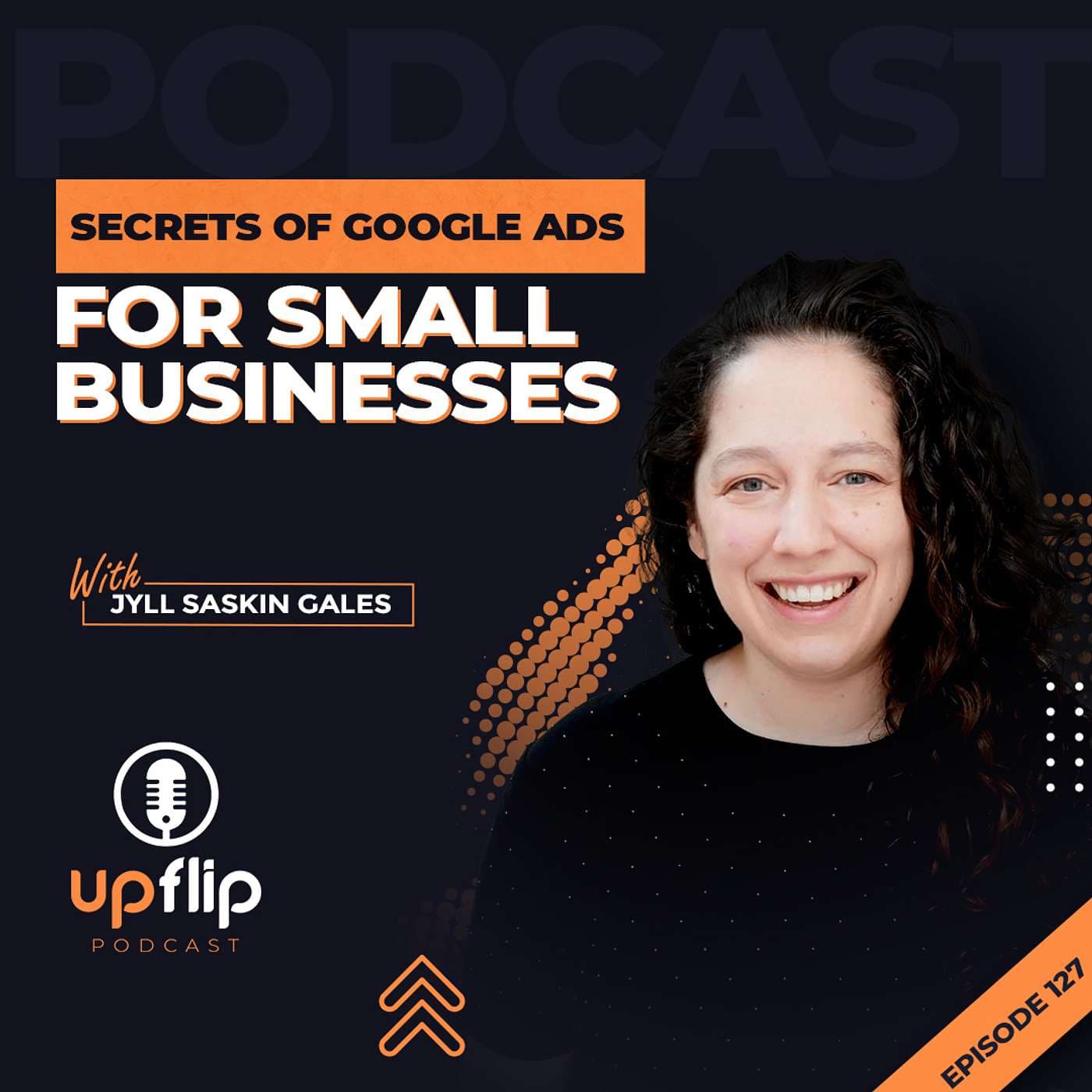
- Episode Title: 127. Make Massive Profits with Google Ads: From an Ex-Google Employee
- Guest: Jyll Saskin Gales, Google Ads expert
- Description: Jyll shares her journey into digital marketing, her focus on Google Ads, her experience transitioning from a Google employee to running her own business, and practical tips for successful Google Ads campaigns.
Key Concepts and Discussions
Introduction to Google Ads
- Jyll's Background:
- Started learning Google Ads in 2014 while working on a side hustle in MBA admissions consulting.
- Joined Google and honed her skills over six years, gaining deep insights into the digital marketing industry.
Transition to Entrepreneurship
- Jyll maintained her side hustle while at Google, eventually leaving to focus on her business after an unsuccessful job opportunity.
- She leveraged her Google Ads expertise to attract clients, initially gaining her first client through TikTok.
Tips for Successful Google Ads Campaigns
- Targeting Competitors’ Traffic:
- Focus on effective methods while being mindful of policy restrictions.
- Craft compelling ad copy with a clear call to action and social proof.
- Getting Started with Google Ads:
- Ensure you have a converting website before launching ads.
- Start with a Google Search campaign focused on 3-5 specific keywords.
- Recommended budget: At least $20/day for effective results.
- Ad Creation:
- Ad copy should highlight unique features and include a call to action.
- Utilize tools like ChatGPT for drafting headlines and descriptions.
- Keyword Selection:
- Use Google's Keyword Planner to identify relevant keywords.
- Avoid overly broad terms; focus on specific, relevant keywords for better conversion rates.
- Performance Optimization:
- Monitor search terms to refine keyword strategy and exclude irrelevant queries.
- A high click-through rate (CTR) indicates ad relevance and effectiveness.
Common Mistakes and Pitfalls
- Low Budget Allocation: Small budgets can lead to low-quality traffic.
- Poor Ad Copy: If ads underperform, often the ad copy is to blame.
- Neglecting Tracking: Implement conversion tracking to measure ad performance effectively.
Outsourcing Google Ads Management
- Key Questions for Agencies/Freelancers:
- Assess communication skills and responsiveness.
- Ensure you maintain ownership of your Google Ads account.
- Avoid agencies that guarantee results—success depends on both parties.
Surprising Insights
- Jyll reflects on the common distrust towards Google Ads from the outside, emphasizing the need for education and understanding of the platform.
Key Takeaways
- Empathy in Marketing: Approach customers with understanding, recognizing their fears and challenges with Google Ads.
- Investment Required: A budget of at least $600/month is necessary to see meaningful results.
- Patience is Key: Success in Google Ads takes time; initial results may not be indicative of long-term success.
Resources
- Google Ads for Beginners Course: Explore the course provided by Jyll on UpFlip Academy for deeper insights into running Google Ads.
- TikTok Videos: Jyll's initial success through TikTok demonstrates the potential of creative content for attracting clients.
Connect with UpFlip
- Website: [UpFlip.com](https://www.upflip.com)
- Social Media:
- [YouTube](https://www.youtube.com/@TheUpFlipPodcast/)
- [Instagram](https://www.instagram.com/upflip/)
- [Facebook](https://www.facebook.com/upflipofficial)
- [Twitter](https://twitter.com/upflipofficial)
Conclusion This episode provides invaluable insights into how entrepreneurs can effectively leverage Google Ads to grow their businesses, along with practical advice from an experienced expert in the field.
Written by AI. May contain mistakes. Listen to the episode to check what was said.
Transcript
Automatic transcript. May contain errors.0:00Hey, Upflippers. If you're looking for the next wave of growth for your company and you're thinking that Google Ads is the way to go, we have the episode for you. This is Ryan Atkinson, and you're listening to the Up Flip podcast, where we uncover how great businesses are built, how they're run behind the scenes, and how you can replicate their success. Today, we are welcoming Jill Saskin-Gales to the show, who notes all things about Google Ads. She's a coach, a consultant, and an expert who's going to drop a ton of advice for us on how to get started with Google Ads for your company. Jill, welcome to the show.
0:32Thanks for having me. It's going to be a great conversation. A lot of our listeners, entrepreneurs, small business owners, or those wanting to get started. A big question that always comes up is how can I grow this? And Google Ads is a great way to do that. And you're going to help us with that. All right. But before we do that, let's lay that groundwork for how you got into digital marketing and why you specifically chose Google Ads as your specialization. Sure. The way I got into digital marketing was actually by getting a job at Google. I had been working in New York after my MBA, and then I was moving back to Toronto where my family was.
1:01And I didn't know what I wanted to do next. And I saw Google was hiring and I thought working at Google, that would probably be cool. Why don't I just apply there, probably get rejected, and then I'll figure out what's next. And then I actually got the job, which was great. And so I had run a bit of Google ads before for a side hustle I had at the time doing MBA admissions consulting. So I had a bit of familiarity with the product, but the rest I learned on the job over my six years at Google got really deep into the digital marketing industry. And now I love sharing that knowledge with other entrepreneurs.
1:28Yes, I'm super excited for that. But let's talk about that Google Ads piece a little bit more. Like, when did you start to like learn Google Ads and why did you start to learn Google Ads? I started to learn Google Ads in 2014 because I was running this side business doing MBA admissions consulting. So helping people apply to business school. And I had gotten my first couple of customers organically by guest writing blogs, commenting in forums, things like that. And then I decided to test what was then called AdWords to see if I could drive people to my business when they were going to Google and searching for MBA application help or MBA consulting help.
2:04And I got mediocre results, I can admit now. When I went in for my interview at Google and they asked me about that, my interviewer gave me a few tips right then and there. And I thought, OK, I've got a lot to learn here. So then once I started working at Google and learned a lot more about how the Google Ads platform worked, I was then able to take what I learned, apply it to my Google Ads account for my own business and get great results then for my own business. And so it was this really nice back and forth because in my day job at Google, I worked with the kind of businesses that spend millions a year on ads.
2:33And I was able to take those learnings and apply them in my business. But also in my conversations with these large advertisers, if I was pitching them on a certain product as part of my job, I can say, look, I spend my own money on this and I've seen these kind of results in my business. So it really worked well both ways. Yeah, I think that's really cool. And Google Ads is especially being able to speak to actual clients about like, here's my experience with it, I think is like an awesome way for your own like career journey and actually climbing that corporate ladder. But you didn't really climb that corporate ladder because you did your own thing.
3:01Can you talk to us about working this as a side hustle and then like really leaving Google to like have your side hustles be like full time? Absolutely. So I kept the MBA admissions consulting side hustle while I was at Google because I liked it. It was fun. I earned some extra money in U.S. dollars, which was nice because I live in Canada. But I ran my side hustle in U.S. dollars. And I actually, you know, I really admire entrepreneurs. I am one now, but I didn't think I would be one. I was not brave enough to leave Google to be an entrepreneur. I actually left Google for another job opportunity.
3:31And unfortunately, that job opportunity didn't work out after about two weeks. So I found myself having just resigned from Google being like, I'm going on to this great job, fell flat on my face. And I felt like, oh, gosh, I need to make money. Like yesterday, what am I going to do? And I thought, well, my most monetizable skill is Google Ads. And so that's how I started my business. I just thought I have to get out there and somehow find clients who will pay me for my Google Ad skills. And I grew it from there. Oh my gosh. Well, let's talk about that then. So two weeks, you fall kind of flat on your face.
4:01Your words, not mine. I will always steer you on. But how did you get that first client thing? Because Google ads is a very monetizable skill. People think about what are high income skills that you can work anywhere. Google ads just is one of those. But a lot of people are like, how do I get my first client? So how did you get your first client with Google ads? I got my first client for Google ads by posting on TikTok. Funnily enough, This was back in 2021 and I had consumed a lot of TikTok and a video came across my feed of someone who's not a Google Ads expert sharing a little Google Ads tip.
4:31And I saw that that video had 10 ,000 views and I was like, what? That many people care about Google Ads on TikTok? And so I waited till my husband went out because I was embarrassed and I sat at my dining table. This is when we were all still at home during COVID and I recorded my first couple of TikTok videos about Google Ads and kept it up. And I was very fortunate that after about 10 days, I had a video go viral. My inbox was flooded with people who wanted to hire me. And that's how I got my first clients. A lot of people who reached out were not the right fit, but some of them were. I'm still friends to this day with some of those initial clients and it really snowballed from there.
5:04So within six months of leaving Google, I had replicated my Google salary through my own business, managing Google ads. That is such a cool story. I think within six months as well, because if you're working at Google, you're probably north of six figures, at least doing very well. Yeah, it was 300K a year at Google. Wow. And so by September that year, I had hit 25K a month. But I will say full cat, like I was exhausted and burned out. So I did it. I proved to myself that I could do it. But then I also was like, OK, this is not sustainable to earn this money this way. I need to shift my business into a way that's more manageable.
5:35And that's why I started to get more into consulting and coaching and teaching, not just the ads management. Yeah, I think that is really cool. And it comes from TikTok. What were in these first few videos? Like to get your first client in 10 days just by posting on TikTok, that sounds like a dream for anyone. So if someone wants to replicate that success, what would you advise for them to create early on? What they should create early on is content that shares value. And I know we hear people say that a lot, but like unique information that they can't find elsewhere. I'm not going to say I was the only person talking about Google ads, but at the time I was one of the only ex-Googlers doing it.
6:11And I was one of the only ones who could explain it in the clear and simple way that I do. So my very, very first video, which still gets views on TikTok to this day, is explaining the difference between SEO and SEM, search engine optimization and search engine marketing, which is Google ads. And my first video that went viral was a video about a tool that actually doesn't exist anymore. But it was a free tool called Find My Audience that helped you get some audience insights from Google. I was shocked that was the one that went viral because it wasn't even about Google ads. But in the video I mentioned, I used to work at Google and that video got to half a million views within a couple of days.
6:46And I got, yeah, tons of clients from it. I love that. I think that is an amazing story. That's actually one of the most unique stories I've heard interviewing a lot of entrepreneurs that you got it from TikTok. But let's kind of pivot now to Google Ads specifically. Small business owners, entrepreneurs, people are listening to this saying, OK, I'm ready to do Google Ads for my own company. For an entrepreneur that is like just starting out, what are like those first steps they should take when setting up a Google Ads campaign? So the first step they should take actually before even setting up the Google Ads campaign is first making sure you have a website that converts.
7:18And by that, I mean, like if you're an e-commerce entrepreneur, you have a website, people are coming to it and they're buying your stuff. Or if you're a service based business, you know, people are coming to your website and contacting you in some way. You want to make sure there is some match between your target audience and what you're offering them before you run your Google Ads account. So assuming you have that in place, then when setting up your Google Ads account, there are actually nearly a dozen different kinds of campaigns you can run in Google Ads. And for the vast majority of businesses, I recommend starting with a search campaign, a Google search campaign.
7:48OK, what is this Google search campaign? We're going to pretend people are very basic knowledge here. Like, what would be a Google search campaign? A Google search campaign means you want to show ads to people when they are searching for stuff on Google. And a lot of the times you may think, isn't that the only thing you can do with Google Ads? But with Google ads, you can also run ads on YouTube, ads on Maps, ads in Gmail, hotel ads, things to do ads, shopping ads. There's a lot of different kinds of ads you can run. There's a lot of fancy bells and whistles, and it can be tempting to jump straight to the fancy stuff.
8:17But for most businesses, you're going to want to start with a basic search campaign where you pick a few keywords, the kinds of things that people might be searching for when they're looking for your business, and then run ads when people are searching for those things. So, for example, let's say you sell yoga pants. You might have a few keywords like yoga pants for women or locally made yoga pants or best yoga pants. To start, you only need three to five keywords. You don't need hundreds, just three to five keywords. A budget of maybe 20 to 30 bucks a day. Write a really nice ad and just start from there.
8:48And from there, you can learn, see what works and optimize and eventually get into all the fancy stuff. When you talk about identifying keywords, because one thing that we're going to space our visual is like we want to start running Google ads. We want to start going after clients, but we don't want like too broad of search terms here. So what criteria do you look for like when identifying those keywords to go after? A really great place to start is a free tool in Google Ads called Keyword Planner. And with Keyword Planner, you can start with a few keywords if you have a general idea of what you want.
9:17Or you can actually just type in your website and have Google look at your website and tell you these are some of the keywords related to your business. And when you're looking at that, Keyword Planner will tell you if keywords are very competitive, meaning a lot of different companies want to advertise. So they're going to be more expensive or they're not very competitive, which means not a lot of other companies want it. So they'll be less expensive. And it'll also tell you, is this the kind of keyword that gets like 10 searches a month or gets like 10 ,000 searches a month? Now, if it gets 10 ,000 searches a month, there's plenty of opportunity.
9:45That could be a good keyword for you. If it's only 10 searches a month, but it's exactly what you offer, that could also be good for you. So I don't like to use the volume as a guide. It's more helpful to look at that competition and keyword planner will tell you what you might expect to pay per click and use that as a guide from there. One of the most common mistakes I see people make is they'll pick 20 keywords and then they'll have a small budget, which just doesn't make sense. So just start with the three to five most relevant keywords. So, for example, instead of just yoga pants, maybe it's yoga pants for women or ethically made yoga pants or flared yoga pants, like something to make it a bit more specific to you so that the person searching for that more specific thing is one likely to convert.
10:24Okay, I like that. A question I have as well, I was listening to like a growth summit in February or so, and they said one of their best growth hacks, as we throw around more terms, one of their best growth hacks for 2024 is to run Google ads on your competitor's search terms. I'm like branded competitors. Okay, you're kind of giving some head nods here. What do you think of that? And can you kind of explain what that would mean as well? Sure, so first of all, this is not a hack, but when you are running ads on Google, you can pick anything as your keywords, including the name of your competitors.
10:54So let's say that you're Nike. Wouldn't it be nice to have that ad budget? You can run ads on people searching for Adidas. So they type Adidas into Google and your Nike ad comes up. There's a few important things to note here. First of all, you can't actually use Adidas's name or your competitor's name in the text of your ad. It's against policy. So while you can advertise on the keyword, you can't actually put their name in your ad. So because of that, not as many people are going to click on your ad. You're going to have what we call a pretty low click-through rate. And the lower your click-through rate, the lower the quality of your ads, the more you're going to have to pay per click.
11:29So if you're trying to advertise to people searching for your competitors, those clicks are going to be very expensive for you. And they may or may not convert well for you. Maybe they will convert well, so it's worth it to you. But maybe not because those people weren't looking for you. They were looking for a competitor. So this is a thing you can do in Google Ads, but it's not something I recommend for beginners. And there are actually much more effective ways, more creative ways to target your competitors' traffic than just going after their keywords. For example, there's something in Google Ads called a custom segment.
11:59And you can show ads to people who have searched for your competitors recently, but just not at the moment they're searching. So, for example, you can show a YouTube ad to someone who has recently been searching for a competitor. Or you could show a display ad to someone who has one of your competitors' apps installed on their phone. And I find that to be much better because you're not trying to intercept them right at that search moment where they're blatantly not looking for you. But, you know, they have been looking for your competitor or they have interacted with your competitor and you can advertise to them in other ways that tends to be much more affordable.
12:29Yeah, it just like blows my mind at like how like nitty gritty you can actually get with Google ads. Like I had no idea about like these custom segment things. It's a little bit like overwhelming on how much you can actually do with Google ads. And I'm sure you walk through that with clients as well. It really can. Even me, like I live and read this stuff every day. I worked at Google. My whole business is based around Google. And still, I'm learning new things every day. I actually just started a personal project this week where I'm going through the entire Google Ads Help Center. Google maintains this very large library of articles, all the documentation of Google Ads, because I'm learning new stuff every day when I do that.
13:04And so that can make it intimidating, sure. But it also creates so much opportunity and creates so much opportunity for creativity, which is pretty cool. That is really cool. There is a lot of opportunity for creativity. So we talked about the keywords. You hone down your keywords. Someone's just getting started. Okay, I have my keywords. What should they be thinking about next? Is that the budget or what would be the next step once you identify those keywords? Next step is to think about your ad. And this is the part that is the afterthought for so many business owners I'd be with. They focus so much on the keywords and the bidding and the budget.
13:35And the last step in the ad creation process is actually writing the ad. But that's the only thing the end user is actually going to see. So it shouldn't be an afterthought. So you want to make sure that your ad has a specific call to action, highlights the features or benefits of working with you, maybe has some social proof. This is something where a tool like ChatGPT or Gemini can be really helpful in helping you draft those headlines and descriptions for Google ads. But don't leave that as a last second afterthought. That's the most important part, in my opinion, because that's the only part the user sees that helps them determine whether or not they actually want to click on your ad.
14:09So I'm hearing like the most important part, you need to include that CTA, highlight, the social proof. This all needs to be within that search. And that's what people need to include when they're actually running these search ads. Exactly. So with the search ad, we've all seen them on Google before. There's kind of the blue headline, it's called. That's the link the person can actually click on. And there's the black text below, which is called the description, where you have a bit more space. And there's all kind of other bells and whistles you can add on to. But that is basic. There's headlines and descriptions.
14:34And even though the end user will only see two or three headlines and one or two descriptions in the ad. When you're actually creating the ad, you can create up to 15 different headlines and up to four different descriptions. And then Google Ads will use its AI algorithm to mix and match all those different combinations to create the right combinations for the right user at the right time, depending what they're searching for. Yes, you want to give it a lot of that variety so that both you and Google Ads can learn what resonates the most with your target audience. I don't want to get too technical here, but we're going to get kind of technical.
15:04What are the elements that go into creating like a great headline on Google ads? Ooh, what are the elements that go into creating a great headline? Well, there's a few that Google would tell you, which I agree with. So you want to make sure that your keywords are included in some of your headlines. So if someone is searching for yoga pants for women, you want to make sure the headline says yoga pants for women and not just yoga pants. So that creates a good, relevant experience. When you're creating great headlines, you want to make sure that they're very unique. So you don't want it to be yoga pants, yoga pants for women, black yoga pants, best yoga pants, try our yoga pants, but that's not enough variety.
15:38So, you know, creating unique ones. One to two of the headlines should be some kind of call to action or drive to action, like shop our best sellers, see our new arrivals, try them on now, and then highlighting what makes you different. You know, how many customers love you or super amazing fabric or whatever it is that makes you special and unique. And you can take up, you know, four, five, six of those different headline slots with those different features or benefits of your products. And then once your ads start to run, you'll see which ones are showing up the most and which ones are resonating the most.
16:09And you can go from there. So Google will tell you that including your keywords, having variety is important. And then what I would add to that is the importance of some calls to action and highlighting some of the features and benefits of what makes you unique. And if you ever need inspiration, by the way, there is something, it's not called the Google Ads Library, but it is the Google Ads Library. It's actually called the Ads Transparency Center. And so you can go to the Ads Transparency Center on Google and look up any company in the world that's running Google Ads and see what their ads look like and use that to get inspiration if you're feeling stuck.
16:40And so let's kind of move along this journey a little bit more. So we've got like identifying the search terms, like those key elements with the headline CTA budget as well. What sort of budget, if someone's just getting started with Google Ads, like would you recommend that they start with? Yeah, so this is actually covered in the Google Ads for Beginners course, but I'll share that with you here as well. A little sneak peek. Please. Two pieces of guidance I have. The first piece of guidance is that as a bare, bare minimum, you should be prepared to spend at least$20 a day for at least a month.
17:09So that means at least$600 in a month. And that's assuming you have like one specific niche product in one location, you know, three to five keywords, that's it. So that's one way to think like if you can't spend at least that and potentially see no return because Google Ads may not be profitable from day one, can't spend that may not be the right fit for you. The other piece of guidance I give is you want to make sure you're spending enough to get at least 10 clicks per day on your ads. Because if you're not going to get at least 10 clicks a day, at least 10 people visiting your virtual storefront, in my experience, it's not worth all the time and effort you're putting into this Google Ads Management if you're not getting at least 10 people a day coming to your website from it.
17:48And that's kind of the basis of where my$20 a day guidance comes from. $2 cost per click is probably the lowest you could reasonably expect to spend. And sometimes your cost per click could be$5 per click or$10 per click, depending on the industry, in which case you need a much bigger budget. So kind of$600 a month or however much it takes to get at least 10 clicks per day. And if you can't spend that, then you may want to take the money you do have and invest in other kinds of marketing first. You talked about a course with like the Google course, but you also have a course with Uplit Academy.
18:18Can you kind of cover what's in there? I know some of this is in there, but can you kind of cover that a little bit? Yes, I'm really excited to have my Google Ads for Beginners course on Upflip Academy. In this course, I'm going to walk you through in about 40 short digestible lessons, just the basic foundations you need to know to be ready to run Google Ads. So we'll go into a bit more detail about some of the things we spoke about here, like keywords and creating an ad and how much you should spend and keyword planner is demonstrated there. But then other things we haven't spoken about yet here, like all the other different kinds of campaigns you run on Google Ads, the different kinds of bid strategies you can use to determine how much you pay, all the topics you need to get ready to run your first Google Ads campaign.
18:56Yes. And that course is packed with insight. This podcast has already been packed with insight. And I want to keep chugging along here. Everyone, please go check out that course. It's also in the show notes below or it's on upflip.com slash academy. me. So let's talk about we got that budget. We got that budget honed in. We're ready to go. You know what? This campaign is actually doing pretty well. Like this is actually bringing in some good leads for us. How do you keep optimizing that campaign to ensure you're driving the best results for your campaign? Sure. So key ways to optimize. I mean, there's infinite, but the ways that I usually like to focus on when I'm just getting started is by looking at your search terms.
19:28So, so far, we've been using the word keyword a lot. What keywords do you want? What keywords do you want to advertise on? But there's actually a difference between a keyword, a search term, and a query. So I just want to break that down for you because it's really important when you're optimizing your campaign. Keyword is what you as an advertiser put in your account to tell Google the kind of searches you want to show on, like yoga pants. A query is what a user actually types into Google. So they might type in yoga pants near me. They may misspell yoga pants as Y-O-A-G pants, right? They could type in lots of different things.
19:59And so when there's a match between your keyword and the user's query, that's called a search term. And you can see it show up in your Google Ads account as a search term. So you pick your keywords and then you see what search terms you actually get from the wide public out there. And sometimes the search terms that come in will be highly relevant to your keywords, which is great. But sometimes you can get search terms come in that are not so relevant. Like Google might decide, you know what, your keyword is yoga pants, but that's really similar to running pants or Pilates pants or exercise pants.
20:29So we're gonna show your ads on those queries. And you would see that in your search terms report. And maybe that is relevant for you and it's converting, in which case, great. You might check your search terms and say, actually, that's not so relevant for me. I don't want that. And so you may need to adjust your keywords or add something called negative keywords to fix that going forward. So usually in your first few weeks of running a search campaign, one of the key ways you're going to optimize to get better results is to check your search terms report and then adjust your keywords or adjust your negative keywords to make sure you're showing up on the searches you want to.
Read the full transcript
21:00And I want to ask the flip side of that question, of course, as well. Let's just say you get a month in and you're like, I just blew like$600. But you know what? I'm going to double down. I'm an entrepreneur. I'm going to double down. Let's try this again. For that next month, what are some like common mistakes that someone might have made in that first month? Besides the keywords we just spoke about, another common mistake is actually just not having enough budget. Google Ads is one of these platforms where you need to spend money to make money. And if you have a really low budget, that means you're going to be bidding really low for those keywords.
21:30And what's the really cheap traffic that's going to be left over at the end? It's the one that no one else wanted. So sometimes, you know, your cost per click, the amount you're paying per click may need to go up in order for you to get to those higher quality users who are more likely to convert. That's often a mistake I see small businesses make is they'll be like, I want my CPCs, my cost per clicks to be as cheap as possible. Look, I got 90 cents CPCs. And I'm like, yes, but none of them bought anything. So that's another common mistake I see there. And the third mistake is something we spoke about earlier, but I'll reiterate is like the ads don't perform well.
22:05And you'll check, you know, my bidding looks fine and my keywords look fine. What's the issue? The issue is your ad. Your ad sucks. And the way you would know that your ad might suck is through a metric called CTR. It stands for click-through rate. By the way, if you like acronyms, you will love Google Ads. There's many of them. So click-through rate means of all the times your ad showed, how often did someone click on it? So a 5 % click-through rate would mean out of every 100 times you show an ad, you get five clicks. And so the higher the click-through rate of your ads, the more that tells Google this is a highly relevant ad, people like this ad.
22:39And of course, Google only makes money when people click on the ad because you only pay when people click on your ad. So Google will prioritize ads that get a higher click-through rate. So assuming that you're advertising on what we call generic keywords, you know, yoga pants or cookies or not for Nike or Adidas or a specific brand. My guidance is you want your click through rate to be at least 5%. And if it's not, there could be a whole bunch of reasons. But the most likely reason is your ad copy sucks. We have like truly like laid the groundwork on like how to set up those campaigns, how to optimize, how to make sure the pitfalls are not there.
23:12And of course, I got to ask some people might be listening right now and they're like, OK, that sounds like a lot of work. I can't like spend the time to do that. Let me just go hire an agency or a freelancer. Very common. We're looking at this as spacebar visuals. If someone is going to go do that, what are some questions that they should be asking to vet out that freelancer slash agency to make sure like there's a fit and like two, you're going to make us successful? Yeah. So one thing you might think is important, but that is not important, is if your agency or freelancer has the Google ad certifications or is a Google partner, that actually doesn't tell you anything about the kind of results they can get from ads.
23:45The Google Ads certifications are actually pretty easy to get and they're pretty out of date and don't have anything to do with actually running ads. So that's not something you should be looking for. What I think is one of the most important things in having a successful relationship with a Google Ads agency or freelancer is actually communication. So in your initial interaction with them, do they respond to you promptly? If you express a concern, do they answer it in a way that makes sense to you? Do they talk down to you or do they take time to educate you and explain things in your language?
24:12that's actually one of the most important things that's going to determine if you have a good working relationship. Another mistake I'll see, you know, small business owners make is they'll want their agency to guarantee results. You know, oh yeah, as long as it's working well, like no, no, no, it doesn't work that way. It's your business. And this person's job is to drive more qualified people to your business. Your business still has to convert them. That's kind of another expectation setting thing that can go awry in the beginning. But ultimately, you know, you don't really know until you start working with someone.
24:40So you may choose someone who has a really big online presence, or maybe they have no online presence at all. Again, that's not going to tell you if they're good at their job or not. References, of course, are helpful as with hiring anybody. But ultimately, I encourage you to look for someone who has good communication skills and who is part of working with you will take the time to actually explain and educate. Oh, and one more red flag I have to mention. You should always own your own Google Ads account. So if this agency or freelancer says that they have some proprietary software or they need to own the account for you, run for the hills.
25:09That is a giant red flag. There's nothing proprietary here. You want to make sure you own your own Google ads accounts that you have full visibility into your ad spend and your campaigns. And that if you do ever part ways with this person, that you're the one who owns the account, not them. I love that. I think I'll add some color here as well. We had a PPC agency back in November. This is actually why I asked the question because like we were going through this process again, but like they filled us in a few ways of like communication was like the biggest thing for us is like the communication is off.
25:37Like we weren't getting like weekly, updates, biweekly updates or whatnot. I mean, that was super frustrating. That's ultimately like what it comes down to is like, is this agency actually going to communicate? And if anyone ever guarantees anything, that is like the biggest red flag for anything. That doesn't even go for PPC. That goes for all businesses out there. Absolutely. But I will say, even if you are planning to outsource, which I agree, this stuff is really complicated. We either need to become an expert or hire an expert. But even if you're going to hire an expert, I still encourage you to pursue some education on your own so that when they throw these words at you, like ROAS or whatever it might be, that you know what they're talking about, right?
26:11Performance max. What does that mean? You want to have some of your own knowledge too. And so that's why a course like Google Ads for Beginners can be really helpful because it's going to teach you kind of the jargon, the language, the mechanics of the way things work. So you can have an educated conversation with your agency or freelancer and not just be confused by the things they're telling you. And so we're winding down on time here. This has been an amazing episode. I want to ask you one question before we get our fan blitz questions, just because I'm curious on this. Throughout your experience with Google Ads, what has been the most surprising lessons you've learned that has shaped how you approach paid advertising?
26:42One of the most surprising things I learned was coming out of Google and just starting to wade into the industry on my own as a non-Googler. How much vitriol people have for Google, which I think comes to a place of fear. You know, Google is a very powerful company. Google Ads are very complicated. They're ever-changing. And so if you've never worked at Google and you're looking at that and you're glad that depends on it, I can really understand that fear and mistrust now and where that comes from. But it was something that was so surprising to me coming straight out of Google because I do understand how Google works.
27:15And I do understand that Google genuinely is a place that wants to write by its customers. So that was a really big disconnect for me to get around. And initially I was sort of dismissive. I was like, oh, you idiots. Like, why would you ever get that? Whereas now I get it and I understand it and I can empathize with it. And so I really enjoy kind of myth busting and be like, no, I assure you that's not what Google's trying to do here. But I see that as a core part of my job as well is being like the Google whisper and the Google calmer downer. So if you're someone who's like fearful and mistrustful, I totally get it.
27:45You absolutely do not have to run Google ads. But if you want to, there's a way to do it and to learn how to work with the system and with the AI and with the changes rather than always trying to fight against them. Yeah. Jill, what I really like about our conversation, reading between the lines here, is like you have a very empathetic approach and like understanding like why people might approach it this way. So I want to applaud you on this podcast that I can feel that. I'm sure listeners can feel that as well. So kudos to you on that. Thank you. My mother's a therapist. So maybe that's where that comes from.
28:11That is probably where it comes from. I love that. But let's go to our fan blitz questions. And people are super eager to hear from you. And listeners, if you want to join this conversation, actually be part of this conversation and learn from like world-class experts, You guys can submit your questions at www.youtube.com slash upflip. Jill, let's wind it down with our fan blitz question, shall we? Let's do it. Awesome. Question number one, how can I get more info on expanding my company? I do auto detailing in Southern Florida. Okay, so you're an auto detailing business and you want to grow with Google ads.
28:42So one of the most powerful capabilities in Google ads for you could potentially be a performance max campaign with a local component. Because as an auto detailing business, your customers are people who are nearby you and they might be searching on Google search. They might be in Google Maps. They may not be actively searching right now, but could use some detailing. So Performance Max is this kind of all in one AI generated type of campaign. But a unique feature it has is that it can use your Google business profile, which is like your map listing to help drive people to get directions to visit your business or to call your business.
29:14And so that would be one thing I'd recommend that a local business like an auto detailing shop test. Nice. Super sharp with it. And if this person is listening, thank you for submitting your question. Go ask Jill if you need a clarifying on that as well. Okay, number two, what recommendations would you give to an online bakery to help it stand out online and get people interested to visit their website? An online bakery who wants to stand out online. Well, when I think of bakery, yes, there's the local component, but I think the visual important component is also very important. So from a Google ads perspective, one format that I think could be really helpful for a bakery is if you're running search ads to make sure you add image assets to those ads so people can see you're tantalizing baked goods to entice them to click.
29:55And if you want to run an image based kind of ad to people who are about to celebrate a special occasion, for example, to want a Valentine's Day gift or have a birthday or whatever it might be, there's a campaign type called demand gen where you show image ads to people. And I think that could be really helpful for a bakery. I like it. Number three, big question here. Thank you again for submitting this. How can I get the most out of a Google ad? Well, I always say that you will get out of Google ads what you put into it. Garbage in, garbage out. So in order for Google ads to do what's best for you, keeping in mind that a lot of this is driven by AI now, what does AI need?
30:31Data. And so for you as a business owner, what that means is a few things. Two key things you're going to want to have to get the most out of Google ads, which most small business owners don't have, is first conversion tracking setup. So it's not enough for just you to know if someone makes a purchase for your website after clicking a Google ad. You want to make sure Google ads knows that as well. So you're going to implement some code on your website to track those conversions and feed that data back to Google. That's number one. And number two is something called audiences. So you're going to want to share with Google ads something like a customer list or people who are your news that are subscribers, more information about the kinds of people who are most likely to become those converters and use that to inform your campaigns as well.
31:12There are ways to do that across search and the other campaign types. I guess I'll call that intermediate Google ads other than Google ads for beginners. But to get the most out of Google ads, you want to feed Google ads the best data. And that's going to come from conversion tracking and from audiences. There you go. I love that answer. Okay. Last one for you on our FanBlitz questions. And I like this question a lot. If you could have anyone in the world endorse your business, who would it be and why? I would go big and I'll say Sundar, the CEO of Google, who I'll call him on a first name basis because why not?
31:42I call myself the Google Pro Online. And so receiving that stamp of approval from the CEO of Google himself would be delightful. That would be a great one. I feel like if you want to talk about expanding your company, there's a good way to do that is get the approval of them. Yeah, I will say I have had the opportunity to teach at Google. So that's been pretty cool to get to go back into Google as the next Googler and teach Google reps about selling Google. That's been very cool. And I'm very appreciative of that. But let's take it all the way to the top. Give me a call, Sundar. I love it. And Sundar, if you're listening to this and you want to contact Jill, Jill, how would be the best way for him to contact you and for all of our listeners to contact you?
32:21Best way to contact me is either via my website. It's jill.ca. That's J-Y-L-L.ca. Or you can find me on your favorite social media platform, I'm probably there as the Google Pro. That's the underscore Google underscore Pro. Hey, UpFlippers. Thank you so much for joining today's episode. It was a ton of fun to talk with Jill about Google Ads. And as someone that's wanting to get started with Google Ads for my own agency, this is a super helpful conversation on how to get started. Three takeaways for you. One, I talked about at the end, but I actually really enjoyed how Jill showed such an empathetic approach for how she deals with customers.
32:56I honestly want to change that mindset in my mind and like approach everything with an empathetic mindset, understanding that they might be doing this because of XYZ. There are always ways around something. My next takeaway is, too, you got to get started with Google ads. And if you are going to get started, do not have a low budget. Jill gave about a six hundred dollar a month budget to start. So if you are going to get started with Google ads, definitely think about that budget. And then three, it takes time to succeed in Google ads. So if you are wanting to get started with Google ads, don't expect amazing results in the first two weeks, even the first month.
33:24It takes time with this. and you need to be patient with Google Ads. So those are my three takeaways. Super excited to run Google Ads for my own agency. Thanks to Jill on this. But if you'd like to learn more about digital marketing and even just digital marketing inspiration, check out episode 120 with Rand Fishkin, where he shares his secrets for building a seven-figure online business in 2024. That's a phenomenal episode. I was actually the host of that one. Rand is an amazing, and that is a great podcast. So give it a shot, and thank you, everyone, for tuning in. Jill, thank you so much for being here today.
33:52Thank you.
33:56you
From the publisher
Jyll Saskin Gales, a Google Ads expert, shares her journey into digital marketing and why she chose Google Ads as her area of focus. She discusses how she started learning Google Ads and the results she achieved for her own business.
Jyll also talks about working as a side hustle while at Google and eventually leaving to focus on her own business. She shares her experience of getting her first client through TikTok and provides tips for creating successful Google Ads campaigns, including selecting keywords, writing compelling ad copy, and setting an appropriate budget.
Takeaways:
- There are various strategies to target competitors' traffic, but it's important to be mindful of policy restrictions and focus on more effective methods.
- Craft compelling ad copy that includes a clear call to action, highlights unique features or benefits, and incorporates social proof.
- When it comes to Google Ads you have to spend lots of money to make money.
Resources:
- Take Jyll’s coure on UpFlip Academy: https://bit.ly/4hh6IgZ
- How to Go from $0 to 7-figures Online (with Rand Fishkin): https://theupflippodcast.buzzsprout.com/1812063/14926269-120-how-to-go-from-0-to-7-figures-online-with-rand-fishkin
Ready to be your own boss without starting from scratch? Grab our FREE Franchise Guide and unlock the secrets of proven business models that have already created thousands of success stories.
Connect with UpFlip:
- On Youtube
- On Instagram
- On Facebook
- @UpFlipOfficial on Twitter
For more insights to start, build, or grow a business, check out the resources on UpFlip.com or head to the UpFlip YouTube channel to see more interviews with business owners and experts.
Thanks for listening!


