
In short
UpFlip Podcast Episode 135 Summary
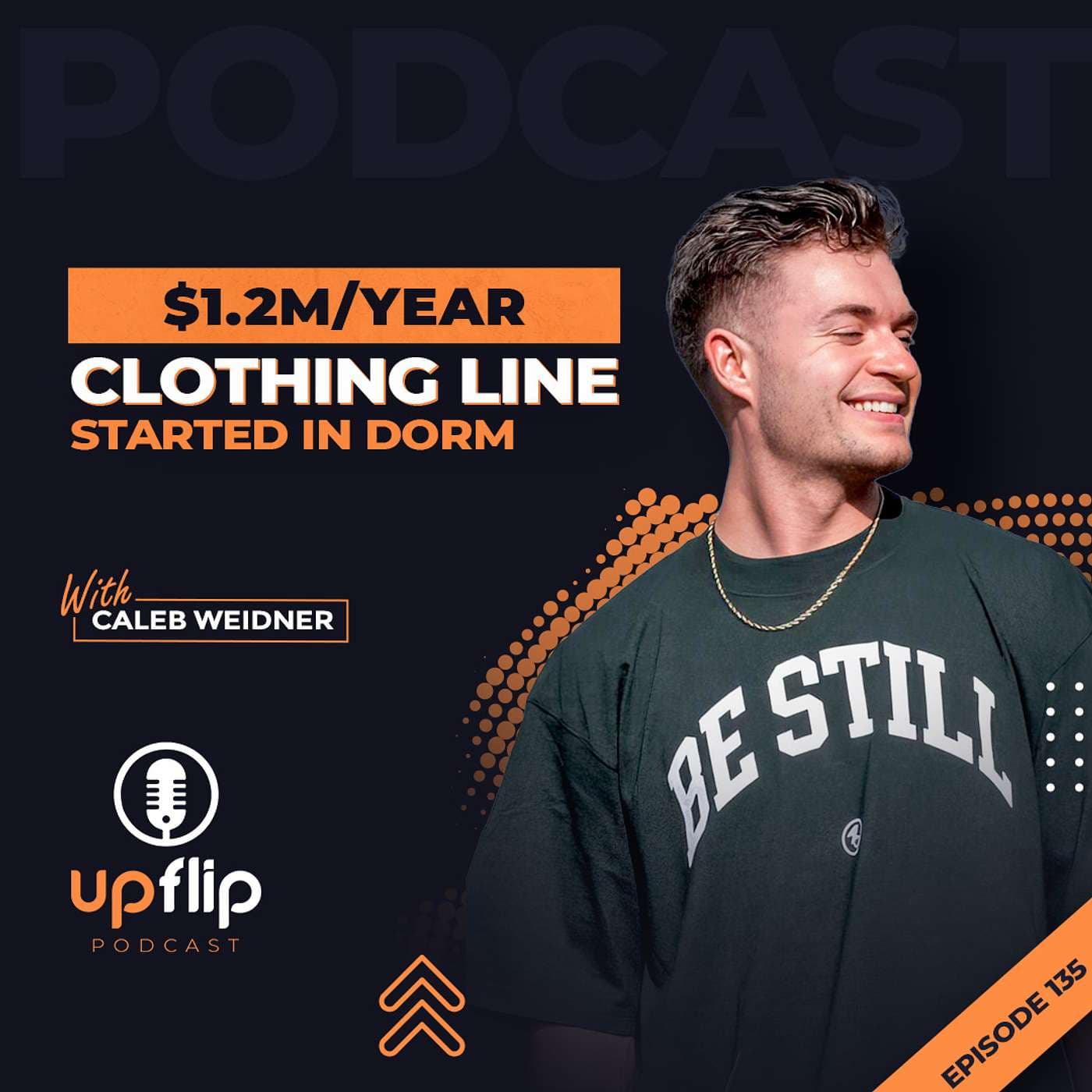
Episode Overview Title: How Two Broke College Kids Started a $1.2M/Year Clothing Line Guest: Caleb Weidner, Co-founder of 4610 Apparel Host: Ryan Atkinson
In this episode, Caleb Weidner shares the inspiring story of how he and his college roommate launched a successful Christian clothing brand, 4610 Apparel, from their dorm room. The discussion delves into the challenges they faced, the marketing strategies they employed, and the importance of building a mission-driven brand.
---
Key Concepts
Founding Story
- Background: Caleb and his roommate Dean created 4610 Apparel during their junior year at Maasai University, inspired by personal experiences with mental health awareness.
- Initial Idea: The concept was born during a late-night discussion focused on mental health, which led to the selection of “Psalm 4610” as the brand's name and logo.
- Logo Creation: Caleb designed the logo using Adobe Illustrator after sketching ideas by hand.
Initial Steps
- First Product: They sourced 50 shirts through a local screen printer, investing $500 ($250 each).
- Market Testing: Sold these shirts for $15 each predominantly to family and friends to gauge interest and gather feedback.
Growth and Development
- Mentorship: A mentor from a college entrepreneurship class helped ignite their passion and provided essential guidance, leading to winning third place in the Impact Venture Challenge and receiving $2,000 in startup funds.
- Key Event: Participation in a Christian music festival solidified their brand's mission and connected them with a broader audience.
Marketing Strategies
- TikTok as a Primary Tool: TikTok became a crucial platform for growth, contributing to 90-95% of their traffic:
- Content Types: Skits depicting interactions between Christians and non-Christians, folding tutorials, and behind-the-scenes looks at their operations.
- Ad Strategies: Caleb advised on focusing on organic reach first before investing in ads, ensuring that content resonates with the audience.
Design Philosophy
- Design Approach: Simple, yet effective designs that appeal to a broad audience.
- Collaboration with Designers: Initially designed in-house, but later began hiring professional graphic designers to enhance product offerings.
---
Key Takeaways
- Mission-Driven Brand: Emphasizing a mission beyond profit can foster authentic customer loyalty and engagement.
- Importance of Mentorship: Having a mentor can provide invaluable support and motivation during challenging times.
- Community Feedback: Engaging directly with customers and incorporating their feedback can lead to better product development.
- Diversity in Marketing: Using multiple platforms and content types can maximize reach and customer engagement.
- Continual Learning: Entrepreneurs should be open to learning and adapting their strategies based on market feedback and trends.
Quotes
- “It was such a pivotal turning point for the business.” - Caleb Weidner on mentorship.
- “The fact that it was driven by a mission... kept us going.” - On the importance of mission in entrepreneurship.
- “You have to love the mission and love what you're doing.” - On the necessity of passion in entrepreneurship.
---
Resources
- [Join a community of likeminded entrepreneurs](https://bit.ly/4filr9x)
- [How to Start a Clothing Brand](https://www.upflip.com/academy)
- [Shop 4610 Apparel](https://fortysixten.co/)
---
Conclusion Caleb Weidner's journey from a college dorm room to running a $1.2 million/year clothing line showcases the power of passion, community, and strategic marketing in building a successful business. His insights provide valuable guidance for aspiring entrepreneurs aiming to make their mark in the saturated apparel industry.
Written by AI. May contain mistakes. Listen to the episode to check what was said.
Transcript
Automatic transcript. May contain errors.0:00The fashion industry is among the most saturated niches out there. How do you carve out space for yourself when competing with the likes of Nike and Calvin Klein? In today's episode, we discuss how to start an apparel company out of a dorm room, how to test the market with limited runs, and marketing strategies to stand out in a crowded space. This is Ryan Atkinson, and you're listening to the Upflip Podcast, where we uncover the secrets of building and running successful businesses. Our guest is Caleb Weiner, who co-founded 4610 Apparel with a friend when they were both college students. What started as an experiment on a shoestring budget has since then grown into a successful business with a dedicated following.
0:35And above all, he remains true to his core values. Super excited for this episode today. Caleb, welcome to the show. Super, super excited to have you on. Thank you for having me. You're going to be great. I love just like apparel brands, like consumer brands. I think they're so much fun and you have a really cool founding source. I'm excited to talk about that. And it really starts in your dorm room with your friend. We alluded into it in that intro, but take us to your college dorm room. You're sitting with a friend and 4610 Apparel. is born. Take us to that moment. Yeah. So it was 1 a.m. on a Friday night, I believe, my junior year at Maasai University, you know, when all great ideas start.
1:07And so my roommate, Dean, was in an entrepreneurship class, wasn't able to find a partner that he could really align with in creating a business. He was in a class that was targeted towards an end goal where you would compete in a Shark Tank style competition called the Impact Venture Challenge. So it was creating a business that had a business side, but also a mission side. And so we kind of talked about it at 1 a.m. in that apartment. And we both had mental health awareness on our minds at that point. We were both struggling a little bit, had some family members struggling. So that was something really near and dear to our hearts in that moment.
1:40And so he came up with the clothing brand idea. We kind of both came up with the mental health side. And then I picked out the verse Psalm 4610, be still and know that I'm God. And they all just kind of combined. We created the logo right there on the spot that morning, technically. And yeah, that's kind of how it came about. That is super interesting. Well, let's talk about this logo then. Did you guys just pull up a Canva document and like start creating this logo or like what was that first logo for you guys? Yeah. So I'm one of those graphic design snobs. And so I was like, I'm not going to use Canva.
2:09I'm not going to do that. So I was bringing out a piece of paper, sketching some 46 ideas. We went through a few variations quickly. And then I went into Adobe Illustrator and made the technical logo, I guess. So that's kind of how it came about. I love that. So you got this idea. It's 1 a.m. You've now got a logo. So you're humming. I mean, you got good momentum on your side. But the first thing is like actually start designing the apparel, I'm sure. So how did you guys then first get that first apparel like line out or were there some of those next steps? Yeah. So the next step was finding a local screen printer.
2:41We wanted to make sure it was quality. We wanted to make sure that we knew who was doing it. It wasn't some sort of random import. And so we found a local screen printer near a college and we honestly, our first shirt was just a gray t-shirt with our logo slapped on the top left corner. That's all it was. And we both pitched 250 bucks each for a$500 order of maybe 50 t-shirts. So that was a lot for us as college students were like, oh man, this is burning our pockets. But, you know, we were dedicated to seeing how it would work. So we took those 50 shirts. My roommate, Dean, he was the vocal one, talks to everyone, friends with everyone on campus.
3:15I'm more of the behind the scenes guy. And we took those 50 shirts and basically just found anyone, family, friends, random people at college that would buy it for 15 bucks. And that was kind of our way to test if people liked the mission and what their suggestions were. Interesting. So you guys spent$500 to get those first 50 shirts you said or so? Yeah. Perfect. And so if I'm mathing this correct, that's about$10 a shirt and you guys are selling them at about$15 per shirt. Yes. Were people like enthusiastic about it, like telling their friends or like how quickly did you get those first 50 t-shirts sold?
3:47Gosh, I think it was about maybe two to three weeks. You know, my roommate, Dean, great salesman, great talker. He can convince people to buy anything. So it did go pretty quick. We were lucky to have family and friends that were really supportive of us. And so that wasn't really too big of a difficulty in the beginning. Yeah. So you got your first 50 shirts sold here. You're feeling good. You and Dean are like, okay, like maybe we have something here, but then how did you guys decide to like keep it going? Cause some people might just be like, oh, let me sell 50 shirts. Like it was fun, but like, I don't really want to do this.
4:17I got a profit, but like, why? And how did you guys decide to like keep going with it? That was exactly our story. We sold those 50 shirts and we were like, where do we go from here? Like there's so many clothing brands, like this is dumb. Like we need to focus on college, what's going on. And so So the program that he was in, in the entrepreneurship class, the Impact Venture Challenge competition, offered a mentor that came from the school that would join us for free, give us advice, kind of hype us up and get us to that next level. And so two, you know, egotistical college guys, you're like, we don't need a mentor.
4:49It's a clothing brand. We can figure this out ourselves. And eventually we're like, you know what, we'll do it. You never know what's going to happen. And so our mentor joined us, Brandon, and he was the spark plug to taking us from where we were honestly about to quit at that point to making us on fire for the mission and wanting to do it just with so much passion. And so our mentor for us was huge. I don't think it would have gotten past that point if we didn't have the mentor at that point. Okay. I'm curious then, like, what did like this mentor like provide to you and like Brandon, like, what did he do and how did he like really be that spark plug for you guys to get going?
5:23He is such a motivator. He is a consultant. So that's his job to go into situations where it's dire and turn it around and get people bought into the mission. So for him, it was nothing. And he's such a, just such a motivational and uplifting person that he just did such a good job of convincing us that the mission, the Be Still movement, all that had legs and could be something big. And it was to the point where he was mentioning, you know, possibly funding us in the beginning. So I think the fact that he believed it so much that he was willing to put his own personal money on the line showed us it was like, hey, there's got to be something to this if this person is so willing to do this off the jump.
6:05I think it's like super important early on, like when you're starting a company is to like find a mentor, someone that believes in you, because like luckily, like I had parents that like always believed in me. But like if you didn't like that feeling of having someone like believe in you dearly where it motivates you and like pushes you to move forward is like so invaluable. And it sounds like that was true to like what Brandon was doing for you guys. Oh, yeah, 100%. Like it was such a pivotal turning point for the business. Yeah. Interesting. So now you got someone that like believes in you, maybe even help finance you guys.
6:34What happens then? So now that you'd have someone believe in you, like what's the next step in your guys' journey? We got to the top five and pitched in front of the audience of 400 people for that business competition. We won third place. And so we did get$2 ,000 in start at money from that. And so we use that to do some legal stuff, website stuff, our first run of like a hundred shirts or something like that. And another thing that Brandon did, our mentor right after that was convincing us to go to a Christian music festival, which was another solidifier in making it from an abstract social media brand to a real life.
7:09We have a booth at this festival. People are coming to us and sharing their mental health and faith stories and really solidifying it as something that is actually impacting people, real people and not social media followers. Yeah. The next step was to go to that Christian music festival. And like, did you guys go there with like a hundred t-shirts you said or so? Yeah, we got a few more. So we were probably there with maybe two to 300 shirts overall. And what was that like? Because I know your first 50 shirts you said where it was like a lot of family and friends. And like, that's one thing, like your mom's going to buy a t-shirt to support you, but going to a music festival, like where you don't know these people is a totally different ball game.
7:43So what was that like for you guys and some of the feedback that you got for the t-shirts? Yeah. So I spent that summer, instead of doing an internship or a full time job, I spent it fully devoted to designing stuff, doing the social media, setting up the booth. And so designing those shirts, I got a lot of feedback from my mom, from my sister, from people. I was like, if I'm going to spend money on this, I'm going to make sure that there Some people like it and my mom's not afraid to give me her opinion. So I knew she wasn't lying and just being like, these are great. And so they actually sold pretty well.
8:14I mean, there are very simple designs just with some 4610, be still a no, just different variations of that. So we didn't get too crazy with it. We made sure they were high quality cotton tees, hoodies, whatever it was. And so they did sell well and people love them. They love the design, the colors. And so that was another really big moment where it was like, wow, people actually want to buy this with their own money, not just like our mom and my brother. Exactly. Like it's a totally different ballgame once you start actually selling to like people you don't know and like people that like they might like hate your brand or like they may not like it.
8:46I'm curious for you. I think it's really cool because this is like mission driven and it's a very mission driven company with clothing to support that. What has been like the value or how would you advise someone of starting a mission driven company? Like how important was that for you guys? Yeah, I mean, I think it's such a huge part of it. I think, especially with the clothing brand, something that there are a lot of, it's hard to find differentiation. And I think it's hard to find when there isn't a lot of differentiation, it's hard to find the motivation to keep going every single day and be consistent.
9:17So the fact that it was driven by a mission that was beyond the clothing, beyond what we were doing, I think that was something that kept me going, kept us going when there wasn't a lot of internal motivation sometimes. And just the fact that people were being affected, we would get messages like, hey, my family member struggled with suicide or depression or whatever it was. Realizing that it was so beyond us is something that really took it from just a clothing brand to a mission, a clothing brand fueled by the mission. Yeah, I feel like that's a great way to build customer loyalty as well. It's like when it's so mission driven, it has to be so cool to get those types of messages because your brand is truly making an impact in people's lives and something they can actually attach on to.
10:00Yeah, for sure. That's the biggest thing is getting a message from someone, seeing how much it impacted their lives. Because being down here in my grandparents' basement running the business, like, I only see the negatives. I see the complaints. I see the bad reviews from time to time. I see the issues. So getting something that positive and that just, I don't know, that intimate from someone about their lives that we have been able to affect is just such a huge part. Yeah. I think intimate is like a really good word for that because that is like someone's like actual like mental health and like mental well-being.
10:33And that is a very intimate thing. And for them to be able to share, like you said, all you see is your grandparents' basement clothes lined up like, oh, my God, like revenue is this this month or they're complaining about this. But getting awesome feedback like that's a motivator in itself to keep going and like keep building this brand, which I think is so, so cool. To all my wannabe entrepreneurs out there or people looking to take their business to the next level, we have an incredible offer for you. Upflip is giving away free lifetime access to the Upflip Academy for one lucky listener and participating has never been easier.
11:07All you need to do is leave us a review on Apple and then send us a screenshot as proof. That is it. And you guys can find the link in the show notes below to participate. Like I said, if you're a wannabe entrepreneur and wanting to connect with other entrepreneurs, this is a great opportunity. And even to think of business ideas and get the blueprint for business ideas, this is an awesome opportunity to do so. and for people that are just starting out with their own businesses, I have been in the UpUp Academy and there are so many great courses on taking that business to the next level, the Ask Me Anything, different groups you can join.
11:37So I'd highly recommend. And all you need to do to participate is simply leave us a review on Apple and send us a screenshot as proof. And that link is in the show notes below. So this music festival, I wanna jump back and kind of keep this storyline going here. So this music festival, it goes well. You guys do well, you get good feedback. Was that the moment in time where you guys are like, like, oh, we have something here? Or when did that really happen for you guys? I definitely think that was the first pivotal moment where this was real. This is real money, real people. We're not being supported by a college or a family and friends like we were, but it wasn't driven by that.
12:12These were real strangers that were coming up to us. I think the other moment shortly after that, coming back to college my senior year was having shelves of inventory in our college apartment and shipping out orders from there, taking packages to the school bookstore and talking to them. They're like, what are all of these packages you're bringing into the bookstore to ship out? And kind of explaining that story and then getting their feedback and just even seeing a random person at my school wearing it that I had no clue they existed. And just all those things combined, I think in that summer to fall period really cemented it as something real.
12:45Yeah. So then how did you like pour fire on this thing? So it's real. You're seeing people wear it in the streets that you don't know, which I think is an awesome experience. But how did you then pour like fire on this thing to like really get it going and take this to the next level. Yeah, I would say in the beginning, 100 % TikTok was the fuel to the fire, however you want to say it. I had previous TikTok experience over COVID. I ran a random account that was up to like 70 ,000 followers and I've had some other accounts. So that was something really natural for me, something I really enjoyed doing.
13:15And so just posting content three to four to five times a day on TikTok was what really grew our audience and motivated me to do so. Let's get a little technical on here what these TikToks were looking like because someone might be interested in growing their consumer brand, any brand in general, and they think TikTok's a good avenue to do that. It is obviously a great avenue to do that. But what specifically did you guys do on TikTok? You're posting a lot, but what specifically were in these posts that you're posting? Early on, there were a few different ones. One of the more peculiar ones I would do were random skits, sort of a skit about an interaction between a non-Christian and a Christian because our big thing is being a billboard for God every day and using your clothing as a walking billboard to spread that message.
13:59So giving a skit as a depiction of that, as a conversation, showing people sort of a trial run on how to do it, how we want people to do it. And I think also one way I grew my audience in the beginning was doing some folding tutorial videos. So kind of finding ways to give the audience advice, to give them value instead of just expecting them to follow us for our clothing brand. So those were two ways I kind of jumpstarted it instead of just being like, these are my clothes, buy them. And then from there, once people were kind of bought into, you know, me as the face of the brand on social media and the brand itself, adding stuff like the behind the scenes on the design, how I'm designing it, videos from the festival, like us doing a dance with some of our customers while the music was playing, just literally every behind the scenes aspect, making that into content and then also giving the audience value.
14:51Yeah. I want to start with that first part that you did with like the skits and the folding thing. I think it's super interesting that you didn't start out with like, oh, here's our apparel and like, this is why you should buy. You offered value up front. Even the folding thing is so simple, but that's something like TikTok, like people are going to love to see even the skits. I feel like that's just like a fun thing to do. And I think you talked about it, like for anyone that wants to grow on TikTok for their brand. I feel like offering a ton of value up front is like the key way to actually do that, similar to what you guys did.
15:17And I think really just testing any and whatever idea you have, because like skits and folding tutorials, like no one would think. And like, even in my mind, I'm like, this is so stupid. Why am I like, there's probably a bunch of middle-aged people watching my folding videos, learn like, so just literally throwing anything you can against the wall and seeing what sticks. And then once one does, just making variations of that, I think is so important. Interesting. And then I think that next step you took with TikTok as well as in, is there a metric in mind that you had or like how many followers did you have before you start talking about like that actual design just for people listening?
15:50Yeah, I would say once you get to 1000, 2000 in those early to mid thousands, I would say that's when you can start driving your own brand a little more when you have a decent amount of people bought into the account. Yeah. So you start providing tenant value, then you start talking about the design and all the things behind the scenes, even doing some like dancing videos with customers as well. I'm curious though, do you have like a number that you can attribute to actual TikTok and like what it did for you guys? Or can you talk a little bit about that? Because I think TikTok is such an interesting way for consumer brands to grow.
16:21And I want to actually show them like the quantifiable value that comes with that. At that point, our advertising was a little bit word of mouth from festivals that was negligible at most. And then we had TikTok and Facebook ads. For us, TikTok was genuinely 90 % of our traffic, 95 % of our traffic. So it generated so many sales, so much traffic to the website, to our Instagram. So that was really the core of how everything spread out from that, the traffic on the website, traffic on Instagram, all those things. So for us, ginormous. It's a really interesting avenue. It sounds like you guys were also start doing ads as well.
16:56When did that equation start to come into play? Because I really want to give people like the sense of like, how the heck do I grow a consumer brand, a clothing brand? How do I do this? You did it successfully. But like, when did you start to do like the Facebook advertising and whatnot? Yeah, I would say we didn't start paying for advertising until our second summer. So I was careful about making sure that I learned how to create organic content that had organic reach instead of throwing money at something that wasn't proven yet in terms of content, because I think it's so easy early on to be like, oh, I'm going to spend this much of my budget and, you know, pay for Facebook ads or pay for TikTok ads, whatever it is.
17:31And I think it's so much more effective to even if it takes a little bit to figure out what works organically and then pour gasoline on that with the advertising money. I think that's really cool. So we talked about those growth strategies there for a little bit. I also want to talk about the like the designs and like how you come up for the designs. Can you like open up your brain a little bit and give like a little bit of tips on like how like you design like everything? Because I think someone listening, if they know this brand, they're like, these designs are sick. I've been on the website.
17:57These designs are so cool. But how do you guys actually go about these designs? Yeah. So early on, a little backstory, I only started graphic design my senior year of high school and then kind of continued that throughout college. Early on, it was a culmination of seeing what worked in other brands and using maybe five to 10 to 15 Christian clothing brands, graphic design accounts, stuff like that, and kind of developing my sense of what works. I stuck to really simple designs just because I knew that would reach the large audience. You know, know, a 15 year old boy could wear it or a 60 year old woman could wear it like anyone would wear these things.
18:33So I think in the beginning, testing them with my parents, my sisters, kind of testing that market to see what they liked to kind of give it some proof of concept in the beginning. So keeping it simple. And then I think as we grew, once we had the funds to do it, which only happened maybe just eight months ago at this point, is we started including some Christian graphic designers that we would partner with just so it was a combination of my designs, but also professional graphic designers. So looking back, honestly, I think when I was starting, I think it would have been a really worthwhile investment to pay a professional graphic designer three, four or 500 bucks to make a design in the beginning, just because I think that could have provided an opportunity to jumpstart it even quicker.
19:17So I think a lot of people force themselves to make it themselves and not everyone has that ability. Even I would say, I didn't have a super ability to make an amazing design right away. That's a lot to expect. That takes time. And unless you're a seasoned graphic designer, that's not going to happen. So I would say investing in the art, investing in that. It seems stupid in the beginning, but that's what people are wearing. That's the selling point. Like if people are just seeing that in an ad or online, they're only going to click if it's eye-catching. What goes into an amazing design? Because as entrepreneurs, we all know, like you kind of have a mindset of like, I'm just gonna do this myself, as you said, and that's totally okay.
19:56At some point, you definitely want to hire like I 1000 % agree with this. But in your minds, like what goes into an amazing design is someone starting from scratch. And they're like, I don't have money to do this. Let me do this myself. What are like three things that goes into an amazing design? I would say one, a good font that is so important, a good way to find a good font, find some graphic designers on Instagram, a lot of them make reels about the fonts they're using recently. And a lot of them are free. You can just download them and use them. So that's super important. Don't be using Comic Sans or any of those times you're Roman.
20:27Yes. I also think the simplicity aspect of it is really important. Not making it too simple, but also not adding things for the sake of adding them. I think a lot of people are like, oh, I need to add three graphics and make it really cool. I think balancing that simplicity with, you know, also the artistic side is super important. And you can see that with some of our early on pieces. It wasn't super innate. There wasn't a ton of colors. It was literally just white. Be still a no in a circle with 46 in the middle. People like that simplicity. At least that was our style. There are different styles out there.
21:00So that doesn't have to be the style, but I think that's a really important of design. I like it. And those are good insights. That's what I was actually going to say about your first design as well. I know you said like, oh, like we need to hire graphic design, but I think people actually like nowadays really like the simplistic designs. I know I do. I designed my own t-shirt here and all I have is a company like logo and name on it. Cause I want like a simple t-shirt, but there is something special about having like a cool, like graphic tee. Like those are still definitely, I'm sure room in the market for those as well.
21:24Yeah. And I think even hiring a graphic designer, if that's an option and there are cheaper ones out there, I think a person that sees in a graphic design will be able to make it super simple, but also just eye catching. It sounds simple, but it is hard to do. It does take experience. So I think if you're going for it yourself, if someone's out there trying to learn it, just create, create, create, keep going, make as much as you can, get as much inspiration as you can, look through magazines, look through ads, anything you can, Pinterest, all that stuff. Just bombard your mind with all that. Yeah, that reflects Jason Kalanis.
22:01I butchered that name. But he said, if you want to learn like UX design, go to like the Lululemons or these companies that have UX design. That's how you're going to actually learn from just kind of like osmosis, which I really like. But let's wind down here. Before we get to our fan blitz questions, I kind of want to just take a moment to like reflect with you. You've been running this for a little over two years now, two and a half years almost. Talk to me like how you've changed as an entrepreneur over the past like two years. Obviously, you're probably like 20, 21 when you started. How has your perception of like entrepreneurship changed?
Read the full transcript
22:27and like how have you changed as an entrepreneur? Yeah, that is a really good question. I would say one of the biggest things that changed for me was going from the grind of it all and starting to focus more on the connections and the people themselves. I think in the beginning as an entrepreneur, I was so focused on the back end, the social media, the design, building all that up. And I think especially for our brand and our mission, making sure that I'm connecting with people and really making sure they feel cared for, even if it is on social media. I'm naturally an introvert. So for me, in the beginning, it was really easy to focus so much on the back end.
23:03But really building that community, building those connections is something that I think I've learned is really important, especially at this point in the journey. It's interesting, always the mindset. Like I've been a full-time entrepreneur now for like six months or so and doing my own thing on the side though. It's always like fun to like reflect and like see like, how's my mindset changed on this topic? Or like, what would I do differently now? So it's really cool to be able to hear you reflect on what you would do differently and how your mindset has changed. Let us wind down though with our FanBlitz questions because people from our community are very excited to hear from you.
23:32And if you guys want to join in on the conversation, everyone go to www.youtube.com slash upflip to join in on the conversation with some world-class entrepreneurs. So they'll be ready to wind us down with our FanBlitz questions. Let's do it. Awesome. Number one, is the market for a clothing line not saturated? What strategies have you employed to overcome this and achieve success? I would say the market for the typical clothing brand where you put a design on a t-shirt, very common. I would say that is saturated. And I've seen a lot of movement from just the normal logo on a shirt, regular design on a shirt to more unique streetwear pieces, whether that's cut and sew stuff, oversized, boxy fit, just finding some niche to move into.
24:17I think that's where the clothing brand space is developing into, kind of moving away from that. Just print something on a shirt. Okay, next question. Which platform are you selling on and what social media has been the most effective? So we are selling on our own website and then Instagram and Facebook. Shop connects into our own Shopify website. And I would say our biggest platform is TikTok Shop. So TikTok feeds right into that. So TikTok Shop, when we joined that, doubled our business. That has been our biggest marketplace. I love it. Yeah, I know TikTok shop has been awesome for brands everywhere.
24:50Can anyone else do this too with a small budget? 100%. I think it's just about the consistency. It's showing up each and every day. People so often think, oh, I'm going to get a video with 5 million views and then I won't ever have to work ever again and show up every day. It's like, no, it's day in, day out. You have to love the mission and love what you're doing because otherwise you're not going to show in day in and day out when the views aren't coming, when the success isn't happening. It's really building that foundation behind the scenes is what makes it take off. I love that. I think consistency comes down to anything, working out, building a business, anything, just be consistent.
25:24Do you prefer digital printing and drop shipping of your shirts or traditional screen printing where you ship by yourself to buyers? I think for me, 100 % screen printing. We have a local screen printing guy. We do it all in-house. If I showed you the room, there's clothes everywhere. And so I think when you do that and create content that shows that to your customers, it makes it feel homey. It makes it feel small. It makes it feel like they're part of the grind. I think when you're dropshipping and doing all that, it's not wrong in and of itself, but I think there's less genuineness in that.
25:57It feels a little bit like a money grab to people. Last question for you too. We kind of talked about this, but how many days slash weeks slash months of marketing and advertising did you do for your first piece of clothing before you sold it? Honestly, before I sold it, there was maybe one Instagram post. That was it. I think a big thing for me to keep my motivation is to not do a ton of advertising beforehand. I like to create stuff behind the scenes and then kind of surprise my audience with it. Because I think if I'm talking about it before it happens, almost all of my motivation to actually carry it out and do it goes away at that point.
26:33So keeping it a secret, keeping it close to my chest, and then kind of surprising people out of nowhere, at least for me and my personal motivation, that's what has worked best. I love that. And Caleb, wind us down. If people are like, this dude is awesome. I want to learn more about him. Where can they connect with you and learn a little bit more about your brand? Yeah. So Instagram and TikTok are our biggest two. We reply to comments, DMs there, always excited to start a conversation, field any questions. TikTok, we get tons of comments about questions. I make videos replying to those questions.
27:02So it's a community there. It's an ongoing conversation. That's what I'm all about. And then with the mental health side, the faith side. That's who we are. So any questions about that, TikTok, Instagram, we got our email on the website, all that fun stuff. Guys, if you have also been dreaming of starting a clothing line like Caleb's, head over to upflip.com slash blog and check out the article on how to start a clothing brand and make seven figures a year. Be sure to share your ideas and successes in the community at Upflip Academy so we can cheer you all on. Caleb, thank you so much for being here today.
27:29You are the absolute man. Thank you. Thank you. Of course. Thank you so much for having me.
27:37you
From the publisher
Caleb Weidner co-founded 4610 Apparel from his college dorm room and now has an incredibly successful Christian clothing line. He sits down with Ryan to share his journey of starting the business with his roommate on a shoestring budget and building it to $1.2M/year.
Caleb opens up about what makes the brand special, how they tested the market, and the sharp marketing moves they achieved using TikTok. Caleb also talks about how building quality connections is crucial for obtaining customer loyalty.
Tune in to hear how 4610 Apparel grew from a dorm room project to a thriving business, showcasing the power of passion and authenticity in the apparel industry.
Resources:
- https://bit.ly/4filr9x Join a community of likeminded entrepreneurs
- https://www.upflip.com/blog/how-to-start-a-clothing-brand Start a Clothing Line
- https://fortysixten.co/ Shop 4610 Apparel
Ready to be your own boss without starting from scratch? Grab our FREE Franchise Guide and unlock the secrets of proven business models that have already created thousands of success stories.
Connect with UpFlip:
- On Youtube
- On Instagram
- On Facebook
- @UpFlipOfficial on Twitter
For more insights to start, build, or grow a business, check out the resources on UpFlip.com or head to the UpFlip YouTube channel to see more interviews with business owners and experts.
Thanks for listening!


