
In short
The UpFlip Podcast - Episode 143: How to Turn Yourself into an Unstoppable Leader
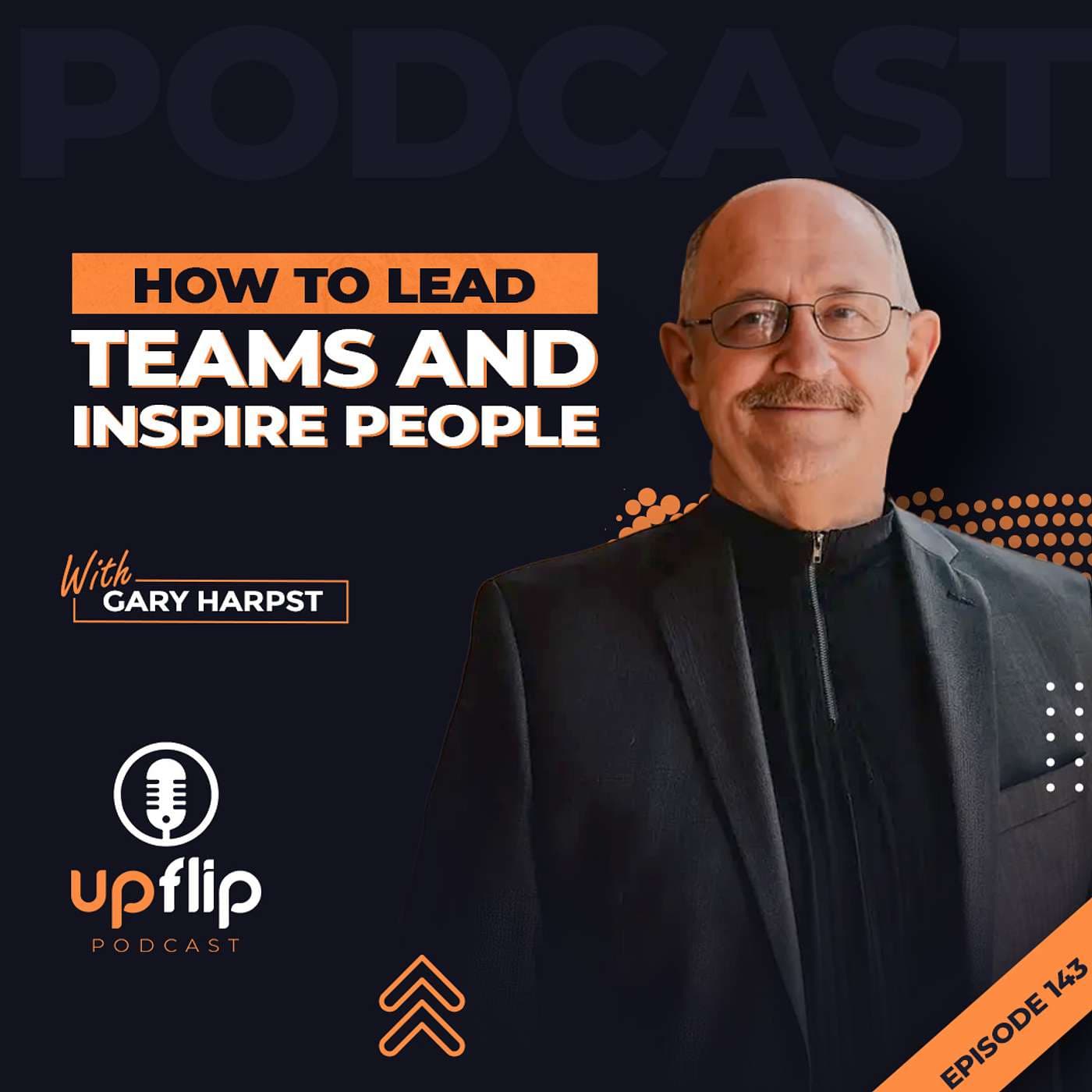
Episode Overview In this episode, Gary Harpst, a bestselling author, keynote speaker, and entrepreneur, shares insights on effective leadership in today's economy. He discusses the challenges entrepreneurs face, the significance of setting ambitious goals, and the need for self-leadership and accountability.
Key Guests
- Gary Harpst
- Former CEO of Solomon Software, which he grew to over 400 employees before its acquisition by Microsoft.
- Author of several books on leadership.
- Shares personal experiences and advice for aspiring leaders.
Episode Highlights
Introduction
- Hosts Ryan welcomes Gary Harpst to the podcast.
- Introduction of Gary’s background in tech and leadership.
Six Disciplines of Leadership Gary outlines six key disciplines essential for effective leadership:
- Vision and Strategy: Define where you want to go.
- Change Roadmap: Determine how to get there.
- Execution: Align and organize the team to achieve goals.
- Day-to-Day Adjustments: Make agile adjustments based on execution.
- Innovation: Foster a culture of bottom-up innovation.
- Organizational Development: Prepare the organization for future growth.
Key Challenges for Entrepreneurs
- Defining passion and energy that drives the business.
- Transitioning from idea generation to execution.
- Importance of leadership beyond just having a great product.
The Role of Leadership
- Leadership is not just about vision but also involves practical execution.
- Past technological advancements highlight the need for effective human interaction.
- Leaders must understand and align human desires toward common goals.
Understanding Human Desire
- Every individual has an intrinsic desire to win.
- Leaders must help team members identify their definition of success and provide pathways to achieve it.
Practical Tactics for Leaders
- Involve team members in goal-setting to foster understanding and ownership.
- Use measurements as a learning tool rather than a strict accountability mechanism.
- Set stretch goals that challenge the team without being demoralizing.
Lessons from Gary's Experience
- Quick growth can lead to operational chaos if systems aren't in place.
- The importance of organic growth and pacing.
- Addressing potential partnership conflicts early in the relationship.
Self-Leadership
- Managing one's emotions is crucial for effective leadership.
- Understanding personal frustrations and desires can lead to better decision-making.
Community Engagement
- The episode closes with a call for listeners to submit questions and engage with the podcast community.
Key Takeaways
- Leadership vs. Management: Understand the difference and the importance of fulfilling people's potential.
- Human Desire: Recognize that people want to win and create an environment for success.
- Self-Leadership: Lead yourself first. Acknowledge your emotions and the emotions of others to lead effectively.
Additional Resources
- Gary Harpst's Website: [leadfirst.ai](https://www.leadfirst.ai/gary-harpst)
- UpFlip Academy: [Join UpFlip Academy](https://bit.ly/4hiB3f6)
- Newsletter Sign-Up: [Get tips and strategies](https://www.upflip.com/newsletter)
---
Suggested Listening
- Episode 120 with Rand Fishkin: Discusses building an online business in 2024.
Conclusion This episode serves as a valuable resource for aspiring entrepreneurs and leaders, imparting wisdom on navigating the complexities of leadership and the importance of fostering a winning culture within teams.
Written by AI. May contain mistakes. Listen to the episode to check what was said.
Transcript
Automatic transcript. May contain errors.0:28What's the difference between a manager and a leader? on behind the scenes and how you can replicate their success. Guys, I am so excited for today's episode. We are welcoming Gary Harps, a bestselling author, keynote speaker, and entrepreneur to the show today. Gary grew his first company, Solomon Software, to more than 400 employees before it's acquired by Microsoft. Since then, he's written three books, co-founded two more businesses, and has taught tens of thousands about leadership. Today, you have an opportunity to become his mentee as well. Gary, welcome to the show. So excited to talk to you about leadership and entrepreneurship today.
0:58Thank you for being here. Well, thanks, Ryan. I love what you guys do. I mentioned earlier, you're kind of an idea farm, so this ought to be a lot of fun. I love it. And a lot of entrepreneurs have ideas. They're going to execute on those ideas. But one of the most important things is I'm learning in my own entrepreneurial journey is leadership. So I'm excited to talk to you about that today. And I want to get started with your six disciplines, methodologies. At like a super high level, can you kind of like please describe these six disciplines? First is just deciding where you want to go. You can call it vision strategy.
1:26but to me, one of the highest levels of leadership. Where do you want to go? The second one is how do you get there? Kind of the roadmap of what has to change. If you're an existing organization, you have some level of revenues and serving some set of customers. How do you get there? That's the second is the change roadmap. Third is execution. It's really hard to align and organize everyone to get them on the same page, especially in a growing organization. And then the fourth is the day-to-day agile adjustments you need to keep on the same page. So the third is more about planning and alignment and allocating resources.
2:01The fourth is more about the day-to-day execution adjustments. The plans are never right. Fifth is about innovation being driven from the bottom up. Some call it continuous improvement. Strategy is top-down. Continuous improvement is bottoms up. And the last one is organization development has to do with how you prepare your organization for the future, because growing organizations eventually outgrow their ability to execute. I absolutely love that. Those are six great disciplines. So like, where do you want to go to the vision three execution for day to day agile adjustments, innovation and organizational development?
2:33I want to ask for someone that is starting a company. They're at the very early stages. Maybe they're at that idea farm. They're doing the ideas. Which of those six do you think is one of the hardest for an entrepreneur to get right, right away? Well, let's define right away. If you mean the first few weeks, months, figuring out what your passion is and what drives your energy. And that's usually not too hard in the sense that some reason you quit your job or you love spending your time. And what quickly happens, though, is as that energy produces something, you end up needing a different skill set for some other thing.
3:08You either have to market it, you have to engineer it if you don't know how to, those sorts of things. So that turns into sort of the second phase. Whatever passion got you to enough success to grow, then the game changes very rapidly. Interesting. Yeah, I feel like a lot of that idea of farming, like what are you actually passionate about and defining of like what you're passionate about? But it also comes down to actually being able to monetize those passions and knowing and having that two mix is once you do get that and you're actually passionate about what you're building is like a huge win just for fulfillment in your own life and being able to actually grow a company because the hard times come like that passion is going to be able to actually get you through.
3:42Absolutely. It's interesting you say that because, you know, we're creatures of desire. And if you don't have that burning fire in you, the world will try to get you to stop. And so that's the difference between successful entrepreneurs and those who aren't. They can't be stopped. Exactly. And I want to continue down this thread of leadership and entrepreneurship. A lot of people might be thinking like, oh, don't I just need a great product? Don't I just need to build the next Facebook? But how important is leadership actually in the day-to-day operations of a business? Well, I do define leadership a little differently than some.
4:18And some people like to make a big distinction between leadership and management. And I view those two as really two sides of the same coin. And to be effective in the world, you not only have to have an idea of where you want to go, which is the traditional view of leadership, but you have to figure out how to get there. And the getting there often informs where you want to go. It's not like this linear process of I decide something and then I'm done deciding where I'm going and then I do something. It's interesting. You think you want to go here, you're doing some of it, and that informs, well, that's not quite right where I want to go.
4:53And you can't separate the two. So that's my view of leadership. Now, the reason I think it's so incredibly important, I remember being asked decades ago when I was in college, why is it that humanity has advanced so much technologically, but not socially? Now, think about that. You think where we were 200 years ago, 500 years ago, it's just amazing what has happened just in the last 50 years. But socially, we have exactly the same problems we had thousands of years ago. We don't get along any better. We don't work together any better. And if anything, we're becoming more fragmented. And so in asking that question, this is related to what leaders really are.
5:32The reason we advance so much technologically is the rules of physics are set. You know, the way electrons bind to other electrons through electromagnetic energy works the same way all the time. So one generation can discover the rules of physics and share them with the next and build on them. But when it comes to human endeavors, if it grows, we have more people working together, but we don't obey the laws of physics. And so really, what is a leader's role? It's not chemistry or physics, it's human interaction. And you really can accomplish anything if you can get people with a shared vision and really rowing in the same direction to pursue that.
6:14But it's very hard because we're so creative and we each have our own ideas and leaders have to be experts in human desire and how to align that desire to a common purpose. So in my view, leaders are the most important role there is in the world. Absolutely. And like everyone can think about like the good leader they've had in their life and like the bad leader, just saying that there was probably like 20 examples that like popped in my head of like a leader that I loved and like a bad leader that like I did not like. I want to ask about that human desire aspect of that, of like what you just said of like, when it comes down to leadership, it like really just comes down to like human desire and actually meeting human desire.
6:50So can you kind of expand that a little bit more of like what you mean on human desire? Is that like someone's goals and aspirations or yeah, can you kind of expand on that a little bit more? Yeah, I would. I happen to be a person of faith and I actually believe the idea that people are created to win. The biblical interpretation of why we exist is to have dominion. That's the word that's used. But the key to being a leader is to realize that every single person you know deep down wants to win. And it's not that they want to win, they need to win. And when people are just, you know, grumbling and muttering and you're having a hard time getting along, they may not even know it, but underneath all of that is they don't feel like they're winning.
7:32And it turns us into grumps and angry people and all those sorts of things. So a leader, if they're really going to tap the potential of a human being, they have to believe that even these people that are hard to get along with underneath it want to win. They just don't know how. And the true leaders help people discover what winning means as a team and as an individual, and they set them up for success. They give them a platform to win. And that unlocks incredible human potential. Yeah, I a thousand percent agree here. Like at the end of the day, like we all want goals. We actually want to strive and like hit those goals.
8:06Like at the end of the day, that's what we want to do as human beings. Like there is a lot to be said there. I'm asking in practice, though, on like winning, like what are some actual tactics that people can like put in place to ensure like you're meeting that human desire like people meeting? Is it like setting goals or like what are some tactics? Yeah, it's not just setting goals, but it's how you set goals. So there's tremendous value. Some people think planning is about setting priorities, and it is, but planning is also a means to create understanding in people of what the goals really are.
8:37And so if you bring people into the process of saying, hey, we think we want to go to here and tell me what you think it takes to get there, and you start engaging them in that process. And in the process, you may tweak where even you want to get to as you listen. But that whole messy process, I mean, if you set in on it, it sounds a little chaotic and not very linear. But what's going on is people are gradually coming to a shared understanding of what they're trying to do. The plan ceases to be not nearly as important. The piece of paper isn't nearly as important as the understanding that's been implanted in people's minds.
9:11And if that understanding is there, then they're much more agile. Because I like to use the football. You call a play in a huddle, but then a trained player knows that something broke down and they adjust what they're doing. But they know what the play is supposed to do so they can adjust. If they don't know what the play is, they don't know how to adjust. And that's how you unleash people is you help them understand. And so good leaders don't just command and control. They involve people in forming the plan. Yeah, absolutely. So it sounds like actually like planning, like, hey, this is what needs to get done at a high level.
9:41And like here, like the objectives we need to like get there. But like if we go off plan, like we can adjust as well then. Yeah, that's right. It's really helpful if you have some kind of measurement because people often think of measurement as primarily an accountability mechanism, but it's not. It's a learning. It's primarily a learning tool because we learn by doing. So if we do X, Y, Z and get A and we don't like A, then we change a little of X, Y, Z. And so this iterative process measurement helps drive learning. Absolutely. And I feel like measurement, that's the one of the biggest things at Spacebar Visuals we've been implementing.
10:13is like actually putting in numbers that we're being held. I don't want to use for accountable because we just want to get that bad word. Yeah. Like accountable to like each like week and every month and like actually planning on them. Hey, how can we have these revenue numbers? How can we have these profitability numbers? And I feel like in my thoughts anyway, it helped drives like, okay, like we have our clear vision of what we're going for. Then all of us can go in that same direction. The accountability side of it is very important to human winning because they like to know this definition of success and I'm changing topics slightly, but what I've noticed is that good leaders know how to set a stretch kind of goal that isn't demoralizing, but it challenges you to think a little bit out of the box to get there.
10:57And so, you know, you can have some goals that are demoralizing and some that raise your vision, if you will, and your performance. Great leaders know how to do that. Can I get a drum roll, please? Because we are giving away a free lifetime access to the Academy for one lucky listener. And it's super simple to participate. All you need to do is leave us a review on Apple and then send us a screenshot as proof. Takes five minutes for lifetime access to the Apple Academy for free. So two steps, leave us a review on Apple Podcasts, send us a screenshot, and the link to participate is in the show notes below.
11:29If you are a wannabe entrepreneur, the courses in there are so invaluable for you to actually get that first business idea off the ground. And then for the current business owners that are looking to sharpen their skills. There are a ton of courses in there for you. And the best part, you're going to be able to connect with other top-notch entrepreneurs in your field to network with them and learn from them. The winner will be announced on July 26th. All you need to do, leave us a review on Apple, send us a screenshot of proof, and you guys can find more details in the show notes below. Yeah, I think it's all about setting those stretch goals, but making it not like super, super stretchy goal where your revenue number is like all of a sudden you want to grow like 800 % year over year.
12:06I think that's unrealistic, but setting actual those stretch goals from very early on even out of a younger company is super beneficial. So you can actually all have something to go for and actually go win at something. I'd like to tell you a story because as a young entrepreneur, I almost bankrupted our first company. It was Solomon Software. And I had this project that I was in love with as a CEO. And so I kept spending money on it and went on for way too long and I almost bankrupted the company. And we ended up having to lay off half our people because of my stubbornness. And it was a real mess.
12:39Well, you'll laugh because you weren't born, but there was a time before graphical interfaces. People don't remember this, but Apple invented the graphic interface or at least popularized it. And so Microsoft did not have a Windows interface and we were on a Microsoft platform and needed to get to Windows because it was starting to emerge. And we just laid off half our staff. So we had nobody to put on the project. We had five people and we had large competitors that were well underway in their Windows development. And the result was those five people, we gave them what you would think of as an impossible goal.
13:14We said, we need to get a product out in two years. Our competitors got 100 people. We've got five. How are we going to do it? And you know what that group did was they didn't complain about the constraints. They said they brainstormed and said, how could we do this in a completely different way. And they figured out how to build a next generation product using components that were already pre-built from other vendors. And we shipped within 30 days of our competitor and our business grew 600 % after that in the next five years. So there is an example of sometimes ridiculous constraints. Actually, if you don't fight the constraints and say, this is unfair, I can't do it and embrace them, you start to think in different ways.
13:54And I guarantee you, if I had had$10 million to put on that project, we would have hired 100 people too. But we didn't have 10 million. We had very little. So a message to your upstart companies is don't be afraid of constraints. Sometimes they're the best friend you got. Gary, that reminds me of, they always talk about like Steve Jobs' reality distortion field of like putting in an impossible task, but like somehow it just always gets completed. That honestly reminds me of like to a T of it. Yeah, it's the same idea. Yeah. And it's all up here as a leader. How do you get people to think, oh, we're doomed and switch?
14:27Now, wait a minute, guys, let's not quit and flip the energy. That's leadership. Yeah. Flip the energy. That's a term that I really like. But can you talk about like what those constraints did? Because when you're like five people, I mean, you really need to be thinking outside the box of like, how can we take leaps and bounds and airplane type steps here? Can you talk a little bit more about that? Like what that constraint did? Well, I'll tell you the story about how it happened. You guys don't know how the industry got started, but I'm old enough to know. And Microsoft at the time was battling to be the operating system of the IBM PC.
15:01There were two or three operating systems. And Bill Gates was a fan of basic software programming. He was a programmer at one point. And they always shipped with their operating system a basic compiler. So somebody in the company, when Windows started to emerge, modified BASIC to become a Windows version of BASIC. But they had it listed in their games category. Just it was part of their play tools. And we spotted that at a conference, that they had this BASIC tool that dealt with the graphic interface part, which was a lot of work. So one of our engineers spotted that and said, well, maybe we could use their BASIC tool to create an accounting application, screen management.
15:39And it saved us years. So here's the funny part. We went to Microsoft and told them what we were doing and they laughed. They said, basic is not a business product. And we said, well, it's going to be because we did this. And we ended up building the largest visual basic application in the world. And then after the fact, Microsoft figured out that it was a business product. So it's funny where constraints lead you. And then eventually you get acquired by Microsoft, which is the whole fun wraparound story of that. Yeah, it completes the circle. Yeah. Yeah, that does complete the circle. I'm just curious from your perspective, if you're looking at when you were first becoming like a CEO and a founder and executive, what were some of those like if you go back in time and tell young Gary like, hey, don't make this mistake or do this this way.
16:23What would you tell young Gary as like a young entrepreneur from a straight leadership perspective? Well, one thing I would say is that recognize what your passion is initially. Like I'm an engineer, so I always like building things. But there is a stage at which you have to change roles or you have to have somebody else step into what that new role is. So we had a crazy PC Magazine review one time that reviewed all our competitors' product, reviewed ours last, and gave us the highest rating they could give. The headline was like the most amazing accounting system in the world. Our business tripled in 90 days.
16:56Wow. And here's the lesson. Growing faster than you can handle is a huge problem. And so we had to put in 70 phone lines, but this was before the internet, so we had to answer the phone. We had to put in 70 phone lines. Well, what's the next step? You had to have people answer the phones. And we didn't have people that knew what they were talking about answering the phones. So we took our best, most knowledgeable people we had on the product and made them managers, and they were no longer answering the phone, trying to coach people who didn't know anything. It was a mess for more than a year. And what's the lesson as a young entrepreneur?
17:30You always think you want this explosive growth. And it is exciting, but there's something to be said for being patient and learning how to handle growth slowly and what I call more organic. I've wasted so many millions of dollars where I was trying to spend money to go faster than was natural. And when you do that, you waste a lot of capital and you create operational messes. And so there is an organic pace of growth. Now, I'm not saying high growth isn't ever appropriate, but you grow into the point where you're ready for that. Yeah, I feel like the biggest problem when you get into something where you grow 300 % over 90 days is the systems are in place.
18:12And at the end of the day, that's kind of what it comes down to of why it might be an operational mess. It's just those systems aren't in place for that type of growth so quick. Yeah. And for startups, you often haven't been there before, so you don't even know exactly what the systems should be. Yeah, exactly. That's actually a phenomenal point. That's one of our goals here at Space Star Visuals. We want to grow and we want to grow fast, but at the same time, one, profitability is our number one goal. At the end of the day, we're going to be profitable in what we do just because from a straight business acumen, you want to be profitable.
18:40But two, we want to have those systems in place because once that does hit, we want to be able to actually sustain and be able to not tabletop over because we weren't ready for it. I mean, what you said to have some gating principle says, look, we're not going to grow faster than our own cash flow per minute. I'm not saying that's always right. Depends on the industry you're in. But for some businesses, that's a great metric. It forces you to be disciplined. Yep, exactly. And for a service-based business, like I'm super happy with that. That's totally cool with me. A question that I do want to ask here, I want to speak to younger entrepreneurs, people that want to be younger entrepreneurs and also older people that want to be like entrepreneurs.
19:15I want to hit both of these targets here. Just the question for both these audiences is like, what are common mistakes you see younger entrepreneurs make like nowadays? And then the same question is, what are common mistakes you see like first time older entrepreneurs making nowadays? Well, I think if you're an engineer like me, a mistake you can make is you want too much perfection too early. You're better off being agile and just doing a little bit minimum viable product kind of concept that's pretty popular. But just get something that drives your learning so that you're not operating out of your head, but you're operating out of feedback from clients.
19:48So that's a mistake I made. And I think engineers in particular can fall for that because they're perfectionists in design and they're more inclined to sit and get it perfect before they want anybody to see it. So that's one mistake. Another, I mean, this is no surprise, but almost everybody underestimates how much time and capital it's going to take to get it right, to get to the point that you truly have a business model that works. and so I did millions of dollars of financing over different periods of time but we ended up building a business that was very very successful I feel like the biggest thing is like especially when it's like your first company it's just like you just got to press send you got to ship it that's a common term nowadays but yeah especially perfection will like never happen really it could maybe but yeah at the end of the day like if you're going to actually build a business you just got to put it out there and see how's the market going to response and how can I get your first paying customer because that's ultimately to me in my mind anyway that's how you know like Like you have a business model that is going to work in a product that will actually sell.
20:46You know, there's one other thing I would share, especially for founders, is if you're partnering with someone or, you know, that very first few people you're very, very dependent on is very, very early, sit down, close the door and say, let's talk about the worst case scenario that could happen in the future. And what, like one of us gets run over by a truck. One of us begins to hate the other one. How are we going to handle this worst case scenario? And I mean, you look at the history, most people don't end up getting crossways with their partners and you're a fool if you think you're immune to that.
21:23So the beauty of facing the worst case is when something like that emerges, you have a way to talk through it and relate to some framework that lets you be sane as you're resolving the problem. So that's a huge mistake that so many early founders, you know, you get together with your college roommate and think, boy, isn't this going to be fun? This is easy. Yeah. And then all of a sudden, one of you gets married and has kids. You have a different set of priorities. You've got half the business. The other guy thinks you're not working enough. You know, all these things happen. Yeah. A good co-founder relationship is like so important.
21:55Like thankfully, like with my co-founder brand, like we have a very good relationship, like a phenomenal working relationship. So I'm very lucky for that. But yeah, you have to know like nobody is immune to a bad co-partnership. So actually sitting down and saying like, what's the worst case scenario and hashing that out, I think is like super important as well. I was just talking to three young fellows in Portugal that were doing some marketing work for me and they split off of the company and did exactly that. And they have a great relationship, but he said it was really eye-opening to talk through for them.
22:22And it cleared the air even before anything occurred. So they're much more robust because they've faced this. Absolutely. I like that. And so we've talked a little bit about leadership in general, but I'm curious, another important part of leadership is like leading yourself as a person as well. I mean, that could be a whole conversation as well. But like, can you talk to leading yourself with like discipline, accountability, and the importance of actually being able to lead yourself? I find it really helpful to, again, I'm an engineer, so I like to understand architecture and design. And there are at least the biblical view of what a human being is, is that there's a part of us that is a source for desire.
22:59There's a reason, function, our minds. And the purpose of reason is to apply logic to our desire. And then the next thing is imagination. and the last is action. And those four things are interacting to produce the actions that occur in our life. And so something can go wrong in any one of those four steps. So if your desires are for things that truly don't align with the way the universe works, you may have a short-term win, but eventually it won't work. Or you may have a good desire, but don't have the intellect or experience or learning to act on it. So you see a child, for example, who wants to walk and is not yet ready.
23:36And they get very frustrated. For adults, I get frustrated when I'm trying to do something I don't know how to do, right? What is the symptom of that? I get angry or I get frustrated or I quit. You know, there's all kinds of reactions. And the reason I'm going through this is to manage yourself as a leader, you have to be a student of your own emotions and be intelligent enough to say, why am I frustrated right now? And step back through, what is it I'm really after? And where is the problem? Do I not have enough resource? Do I not have enough skill? Or is the desire wrong in the first place? And if you could start doing that, by the way, for yourself, you will be a better leader because it applies to the people around you.
Read the full transcript
24:14And I've grown, it's taken me a long time to quit reacting when people are angry and acting in a way that seems stupid. And you just begin to have a dialogue with them and help them think through what is behind this action. That self enlightenment actually takes a lot of the pressure off of yourself. You begin to say, oh, this is why I'm doing this. And as a leader, you can help them do that. And ultimately, you have to do it for yourself. Yeah, absolutely. I feel like before you lead anyone else, you're going to have to lead yourself and understand and be mindful enough of other people's emotions and your own emotions, especially of like understanding like, oh, like I can feel this frustration bubbling up.
24:50And that's why it's important to be mindful and take a step back and actually understand that desire, those skills, the resources. So you can actually lead yourself and then lead other people as well. I woke up this morning. I was traveling yesterday. I had a day full of meetings, tons of notes and feedback from all the people I talked to that were good ideas. I was behind because I was out of the office and I could just feel the tension rising in me way too much to do for today. And what does that do? I start to get a little tense. Then I start to interact with the people around me in a tense way.
25:21And all of a sudden things start to compound in the wrong direction. And then when I spot that on myself, I just say, wait a minute, there is enough time to do what is the most important. The issue is which thing is most important. And you just sort of calm down, prioritize and work yourself through it. So that's self-leadership. I totally agree with what you're saying. Yeah. And this has been a great conversation. Unfortunately, we are running down on time here. We are going to our fan blitz questions now, and this is our last segment. And these are actually questions submitted from our community.
25:51And guys, if you want to join in on amazing entrepreneurs like Gary, get your questions in at www.youtube.com slash upflip, where you can submit your questions there. But Gary, you ready for our last five questions here? Yeah, let's do it. Let us do it. Number one, how does one's business thrive in a system ripe with corruption without being corrupt? Wonderful question. Number one, decide what your values are that are uncompromisable. And number two, align yourself with people that agree with that. And so often a nation divided cannot stand. And so if you're going to stand against the world, you have to have a team that is on the same page.
26:29You can't have division within the group. And that's not a full answer to what the person asked, but it's the initial foundation from what you build. And then after that, you just have to keep innovating, find customers and markets that want to do business the way you want to do business, but don't give up. Keep tweaking, but don't give up. Don't compromise. I love that. Really good stuff. This next question I'm super excited for. This is a great question I first submitted. You should be a podcaster yourself. What are some business fundamentals and lessons that helped you get where you are no matter what business it is?
27:01Well, I would go back to my partners. I've had the same partners through four businesses and we're going on for our fifth decade. Wow. Are you serious? Yes. Same guys. And in our particular case, I'm not saying this is true for everyone, but we all shared some things that were more important to us than the business itself in terms of our values, our faith, our families. So we never in 40 years had a split vote on anything, not once. We would just sort of get together, talk through the options and get a one mind, sometimes pray through it, whatever. But that is the secret to our success is being one with the owners.
27:39That is incredible. Gary, next time you guys are four together in person, let me know and I will fly up to where you are at just to be a fly on the wall there. That is so cool. We still do it after all those years. We still do it. Well, let me know. I'm flying out to where you guys meet. Number three, what advice do you have for being a great leader when running a very small crew? Oh, I love this because I personally like small crews. One, involve them in everything. Every organization has different advantages. If you're Microsoft, you've got 100 ,000, 200 ,000 employees, you've got advantages.
28:07A team of five people has incredible advantages because everybody can truly understand with no dilution, exactly what you're trying to do, and you can make a left turn in no time. And I'll give you an example. We've got a team of six people right now at Lead First. And 90 days ago, we switched from a$25 ,000 entry point full service offering to a$20 a month offering. And we did it in 90 days. Wow. We could never have done that with 10 ,000 people or 1 ,000 people or even 500 people. That's crazy because we're also going through pricing as well. The decisions are moving like just like that. Like, oh, let's do this, this, this.
28:45All right, let's go. Well, Microsoft can't do that. So it's a shame if you're a small company and you do not leverage your ability to be agile. Oh, you can be so fast. It's really fun how the speed you can move at, which is awesome. Number four, what do you do that has no inherent monetary value? Well, you know, my own view is that work, its primary value is not profit. work is a means to helping humans fulfill their purpose. And so here I am in my 70s, and I have never worked a day in my life. I love what I do. And the idea of quitting is, I don't even understand that. And every person that works with me gets fulfillment out of their life.
29:27What would your life be without this? So I don't know if I'm answering their question, but the success of the business, financial, is a byproduct, not the main product. It's a byproduct of people working together to fulfill their destiny. That's amazing. I like that a lot. And that's the fun thing about being an entrepreneur, helping people fulfill their destiny and their potential. Number five, last one for you here. If there was a movie made about your journey, what would the title be? Oh, I'd love The World's Fastest Indian. It happens to be an actual movie. And it's about a guy who aspired to run at the salt flats on his motorcycle and he was from New Zealand.
30:04True story. And he shows up at the salt flats with bald tires and an old motorcycle that he'd renovated and they laughed wouldn't let him run because safety. They finally thought, oh, this old guy, he was in his 60s and we'll let him go. And he runs and he sets a world record. But there's a scene in the movie where they're kind of filming from his point of view on this motorcycle and the salt flats, they paint this black line for miles and they set up a timer between them. So you got a mile to get up to speed, and then they monitor your speed between these mile markers. And the black line is what you've got to stay on.
30:36That's the shortest distance between two points is staying on that black line. He is never on the black line, and none of us are ever on the black line. We're going back and forth off our line. And success is not being on the line. Success is having the line. You see, if he didn't have a line, he wouldn't know how to adjust his life. And so that movie manifests to me what life is all about. It's not perfection. It is just having a purpose. And you feel like most of the time you're not on it, but it's adjusting your decisions real time, all the time. And at the end, you set a world record. I love that.
31:11Well, Gary, I appreciate you so much for being here. Last thing for you, if people want to connect with you, where can people learn a little bit more about you? Website, book, all that stuff, please plug it all. Oh, leadfirst.ai is our webpage. And on there is my book. My book is titled Built to Beat Chaos, Biblical Wisdom for Leading Yourself and Others. So life appears to be chaos, but the book is about, it's not really. Chaos is not our enemy. It's our purpose. This was an awesome episode with Gary Harps. I have three quick takeaways for you. There's a difference between leadership and management.
31:44When you're a leadership position, you have to find ways to fulfill your people and let them flourish. Number two, leadership at the end of day comes down to human desire and people wanting to win. So you have to allow your people to win. If that's setting up goals for them, metrics for them to hit, people want to win. And at the end of the day, that's all leadership comes down to. And then number three, at the very end of the episode, we talked about being able to manage and lead yourself. If you can't lead yourself, you're not going to be able to lead other people. So it's being able to take a step back, understand the emotions you're having, and then also identifying what the emotions other people are having.
32:14That is truly how you are going to lead yourself and lead other people. And let me suggest an episode for you guys to check out. And that's episode 120 with Rand Fishkin when he shares how to build an online business in 2024. This is my first episode I did with Uplip and Rand came with it. Super technical interview about how to build that online business in 2024 and really take that side income to the next level or even get started with that side income all through an online business. Highly recommend you guys to check that out. Rand is the man and we will check you out on the next episode. Gary, thank you so much for being here today.
32:46Appreciate you so, so much. Thank you, Ryan. I love what you do. Thank you.
From the publisher
Gary Harpst is a bestselling author, keynote speaker, and entrepreneur. From the years 1980 to 2000, he led the tech company Solomon Software to major success before it was eventually acquired by Microsoft in 2001. The craziest part? During his time there Gary guided over 400 employees to generate more than $60 million in revenue and service 40,000 clients worldwide. In this episode, he joins Ryan to talk through effective leadership in the current economy
Gary discusses the challenges faced by entrepreneurs, the importance of setting stretch goals, and the need for self-leadership and accountability. He also gives valuable insight and advice from personal experiences for aspiring leaders and entrepreneurs.
Tune in to learn how to better define your desires and goals as you set yourself up to be the next great leader within your industry.
Resources:
- https://bit.ly/4hiB3f6 Join UpFlip Academy
- https://www.upflip.com/newsletter Sign up to receive even more tips and strategies directly to your inbox
- https://www.leadfirst.ai/gary-harpst Connect with Gary
Ready to be your own boss without starting from scratch? Grab our FREE Franchise Guide and unlock the secrets of proven business models that have already created thousands of success stories.
Connect with UpFlip:
- On Youtube
- On Instagram
- On Facebook
- @UpFlipOfficial on Twitter
For more insights to start, build, or grow a business, check out the resources on UpFlip.com or head to the UpFlip YouTube channel to see more interviews with business owners and experts.
Thanks for listening!


