
In short
UpFlip Podcast Episode Notes
Episode Title
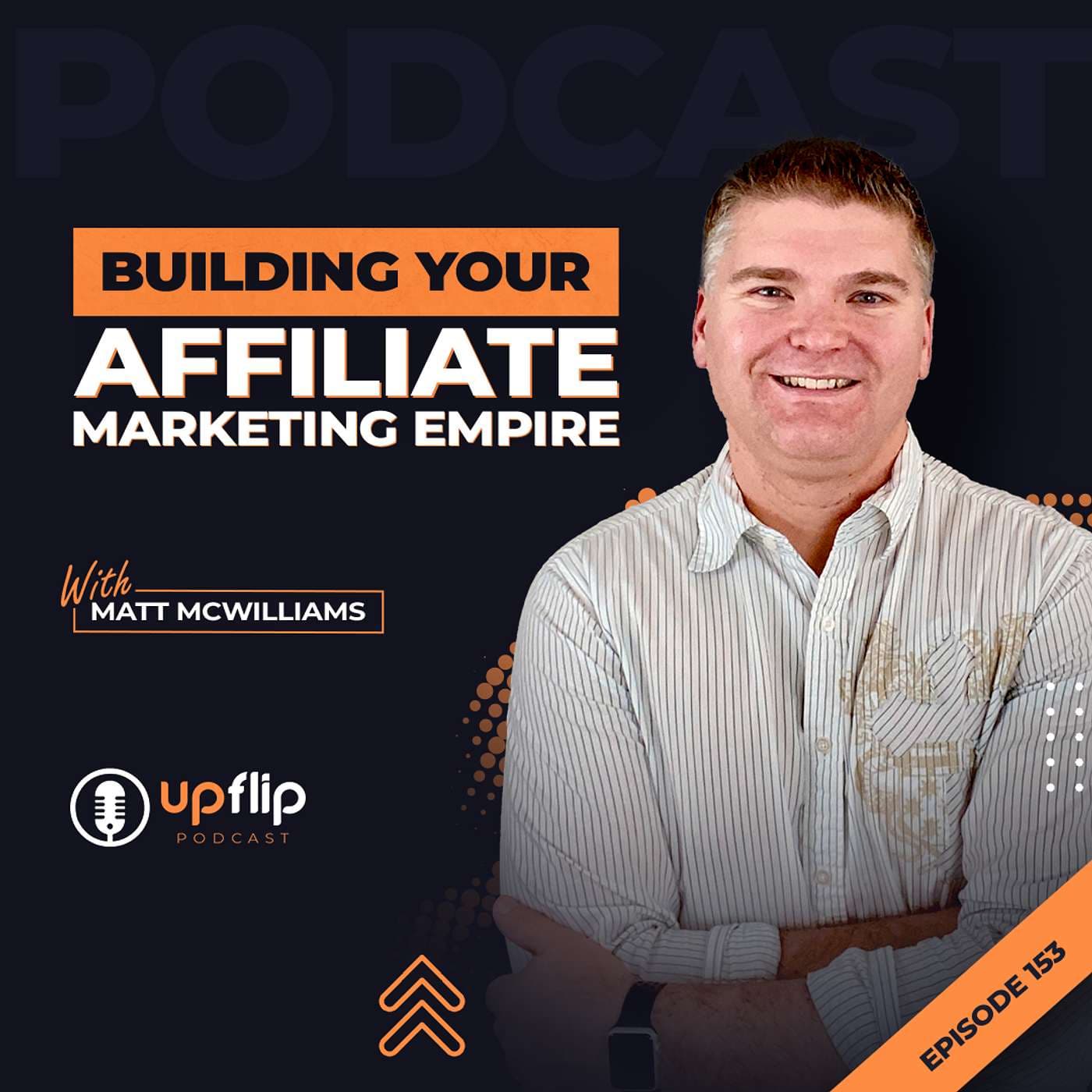
Cracking The Code - Zero to Six Figures w/ Affiliate Marketing Episode Number: 153 Host: Ryan Atkinson Guest: Matt McWilliams
---
Episode Overview In this episode, Matt McWilliams shares his journey and expertise in affiliate marketing, detailing how he transitioned from $0 to six figures and worked with major brands like Adidas and Tony Robbins. He offers insights on selecting profitable niches, effective marketing strategies, and driving traffic through affiliate offers.
Key Topics Discussed
- Understanding Affiliate Marketing:
- Definition and historical context of affiliate marketing.
- Comparison to traditional referral systems (e.g., ancient Rome).
- The Value of Affiliate Programs for Businesses:
- Low-risk marketing strategy.
- Affiliates handle targeting, which reduces the burden on businesses.
- Warm prospects: potential customers come with an established trust.
- The compounding effect of successful affiliate programs.
- Setting Up an Affiliate Program:
- Identifying who has your audience.
- Establishing relationships with prospective affiliates.
- Utilizing affiliate networks for technology and management.
- Engagement and Retention:
- Keeping affiliates engaged through communication and contests.
- Strategies for ongoing relationship management with affiliates.
Resources Mentioned
- [Matt McWilliams’ Website](https://www.mattmcwilliams.com/)
- [UpFlip Blog](https://www.upflip.com/blog)
- [Join UpFlip Academy](https://bit.ly/3UvoC5P)
- Free [Franchise Guide](https://bit.ly/4aWuGvc)
---
Key Takeaways
- Affiliate Marketing Fundamentals:
- It’s essential to understand the basic principles of affiliate marketing and how it operates within today's digital landscape.
- Identify who has your audience and utilize that to drive affiliate partnerships.
- Building Relationships:
- Relationships are crucial in affiliate marketing. Engage with potential affiliates early, even before launching a product or service.
- Choosing Products for Affiliate Programs:
- Focus on a few strong products initially; it’s better to go deep (one niche) rather than wide (multiple products without focus).
- Engagement Strategies:
- Communicate regularly with affiliates, provide necessary resources, and create incentives like contests to maintain interest.
- Adaptability Across Industries:
- Affiliate marketing isn’t just for B2C; B2B companies can also create successful affiliate programs by identifying the right partners and audiences.
---
Fan Blitz Questions
- Impact of AI on Affiliate Marketing:
- AI can enhance affiliate marketing by creating custom copy for affiliates, streamlining processes.
- Short Form Content vs. Email:
- Email has proven to be significantly more effective for conversions compared to social media leads.
- Best Way for Beginners:
- Start with free resources to learn the basics, such as recommended websites; choose products that resonate personally.
- Budget Constraints:
- Form small groups with peers to share knowledge and best practices rather than spending on expensive courses.
- Maintaining Personal Happiness:
- Engaging in outdoor activities and minimizing screen time during calls helps maintain well-being.
---
Conclusion Matt McWilliams emphasizes that affiliate marketing can be accessible for anyone willing to learn and adapt. By building solid relationships and focusing on specific niches, small businesses can leverage affiliate programs effectively to grow their revenue.
For further insights, listeners are encouraged to check out past episodes, such as Episode 120 featuring Rand Fishkin, which offers additional tips on launching online businesses in 2024.
---
Thank you for tuning into the UpFlip podcast!
Written by AI. May contain mistakes. Listen to the episode to check what was said.
Transcript
Automatic transcript. May contain errors.0:00The affiliate marketing industry is worth over$17 billion. But how do you get your slice of the affiliate pie and get into this business in 2024? In this episode, we'll talk about how affiliate marketing has changed in the last few years, how to pick a profitable niche while dodging a sketchy one, and marketing strategies that will skyrocket your success as an affiliate marketer. This is Ryan Atkinson, and you're listening to the Uplit Podcast, where we uncover the secrets of building and running a successful business. Today, we have with us Matt McWilliams, a four-time affiliate manager of the year.
0:30Matt has worked with hundreds of businesses, including Adidas, Kevin Harrington, and Tony Robbins. His knowledge in the field is unrivaled, and we are so excited to have him on today. Matt, welcome to the show. Hey, thanks for having me, Ryan. A lot of people out there are going to be thinking, I've heard of affiliate marketing. I know what it is, but in truth, not a lot of them know what it is. So let's just lay that groundwork for affiliate marketing and how you would define affiliate marketing for someone that is new or wants to explore the space a little bit more. Let's lay that groundwork.
0:56Yeah, I mean, the basic concept's been around probably since the dawn of time. You know, the ancient Romans did affiliate marketing. All we did was 30 years ago, we added technology to it, right? So, you know, you got, I can only name things like one ancient Roman name, like, you know, like Caius and I don't know, what's the Commodus? You know, they're walking down the street and they're like, oh, Caius says Commodus, like, hey man, do you know a good bakery? And Commodus is like, yeah, let me take you to so-and-so. And when they walk into so-and-so's bakery there, he's like, ah, Commodus, my friend, you know, and he's like, thank you for the referral.
1:22Here's a free sandwich. That's affiliate marketing. If you really think about it, I have an audience in this case, he had Caius, you know, then what we've done with the added scale because nobody outside of a few people in the world had audiences 50 years ago, right? Like I would have been a complete nobody 25 years ago. If you think about it, instead I have, you know, roughly a quarter of a million people who listened to a podcast about a topic every month, quarter million people listened to a podcast about a topic that only about a quarter million and one people are even interested in and whatever, you know, 15, 20 ,000 people on an email list.
1:54Like that doesn't sound like a lot compared to some people, but it's like, these are my target audience. That wasn't even possible 25, 30 years ago. And so all we did was add scale and technology to it where now I have an audience. I go out and say, Hey, here's a product that I recommend. Here's a product that changed my life. Here's a product that worked for a friend of mine. Here's a product that I think will help you. Here's a product I wish I had when I started my business 10 years ago. You know, whatever the case may be, go try this out. That's affiliate marketing. And so the ultimate question that I always ask when I talk to our clients or prospective clients, when they're starting an affiliate program or trying to scale an affiliate a program, for example.
2:25So coming from that perspective, very simple question. Who has my audience? It already exists. Like you don't have to go find it. You don't have to run ads on one of the three big networks and hope that some people in your audience are watching the Dick Van Dyke show. You know, there are people out there who have your audience. A guy I'm working with now, a coaching client, and talk about niche when you think about it, but then you start going, wait a minute, no, this is bigger than I think it is. They make an AI robot, a little furry, cuddly AI robot, all right, that is programmed to help kids with certain, we'll just say issues, right?
2:55So ADHD, they're on the autism spectrum, anxiety disorder, things like that, right? And you go, okay, so who has their audience? I mean, immediately, because I've worked in the parenting niche and I know people, I was like, Debbie Steinberg, she works with people who, parents of kids who are really smart, but have ADHD or on the spectrum or have anxiety. Dana, you know, Abraham, Jason, it's a silly hooky. I'm like, I'm just thinking like, who has my audience? And you go, that's easy for you, Matt. You know people. Yeah. But even if you don't know people, there's this website you may have heard of.
3:20It's called Google. You can go Google things and you can find people who have your audience. So at its core, that's a little bit of a long explanation, but that's all affiliate marketing is. I'm like, I'm trying to super simplify it so you understand it's not that complicated. Yeah, I absolutely love that. And I feel like an affiliate marketing program for businesses are a great way for you to actually take off as you just gave that Roman Empire example of Julius Caesar walking in and recommending a bakery. Businesses can use this as well. And can you talk about affiliate marketing programs for businesses and how they can use this to their advantage to attract more clients to their company?
3:52Multiple companies I've worked with, affiliate programs, what saved them. My company, and that's how I got into the affiliate world back in 2005. You know, we're now 19 years almost to the day. May of 2005, we were broke. We literally couldn't make payroll in 13 days. And I remember we had this, it was Memorial Day weekend. We had this big meeting. I'm supposed to be like at a cookout or something. I'm supposed to do something that weekend that's fun. Instead, I spent the entire weekend trying to learn how to build an affiliate program. I spent the entire weekend working with our programmer. Back then, you didn't have, like right now, you could have an affiliate program, No matter if you're listening to this, we're recording this at 317 in the afternoon, Eastern time by 530 this afternoon, I could have an affiliate program.
4:28That's how easy the technology is today. That wasn't the case back then. I had to get with our program and be like, hey, can you code this? Oh, by the way, I can't pay you. But if it works, we'll give you a percentage of the earnings. By the way, that worked out really well for him because 18 months later, we're doing over a million dollars a month from our affiliate program. I took it from nothing, non-existent, to over a million dollars a month in 18 months. And we did that that weekend because we were in that situation. We're broke. Now, why is that? Why does an affiliate program work for a business?
4:54Well, number one, there's no risk. You know, as a company that was broke, we could not afford to go spend any money, you know, and hope that it works. Like there was no Zuckerberg back. I mean, he was alive, but no Facebook, you know, just to be clear. Like you think about it, you go, no matter how good your Facebook ads, you have to pay Zuckerberg first before you get money back. That sucks. Like I want to make money before I spend it. You know, the second thing is that, you know, you don't have to worry about the targeting because the affiliates do the targeting for you. You know, if you think about this, like back in the day, you know, I mentioned before, I kind of talked about it before, it was kind of the wild, wild west, right?
5:25You had, you know, like ABC, NBC and CBS and that was it. And like, you just had to hope people were watching. But even now we get so caught up in targeting, right? Like we get so myopic. So mistake one is we get too broad. And if you try to target everyone, you target no one. But the second mistake is we get so myopic. Like I only want to target men who are 31 to 33 years old, who homeschool. They have 2.6 kids in their favorite football teams, the NFC West. There's like eight of those people, right? You're not going to be like you can reach. nobody. So you don't have to guess it targeting your affiliates do it for you.
5:52Like I said earlier, who has my audience? The third thing is just the warm prospects. If you think about this, and again, I'm picking on Facebook ads. I run Facebook ads. We spend money on Facebook ads. I am not suggesting that an affiliate program should account for 100 % of your sales. Some of our clients, it's 60, 70 % of their sales, but it's still not a hundred percent. So I'm not picking on Facebook because I think it's bad. But if you think about this, when you go to Facebook and you run an ad, you are basically saying good things about yourself. Hey, look at my product. It's awesome. Okay, cool.
6:20Great. But when an affiliate sends an email or tweet or whatever they're called these days and X, I don't even know. They post on Instagram, they post and they say nice things about you. That's like a third party referral. So the prospects come in warmer and we've studied this. There is no other form of marketing, including SEO. SEO is usually the highest converting of all the channels. It's not compared to affiliates. It converts slightly better. It turning clicks into leads and leads into sales as affiliates do. And the fourth thing is just success builds on success. Like if you run a good Facebook ad, congratulations, you ran one good Facebook ad.
6:49You have to now go write a second one, but affiliates talk. And we have found time and time again, I can tell you countless stories of programs we've taken over where frankly, I had to work really, really hard to get the first 100 affiliates. I had to bust my butt, but the next 900 came in less time and with less effort than the first 100 because they talk to each other. They see what each other's doing. They follow each other. And like, I got to be a part of that program. And so those are the reasons why this works so well. Yeah. I feel like it's a compounding effect. Like the first a hundred are hard, but after that, just as you see with anything, investing, working out, eating right, like it is all like a compound effect of like actually growing it.
7:25So if a business owner, someone that is a, just starting out their company or wants to start a company and they're like, okay, I'm ready for this affiliate marketing program. Like let's do it. What's like the first thing that they should do to start getting this set up? Yeah. Now, the very first thing, I mean, again, ask the question that I said, who has my audience? So, okay. AI robot for kids with, you know, sensory issues, developmental disorders, whatever you want to call it. You know, sometimes I like to call them superpowers. You know, I have ADD, right? I think it is probably the greatest superpower ever.
7:54It drives my wife nuts, drives my kids nuts, drives myself nuts about 10 % of the time. But it's still really cool. But either way, you know, there are things that I have to adjust in my life because of that. So superpower, whatever you want to call it. But they've got something that makes them not, you know, the norm, so to speak. It's a pretty niche product. You know, it's a product that also, frankly, the parents have to be of at least average income or above. And they have to have a knowledge enough to understand that, like, no AI does not mean that this furry little thing is going to somehow start grabbing knives and trying to stab your kids.
8:26So that rules out some of the people, too. But I'm like, OK, who has my audience? You know, that's the first thing. Do I know, do I know my market well enough to know, oh my gosh, I can think of 12 bloggers and influencers that have my audience. And if not, we go to Google and we start finding them. The second thing, you know, you ask for the first thing. That's the first thing that's pretty easy. We start looking for those people who have my audience. We develop relationships with them. I mean, I'm going to butcher this quote, but you know, Jeffrey Gittimer said that all things being equal, we want to do business with our friends and all things not being equal.
8:53We still want to do business with our friends. I paid more for my car than I had to. probably 750 bucks more, thousand bucks, maybe as much as 1500 bucks more than I could have gone to another dealership. And I probably could have gotten the same vehicle for a little bit less, but I bought it for my friend and I knew I was buying it for more, but I also knew that I was going to be taken care of. Why? Because we want to do business with our friends. You know, there are plenty of things I have paid more. I know we pay more when the guy comes out every year to service our furnace. I know we pay more, but he's a nice guy and we've become friends.
9:24So why would I switch to a cheaper person? So we develop those relationships with people that could be prospective affiliates and then we get them into affiliates. So those are the first steps. That's the pre-work. Like you have to do that today. You know, the old saying, what is it? The best time to plant a tree is 20 years ago. The second best time is now. The best time to start building those relationships is before you're like I was, you know, like desperately need them. Then you got to set up the tech and the tech is super easy. The easiest way to do this is to join an affiliate network. All right.
9:50You do not need special software, although it exists. You can run one in-house, but I highly recommend being on a network because there are potentially hundreds of thousands of affiliates on there already of whom a few thousand are great fits for your program, not 20 ,000 plus, unless you're in a program like I ran Shutterfly's affiliate program. I've run Adidas's and we had over a hundred thousand in each of those affiliate programs. You're probably not running a product like that. Okay. But in those cases, you know, there's still a couple thousand affiliates that are ideal candidates to be in your program.
10:21And it's a lot easier to be network. There's so many reasons I have time to get into. I'll just share the biggest one is they cover the tech and they cover all the tax stuff. So you don't have to worry about that. You have to manage the affiliate still on your own, but for hiring affiliate manager like us, but yeah, those are really the first few steps. And then from there, I mean, the next one is just to think of ways that you can make this exciting, make it fun, make it engaging, keep your affiliates, keep in touch with your affiliates. It's the biggest mistake I see. I even made this mistake last year with an affiliate program where we run because I got busy and we didn't have a lot going on.
10:52And I was like, crap, it's been three weeks since I communicated with our affiliates. What? I mean, I talk about this stuff on my podcast. I talk about this stuff. Don't not communicate with your affiliates. I'm like, oh, shoot. You know, I did the same thing. I get it. But communicate with your affiliates, come up with creative ways to engage them, like contests, you know, anything like we're doing one in June for our affiliate program where it's like, hey, on this particular product, we're paying double commissions for the whole month of June. We're going to basically break even on those sales, but it gets them engaged.
11:20And we make sales of other stuff where we, you know, only pay a regular commission and things like that. Find ways, run a contest, offer a special commission. Just do things that are fun. Educate your affiliates, send them helpful information and tips. If you have an affiliate who's doing something really cool, hey, say to that affiliate, hey, do you mind if we record a 15 minute video and share with the other affiliates? And some of the times they'll be like, no, I want to keep this a secret. It's my secret sauce. That's cool. But most of the time, probably 95 % of them are like, heck yeah, let's do a video.
11:46And then you share that with your other affiliates and keep them engaged. So those are the steps in the progression there. If you enjoy diving to the nitty gritty of entrepreneurs with us, let us know that by leaving a review. Your feedback helps us grow and improve. And we really appreciate those who have done so. Like Sean, who said, I really like how they focus primarily on blue collar businesses and give them the much needed spotlight they deserve. The YouTube versions of these interviews are absolutely fantastic too. Highly recommend both. Sean, thank you for your support and everyone for supporting the podcast.
12:14You covered the question of like, how do you keep them engaged? And you covered that double commission, do contests, all that good stuff. I feel like choosing the product though, let's just say you have a big product line or three or four different products. How do you properly choose the right one that should be an affiliate program? Do you try to spread it across the board? Do you just go for one? I mean, most of the time, if you have an existing product suite, you probably already have an affiliate program. Most of the time, not always, not always, but most of the time. So usually you're starting your affiliate program when you only have one or two or three products.
12:43We have an ex-client because they have progressed way past what we could do for them in the sense that they needed an entire in-house team running their affiliate program because they're north of over a billion dollars in sales annually now. When we were last working with them, they were at about 300 million. When they started, they had two products and then they've got definitely over a hundred products now. I mean, it's a huge line of products. But yeah, they started with two. And so we perfected it with that. We were doing a few million a year and then we added more and then we grew from there.
13:11But if you happen to have a bunch, yeah, I mean, you could start with some of the more popular products. You probably have five to 10 bestsellers, you know, that really do stand out. The other way to look at it is, do you have a line of products that are really specific to a particular market whom you could corner that market to start with? So a great example of that is actually, this actually is a perfect example. I work with a supplement company. So we've got multivitamins, collagen powder, stuff for bodybuilders, digestive products, all that. Okay, where do we start with this? Because we could go, like, we have supplements.
13:42That's a lot of different things. Over 60, under 60, men, women, pregnant, not, you know, on your period, not on your period, healthy nails, long hair, short hair, blonde hair. I mean, all these things are like, you could go into many different directions. Okay, let's focus on digestion. We have about five products on digestion. We are going to corner the digestion market. We are going to dominate the digestion market. It's a discipline. But for six to nine months, it was like digestion, digestion, digestion. Oh yeah, sure. If somebody came to us, we'd take them to promote the other stuff. But it was all digestion all the time.
14:11It was all we talked about. And it got to the point where we dominated that digestion market. So then first of all, some of those people who talk about digestion also talk about other stuff. So it was easy to just start expanding and those other areas started to grow. Then we had the model. So then it was like, okay, from there we went into collagen and coenzyme Q10 and stuff like that. Like we were going to dominate the, basically the over 50 female skincare and other like arthritis, you know, things like that market, right? We were going to dominate and we did, we dominated that. And then from there it was like, boom, we went to another thing and another thing and another thing.
14:43And the same is true with the types of affiliates you work with. When I took over Shutterfly's program, they were doing about 15 million a year. So this is back in 2011, actually late 2010. Sorry. We had a meeting with the CEO and I remember he's like, okay, we got to target mommy bloggers and photographers and wedding photographers, wedding planners, nonprofits, PTOs. and children's hospitals. I was like, Greg, settle down. I'm going to go after one market. And I told him how this is going to work. And he didn't like it, but he trusted me because I had a reputation. That's one of the good things when you win affiliate manager of the year four times, they're like, well, you know this better than I do.
15:14Okay, fine. We'll try it your way for a year and see if it works. And if it doesn't, then we'll fire you. Okay, cool. I went after mommy bloggers. Now I picked that for two reasons. Number one, I knew a bunch, so I knew I could get a quick start. Number two, there was a very side benefit that I thought of that was selfish, which was if a mommy blogger, like if we release a promo code and a mommy blogger blogs about it or tweets about it, whatever, and then I can go to the CEO and say, Hey, go Google that promo code in the word shutterfly and see what you find. And he finds 7 ,000 results within four hours of the promo code going live.
15:43So he's like, well, it's amazing. Even if the sales aren't quite there yet, you know? So I went after mommy bloggers and I worked my butt off for about five months to get as many mommy bloggers as I could. I probably got like 200. Right around that point though, is when you hit critical mass, here's what happens. If you're a mommy blogger, who do you most likely follow online? Other mommy bloggers, right? Just like if you're a copywriter, you follow other copywriters. If you're in the health and fitness industry, you follow other people in the health and fitness industry. So they follow other mommy bloggers.
16:08And here's the thing, when they see one promotion from Shutterfly, it's easy to ignore. But if you're a mommy blogger and you'll send, you go, oh my gosh, I got eight notifications today about Shutterfly. I got to go check that out. So I worked my tail off for five months to get 200. I mean, basically like one a day, one and a half a day. And then all of a sudden we started getting two a day coming to us and then three a day coming to us, four a day. When we hit the Christmas time, like late October, early November, prep for Christmas, Q4 of that year, about 10 months after we started, I was getting over 50 applications a day for mommy bloggers.
16:38Wow. That I had nothing to do with recruiting them because it got to the point, Ryan, where basically if you were a mommy blogger, it was like step one, register your domain. Step two, set a posting. Step three, register for the Shutterfly affiliate program. And I cornered that market for a year. I didn't focus on anything else. The old saying, you go, instead of going an inch deep and a mile wide, we went an inch wide and a mile deep. It was so true. So we dominated that market. We grew from 15 million to about 65 million. I did the same thing then with photographers, but I didn't focus on all photographers.
17:05I focused specifically on graduation photographers. Now, do they do other photography? Sure. But I only wanted, I was like focused on graduation. Why? Because that was coming up in May and I was doing this in January. So when are they taking the pictures? February, March. When are they ordering all their stuff early April? So I'm like, I'm going to go kick. And we did, we did it with the grad and then we did wedding photographers and we did nonprofits. And we went down all the list of things that he wanted to do, but again, one by one. And the same is true when you're picking products. You might start small and go from there.
17:35Interesting. I want to ask too, because a question comes to mind. Our listeners have a very diverse background. Some of them are in consumer brands. Some of them are B2B SaaS companies. A lot of what it sounded like so far is this could be a little bit more consumer focused, but is there room for affiliate like marketing programs with like B2B SaaS companies or are there just better industries? Yeah. Right now we have one client that's in B2B. Most of our stuff is B2C, but I mean, it's no different. You know, there's still a C at the B, you know, if you think about it, it's still a decision maker or maybe a few people.
18:07I mean, I think about like one of my former clients, he was in sales training, right? So typically training sales teams of 20 or more people. So the definition of B2B. Well, who makes the decision about whether or not to hire the sales trainer? A single person at that company, usually the sales manager, who has a budget decided by the company, but typically within that budget, it's his decision on how he spends their $85 ,000 a year training budget. It's still B2C if you think about it. You're still convincing one person to make one decision. So the affiliate marketing is the same thing. Who has our audience?
18:39Who has an audience of sales managers? Are there website? Are there influencers out there with audiences of sales managers? Yeah, of course. So you go find those sales managers and you talk to them. I cut my teeth. Mine initially wasn't B2B. We worked with insurance agents. So all of our affiliates that referred insurance agents were people who had forums, groups, associations of insurance agents. I started with one, same kind of principle. I went to the Tennessee Allstate Agents group. Why? Because my two business partners were both Allstate agents in Tennessee. So we went to them, we got them.
19:09Once we had the Tennessee Allstate Association and they were making a certain amount of money, it was so much easier. We got Kentucky, Indiana, Arkansas, Mississippi, Alabama, like West Virginia, surrounding states. Before we know, we had Ohio, Illinois. Well, now once we had all the all-state agents, all I had to do is get one state farm association. I got them, grew from there. Once we got the state farm, we went to the next one and the next one, and then we went to independent agents. And so the principle's the same. We're still convincing one person at that association, hey, do you want to promote our insurance leads company to your agents?
Read the full transcript
19:38Same thing. I'm curious though, on this B2B thread, is it kind of like a referral program? I mean, they're pretty synonymous terms here, but yeah, I mean, can you kind of talk me over like the mental block that I have right now of like, if you're like a B2B marketer, like, are you just going to go promote like a video marketing agency that you've used before? And like, if so, like, how would you want to set up that affiliate program for them? All right. So video marketing agency, how would I set up an affiliate program for a video marketing agency? Okay. Again, the question, who has my audience?
20:05So who has people who want video marketing. If there's a, you know, if you like, okay, we want bigger brands, things like that versus, you know, individual users and things like that. I mean, I don't know the websites, but there are definitely websites out there that specifically talk about video marketing and are primarily, you know, working with say companies of 10 or more employees. And I'm going to go to them and say, first of all, Hey, you know, do you need our services? Cause if so, I'd love to help you out. And then if it works for you, you know, I'd love to figure out a way to do a partnership together.
20:35And yeah, call it a referral program, call it an affiliate program. It's the same concept. You're going to go on and maybe you're going to become a featured trainer in their backend. That's going to be the first step. Maybe you're going to do a podcast interview with them for their small podcast, but it's a super targeted podcast. Like I said, we get a little bit less than a quarter million downloads a month, but it is like they're all demographically pretty much the same people. And so do you want to do a podcast interview? Do you want to send, Hey, how about sending an email out? Let's do a training together.
21:06You know, whatever the case may be, there's all kinds of options. I mean, I do this with like for our stuff. We have a major publisher. We run a lot of book launches because book launches with affiliates are an affiliate program. They're just for a book launch. And we have a very specific way we do it. We've done 13 of them now, 12 of which have been bestsellers. The one that wasn't, it's actually a funny story I don't have time to get into. We screwed something up because we didn't know better and whatever. And, you know, so we work with a publisher and I mean, this is totally B2B, but every six months or so, they send out an email and say, hey, you should talk to Matt and his company.
21:37You know, here's what they can do, blah, blah, blah, blah, blah. About once a year, we do a training where we train their authors. And so, of course, there are authors who are like, I can't afford you. I'm not like, I don't necessarily want to be surprised how many of them are like, I don't care if I'm a bestseller, you know, whatever. Then they can get free information. They can go DIY it if they want to or not do anything with. But the ones who want to take it to the next step, usually we end up talking to three or four of them. We sign, you know, one or two of them up as clients. And then, you know, we pay a pretty substantial amount of money to that publisher as a referral fee, as an affiliate commission, whatever you want to call it.
22:08It's great. You know, it's the same concept, though. Well, Matt, we're going to wind down with our fan blitz questions because we have some very eager people that are interested to learn about affiliate marketing. And these questions actually come from our UpFlip community. And guys, if you want to join in on the conversation, you guys can go to youtube.com slash UpFlip and submit your questions there and join in on these conversations. But Matt, you ready for these last five questions from our community? Yeah. Fire away. Perfect. So number one is what is the impact of AI on affiliate marketing?
22:35Because it seems that SEO for search engine will soon become obsolete. SEO is never going to become obsolete. First of all, SEO is like I mentioned earlier, it's a pretty small part of the affiliate marketing game. It's substantial enough in that I would never advise somebody to not do SEO, but it's always going to be a part of the game. But I mean, the biggest impact that it's going to have on affiliate marketing is actually on the affiliate management side, but it comes back to the affiliate side. That is the ability of affiliate programs to create custom copy, custom swipe copy for affiliates.
23:06Something we started doing, we create language models for all of our affiliates. So like if you were an affiliate for me, Ryan, I would take 50 of your emails, go load them into one of our bots and I would create a language model called Ryan Atkinson. It's got your voice, your tone, your style, the words you use and don't use. And then I'm going to take that and say, Hey, here's our generic swipe copy, right? Go write this in the tone of Ryan Atkinson. And it does. And when I hand you that email, you're pretty much looking at it going, I can just send this. Because we used to do that for our big affiliates, but I had to pay a copywriter or do it myself.
23:35So it either cost me 150 bucks per affiliate, not an insubstantial amount of money times 10 every month. It's 18 ,000 bucks a year I could keep, or it took me a couple of hours. And so either way, it was a pretty substantial investment of time or money. And now it's super easy. I like it. Number two, is short form content reels the only way to get customers? No. In fact, they're probably two of the least effective ways in terms of conversions. We did a study. So back in 2013, 14 or 15, somewhere in there, I did a study. What was the value of a social media lead versus an email lead? And social media was at about one twelfth of email.
24:10So not terribly different, but one twelfth. Late 2010s, it was about one thirtieth. We're down around 140th now. So in other words, what this means, if I send a thousand leads via Twitter, Facebook, Instagram, you know, TikTok, whatever, and you send 50 leads from email, you will probably make more sales than me eight days a week and twice on Sundays. So when we look at the stats and we see like these affiliates who, you know, gosh, she sent 3 ,200 leads and had two sales. And then this other guy had 180 leads and made six sales, like 99.9 % of the time. It's yep. Email, social media, or vice versa.
24:45So yeah, as far as conversion rates, it's email, email, email. I mean, email is king, queen, and court jester. That is facts. I will double down on that because we are seeing email as our best conversion rates as well. Number three, what is the best way for a beginner to learn affiliate marketing with no experience? No experience? Go buy my course. The best way, actually, I'm going to send them to a URL. This is totally free and it's the best way to start. To be clear, this is not the best way to make$10 ,000 a month. This is the best way to get started making a few hundred bucks, maybe a thousand bucks a month to just kind of get your taste buds wet.
25:20So to speak, if you go to mammothwilliams.com forward slash quick start, that is the best place. It's got a guy that'll just walk you through because that's a 25 minute answer. But the number one thing in there that I talk about, I'll give you this is you have to pick the right product. So I tell people, look at your desktop. Like it could be your actual desktop on your computer. It could be your desktop here. Like everything I do is on the computer. So if I looked at my desktop, I'm like my earbuds, I don't What am I going to recommend as an affiliate? But if you're a gardener, go to your gardening shed and just be like, okay, what here?
25:47What is it? If you're in the health and fitness, go to your gym. What workout bands would you recommend to somebody who's getting started working out? What dumbbell set? What supplements would you recommend? Go to your medicine cabinet. That's weird. Don't promote descriptions. Go to your supplement cabinet. Go to your refrigerator. Look at your desk. What websites do you log into more than once a day? Look at stuff like that and start recommending those products. What's the best way to start out when your budget isn't big to spend on mentorship and expensive courses? Don't. And this is coming from somebody whose primary business is selling courses in coaching.
26:21Well, outside of our agency, which is our primary, primary business, I do a lot of coaching. I do a lot of consulting, sell a lot of courses that teach people how to start an affiliate program or start affiliate marketing and grow their business using those things. But if I literally had no money, I would find a group of five to six, seven, maybe other people. This is how I did it when I had no money. All of us have been there. I mean, dude, it's one point. I started my first business. I was living in my mom's living room, sleeping on her pullout couch. I had to sleep in the shape of an S to get around the coils that were popping out of the mattress.
26:53I lived off of Totino's pizza. Taco Bell for$5 was like my gourmet once a month meal. I've been there, right? What did I do? I found a group of people just like me. I'm still best friends with almost every one of them today. We've made, as you talk about, again, relationships and affiliates, some of us, we've had hundreds of thousands of dollars of transactions between us over the years. But when we first all started, we had, you know, no subscribers. We didn't know what the heck we're doing, but we learned together. And one of us was an expert in this area. And the other of us, like I learned affiliate stuff.
27:23So two years into that, I was teaching them everything I knew about affiliate marketing. One of them became an expert at podcasting and started a podcast. And so it's some people that your peers with are either a notch below you or a notch above you meet once a week for an hour and talk through things. Last question for you then from our fan But what are the things you do to keep yourself happy and moving forward every day? Number one, right now, this is what we're doing is the only time all day I will stare at a computer screen and talk to another person. If I'm on the phone or on a call, I'm walking.
27:50If I can do it, I'm outside. No matter what the weather's like. I mean, if I have to, I'll just go out to my porch. If the wind's not blowing too hard, I'll go to my porch, you know. At least there's something there, you know. I'm smelling the rain even. I'm getting sunlight if there's sun out. I'm hearing nature sounds. I mean, we have a creek that runs through our property. I'm hearing the creek babble. You know, I get to see our groundhog and our ducks and, you know, and our geese and the crane that randomly comes. And I kind of hate that guy sometimes, you know, and I get to just like be outside and walk around and be active.
28:18And I mean, for me during the day, like because it's so easy to get caught up. I work on a computer for nine hours a day, five days a week. It's so easy to get caught up in that and like not moving and not being outside. But for me, if you can do calls, I think video calls were great when they first came out because it's like, dude, I can see you, man. You know, like why I went Cheech and Chong all of a sudden there, but like it was mind well, you're in Moldova. You're overseas. What time is it? Oh, what time is it? It's three in the morning, dude. And we're talking. That was amazing. Now it's like, I'm so past that.
28:48Like voice is fine. Voice is totally fine. If I miss your eye roll, I'm okay. Yeah, yeah. I love that. Well, Matt, thank you so much for joining us today. If people are like, I want to get started with this affiliate marketing stuff, but I don't know where, where can they connect with you? learn more about you and what you have to offer. Before you get started with affiliate marketing, go to mattmcwilliams.com forward slash quick start. That's the best place to start affiliate marketing. If you want to start an affiliate program, I mentioned that first step was just to start finding people, right?
29:14To develop those relationships. If you go to mattmcwilliams.com forward slash first 100 F I R S T 1 0 0. I've got a guide in there on 15 places to find affiliates. It's got some templates in there for how to reach out to them, how to start developing those relationships. So those are the two best places to go just depending upon which one go to both if you want. That's cool too. Hey guys, thank you so much for tuning into today's episode with Matt. Here are three quick takeaways for you. Number one, if you are a small business or looking to get started with the business, definitely include an affiliate program early on.
29:43It's a really great way. And as Matt explained, you don't have to pay for anything until it actually performs. So super cheap way to actually gain customers to go deep into what you are doing. He said that quick quote of like, we went an inch wide and a mile deep. So if you are going to go with an affiliate program, definitely choose to go deep with it. And then my third takeaway from this episode is that affiliate marketing is something any business can do. You just need to do it correct. I asked that question about the video marketing and like B2B, and he gave that great example of like how you can actually do that.
30:13So if you guys enjoyed this episode, please make sure to check out our recent episode of 120 with Rand Fishkin. We dove deep into the do's and don'ts of launching an online business in 2024, packed with Rand's top shelf tips for digital marketing success. If you're plotting your digital empire, this episode's a goldmine. Make sure to revisit it, take notes and start applying those insights today. Matt, thank you so, so much for being here today. Thanks for having me, Ryan.
From the publisher
Matt McWilliams launched his very first online affiliate marketing business at 22 years old and has since gone from $0 to six figures and managed major companies and people like Adidas, Shutterfly, Tony Robbins, and Shark Tank’s Kevin Harrington. He also runs his own podcast “The Affiliate Guy”, where he gives tips about the industry, and he’s a four-time recipient of the Affiliate Manager of Year award. Matt now discusses how to best shape the marketing strategies of small businesses and entrepreneurs.
Matt teaches you how to select a profitable niche market, how to upscale your business with affiliate marketing strategies, and talks about how affiliate marketing has changed over the last few years. He also explains the best methods for driving traffic with specialized affiliate offers.
Resources:
- https://www.upflip.com/blog Read more business success tips and tricks
- https://bit.ly/3UvoC5P Join UpFlip Academy for free
- https://www.mattmcwilliams.com/ Connect with Matt
Ready to be your own boss without starting from scratch? Grab our FREE Franchise Guide and unlock the secrets of proven business models that have already created thousands of success stories.
Connect with UpFlip:
- On Youtube
- On Instagram
- On Facebook
- @UpFlipOfficial on Twitter
For more insights to start, build, or grow a business, check out the resources on UpFlip.com or head to the UpFlip YouTube channel to see more interviews with business owners and experts.
Thanks for listening!


