
In short
UpFlip Podcast Episode Notes
Episode Title
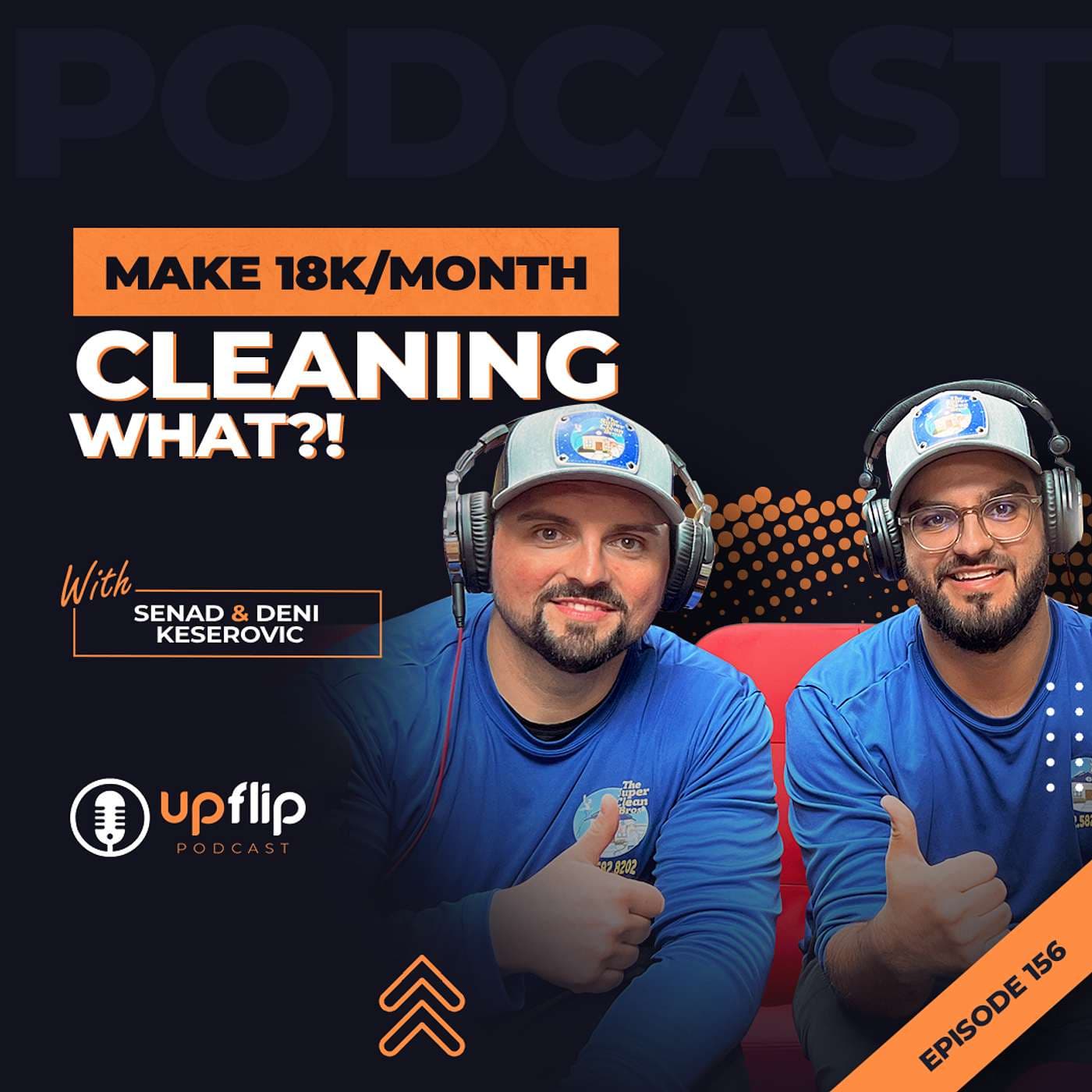
156. $18K/Month with This ONE Service — Niche Business Idea
Episode Overview In this episode, hosts Ryan Atkinson interviews brothers Sanad and Denny Karasovic, co-founders of Super Clean Bros. They discuss their journey in establishing a solar panel cleaning service that has rapidly grown to generate over $18,000 per month. The episode outlines the importance of niche business ideas, customer relationships, and operational efficiency through technology.
---
Key Themes and Discussions
- Origin of Super Clean Bros
- Background: Sanad was involved in trucking and logistics, while Denny worked in the pharmacy field. Both had entrepreneurial aspirations.
- Idea Generation: The concept for Super Clean Bros emerged during COVID-19 while discussing various cleaning services, particularly solar panel cleaning, which was less common in their area.
- Business Model and Pricing Strategy
- Flat Rate Pricing: They opted for a flat rate pricing model rather than charging per panel. This was perceived as fairer to customers and simplified pricing.
- Base Prices:
- $249 for single-story homes
- $299 for two-story homes
- Customer Value Proposition: Business focuses on long-term value for homeowners, ensuring clean solar panels enhance energy production and protect warranties.
- Initial Funding and Launch
- Startup Capital: The brothers withdrew from their 401(k) accounts—$9,000 from Sanad and $7,500 from Denny—to cover initial costs.
- Early Clients: They began by cleaning solar panels for friends and family to refine their techniques and gain initial experience.
- Growth Strategies
- Marketing Tactics:
- Wrapped trailers for visibility while driving.
- Participation in community events and news appearances (e.g., Fox 10 News) boosted credibility and exposure.
- Referral marketing proved significant, with 60% of clients being repeat customers.
- Use of Technology:
- Implemented a Customer Relationship Management (CRM) system to streamline operations and automate scheduling.
- Utilized Square for payments and invoicing, enhancing professionalism and client convenience.
- Operational Efficiency
- Equipment Upgrades: Initial equipment was limited but evolved into more efficient setups that drastically reduced cleaning time.
- Hiring Practices: Currently only the two of them manage operations, hiring temporary workers for larger projects as needed to maintain quality control.
---
Key Takeaways
- Niche Business Potential: Identifying a specific problem, such as dirty solar panels, can lead to a successful business model.
- Customer Relationships are Crucial: Building trust through quality service and communication leads to repeat business and referrals.
- Embrace Technology: Leveraging CRM systems and efficient payment platforms can streamline operations and enhance customer experience.
- Continuous Learning & Adaptation: The importance of researching industry standards and adapting to changes for sustained growth.
---
Resources Mentioned
- [Start a cleaning business for free](https://bit.ly/47Z1DWb)
- [UpFlip Blog for business insights](https://www.upflip.com/blog)
- [Super Clean Bros Website](https://thesupercleanbros.com/)
---
Conclusion The episode emphasizes the power of niche services in entrepreneurship and provides actionable insights for aspiring business owners. The Karasovic brothers exemplify how passion combined with strategic planning can lead to substantial financial success.
Written by AI. May contain mistakes. Listen to the episode to check what was said.
Transcript
Automatic transcript. May contain errors.0:00Sometimes the most lucrative business ideas are right in front of you. That's exactly what happened to these brothers who now rake in$18 ,000 a month cleaning solar panels. They learned how to scale up business that solved one single problem, and more importantly, provided homeowners with value over the long run. This is Ryan Atkinson, and you're listening to the Outfit Podcast, where we uncover how great businesses are built and the secrets to replicating their success. Today, we're sitting now with Sanad and Denny Keserovic, co-founders of Super Clean Bros. This is going to be an amazing episode talking about how they started their own company, cleaning solar panels.
0:38We're going to discuss exactly the steps that they took to get started and how they grew to that$18 ,000 a month. Super excited for this one. Sanad and Denny, thank you so much for being here. Thank you for having us. I think this is going to be a really interesting episode. One, because typically when you have these interviews, it's only one person doing it. And it's always fun when you get two when they're actually brothers. It makes for like a whole new dynamic. So thank you guys again so, so much for being here. No worries. Let's talk about the early beginnings of Super Clean Bros. What were you both like doing up until this point of like saying like, hey, let's go start this business together?
1:09So I was in trucking and logistics of delivering loads and things like that, supervising drivers. And kind of my thing was I was entrepreneurship and I did have a trucking company prior, but then sold that and was just working for a corporation and basically had an itch again to get into, you know, managing a company of my own and entrepreneurship. And that's kind of like I was thinking and we were one day tinkering with our trucks in the garage and we're just like, we should start something. And we were talking, discussing pressure washing, solar panel cleaning, a lot of these home cleaning necessities.
1:47And that's how the super clean bros kind of came on. And then like, Danny, what were you doing? Were you doing like the same thing just to kind of clarify that for the audience here. Yeah. I was in the pharmacy field, so completely different. So I just, you know, did pharmaceutical and got out of that to pursue this and go with my brother and started off with just thinking about as an idea, build up small. And then the way we developed going from there is, you know, we had to pull funds from somewhere. So we both worked for a corporation. We had our 401k and we're like, let's not take a big lump sum loan during COVID.
2:19So we just did the minimum and then started buying our equipment from there. Interesting. I want to ask, like, what was that first conversation? Were you guys just like eating dinner together? Were you guys having a few drinks and all of a sudden you're scribbling on a napkin or like, yeah, how did that first conversation happen? Draw that picture for us? Well, we were just in the garage. We like to go off-roading and we were just messing around with our vehicles and doing actually some electrical work on our lights and started talking about it that we should start something. But it was also middle of COVID.
2:48So we knew right the way, we didn't want to do anything that deals with kind of working inside the house or inside of a commercial business, just the way things were going. So we were thinking, well, if we do any kind of cleaning, it should be maybe exterior cleaning and solar panels were being like put up left and right on these homes and buildings. And I've never seen anybody clean them. So I started doing a little bit of research and looking companies that make the equipment to use, basically comparing Europe to here. In Europe, they're about 15 years ahead with building cleaning material, machinery, and things like that.
3:23I mean, most brushes and pulls, drone technology comes from Europe to clean these panels or clean a building. So we started looking into that and actually found a company here in the United States that orders most of its parts from Europe. They're based out of California, AM pressure washing, and we've built a close relationship with the owner and it started from there. And so you guys took out money from your 401k to like get the initial startup cost of starting a business. How much money did you guys take out of your 401k to get this thing started? I believe I took out about 9 ,000. Yeah. And I took out about 7 ,500.
3:57Okay. Very nice. So yeah, about$16 ,500 you guys took out. And then that first step is you identify like, oh, cleaning, like we know Europe's way ahead. We're going to start cleaning. So what was that first step to actually getting your first client to say like, hey, can we come over and like clean your solar panels? Or like, yeah, what did that step look like for you guys? That was, you know, just getting friends and family involved first. We know them. We'll still take care of their stuff and practice cleaning their solar panels. We have solar panels on our roof. Clean those, figure out what's the best tactic.
4:24The equipment when we started with was not the equipment we use today. So the time difference, what it took us about an hour, hour and a half to clean. Yeah, hour and a half to clean. Now it takes longer to set up and clean. Takes about maybe 15, 20 minutes to clean about 40 panels. Oh my gosh. Yeah. Let's talk about that equipment then. So what were you guys using that was taking you so long and like, how'd you cut down your time? Like dramatically? Yeah. Yeah. When we started, so it was middle of COVID. So finding equipment and ordering equipment and then getting this equipment delivered to us was a challenge.
4:55For example, we ordered some equipment in March and we ended up finally getting it in mid-September. So we were waiting well over six months for some of this equipment to come in. And then when we started using it, it was great. And some of it was already commercial grade equipment, but it wasn't what we wanted. And we were like, okay, there has to be something better out there. And then started researching more and more when income started coming in and then started basically buying things that will speed up the process because time is money. We can do more jobs in one day. And yeah, you know, it was a lot of research and finding a company that will work with us and also show us how this equipment works.
5:32And if we have any issues, will they actually support us? Or was it just, you know, once they sell it, they forget about us and we're on our own. So what are the supplies you need? So if someone's like listening right now, they're like, okay, this is like a pretty interesting idea. Like solar panels, haven't heard of this one before. This is the first time I've had this conversation on this podcast. So this is the first time I'm hearing it as well. But like, what are some of those beginning supplies that someone would need? If they're like, I'm going to go to my friends and family and try this out, what supplies would they need to get started?
5:57So So definitely they would need a pressure washer that's three gallons a minute. They would need a big tank, like at least a hundred gallon tank, and then they will have to set up a deionized system. We have a three-part filtration system. So basically when you connect the garden hose to the spigot, it will go through the garden hose, go through a pre-filter, then two additional filters, and then it will fill up this tank that has basically spotless deionized water that you use to clean the panels. Because if you use regular water, it's high in calcium. And once it dries, it will leave spots and burn into the actual panel itself.
6:29And that's a no-no. You're making it sound so easy, honestly. It seems easy, but to get there, it's a lot of work. I mean, it took us, I think, almost a year until we upgraded fully into our system that we use today. You know, we started off with a small five by eight foot trailer, realized there's not enough space we need. We have two pressure washers for the DNI system, one for window washing, one for solar cleaning. So one can be on the ground, one can be on the roof working. And then we have a pressure washer that was, you know, a wheel out and on the eight foot trailer. And it was like, it was cramped.
6:59It was a cramped space. So we upgraded to a full size 14 foot by seven foot trailer and upgraded to a hot burner system. So we have hot water on deck with our trailer. So if we need to get those tough grime stains, oil stains out of the pavers or concrete, it's all taken care of. Let's talk about that first year a little bit more as well. So you guys started off with friends and family. How long did it take for you guys to actually get like your first customer? And you can kind of tell us how did you guys get your first like paying non-friends and family customer? So in mid-September, we finally got our equipment.
7:29And in about mid-October, we actually got our first clients and people were calling us. Just exposure because we had our trailer wrapped. So when we're driving down the road, you know, it's a billboard and people would call. And then it's not just solar panel cleaning. We also do, you know, windows, bird proofing, gutter cleaning, house washes, roof washes. So it was around that holiday time where people wanted to actually get things clean before family members come out of town, before they put all the holiday lighting up and things like that. So from October till December, we made just less than$10 ,000.
8:03But then after that, you know, January, February, March was kind of slow. And then April, it kicked off again for us. And we were just, you know, we had a job every other day. And then once we got into June, July, it seemed like we had a job every day lined up to do some kind of cleaning, either windows, pressure washing, solar panel cleaning or bird proofing. And what really piqued our goals was being on Fox 10 News, the local news here. And as soon as they showcased that we do bird proofing and solar cleaning, the calls just started coming in. That was in June. And so we're getting calls all the way to be booked through almost November from there.
8:37So it was like free publicity for us. and we were at a home and garden show and our phone was nonstop ringing and we had terrible service there. And I was like, come on, just let the voicemails come in and we'll just call right after we're done from the home and garden show. And then I think we had about 20 missed calls in that first day. And then it just gradually grew the next day. Interesting. It reminds me of like when people go on Shark Tank and like after they go on Shark Tank, your revenue goes up like 400 % by some instances. But that exposure, it sounds like on Fox 10 News is like really what got this thing going.
9:08It sounds like you guys had some pretty good traction going, but that is really what like took you guys to the next level. I want to talk about that a little bit more. Were you guys doing any other marketing activities before this Fox 10 News appearance or was this like truly like the number one thing that like drew you guys forward? I was inclined in graphic design with high school. And so our brother's like, we should design some door hangers front and back and get all the services that we do. And we don't like the door knockers. We're opposed to door knocking. So we're just let's hit as many houses as we can.
9:36just hang our signs, let them know we're in the area, and then just see if we get calls. You know, I think we hung like 250 our first day and we got maybe two or three calls out of that. So the interest peaked. And so you go into the community, you do one house and the neighbor sees it. It's the curb appeal. The neighbor's like, oh, can you do mine? And how much would it be? And now you don't have to knock. You don't have to hang. You just communicate with the customer that's next door because they come looking for you. I really like that approach. It's honestly like social proof in a way of like, oh, well, my neighbor's is doing it.
10:05like, I should probably be doing this as well. It sounds like that was like an effective strategy for you guys. Yeah, we definitely get a lot of calls from people. Hey, you were referred by so-and-so. And so it's just a word of mouth and the credibility and trust. I want to thank a listener, Tammy Jersey Girl, who recently said, every show has so much gold. This is for every entrepreneur or wannabe entrepreneur to get started and also get to the next level. Keep doing what you're doing. Tammy, you keep doing what you are doing. Thank you so much for this review. They mean the world to me. So thank you so, so much for this.
10:35So when you say you get like two or three jobs, depending on the industry, that could be if it's a clothing brand, like two to three shirts sold is not a lot. But two to three, like very high ticket items, like that's a big deal. Can you guys kind of talk about like your average ticket size when it comes to like these jobs specifically for like solar panels? So, yeah, the average ticket size right now is about six hundred fifty dollars. And we usually do about two to three jobs in a day. Our bigger jobs will do on like Friday, Saturdays and Sundays because usually people are home and they want to be home when we're doing that.
11:06We're talking about that's like a bird proofing job or house washes, window washing. Sometimes they want the interior and exterior done at the same time. So they kind of want to be there, you know, for that. Yeah, I mean, six hundred fifty dollars. I know a lot of the listeners that want to start companies like their ears are probably peaking up, especially if you're doing like two to three jobs a day. When it comes specifically, could you guys give like a percentage of like how your guys's jobs come through now? Is it like 75 % referral, 10 % XYZ, 10 % XYZ, 5 %? Can you kind of talk about that a little bit more?
11:35Sure. About 60 % of our customers are repeat customers. So we have them set up on a every six month basis, depending on what they're getting done. Solar panels are usually every six months. They get cleaned in Windows. And then we get a lot of calls. They were looking on Google. So, you know, they were looking for bird proofing and those are kind of like bigger jobs. and the customer will find us and go on our website or our Instagram and kind of see what we do and how it's done. And then they'll give us a call or we'll get also a lot of referrals from previous clients that we've helped out and are saying is make your mess our problem.
12:08So we eliminated that problem for them and made it our mess. What I like about that is like, those are like free marketing activities. You guys aren't like throwing like hundreds of thousand dollars into like Google ads or anything. It sounds like it's referrals, just kind of posting like Google reviews? We'll sometimes do like Google ads or mailers, just if we're trying to pick up on a certain criteria or job, you know, if you want to hit a certain area or something like that to pick up more clients in that area, then we'll do it. But all we have is just a website with SEO and that's pretty much it.
12:39And then our vehicles are wrapped, our trailers are wrapped. So when we're going down the road, you know, people can see and we get a lot of calls that as well. And our Instagram is pretty big with our videos. So with their little shorts and reels, we try uploading almost every day if we can, but it's a lot of work. Nice. Two things here. One, I love that you guys kind of have like a flywheel going with like this six month basis. It sounds like you guys do such a nice job that every six months, you're kind of just building that flywheel. So you're always having business if it's a repeat or a new customer.
13:07Specifically, I want to ask now about how you guys have scaled these operations up because now you guys have trucks, you have trailers, you have new equipment. Can you talk Talk about like employees from like zero to like the first year and maybe like beyond that now. Like how is your guys' operation scaled up? And like what can people know about like scaling a company like this? Like what should they know? Great question. We don't have any employees. It's just us two. There you go. When we do have bigger commercial projects, we'll hire help just so we can get this done sooner for the client because there is a deadline.
13:37Otherwise, it's just us two because we've tried. It's just you can't count on them and hope that they'll do the same job with same quality as we do. Our Google reviews are all five star reviews. We have like over 50 reviews. And this is kind of like we want to keep that as five stars as long as we can and not ruin that, I guess. We want to have a lot of good quality relationship with our customers. And they're always impressed that, oh, you two are the owners and actually working. A lot of them are thinking we're just going to send a crew out and then do the job for us. And, you know, we just do the calls and do the appointments, but we do it all like we're one stop shop for the customer, at least.
14:16Yeah, I want to ask, like, is that a lot on you guys to just be like a two man shop, especially doing like 18K a month? You guys have two or three jobs a day now. Like, is that a lot for you guys? I'm just like curious. It sounds like a lot, honestly. Sometimes it is, but you just find a way how to get it done. We use a lot of CRMs and basically booking apps and things like that to keep us going in like a well-oiled machine, you know, so we don't miss any appointments. We make sure we're in touch with our clients. Our CRM also lets them know two days before and one hour before we get there. So it kind of does a lot of that work for us.
14:47So we don't have to keep calling, reminding and things like that, because we're just, you know, going from a job to a job, you know. I like that you guys like apply tech in this, because I feel like a lot of times when we have companies that are like similar years on, like we've had other like cleaning services, like house cleaning service and stuff, nothing specifically like this. A lot of times they say like beat the competition, you need to apply like automation, like actual have like tech within your workflows. And it sounds like you guys have that with like your CRM and like other automations in place, similar like those reminders, essentially.
15:13I mean, our CRM rebooks them right when we're done with the job, it books them for the next six months. We don't have to worry about it. Drastically, that's been helping us a lot to get the repeat clients because we just tell the customer, hey, we'll book you for six months. It's automated. If you want to reschedule, cancel, just that's fine. We won't be upset. You know, you have an option that we're there, that we're coming back in six months and you can just let us know to reschedule if needed. And most love that it automatically reschedules them for six months and sends them that reminder because people are so busy that they forget.
15:42And, you know, 48 hours before we show up, it's going to remind them. And then if they have to do any changes with their plans, they have enough time and then lets them also an hour before. Now, hey, they're about three here, you know, they're on their way. Interesting. Yeah. It sounds like you guys make like a very frictionless process to like get those repeat customers by like automatically scheduling them. Yeah. And we get a lot of customers that will just, you know, be the first time cleaning their windows and they love the whole technology thing and makes it so easy for them that they're like, OK, you know what, just schedule me, you know, for driving and cleaning or this cleaning or that, you know.
16:14So we kind of made this business as a one stop shop for anything that they need exterior cleaning wise. The only interior cleaning we do is windows. Everything else is exterior. here. That's great stuff. I want to ask one more question, just a little bit more about like the technical details. I have some just some interesting questions to ask you guys. Just I'm curious on like the dynamic. But before we do that, can you explain like the CRM that you guys are using? Because I think it is very interesting that you are applying like very 21st century, like tech into this company like this. And I think it's super important.
16:39So can you kind of tell us about like a tech stack that you guys have? Yeah. So we use Square as easy as it sounds. It's just Square. I mean, there's multiple options out there for booking and stuff like there's Jobber and there's plenty of other markets for that. But we just decided to use Square because we're used to it. You know, other services like you go to the haircut salon and get your hair done and they're using Square and you're like, how can you use that towards the cleaning services? And when we did the research, they actually did have things in place and you just have to mess with it and make your own.
17:07And I really like that option. It's a quick 30 minute feel on how their system works and you can get it down really well. I really love the fact that you can just use your iPhone to, you know, use the NFC to charge the credit cards or debit cards from the customer right away, send invoices. If it's a corporate account, it looks professional and they like it too, because it's email text or a phone call straight through the app. Yeah. When we did our research, it was like a lot of companies use different things, but they also use a bunch of different applications for electronically sending the bills, things like that.
17:37We can get it all done on our phone through that same app with Square and not worry about it. I think this has been great, just like technical advice on like how to get started, what your operations looks like, especially that tech stack. I want to get set back and kind of make a hard pivot on the conversation and talk about the dynamics of like working with your brother. What's the like the dynamic of working with your brother and like actually building a company? It's one thing to do with like your partner or like someone else. Well, Sonata and I are nine years apart. He's older than me. So growing up, we were always bickering.
18:04We didn't have any common interest. Like if I played video games, he would be already, you know, nine years ahead. He's out of video games. He's studying for school or doing something else. But the older we got, the common interest we had was, you know, off-roading and camping and stuff. So that got us connected and rebonded together. And we decided, you know, a business track together would be a great relationship bonding experience. And him and I work really well together. It's easy. You can get frustrated with family and stuff, but there's nothing that we can do to each other that we won't come back to go to work the next day or something.
18:35Like if an argument breaks out, not that we have any, but if we did, it wouldn't be like detrimental to the business because we can keep our cool, especially him. I don't know how he does it. So I'm more of a hands-on person, so I can build things, fix things, make things. He's more like the technology computer stuff. I can do it. It doesn't interest me as much. I can get to a job site and a customer client can explain to me what's going on. And in my head, I already have the wheels turning. How am I going to approach this problem and fix it? Where with him is like, he might not see that picture, but he can do the marketing and the computer stuff.
19:09So as long as I show him, have him picture a blueprint and he'll see, and then we'll just knock it out and go from there. Interesting. Yeah, it sounds like it's a good like yin and yang of like, so now like you're a little bit more like hands on with everything. And then you're like a little bit more like computer where it's like, I think that's like a good balance to have, especially when like you are building a company. And the crazy part is like when we started this, we were just, you know, doing this as a side hustle, just extra money. And then it just slowly blew up. And it's like, you know, it's an actual like company with the makes a profit and comparing it from year to year.
19:43Our growth just keeps increasing crazy amounts. Yeah. And before we get to our fan blitz questions, you talk about that growth a little bit more like what's one thing someone should know if they're wanting to start like a similar business to this? I want to give you guys like that final stage for our last five questions here. So when you start something like this, don't think, you know, it's you're going to be rich overnight and it's going to explode overnight. It's going to be slow in the beginning for at least the first year until you start building up clientele, people actually noticing you.
20:10You know, people are going to do their research to see, OK, who is this company? What are they all about? probably once a week, somebody is going to tell us, Hey, I saw you guys online, but I read all the reviews and things like that. And based off of the reviews, I decided to call you. So even when you're, you know, we're three years plus into this business, people are still doing their research and making sure they're picking the right company. So it's very important for you, whatever you do in the beginning, you got to make sure that you do it right. And you'll spend a lot more time there, but building that reputation is key.
Read the full transcript
20:38Awesome. Reputation is everything and getting those Google reviews is huge. I know that's for my own business as well. That's the social proof of like being able to say like, oh, we have like 30 customer testimonials or reviews is something that does not go unnoticed with people. But let's go to our fan blitz questions. And these are our last five questions that shows and these are actually submitted from our community. And guys, if you wanna join in on world-class entrepreneurs on how you can start your own business, the questions that you have, you can submit these at www.youtube.com. To submit all your questions there.
21:03But you guys ready to close us out with our last five questions? Yeah. Awesome. Number one, what is your offer for cleaning solar panels? Example, how did you position and pitch it to homeowners and businesses? And what do you charge for the service? So the way we charge for solar panel cleaning, we're based out in Peoria. So you have a certain radius of how far you're willing to travel. But our standard rates are if they're a one-story or two-story home. We're not charging the residents per panel because it's not fair to them. Because that should be just a commercial price for like a commercial building or a solar farm.
21:35So you start off at a budget, a certain amount. So you can do$249 for a single-story home and then$299 for a two-story home. Once you do that, that's where you have a base price of what you're going to charge for those solar panel cleaning. And customers really like that because a guy's going to go to somebody's house and be like, oh, you have 30 panels, it's$5 a panel, it's$150. Yes, it's less, but the neighbor next door has several more panels, 40 panels to 50 panels. Now you're charging them$200. It's not really fair. And it's the time it takes to clean one house to the next house should be about the same.
22:05And we just make it fair to the customer, charge them a flat rate versus, you know, some even now charging 12 to 15 bucks a panel, which is really crazy high for a resident. Why did you guys opt to start up a physical service based business? Was the business born out of necessity or a passion? It was passion, but also looking into the generation, the younger generation these days is not, I guess I would say savvy or knows, is not educated. You know, a home requires maintenance just like anything else. And if you don't take care of it, you know, things will break. You're going to have major repairs that you'll have to dish out for.
22:42So a company like ours, that's a one-stop shop for everything, you know, helps the community and the residents and the population as well. What's the best part of being an entrepreneur? The best part, I guess, being your own boss, having your own time, finding time to be with your family a lot. That's the best part is, you know, having free time to yourself and making the business around your time so it doesn't have any conflict with family, friends or any of that. It's not the easiest thing in the beginning, but it gets easier the longer you do it. For me, it's just rewarding making your own success and filling your own dreams.
23:15Yeah, I say this a lot on the podcast, but the three W's of why I started a business is I had to decide where I work, when I work and with who I work. And that's definitely the best part of being an entrepreneur. You get to decide all three of those things. Number four, what was the deciding moment in your previous job, which made you say, yep, never doing this again? So I did pharmaceuticals, retail pharmaceuticals, and dealing with stuff that you have no control over. Just decided you can do so much and you can do the right or wrong thing. And next day, your general manager is going to be like, you did the wrong thing when you thought it was the right thing and you have no control over that.
23:47So it's having your own business, you know, you can control the goods and the bads pretty easily. In my career, basically where I was and what I was doing, my next step was being a manager. And that means, you know, getting a salary. And as the saying goes, corporations give you a salary to forget about your dreams. And I don't want to forget about mine. So I decided to do my old thing. I love that. That is great. I agree with that. Number five, if you were to start another business tomorrow, what would you do first? Well, the first thing is always for me. I do a lot of research before I do anything, looking at what the need is, what the requirements are, and is there any licensing experience needed?
24:29But there's so much out there. If you put a bunch of effort into it and some of your time, you can accomplish anything. It's just, is it the right time and the right place for you, I guess. Learning is the biggest curve that you can have to get a step forward in any business that you do. And relationships are everything. I mean, in business, just kind of make sure you're building those relationships with everyone On this small or big, it doesn't matter. Always make sure you are leaving everything on a positive note. I love it. Well, I think we are ending this on a positive note. Those are our last five questions of the Fan Blitz question.
24:58So I want to thank you guys both so, so much for being here. And if someone's like, oh my God, this business sounds incredible. I want to learn more about them. Where can people go to contact you guys? TheSuperCleanBros.com or 602-582-8202. Give us a call, text. We'll answer right back. Or our Instagram is pretty big. You'll see a lot of videos. You can learn from those and go from there. Nice. And what is that Instagram handle? At the super clean bros. Guys, this was an amazing episode with Sanan and Denny. Three quick takeaways for you. As we always say, to get your first customer, look to friends and family.
25:30They're going to be your best source to actually see if you have a good business ID and if you can execute. Number two, social proof with neighbors. They were talking about going door to door, leaving stuff. And then eventually they started getting neighbors calling and saying, hey, I saw you did this. I saw your referral. So social proof is huge for this business. And then number three, if you are wanting to start a company like this, put automation and tech in place. It's going to be a super easy way for you to retain customers. They gave the example that once they're done, every six months, it's just going to automatically schedule you again.
25:56Love that little tidbit. If you're still listening and haven't left us a review yet, pause the show and do it now. Your reviews mean so much to me, and they help to get the show in front of more people who, just like you, want to leave their nine to five and start their own business. I appreciate you all. Sanad and Denny, thank you so much for being here. Thank you, Ron. Thank you. Thank you.
From the publisher
Sanad and Denny Karasovic began their company, Super Clean Bros, when they found out that dirty solar panels are responsible for reducing overall production by 50%. They now offer cleaning services to homeowners with solar panels to help save money, maximize energy, and protect their warranties. They join Ryan to discuss how their niche business idea quickly saw significant growth in such a short amount of time and are bringing in over $18K per month.
Sanad and Denny explain how starting a business with a flat rate pricing model can be seen as a fair way to appeal to customers, using personal funds such as investments can be a great option to use as startup capital, and building quality relationships will create loyal customers and positive reviews. They also talk about the use of CRM and how it can streamline operations to improve customer experiences.
Resources:
- Start a cleaning business for free today: https://bit.ly/47Z1DWb
- Check out the blog for more business insights: https://www.upflip.com/blog
- Connect with Sanad and Denny Karasovic: https://thesupercleanbros.com/
Ready to be your own boss without starting from scratch? Grab our FREE Franchise Guide and unlock the secrets of proven business models that have already created thousands of success stories.
Connect with UpFlip:
- On Youtube
- On Instagram
- On Facebook
- @UpFlipOfficial on Twitter
For more insights to start, build, or grow a business, check out the resources on UpFlip.com or head to the UpFlip YouTube channel to see more interviews with business owners and experts.
Thanks for listening!


