
In short
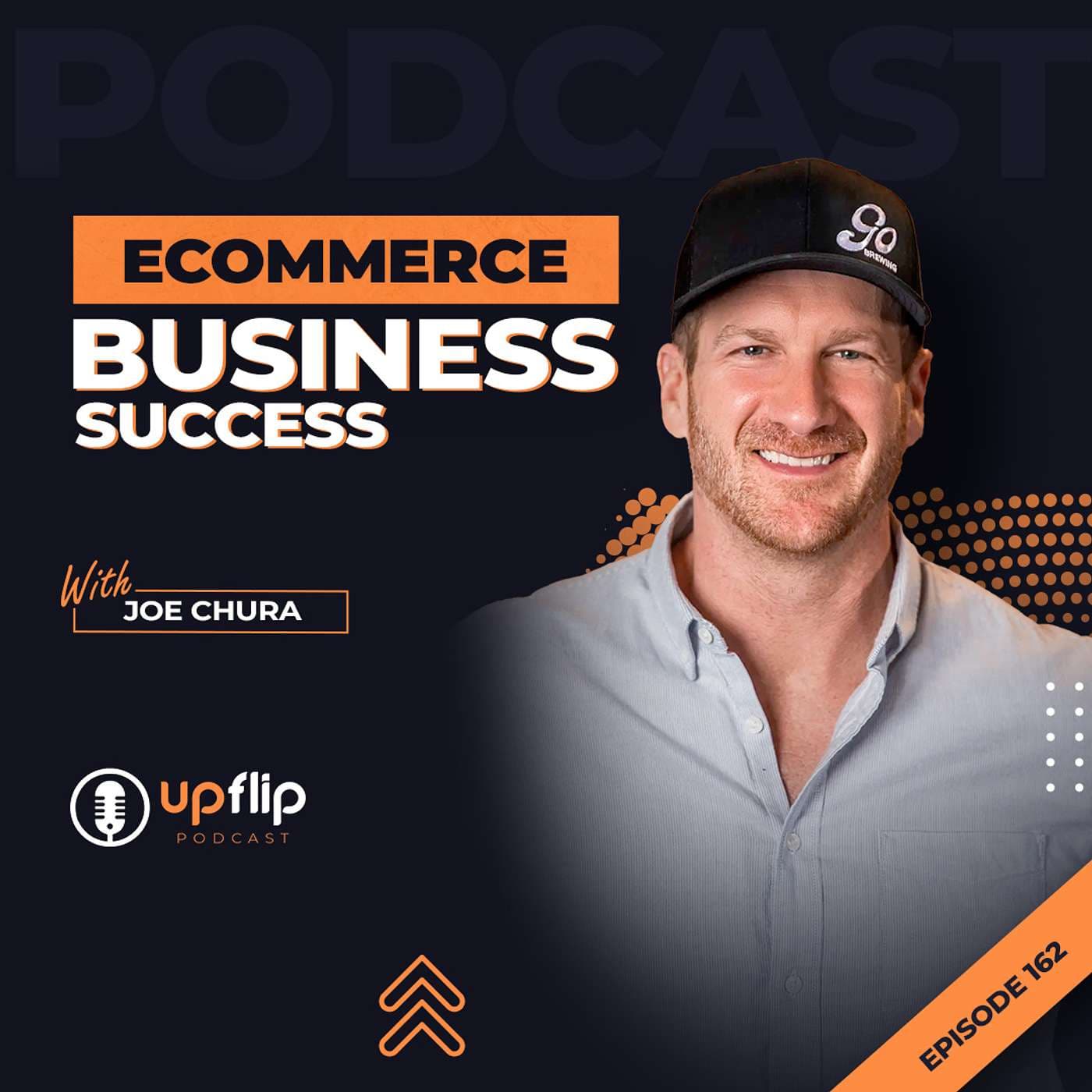
UpFlip Podcast Episode 162: His Million Dollar Ecommerce Success That Started Locally!
Podcast Overview
- Title: The UpFlip Podcast
- Description: Focuses on how successful businesses operate and the principles behind their success, aiming to inspire entrepreneurship.
- Episode: 162
- Guest: Joe Chura, founder of Go Brewing
- Key Topics: E-commerce success, competitive strategies, personal journey of entrepreneurship.
Episode Highlights
Introduction
- Host: Ryan Atkinson
- Guest Introduction:
- Joe Chura is recognized for creating multi-million dollar brands via e-commerce, particularly with Go Brewing, a non-alcoholic beer brand.
Joe Chura's Early Life and Career Journey
- Age 20 Experience:
- Joe describes his early career at Ford Motor Company, working on the assembly line while preparing for fatherhood.
- He felt limited by his environment and aspired for more beyond being a supervisor at the plant.
- Education and Growth:
- Studied while on the night shift, seeking a better future.
- Realized his aspirations were limited by his surroundings and the prevalent mindset at Ford.
Transition to Entrepreneurship
- Finding Purpose:
- After selling his previous company, Joe faced a sense of emptiness and depression.
- Inspired by personal challenges with alcohol consumption and family history, he decided to create something meaningful.
- The Birth of Go Brewing:
- During the pandemic, Joe and his wife committed to making a change in their lives. Joe abstained from alcohol for 75 days, leading to the idea of a non-alcoholic beer brand.
- He identified a gap in the market for quality non-alcoholic options.
Building Go Brewing
- Initial Steps:
- Joe focused on finding a head brewer, emphasizing the need for expertise in brewing.
- He transformed his garage into a brewing facility and began with a small team.
- Local Market Testing:
- Emphasized starting small to understand customer preferences before expanding.
- Utilized local marketing strategies and built relationships with independent shops.
Branding and Marketing Strategies
- Differentiation:
- Aimed for a unique brand identity, focusing on storytelling that resonates with consumers.
- Developed packaging that conveys a powerful narrative, inspired by real-life stories.
- Customer Engagement:
- Actively sought customer feedback to refine products and marketing strategies.
- Built a community around the brand, engaging with customers both online and offline.
Challenges and Growth
- Start-Up Costs:
- Joe self-funded the venture, which was a significant financial commitment, especially for a brewing facility.
- Overcoming Setbacks:
- Faced challenges such as equipment failures and changes in Amazon's listing policies but adapted quickly to pivot the business.
Key Performance Indicators (KPIs)
- Identified growth metrics that include:
- Sustained month-over-month growth.
- Expansion into new retail and distribution channels.
- Customer feedback and engagement metrics.
Final Reflections
- Personal Growth:
- Joe notes that entrepreneurship reignited his passion and creativity, emphasizing the importance of fulfillment in work.
- Advice for Aspiring Entrepreneurs:
- Start without waiting for a perfect moment; take actionable steps.
- Ensure passion drives your work to overcome the challenges of entrepreneurship.
Key Takeaways
- Fulfillment in Work: It's essential to find joy and passion in what you do as an entrepreneur.
- Calculated Risks: Establish KPIs and metrics to assess progress and enable informed decision-making.
- Passion-Driven Growth: Genuine enthusiasm for your business will help navigate challenges and inspire growth.
Resources Mentioned
- Go Brewing: [Website](http://gobrewing.com)
- 500 Free Business Ideas: [Link](https://bit.ly/48QSU8Z)
- Previous Episode: [Episode 141](https://www.upflip.com/podcast)
- Connect with Joe: [Instagram](https://www.instagram.com/gobrewing)
Conclusion The episode encapsulates Joe Chura's inspiring journey from assembly line worker to successful entrepreneur in the e-commerce space. His story highlights the importance of resilience, strategic thinking, and the drive to create a meaningful business.
Written by AI. May contain mistakes. Listen to the episode to check what was said.
Transcript
Automatic transcript. May contain errors.0:00If you ever thought it was impossible to compete in a crowded online market, think again. We have the founder of Go Brewing on the podcast today. He has extensive experience in building multi-million dollar online brands that bring you in unreal revenue and continue to grow and adapt as the internet changes. Even you can create the foundation of a successful business online in just five minutes. This is Ryan Atkinson and you're listening to the podcast where we uncover how great businesses are built and the secrets to their success. Joe Chura, founder of the non-alcoholic beer powerhouse Go Brewing is here to talk about creating million-dollar e-commerce businesses and how to compete online.
0:35Joe built three successful businesses that all solve tens of millions in revenue. With SEO, e-commerce, and market positioning, he's been able to create companies that not only complete for clicks, but win consumers for life. Thank you so much for being here today, Joe. So excited to have you on. Yeah, it's great to be here, Ryan. It's going to be great. You have a great story. And I want to start off with your story because before GoBrewing, like I said, you had multiple CEO roles. You got acquired by Cars.com for$205 million dollars. That is a million. And now go brewery. But I want to talk about your beginnings, age 20.
1:05Can you take us to what Joe Chura at age 20 was doing? Yeah. At age 20, I found out I was going to be a father. And I want to set this up by saying I had no business being a father at age 20. I could barely take care of myself. And I found myself working on the assembly line at Ford Motor Company in Chicago. And that is primarily because I needed a job because I was going to be a father, as I mentioned. And the only people I knew were my girlfriend at the time, her family, who all worked at the Ford plant. And my first day there, I knew I didn't want to do it forever. There was a lot of discussions around people's tenure there.
1:43I call it the countdown when the common language was, how many years do you have left till you retire? So from day one, I heard I have 20 years left, I have 10 years left. And it was like this perpetual place where you could not get out of working at the plant. It seemed unheard of. Why would you leave there? You have an amazing job. And my dream at the time was to be a supervisor at the plant. That is all I could see. And to get that job would have been unbelievable. But the only way for me to get that job was to go to school. So I enrolled in school, in college, so I'm 21, just had a child. And I'm going to school during the day because I was on the night shift.
2:22When you start at four, you're on the night shift, get off, it's from like 3.30 to midnight or something like that. And then I would wake up, I would go to school in the morning and I started to do that. I started to struggle. I started to get a little behind. But then as I started to get better and faster at my job, building the 98 Taurus, like putting these parts on, I found myself with 15 seconds in between building cars. And instead of staring at these supervisors, I started to read 15 seconds at a time, my textbooks in college. And I did that 72 times per hour, eight to 10 hours a day for five years.
2:55And what I realized, Ryan, during that time is my aspirations were limited to what I saw. The most successful people in my world at that time were supervisors at the plant. So that was the epitome of where I wanted to go in life. And it wasn't until I was able to get out of the plant, the marketing sales division at Ford, after I graduated that I saw bigger opportunities in life. And even at that point, they became constrained to my environment. I think that's a really interesting perception to have because a lot of times when someone younger in their career, someone just young in general is looking for inspiration, they're often looking to like their co-workers or like their parents.
3:35And like, if my parents only a manager, like that's kind of my ceiling. And I feel like that's kind of similar to like what you were experiencing at four is like a team supervised lead, whatever is like my ceiling, but you knew you wanted to go beyond that. And you're actually taking action steps to do that. I want to talk about Go Brewery now because Joe, you've been in cars for your whole life and now you're going to go to a brewery. How does this idea pop into your mind? Yeah. So I've heard a lot of people say this on your podcasts. You really have to find your why in life and your purpose.
4:00And when I was building these companies, my definition of success wasn't a sale or an ending, a fiddite thing. In fact, when I was growing these businesses, people would be like, oh my God, don't you just look around and see what you built? I'm like, no, because business is fickle. It could change immediately. It could change the next day. You can't control a lot of things. So what I would tell people is until I have like an exit or something that can happen that I can't get taken away from me, please don't say that. So that happened. And I thought I would feel great about myself. I thought I was going to just be like, yep, I did it.
4:28And yeah, that lasted for like maybe a month. And then I started to feel lower. It was almost like this dopamine rush that I had for building up this company for many years just crashed. And I was like, what is my purpose? So I started to drink a little more than I should. And my father succumbed from alcoholism in 2006, runs in my family, like many of your listeners, I'm sure have families and parents, maybe yourself, you struggle with alcohol. My brother was four years younger than me in the hospital every week, literally about to die, a hundred pounds overweight. And I started to really analyze myself and I'm like, man, I'm not heading down a good path.
5:00I started to get a bunch of weight. I started to get depressed. And in 2020, my wife and I, during the middle of COVID, we're like, we got to do something. Our life had been about, hey, the diet starts Monday. Everything starts Monday. Everything starts next week. And finally, we're like, screw that. So we did a challenge. I abstained for 75 days from alcohol for the first time of my life as I was a kid. I mean, I never went more than like three or four days without drinking something. So I say to people, you don't know what it's like because you're still always under the cloud of alcohol. I was always under the cloud, even if I didn't drink for a few days.
5:29It's still in you. And what happened is during the 75-day challenge, like three weeks into it, my skin started to become clearer. I started to have less anxiety. I started to feel more confident. The only thing that curbed my craving was any beer. That's it. So I started drinking more of it and went through the 75 days. I ended up losing significant weight. I have a bunch of before afters online. And then I wanted to continue that, not necessarily abstaining or being a teetoler, but like really controlling my drinking. And as I started to study the non-alcoholic market, I was like, man, there's a lot of opportunity here.
6:04And this is like now this is 21. It is really manifesting itself. And every day I woke up and I couldn't stop thinking about it. The only issue is the only thing I knew about beer is how to drink it. I didn't know how to make it, but I didn't know how to sell online. And with any beer, I found out you could sell online. So that really gave me the confidence to take that next step, which we could talk about. It's like, it's really important to find your passion and then take a step forward toward that. Well, Joe, you just took the question out of my mouth because that's exactly what I was about to ask.
6:30I want to first off say like, congratulations, like getting off 75 days of alcohol is like a huge accomplishment for anyone. Listeners like definitely as well. So I applaud you for that. but I want to go to that next step. What was that next step once you identified like, okay, like I'm actually going to go create an NA brand, non-alcoholic brand. Yeah. So what I did is because I didn't know how to make beer, I knew my biggest issue was one, I had to get my wife's buy-in. She's my partner in this and she really helped me early on in my life recognize the opportunity in myself. And once she was like, yeah, I love the idea.
7:01I don't waste time. The next day I started to converse with people. I put a job posting out there. I didn't even know what to ask. I didn't even know what to ask someone, but all I knew I was looking for a head brewer. So I like someone else's posting, I pushed it out there. And I before I even had a company, because I knew that was the thing. I needed to find a partner that can make the beer. Otherwise, we're creating an LLC and sitting around and talking about it. So I did job posting, interviewed a bunch of people. Luckily, I had a bit of a background to not make myself look like a lunatic.
7:31And I found who is my partner today, James Bigler, He was an amazing human. And honestly, at the time, it could have been a complete crapshoot. And I'd let not be here today talking about this story. But I knew that was the first step in creating this business. And then James was hired on as a full-time employee. We transformed my garage into a brewery and we went to work. And every day, my wife would be driving the kids to school. They'd be shoveled in the garage and James would be in there working. And then we started to add a couple more employees and really built it from the ground up. And that was the formation.
8:02That was the first step in taking action in this case. I want to take a moment to thank our listener Mars and they said this Uplit podcast stands out for its well-researched and informative content that caters to a wide audience. One of the greatest aspects of the show is its ability to discuss topics that can be applied to everyday life, making it both relatable and empowering. Each episode provides valuable information backed by solid evidence and expertise. The hosts do an excellent job of breaking down complex ideas and making them accessible to everyone, ensuring no topic feels out of reach.
8:32Wow. Thank you, MarsN. If you've been listening for a while and haven't left us a review, would you consider doing it now? It helps us continue bringing great guests like Joe on the podcast. What I like about this is when you launch GoBrewery, you started by testing your brand on a smaller local scale to really understand your customer preferences. You didn't go humongous right away. And for people listening for e-commerce, this could be a really powerful approach for you. Because before going in all in, you want to see how your product performs with a targeted audience and gathering feedback and making adjustments early on can set you up for a much smoother and more successful expansion.
9:07So definitely keep that in mind for all you listeners. Start small, grow from there. I want to talk about an important step in your journey as well. And that is like the actual brand and marketing that goes into developing any CPG brand. But specifically when it comes to like non-alcoholic brands, I feel like you need to market it and brand it in like a very strategic way because some people might be like, oh, NA, like no way. How did you guys go about the branding and marketing for a non-alcoholic beer? Those intentional steps you had. We saw a gap and we analyzed the market with storytelling and we wanted a storytellers with an edge.
9:39So we looked at all the brands were in the market and we're like, how do we differentiate ourself? Well, we want to differentiate ourself from a product standpoint by having a best in class product, like who doesn't want to do that? But the fact that we were making it ourself was actually a key differentiator. Because what it turns out in this space, this might be kept an obvious to some people in the CPG space. For me, it wasn't. Most people contract brew out or they'll contract out their beverages or their products. I didn't want to do that. I didn't even know that was an option. So us controlling the quality of our product was critical.
10:08And I wanted to have packaging that had more of a liquid death feel than like cozy warm feel. And I wanted to tell a story within those packaging chains, within the cans itself. I wanted to tell a story. So if you look at our cans and you look at the back of it, you scan the QR code, you actually read about a person that could inspire you. But these people aren't well known. So we're exposing stories of inspiration that you would never otherwise have known these people. And that's kind of really how we started. And that was the ideation of to create our logos and to create Go, the brand itself.
10:38And really, it's just kind of our just do it. Like it was it made a lot of sense to us because sometimes we overthink a lot of things, Ryan. And the most important thing is that first step in many cases. I love that. So we have two first steps that you took here. First, you identified, okay, I need a head brewer, someone that actually knows that to make this stuff. Your next step was like, how am I going to market? How am I going to brand this? You kind of combine those things and boom, you have a product. How did you guys go about getting your first customer then, your first sale? I'm sure you guys did some friends and family stuff, but your first actual sale that wasn't a friend or family.
11:09It's a good question. So we decided to launch simultaneously a tap room and an online store. and then we had no means to get real distribution. And honestly, we didn't want to initially because when you're first creating a brand like this, I didn't even know what beers would sell. I didn't know what beers would people like. I didn't know the reaction to the market. Like we just didn't know any of that. So the first thing I would say is like expose and try to market whatever you can at the given moment. At the given moment, I'd like to look at it as like, okay, we were near these other breweries.
11:42Let's be on the consideration set for someone to walk into our brewery So that was number one. And then all our marketing was localized, but that was never my goal. My goal was never to be a neighborhood brewery. I think those are amazing, but to be a sustainable brewing company for myself, it was to be a national brand, but we needed to start somewhere. So all our content early on was like the taproom content. And then it expanded, then we sold online, then we started getting customers to buy from us from all over the US. And then we started to get reviews for those. And we started to ask those, we started to have a personal relationship, We started to reach out and then independent bottle shops started to reach out to us like very small volume, but important.
12:18And we just simply would like go meet with them and we'd ask them questions. And who better to ask than a N.A. Bottle Shop who has all the different products. And I would sit with them and I would say, hey, what's selling? What packages are moving? What's the best style we can make? And I would just listen and then we would create it. And then fast forward a few months, we find out we win the Best of Craft Beer Awards, a gold and silver, three months into our business. You guys have 230 Google reviews and you're at a 4.9 star, which if I see that, that is incredible. So I want to, again, applaud you from afar on that.
12:48That is like building a brand that people love. And of course, you're winning these awards and everything. I think a question, someone might be super excited listening to this. They're like, oh my gosh, I might go do my own CPG brand. Let's talk about those startup costs I go. And I want to kind of rewind. I should ask that before I apologize. But what were those startup costs with initially launching this brand to eventually where you can get it to somebody that it's award winning? Yeah, so I was very fortunate by having to exit and being able to self-fund this. And that could be a challenge for people.
13:14In fact, I just took our first round of capital a few weeks ago. I've self-funded it to this point. And for us, building the brewery, depending on what you want to do, is going to adjust your costs. So you can contract manufacturer out. And in fact, if you're building a non-beer product, you probably should. So your costs are going to be different than ours. Ours were a lot in building a manufacturing facility, a brewery. Those are a lot of hard costs, a lot of hard assets, lots of tanks. We had to buy a pasteurizer, which was$500 ,000 to make sure the beer is safe coming out of it. And we had to invest a lot in what other breweries normally wouldn't.
13:48But we also made our beer in a way where we didn't have to take out the alcohol. So we just brew it in a way where it doesn't produce a lot. So I would look at your process, make sure you're making it in the most efficient way possible. And you can start somewhere. If you want to start contracting it out, whatever that may be, and then you want to eventually make it yourself or you want to make it yourself and then contract it out, whatever direction you want to go in. For us, it was a several million dollar investment initially, and it probably wouldn't have happened the way it did unless I had that exit.
14:16Absolutely. I think that is a very humble of you to say and acknowledge that you had a little bit of funds to play with here, especially to get started. I think that is very mindful of you. And I'm sure along this whole journey, you guys have had setbacks, challenges, failures while you've been going to grow a brewery. I know you talked about, I just said, I mean, Google reviews you guys had. I know you guys talked about the award you won, but early on, can you share a story with us about a failure challenge you guys had at Go Brewing that kind of propelled you forward? Oh man, Ryan, there's failures every single day.
14:43As I said, this business is very, very fickle. I would say just a real basic one. Early on, we're pouring our beer for the first time at this charitable event and we pour ice in the cooler that creates the kegs and all the beer lines freeze. We have nothing to pour. So it's just like, that's a minor example of like, what do you do? Now you have this big thing, Go Brewing is here for the first time, all the beer lines are frozen, you know, you just have to figure it out. And we had to bring in hot water, we ended up like only one beer line was somewhat working and then finally it came back up. Another recent example is, Go Brewing was ranked on Amazon.
15:20It's like one of the number one N.A. brands. Well, Amazon changes their policy overnight and they're like, well, we're not gonna allow N.A. anymore and our listings get taken down. And you've invested all of this effort time and effort in Amazon. And we've built an amazing store. We have 20 % of our sales are coming from Amazon. What do you do? First thing I did is I was like, all right, we need to pivot because what advantage do we have? We can make our own products. Let's make a product that's 0%. Let's expand one of the brands that we know are doing well. Let's not lose that channel. Let's not lose everything we built.
15:54And let's talk to Amazon and see if there's a way around this. But that's just another example. Right now, we have an incredible pipeline of orders in front of us that are going to need to be fulfilled by the end of this year. And I am obsessively trying to figure out how we're going to do it now. I think the pipeline thing is very true because a lot of times people talk in business is like, sometimes when these lucky breaks, not even a lucky break, but some of the times when these come to you, it's like do or die. Like you said, you get one opportunity with some of these huge retailers to fulfill these needs and actually be able to place the order.
16:24I'm sure that's very stressful for you as a CEO to actually be able to be like, we need to execute this. And I'm sure it's a very challenging mental process for you to figure out the actual process to fulfill these orders. Yeah, because there's a lot of different components to that, you know, and it has to be a great tasting product at the end of it because the customers are not going to be forgiving. You know, they're not going to care the circumstance at which we're creating these orders that were rushed. And, you know, we're being really intentional now about it and planning everything out and also planning for anyone listening to like, what do you do if something goes wrong?
16:53We're trying to think of that ahead of time. A great thing to think about in life is plan in advance what you know in advance. And in advance, we know certain things can go wrong. What were some of those KPIs that you had when assessing risk? Because as entrepreneurs, people say like, take these huge swings, swing for the fences. But they also need to be calculated when you're at a certain stage. So I like developing KPIs to actually build that confidence. So can you talk to us about those KPIs that you built? 100%. And a lot of these KPIs are not dissimilar to what they were at my last company.
17:22It's like, we need to show sustained growth month over month, quarter over quarter. We need to expand our channels. So I knew that the future was retail. It's being in stores, being in chains. That is where the volume of CPG comes from. And if I didn't hire an amazing head of sales who then built this amazing team, we probably wouldn't have had the volume issues that we have today. So the KPI was simply, are we getting distributors that want to carry our product, which is very challenging in this state age? And then are we getting retailers that want to carry our product? Those two things could have been slower.
17:56Those two things could have not manifested. Both of those KPIs of how many accounts do we have? How many states are we in as far as distribution? How many online sales are we getting? All of those main sales KPIs were going exactly the way we want them to go, in some cases faster than we even thought. And met our forecast. It's as simple as that. So we modeled what our forecasts could be. And as we were hitting it, we felt comfortable taking that next level of risk. What I love about... the space that you're in. Just from my stat on the side, in the NA space between August 2021 and August 2022, total dollar sales of non-alcoholic drinks in the US stood at 395 million.
18:36And that was a year over your growth of 20%. So there's definitely trends behind you. And I feel like you guys got in at literally the perfect time to be able to capitalize on this. Yeah. I often tell people if anyone has watched Indiana Jones and he dives through the cave as the rocks closing it on him. And if he didn't, he'd be stuck on the other side forever. That's how I felt with the timing of how we got into this space. You got to create your own luck. I absolutely love that. I want to ask you one more question before we get to our fan blitz questions. I feel like just reflecting on your career and like what you've talked about today, you have done Ford, you grinded your nose to the ground and Ford studying every day, what will see our old soul about doing girl brewery?
19:13What time in your life did you feel like you grew the most like personally? So when I started Go Again, I didn't realize how anxious and depressed I'd been. And And that is because the last company that I created, I got to 800 employees. I stayed on as a CEO for three years after I sold. We went from$40 million to over$100 million in annual recurring revenue. My day-to-day job was dealing with the thousands of clients that we had and the hundreds of employees. I started not to do anything fun again. And I didn't even know it because it's a slow burn. It's a slow burn. You just wake up and you just do your thing.
19:50And I started to lose my purpose. But I didn't know it until I started creating Facebook ads and started doing SEO and optimizing GoBrewings website and started doing keyword research and started building email flows and started reading books on the best email flows to build. And then I would find myself lost. My favorite time was in the corner. This sounds so nerdy. Literally building email flows and building automation. And I could not wait to wake up and do it. And that's when I realized that it was the creation that was everything to me. And I would say that anyone listening to this, if you are feeling lost or you're stuck, get out of it and try something that you think you're, you know, you could be passionate about because you'd be surprised and how stuck you can be and not even realize it.
20:36Tell you, you know, I love it. Well, you have created an amazing episode in this today. So I want to thank you before we jump to these fan blitz questions for coming on here. But let's go to those fan blitz questions because these are submitted from our community. And guys, if you want to join in on world-class entrepreneurs, join in on conversations with Joe, please go to youtube.com slash uplift and submit your questions there. But Joe, we got five more questions if you're ready for these. Let's go. Number one, given a chance, what is the one thing about business in general that you like to change fundamentally?
21:03I would like for people to be able to start. And I think there's this, there is this moment we all have where it feels like this needs to be this eureka moment and everything is going to be put together for them. And that's not it at all. If you're waiting for that, it will not happen. What happens is you start to figure things out and you will never know where you can go unless You just begin, begin, make sure you're passionate about it and then take that first step like I talked about and then gut check your passion because entrepreneurship is extremely tough. If you're not waking up excited about it, the chances of you failing increase exponentially.
Read the full transcript
21:44Yeah, I love what you do. I love that one. What's one sentence you'd like to hear from your employees? I love it here. Simple enough. That's a good one. I like it. Number three, what's the most difficult decision you had to make to fulfill your destiny? I would say quitting my job or going to the CEO of the last companies that I sold and having a conversation with him stating that I felt like the oxygen was kind of being sucked out of my atmosphere. And I had to have that conversation with him because it was an amazing company and an amazing acquisition. It is everything that could go right. Certainly there's minor issues, But for the most part, the employees were better off.
22:25Everyone was better off. It was incredible. But I wasn't being fulfilled. And I had to have that conversation with him. After I fulfilled three years and did everything I was going to say, but I knew it was for the betterment of not only myself, but the organization that they could live on without me. And that was our biggest fear, even his, is like, you've built this, like you're part of the brand. But I heard one of your guests say, like the definition of success is to build a company as if you're not there. He said it a different way, but mine has been that. And I didn't learn that until later on because initially it was all about ego.
22:55It was all about like, oh, yeah, they have to like, I'm here. Like, this will fail without me. And then you're like, that's the worst company ever. Like the company needs to succeed without you. That's the definition of a successful company. That's actually been a mindset shift that I've had here at Space Star Visuals is like, oh, my God, I need to be doing everything like every single day. And then it's been a huge mindset shift recently of like, you know what? We actually hired people to do that. I don't need to be doing that. But it's better for the company that way. Anyways. OK, two more here.
23:19What do you know more about than most people? Let's say digital marketing and the nerdiness of search engine optimization. I love it. I mean, I just, yeah, I love it. I like it. You might need to give us an SEO class then, which would be great. Okay, last one for you, Joe. Which of your earliest jobs is serving you most in your current roles? I identify today as being an assembly line worker. I'm a blue collar guy from the Southside of Chicago. And I feel so lucky and I'm feeling so much gratitude to have had the career I had, been at the assembly line, worked my way up through Ford the way I did to sit here today with you on a podcast.
23:55I could not even imagine that. But it was all these little steps over time, but it would never happen if I didn't have an opportunity to be an assembly line worker at that plant. I like it. Well, Joe, I am thankful that you were an assembly line worker as well, because it brought you to the Upflip podcast. And I want to thank you for being on the Upflip podcast. So thank you so much for being here. People are like, oh my gosh, this Joe dude is awesome as I'm sure they're thinking. Can you please let us know where they can find you and learn a little bit more about GoBrewing. Yeah, you can go to our website, GoBrewing.com.
24:21You can look us up on Amazon if we're there in some capacity. And then I'm on Instagram and LinkedIn, Joe Chura. Feel free to connect anytime. I'm happy to help. I really love to give advice to people and just be a sounding board. Everyone, that was an amazing episode with Joe. I'm leaving that feeling like electric. Joe was just a joy to talk to. Three quick takeaways for you. Number one, be fulfilled in your work. Like you said at the very end, entrepreneurship is so, so hard. And I can be a testament to this too. If you're not waking up every day, charged up and ready to go and being like, oh my gosh, I love doing this.
24:52It's going to be a very hard time for you to actually build it. Number two, I love when he talked about calculated risks, you need to set KPIs in place to say, hey, if we hit this, I can build a little bit of confidence that we're heading in the right direction. And then you can take those calculated risks as he did and taking investment money. Number three, similar to number one, be passionate about what you're doing. You guys got to love, love, love what you are doing to be able to actually grow it and do something that you love every single day. It's a huge thing for entrepreneurship. If you're looking for more inspiration on starting your own e-commerce company, be sure to check out episode 141 with Adam Junets.
25:24Adam shares his secrets on how to start your own product-based business in under five minutes. Don't miss it. Stay inspired. And we'll see you on the next time on the Upflip Podcast. Joe, thank you so much again for being here. Thank you.
From the publisher
Joe Chura, founder of the non alcoholic beer powerhouse Go Brewing, is here to talk about creating million-dollar ecommerce businesses and how to compete online. Joe built three successful businesses that all saw tens of millions in revenue. With SEO, ecommerce, and market positioning, he’s been able to create companies that not only compete for clicks, but win over consumers for life.
If you’ve ever thought it’s impossible to compete in a crowded online market — think again.
Resources:
- 500 free business ideas: https://bit.ly/48QSU8Z
- Episode 141: https://www.upflip.com/podcast
- Connect with Joe: https://www.instagram.com/gobrewing
Ready to be your own boss without starting from scratch? Grab our FREE Franchise Guide and unlock the secrets of proven business models that have already created thousands of success stories.
Connect with UpFlip:
- On Youtube
- On Instagram
- On Facebook
- @UpFlipOfficial on Twitter
For more insights to start, build, or grow a business, check out the resources on UpFlip.com or head to the UpFlip YouTube channel to see more interviews with business owners and experts.
Thanks for listening!


