
In short
UpFlip Podcast Episode 178 Summary
Episode Overview
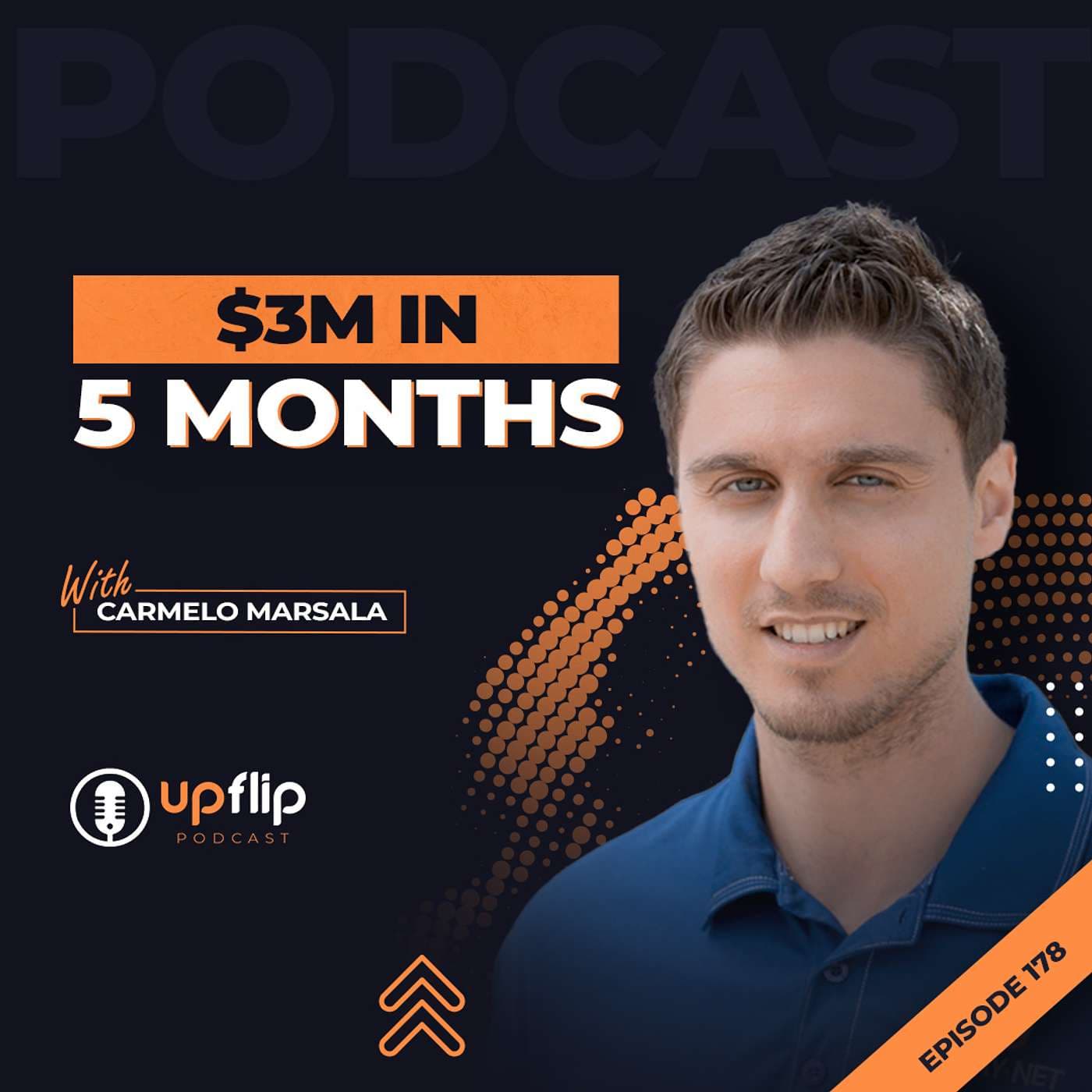
- Title: This Business Innovation Brought in $3M in 5 Months (HOW?!)
- Host: Ryan Atkinson
- Guest: Carmelo Marsala, Founder of Spray-Net
- Focus: Transformation of Spray-Net from an average home service company to a franchise powerhouse, achieving significant revenue growth through innovation, patented technology, and strategic franchising.
Key Topics Discussed
Carmelo's Journey
- Began in home services at age 18, motivated by a desire to run a business rather than a specific interest in painting.
- Discovered the need for value creation in the painting industry, leading to innovative solutions.
Innovations and Patents
- Developed four industry-shaping patents, including:
- Weather-adjustable paint chemistry
- Vinyl protection processes
- Roof rejuvenation processes
- These innovations set Spray-Net apart in the home services industry, providing a competitive edge.
Business Growth and Revenue
- Successfully scaled revenues from $150K to $3M in just five months.
- Emphasized the importance of marketing through multiple channels:
- Facebook ads
- Home shows
- Word of mouth referrals
- Noted that rapid growth can be chaotic but provides valuable learning experiences.
Franchising as a Growth Strategy
- Franchising was identified as a key strategy for scaling the business.
- Initially attracted interest after appearing on Dragons' Den, resulting in 1,200 franchise requests within 24 hours—a record-breaking response.
- Focus on training and support for franchisees, which includes:
- Pre-training and in-person training weeks
- Marketing support
- A business coach for ongoing assistance
Challenges Encountered
- Faced challenges in managing rapid growth and meeting franchisee needs, leading to the necessity of established systems and processes.
- Transitioned from a hands-on role to building a support team and creating standardized operating procedures (SOPs).
Key Takeaways
- Specialization: Emphasizing specialization allowed Spray-Net to maintain a strong brand promise around quality and service.
- Value Creation: The importance of creating true value for customers beyond just pricing, distinguishing the business from competitors.
- Persistence and Resilience: Highlighted as crucial traits for entrepreneurial success, along with the need to embrace ignorance and naivety when starting out.
Final Insights
- Carmelo emphasizes that anyone can innovate within an established industry by recognizing opportunities and educating themselves.
- Franchising offers a pathway for aspiring entrepreneurs who may not have a unique business idea but are willing to put in the work.
Resources
- Start Your Business Today: [Start Your Business](https://links.upflip.com/3Dzq95N)
- Connect with Carmelo: [SprayNet Franchise](https://www.spraynetfranchise.com/start-a-franchise/)
- Franchise Guide: [Grab the FREE Franchise Guide](https://bit.ly/4aWuGvc)
Connect with UpFlip
- YouTube: [UpFlip Podcast Channel](https://www.youtube.com/@TheUpFlipPodcast/)
- Instagram: [UpFlip Instagram](https://www.instagram.com/upflip/)
- Facebook: [UpFlip Official](https://www.facebook.com/upflipofficial)
- Twitter: [@UpFlipOfficial](https://twitter.com/upflipofficial)
- Website: [UpFlip Website](https://www.upflip.com)
Conclusion Carmelo Marsala’s story illustrates the power of innovation, strategic thought, and perseverance in transforming a traditional business model into a franchise success. This episode serves as a roadmap for aspiring entrepreneurs looking to break into established industries with creative solutions.
Written by AI. May contain mistakes. Listen to the episode to check what was said.
Transcript
Automatic transcript. May contain errors.0:00What if the secret to dominating an industry wasn't just about following a proven system, but inventing an entirely new one? You can become an innovator in any field by realizing an opportunity and just going for it, pursue it. The smartest business move I've ever made was realizing my weaknesses and hiring for that. I was just 18 when I started in home services, and today my company is doing$30 million in system-wide revenue. This is Ryan Atkinson, and you're listening to The Health Food Podcast, where we uncover the secrets of building and running successful businesses. Today, we're excited to have Carmelo Marsala, the founder of SprayNet, on the show.
0:32Carmelo's not your typical franchise founder. He's a true innovator, holding three groundbreaking patents in the home service industry. From weather-adjustable paint chemistry to vinyl protection and roof rejuvenation processes, Carmelo has set his franchise apart with cutting-edge solutions. With over 100 territories sold and a reputation for quality, he's here to share how his inventions have transformed home services and what it really takes to succeed in this competitive space. Carmelo, I am so, so excited to have you on the show. Thank you so, so much for being here. Thanks, man. Thanks for having me, Ryan.
1:00I'm excited to be here. You are a pro in the home services industry. You've been doing it since you were just 18 years old, which is like crazy to like say out loud. Like that's such a long time. Can you take us back to those early days and share what drew you to the home services industry? It's crazy. It's been almost 20 years. That's like a lifetime. It's huge, huge. Make me feel old. I'm doing something for 20 years. But yeah, I mean, going back, honestly, like I wish I had a better story to tell about like how I strategically chose the home improvement sector, which a lot of people are doing now because it's booming.
1:35But for me, I just really wanted to run my own business. And I saw a student painting franchise at university and I said, let me try this. And that's kind of how the journey all began. Interesting. I want to ask about joining that as whatever. You're 18 year old, you're in college, you're kind of bright eye, bushy tail. Take us to that first few jobs that you were doing painting. Did you ever think it would turn into something where it's like, crap, I'm gonna be doing this for 20 years? Not at all. For me, honestly, at that point, I didn't really care what kind of business. I just wanted to run a business.
2:05I remember when I signed up to apply for the student painting, I was just dreaming of like, oh my God, who am I going to hire? What's my team going to look like? How big can I get this? How many jobs can I sell? And it was just like, I wasn't obsessed with paint, to be honest, but it did lead to a very fruitful path. I only realized that I would be doing this longer three years in. I actually didn't like painting, to be quite honest. What started to put me off was every time I would do a quote, the owner would be like, well, I can do this myself or my brother-in-law could do this or the other, you know, five million other painters can do this.
2:34And at some point I'm like, man, I'm just literally selling time. I'm not creating a value here. And it just started to put me off a little bit. And that's what led me to this path actually. Interesting. Yeah. Let's talk about that three-year path and what path you're on now. Give us that story about like finding SprayNet. What were some of those like key milestones that like really took you there? Like it really started with one customer that I really like. We've done two jobs for him. I say, can you paint my front door? And typically at that point, I didn't like to do them because I knew that they would always like scratch, chip, peel.
3:02The products on the market weren't great. So I said, I need to do more research on this. And I found this like, you know, this is really good product. And I said, okay, I'm going to spray this product on that way. It'll look brush and roll. So I spray the product on the door. It kind of looks really good, right? Like for the first day, calls me back a week later. He's like, Hey, I'm really sorry. My son with a school bag scratched the door. And I'm like, man, like I knew that was going to happen. I think it's going to keep happening. And I said, look, I'll come touch it up. But honestly, I think it's going to keep happening.
3:28And that's when I was like, I can't keep doing this. I just feel bad for these customers that are paying me for something that's not going to last. And then the path really where that came from is the other aha moment, literally the week after my buddy, his parents got a brand new front door and it was painted for a factory. And I said, that's not going to scratch. It's not going to chip. It's not going to peel. How are they doing that? And that's really the beginnings of how we started this journey. Oh, that's so interesting. So how old are you when you're starting to like have these realizations?
3:53I want to, you know, play on words here, paint the picture of like how old you were. I would love to hear all that as well. Listeners, I'll be able to hear that. So at 21 years old, I saw this brand new door and I said, I got to figure out how they do this in a factory. So I went to the factory and I said, hey, can I grab some of that paint that you guys are using in the factory and be able to apply it on site? And that was actually not as easy as I anticipated. So those products, A, were super toxic and B, they dry too fast because when you're painting a door in a factory, you want to be able to spray it, wrap it, ship it out.
4:22So I said, if we can tweak this or tailor this to be able to apply it on site, we'd you on something. And that's kind of how it all started. Yeah, that's really interesting. So once you get like all the paints and stuff, I would love to hear about that journey as well. So let's just say, okay, got like the paint. I know like this is going to be scratch resistant here. Like what's kind of the next step there? Well, that's the thing is the paint didn't work. So, oh no. Yeah. So the thing is it worked. You can't apply it on site. You know, like when it's cold outside or when it's hot outside, it would crack.
4:49I just wasn't getting that same finish because in a factory, everything's controlled. So I actually went to look at how these paints are manufactured And I finally found a chemist who believed in, you know, what I was trying to do here. It's like, hey, how about if we tweak this or like apply this on site and then eventually, you know, weather adjust it? Because that's what we realized we had to do is if it's too hot, too cold, we had to be able to slow down or speed up the dry time. And that's actually how we started our first paint formulation. Oh my God, that's super interesting. So you guys went to a chemist to help you guys develop like this first paint here.
5:19And not just one chemist, many chemists. Everybody told me it was impossible. So I actually took some online formulation courses. I actually went to the Missouri Institute of Paint Formulation to figure this out so that I could actually speak to them in a way where I was like, no, I think if we do this, it'd be possible. Finally found someone who was open to the idea. Because this is your first patent in paint that you guys are creating here, it sounds like. That's our first patented process. Yeah. That's so crazy. So what was that process like to go from idea to like final product? I want to talk about the competitive advantage it also gave you guys, because obviously you're doing this, get your moat around you.
5:50But I'd love to hear what was that process like and how did it give you a competitive advantage? Well, the process was long. I mean, being able to do this, there was a reason why everybody said it couldn't be done because many factors at play here, you have to formulate for the equipment. You have to formulate for the applicators. At this point, it was myself. So that was easy for me. But you also have to formulate for the weather. And that's where our patent came from. We had to be able to speed up or slow down based on the weather that day. We finally came up with a viable product and we tested it on a few houses and it held, right?
6:18And we knew that it was going to hold long-term. We just needed to make sure that we were able to apply it in all these different conditions. That's how we started. So from there, we did front doors, garage doors, then vinyl windows. And then we branched out into all the other services that we do now. We're taking the same approach, really. Who was working on this? Was it just you? I know you're saying we here. So who was all like part of that early founding team for SprayNet? So at first, I had a crew of guys that actually could apply on site, right? From my earlier days. But in terms of the actual technical stuff, I actually had found a local paint manufacturer who became a small partner in the business.
6:49At this point, they're no longer involved in the business. We have our own in-house chemists. But that's who actually started the whole process with us and believed in us from day one. Oh, super interesting. Did you ever consider throughout this whole thing, just like selling your paint, like skipping the service side of the business? Because obviously that would just be lucrative as well. Just sell the paint here. Like here's a bucket, go to the Home Depots of the world. Like, did you ever consider that? That's actually a good point. So the problem with that is we would like to eventually have a DIY version.
7:15The thing is, the reason why we're able to do what we do is because we go from formulation to application. And the reason that that's important is because I can't just give you this product, Brian, be like, hey, apply it. It's formulated literally for the equipment that we use. And we have a specific process that we use to apply it. If you don't do all of those pieces together, you're not going to get that longevity and that factory finish. So it's not really a product that you can just have on the shelves of the stores. We are working on something that would be like that. It just wouldn't be as, I guess, as durable, but, you know, better than what exists on the market.
7:46When you're going to customers, I mean, talk about building that competitive advantage and why it's so important as an entrepreneur in the home services business to have some sort of competitive advantage such as this? Yeah, well, I mean, for me, literally I got out of the conventional painting space because I felt like I wasn't creating any value for the homeowner. I was literally just selling time. And the thing is, if you're selling time, at the end of the day, you're selling a commodity. And you know this, Ryan, in a competitive business, in a competitive industry, when you're a commodity, price is really your determining factor.
8:15Everybody says they're different, but at the end of the day, everybody's using the same product, doing it the same way, just saying they're better, they're different. But then price comes into play. I didn't want price to be the main factor. I wanted really to create value so that we would be able to maintain a gross margin and the customers would also get a good value out of what we're doing. So for me, it was really about creating value and having win-win. You don't want to be a commodity. Like a lot of people, so we're in the video marketing space, my own personal company here, like who we compete against could be a freelancer from India or could be one of the biggest video marketing companies in the world.
8:45And a lot of times, of course, how good is it but a lot of times like you can be competing against people that are either freelancers in India that are saying hey I can do this for a hundred dollars and like it is tough and you want to get away from that and find some sort of competitive advantage as you did. We actually just secured our fourth patent then we keep patenting stuff just really the purpose of that is to show that like hey we're actually doing something different we're creating real value for you and like where we're positioning ourselves not even painting is we're an alternative to replacement so you know you can replace all of this stuff but for a fraction of the cost you You can get all the benefits, you know, for a fraction of the cost, time and mess, right?
9:16That's kind of our key thing. So I don't even consider ourselves really in the painting industry. We actually refer a lot of jobs to painters, right? Like we don't do walls, we don't do peeling paint. We don't do that stuff. We really specialize. And I think specialization is another good one because I think people try to do everything at this point. When you try to do everything, you know, jack of all trades, master of none. We really want to specialize and be the best at what we're doing. Yeah, I want to talk about that some more as well, because we have a ton of home services on the Outflow podcast.
9:41Like that is our true wheelhouse of what we have. And you're saying, you know, don't offer every service out there. You're really saying specialize in one and get really good at that. Why? For me personally, I mean, there's no right or wrong answer to this. For me personally, it's about our brand promise. And, you know, as a franchisor, what we're selling essentially to franchisees, our brand and our brand promise is a 15 year no peel warranty, no hassle for the customer and transparent pricing. So in order for us to be able to deliver on that promise, our services need to fit within it. And if it doesn't fit within it, we don't offer it.
10:14So that was really, that stems from my days and the pain that I had as a conventional painter. I just didn't want to be like everybody else, right? I wanted to offer something that was different. So we created that USP and we really stick to it. So once you get this patented paint here, I would love to talk about like revenue in those early days. You get this patent and paint, you guys are like, all right, we've got something here. I mean, talk to us how that impacts you guys' revenue, especially in those early days. Well, let me give you a bit of context. Because at first I thought, you know, if I just take these conventional paints and I spray them, I'd be on for something.
10:43I'd be like, you know, like at least, yeah, like revolutionary, right? But not really. So, I mean, it was better than brushing and rolling them because the finish was better, right? And it's funny, just from spraying the products, that was almost enough to differentiate ourselves. And we grew really fast. But really when we started growing extremely quickly is when we added the layer of like this custom chemistry, right? Because then we're really able to offer something different. We went from$150K in revenue to$3 million in revenue in less than three years. What? Yeah. And when I talk about revenue, that was annual revenue.
11:14But back then, we were only operating five months of the year because we were doing only exteriors. So it was nuts. We did 1 ,200 jobs in five months because here in Canada, we could only operate from May to maybe October. And the rest of the year, we couldn't do anything because we didn't do kitchens back then. Wait. So I want to know that again. you guys did$3 million in revenue and basically like five months of business. Am I hearing that right? Yep, yep. That is literally insane. And it's from all exterior paint jobs because of this patented paint here. Only exteriors. And it was just nuts.
11:46We had like 60 guys. It was craziness. Oh my God. I mean, how are you guys marketing that? Because I want to talk to like, to people that do want to do$3 million in five months. Of course, there's a lot to get there. I'm mindful of that. I want to talk about like, how did you guys market that? Like, was it all referrals? where you just guys, hey, we've got this innovative paint. Like you won't chip. Like talk to us about that. That is amazing. $3 million in five months. Yeah, it was that. But you know, they say like build it and they will come. No, they won't. People need to know about you to market it.
12:13So like any opportunity we had to market our product with the Facebook ads, Google ads, magazines, direct mail, home shows. We literally did everything. We also got a ton of referrals because the thing is once people start realizing, wow, this is actually real and possible. Like we did 13 houses on one street And then we realized, we call it fishing. So we would create bait, right? Like the bait would be the home wrapped up in blue and orange tape. We actually manufactured our own blue and orange tape. We had a spray booth out front. We had feather flags. And people would just come and line up and be like, what are you guys doing?
12:43And we were just, that was our bait. We'd go fishing. We'd get those leads. So we'd generate from job size to paid. Basically, whatever we could do, we were doing it. Oh my God. That is so amazing. Obviously, when you get to that point, you're like, okay, were you guys franchising that when you did that? We were not. And I'll tell the story of how we became a franchise next. So$3 million in five months sounds amazing, but when it's your fourth year in business, you know, in business for yourself, I was a franchisee before, you know, I didn't have systems. The story I like to tell is I'm on a ladder here, spraying a house, customer calling me.
13:11At this point, I'm the call center. I'm the marketing team. You know, we had some sales guys, but I was basically doing everything. And my phone fell from my ear. I threw my spray gun down. I said, this is not sustainable. This is craziness. I'm working like 20 hours a day, literally barely sleeping. You know, I know it was only five months, but even in the off season, we had stuff to prep. So in that off season, actually, I read the E-Myth Revisited, and I think I spoke about this on the Uflip video, and it spoke about franchising. And I said, well, man, I used to be a franchisee. Maybe I could scale this thing through franchising.
13:42And that's when we really started putting systems in place to be able to replicate it, but also not me being the entire bottleneck of a business. Oh, man, it's always so interesting to see how that light bulb moment just goes over your head. It's like, oh, you know what? I should franchise this. So you're working 20 hours a day, decided to put some systems in place. Like what were those early systems that you guys put in place? The first one, anyway, so it's funny because our production guys were like, we can't read the sales guy's handwriting. And we're like, wow, this is a stupid problem. So we decided to digitize the coding system.
14:10That allowed us to also standardize pricing. And then from there, we actually built our own custom software. And now it's an entire year apiece. So it handles scheduling, production, all the KPIs. It's really a software that allows us now to scale the business. I want to ask, so you had like the software in place, like you're identifying like opportunities to scale this as well. And you guys are like, all right, let's go franchise this. You go through all the legal paperwork, obviously. Now you need to get someone to franchise it. Talk to us about landing your guys' first like franchisee. Like how did it come across?
14:40What market was it in? Tell us about that. So actually, because we started to get more and more popular, people started asking us for a franchise, right? Which was cool. And that's how we found a good amount of our franchisees. They actually wanted to get their house done. and then eventually they just bought the franchise to be able to do it. So we actually got two franchisees, one two hours east of here, one two hours west of here. This was 2014. So they actually just both renewed their 10-year agreement like last year. Wow. Yeah, amazing. That's amazing. We had franchises that have been here for 10 years.
15:08Anyways, long story short, the training was basically like, hey, got new questions? I didn't know yet, right? And both of them were actually really successful in their first year. So I said, I think we're on to something here. So with their help, we actually put together some training systems, etc. And this was a long time. But I mean, now what we have today versus what we had then is like, it's craziness. It's like night and day. That's how we started like jotting everything down. Like the questions they had, we started creating more and more standard operating procedures from them. Interesting.
15:36Then how'd you guys like attract like the next cohort? I'm curious, like how you actually got them? Was it like word of mouth? Like, hey, this is working really well. Was it like, hey, franchises from our website, we'd love to hear like how you got these franchisees. So actually, we grew from two franchisees to about 10, kind of just organically. like let's say that other franchisee now did as and then people saw them near there and then to get from 10 to like you know actually becoming a franchisor which i think is about 30 40 franchises at least when you really start you know having a proven model we actually went on a show called dragons then which is the equivalent of shard tank oh yes yes yes yes yes yeah uh this is in 2016 and we actually broke the internet literally speaking microsoft thought we were getting hacked and they shut off all of our servers because we got 1 ,200 franchise requests within 24 hours.
16:23We made history on the show. And yeah, and then we sold out basically the entire country of Canada. Oh my gosh. I mean, I'd love to hear how did that go? I mean, you have 1 ,200 requests here. Like how many of these do you accept? Like how do you scale that? Was this like, because moments like these happen in entrepreneurship where you're like, oh God, this is my one opportunity to actually take advantage of it. I mean, you guys saw that and you obviously did. I'd love to hear like, take us back to that. What were those feelings like? Since we're going to be honest on this podcast, it was a mess.
16:52Like, you know, like doing 3 million where you don't know what you're doing was messy and we figured that out. But when you're not really sure how to be a franchisor yet, now you've got 1 ,200 franchise requests. It literally was like, whoever's calling us the most is going to get this franchise. Like if they wanted that back, we couldn't possibly get back to everybody. And from that, we had a 25 new franchise because Canada's not very big, right? Like, I mean, we've got 30, 35 franchisees here. So like literally we only had room for like about 25 new franchisees. And it was literally people who wanted it the most because we figured if they wanted that bad, they'll do well, right?
17:25They'll do what it takes to succeed. And 2016 to about 2018 was a huge learning experience for us as a franchisor because, I mean, we didn't really know how to be a franchisor yet. Now we've got, you know, 30 plus franchisees. That was messy, but a lot of them made it. And in 2018, actually, we won the Franchisees Choice Award, which was huge for us. That's huge. Yeah, we figured out how to be a good franchise or despite, you know, building the plane while flying it kind of thing. So lots of learnings while doing throughout the years. Oh, man, that is so crazy. I mean, you just have like so much more like responsibility.
17:56I mean, what challenges did you face like scaling this? Like what were like those really big challenges from I think you said 2015, 2016? Like talk to us about those big challenges. Well, the thing is, like, you know, our first few franchisees were close to anywhere like within driving distance. You can speak to like five, 10 people relatively easy. It was like 30 people. Now we needed a franchise support team. You know, we need to take people out of our corporate operations. So like our corporate territories, they'll support them. That suffered. We also realized that like some of the other franchises kind of already knew our business because they want to be customers.
18:28These people didn't and they'd never had run a business before. So we had to teach them things that we didn't even realize we had to teach them. Oh God. It was just like nuts. It was like, wow, we don't know that. Like we need to create an SOP for that. And it's like, we need to update our training program. The thing is, we were training all these guys at the same time. So we didn't have the opportunity to iterate, which we've done, you know, throughout the years now, like our training program is night and day. But it was just basically, we were all in it together. And I'm grateful for all those franchises.
18:53We actually had our convention in Mexico. And we're actually joking about it for some of those OG franchisees. And they're like, man, like what a difference it is today from when we started. They were like almost like guinea pigs, right? Yeah, yeah. I think that is so crazy because like systemizing a business is obviously like so important to do. But like until you have that systemizing hat on, you really don't know like what you need to systemize until questions start coming your way. And like, OK, like I need to systemize. I'm sure you guys felt that so many times throughout that growing process.
19:21Oh, yeah. And now we have many forums where franchises can ask questions. And we actually use AI bots now to be able to answer them. So we actually use an AI bot that scours all of our material to be able to answer questions for franchises like literally within seconds. We went from not having enough content to having so much content that franchises were overwhelmed with the amount of content. So we're creating AI bot so they can just ask that question conversationally and get the information they need. Ah, dude, it's so crazy. I want to ask about like the support that you guys offer franchisees.
Read the full transcript
19:49So if someone like signs up, like what are they getting from like a marketing perspective, technology, operations, like talk to us about this. Let's just say someone's like, hey, you know what? I want to do SprayNet. What do you give them? Oh, man, there's so much training. We've got a one week of virtual pre-training. Then we have two weeks of virtual training with the group. Like we're actually in training right now with six new franchisees. Oh, wow. Actually, yeah, seven. And they're at their fourth week. So after those two virtual weeks, there's a full week at our Miami office. So right now they're actually in our Miami office for one week of in-person training.
20:18That in-person training, we had a whole facility where they could spray different doors into in-person sales training. Then after that, all the while their marketing is beginning. So our marketing team starts all their digital marketing stuff. Then they create their annual financial plan. Then we go in their territory to do the first sales. Then we go in their territory to do the first few jobs. And then they have an assigned business coach. I mean, I could talk about this for longer, but that's at a high level what it is. And if they do want to learn information, we'll definitely have more in the description below where you guys can click the link in the description and hear more about SprayNet.
20:48And if someone does want to join your guys' catalog of franchisees, I mean, how many franchisees do you guys have today? We've got over 70 franchisees and about 130 franchise locations. Wow. And I know you guys started in Canada and you guys are obviously in the United States now. What were the challenges of going from Canada to the United States? Were there any challenges? I'm just curious on that. It's international business at that point. Yeah, I mean, what most people are realizing about Canada is 90 % of our population lives within an hour and a half of the U.S. border. So like, I mean, I know there's a lot of jokes about a 51st state now and all of that.
21:21But I mean, the reality is we're very similar, right? We always dream about doing business in the U.S. because it's a similar market, just much bigger. And for us, what's cool is like, you know, it's a lot less seasonal too. Some places they can work 10 months or 12 months of the year exteriors. The challenges really were just in the way that people buy franchises in the U.S. versus Canada. So a lot of the people here knew the brand, bought the franchise. In the U.S., a lot of people work through different types of franchise consultants. And they're just exploring franchising in general. So they don't necessarily know SprayNet yet.
21:53They're just looking for their next opportunity. So the education process was slightly different. But once franchisees are onboarded, I think it's very similar. I mean, both markets are so similar. I mean, it's not like we're going like to Europe here. You know what I mean? I loved everything that we had talked about straight. Now I want to keep talking about like advice for people. You know, you guys have innovated a lot in like an established industry. So that's kind of my question here. Like what advice would you give to someone looking to innovate in an established industry? Not even home services, but just in like general, like what are you looking for?
22:21I mean, look, nothing's impossible. If you think that there's an opportunity within the industry that you're in, educate yourself. I mean, it's so much easier now. You even have chat GPT. You could ask all these questions. You can find out where to learn stuff. Oh, yeah. Like, man, I wish I had all that stuff like back then. But like, let's all collectively create value together. Let's not keep doing things just the way that we're doing. And I know that's a lot to say because it's already hard just running a regular business. You know, having to change things. But, you know, I challenge everyone.
22:49Just do it if you think you can. Or if you're not interested in reinventing the wheel, you know, franchising is a great route for just operating and running a business. I actually, that's how I started. Right. I love to hear like, who is franchising for? If someone's like listening and they're like, okay, I've considered franchising. I don't really know. What advice would you give to someone like who is franchising really for here? I think it's everybody who's got that like itch. Like, you know what I hear the most is like, you know, the nine to five grind. I'm traveling a lot. I don't get to have an impact on my community.
23:18Another thing I hear a lot is I'm making somebody else rich. I don't have an asset for myself. But they always say, but I don't have a good idea. And that's exactly what franchising is. You don't need the idea. You just need the sweat equity to run and build a business for yourself, right? We've got the idea. We've got the systems. You can build that business for yourself and build an asset for yourself, right? I love it. I know you're 20 years into this now. I started when you're 18. If you go back to your own yourself, like what's one piece of advice that you would give? I know this question was asking the L flip and I know it's not a popular answer, but I don't like giving advice to my younger self in hindsight just because hindsight is 20-20.
23:54I think you need to be a bit naive because if I wasn't naive, I probably wouldn't have tried to do what I did. That's good. So I think it's like, hey, educate yourself, read, make sure that you know what you're talking about somewhat, but like be naive, go out there, go get it, just try. I mean, if you don't quit, you can't fail, right? So I would just say persistence, grit, resilience, all those keywords that everybody use, all those buzzwords, just go for it. Just do it. It's so, so good. Yeah, I think that is like the benefit of being younger in your 20s. You're kind of naive to like actually how hard it is like running a business.
24:27Had I known how hard it was, I probably wouldn't have done it. Yeah. Oh, yeah. That's what the NVIDIA CEO, I'm playing as a name right now, but the NVIDIA CEO and founder, he was asked a similar question. He said, like, what would you tell your younger self? He's like, I don't think I would honestly do that because the ups and downs of entrepreneurship, as you know, are very, very real. Like you have those high moments where you're like, oh, my God, we just did record breaking numbers. The next day you have 30 customer complaints where you're in the lows of lows. Like the variability with entrepreneurship is just so insane.
24:54Well, that's the thing. And that's why franchising is good in between though, because there's a lot of stuff you don't have to do, right? It's a nice in between. Well, it's been an honor to have you so far. I'm excited to go to our Fan Blitz questions. And these are questions submitted from our community. If you guys want to join in our world-class entrepreneurs, go to www.youtube.com slash upflip and submit your questions there. Carmelo, you ready for our last five questions here? Let's do it. Cool. Number one, what's the best and worst part of being an entrepreneur? The best part is looking into that crowd in Mexico and seeing all the people that are here because of the brand, because of you.
25:25The worst part is all those low lows. But I mean, it's part of the game. When it rains, it pours. Sometimes it just all happens at once. So yeah, obviously that sucks. But hey, you can't have highs if you don't have lows. Yeah, so, so good. Number two, what book had the biggest impact on your business? Two of them. The E-Myth Revisited, because I mentioned that one earlier, because it helped me start the franchising. And the hard thing about hard things, it just really shows you what it means to succeed. And you're not the only one that's grinding. It's just a requirement. Number three, if you could have anyone in the world endorse your business, who would it be?
25:58That is a great question. Anybody in the world endorse our business? Wow. I can't think of anybody right off the top of my head right now. Taylor Swift, Elon Musk, Bill Gates. My daughter would love if I would say Taylor Swift. I am a huge fan of Elon Musk. So obviously, you know, if you were to endorse our business, it would mean that, you know, he actually thought there was something different here and true. So I guess let's go with Elon Musk. Yeah, and the reach Elon Musk has is pretty significant, so. Oh yeah, that would be good, yeah. Yeah, yeah, yeah. That's also the reason I love Elon Musk for that question.
26:31Number four, what's one sentence you want to hear from your franchisees? I don't regret doing this. It was the best decision I ever made. That's really good. Number five, last one for you. Did you ever imagine you'd reach this level of success? When you say success, for me, I feel like we're not there yet. The job's not done. It was always a plan to franchise across North America. So I like to say failing to plan is planning to fail. So yeah, I think we were intentional about getting here. And now the next step is crossing the$100 million mark. Well, I feel like I have crossed the$100 million mark on this episode.
27:02Carmelo, you have been so, so good. I appreciate you joining. If someone's like, oh my gosh, I need to learn more about him, need to learn more about SprayNet, where can they learn more about you and SprayNet? SprayNetFranchise.com. That's where our franchise went. We're just SprayNet.com. That's also just our consumer-facing website. Everyone, that was an awesome episode with Carmelo. It blows my mind. $3 million in five months is just crazy. Three quick takeaways for you. Number one, have a competitive advantage. He developed that pain so he could have a competitive advantage in the home services industry.
27:30Super important for you to do. Number two, love what you do. If you are looking at a franchise opportunity, make sure you love it. Make sure you love the work and something that you can see yourself doing for 10, 20, 30 years. Last one, I love his tidbit, be naive. When you start a company, you really have no idea what you're getting yourself into. with the highs and lows, but also just figuring out how to make it work. Really good episode here with Carmelo. If you've been enjoying this episode, please don't forget to leave us a review. Your reviews and feedback allow us to bring more amazing guests like Carmelo onto the show.
27:58Carmelo, thank you so much for being here today. Thanks, Ryan. Have fun.
From the publisher
Carmelo Marsala joins the UpFlip Podcast to unpack how he transformed Spray-Net from an average home service company into a franchise powerhouse. With 4 industry-shaping patents, Carmelo managed to scale his company to over 120 territories across North America. Earning him coverage from several mainstream media such as Forbes, Dragons' Den, Entrepreneur Magazine, Franchise Times, HGTV, and NetFlix.
He explained a couple of strategies that he used for his business growth, mastering franchising challenges, managing product development, and leveraging technology to outpace his competitors. For entrepreneurs craving actionable insights on innovation and expansion, this episode delivers a no-nonsense roadmap to success.
Takeaways
- Carmelo Marsala is an innovator in the home services industry.
- He started his journey in home services at 18 years old.
- Carmelo's initial motivation was to run his own business, not specifically to paint.
- He realized the need for value creation in the painting industry.
- The patented paint technology was developed to address common issues with conventional paints.
- Carmelo emphasizes the importance of specialization in business.
- He grew his revenue from 150K to 3 million in 5 months.
- Marketing strategies included various channels like Facebook ads and home shows.
- Franchising was a key strategy for scaling the business.
- Carmelo's experience on Dragons Den helped attract more franchisees. We broke the internet with 1,200 franchise requests.
- Rapid growth can be messy but is a learning experience.
- Winning the Franchisees Choice Award was a significant milestone.
- Creating a franchise support team was essential for scaling.
- Using AI technology has improved franchisee support.
- Training programs have evolved significantly over the years.
- Expanding into the U.S. market presented unique challenges.
- Franchising allows individuals to build a business without needing a unique idea.
- Cultural fit is crucial when selecting a franchise opportunity.
- Persistence and resilience are key to entrepreneurial success.
Resources:
- Start Your Business Today: https://links.upflip.com/3Dzq95N
- Connect with Carmelo: https://www.spraynetfranchise.com/start-a-franchise/
Ready to be your own boss without starting from scratch? Grab our FREE Franchise Guide and unlock the secrets of proven business models that have already created thousands of success stories.
Connect with UpFlip:
- On Youtube
- On Instagram
- On Facebook
- @UpFlipOfficial on Twitter
For more insights to start, build, or grow a business, check out the resources on UpFlip.com or head to the UpFlip YouTube channel to see more interviews with business owners and experts.
Thanks for listening!


