
In short
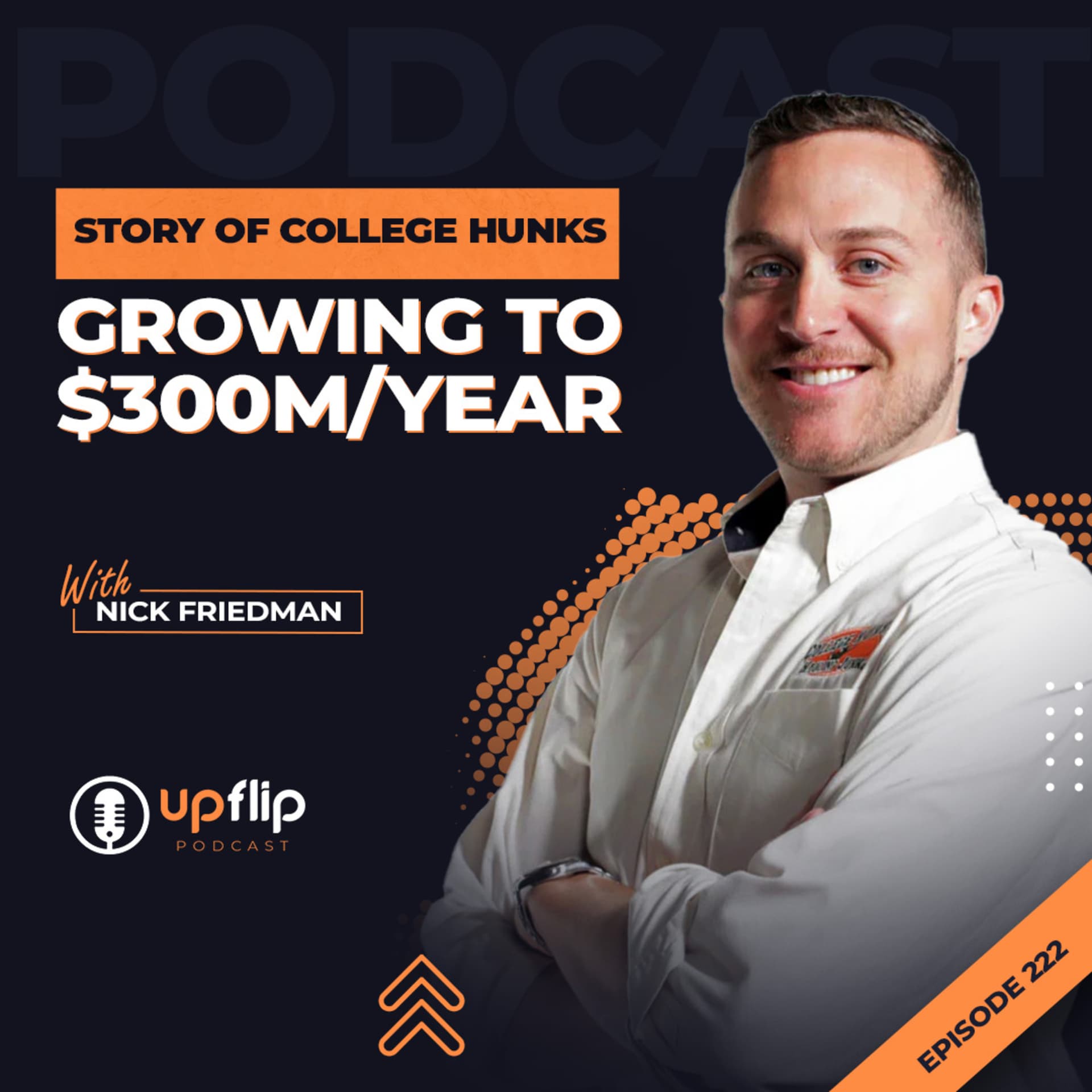
The UpFlip Podcast Episode 222: How a Broke College Kid Built a Business That Scales in Real Estate
Episode Summary In this episode of the UpFlip Podcast, Nick Friedman, co-founder of College Hunks Hauling Junk & Moving, shares his journey from a broke college student to leading a $300 million service brand. The discussion delves into the strategies and systems that enabled the company to thrive, even during financial crises and market volatility.
Key Themes and Insights
- Origin Story: The idea for College Hunks began as a summer side hustle using a friend's cargo van. The catchy name and fun marketing helped the business gain traction and recognition.
- Adversity and Resilience: The company faced significant challenges during the 2008 housing market crash and the COVID-19 pandemic but emerged stronger by staying true to their mission and adapting their strategies.
- Marketing Techniques: The episode highlights the importance of guerrilla marketing tactics, like using their trucks as billboards, and how they created a distinctive brand presence with their orange trucks and memorable name.
- Business Structure and Systems: Nick emphasizes the need for entrepreneurs to create systems before scaling, enabling smoother operations and successful franchising.
Key Takeaways
- The "Purple Cow" Strategy: A catchy name and eye-catching branding can set a business apart in a crowded market.
- Guerrilla Marketing: Using creative, low-cost marketing strategies can yield significant visibility and customer engagement.
- E-Myth Shift: Entrepreneurs must transition from working in their business to working on it by developing systems and processes for growth.
- H.U.N.K.S. Acronym: Establishing a strong company culture based on values—Honest, Uniformed, Nice, Knowledgeable, Service—can enhance employee engagement and customer satisfaction.
- Setting Goals: Ambitious, long-term goals (10x growth) should be coupled with actionable, short-term plans to guide daily efforts.
- The Importance of Customer Loyalty: Creating a positive customer experience can turn one-time clients into lifelong advocates.
Detailed Insights
- Origin Story
- Started with a simple business plan competition in college.
- A friend’s mother's cargo van and a humorous name sparked the idea.
- Transitioned from a summer job to a year-round business after winning a business plan contest.
- Marketing Strategies
- Guerrilla Marketing: Utilized vehicles as mobile advertising and strategically parked them in high-visibility locations.
- Name and Branding: The catchy name "College Hunks" and bright orange trucks served as an immediate recognizability factor.
- Building Systems
- Emphasized documentation of processes to facilitate hiring and scaling.
- Adopted the mindset of creating systems to avoid burnout and inefficiencies.
- Introduced safety checklists and operational protocols early on.
- Navigating Adversity
- Surviving the 2008 financial crisis provided valuable lessons in resilience.
- COVID-19 required quick adaptations to maintain operations and customer service.
- Growth Mindset and Planning
- Importance of setting audacious long-term goals and breaking them down into smaller, actionable steps.
- Suggested frameworks like the "10x vs. 2x" mindset for strategic planning.
- Company Culture
- Prioritized establishing a strong company culture that aligns with their core values.
- Focused on both customer experience and employee satisfaction to drive business success.
Timestamps
- 00:00 - Intro: From Cargo Van to $300M
- 02:15 - The Origin Story: Winning a Business Plan Competition
- 05:40 - Naming the Business & Standing Out
- 08:30 - Guerrilla Marketing Tactics (The Rolling Billboard)
- 15:30 - Building a World-Class Customer Experience
- 18:45 - The "E-Myth" Moment: Working ON the Business
- 22:10 - The "Why, Where, Who" Framework
- 26:00 - Overcoming the 2008 Crash & Adversity
- 31:15 - The Fan Blitz: Best Books & Early Mistakes
Resources
- Learn more about starting a junk removal business: [UpFlip Course](https://www.upflip.com/course/moving-and-junk-removal-blueprint)
- Connect with Nick Friedman: [Instagram](https://www.instagram.com/nickfriedman1/?hl=en)
Final Thoughts This episode is a treasure trove for aspiring entrepreneurs and established business owners alike. Nick's insights into the importance of creativity in marketing, the necessity of building systems, and resilience in the face of adversity provide valuable lessons for anyone looking to grow their business. Whether you're starting out or looking to scale, the principles shared in this episode can help pave the path to success.
Written by AI. May contain mistakes. Listen to the episode to check what was said.
Chapters
Tap a time to open that second in VOThe Origin Story of College Hunks
0:45 to 3:24
Discover how College Hunks started as a side hustle in college.
“went from flyers in a beat up van to national franchise machine, but service founders can steal from that playbook today.”
Naming and Branding Strategies
3:24 to 5:58
Understand the importance of catchy names and branding in business.
“to write a business plan for an entrepreneurship competition.”
Customer Acquisition Strategies
5:58 to 7:54
Learn effective customer acquisition methods for new businesses.
“and social media didn't exist when we got started.”
The Shift to Paid Marketing
7:54 to 10:59
Explore when and how to transition into paid marketing channels.
“And like, I'm happy to say I've been able to interview you like twice now.”
Standing Out in a Competitive Market
10:59 to 14:00
Identify key strategies for differentiating your business in a crowded field.
“And now it's evolved, as I mentioned, into more of a holistic marketing mix.”
Building a Sustainable Business
14:00 to 16:00
Learn how loyalty, training, and customer experience contribute to business longevity.
“And so loyalty and reputation and reviews and referrals are so critical to creating a sustainable business.”
The Importance of Systems for Growth
16:00 to 17:48
Discover how creating systems helped scale the business beyond the owners' initial roles.
“I want to get into the ops standpoint of this because we've hammered home marketing.”
Finding Your Business's Core Purpose
17:48 to 21:00
Understand why defining the 'why' and 'who' is crucial for building a successful business.
“owners fall into that trap and don't figure out a way to sort of delegate and elevate themselves out of it.”
Navigating Adversity in Business
21:00 to 22:33
Explore the significance of resilience and learning from challenging moments in entrepreneurship.
“Obviously, your 20-night overnight success applies to you on that.”
Leveraging Peer Support for Success
22:33 to 25:32
Gain insights into the value of peer networks and community support for entrepreneurs.
“Very few entrepreneurs, I should say, ever got into a business and then said, I made more money faster than I thought I was going to.”
Show all 15 chapters
Strategies for Ambitious Growth
25:32 to 28:00
Learn how to set ambitious growth targets and develop actionable plans to achieve them.
“So adversity, let's talk about growth as well.”
Quarterly Planning and the EOS Model
28:00 to 29:38
Learn about effective quarterly planning strategies using the EOS framework.
“Now, it might take 20 years to hit the 10-year target.”
Taking the Leap: Starting Your Business
29:38 to 30:56
Find out essential advice for individuals ready to start a business immediately.
“We're going to ask us some more questions about books in our flamblitz, I'm sure here.”
Learning from Failure: Entrepreneurial Insights
30:56 to 32:09
Discover valuable insights from Nick's experience in entrepreneurship.
“Well, let's dive into our fan blitz questions.”
Key Books and Marketing Tactics
32:09 to 34:16
Get recommendations for essential reads and effective marketing strategies.
“He's sort of a old school thought leader.”
Transcript
Automatic transcript. May contain errors.0:00Nick didn't start college hunks hauling junk with a grand vision of franchising or a$300 million dollar business in mind. He started because his corporate job felt wrong and because an old cargo van and a funny name revealed something most people miss, demand hides in plain sight. What began as a summer side hustle turned into one of the most recognizable service brands in the country with 200 franchises,$300 million in revenue, system-wide sales, and a business that has survived the 2008 housing collapse, COVID, and volatile housing market while continuing to grow. And Nick's story is about building systems before scale, turning skepticism into fuel and embracing what makes you different instead of sanding it down.
0:43This episode is gonna break down how college hunks went from flyers in a beat up van to national franchise machine, but service founders can steal from that playbook today. Nick, thank you so much for joining the podcast here. Great to see you again. I know I did the YouTube shoot with you, but thank you so much for being here again. Oh, my pleasure. Thanks for having me. It's gonna be so good. And if people haven't seen the iconic huge orange trucks, are thinking, what is College Hunks? What is College Hunks? So we are a national franchise that offers moving and junk removal. Think about anything that trucks and labor can do.
1:14We go into homes, we go into offices, haul away unwanted furniture, debris, and then also move people from point A to point B. We say, remove the things you love, we get rid of the things you don't. And as you mentioned, we've got 200 franchises around the country that are operating and performing that work. And it's so cool to see all your guys' trucks. I was telling you when I came back from that shoot, I actually saw your truck outside. So I think that was like a sign from above about like how big you guys are and how cool that interview was. I always say when you see that truck just for that moment, you know that all is well in the world because of what that represents and the story behind it.
1:43I love it. And I alluded to it in the intro here, but what revenue are you guys doing here in 2024? I know we're at the end of 2025, whatever you can share there. Yeah, absolutely. We're on track to do about 300 million in annual sales, which is hard for me to even wrap my head around being that we started, as you mentioned, with a beat up cargo van and kind of just a dream and a catchy name back in college. Well, let's start back in college then. So, you know, you had the dream, you had the cargo van. I mean, how, what is the origin story of college hunks? Yeah, I would say most kids don't grow up saying, Hey, I want to own a moving company when I grow up, or, Hey, I want to be a junk hauler when I grow up.
2:14And I was no exception to that. I was brought up to follow the more traditional career path. You work hard in school, you get good grades, you get a job, you move up the corporate ladder, but it was actually the summer before our senior year of college. We were home for summer vacation. My best friend from high school, his mom had a beat up cargo van from her furniture store. And she said, once you guys go take the van, you can move furniture, haul junk away. And then she looked us up and down. She goes, you guys can be college hunks who haul junk. And we laughed about it at first. That was, I think, the first time anybody even called me a hunk.
2:40So you can come by it honestly. But I was like, you know what? That's kind of catchy. Why don't we make that into a flyer and stick in the mailboxes? And people had a need for the service. They thought the name was catchy. So that was really the light bulb moment for me, where it was something we could do. We did it that summer. Went back to school, graduated, got regular jobs briefly and said, you know what? let's make this a year round venture. I think most college kids would probably stop after college. We decided to, you know, see how far we could take. And here we are 20 years later. I call it a 20 year overnight success.
3:07We've made it into quite a business. Yeah, quite the business indeed. So you started before your senior year of college. So did you work on it all during your senior year? Or is it just a summer thing, like a summer fling in a sense, but like a summer thing? Yeah. Talk to me. Probably more like a summer fling. Although our senior year of college, we had an opportunity to write a business plan for an entrepreneurship competition. And we submitted it and it ended up winning first prize out of about 150 entries when we were seniors in college. So that did give us a little more confidence in the idea.
3:35I think a little more credibility to the concept. But even with that, we still decided to go into the quote unquote real world after college and get a real job. And I remember being just very unfulfilled about three months into that experience and emailing Omar, my business partner, my best friend at the time, still my best friend, by the way, and said, hey, what's our timeline for starting this business on a year round venture? He emailed me back all capital letters by timelines right now, exclamation point, let's do this. So, you know, there was some skepticism from people, outsiders, you know, you're gonna quit your job to haul junk and I call it college hunk.
4:04Are you throwing away your college degree to start a junk business? But we decided to prove those doubters wrong and just kind of keep going. I wanna make this actual for our listeners as well. So the college hunks hauling junk, that's obviously super catchy. You're 22 out of school. I'm sure you look great now. I'm sure you looked phenomenal back then as well. That's like an advantage because like it is catchy. It's kind of fun. Like College Hunks like definitely has a ring to it. How should founders like think about naming their business? And next question for that is like, why was College Hunks hauling junk such an advantage early on?
4:34You know, I think of it as kind of a pattern interrupt. It's not what people typically associate with moving or hauling. And it's, you know, bright orange and green colors, bright, shiny trucks. And so I do think that the name and the image is important to stand out. I realized very quickly it was a conversation piece. People would be like, wait, what are you doing? What's it called? We got kind of annoyed. They'd be like, well, are they all really hunks? Are they all really in college? But we said, you know what? At least they're asking questions. They're curious. They want to find out more. And there was a book we read called The Purple Cow by Seth Godin.
5:02And he's talking about if you're driving down a country road, you see a field of brown cows, you've seen it before, you're just going to keep driving. But if there's a purple cow sitting in that field, you're going to pull over, take pictures of it, put it on social media, tell your friends about it, ask about why is that cow purple? And so to me, that's really the key is if somebody is getting started in a business, think of something that's going to stand out in a crowded landscape, both the name, the colors, but then you also have to have the stake behind the sizzle. So it's not just enough to have a catchy name and catchy colors, but you got to have a service or product that really backs it up or is also different and unique and remarkable in its own way.
5:34Another question that comes to mind here as well as standing out early on, obviously channels have changed. It was over whatever, 20 years ago to become such an overnight success. But like what you know now, someone wanted to start a similar company from ground zero. They're like, hey, I want to be the next Nick and just start this myself. Like of what you know now about like acquiring customers, like what would be the best customer acquisition strategy early on? I'll throw in a plug for our franchise. If you don't want to go it alone, you can look at our franchise opportunities. But if somebody wants to get into a business and get started on their own, whether it's in this field or any other field, start with a simple, you know, old school method of business card, logo on the truck or the vehicle or a magnet on your personal vehicle, flyers.
6:12and social media didn't exist when we got started. So it was kind of old grassroots door hangers, park in our truck, invisible locations. People thought we had multiple trucks, even though we just had the one truck is because we strategically put it in different parts of town where people would notice it and think that we had more than one vehicle. And then I always say, don't be ashamed or self-conscious about promoting what it is that you're doing, especially at the beginning, because if you're not the one advocating for your solution, who will? Eventually, yes, you'll get great ambassadors and your clients and evangelists and your team members.
6:42But coming out of the gates, you gotta be the one that's telling everybody about what it is that you're doing and how you can help them. So we were knocking on neighbors' doors. We were calling on local real estate offices and just kind of being, we like to say, the mayor of our market in the moving and junk removal space. Putting the truck everywhere is like, that is your strategic advantage. Talk to us a little bit more about that, yeah. We call it parketing. It's really simple, right? A monthly billboard on a high traffic area might cost you 5 ,000 bucks a month, But that truck is a rolling billboard.
7:11And we say nothing gets the trucks on the road like the trucks on the road because people see it. It creates a brand impression. Somebody has to see a brand seven, eight times, maybe nowadays 27 times before it even registers in their subconscious. And so being in a visible location, we would cut deals with a local gas station or a vacant lot, you know, like where you see the Christmas trees or you see the fireworks pop up seasonally. Those lots might be looking for some, you know, additional income when the Christmas trees and the fireworks aren't there. So we would pay them a small amount monthly to be able to put our truck there when it wasn't being used.
7:42And it just, again, it's eyeballs and impressions and something that we continue to this day to preach to our franchise owners as a critical part of their business. Talk to us about the orange truck as well. I mean, was that your idea? Was that Omar's idea? Cause that's something to me, like if I see the orange truck now, I'm like, I like, I don't even have to see the name. Like I know like who exactly that is. And like, I'm happy to say I've been able to interview you like twice now. I'm very grateful for that. But like, talk to us about like the orange truck. Like how did that come out to be?
8:06Yeah, well, we were, we were looking at college and professional sports teams to try to come up with a color scheme. And we were just, we were looking at different combinations and sports teams that really stand out and are viewed as somewhat iconic. And we were talking to a designer and they said, hey, you know, orange and green really goes well together. They pop. And a light bulb went off for us because that's actually where Omar went to school for undergrad and got his business degree was University of Miami. And that's a smaller private university, but everybody knows the Miami Hurricanes.
8:34So we were like, yeah, that's it. Like let's sort of mirror and imitate something that's already sort of commonly known. Now we tell people that the orange represents our fun, playful culture. The green represents our environmentally friendly recycling practices because not everybody likes the Miami Hurricanes, of course. We don't want to discount customers that might be, you know, avid Miami Hurricane haters. But yeah, I mean, those colors stood out. We knew that if we got those on our trucks, we got those on our uniforms, it could create a memorable impression in a crowded landscape. And that's what we continue to do.
9:03Are you working a nine to five, but dream of entrepreneurial freedom? Look no further than the Uflip Academy, the number one entrepreneurial platform with 20 plus step-by-step courses taught by active business owners, live workshops, hands-on skill training, a business idea database, and a thriving entrepreneur community to keep you accountable. Click the link in the description below to join the Uplup Academy today and make this the year you stopped dreaming and started building your business without guesswork. Reading kind of between the lines here, I mean, you got the trucks that were parking and then you got like the orange trucks everywhere.
9:40That sounds like a little bit of like guerrilla marketing in a sense. When did you guys make the shift into like paid then? And like, what should founders know about like, when's the right time to go into like paid channels? I think marketing has to be a mix. You know, the guerrilla marketing is tried and true. It's been around since probably the stone ages, right? Just, just pounding the pavement, getting your name out there, whether it's door hangers, signs, flyers, posting up on local bulletin boards and the coffee shops. So we continue to do that to this day. But right as we were starting was actually right around the time paid Google searches started to be a thing and things were moving away from the yellow pages into paid Google search.
10:17And so we started dipping our foot in the water and realizing, hey, this is where people are looking for this type of service. So we got to get in the game. And then Facebook came about and now Instagram and TikTok and some of the other social media platforms as well. And I think it's actually also sort of a resurgence now, even in TV and cable television, because there's so many messages that are getting bombarded to people that are scrolling through their phones. So you got to try to meet people where they are. And so I would say it was about six months into our business where we were able to cashflow the business enough.
10:47We didn't have a lot of overhead. We were still working from home. We were parking the truck in our parents' driveway. And we realized, hey, let's start experimenting with some more paid advertising. And it started with Google Pay Per Click. That's still a big part of our advertising mix today. And now it's evolved, as I mentioned, into more of a holistic marketing mix. And I think a marketing, almost like an investment portfolio. You see those pie charts where you have no-cost advertising, but then you have other investments of where you might deploy. Some might be TV, radio, which are higher cost.
11:16Others might be Facebook and Google, which are more lower funnel where people are actually looking for the service. We've done some direct mail as well. And so I think evolving and exploring and being willing to try things and making sure you're measuring the results was critical. Were you guys able to hop on early trends then and identify like what works. That's kind of what it sounds like with the Google, where it was transitioning away from yellow pages. You guys were able to like kind of identify like, oh, people are starting to go to Google. Let's like test it and like double down on it. Sounds like you guys kind of did that with TikTok and et cetera.
11:44A hundred percent. I mean, I remember we took out yellow page ads. That's how old our business is. We advertise in the yellow pages and the yellow page sales representatives, but recognize that those are becoming almost like stone age tablets that people weren't looking at anymore. And people's eyeballs were on the computer. People were going to Google for their answers. Now with AI search, that's going to become something that we're evaluating and looking at as well, because AI is giving people answers beyond Google pay-per-click. And so I think just being open-minded and being a learner and leaning into some of these new strategies and trends is critical as you're evolving your business and hoping to scale the business.
12:23The other day I was like, I might actually just start like an AEO agency, like an IEO, I guess, artificial intelligence engine, like optimization agency. So I might be giving you a cold call and asking if you need some services. Absolutely. I think a lot of the SEO companies are having to add that into their competencies because the organic search on Google is now becoming a little bit overrun and overloaded by the Gemini search or the chat GBT searches. And so, you know, those searches are crawling a different type of result and providing a different type of feedback than what your traditional kind of search engine optimization, organic results in Google is giving you.
13:02So how are you guys standing out in the market? Like currently, because there is no lie, there are a lot of moving businesses out there. You guys are like really in the belly of the beast with it. You guys are obviously a titan in the industry, but like, there's a lot. How do you guys like stand out? Like when you guys are marketing, like, what's the keys to that that people should know? I think it's nuanced. I think it starts with the image and just making sure that you're visible as a consumer brand, we always are promoting, always branding is one of our core values. So we just sort of made that ingrained in our DNA at the franchisee level.
13:32We encourage them to get out into networking groups. We encourage them to continue the guerrilla marketing efforts, but then it evolves. So like you get a customer or a lead, that lead is gold and you got to treat it as such. So being the first to be able to answer the call or first to respond to an online inquiry, when you do book an appointment, and making sure that it is a positive experience, it's going to turn into an online review or potentially a referral to turn into more business. So you create that loyalty, that loyalty loop, because people aren't moving every other month. It's not a subscription service.
14:01And so loyalty and reputation and reviews and referrals are so critical to creating a sustainable business. And so, of course, we made an intentional focus on the marketing and advertising, but I think we made an even bigger focus on how we train our labor, how we train our estimators, our hunks, as we call them. And we made HUNKS actually into an acronym, which stands for honest, uniform, nice, knowledgeable service. And that's become our brand promise. And so we tell our clients and we tell our team members, like, that's what people are expecting. That's what we're promising them. So we've got to deliver that on every single touch point so that we can stand out.
14:35And services in general, whether it's our industry or otherwise, can be littered with mediocrity. And so if we can do things better from an execution standpoint, we can create longevity in this business. And you can, too, in any business. I think that's what's so important about any home service base. Honestly, any company is like, you know, just doing the little things right can set you ahead of so much farther than competition. I think it's cliche to say, like, focus on the customer experience. But it's true. Your customers are paying your bills. But you also got to focus on your team member experience because your team members are delivering the customer experience.
15:06And so we do an exercise both with our team members and how we train them is what do our team members expect when they come to work for us? what might upset them as a team member and what can we do as a company to 100 % of the time to meet their expectations. Same thing on the customer side. We do an exercise where we make a list, a column, you know, what are customers expecting when they call us out to move their furniture, haul their junk away? What are things that could go wrong? Usually it's a missed expectation. So late, damages, rude, not a frictionless experience. And then we come up with a list of non-negotiables that we call them 100 % of the time activities that we can do to sort of mitigate the likelihood of those complaints or likelihood of those missed expectations happening.
15:45And so training is, I think, critical in any business. We say if you're not training, you're not gaining. We say that training is something we do. It's not something we did. So it's just an ongoing reinforcement of the college hunks way of interacting with the customers and delivering the service. That is so good. I want to get into the ops standpoint of this because we've hammered home marketing. We talked a little bit more about hiring and leading and that. We'll talk more about leadership as well. But ops of this, I mean, when you guys were just getting started, were you the ones actually hauling everything away?
16:14Like and how long did it take for you to actually like hire someone else to do and like step out of that role? We were doing all the work ourselves. We were driving the trucks. We were answering the phones. We were hauling the junk. I think I told you on the YouTube video. We had an 800 number because we want to make ourselves look like a national company. We put it on the back of the truck, but it was still routed to our cell phone. So people called to complain about driving. I'd be in the driver's seat answering the phone saying, oh, yeah, we'll fire those guys when they get back to the office.
16:36probably fired ourselves three or four times that first summer. And we started to burn out a little bit. And one of our mentors recommended to us a book called The E-Myth Revisited by a guy named Michael Gerber. And really the key message in that book is that in order to scale a business, you've got to learn how to not just work in it, but learn how to work on it, which basically means creating systems and processes for the business to grow. So when we read the book, it felt like it was written about us. And it was like the next light bulb moment for us where we said, hey, if we're ever going to have another truck, let alone another location, we got to just start documenting how we do everything.
17:08And so we just started creating simple checklists. Nowadays, you know, we didn't have the luxury of a chat CBT that could help, you know, map out those checklists for us. We had to kind of create them manually. And then when we started hiring people, we would encourage them and empower them to help improve whatever systems might be missing. If somebody was saying, hey, this isn't working or this customer situation went sideways, we would always ask ourselves, well, what system could we put in place to help prevent that or do a better job with that in the future? And so I think that mindset shift is what allowed us to ultimately hire people and then shift.
17:38And that probably was six months into where we were like burning out on the trucks and we were like, hey, we got to figure out another way of doing this. Otherwise, we're just going to be sort of slaving away in our own business perpetually. And I think a lot of business owners fall into that trap and don't figure out a way to sort of delegate and elevate themselves out of it. Delegate Elevate. That's really good there. I think building systems is like, it's so critical, but like for me and my own company, like it's like a hard step to take. I mean, was it hard for you? I don't know if it's just me and like my IQ level, obviously, but like, I mean, was it hard for you to do that?
18:08Nothing in business is easy. I mean, some stuff comes a little bit more naturally to people than others when it comes to entrepreneurship or business leadership, but all of it is, I think, develop muscle memory and muscle improvement and creating systems was no exception. So like I said, it just started with writing in a notepad, what we were doing every day and stuff that we just sort of were doing a second nature, like loading the truck in the morning or answering the phone to a customer. We just started writing down scripts. Again, nowadays you can go to like a chat GPT or other AI platforms.
18:36It can help at least write that first draft for you. And I think that shortcuts a lot of the heavy lifting that maybe we had to do ourselves or same with your platforms that you guys offer, right? The master class that I did with you guys, those things didn't exist or weren't as easily accessible. So I had to read books and go to conferences and listen to speakers and try to adopt those best practices that I was hearing from books and speakers and bring them back into my business. So I think playbooks and formulas are a lot more readily accessible nowadays, which makes the execution side that much more critical.
19:06It's so, so critical. This is a large question here. If you could give advice to someone that is starting a moving company, obviously you guys have it all scripted out. So go to you first. Second, if they're like, I'm absolutely not doing that, they should, but they're not. What would be like the first two or three that someone should absolutely like SO key out for actually moving because no one wants to continue to move stuff. So actually moving the stuff. So believe it or not, I always say with businesses, you got to have a foundational framework first. And so the what and the how is the tactical, but I actually like to start and encourage people to start with the why and the where and the who meaning why are we doing what we're doing?
19:43Like, why do we even exist? Yes, we want to make money. Yes, I want to create a living and a lifestyle and be able to have nice things. But like, why am I really here as a business? And it's to solve people's problems. It's to make a positive impact. It's to be a great platform for franchise owners and team members. So we started with the why. And I would encourage any business owner to start with the why first. And then the where is, what are you trying to create? Like, we had this vision of being a national brand. That was our destination, starting with the end in mind. So, you know, having a destination of where you want to be three years from now.
20:11And then having a set of values that defines the type of people that you want to bring into your organization to help make that vision a reality. So get those steps in first. I think that gets overlooked by a lot of business owners because you rush straight to the how and the what. And then the how and the what is the tactical stuff. That's the blocking and tackling. So the how and the what would be a phone script. How do we answer the call? How do we close a sale? How do we overcome objections? The how and the what would be the in-home estimation. How do I walk through and estimate how long this job is going to take and how much I should charge for it.
Read the full transcript
20:41The how and the what is going to, how do I load and wrap this furniture and put it in the truck so it doesn't get broken? And so those things you kind of learn on the fly. And of course, you have to have those if you're going to hire people to perform those duties. But I would encourage any business owner of any industry, in particular with this one as well, to start with the why, the where, and the who, and then start mapping out the how and the what. How has culture been? Obviously, your 20-night overnight success applies to you on that. How has like the culture evolved and like how have you had to evolve as a leader scaling from, you know, two employees to 10 to 500, like, et cetera?
21:15I think the nice thing is once we realized that we needed the why and the where and the who, those things really became static where me as a leader, I'm championing and beating those drums regularly where I'm talking about our core values. I'm talking about our destination. I'm talking about our company purpose regularly. And that helps to find the framework of what people describe as company culture. Culture is based on what we say, not what's on the walls, meaning like not what's on a poster or in the handbook, but what's in the halls, meaning who are the people that you're bringing into your organization.
21:43Culture drives behavior. Behavior drives the results of the organization. And so hypercritical. None of this stuff happens overnight. It becomes intentional as a leader to be championing and reinforcing and repeating yourself regularly about why we exist, who we want in our organization, where we're trying to go as an organization. and then that will inspire and attract people to wanna be a part of that journey as well. And that ultimately transcends into our franchise ownership and their team members and the client experience ultimately. Talk to us about growing this through adversity as well because obviously to get to whatever, $300 million in revenue, this was not a walk in the park.
22:19You're throwing flowers on the ground. Like this is hard. Talk to us about some of the hardest moments for you and like what that taught for you and like the importance of adversity in a business. Yeah, I mean, I think every entrepreneur needs a high level of pain threshold because you're either having a breakdown or a breakthrough on any given day or any given hour. Very few entrepreneurs, I should say, ever got into a business and then said, I made more money faster than I thought I was going to. It's usually harder and takes longer than it ever did. And the old Mike Tyson quote, we all have a plan until we get punched in the face.
22:47So I think the ability to kind of keep picking yourself up, failing forward, moving forward is absolutely critical. It's innate in some entrepreneurs, but I think it can be a learned muscle as well along the way. Look, some of our setbacks, we started franchising in 2008, 2009, which was the peak of the housing market crisis of the early 2000s. So if you thought about a time in history to start franchising a home service business, that was definitely not the ideal time. We felt like we were dragging an anchor through the sand using any kind of analogy, walking up a snowy hill or spinning our wheels through the mud.
23:18But I think that was actually the best thing that could have happened to us in our evolution because we didn't know any different. It was kind of like we either have to make this work or we have to go do something else. And we just decided to keep marching forward. You know, same thing with franchising. We got into it thinking it was going to be this sort of glamorized way to make the business grow. And we sold a couple of franchises and people telling us how great we were. But they didn't tell us ahead of time or we didn't realize ahead of time, you need 50, 100 franchisees before that small royalty stream can really cover your overhead.
23:45And it's, you know, a lucrative business. And so we had to sort of march through that treacherous march to get to that 50, 100 franchisees. So COVID was obviously another one you mentioned in the intro. The housing market today is not the easiest with high mortgage rates as they are. So I think adversity builds resilience and persistence. And there's folks that can find their way through that and navigate through it. And there's folks that decide to jump ship and go do something else. I feel like that is really what separates an entrepreneur from someone that is not an entrepreneur. It's like those hard times because that will really make or break your business.
24:17I remember last year for us, Q4 2024, hardest time of my life. Looking back on it, one, we got through it. Thank God for that. but like choose like I'm so grateful for that moment now to like be able to go through that because now when hard times come on it's like I've been through that I can I know I can get through this it's like going to the gym but just a very elongated stretch of time right like when you go to the gym and you're beating yourself up afterwards you feel really great about it and glad you did it in business there might be these long stretches of difficult moments and you don't know if there's ever going to be a light at the end of the tunnel but the light does eventually come and the other thing I was going to mention that's really valuable through any of the ups and downs as businesses, having a great peer group to be able to lean on.
24:56So I joined the Young Presidents Organization, YPO. Previously, I was in Entrepreneurs Organization, EO. I think being part of some of the online communities like you guys have created is extremely valuable because it gives you an outlet. It gives you a resource group. It gives you a reference group to be able to talk to and just work through challenges. Now I see a lot of online chat groups or Facebook groups that are relevant to businesses and startups where people can kind of trade ideas and share some of the challenges that they're going through because, you know, entrepreneurship can be lonely as well.
25:24And you can't always talk to your friends, neighbors, or relatives about it because they may not know what it is that you're going through. So having that peer group, I would say has been extremely valuable for me as well. So adversity, let's talk about growth as well. So I'm going to ask a selfish question here. So we grew about 120 % from 2024, which is great, but we're, you know, we're a six figure business. We're not, you're doing three intermillion where it's a little bit easier to get these numbers. We obviously want to do that again. So we want to be a higher end six figure agency. We're going to have to scale about 100 % again.
25:52How should we think about doubling growth again? Basically 100 % last year, 100 % and we want to do 100 % next year. Like what should I be thinking about? Yeah, there was a book that I read called 10X is Easier Than 2X. And the simple concept of that book is incremental thinking and incremental planning will get you incremental results. It's always a balance because nothing happens overnight, but you have and can experience that rocket ship growth by taking massive strides forward. So I think setting ambitious goals and then reverse engineering to the present to say, you know, what's missing? What does that business look like when it's 100 percent bigger than it is today?
26:30Who are the positions that I have to fill and who are the positions that I have to fill now, not later? And so as actually by the same author who wrote that 10X is easier than 2X, he also wrote a book called Ask Who, Not How. And so the who I think is just extremely critical when you're in hyper growth. Are the people on your team, do they have the skill, the will, and the capacity to get to that next level? And if not, are there certain subject matter experts, either external consultants or internal team members have to bring on to help champion that growth? And it might be sales, it might be marketing, it might be finance, you know, could be IT or technology.
27:06And so there's obviously a multitude of options out there. But I think mapping out like very ambitious, aggressive growth goals and not letting yourself, you know, fall into this incrementalism mindset where, you know, I like to say, let's not be rearranging the deck chairs on the Titanic. Let's think about how we're going to become a billion dollar brand. And so I think that's important as well. Yeah, that's super important. But what is that balance of like not being too audacious, but also being like realistic? I mean, I could say, hey, we're gonna be doing$10 million next year, which is obviously incredibly audacious.
27:34But like, what is that balance there, do you think? I would say put a 10-year audacious goal that seems like almost like crazy, right? Like we're gonna be a billion dollar brand in 10 years because that's far enough out into the future where like it's crazy enough to be possible and then people might believe it and you're gonna start marching towards it. Then have a three-year target, which is a little bit more within grasp. And then let's have a one-year target that is on track to get us to that three-year target that could actually give us a little bit of confidence that we might hit the 10-year target.
28:01Now, it might take 20 years to hit the 10-year target. It might take six years to hit three-year. It might take two or three years to hit the one-year. But you set very specific targets that are stretched that might scare you out of your comfort zone a little bit. And then you reverse engineer to the present to say, okay, what do we have to do next quarter, next month, next week to move those things? And there's usually, you know, three to five things that you can really move forward each quarter. And there's, you know, three to five things that you might be able to do this month that are marching towards that quarterly outcome.
28:32And just continue to be maniacal about those activities and urgent about the effort. How do you guys do your quarterly like planning? Like, do you guys have like an OKR system or something? Or like, how do you guys do your planning? We subscribe to the book Traction and its entrepreneurial operating system, EOS. So we're a believer in that model. There's plenty of them, others out there that work. I think the important thing is to have a model that you follow. And the thing I love about the entrepreneurial operating system is it kind of follows that model and framework that I just described, having a 10-year, big, hairy, audacious goal, a three-year vision, a one-year target, and then a quarterly cadence of meeting and setting what they call rocks, which is kind of like the big priorities that you're going to try to move forward.
29:14And you have measurables and what you've described as OKRs, we call them, you know, key performance indicators or a scorecard really that tells you if we're on track or off track to hit these quarterly monthly goals and make some in-game adjustments as needed. You know, maybe a team member's falling short, maybe an initiative isn't working. That allows us to focus on what's working, what's not, and what do we need to continue to create momentum for as well. So I'm a big believer in the EOS model. Super good. We're going to ask us some more questions about books in our flamblitz, I'm sure here.
29:43But last question before we actually get there, advice for someone that needs to just take the next step of starting any company like tomorrow or within like the next three days. What's the advice? Is it simply just go do it? Or like, what is that advice for you, Nick? One thing that was shared with me is you're never going to have less responsibility than you do today. Like as you get older, more and more responsibility, more and more excuses or reasons not to take a risk are going to start coming to the picture. So do a little bit of a fear setting exercise, map out like, hey, what's the worst thing that could happen if I take this leap and it doesn't work.
30:16And in my mind, when I was back and coming out of college, I didn't have a lot of responsibilities, but I just set my mind. I was like, okay, I'll go back and I don't know, maybe get a graduate degree and go get a job somewhere. And I can look at that as a learning experience. And I consider that the worst that could happen. So, you know, have some fallback or some failstates of like, you know, what's the worst that could happen if this doesn't work, but then move forward as if you've burned the boats and that's not even an option. Those would be my two pieces of advice. Yeah. I mean, ideas are great, but the people that take an idea and start to move it down the path into activation and realization are the ones that are going to start seeing some momentum, some progress.
30:49And yes, you're going to have setbacks, but you're going to start getting excited and enthusiastic about continuing to push that momentum forward. Super, super good. Well, let's dive into our fan blitz questions. These are just questions submitted from our communities. Listeners, you want to join in on entrepreneurs that are doing whatever$300 million a year, like Nick, email us at podcastandupfloat.com and get your questions submitted there. But Nick, ready for our last five here. Let's do it. What was the first sign that College Hunks was not just a summer hustle, but a real business opportunity?
31:15The first sign of that was actually funny enough. It was from a sign. We put out a yard sign and a Washington Post reporter saw the sign, thought the name was catchy, called the 800 number that we put on it. I was still writing to my cell phone. I answered and she was like, tell me about this College Hunks business. Never heard of it. Sounds really funny. And I said, hey, oh yeah, it was something we did last summer. We want a business plan and now we're doing it year round. She came out and did a full page profile about us in the Washington Post. So that was the moment for me where I was like, wow, this is something that's real.
31:40It's got some lightning in a bottle effort to it. And, uh, you know, let's keep going. Super, super cool. Number two, here is our book question. What are two to three books that you would recommend every entrepreneur to read? And I'm going to challenge you to not give the E-myth one. Good to Great by Jim Collins is so relevant. I read it 20 years ago. I saw him speak a year ago and his framework and models that he talks about in that book are timeless. And, you know, the other one that I think I would, I would encourage people to read is, and this was kind of also an oldie, but good. He is Maximum Achievement by Brian Tracy.
32:09He's sort of a old school thought leader. And I read that book. I've still got pages dog-eared and underlined that I go back and look to. And then the other one is Dale Carnegie, How to Stop Worrying and Start Living. I know a lot of people think about his book, How to Win Friends and Influence People. How to Stop Worrying and Start Living is a lesser known book of his, but it helps you sort of navigate the mental ups and downs of the entrepreneurial journey. That's really good. I actually have not heard, I love How to Win Friends and Influence. That's actually one of my favorite books. I did not know that one though.
32:35That is, that's good. What marketing tactic from the early days would still work today for a brand new local service business? Yeah, we've talked about it. Signs and parking, you know, parking a vehicle in a visible location and putting out those little yard signs that have the phone number and website on it or have the logo and website on it. Gets eyeballs, it gets people to see it. Simple enough. What's one early system you documented that paid dividends years later? Honestly, it was the safety checklist that we did each morning. Basically checking the oil in the vehicles, doing a walk around, reporting back, getting a DOT safety checklist from the Department of Transportation, checking them in, checking them out.
33:13We set that in a pretty early stage and we still use those tools today because I think sometimes safety can be a little bit overlooked, especially with an entrepreneurial mind. You're thinking like Elon would say, requirements or recommendations, let's just kind of move past those, but you don't want to take too many risks where you can completely throw the baby out with the bathwater. Very last one for you. why do most service founders wait too long to start working on the business instead of in the business? Well, like us, we get caught up in the day-to-day. We get caught up answering the phone, driving the trucks, doing the physical tactical work.
33:44And it's very difficult because you're thinking like, if it's gonna get done right, I gotta do it myself. And you are gonna make some mistakes when you start hiring people, when you put people out there in the field to do what you were doing so naturally. And there's a fear of sort of letting go of the reins or letting go of the blind. And that's why I think it's so critical to work on those systems, to be able to train somebody, but then also hire somebody with a willingness to learn and an eagerness to deliver a good service so that you can give them the skills to ultimately perform and then eventually elevate yourself out of the day-to-day.
34:13Nick, well, thank you so much. You have been amazing. I always love talking with you. So thank you again for the opportunity to come back on. If someone's like, oh my gosh, I need to learn more about Nick and check out CollegeHunk's website, LinkedIn, where can they connect with you? Yeah, so if you wanna connect with me directly, it's nickfriedman.com. I've got my social media links on there and some other ways to contact me. If you're interested in the franchise, collegehunksfranchise.com. And then you can also connect to our main consumer website, of course, for moving or junk removal needs.
34:39Listeners, that was a great episode with Nick. Three quick takeaways. Number one, know your why. It's going to get really hard. He talked about adversity and getting through that. You need to know your why and why you're actually doing this. Number two is all about marketing and building a brand. You want to build something that's memorable, have the fun name, have the cool truck. It's a great way to actually stand out, especially when you're just getting started. And number three, he didn't come out and exactly say this, but it is a takeaway is to read. He dropped so many books just off the top of his head being like, hey, I read this.
35:08I read this. I read this. I think there's a lot to love and take away from that. If you guys are enjoying this podcast, please use a five star rating wherever you get your podcast. It helps us get more amazing entrepreneurs like Nick on the show. And we will see you next Monday. Nick, thank you so much for your time today. Thank you.
35:27you
From the publisher
How do you turn a beat-up cargo van and a funny name into a $300 million empire? Nick Friedman, co-founder of College Hunks Hauling Junk & Moving, joins UpFlip to reveal the blueprint behind one of America’s most iconic service brands.
From a summer side hustle to over 200 locations, Nick breaks down the exact systems used to survive the 2008 housing crash, COVID, and volatile markets.
In this episode, you’ll learn:
The "Purple Cow" Strategy: Why a funny name and bright orange trucks were the ultimate "pattern interrupt" to dominate a crowded market.
Guerilla Marketing: How to use your vehicle as a rolling billboard and secure high-visibility parking spots for free.
The E-Myth Shift: The specific moment Nick realized he had to stop driving the truck to start building the business.
The H.U.N.K.S. Acronym: How to build a world-class company culture using values (Honest, Uniformed, Nice, Knowledgeable, Service).
Systems Before Scale: Why documenting simple tasks (like safety checklists) allowed them to franchise successfully.
"Who Not How": The mindset shift required to go from incremental growth to 10x expansion.
The "Why, Where, Who" Framework: Why you must define your destination before worrying about the tactical "how."
Loyalty Loops: How to turn a one-time moving customer into a lifetime referral source.
Surviving Adversity: Lessons learned from launching a franchise model during the peak of the 2008 financial crisis.
10x vs. 2x Planning: How to set audacious 10-year goals and reverse engineer them into quarterly "rocks."
Timestamps:
(00:00) Intro: From Cargo Van to $300M
(02:15) The Origin Story: Winning a Business Plan Competition
(05:40) Naming the Business & Standing Out
(08:30) Guerrilla Marketing Tactics (The Rolling Billboard)(11:50) When to Transition to Paid Ads
(15:30) Building a World-Class Customer Experience
(18:45) The "E-Myth" Moment: Working ON the Business
(22:10) The "Why, Where, Who" Framework
(26:00) Overcoming the 2008 Crash & Adversity
(31:15) The Fan Blitz: Best Books & Early Mistakes
Tags: Business scaling, Entrepreneurship, Home Services, College Hunks, Business growth, Business leadership, Customer retention, Junk Hauling
Resources:
Grow your junk removal business today: https://www.upflip.com/course/moving-and-junk-removal-blueprint
Connect with Nick: https://www.instagram.com/nickfriedman1/?hl=en


