
In short
UpFlip Podcast Episode Notes
Episode Information
- Podcast Title: The UpFlip Podcast
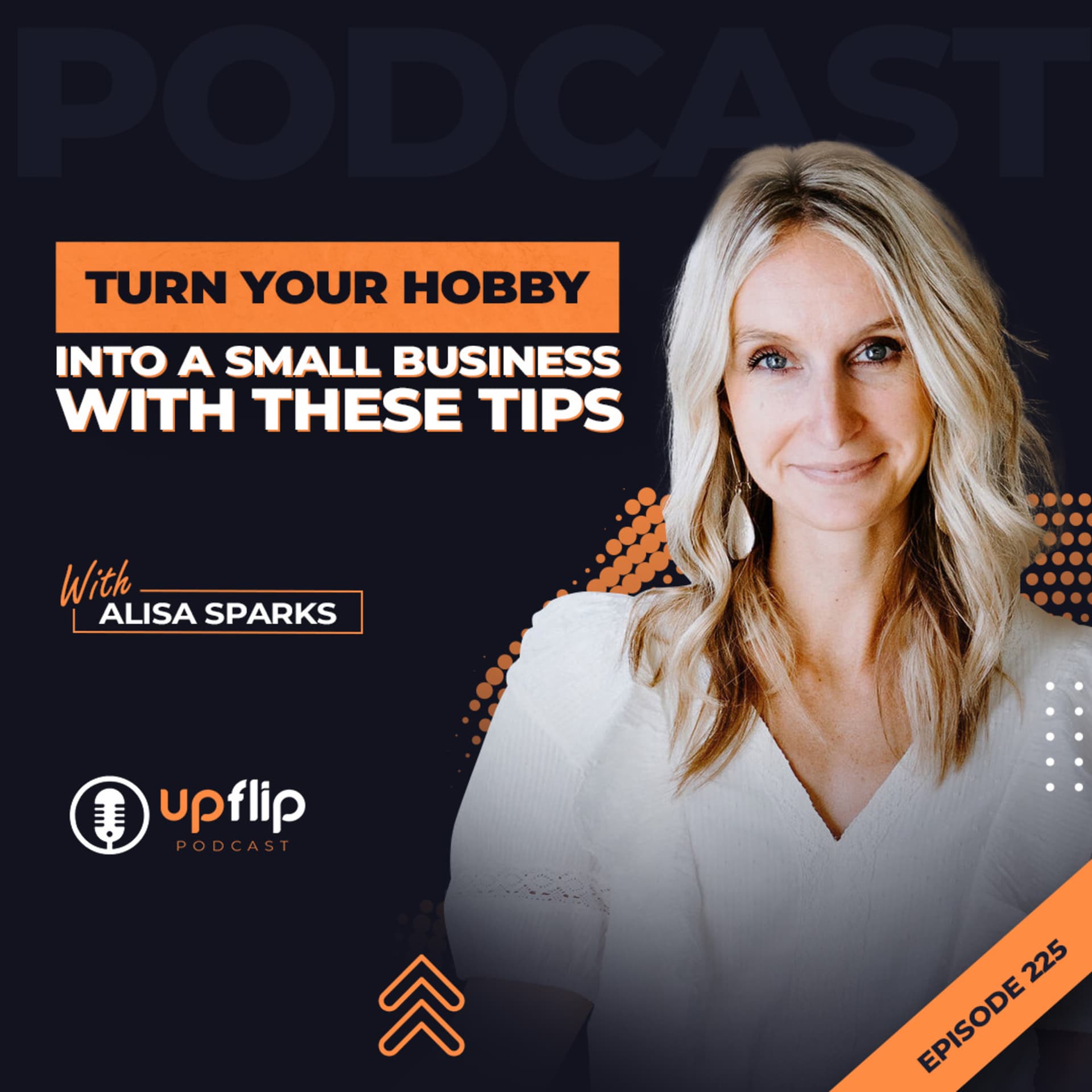
- Episode Title: 225. Turn your Hobby Into a Small Business with These Tips
- Host: Ryan Atkinson
- Guest: Alisa Sparks
- Date: [Insert Episode Date Here]
Episode Summary In this episode, Alisa Sparks discusses her journey in transforming her home staging brand, Linden Creek, into a $4 million revenue-generating business with 20 locations. She emphasizes that many small business owners run "hobbies" rather than actual businesses due to a lack of financial clarity and systems. Alisa provides actionable insights on how to escape the hobbyist trap, the significance of proper pricing strategies, leveraging AI for efficiency, and scaling a business intelligently.
Key Concepts and Discussions
- The Hobbyist Trap
- Definition: Many entrepreneurs chase their passions without treating their endeavors as businesses, resulting in confusion over their financial metrics.
- Statistics: Around 50% of home service business owners do not know their profit margins.
- Warning Signs:
- Lack of clarity on financial numbers.
- Sole reliance on passion rather than systems in business operations.
- Pricing Strategies
- Middle Market Death Zone: Pricing services in the middle range can hinder business growth. Instead, focus on luxury pricing or cost-effective pricing.
- Luxury Market: Charge higher rates by solving high-stakes problems for clients.
- Cost-Effective Market: Be efficient and cater to a price-sensitive audience.
- AI and SOPs for Efficiency
- Standard Operating Procedures (SOPs): Essential for replicating tasks and delegating efficiently.
- AI Leverage: Use tools like ChatGPT to create SOPs and automate routine tasks.
- Documentation Tips: Keep SOPs concise (one page or less) and leverage video tools (Scribe, Loom) to record processes.
- Shifting Mindsets from Hobbyist to CEO
- Know Your Numbers: Understanding costs and profits is crucial to making informed business decisions.
- Customer Understanding: Identify and address what keeps your target audience awake at night, allowing for tailored solutions and pricing.
Key Takeaways
- Know Your Numbers: Always track financial metrics to avoid running a hobby instead of a business.
- Audience Focus: Determine if your target audience is price-sensitive or looking for luxury services to tailor your offerings accordingly.
- Create SOPs Early: Establishing processes early allows for better scalability and efficiency as the business grows.
Resources
- Linden Creek Website: [linden-creek.com](https://linden-creek.com)
- Franchise Opportunities: [Linden Creek Franchise](https://linden-creek.com/franchise)
- Connect with Alisa: [Instagram](https://www.instagram.com/alisa_sparks_/)
Conclusion Alisa Sparks provides invaluable insights on transforming passion into a sustainable business. By focusing on financial clarity, strategic pricing, and efficient systems, entrepreneurs can break free from the hobbyist mindset and build successful enterprises.
---
This markdown document serves as a comprehensive summary of the podcast episode featuring Alisa Sparks, highlighting key discussions and providing actionable insights for listeners looking to turn their passions into profitable businesses.
Written by AI. May contain mistakes. Listen to the episode to check what was said.
Chapters
Tap a time to open that second in VOUnderstanding the Hobby Trap
0:46 to 2:30
Discussion on the pitfalls of treating a business like a hobby and its consequences.
“Before we dive into more of that shift and how you can be like a hobbyist or a real business, tell us more about you.”
Identifying Early Warning Signs
2:31 to 6:00
Exploring early indicators that suggest a business is being run as a hobby rather than a real company.
“They're operating a hobby that they love.”
The Need for Systems in Service Businesses
6:01 to 8:10
Advice on creating systems and SOPs to transition from hobbyist practices to a structured business approach.
“We're like a team of five, so I should have been doing this a while ago, like I know.”
Frameworks for Creative Processes
8:11 to 12:00
Discussing how to build flexible frameworks for creative tasks while maintaining structure.
“So there's consistency, but what one designer does is going to be different than the next.”
Overcoming Pricing Challenges
12:45 to 14:03
Insights into why many business owners underprice their services and strategies to communicate value.
“And so it's our job to solve these problems before somebody ever walks into the home, to create purpose for them, to show them the vision of what their home is going to be.”
Identifying Your Target Audience
14:03 to 16:45
Learn how understanding your audience's needs can enhance your business strategy.
“but there are consumers out there that value convenience.”
Challenging Market Assumptions
16:46 to 19:04
Discover insights on pricing strategies and market positioning.
“It doesn't mean you have to go at the lowest market and maybe you should go to the lowest market.”
The Importance of Knowing Your Numbers
19:05 to 21:00
Understand why data-driven decisions are crucial for business success.
“That was literally to my next question here, because a lot of advice on online and stuff and advice that you're giving to, and it's good advice.”
Utilizing AI for Business Growth
21:01 to 22:21
Explore how AI can be used for education and task automation.
“Then from there, figure out what you want your profit to be.”
Resetting Your Business Strategy
22:22 to 25:51
Learn strategies for reassessing and resetting your business without failure.
“And that's really advantageous and beneficial.”
Show all 13 chapters
Key Metrics for Service Business Success
28:00 to 28:49
Learn essential metrics service business owners should track weekly.
“have my time and my bandwidth ready for it.”
Connecting with Alisa Sparks
28:49 to 29:12
Discover how to connect with Alisa Sparks and learn about Linden Creek.
“It sounds like, oh my gosh, I need to learn more about her.”
Three Key Takeaways from Alisa Sparks
29:12 to 30:03
Understand the critical points for turning a hobby into a business.
“She hit on that quite a bit throughout the podcast.”
Transcript
Automatic transcript. May contain errors.0:00Here's something I want everyone listening to sit with for a second. About half of small business owners aren't really running businesses. They're running hobbies. They're working nonstop. They're talented, but everything depends on them. There's no system, no clarity, and no real control. Elisa Sparks has a strong take on why this happens, and she's built a service business that's scaled to 20 locations without burning out or guessing. Today, we're breaking down what separates hobbyists from real CEOs. I'm Ryan Atkinson, and you're listening to Self-Flip Podcast, where we uncover the secrets of building and running successful businesses.
0:33I'm excited to welcome Alisa onto the show today to talk about how you can avoid the trap of running your business like a hobby instead of an actual business, SOPs, franchises, all that stuff. So thank you so much for being here today. Thanks so much for having me, Ryan. I'm excited to be here. It's going to be so good. Before we dive into more of that shift and how you can be like a hobbyist or a real business, tell us more about you. What exactly do you do? Yeah, I am the franchise owner for Linden Creek, which is an interior design and home staging franchise. Last year, we did$4 million in revenue across the brand, and we're rapidly growing.
1:05We've now awarded 20 franchise locations across the country. Nice. I like it. Well, we're going to talk more about that in general, but let's first say, you know, you've said roughly 50 % of small business owners are running hobbies and not companies. What does that really look like in real life? And you have real experience from doing something similar to that. Yeah. So there's something really interesting that I found that happens in these industries where there's trade or there's creativity that is a big factor in what the day-to-day is. So we are part of the home staging and interior design industry.
1:37And what we have found is that about that so many individuals fall in love with the design and the creative element. And then they decide the answer is I must start my own business. So they start their own business, but they're more focused on the work they're doing than actually running the business and making sure they have something successful. There is an industry statistic that was actually released a couple years ago that said for the home staging industry specifically, only 50 % of business owners actually knew what their profit was at the end of the year. Oh my gosh. Half of them knew whether or not they were making money and how much money they were making at the end of the year, which says we have individuals in the industry that just love designing, but are not running a true business.
2:20And unfortunately, I've now been in the industry for about eight years and I have watched all too many individuals open up their business and close their doors two to three years later. And it's simply because people are not operating a business. They're operating a hobby that they love. And so one of my big missions and focuses is really to be able to change that. I really think you should be able to do what you love, but you should be able to make money at it, be successful and truly run it as a business. I'm curious, what are some of those early warning signs that this may be hobbies and not like knowing your profit margin?
2:53Because I want to speak to the people that are just getting, you know, the listeners that are just getting off the ground or like maybe they're five months into it and they don't know that they're running like a hobby instead of a business. So what are some of those early red flags someone should be thinking about here? I think the biggest things are you need to know your numbers. You need to know what your costs are every single month. How much does it cost for you to go and complete a job, whatever your industry may be, and then make sure that you're building pricing so that you're profitable.
3:18We see common trends that are red flags of people saying, I called a bunch of my competitors in the area. I figured out what they were pricing. I figured they knew what they were doing. So I just kind of put my numbers in there around that range. But the problem with that is you might have different expenses than they do. They might just be picking a number out of the sky. And so now you're all picking numbers out of the sky together. And so it is crucial to actually know what your expenses are so that you can build a system that's going to allow you to be profitable. You've seen a lot of people start like design.
3:48She's like, oh, I'm really good at design. Like, let me just actually go like do this myself. Why do you think like the service businesses, and this is just like kind of in general as well. Why do you think like service businesses are like especially like vulnerable to like this hobby trap? I think it really just comes down to the passion around it. So what's interesting is oftentimes other industries can maybe be a little bit more boring. Like they're not exciting. You're doing your nine to five. And so you're much more focused on the actual business side of it. in this, when you're really doing something creative and beautiful, that also is a hobby for so many people.
4:21It's easy to forget the business side and focus so heavily on the actual work, the artistry around it. And that's where we really see people falling flat. And this isn't just like hobbyists as well. I know like a lot of smart people, like they honestly might be like too smart where they are around those like a hobby and like a little bit of like your background here is like you're a straight A student. You're, you know, you have a finance background, a rule follower. I think it's that as well. Like, why do you even think like highly capable and like highly intelligent people even fall into like this hobbyist trap instead of switching it to CEO mode?
4:48And listeners, I promise we're going to talk about making that switch to CEO mode, but just one more question there. Yeah, no, absolutely. So I think it's twofold. It's one, you need to know your numbers. But the second part of it is you need to, as a CEO, get out of your own way. So step one is make sure you've built a model that's going to work. But step two is if you're going to scale it, you need to learn how to replicate yourself. You need to create SOPs and systems so that somebody else can come in and take some of that workload. And it's not just falling on you, the one smart one where everything is stuck inside of your own brain.
5:19Someone might be listening to this and like, okay, well, I'm just like a team of one right now. Like, I don't know when I'm going to scale. Should I start doing SOPs now? Should I start doing them like when I'm thinking about people? Like when's the right time to start building out SOPs for yourself and a company? You know, I always feel like creating SOPs as early on is great because even if it's only you, this allows you to get really good clarity on your process and your procedures and to make things more efficient and to make sure that you understand what the expectation is. Because if you can keep creating the same result over and over again for a client, then it's going to be even easier for you to teach that.
5:52The other piece of this is it forces you to sit down and truly reflect on the steps that you're taking each and every time, which might allow you to see some opportunities to improve efficiencies, to adjust things a little bit, to make your business even stronger. I'm curious, like what's like, give me like the high level of like how to write an SOP because I'm asking this for myself because so Space Star Visuals, like we run like a video marketing agency and you know, I'm really like starting to think about like how do I build out an SOP? We're like a team of five, so I should have been doing this a while ago, like I know.
6:19But basically I have the five-step process there at each stage, we're gonna be writing an SOP, what needs to happen at each stage in that five-step process. Tell me like, how should I like be thinking about like doing this when I actually need to write it out and like communicate it to somebody else because that's what like my biggest hurdle is right now. Yeah. So two tips that I would definitely recommend. One is one of the biggest challenges with SOPs, and I've learned this the hard way, is you document so much information that no one actually uses it or reads it. So the biggest thing is like keep it a page or less and keep it simple and straightforward.
6:50Maybe you're going to have multiple SOPs and the end of your SOP says, the next step is to take on this next SOP action, but keep them short and simple so they're used. But the second piece of it is we have the great benefit now of AI and video. And so one of my favorite things to do if there's a lot of step-by-step activity is I'll use resources like Scribe that will actually follow every mouse click that I make in a software solution and record it on my behalf. Or I'll use a video recording like Loom, and then I can actually record the steps I'm doing. You can have my voice in it there. So now I have a video version of that.
7:23But I can actually take the transcript. I can drop it into chat GPT and it can even help me build out and create that SOP. So instead of me having to panic and think through every single detail, sometimes it's actually doing the action, having some resource that's within software and AI to watch what you're doing and spit it back out for you. Super simple. A question that comes to mind again, I'm asking this selfishly, but people will be able to relate to this. There might be something in my business that I actually like don't know how to do, but I know I need to like SOP it out. How should I approach that?
7:52Cause I'm like really thinking about like the design phase for my own self, for like our videos and stuff. Like how do I actually detail something that's like really creative? Like I want someone to have like their creative spin on it, but like, I don't know, how should I approach something like that? Great question. So we run into this in our business all the time too. We are a creative industry and there are rules or frameworks, if you will, around how we design a space. So there's consistency, but what one designer does is going to be different than the next. And so I think the biggest thing is not to say step one is to always pick a white sofa.
8:21step two is to pick a blue chair, but to say, you know, you're going to want to create a living room setup. And so these are the five elements that need to be in every living room. And these are the three things you want to be mindful of when you create a living room. Make sure that you don't use more than three wood tones. Make sure that you are using neutral colors that play nicely together, whatever those examples might be. But it's much more of a checklist of every finished design project should have these five elements all together. And these are the things you need to pull from source from to make sure you're creating a consistent project.
8:57But then from there, you take that framework and you make it what you want it to be. Are you working a nine to five, but dream of entrepreneurial freedom? Look no further than the UFLIP Academy, the number one entrepreneurial platform with 20 plus step-by-step courses taught by active business owners, live workshops, hands-on skill training, a business idea database, and a thriving entrepreneur community to keep you accountable. Click the link in the description below to join the Uplup Academy today and make this the year you stopped dreaming and started building your business without guesswork.
9:32And talk to us more about like the design and like SO keying that out because a lot of times you treat design like math with like the formulas, ratios, like repeatability. I love like that straight A mentality. I was like a straight B student. So like, I appreciate that so much, but tell us more about like how like you make, you know, your design, you approach it with math, but you make it repeatable with formulas, ratios and everything like that. Yeah, absolutely. Um, I think I'm one of the few creatives in the industry that like did this backwards, if you will. Um, most people walk in and I had coffee the other day with somebody in the industry and she was like, I walk into a space and I just feel it and it speaks to me and then I make it happen.
10:05And I was like, I don't feel anything and I don't make anything happen. That is not the way my brain works. For me, my background is finance. I love numbers and analytics. And so when I fell in love with design, I studied it like it was a math equation. I would look at a really beautiful picture and I would go, why does this room work? What elements are playing together? What patterns are playing together? Hey, I love what's on the coffee table, but I'm noticing a trend in a pattern. Every coffee table has five items on it. Two of them are squares, three are circles, whatever it may be. And so I just started doing pattern recognition in these beautiful spaces.
10:38And then I took those patterns I was finding and I installed them in my designs and I found it worked. And so there are some one-on-one design fundamentals, like how you determine the size of a chandelier. It's math. How you determine the size of a rug. Typically it's 18 inches away from the wall. So you take, you measure the size of the room, subtract your 36 inches and you've got your rug size. But from there, it really came down to just pattern recognition. And so we build out frameworks for if you're doing a living room and you know now your rug is a nine by 12. You can use one of these four floor plan designs.
11:12So you've got your framework, but you pick which sofas you want to use. You pick which chairs you want to place in there, as long as they're hitting the requirements of less than three wood tones, all these little details. And so that's really how we teach design. What's fun is my husband joined our company about 18 months ago now, not a designer. If you saw his house before he married him, you'd be like, red flags. This is not somebody you want designing a space. But we joked and we said, And, you know, if you come on board and I can teach you how to do this, we know that there's proof to it.
11:42And he can walk into a space now and critique our team and give feedback on adjustments that need to be made to size and scale and floor plan and placement, purely because we've built out a framework of fundamentals of step by step from a math standpoint on how you design the space. What's so funny about this is I was literally, I'm not even kidding, about an hour and a half ago, I was like redesigning my like a living room just because like, I don't even know why I was doing it, but like I wanted to like refresh it. And there was just like, I don't know anything about interior design. So I'm going to put that out there.
12:09But I was just like moving like my lamp in places. And like the feel is just off. I was like, this like does not look right. Like this doesn't feel right. But like it is creative. And like, I'm sure it's something that you've had to learn over like years about like what really works and what doesn't work. Yeah, absolutely. And there is always this creative element. You know, it's still to this day, there are houses we've staged and designed hundreds of homes across the years. But there are still homes we walk into and we scratch our heads and we're like, what what do you do with this weird unconventional space?
12:35But I think what's fun is those become problems and challenges. And if I'm struggling to figure it out, every other homeowner that's going to walk into this property is really going to struggle to figure it out. And so it's our job to solve these problems before somebody ever walks into the home, to create purpose for them, to show them the vision of what their home is going to be. So we've talked a little bit more about like the design SOP part of that, but something, again, you said earlier on is a lot of founders or, you know, hobbyists at this point, you can call them, they underprice their services.
13:02and you know, they're not profitable. They may not even know they're not profitable. Why do people like underpriced services? Like, why do you think it's always like the hobbyists that do it too? Yeah. To me, I think it's purely fear. It's a combination of, um, I'm afraid I'm not going to land the job. And the second part of it is I don't know how to communicate my value or what separates me. So Linden Creek specifically, we sit in the luxury space. And so when we are out to stage or to bid out a staging job, specifically in home staging, we typically sit anywhere from like 30 to 50 % higher than a lot of our competition in our network.
13:36And so we walk in the door and we say, we are probably going to be the most expensive person that you're going to talk to in this process. But here is the reason why. Like, let me be straightforward. Let me own it. But I'm going to tell you the value we're going to provide, what sets us apart. And that's the biggest challenge is most, a lot of business owners assume that price is the most valuable thing to a consumer, but it is not always the most valuable thing. For some consumers, price matters most for those that are budget conscious, but there are consumers out there that value convenience.
14:07They value trust and authority. They value expertise. And so it's really important to know who your target audience is. It's not just home sellers. Who are the home sellers? Are you sitting in the luxury market? Are you working with investors that are flipping houses quickly? They're going to prioritize something different than somebody that's buying a$5 million home. And so it really comes down to knowing who your niche is and then taking a step back and going, what's the thing that keeps them up at night? That's like one of my favorite questions to think about when I'm analyzing my avatar is what is their biggest stress?
14:39What keeps them up at night? And how can I solve that? And a person that's buying or selling a$5 million home, they value time and expertise more than they value anything. They don't care about if something is 20 % more expensive than somebody else. What they want is to know that the product is handled so they can worry about everything else they're doing. And so then your conversation around the value you provide gets to be focused on exactly what it is that they need. And that's how it's easy to then communicate a difference in price and value. That is a really good tidbit. So listeners, I'd actually recommend you rewind that and listen to all that.
15:13And at least I will say your straight A sharpness is coming out with this. So a question that I want to ask here. So you kind of get those two avatars more like the budget conscious people and two that are worried about like, you know, convenience and like authority and like, I know you're going to do a good job. If someone's just getting started, which avatar should they lean into first? Do you think there's one that's better than the other? That's a great question. Let me share my real life story on this. I would have told you before I started my business, you always start like cheaper and then maybe you work your way up.
15:41When I started Linden Creek, I thought I was going to be sort of a middle market stager. I knew how to thrift. I knew how to flip inventory. I was like, I can find good deals. That's where I'm going to sit. And the very first listing that I landed was a million dollars on accident, which in Raleigh at the time was a luxury listing. And so I was like, shoot, yay. But like, I have to knock this thing out of the park. And so I did everything I could. I over delivered. We nailed it. The house sold right away. The second listing I accidentally landed also was a million dollar property. And I went, that is so not the goal, but like, let me over deliver.
16:14Let me spend more than I was planning on an inventory. Let me make sure I do it right. And in that second home, an agent was walking through the property and she called me and she goes, I don't know who you are and I don't know where you have been, but our market has been looking for a luxury stager like you this whole time. And I put on my brakes and I went, shoot, I was planning on looking like everybody else being that middle market stager. But what I missed is there's an underserved niche in my market that needs to be served. And so if I can do this and do it right, I now own that market share.
16:45And so what I would say in challenge is this was the lesson that I learned is just because you're new to your industry or you're providing the service for the first time doesn't mean you can't go after a luxury market. It doesn't mean you have to go at the lowest market and maybe you should go to the lowest market. You decide who you want your target avatar to be. Address your industry, figure out what the market is doing right now, where there might be an unmet need and serve that need. when I was starting space for our visuals we started out that like lower tier market where like you know just for example like 10 videos with space for visuals was like seven thousand dollars like seven hundred dollars a video I didn't know anything about video when I was going to start I was just like threw that number out there and it worked now our cheapest option is like six videos for 24 ,000 like just let that soak in like how much are like how much better we are there I am curious though when you're going after these luxuries and like you know the stories you just shared though did you not know what you didn't know on how to like deliver something so like luxurious.
17:42Kind of get the question I'm asking there is like, how did you know to over deliver and like how you could exceed expectations when you're just getting started is really my question there. Yeah, I think the biggest thing again was like pausing and reflecting who my avatar was in that million dollar property. So what is the thing that's keeping them up at night? It's that they want to have the confidence in the product they're delivering. And then doing my homework, what does it look like when other houses at that luxury price point are getting staged, maybe in other markets? Are there other, you know, video and media companies out there that are delivering a product at that higher end?
18:14What's setting them apart from somebody that's maybe offering a lower price? And so it's really learning the nuances and the differentiating factors of what sets somebody apart in these different marketplaces and then making sure that you're doing it and you're doing it really well. And I think, you know, sometimes people make the assumption, hey, I've got to be luxury and I've got to sell top dollar. Like that's where the money is made. And yes, there's potential there, but there is a massive market opportunity at the very bottom cost-effective part of it. So if you can churn out a product quickly and be wildly efficient and be the leading competitor in price, you've got a very real opportunity at just crushing it.
18:50But if you're going to sit in the middle of those two, that's where it gets a little bit tricky because you're not quite the best of the best in luxury. You're not quite the cheapest. And so now you're competing against both of those benchmarks and parameters. And that's where it can be a little more challenging to really vocalize your value and your price. That was literally to my next question here, because a lot of advice on online and stuff and advice that you're giving to, and it's good advice. I want to caveat that. It is good advice. It's either you go after the really high end or you go after the bottom.
19:21The middle ground is kind of like the death trap of starting a company. Expand on that a little bit more on why that middle tier pricing is like, you know, that's not where you want to start at with the business. Expand on that a little bit more. Yeah, absolutely. So the biggest challenge was sitting in the middle is there is going to be somebody that's going to be priced lower than you. There's going to be somebody that's going to deliver a better product than you. And so it's really hard when you're having that sales conversation with somebody to say, this is the reason you need to hire me because they can have the really easy objection of, yeah, but XYZ alternative company can give me something better Or yeah, but XYZ can do it for cheaper.
19:56And so if you're not sitting on either one of those, or you're not just really tuned in and niched into your customer avatar, there's going to be that challenge. Now, I will say, if you found a way to really niche down, so I only offer staging services to real estate investors, for example. We just do flippers, and we are really good at it. Then now you become the expert in a specific place, and that gives you that potential. But unless you're intentionally really niched down to a specific customer segment, it can be really hard to be sitting in that middle zone. So last question before pricing, I do want to ask about AI, because obviously that's an important part.
20:29Is there like a science on how you price? Is it just looking at the competitors and saying, OK, like I'm going to be like right here? Or do you have like a backwards like reverse engineer type of formula? Like if someone's setting pricing for the first time, like what should they be thinking about? My two cents is if you're doing pricing the first time, don't care about what your customer is doing. First and foremost, figure out what your data is and where your numbers are. What are your overhead costs? What is your rent for whatever buildings that you're needing to rent from? How much does it cost to pay your team on a monthly basis?
20:59What job costs are associated with that? Figure out what your cost is. Then from there, figure out what you want your profit to be. And you can very easily Google and say, hey, what is a normal gross or what is a normal net profit for a service-based company or for these different sectors so that you can understand where the industry sits? But just because a service-based company should be making 20 % profit every month doesn't mean you have to make 20 % profit. Ask the question, like, what could I do to make a 30 % profit? How could I set my services apart in a way that maybe I'm making 30 % instead of 20%, but I'm delivering something really exceptional?
Read the full transcript
21:33And so use that as your framework to determine your pricing. Then take that and compare it to what your competitors are doing. Are you sitting higher? Are you sitting lower? Where are you in that range? and use that as a pulse check to either adjust your value conversation of this is why we're sitting here and how we differentiate ourselves. You don't need to name drop, hey, ABC companies doing this and we're doing that. But to say this is the thing that sets us apart, that differentiates us from others in the industry. Once you now know that pricing information. Let's go into a little bit of AI here because you're big on like AI is like a big like force multiplier.
22:08Everyone knows that AI is like here, but I don't need to say anything more about that. For a first time founder, Or how can they use AI today as to act like a team of like five or like expand like what they're currently doing? Yeah, the biggest thing is AI is really easy and obvious right now from like a research tool. Like everybody uses it like Google. Hey, how do I blah, blah, blah. How does this happen? And that's really advantageous and beneficial. But I would challenge your thinking to use it for two things. One, to use it to be your teacher. One of the things you can actually do is like take your chat GPT or your grok or whatever you want to use with you on a walk and have a conversation if you're trying to learn about a new skill set.
22:45So maybe you're thinking about SEO. Have a conversation with Grok. Hey, tell me base level about SEO and how I can use it to really increase the growth in my business. Here's my industry. And it'll give you some feedback and you can have back and forth conversations and dialogue. So it's almost like having a mentor or a teacher there in your pocket to teach you the skills that you maybe don't have yet. So that's a big one that I would say is sometimes missed is using it as your coach and your mentor and your teacher to educate you about what you don't know. The other piece of it is using it to actually build out AI agents for you.
23:21So in a way where you have dedicated voices, maybe for your social media, you have a dedicated way of communicating in your email. allow your AI to really learn you and who you are and how you utilize it in these different ways to actually streamline what you're doing in your day-to-day tasks. There are probably things that you're doing as you're starting up your business that you could just automate or streamline. And so if you don't know if you can automate it, ask, hey, can I automate this process that I'm doing? And it'll say, yes, here's how you do it. But automation is one piece and then education is the other.
23:55I want to ask specifically about the automation piece. What's like the low hanging fruit that someone could automate like right away in their business? Yeah, I would say really simple. It would be emails and any sort of marketing that you're doing. And the reason that I say that is don't say, hey, just send a general email. But one of my favorite things to do is it allows me to like cleanly communicate and to do it more efficiently. And so I will brain dump my quick and dirty thoughts. Hey, I need to send an email to my team. I want to tell them that I'm really proud of them because of this accomplishment they just nailed in Q4.
24:27I want to share the vision and these three steps that we're going to be taking. Can you make that in a nice way? And now AI knows my voice. So it's not this poised, professional, perfect. It truly sounds like I sound because my AI is now trained to know that I love coffee. It knows that I hate using certain words, but I love using other words. And so it uses those nuances to create something really clean instead of me agonizing for 25 minutes to make sure I've nailed it just right and communicated this in the right way. Super good. That's one of my favorite usage cases. One, I love when I have to brain dump to chat to BT or learn from them.
25:02How I prompt it is act as a world-class CEO coach or something like that. What would you do in this instance? I think that prompt can help get more clear answers as well there. So lots of love right there. Let's go to our last question here before Fan Blitz here. If someone has been listening to this podcast and they're like, oh my gosh, I hear you. I am in that hobbyist form, but I don't want to burn my whole business down by turning into a business or turning into an official business. What's the fastest way to reset without burning everything down? Wow, great question. I think the fastest way to reset is to pause and one, figure out, get your numbers.
25:36Know your numbers so that you have data to make decisions. The biggest thing with owning a business is you should never make a decision because you have a gut feeling or you suspect that something might be the case. Every decision you make should come from data. And so you need to have KPIs. You need to have metrics. You need to see how your social media following is growing or declining. And then you can say, this is why this is happening. And so knowing your profitability, knowing how much money you're making on a project or losing on a project is going to allow you to then decide, here are the three things in my business that I need to fix immediately so I can be successful.
26:12That is the straight A finance background, right there, which I appreciate and love. That's right. Cool. Let's go to our fan list questions. And these are questions from our community listeners. Anyone join on world-class entrepreneurs and get your voices heard on this podcast, email us at podcast at upflip.com and we will get all your questions, but ready for our last five here? Let's do it. What's one thing a business owner does that immediately tells you, yeah, this is a hobby. Does not know their numbers. That's a quick and easy one. You've just got to know your numbers. I can't say it enough.
26:41Super good. Next one. What's a piece of business advice that sounds smart, but usually gets people stuck? I would say a great piece of business advice is hire A players. Yes, you should absolutely hire A players. That's a great thing to do. But there's a whole lot of nuance around how to actually do that and do that successfully. That deep diving into what it takes to attract, retain, interview those A players so that you have them for your business and what it really needs to be an A is much bigger than that. The definition of an A player is so hard. I'm still trying to like, it's, I feel like it's all, I don't know if it's evolving, but it's hard to say like, what is an A player?
27:22I think it's ever changing in all of our businesses. That is for sure. If you had to fire one task from a founder's to-do list forever, what would it be? One task from a founder's to-do list. Gosh, just one. That's so hard. I would almost to say it's actually email management. So I made this terrible mistake of not hiring an executive assistant until four months ago. So for the last eight years, I had been handling all of my own emails, handling all of my own admin tasks, all of the random letters from the IRS and payroll and you name it. And I will say the biggest lift that I have had through and through in my business has been getting somebody to focus on those details so that I don't screw them up and that I can actually focus on making the big decisions and have my time and my bandwidth ready for it.
28:04What's one metric every service business owner should check weekly? You should on a weekly basis check both your top line sales and then secondary cash flow. So like how much money do you actually have in your bank? Really good. Very last one for you here. What's one tool, habit or system you'd sneak into every new founder's business if you could? That would definitely be AI. My go-to tends to be chat GPT is really beneficial just because you can build, well, all of them, you can build out projects and things like that. So take your pick. But ChatGPT is a necessity for just maximizing everything you're doing.
28:43Super good. Well, Lisa, this has been so amazing. This was really sharp, like really impactful, a ton of actual advice here. So thank you so much. It sounds like, oh my gosh, I need to learn more about her. Check out Linden Creek. Where can they connect with you and learn more about Linden Creek at? Yeah, check us out at linden-creek.com. If you're interested in learning more about our franchise opportunities, We do have some territories available throughout the country still. So you can see us at lyndon-creek.com slash franchise. Listeners, that was a great episode with Alisa Sparks. Three quick takeaways for you.
29:12Know your numbers right away. She hit on that quite a bit throughout the podcast. You've got to know your numbers right away if you're going to turn your hobbyist company into a real business. Number two, know your target audience because it'll impact pricing. You either need to go for the lower market and be really inexpensive, but really fast with good quality still, or you need to be that luxurious market where you're going to have to like top tier clients that are going to pay like top tier revenue. So got to decide the middle ground, it will be your deathbed. Number three, once you know your target audience, you got to really know that avatar, you got to make sure, okay, is the reason they're buying from me because they're price conscious?
29:49Or are they looking for convenience, they don't have to worry about it, they know they're going to get a good product, you really have to decide that once you are getting your pricing, you got to know your avatar, you got to know that avatar. Well, What keeps them up at night? That's the biggest thing you got to ask for yourself. Great episode with her. If you guys are loving this podcast, please give us a five-star rating wherever you listen and give us a great review wherever you listen. It really helps us get more amazing entrepreneurs like Elisa onto the show. We'll see you next Monday. Awesome, you're the best.
30:15Thank you so much for your time today. Thanks so much, Ryan.
From the publisher
Alisa Sparks grew her home staging brand, Linden Creek, to $4 million in revenue and 20 locations by treating her passion like a math equation rather than a creative outlet. In this episode, Alisa warns that 50% of owners in Home Services are actually running "hobbies" because they lack clarity on their numbers. She breaks down exactly how to escape the hobbyist trap, revealing why "middle market" pricing is a death sentence and how to shift your Business mindset to confidently price for luxury markets.
You will learn how to leverage AI to build SOPs that allow you to replicate yourself, the specific financial metrics you must track weekly, and the secrets to successful Business scaling. Alisa also shares her journey into the Franchise model, offering a roadmap for anyone looking to expand their service business without burning out.
In this episode, you'll learn:
The "Hobbyist Trap": Why 50% of owners are accidentally running hobbies instead of businesses—and the #1 financial metric that exposes the truth.
The Middle Market Death Zone: Why pricing your services in the "middle" leads to failure, and how to confidently command luxury rates by solving your client’s sleepless nights.
AI-Powered Systems: How to use tools like ChatGPT to build "set it and forget it" SOPs that replicate your best work without burning you out.
Creativity as Math: Alisa’s unique framework for turning subjective skills (like design) into repeatable formulas that anyone on your team can execute.
Weekly Financial Habits: The two exact numbers every service entrepreneur must check every Friday to ensure they are cash-flow positive.
Resources:
Grow your business today: https://links.upflip.com/the-business-startup-and-growth-blueprint-podcast
Connect with Alisa:
https://www.instagram.com/alisa_sparks_/


