
In short
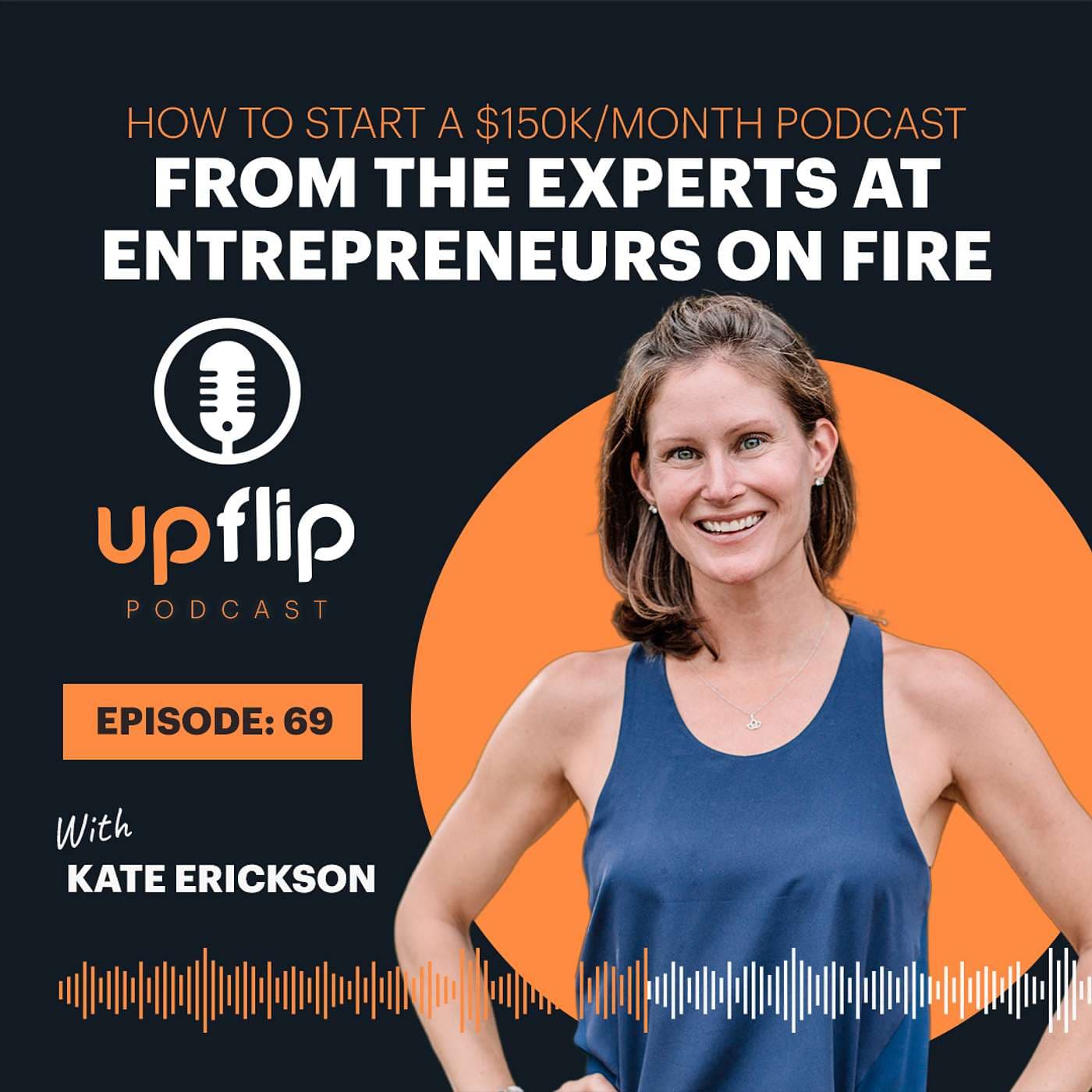
UpFlip Podcast Episode Summary
Episode Title
How to Make $150K/Month by Starting a Podcast
Episode Number
69
Podcast Description The UpFlip podcast focuses on the behind-the-scenes workings of great businesses and how their success can be replicated. With an emphasis on the accessibility of entrepreneurial knowledge, the show has garnered a large audience through practical advice and insights.
Key Takeaways
- Interview Subject: Kate Erickson from Entrepreneurs on Fire (EOFire) discusses their successful podcast with nearly 4,000 episodes.
- Founders: John Lee Dumas began EOFire in 2012 to fill a gap in the podcasting market for daily entrepreneurial content.
- Growth and Revenue: EOFire has achieved over $150,000/month in revenue through various streams including sponsorships, affiliate marketing, physical products, and courses.
Detailed Overview
Introduction
- Kate Erickson is introduced as a pivotal member of EOFire, responsible for building systems and products.
- The podcast began with John Lee Dumas, who sought daily entrepreneurial content during his commutes.
EOFire's Success Factors
- Timing: Entered the podcasting space when daily shows focused on entrepreneurship were scarce.
- Hard Work: Dumas's dedication and focus were key to navigating the early days of podcasting.
- Building Relationships: Networking with industry figures and mentors was vital for driving early growth.
Podcast Growth Timeline
- Initial Growth: Achieved the first 100 subscribers in about a month, with rapid growth following through networking and guest appearances.
- Subscriber Engagement: Early engagement through high-profile interviews played a significant role in growth.
Monetization Strategies
- First Revenue: Initially generated income through mentoring and coaching requests from listeners.
- Diverse Revenue Streams:
- Sponsorships: Approximately 80% of revenue.
- Courses and Affiliates: Each contributes about 13%.
- Physical Products: The smallest percentage of income.
Unique Insights and Lessons
- Audience Feedback: Creating products and offerings based on listener demand rather than assumptions.
- Relationships: The importance of guest collaboration and mutual promotion in growing the audience.
Challenges and Resilience
- Business Reassessment: The team experienced moments of doubt and reevaluation to ensure they were building a business they loved.
- Burnout Management: Emphasizes the importance of batching work to maintain productivity without burning out.
Tips for Aspiring Podcasters
- Identify Your Niche: Understanding your audience and niche is crucial for growth.
- Avoid Obsessions with Metrics: Focus on providing value rather than solely on download numbers.
- Utilize Audience Insight: Use listener feedback to shape content and offerings effectively.
Practical Advice
- Podcast Structure: Regular frequency is essential; at least once a week to maintain audience routine.
- Tech and Tools: Recommendations include Libsyn for hosting, Adobe Audition for editing, and various project management tools like Asana for workflow management.
Conclusion
- Key Takeaway: Podcasting is a long-term endeavor requiring patience, commitment, and strategic planning.
- Final Thoughts: Kate emphasizes the importance of community and the joy of podcasting, encouraging listeners to pursue their passions without fear of competition.
Resources Mentioned
- [EOFire Podcast](https://www.eofire.com/)
- [500 Free Business Ideas](https://bit.ly/3YDyYTQ)
- [Franchise Guide](https://bit.ly/4aWuGvc)
Connect with UpFlip
- [YouTube](https://www.youtube.com/@TheUpFlipPodcast/)
- [Instagram](https://www.instagram.com/upflip/)
- [Facebook](https://www.facebook.com/upflipofficial)
- [Twitter](https://twitter.com/upflipofficial)
Thanks for listening to this episode of UpFlip Podcast!
Written by AI. May contain mistakes. Listen to the episode to check what was said.
Transcript
Automatic transcript. May contain errors.0:00Patience, drive, discipline. You've got to have passion for what you're talking about. You've got to be willing to do the due diligence, to do the research, to put yourself in your listener. and avatar shoes. You've got to be engaging and you've got to be unique. Hello and welcome to another episode of the UpFlip podcast. I'm your host, Alex Freeman. Today, we're looking at Entrepreneurs on Fire, one of the world's most popular business podcasts. They've released nearly 4 ,000 episodes since launching in 2012, including interviews with thought leaders like Tony Robbins, Gary Vaynerchuk, and Barbara Corcoran.
0:36Kate Erickson is a huge part of that success. She joined Fire Nation shortly after their launch to create systems and products and hosts Kate's Take, taking listeners behind the scenes of seven-figure businesses. I'm excited to hear her insights into how to start and grow a profitable podcasting business, and I hope you are too. Let's talk to her. Kate, how you doing? I'm doing awesome, Alex. How are you? I'm doing great. It's a great day. To kind of get us started, can you talk about when you joined the EO Fire team and kind of the inspiration behind creating the podcast in general? Yeah, absolutely.
1:10So my now husband, my then boyfriend, John, had the idea to start Entrepreneurs on Fire because he was sick of driving in the car and having to listen to the radio. And there are a couple of podcasts producing weekly shows around entrepreneurship. And he was really intrigued by these interviews, super inspired. And so he thought, why isn't anyone doing this daily? I'm in the car every single day. I want more of this content. So he decided to be the change that he wanted to see. He went ahead and launched that podcast. And within about six months, I was working a corporate job at the time. He said, Kate, this thing's kind of taken off.
1:43Like, what do you think about quitting your job and joining me? And that was kind of the inspiration for me to jump ship and join the team. Wow. I mean, that's just an incredible leap to take. What is it that has made EO Fire so successful? Like, what's the secret sauce that you all are doing different from other podcasts? I wish there was an easy answer to that. But as you know, and I'm sure all the listeners know, there is no one silver bullet or golden ticket or any of that stuff. But with entrepreneurs on fire, you know, I think there is a lot of things working at the same time that combine to create the success that we have today.
2:20I think one of those things was timing. When John got into the podcasting game, it was not what it is today. I think that his podcast was very unique. Back then, there was no other daily podcast interviewing entrepreneurs. And he's a really hard worker. When he puts his mind to something, he's focused, he's driven, he's disciplined, he holds himself accountable. And that's really tough to do because there are distractions everywhere. So I think that those are some of the things at play that pull people off course from getting to where they want to be with their business. And John had the perfect formula going.
2:56You did mention that podcasting being a different animal then than it is now, but I'm curious if we can kind of put some markers in the ground on this timeline. How long did it take to get to the first 100 subscribers and then the first 1000 subscribers? So the first 100 subscribers was probably like within a month, I would say, and the first 1000 very quickly thereafter, it was very much kind of a little hockey stick, if you will. The first few downloads were, of course, me, his mom, his other family members. But word caught on really fast. You know, he was interviewing some really big names in the entrepreneurial space.
3:31He had set himself up for success, building relationships, hiring a mentor, becoming a part of a mastermind. And this support system that he had around him sharing the podcast to their existing audiences really helped us take off quite quickly there in the beginning. Now, obviously, it's one thing to have subscriber growth going through the roof. But if the podcast is going to be a business, then obviously revenue needs to start to come into play. So can you talk about how in the early days EO Fire started to convert some of those listeners and subscribers into revenue and what might be the most effective way to do that now?
4:03Yeah. So what we always started out with, product services, offers from the very beginning, and what we still do today is we listen to what our audience is telling us that they want. We don't guess. We don't create something out of thin air. We don't say, oh, I think this is a good idea. I'm going to create it. We listen to our listeners and then we create what a lot of people are asking us for. And some of John's very first revenue was listeners reaching out to him and saying, do you mentor people? You know a lot of stuff. You are obviously, you know, getting pretty seasoned in the podcasting space.
4:38And I'm looking for a mentor. Like, will you coach me? And that was actually the first revenue that John generated is people reaching out and asking if he would coach them. That's really interesting because I think that most people hear podcasts, oh, it's sponsorships, that's the revenue stream. Can you break down the different revenue streams that now make up EO Fire? Yeah. So we have four main revenue streams right now. That would be sponsorships, affiliate revenue, our physical products, which are journals and books. And then we have our online courses. So that is Podcasters Paradise, our flagship product, where we teach people how to create, grow and monetize their own podcasts.
5:14And over the years, we've had multiple other online courses. But actually today, that is the only online course that we have running. We at one time had a course on webinars. We have a lot of free funnels that go into our affiliate offers. So those would be the four main revenue streams right now. And how does that break down in the makeup of the monthly revenue? Is it like a clean 25 % in each category? No. Where's the big one? Where's the smaller one? Sponsorships is the big one for sure. our physical products is the smallest one. Makes a lot of sense, right? You can scale sponsorships really easily when you have a lot of listeners.
5:51And physical products always come with storage and fees and advertising and all that other stuff. Not any of the things that people usually think about when they're thinking about selling physical products. It sounds really fun to put your logo on something and have someone buy it, but the profit margins are not great. I'm sure some people have cracked the code on this. It's just never been like a super hardcore focus of ours. We wanted to get our journals into the hands of people to help make an impact. And we've been able to do that. So we call it a success, right? But it is our lowest income generator.
6:23Percentage wise, I'd say sponsorships are probably about 80%. And then courses and affiliates are maybe 13 each. And then the rest is the journals. Looking back, what do you think is the one thing that was the most impactful in helping EO Fire grow? And why do you think that made such a big difference? Relationships. I really think that the relationships that John built starting before he ever even launched the podcast, like he invested real time, real energy, real feelings into creating great relationships with great people. And that support network, whether it was people he was in a mastermind with, whether it was mentors or people that he had hired and paid money, that support system and all the guests who have been on the podcast.
7:09I mean, we owe huge credit to our guests who come on the podcast because especially in the early days, as I mentioned before, them sharing out the podcast was a huge reason why our listenership grew as fast as it did. Now, I guess the flip side of talking about all the great growth is what's been the lowest point for EO Fire so far and how did you get back from it, whatever that point was? I definitely remember a moment in time when John and I were sitting in my office. I was sitting exactly where I'm sitting right now recording this interview with you. John was sitting on a little couch that I have in my office facing me and we looked at each other and we're kind of going through what we were running at the time, what products and services we were offering, what our team looked like.
7:53We had a core team of six virtual team members and then probably like three to four contractors who were all on retainer. And we just looked at each other and said, this is not the business that we want to run. We got excited. We got inspired. John has a lot of great ideas. I love implementing ideas. And you know, it's easy to get carried away when you're on a roll and you want to make a bigger impact and you want to grow and you want to do bigger and better things. But you always have to be checking in with yourself because if you get down the road far enough to where you're running a business that you don't love, then what are you doing it for?
8:31A quick reminder to our listeners that if you're enjoying this episode, make sure you let us know about it by reviewing on Apple, Spotify, or wherever you're listening to this podcast. Kate, creating a podcast is a lot of work and all of the content accoutrements that go alongside a podcast as well. It's not just sit down and do the interview. How do you maintain your momentum as a content creator and keep yourself from burning out? A lot of it's the systems that we have set up in place. Both John and I are big, huge fans of batching the work that we do. In batching the work that we do, we're never constantly churning, churning, churning, churning.
9:08It's more like sprints. So when I say batching, it's taking content and doing multiple of those in one session versus spreading it out, say, over across a week or a couple of weeks or a month. Today, John is in his office right next to mine recording seven back-to-back interviews. That means that he does not need to record another interview until next week. And so everything that we have set up in the business, especially our content creation, blog content, email content, any of that content, that's all created in batches. So there's never like this constant feeling of you never get a break, right?
9:43And I love that setup for working. I think it's the most productive way for work to happen. So sort of the next series of questions I have for you is a little bit of the how-to section. So if you want to just kind of like think towards a listener who's considering getting into the podcasting game and what advice you may offer them, that's probably the best way to approach these. So the first one being like, how do you grow an audience quickly? How do you build that up? And what are maybe some benchmarks of episode downloads that somebody should be looking at to know whether or not it's working?
10:09So in terms of benchmark, Libsyn puts out stats on a regular basis. That's a podcast media host that we use. And around 125 downloads per episode is a normal median, what you can expect from most podcasts. So if you're above that, then you're doing great. How do you grow a podcast audience quickly? You don't. Again, I feel like we were in a very unique position at the time. We were able to grow an audience quickly and there's always going to be anomalies like that. For the 99 % of other podcasters, this does not happen overnight. Podcasting is a long game. And I really think that where your focus has to be to grow an audience is you have to know exactly who your audience is and you have to have a very clear niche.
10:55And those are two things that 99 % of podcasters are not doing before they launch their podcast because they're so excited about growing. They're so excited about monetizing, but they're skipping the foundation. That's a great point. And I kind of want to stick with that topic for just a second. If someone is maybe unsure about what their specific podcast that they want to host is or produce, how can they go about choosing that niche and focus for the show? Yeah, definitely. So we have an exercise that we like to call your zone of fire. But also, I'm sure most people know it as like your zone of genius exercise.
11:30And this is just taking time, taking out a sheet of paper, drawing a line down the middle. On the left, you have your expertise. On the right, you have your passion. and you spend five minutes on each side, writing out everything that you have experience doing and then everything that you are passionate about. And at the end of those five minutes on each side, just keep writing. Even if you run out of things to write about, keep thinking about it until your timer goes off because oftentimes that's when we actually find the things that we have experience doing and that we're passionate about. And then you're gonna set a timer and you're gonna figure out where there's overlap.
12:04Where do your experiences and your expertise and your passion meet. And when I say experiences and expertise, I'm not talking you went to college for it or you've studied 10 ,000 hours of it. Like for me, one of my expertises is I'm a super organized person. And that might not be something that comes to mind to me like immediately. But when I think about if my friends come to me and ask me something, if somebody asked me for advice, if I were to ask my family what they think that I'm really good at or what some of my skills are, that's kind of the expertise that I'm talking about here. That overlap is your zone of fire, and that would be a really awesome place to start.
12:41So outside of not niching down and all of that, what is one mistake that you see other podcasters make that hinders their growth? Being like over obsessive about it. I mean, just living in their stats and only focusing on their numbers. You have to understand that if you have an episode with 100 downloads, that means that you just stood in front of 100 people and they listen to you, that's pretty huge, right? Not many of us stand in front of 100 people and get to share a message. So I really think that the biggest mistake people make is they get too caught up in the numbers. They get too caught up in what it's supposed to look like or what it has to look like or it's not going the way that I want it.
13:19And I think that benchmarks are really important. I think that stats are really important, but I don't think that it's something that you should beat yourself up over. It's all about iteration. If you're not seeing the numbers that you like or that you want, then you need to go back to the drawing board and figure out why. And then one more kind of in this same vein about popular podcast niches. Like, are there any that are oversaturated that new podcasters should like definitely avoid? Or is it really if you've got the expertise, you should give it a shot? I say if you have the expertise, you should give it a shot.
13:49There certainly are podcast categories that are more heavily podcasted about. Religion, comedy, business is a big one. But you know what? I don't think that that should stop people from starting a podcast on a topic that they are super passionate about, that they have experience with, and that they have gone out, found an avatar, they know a niche, and they know that there's people out there that need this. You just need to be unique. It's okay if there's other podcasts already doing this. How are you going to make yourself different? I love that. Let's talk about the EO Fire podcast network. So there's several channels within the network.
14:24Can you briefly talk about what each focus is on and the value of separating them out into different channels as opposed to having them all in one feed? Yeah, definitely. So Entrepreneurs on Fire is the flagship. I started a podcast called Kate's Take in 2014, a couple years after that, because again, going back to listening to our listeners, a lot of people were asking about what was going on behind the scenes of this business. Like, how are you doing this? What do your systems look like? How do you create those systems? What does it look like to manage a community? How are you launching these products?
14:55How do I set up a funnel? So many questions that are all the things that I do in the business. So I thought, Hey, why don't I start a podcast? And I'll start teaching people exactly what I'm doing. I'll talk about the systems that we create. I'll talk about those marketing funnels and the products and all of that. So that was the inspiration to start Kate's Take. It was also just a really big exercise for me personally and putting myself out there. I'm very much like a behind the scenes person, and I'm not an extrovert. And I knew that it would be a great challenge for me to start that podcast.
15:26We also have quotes on fire, which is John Daly sharing a quote and just kind of providing a little inspiration there. Those are kind of more the niche ones and the daily fire where it was just kind of a way to give people a really super quick bit of inspiration for their day. And again, that was just something that people always ask about, like, you should do a quote show, you should do an inspiration show. And so we gave it a try. We wanted to see what would happen. And those shows also get good study downloads. So we continue doing them. Can you talk about what you think are the main skills that you need to run a profitable podcast?
16:03I'll say empire, empire. Empire, that's a biggie. Patience, drive, discipline. You've got to have passion for what you're talking about. You've got to be willing to do the due diligence, to do the research, to put yourself in your listener and avatar shoes. You've got to be engaging and you've got to be unique. I love all of that. That's all really, really strong advice and developable skills, not necessarily a talent you're born with necessarily, but you can develop all of those skills, which is great. Can you talk about choosing the right platform for your podcast in terms of like a hosting platform?
16:38Like what does EO Fire use and what should somebody be looking for when they're making that decision? We use Libsyn. And the reason that we use Libsyn and we love Libsyn is they are fully focused on podcasters. They don't have a music platform. They don't host a bunch of different types of files. They don't offer everything to everyone. And a lot of podcast hosting platforms out there do offer not everything, but a lot to a lot of different people. So we've always loved the focus that Libsyn has in the podcasting space. They always have their finger on the pulse. They put out a great podcast called The Feed, where they talk about podcasting news.
17:15So they're very much into educating the podcasting space, keeping podcasters informed. Their support is awesome. Support is a biggie. I mean, a lot of people ask, why shouldn't I just go on a free hosting platform? And my answer to that is you get what you pay for. And so I've always believed that Lipson has incredibly reasonable hosting plans starting at like$5 a month, depending on how often you're podcasting and how big your files are, the cost goes up from there. But I've always been of the opinion that it's well worth it to invest. I mean, even if it's 15 bucks, that's like skipping lunch one day, you know, eat lunch at home instead of going out for lunch.
17:52It's not that big of an investment if you're really serious about podcasting. What about your equipment setup? What is your equipment setup? What does it look like to record and edit episodes? And what maybe would you recommend someone who doesn't yet have the gear? What should they go out looking for? Alex, I'm so super simple when it comes to podcasting. Like I want to be able to take my podcasting stuff with me anywhere. I don't usually do that. I like recording in my office. I don't like podcasting while I travel, but I want to have that freedom. So I literally have a MacBook Pro laptop. I have an ATR 2100 USB plugged into my laptop.
18:26And when I'm recording my own episodes, I'm doing that into Adobe Audition, which is my favorite recording and editing platform. This is a part of the Adobe Creative Cloud. So if you have that subscription, then Adobe Edition is included. If not, you can either get the Creative Cloud or you can just do a subscription to Adobe Edition. There are also great free options out there. There's GarageBand for Mac users. There's Audacity for PC. So I'm not saying that Adobe Edition is the only option. It's certainly not, but that's what I use and love. You know, you mentioned the Adobe Creative Cloud and maybe that slides into these tools as well.
19:00On the promotion and marketing side, what tools and software do you recommend for podcasters to be taking advantage of? There are some really cool things coming out with AI and just the influx of interest in all these different platforms. One that I'm really impressed with right now and that I've got my eye on, we haven't fully integrated into our own systems yet, but it's called Capshow. Have you heard of this? Yeah, that name sounds really familiar, but I also have not dabbled into it yet. Okay. Yeah. So it's C-A-P-S-H-O. Had the pleasure of meeting the founders at Podfest this year in Florida.
19:34And I just think they're doing some really awesome things. So CapShow is a really cool tool. We use also repurpose.io. Hanni Mora created this tool. It's a great audiogram tool that will put your podcast on YouTube and on social media channels. So we use a few tools like that Hootsuite to schedule out social media posts. And then we're big, big fans of Boomerang for Gmail, which is a tool that helps you schedule out emails. So when we're talking like guest reminders and any of those automated emails that go along with scheduling an interview and following up on that, which you guys do a great job of on your podcast.
20:12All those email notifications can be systematized and scheduled so that you don't have to worry about, you know, being there, clicking a button. So this is going to bring us to a section of the show that we call our Fan Blitz questions. These questions come from our YouTube community. You can go to youtube.com slash upflip, join the community and pose questions to future podcast guests. So Kate, We got about eight questions. We're going to try and do a 90 seconds. Ooh, all right. Are you ready? Yes. All right. When you were first starting the business, were you afraid of the competition? No. Great answer.
20:45If you could go back in time and tell your younger self, don't do this thing, what would it be? Be afraid to start. How would you feel about working for someone who knows less than you? I don't think I'd feel super great about that, to be honest. What was that deciding moment in your previous job, which made you say, yep, never doing this again? I was offered a promotion and then it was taken away from me. Ooh, yeah, that makes a lot of sense. If you could sell your product or service to one celebrity, who would it be? Oprah. Ooh, great choice. If there was a movie made about your journey, what would the title be?
21:21Just Start. Can you tell us about your most bizarre business encounter? I've had so many of them daily. I get emails that I just can't believe that they're actually being sent. So I've got lots of them. Last one here. What or who would you like to have as a mascot for the EO Fire brand? Oh, it's got to be a flame, a walking flame. Yeah, absolutely. Absolutely. It has to be a flame. All right. That is it for the fan blitz questions. Kate, we've been doing the show for a while now. You did the absolute best in recognizing the blitz portion of those questions. So really well done on that. Well done.
21:58I follow instruction well. You win fan blitz questions. You did it. A few more questions from me, and you can take a little more than three seconds to answer these. Okay. Can you talk us through the lead funnel and how you go about building an effective lead funnel and how you increase conversions in that lead funnel? Yes. So we've identified our podcast as the top of our funnel, meaning that everyone who's coming into our business is very likely encountering us for the first time because they've listened to the podcast. So that's, of course, been among many iterations and testing and researching and looking at stats and website visitors and all this good stuff.
22:38So the fact that we identified that as the top of our funnel means that every call to action that we want to lead into one of our funnels is being audibly said by John on the podcast. So if we know that people are reaching us most likely for the first time through the podcast, then our calls to action are going to lead them into either a free course onto our weekly email list, or if we're running a promotion or a deal or something like that, probably to a phone call with John. And we've enhanced that and iterated on that by testing different calls to action, by testing different offers. Again, all the free courses that I mentioned, those have all been requested by our audience in bulk.
23:23And so as one example, one of our greatest converting funnels is to our Podcasters Paradise course. So if you listen to Entrepreneurs on Fire, you've probably heard John talk about freepodcastcourse.com before. That is a free course that will teach you how to create and launch your podcast. And at the end of that free course, we invite you to a masterclass, also free, where John talks for one hour about the perfect launch plan, how to grow your podcast, and how to monetize your podcast. And at the end of that masterclass, we're going to invite you to join Podcasters Paradise. So that's kind of like a very abbreviated look at what one of our funnels looks like.
Read the full transcript
24:01That's great. Can you talk about the social strategy for the podcast business? Like what platforms are you on? Are the platforms that you'd recommend somebody be on kind of niche specific or are there kind of generally these are the good platforms for podcasts? Yeah, social media is tricky, huh? It's certainly evolved a lot over the years. Our social strategy, it seems to be constantly changing. That's what it feels like anyway. In the beginning, you know, we kind of were doing that be everywhere strategy where we were on LinkedIn and we were on YouTube, we were on Instagram, we were on Facebook and Twitter and everywhere.
24:36I don't think personally is the best strategy, especially in the beginning. I'm a huge fan of choosing one social media platform that you enjoy being on and that you know that your audience is hanging out on. So those two boxes have to be checked, in my opinion. If they're not, then it doesn't matter. I don't think that it will be a good strategy for you if you hate being on the platform or, of course, you know, your audience isn't there. So that's kind of the approach that we take to it. John has a lot of fun on Instagram. We have a big audience on Instagram. He has a lot of followers doing Instagram stories and posting the podcast on reels has been a good push for us and a good driver to the podcast.
25:20And then YouTube, of course, it's a strong search engine. It's a strong channel. It's a strong medium. And so I think that having your podcast in some capacity, Maybe more YouTube shorts for most people because a lot of people do audio only and you've got to be compelling enough. If people are on YouTube, they probably want to watch something. So you just got to keep that in mind. Now, this is the section of the show where it's going to get even more meta as we podcast about podcasting here. What makes someone a great podcast guest? What kind of researcher screening does EO Fire do when choosing guests?
25:54Yeah, that's a great question. So we started an application process years and years ago. Once the podcast grew in popularity, we got a massive influx of requests to be on the podcast. And it would have been an impossible thing to manage had we not set up some type of system for it. So we put an application process in place, kind of put up a barrier for people. At one point, we even went to the length of having people submit a 30 to 45 second video of themselves as a part of the application. That was another kind of block in place just to make sure that people are serious. Because when your podcast is really popular and you have a lot of listens, a lot of people want to be on it just because they feel like it's going to be a free advertising channel for themselves.
26:40And those don't always make the best guess. We want guests who are going to provide value for our audience and who are showing up to teach lessons and to share their expertise. And of course, we want them to be able to promote their business and what they're working on, but we don't like it to lead with that. So that's kind of how the application is set up. Now, what advice might you offer to a new podcast that has yet to build their name recognition? How do they go about landing high quality guests? There's a really awesome platform called Guestio, and they have very high quality guests, vetted guests.
27:14You can actually leave ratings for guests and hosts on that platform. You can charge to be a guest or as a host. You can charge people to be on your show. Not everyone does. You can go on there and do interview swaps and it doesn't cost anything. It's just about finding the right people for the right show. But they have it set up in a really great way. It's the best guest host interactive platform that I've seen. Really love that business a lot. We're actually investors in it because we believe in it so strongly. So for anyone who hasn't really built a big network or doesn't really know where to start when looking for great guests, I think a platform like Guestio could be a great place to start.
27:55Now, can you talk me through your process of preparing for an interview? What are the things you want to make sure that you have in place before you start recording? You know, when I first started guesting on podcasts, I was very, very intense about it. And I would like draft out my answers to all the questions and And I'd have notes by me and I'd have references and all kinds of stuff. And as I started doing it more, like anything, if you put in the reps, you're going to get a lot better at it. And that was also one of the goals when I started my podcast. I wanted to become really good at talking about the things that people ask me about a lot because that way it's easier for me.
28:34I provide more value. People get what they want. Everyone's happy. So I started doing it more and more and more. I kind of started dropping the notes part and stopped obsessing about every single answer to every single question. A lot of times hosts don't even send over questions. So it really kind of depends on what podcast you're guessing on too. Everyone has a different system and a different setup and a different process. So whereas you guys were very detailed, you sent me over all the questions, I had a chance to look those over. Of course, I want to be prepared. And of course, my main goal is to come on and provide value.
29:09But I'd say one of the most important things for me is just understanding the podcast and understanding the audience that I'm going to be speaking to. Because if I know those things, then I know I can navigate the interview. From the side of the business, I want to ask about the episode frequency for a new podcast. Obviously, EO Fire has multiple shows that run daily, but that is not necessarily the correct rhythm for every show. How do you figure out what that right rhythm is for a show? I really feel like if you're going to be serious about podcasting, that once a week is the minimum. Less than that, and you're never going to become a part of someone's routine.
29:43So I really think once a week is the minimum. I totally agree with you that daily is not for everyone. Twice a week, three times a week, five times a week. Really, the best way to figure that out is to figure out what you can manage given the time that you have available. So whatever schedule you have, maybe you work a day job, maybe you're side hustling your podcast. Maybe you have all the time in the world for your podcast. Maybe you have a family and you're watching your kids during the day. You know, everybody's in a different scenario in a different situation. So you have to find out as an individual what you can dedicate time-wise and then go from there.
30:18And then how long does it take to produce a single episode of the show? Pick whichever one of the shows you want to talk about. But I'm just curious, can you talk about the start to finish kind of process of getting a show completed and what the major steps are in that process? Yeah, John is lightning fast. Of course, he's done this almost 4 ,000 times now. So again, back to putting in the reps. The more you do it, the better you become, the better your systems become. He's knocking out an interview in 25 minutes. He's editing it in five. He's taking a minute or two to insert any sponsorships and intros and outros.
30:51And then that file gets passed off to one of our team members who uploads it to the media host, puts in the title and the description and then schedules it to go live. So we have a pretty seamless process in place now, but it definitely has not always been that way. What about your courses? How long does it take to develop the courses? Our courses have always been kind of over time. It's never been like, let's create an entire course and then we launch it. Like with Podcasters Paradise, we actually brought that to market to get proof of concept from people before we ever created anything for it.
31:26So we had a lot of people telling us that they wanted to learn how to create, grow and monetize their podcasts. We came up with the idea that creating a course would be really cool, that that's something that we enjoy doing is creating that content and how cool to bring people together in a community and be able to give people what they want, create a somewhat passive income stream once it's all built. And so we launched the idea of that on a live webinar. And we said, if we get 25 people to join, we will create this. We had 50 people join. And a week later, 100 more people join. So we got to work and probably over a month, we interacted, of course, with this beta group of people, this 150 people who had joined us and asked them what they wanted in a course.
32:12What do you expect from this? What would be most helpful for you? videos, resources, templates, Facebook group, and we kind of built it alongside them, which was a really valuable exercise. And it's what we've done with every single one of our courses since. I love that proof of concept because you actually have people voting with their wallet. A lot of people will tell you, yes, that sounds awesome. I want it. And then you go create it and they don't pay you money for it. So that proof of concept has always been really important to us. make people vote with their wallet. So with all of these various irons in the fire, all this content that's being created on such a regular basis, how do you coordinate and manage the workflow at EO Fire?
32:53Like what scheduling and collaboration tools would you recommend? I love Asana. That's what I use as a task and project management tool for myself and for my VAs. Myself, John, and the team as a whole, we're really big fans of Google Drive. So Google Docs, Google Spreadsheets, those are great, right? Just because they're live time editing and everybody has access to the same information at any given second. So a lot of our podcast production stuff, who's coming on the show, when they're coming on the show, when their episode's going live, what sponsors are in that episode, that's all managed very simply in a Google Spreadsheet.
33:29There are a lot of new tools coming out. I've been hearing a lot about Notion. looks like a very robust and awesome tool to help you manage a lot of this stuff in one place. Unfortunately, none of these tools existed when we first started. And so that's why we do have a lot of really basic tools that we use in the business, but it works really well for us. And at this point, we really haven't felt the need to blow things up to switch to a different platform. So Asana for task management and Google Drive for pretty much everything else. Now, throughout this interview, you have made mention of a lot of systems that seem really dialed in.
34:07Some of that obviously coming from having done over 4 ,000 podcast episodes in some regards. But how have those systems evolved with the business? Can you talk about how you've initially put the systems in place and then what your process is for making sure that they are still functioning at the highest level? So John had a virtual team member before I even joined the team. And so when I joined the team, we were three. And at that point in time, pretty much every system that we had in the business or even that we were creating at that point in time was a checklist. like what needs to happen every time we do this thing for it to be done successfully.
34:45And once we started getting more elaborate systems and more irons in the fire, as you said, then we started, you know, maybe making video tutorials, we're starting to delegate things. And so it was easier to create a video tutorial that would show someone else how to do something the way that we wanted it done versus, you know, try and get on a Skype call or share your screen. and then the person forgets the next week and everything doesn't work. So we started doing a lot of video creation for our systems. Then we found some cool tools like Sweet Process. I've used Sweet Process a lot to put these different systems together because I found that by the end of creating a system that I might have a checklist, a couple videos, some screenshots, and maybe an audio clip.
35:34And it's like, how am I supposed to put this all together so that it makes sense if I'm delegating this to somebody else. And Sweet Process is a tool that helps you do that. So it's kind of dependent on the system itself and how many different people are involved. I'm a big fan of, like I said, just a very simple checklist I think can go a long ways because a lot of the times when we're doing repetitive tasks, even if we might be doing them really often, we still end up missing steps. I don't think I'm alone in the podcasting world when I say that I've recorded an entire episode without actually hitting the record button.
36:07So, you know, sometimes a simple check. You are not alone. I can tell you that for sure. Thank you. Thank you. But yeah, I mean, you get to recording an episode, but then you also have to consider that that episode needs to be uploaded. You need to create social media. You have a show notes page. Maybe you're sending an email out for it. So when you're trying to bring all these moving pieces together, having a system or a tool like Sweet Process or something where you can bring a lot of different file types into one flow is really helpful. How big is the EO Fire team now? We are five, myself, John, and three virtual team members.
36:43Can you talk about what roles those people are filling and what key roles to have on a profitable podcast team are? Absolutely. For us, we have a team member who's my virtual assistant, and she helps me with community management, reporting, and customer service. And then John's virtual assistant is kind of the head of all things podcast management. So any guest coordination, any emails that are going out when the episodes are going live, making sure that the show notes are ready for that, that everything's scheduled and ready to go sponsorships that sponsors are being put in the right place. That's John's virtual assistant.
37:22And then our third virtual assistant who also is mainly helping John out. He does a lot of our Amazon advertising. He is also big into video and audio. So he's the one that's uploading all of our episodes. He's focused on the YouTube channel and on helping us create reels for Instagram. So he kind of handles audio video stuff. What's one thing that you've learned since joining EO Fire that you wish you knew when you joined the company? I guess I'd say how integral having these systems in place is. I mean, there was a long time where I was kind of trying to get a feel for my position. I mean, I really hadn't been an entrepreneur before this.
38:06So I was kind of thrown into the deep end a little bit. And I was used to being at a job where like somebody would just tell me what to do and then I would do it. And I loved the freedom of being able to create my own schedule for all the obvious reasons. But it was also really difficult because I didn't know what to do. So navigating that and kind of figuring out what I was best at and what I really enjoyed doing and then being able to create systems around that, I think I probably would have tried to handle that a little bit differently. It kind of felt like a fish out of water for a while there.
38:42If you could pick the one thing that people take from this interview, what would it be? That podcasting is a marathon, not a sprint. It's really one of the most fabulous things that we've ever done in our life. I mean, it's created this business for us. We're incredibly passionate about it. It is such a fun medium. I've never met cooler people than podcasters. It's an amazing community. There's so, so much to be had from it. But you have to understand that podcasting isn't about just like jumping in, growing an audience and making a ton of money. It's not how it works. What's your favorite business book and why?
39:17My favorite business book? I don't know that a lot of... Well, yeah, It's definitely a business book in my mind, Essentialism by Greg McKeown. Kate, where can people learn more about you, what you're working on and EO Fire? Everything that we do is over at EOFire.com. That's where you can find our blog, our free courses, all of our podcasts and everything that we have going on. That is going to do it for this episode of the UpFlip podcast. A reminder to our viewers, check out the blog where you can find more actionable advice on starting a business from scratch and growing it to six figures and beyond.
39:48That is upflip.com slash blog or click the link in the description below. Kate Erickson of EO Fire. Thanks so much for joining us. Thank you so much for having me, Alex.
From the publisher
Entrepreneurs on Fire is among the most popular and profitable business podcasts, with nearly 4,000 episodes, more than 142 million listens, and an average revenue of more than $150,000 a month. Hear the EOFire team’s tips for starting a podcast in this interview.
Host John Lee Dumas started Entrepreneurs on Fire in 2012 to fill a void in the market. Their consistently valuable free content was an instant hit, and Kate Erickson joined the team six months later to create systems to manage their growing audience. A decade later, they’ve interviewed more than 3,000 entrepreneurs and given inspiration and actionable strategies to countless more.
Now, Kate’s talking to the UpFlip team about how to start a podcast with this kind of massive growth potential. You’ll hear both what drove EOFire’s success and the mistakes they made along the way, along with some helpful resources and other advice that will be invaluable to anyone starting a podcast in 2023.
Resources:
- https://bit.ly/3YDyYTQ 500 free business ideas
- EOFire - Listen to the Entrepreneur on Fire podcast
Ready to be your own boss without starting from scratch? Grab our FREE Franchise Guide and unlock the secrets of proven business models that have already created thousands of success stories.
Connect with UpFlip:
- On Youtube
- On Instagram
- On Facebook
- @UpFlipOfficial on Twitter
For more insights to start, build, or grow a business, check out the resources on UpFlip.com or head to the UpFlip YouTube channel to see more interviews with business owners and experts.
Thanks for listening!


