
In short
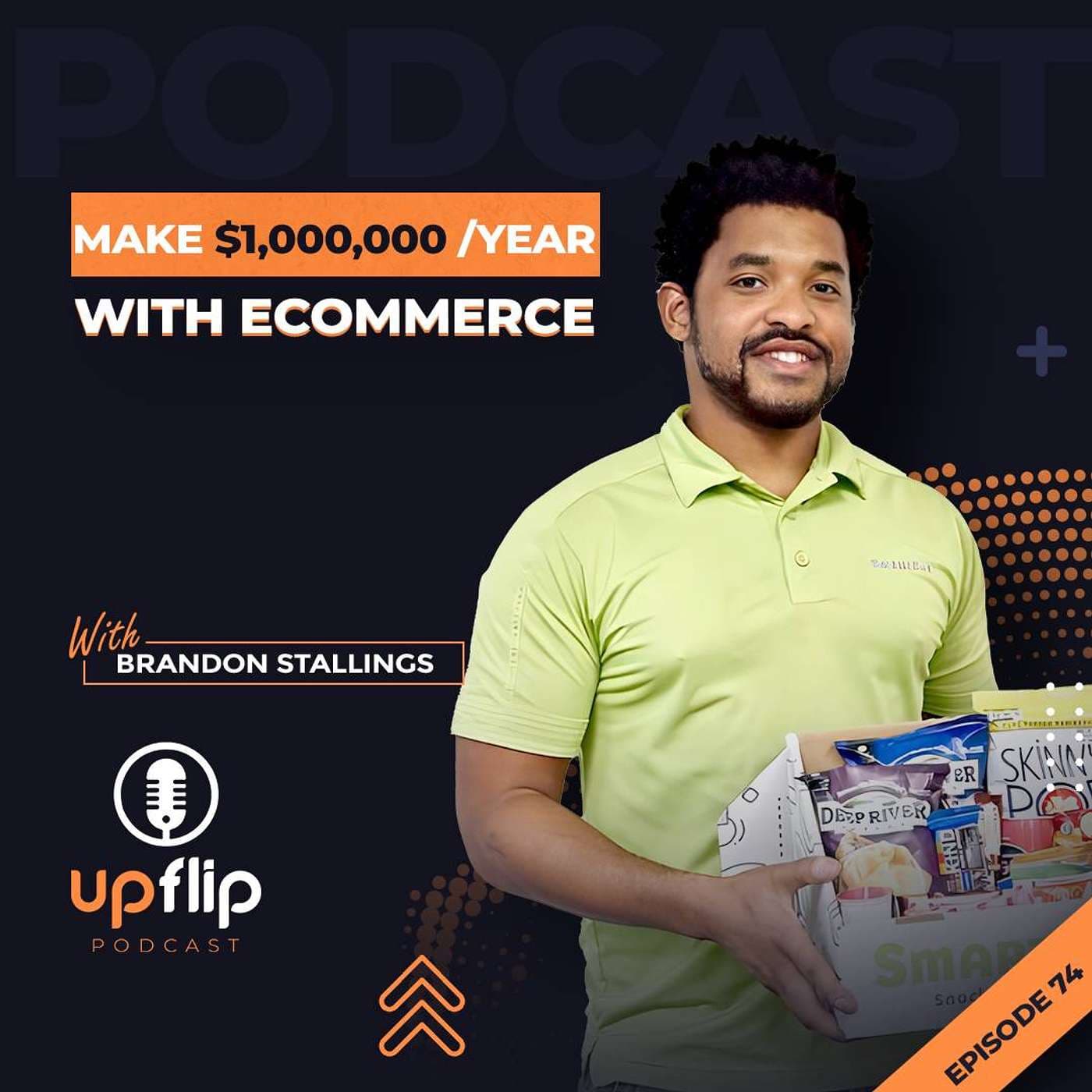
The UpFlip Podcast Episode 74: Make $1 Million a Year with Ecommerce (Here's How)
Podcast Overview The UpFlip Podcast explores how successful businesses are built and operated, aiming to inspire entrepreneurs by sharing practical insights and advice. This episode features Brandon Stallings, the founder of SmartBox, who transitioned from a local vending business to a thriving e-commerce model.
Key Guest
Brandon Stallings
- Background: Originally started a local vending business with a focus on healthy snacks.
- Transition to E-commerce: Pivoted to e-commerce in 2019, achieving significant monthly revenue growth.
- Business Model: SmartBox offers customized snack boxes with an emphasis on convenience, variety, and quality.
Episode Highlights
Transition to E-commerce
- Motivation for the Pivot:
- Found e-commerce more aligned with his skills and passions.
- Realized limitations of the local vending model (e.g., market size, physical assets).
Key Success Elements
- Skills from Previous Ventures:
- Experience in day-to-day operations, HR, and overcoming adversity helped in managing the new business model.
- Growth Strategies:
- Focused on digital advertising and customer acquisition.
- Adapted quickly to market changes, especially during and after the COVID-19 pandemic.
Challenges Faced
- Selling the Vending Business: Took approximately a year, dealing with a limited local market.
- Adapting to E-commerce: Required a complete overhaul of business operations and marketing strategies.
Lessons Learned
- Outsourcing: Early realization that outsourcing is crucial for efficiency in e-commerce.
- Mistakes Made: Delayed adapting marketing strategies to meet changing consumer behavior.
Starting an E-commerce Business
- Startup Costs:
- Building a website, digital fees, and initial marketing expenses.
- Importance of customer feedback and market testing before launching.
Mission and Vision of SmartBox
- Core Focus: "Snacking done your way" emphasizing customization and convenience.
- Meaningful Gifting: Promotes the idea of gifting healthy snacks for various occasions.
Revenue Model
- Diverse Offerings:
- Corporate gifting (originally 90% of revenue) balanced with individual subscriptions and one-time purchases.
- Introduction of build-your-own boxes and subscription models.
Marketing and Customer Acquisition
- Target Customer Profiles:
- Importance of identifying where potential customers seek information.
- Pre-marketing efforts to gauge interest before launching products.
Customer Service Philosophy
- No Snack Left Behind: Commitment to resolving customer issues fully to foster loyalty and positive reviews.
Key Takeaways
- Persistency in Business: Every entrepreneur will face challenges, but believing in the idea is crucial for success.
- Data-Driven Decisions: Regular assessment of customer feedback and marketing analytics is essential for growth.
- Vision and Accessibility: A clear mission and accessible offerings help differentiate a business in a crowded market.
Conclusion Brandon Stallings shares valuable insights into the journey of transitioning from a local vending business to a successful e-commerce venture. His experiences underscore the importance of adaptability, customer focus, and strategic marketing in achieving business success.
Resources
- [SmartBox Company Website](https://smartboxcompany.com/)
- [UpFlip Franchise Guide](https://bit.ly/4aWuGvc)
Connect with UpFlip
- [YouTube](https://www.youtube.com/@TheUpFlipPodcast/)
- [Instagram](https://www.instagram.com/upflip/)
- [Facebook](https://www.facebook.com/upflipofficial)
- [Twitter](https://twitter.com/upflipofficial)
---
This structured summary outlines the essential themes and insights from the podcast episode while providing a clear understanding of Brandon Stallings' journey and the business model behind SmartBox.
Written by AI. May contain mistakes. Listen to the episode to check what was said.
Transcript
Automatic transcript. May contain errors.0:00How does reselling healthy snacks and pocketing a million dollars a year sound? Our guest today did exactly that. His remarkable transition from operating a local vending business to harnessing the power of e-commerce and launching Smartbox leaves us with a lot to learn. I know guys in the subscriptions industry that say they work 16 hours a week, okay, and their company makes$500 ,000 a month top line. You got to figure out where do I target people? Where do I want them to see us for the first time? And what do I want them to see? Every entrepreneur is going to sometimes feel like quitting, but everybody needs to know that you deserve to be successful.
0:39You feel like a different person whenever you do something and it works. I'm your host, Alex Freeman, and I'm joined by Brandon Stalling to unravel the world of e-commerce. Everything you need to launch your business and take your slice of this$5.7 trillion industry will be revealed right here today. Brandon, welcome to the show. Thanks so much for having me, Alex. Let's start with your background and story. When and how did you start Smartbox? Yeah, so actually there's been basically two versions of Smartbox or, you know, I've basically done a lot with it with exception to changing the name. And we started in 2012 actually with an original Smartbox company that was vending machine business.
1:21I started with like a vending franchise back in the day during my collegiate days at FSU. We transitioned to our own business. We were able to use a lot of assets from that business. And I eventually launched my own vending business called Smartbox, where we had touch screens and a lot of cool technology, a lot of automation in the business. And it was all about healthy vending. So probably one of the coolest vending businesses in town. And for the most part, we remained local over the life of that business. And I did a lot of other things like self-checkout kiosks, hot food, cafe. and eventually we transitioned to e-commerce and I sold everything that I had done before and relaunched the company as of this past November as a fully e-commerce business.
2:06It actually used to be a side business and we did corporate gifting as well. So lots of different things under that umbrella. Wow. Why ultimately did you decide to make that pivot into e-commerce from the local vending business? Well, it was much more my cup of tea, I think. In vending, it's sort of a night and day difference. In vending, there's trucks, there's equipment, there's assets, there's a warehouse, there's people. So with all those resources, I mean, I can make the machine as glitzy as I can with touch screens that allow you to review nutrition labels, send us a message directly instead of the whole phone call and petty cash thing, digital refunds, everything.
2:46We had the works, but you eventually hit sort of a ceiling because it's all about getting, you know, accounts in a very limited market. So, I mean, the difference is with e-commerce being able to be basically national and international in some cases instantly. And I come from a very digital background. It was much more my cup of tea and I've already had more success in this industry than I have the previous. What sort of skills or knowledge that you gained from running the company in its previous iterations do you think that helped you in particular when you made that final pivot into e-commerce.
3:18Yeah, yeah, absolutely. So plain and simply, I've learned to run a business, you know, running a business that, you know, not just necessarily day-to-day operations, but what you need to do and the capabilities and the flexibility that you need to have to run a business. So being able to just knowing how to deal with people, I've seen like every issue, even though in vending, there's a lot more money in my new business, in vending, what it taught me was just every single issue that I've seen with HR especially and managing people, managing a facility, making decisions. I mean, it's really those things.
3:52I've always had sort of the digital side of things. I just didn't know that there was a better way or like something out there that was just more sort of suited from that perspective. But everything else when it comes to how to run a business and how to deal with adversity and chaos and sometimes financial issues and things like that. I think I've seen a lot of different things now. Therefore, there's not a lot that scares me. What was the most challenging part of that transition from the local brick and mortar ask vending business to the e-commerce business? Well, number one, selling my vending business, it took, you know, about a year to actually sell the whole thing.
4:31You know, you're dealing with a limited market in that it's local. So you got to find a buyer that's local, that's going to take it over. It's the physical labor. There's so much actually in e-commerce to me that was just easier for me. Now, I appreciate the work that my third-party fulfillment center does. They have all the resources to be able to do fulfillment. But I think one of the toughest challenges was learning that it takes a different business model. You can't run the same thing out of the same operation. Now we're in a place where, I mean, 90 % of the business is outsourced. And so I think the hardest thing was just how long it took to get things set up.
5:08And I think the other thing was learning the changing environment of the industry. I mean, advertising now, digital advertising is different than it was during COVID. I was able to really ride this wave of bulk orders and work from home gifts during that time. But then now we've got to be successful in today's day and age in a normal economy and really kind of a struggling normal economy. So like it's been a challenge, but we've figured out how to do digital ads differently as opposed to just this amazing growth that we saw during COVID since everybody was sort of forced to work from home and order things online.
5:45Since you've made the pivot to the e-commerce version of the business, what mistakes have you made and what have you learned from them? Well, so just like I was saying, trying to do the same thing with the same overhead in e-commerce, I learned when I went to these trade shows like SubSummit and from what I've learned from other organizations whose trade shows I will attend like RetailX is that outsourcing is the way to go. A lot of these entrepreneurs in this industry work from home. It's very digital. And, you know, a lot of them know how to do the advertising and know how to do things that I was never equipped with.
6:18I'm very good at a lot of the back end stuff. I sort of operate as the company's e-commerce manager, but at the same time, there are things that I need to outsource as well. So I think the biggest mistake was just waiting too long to change things, especially from like a marketing and advertising perspective. It's kind of interesting how the industry changes, but just learning how to pivot and, you know, even after setting up the business differently, learning that like my model when it comes to acquisition wasn't exactly what was going to work for today's day and age. So you got to change quickly.
6:53And I eventually did it, but it took a lot of hard, sort of costly lessons learned in order to get there. But luckily, things get easier and easier as you fix them. And in e-commerce, once you fix something, you don't have to fix it again, kind of like a vending machine, if that makes sense. And if somebody's listening to this and they're saying, oh, I kind of want to get into this style of e-commerce business, what are some of the startup costs that they might be looking at? If I were to do this all over again, I would be blessed with the opportunity to be able to build a website to really get it right, you know, and to then leverage my experience as well.
7:29So the giving the customers the ability to leave a review, to give us feedback, having a whole feedback loop. I think the startup costs, the building of the website, you know, the digital monthly fees that come along with that. But then before you even go big and start fulfilling orders or doing any of that, doing some focus group-like testing. So acquiring an email list, not by purchasing it, but perhaps by doing some giveaway campaigns and things like that in the beginning to just sort of get some interest and some people on your email list, some followers on your social media. Acquiring all of that before you even make the first sale and then asking people, how do you interpret this?
8:10Where do you get your information? how'd you find us and really just defining your target market, measuring 10 times and cutting once and having that discipline before you really go into business, especially if you're selling physical goods. I guess software as a service might be a little different, but physical goods, I would say before you even make a sale and go to a third party fulfillment center. And then again, there's that setup cost as well. You might have to pay some storage fees in this process and things like that. But yeah, I mean, it's pretty minimal if you can keep it digital, but I would say trying to acquire as many potential customers as you can before acquiring actual paying customers before you go into business.
8:47And that way, you could be profitable right out of the gates, potentially. Listeners, if you're looking for more advice on how to start and grow an online business, check out our interview with Ron Stefanski in episode 50 to find out how he makes 85 % profit margins on his online business revenue. Brandon, can you tell me about the vision or mission that you have at SmartBox and also why it's important for an e-commerce business to have a vision. Yeah, it's important for any founder to have a vision. And for this SmartBox, this iteration, it's about snacking done your way. If you go on our website, there's all kinds of ways to purchase and all kinds of things you can actually purchase.
9:25So the idea is discover new snacks. You can discover products that are not normally on your store shelves. We have access to thousands of items from all over the world. And you'll see in our store that there are certain flavors of goods or certain goods that aren't available, maybe in your local store. That's an ever increasing amount. And you'll be surprised how many things are so good, but they're just not in that grocery store because it just hasn't made it to the main street. There's actually more products like that than there are things that you see on the store shelves. So there's that. And then there's, you know, you can do it your way.
9:59So you can subscribe to a snack box. You can build your own box as a gift or as a subscription. You can do corporate gifting, bulk ordering, and you can actually ship items to multiple addresses in one transaction on our store. So it's really like, I think that's probably the third thing as far as our mission and vision is a meaningful gift. I've learned throughout this process. I mean, we started with corporate gifting during COVID to help companies out and to pivot away from vending, which obviously vending was very affected by COVID. And I learned the power of a meaningful gift and being able to provide a customer the ability to add a bow, write a card, attach it to a snack box.
10:39I mean, the reasons I see some of these people gifting, you know, like for example, rescuing a newborn in intensive care and thanking the doctors for that. I'm just happy to be the material behind the gesture in that case. I'm curious about your proudest moment as a business owner and how that moment may have helped you grow the business. Well, I think one of them was when I first turned a profit back in 2017, we worked really hard on getting these two really big self-checkout kiosk customers. And that was back during the vending days when we were up against a Goliath. We were the David versus like a company called Canteen that was like a Goliath in the market.
11:20They're able to beat Goliath and get in two of the biggest accounts in Jackson. Now, eventually, the empire did strike back, but we successfully got those accounts, had a really good year. I ended up actually winning an award that year for 40 under 40. Actually, you know what? That was 2015. Well, maybe that's the second most proudest moment, winning that local 40 under 40 award. But I think at first, turning a profit felt really good. Whenever you do that, you feel like a different person. It's a fleeting thing as well, because eventually I had to do it again and then a third time. So you feel like a different person whenever you do something and it works.
11:59And if it's a new idea, something that hasn't been done by others exactly, then even more so, you definitely feel a lot less crazy. Even in the industry that I'm in now with snack boxes, there's not anything that's exactly like ours. And if you look at some of the gifting competitors, there's probably less than 10 that I can find that really kind of are part of our industry. There's plenty of room to compete on the internet. So I think that might be another thing is being able to differentiate so much in this industry as opposed to the other. Now, one thing that struck me in that answer was these major accomplishments come along with stress in the process of getting to them being accomplished or even just the stress of pivoting into e-commerce from what you had been doing, all these different moments where I can imagine the stress got really high.
12:50How do you manage stress in those moments? And what advice do you have for other business owners to help them manage their stress? My dad told me one time, you know, if you stick around long enough, you'll get what you want. I think that part of it is, you know, you will go through a period where you're very uncomfortable. But there comes a time where you actually get used to some of this. You come to sort of realize that believing that your idea is going to work and that it'll all work out despite some of the setbacks. Every entrepreneur is going to sometimes feel like quitting, feel like giving up.
13:22But everybody needs to know that you deserve to be successful. And it's very brave of you to take risks. And as long as the idea makes sense and that it can make money one day and you believe in it. Also, if it's helping others, obviously, I don't want to be in the business selling cigarettes. I want to help people with whatever we're doing and make money doing it. So it's something that you can feel good about. So I've gone through a lot of stressful situations, but eventually you get to the point where you understand that those situations are going to happen and you don't panic. The idea is to don't panic and think that it's the end of the world.
14:01Just handle the issue and understand that that's part of the job. I want to dive into marketing and advertising a little bit. And I guess to start, I'm sure the specifics of this answer are going to apply most directly to the actual niche of business that you're in. But I'm curious about building a strategy for attracting customers to a new e-commerce business that perhaps doesn't have a brick and mortar comparison hand that they're used to. So if you're building a new e-commerce business, how do you begin to build that customer acquisition strategy? I would say that there's a couple of different questions to ask.
14:37And that is, I mean, first of all, you got to start with what you're selling. So I mean, say you're selling like cosmetics or something, right? Well, sort of define your target market as best as possible. These cosmetics are going to be for women between the ages of 30 and 55. So then the next question is where do they get their information about that already? Do they go on Pinterest? Do they get it from social media? What are other companies that do cosmetics doing online? And where do you find this? So where do they get their information? And then you build this solution, this website perhaps, but you've got to sort of meet them where they are.
15:15So if you decide that, or if you come to find that, okay, women typically get their information about these cosmetics in this particular segment from Pinterest, then you got to go meet them on Pinterest. And then just like sort of what I was saying before, doing some campaigns, some pre-marketing on there to drive interest and see how people react. Ask people, how do you interpret this? I mean, where do you get your information and how do you interpret us? And eventually if someone makes a purchase, what made you make that purchase? I mean, you just get like a few early adopters and it's like, what drove you over the line?
15:54I mean, and that knowledge from those three questions is super valuable because if you ask someone, you know, going back to the, how would you interpret question, then it's almost like they'll use words that you may have not have thought of before, or you can figure out kind of what you mean to them. And that's, I think the core of being able to understand what your core value is going to be to the customer. As you go through that process, how long do you give it for someone to be responding versus, okay, maybe we need to, in the cosmetics example, okay, we think it's Pinterest. We think Pinterest is the spot.
16:28Let's run this pre-marketing campaign. And the response we're getting is not what we're expecting. We need to pivot. How long does that process take versus like, it just takes time in the market for the message to start to get out there versus we're throwing good money after bad. We need to pivot the strategy. That's why it's important to have people with expertise behind you, especially in the field of marketing. I wasn't one at first to have a whole lot of knowledge in digital marketing. And I've learned that it's very valuable to have those who really kind of know what they're doing when it comes to these campaigns and the analytics.
17:00So, I mean, I would think that first, if you don't know how to do it, then find someone to help you that does know how to do it so they can guide you along with this. But that being said, yeah, the question is going to be once you sort of do some test campaigns or maybe just any sort of testing is what are we getting? I mean, are we getting responses? You either will or, you know, you won't get as many as you want. So that'll say something. The truth is always in the data. And the most value I think is whenever you see direct answers to like surveys and people say things like, you know, here's one question we ask in our surveys.
17:33Why have you not purchased yet to people who haven't. And it's like, they'll say things like, well, the cost or the cost of shipping, or I didn't have the ability to add a note. Well, we do have that ability. It looks like people weren't able to find that. So how do we make that more clear? So you got to, as far as how long it takes, it doesn't take long at all if you throw enough money behind it, right? I mean, we do test campaigns for a week, essentially, where we throw$400 or$500 behind something just to see what we get. And then we can certainly tell what it's going to do at scale at that point.
18:09But the devil is in the details. And in this business, the devil is in the data. So the analytics, as far as those metrics that you see on the Google Analytics, for example, but not just those, but people's direct answers, the more of that direct feedback that you can get, it doesn't take very many people to start seeing a pattern, essentially. I mean, your first 100 people are going to tell you a lot about your product. And we've gotten a lot more than that. And it's been very valuable. How much are you spending in an average month on advertising? And where are you finding the best ROI on that spend?
18:44It depends on if it's during a pandemic or not. But we could just throw so much money during COVID at Google ads, for example, because of how many people were forced to go and search for things online. I mean, I think it was like three times the amount of search volume and leads gen activity that was going on at the time during 2020 and 2021. And that being said, I've spent as high as like$31 ,000 in a month on just Google ads. And then you add in social, we've spent a lot of money there, but we've been able to also figure out how to spend a third of that amount to get the same result and then do some things on social that don't even involve getting the sale.
19:29One of the things that I'm getting out of the philosophy of doing is this whole get the sale or nothing advertising strategy where you're sending a lot of traffic to the site. It's based off of conversions. And if you don't get the conversion, then you've essentially paid for that traffic. You might never see that person again. The idea is when you get traffic, if you don't get the purchase, then maybe through your pop-up or your footer or some other page that you're sending them to, you at least get the email contact information where you can follow up with a discount code or something like that.
19:59And to create a funnel so that you can nurture those leads. So that's where retargeting comes into play. And you got to figure out where do I target people? Where do I want them to see us for the first time? And what do I want them to see? How do I put the brand in front of them? And then how do I nurture those people who may have hit the website, but they're not ready to make a purchase? Because in e-commerce, people make purchases on their own time. They do not just stop what they're doing and make a purchase right then and there. They're going to do it on their own time. So you've got to get in front of them on average seven to 13 times in order to get that purchase.
20:35So this is going to bring us to a section of the show that we call our Fan Blitz questions. These questions come from our YouTube community. Listeners, you can go join the community, go to youtube.com slash upflip, and you can post questions to future podcast guests. Brandon, I've got five questions we're going to try and do in approximately a minute. Are you ready? Wonderful. Yes, I'm ready. All right. At this stage of success, what advice would you give to your teenage self? Don't worry. You're going to get what you want. Everything will be fine. Stay the course. What's the biggest purchase that you regret?
21:06Remodeling our office and warehouse four months before I had to close it down. Oof. If you could sell your product to one celebrity, who would it be? This was a tough one. I had this one. Okay. I would say an athlete, someone who could get me in front of others like, you know, oh my gosh, why don't we just go with Tiger Woods to keep it going? I love it. What are some of the nicknames you have for customers or co-workers? I thought about this. I don't have like nicknames for customers and co-workers, but I do have plenty of nicknames for competitors and vendors. Like, you know, there's this one company locally.
21:39I love them. I do plenty of business with them, but they're called fast signs and I'll refer to them as slow signs if they're being slow and things like that. Last one here. If you wanted to sell your product to aliens, what name would it have? Oh, well, I would say, I guess something with a good ring to it, space case, you know, or, you know, sold. That's great. That's a great one. That's going to do it for our fan blitz questions. Listeners, let us know what you think of this episode by reviewing it on Apple, Spotify, or wherever you're listening right now. Brandon, how would you describe the SmartBox brand and how did you establish that for customers when you were first starting?
22:20Yeah. So we were in a transition where it was a vending business. And when I discovered the subscription trade association subta and what you could do with e-commerce, I was just so excited. So I was so ready to convert SmartBox. What I didn't know was just how much I would have to do in order to accomplish that and how much I would have to basically give up in order to do that. So the brand had always been before about like healthy snacks, vending, healthy snacks in a vending machine, basically. But I floated the idea several times of doing a complete name change. The SmartBox brand, sort of like I was saying before now, is about three things, all right?
23:02Access, convenience, and meaningful gifting. So access to an array of snacks. We believe in snacking. We love our snackers. That is our customers. And the convenience of being able to snack your way and being able to do that on a regular basis. But we're also going to be a provider that can help you send someone a meaningful gift. So discovering new snacks, the convenience of being able to do it your way anytime, anywhere. And for both companies, because we do do corporate gifting as well, but for companies and individuals, sending a meaningful gift as well when the holidays or a birthday or an anniversary comes around or what's most popular I see is the birth of a child or the rescuing of a child.
23:50I mean, there's quite a few super meaningful reasons and I'm happy to do that. And that's what we see every day online. We've kind of talked around this, but can you give our listeners just kind of an overview of the different offerings that SmartBox has currently? Yeah. So basically we've got eight different snack box themes. We've got the family box, for example, which is, has our highest item count. It's going to have an array of healthier options for both kids and adults. It's great for if you want to send it as a subscription box to your home, stock your kid's lunch box with some Annie's bunny grams.
24:25We've got so many of the popular things I'm going to name like cliff bar and kind and Annie's and those things that you see. But then we've got some less popular things that are super delicious, like the malk cookies or the muddy bites. To be honest, a lot of people like a lot of the sweet stuff and we're here for it. But the majority of our products that we carry contain all natural ingredients. We stay away from refined sugar and some of the big no-nos, but we're super flexible yet still. And so just to give another example is our celebration box is our most popular corporate gift. It's going to be your higher end items.
Read the full transcript
25:03And it makes for really honestly the best gift that you can find in the store along with the surprise me box, which is sort of a free for all box that we use for corporate gifting. It can be an excellent utility box for if you want to create your own. We're very flexible with the inventory that we carry. And then we also have options for vegan, gluten-free and keto as well. Incredible. And can you lay out for us as well how each of these different options kind of figure into the revenue? Like, I mean, one-time purchasers, subscribers, corporate gifting, how does that all factor into the revenue side of the business?
25:37So when we started out, 90 % of it at least was corporate gifting. It was all bulk orders. These are companies, I mean, like just last month, we did business with Lululemon in Canada, and then Lyft, corporate. We've done business with colleges like Auburn University and Ohio State, even though I went to Alabama for a year, the hard feelings. But we're totally non-discriminatory when it comes to schools and stuff like that. They didn't make you put War Eagle on the box or anything, did they? Well, they did make us put Auburn on the box. We do custom branding, actually, where you can put your logo and we will adopt your colors to our iconography that you see on the box.
26:19So you see that logo, that SmartBox logo on the front, we'll just swap it out with yours and then it'll be your color. So we did that with T-Mobile earlier this year. So I'm just like blessed to be doing business with all these different really big companies, you know, all over the world. We shipped to probably about 20 at least different countries from India to Canada and Mexico, of course, but also to the UK, to Israel. I mean, just like all these different countries that we've shipped to. So international corporate gifting made up originally 90 % of it, but now it's nice and balanced, more like sort of a 60-40 between online and corporate where you're going to have maybe subscriptions makes up about a third of the online sales right now, and it's growing.
27:03And that's because a lot of our subscriptions are prepaid. You can send a prepaid subscription as a gift to someone as well. There's all this flexibility around the snack boxes. I think the snack boxes are definitely the favorite, but now that we have Build-A-Box, a lot of people are selecting the items to go in the box. And I'm seeing actually an increase in snack shoppers as well. That is people that are just buying individual items. So I mean, it's now kind of all across the board when it comes to online sales, which we like. And I would say that even online, it's kind of B2B first. There's a lot of companies as well that are sending boxes yet still to their employees or maybe stocking their office.
27:41We have a build-your-own office snack subscription now. People like to sort of order preset boxes. It depends on how much time you want to spend shopping, basically. Are you doing anything different in your strategy for those B2B customers versus B2C, or is it all kind of wrapped together into the overall branding of the company? So in a way it is, and in other ways it isn't. So I mean, obviously, I think our most popular three social media platforms are LinkedIn, Pinterest, and Instagram, right? Well, obviously on Instagram, the B2C sort of one-time purchase shoppers are going to be on there, the giveaway campaigns, the flash sales, things like that.
28:19And then you've got LinkedIn, which is definitely more of a corporate audience. So we're talking about something different on there as opposed to Instagram. So, I mean, your strategy from like digital, there are clear differences, same with like anywhere else but in some other ways it's all blended together so on our website it caters to everyone anyone that passes through you're going to see the same products and you know from a messaging perspective we try to make it appealing to everyone but it's amazing to see some businesses make purchases and then i think we had a purchase yesterday from new york life for example online that's i believe a life insurance company but it's really cool to see that.
29:00And then you've got individuals who are just sending things to their daughter and they could be ordering the same exact thing, but it's all about the value that they see. And then I feel like in a lot of the e-commerce space, a subscription model is what wins the day in many ways. And it's the goal for a lot of folks. What advice do you have for setting up a successful subscription service as an e-commerce business? I was watching something the other day. It's not necessarily about talking about how cool your product is, but what it means to them and what it's going to do to your customer, the benefits that it's going to provide them and how it's going to make their life better.
29:36I think a website should answer really three things. Once someone lands on it, it should be clear what you do, but it should also tell you, okay, how's it going to make my life better? And where do I sign up? And will you offer me something just to get started? I think that's the best way to go about it. To your earlier point, yeah. I mean, And one-time purchases in e-commerce, very hard for that to be successful on its own. So that's why for us, the combination of subscriptions and one-time, and then also bulk orders sort of doing it all, that's how you eventually can turn a profit because it's really difficult to have that revolving door of one-time purchasers that don't bring any value post-sale, especially if you're dealing with a high cost per acquisition.
30:20How passive of an income is this or could this be for you as the owner? How many hours are you working in an average week and what are you doing with that time? So in the beginning, when I relaunched everything, I was in, this was only because of my own, I was really passionate about this. I actually love doing this. I love this more than anything I've done before. So I was working nine and 12 hour days in the beginning just to get it going. But actually, you know, now, see, once you fix something, it's fixed. So and then all you really have to do is run the business and then manage the acquisition, the analytics, you know, where most of your money is going, which will be probably marketing and e-commerce.
31:01Right. So, you know, measuring that, always assessing the changes in the market. So I'm totally up for that task. That stuff comes to me easy. So it is not a 40 hour a week endeavor. It is something that can, for me, is eventually going to be 90 % automated. Same can be for our team members. All right. We just have to handle the most important things. We've got two people on our team and we've just got to handle our responsibilities. But I know guys in the subscriptions industry that say they work 16 hours a week. Okay. And their company makes$500 ,000 a month top line. Now we're not even there yet.
31:38All right. These guys are 30 under 30 Forbes list caliber people, but there's a great deal of automation that can be done in e-commerce, but it does take a long time to get there. So it will be longer in the beginning, but at a certain point, it really just depends on how much you want to put in. What does exceptional customer service mean to you and how do you provide that to Smartbox customers? Well, we have a policy that I call no snack left behind. And that is if someone has an issue, like for example, any issue with shipments or if like someone was missing a product in their order, we make sure that they either get that product or they get the refund for that product.
32:18I make sure that every single online shopper is addressed, their issue is dealt with if there is one. And at the end of the day, we resolve it so that we can have that positive reinforcement because it makes people more likely to purchase again in the future or refer you versus leaving a negative review. The whole idea, honestly, from a business perspective, is to stay out of negative reviews and don't get negative reviews left anywhere. But if you can at least at a minimum show people that you're on top of it and that you're working on it, even if it's something that's complicated or something that you can't resolve right away, they will love you for it.
32:54I've had this one shipment where this girl in Mexico, for some reason, I swear, the UPS is having a lot of trouble with this one Mexico shipment, but we reshipped it. We've incurred the cost of this. And, you know, I even had to get with my UPS rep on this, but it's been about a month. Hopefully it'll make it through customs. All right. We're watching it closely, but it doesn't take a whole lot of effort to just, you know, make sure that someone's shipment gets handled, for example, which is pretty much mostly what we deal with. And, you know, there's a such thing as preventative maintenance for making sure that you never get into any sort of catastrophic issues when it comes to like corporate gifting bulk orders, that thing.
33:32If you can plan it ahead as much as possible, then you can have good customer service because you don't have an issue in the first place. If you could pick the one thing that people take from this interview, what would it be? I think that earlier part about you really want to know where your customer is, ask them where you get your information and how would you interpret us and what made you purchase or what will make you purchase or why have you not. That's probably the most valuable thing that we talked about. That's something that you've got to master in order to then go and run the right campaigns on the right channels.
34:04That is like social media or search or wherever. It may not be either of those things. It may be an SEO strategy or embedding yourself into blog posts. It could be like if you're selling baby products, it could just recruiting a bunch of mom bloggers and using influencers. We've tried that before, but I think that that's probably the most valuable information we've shared today. What's your favorite business book and why? I've got a few, okay? My dad would say The Art of War, but one of my favorites was David and Goliath by Malcolm Gladwell. At the time, it was really helpful for me as far as going up against bigger companies in an industry, being super competitive.
34:46How do you win over customers, over other things that are more established and trusted? It's got three parts. And I think that the entire book from cover to cover, every single bit of information from that was super valuable to me. And it helped me see things a lot differently and to be more competitive and to choose my battles better. Brandon, where can people learn more about you and Smartbox? So I'm on LinkedIn and Instagram. The handle is Smartbox Company. That's just all one word, Smartbox Company. Everything spelled out. You can find us on LinkedIn, Instagram, Pinterest, all the same handle.
35:25You can also check out smartboxcompany.com. That's our online store. Feel free to use the promo code SNACKTIME for 10 % off on your first purchase. As far as looking for myself, I'm also on LinkedIn and Instagram, random box. But I would prefer you go to Smartbox and check it out. You can find it. That is going to do it for this episode of the UpFlip Podcast. Listeners, you can find more advice for how to start a business the right way on the UpFlip Hub. And if you enjoyed this episode, please make sure to leave a review on Apple Podcasts or wherever you are listening to the show. Brandon Stallings of Smartbox, thank you so much for joining us.
36:01Thanks so much, Alex. I've really had a great time with this. Really appreciate it. And I hope your listeners enjoy.
From the publisher
Brandon Stallings was successful as a local vending business owner, but when he pivoted to an e-commerce business his revenue soared to 6 figures a month. He explains how to start an e-commerce business with huge growth potential in this episode.
SmartBox delivers customized snack boxes packed with healthy, all-natural snacks all around the world. Their combination of convenience, variety, and quality has propelled the business to incredible levels of success since Brandon shifted to an e-commerce business model in 2019.
Expanding his potential customer base to the global scale definitely contributed to SmartBox’s growth. That wasn’t the only reason Brandon’s been so successful, though. He also found e-commerce was a better fit for his skills. He’ll explain what those key skills are in this interview. We’ll also hear how he adjusted his systems and operations from local vending to an e-commerce business model, and how committing to values like sustainability has helped him scale his business.
Resources:
- https://bit.ly/3YDThAc Start your ecommerce or vending business today
- SmartBox - Connect with Brandon
Ready to be your own boss without starting from scratch? Grab our FREE Franchise Guide and unlock the secrets of proven business models that have already created thousands of success stories.
Connect with UpFlip:
- On Youtube
- On Instagram
- On Facebook
- @UpFlipOfficial on Twitter
For more insights to start, build, or grow a business, check out the resources on UpFlip.com or head to the UpFlip YouTube channel to see more interviews with business owners and experts.
Thanks for listening!


