
In short
UpFlip Podcast Episode Summary
Episode Title
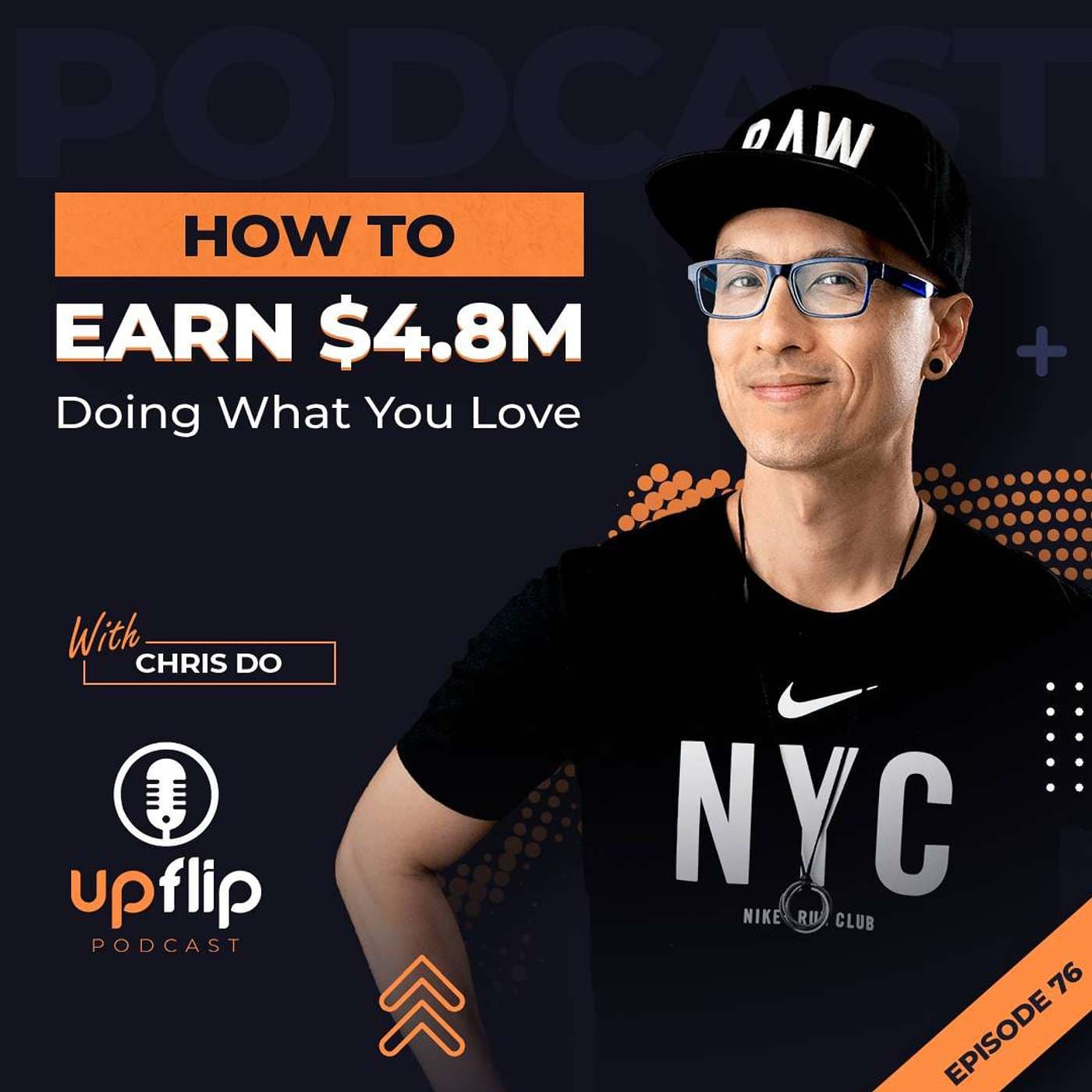
76. How to Earn $4.8M/Year Doing What You Love
Host
Alex Freeman
Guest
Chris Do, Founder of The Futur
Episode Overview In this episode, Chris Do shares his journey from running a production company to founding The Futur, where he teaches people how to monetize their passions. His mission is to educate 1 billion people on making a living doing what they love. The conversation dives into challenges, strategies for success, and insights on running a creative business.
---
Key Takeaways
Chris Doe's Background
- Previous Experience: Chris was a graphic designer and motion designer before venturing into education.
- YouTube Influence: He was encouraged to create YouTube videos in 2014, a decision that transformed his career.
Mission of The Futur
- Core Goal: To teach 1 billion people how to make a living from their passions.
- Business Transition: Shifted from client work to creating educational content.
Discovering Passion and Monetization
- Finding Passion: It often involves reflecting on childhood interests and recognizing activities that induce a flow state.
- Researching Market Demand: Identifying intersections between personal passions and market needs is crucial for profitability.
Revenue Streams
- Diverse Income Sources:
- Courses: Initial primary source of revenue.
- Community Coaching: The Future Pro Group has become the largest income stream.
- Brand Deals: Collaborations with corporations.
- YouTube Ad Revenue: Passive income from video views.
- Speaking Engagements: Additional revenue from public speaking.
Business Strategies
- Service vs. Product Orientation: The Futur operates as a product company, focusing on selling to many customers rather than a few clients.
- No Traditional Business Plans: Chris advocates for flexible goal setting without rigid business plans to adapt to market changes.
Creative Process and Marketing
- Content Creation: Emphasizes the importance of producing valuable content to build a loyal audience.
- Lead Generation: Focus on providing value rather than pursuing transactional relationships with potential clients.
Overcoming Challenges
- Initial Struggles: Transitioning from a service mindset to defining his own agenda was challenging.
- Burnout Management: Recognizes burnout as a symptom of working on disliked projects or with unfulfilling clients. Advocates for realistic goal setting and taking breaks.
Coaching and Team Building
- Importance of Mentorship: Hiring a business coach significantly improved revenue.
- Team Expansion: Grow your team as needed, preferring independent contractors initially to ensure cultural fit.
Audience Engagement
- Social Media Utilization: Engage with audiences through platforms that align with personal strengths.
- Value Exchange: Build trust through consistent value delivery, leading to natural customer loyalty.
---
Conclusion Chris Do emphasizes that success in creative entrepreneurship requires a balance of passion, market understanding, and business acumen. His journey illustrates the potential for monetizing creativity while advocating for a strategic approach to business growth and audience engagement.
Resources Mentioned
- [The Futur](https://thefutur.com/)
- [Franchise Guide](https://bit.ly/4aWuGvc)
- UpFlip [YouTube Channel](https://www.youtube.com/@TheUpFlipPodcast/)
---
Connect with UpFlip
- [YouTube](https://www.youtube.com/@TheUpFlipPodcast/)
- [Instagram](https://www.instagram.com/upflip/)
- [Facebook](https://www.facebook.com/upflipofficial)
- [Twitter](https://twitter.com/upflipofficial)
For more insights on starting and growing a business, visit [UpFlip.com](https://www.upflip.com) or check out the UpFlip blog for actionable advice.
Thank you for listening!
Written by AI. May contain mistakes. Listen to the episode to check what was said.
Transcript
Automatic transcript. May contain errors.0:00As the old adage goes, do what you love and you'll never work a day in your life. Although true, it's way easier said than done. Do you know what you love? Do you know whether you should pursue it? And most importantly, do you know how to monetize it? We are now getting preferential treatment over others. And the last time we did that, we turned a$100 ,000 job into a 1 million plus job. Every change, every piece of knowledge you acquire allows you to do what you do better, faster, and for more money. It's harder to find new clients than it is to keep a client that you already have. So focus on them.
0:32I'm saving and reserving my free time to learn because I know everything I learned is going to magnify through the pieces of content that I create. So I delegate almost every single thing except for the parts that cannot be delegated. So when I make an announcement, I'm going to do a workshop or a talk. They'll show up. If I launch a video, they'll make sure they watch the whole video. I'm your host, Alex Freeman, and I'm joined by Chris Doe, founder of The Future, who turned his love of teaching into a 400K a month business. Earning exorbitant amounts of money from your passion is possible, but the key is doing it the right way.
1:06And that's exactly what we're covering in today's episode. Let's get started. Chris, thanks so much for joining us. Glad to be here. Thanks for having me. So to get things started, tell me a bit about your background. When and why did you start the future and how did you get there? I'm a traditionally trained graphic designer who, upon graduation, got into motion design and making commercials and music videos. But in 2014, a friend of mine asked me to start making YouTube videos. I reluctantly said yes. And that decision changed the course of my life. Making videos is now my primary business. Teaching others is what I do.
1:37Incredible. And can you tell me about your mission with the future and how you kind of came to that decision as being the goal and how that big picture vision helped the company grow? Sure. Our mission is to teach 1 billion people how to make a living doing what they love. And this expression came from a management meeting with my executive team. We were transitioning from doing client work, making videos and commercials into creating content. And I wanted to know, what are we doing now? What is it that we're in the business of? And I wanted to be able to articulate to them in a short, succinct way.
2:07I told them a story. I could tell it worked. That night I went home and kind of thought about it. And by the next morning, I was able to rewrite it into the sentence which I just said to you. Helping people to monetize what they love doing begs the question of how does somebody figure out what they love doing? If somebody hasn't figured that out yet. What steps should they take? And how did you discover what you love doing? I think finding what you love doing is sometimes a lifelong pursuit that some of us never actually find. Most of us in our childhood know what it is that we love, but we're told not to pursue that.
2:38That's a frivolous pursuit that we'll never make any money. We'll be starving. I was one of those people. And I thought for a long time that creativity was the thing that you do as part of your pastime, your hobby, but not as a career. It wasn't until I met a real life graphic designer who was actually making a living doing what he loved that it gave me permission to pursue the same. And so I would suggest to people, think back when you were like five or seven years old, think about what you love to do, where you lose track of time when you're in your total flow state. One in which you're almost like not gonna go to the bathroom because you're having so much fun doing it.
3:06That's a clue. So go back to that place. As somebody uncovers what they do love doing, understanding that it could be a profitable business. So how do they take that leap? What kind of research should somebody be doing to identify a target market for what they love doing and verify that it can be profitable. If you truly found something that you love doing, you have an inherent built-in advantage over other people who are just kind of doing it and phoning it in. You're naturally passionate, you're very curious and you can become obsessed. So allow yourself to become obsessed. Learn as much as you can about what it is that you do and put in the time and the necessary work to become excellent.
3:40Once you do that, look for a market that might need something close to the way of the thing that you like to do. When you can find the intersection between what a market needs, what a starving market wants, and what it is that you love to do, you may have found your purpose in life. I love that. Almost finding it to be an obsession. So when you found your own obsession, how long did it take for that obsession to become profitable? And did you have any struggles staying motivated if you were in that kind of obsessive flow state with it? I taught in a private art school for over 15 years. I would say that I was obsessed, but I wasn't thinking about it as a long-term career thing.
4:13I thought it was a way to give back to the community. It wasn't until many years later that I meet my former business partner, Jose Caballet, that we started to formulize a business plan or create a business around education. So there was a lot to learn. Prior to that, someone else took care of the enrollment of students, the marketing, all the things that you need to do to run a class. I just focused on teaching. So now I had to learn a whole different skill set. And it does take some time. I think from the time in which we started teaching online until when it became semi-reasonable to start a business, I think it took a little over three years.
4:43And in the business now, can you break down what revenue streams exist in the business for you? Yes. In an education business like the one in which we run, there are multiple buckets that add up to a larger sum of money. So we make money by creating courses that used to be the primary way in which we made money. And then we run a community, a coaching community called the Future Pro Group. Now that's become the single largest source of revenue for us. So much so that we've split into two groups, Accelerator and Pro, for people who are starting from zero and who need to get to 100K. And the Pro is for anyone who's from 100K who wants to get to half a million to a million dollars.
5:16We also do brand deals where we're working with large corporations and sponsored projects. They do pay us quite a bit of money. We make passive income through YouTube AdSense for the videos that are viewed by hopefully thousands or millions of people. Every single month, we make money that way. And I do also make money doing public speaking and running workshops. So all those combined is what allows us to run our business. What I might take from that initially is just kind of my own reflection of that is that the best way to scale revenue in a creative business is to create these multiple buckets.
5:45Is that true? Or is there a different strategy that I may have missed? There are two different kinds of businesses in which we want to lump together under the umbrella of creative business. One is service oriented, one is product oriented. The future is really a product company. We don't really have clients. We have customers and there's a big difference. Instead of selling to a few people, we sell to many. And so they're products that we release and we release whatever we want, whenever we want, based on our understanding of the market, product fit. Now, when it comes to service industry, which is something that I used to work in for over two decades, entirely different business model.
6:15Here, we're looking for a few clients in which the products are high six figures, mid six figures. And we're not looking for a ton of clients. We're just looking for the right kinds of clients. High competition, a totally different business model. And now we don't have customers, we have clients, and we have to really focus on customer service. We have to give the clients what it is that they want and make them feel great about the process of receiving the services. Very different businesses altogether, different ways of running it, different ways of marketing it. Note for our listeners that you can hear more growth strategies for small business in episode 58 of the podcast, where we interview entrepreneur and business expert, Barry Maltz.
6:47Chris, now I know a lot of creatives in my life, and a lot of them are free spirits, free flowing. And I think that as you become a creative business, that can be the temptation. Does a creative business need a business plan? And how did you plan before you started the future? Now I've run and started two multi seven figure businesses, and I've never had a business plan. I don't believe in business plans, but I'm not saying that they're not good for every kind of person. The problem with business plans is it's asking you to forecast into the future based on too little information and you can get stuck or married to your own business plan.
7:19And what I mean by that is, let's say you're in the business of client services and you're going to do design and branding for companies and a new business emerges, say, for example, in this case, an education business where you can create products and you can do public speaking, but you're so married to seeing your business plan through that you don't respond to new opportunities or challenges. I don't know about you, but a year and a half ago, probably no one was talking about artificial intelligence. And now you can't turn anywhere on the internet without somebody talking about AI. So if you made your business plan two years ago and it didn't foresee AIs being a massive disruptive force within the creative world, then you're going to stick to your business plan.
7:53And that's the problem. And a lot of people say a business plan is short for BS. And you know what that stands for. So true. So talk to me about how with that in mind, without utilizing a traditional business plan or the kind of BS levels of forecasting that can exist in that process, what steps are you taking to set smart business goals for your business? We have a couple of different goals and the clearest path forward is to set revenue goals. There's two different ways that you can approach this. I talk about this. One is where you look back at historical information and see patterns that emerge, different markets and percentages of growth and you project forward.
8:29I think that's a very reasonable way of figuring out how to forecast what you're going to do this year and the next couple of years based on how you've done historically. I don't want reasonable results. I'm an unreasonable person. So what I do is I look forward to the future. I think about where I want to be in the next one, two to three years, financially speaking. And I set these really lofty goals based on zero information. And then what I do is I just sit throughout the rest of the year thinking about how do I close the gap between where we are and where we want to be. Last year, we did$5.4 million in revenue.
8:57This year, I want us to hit$8.5 million. So we have to close a$3 million gap. I do not know how to get there just yet, but I'm looking for three$1 million ideas. This kind of forecasting forces you to really audit and make sure that you're doing the right kinds of things that are going to get you there. For example, if a new business opportunity comes in and it's$100 ,000 opportunity, everybody in the team will think, this is great, let's do this. But you know how many of those I have to do or find in order for me to get to that$3 million gap. I'd have to do 30 of those opportunities and there are not that many of them.
9:27So it forces me to filter and select the right kinds of ideas. What's the biggest myth that people believe about doing what you love for a living? And what's the actual reality of that situation? Well, there's a couple of things like doing what you love. It doesn't mean that you will never work. That's a big myth there because that's the rest of the expression. If you do what you love, you'll never work a day in your life. No, you work like hell because if you have raw talent, that's the part that the love speaks about. But if that talent isn't discipline, if you don't seek personal growth, development and coaching, and you're not constantly thinking about how do I optimize this?
10:00how do you become not just best in town or best in country, but best in world, then you're going to leave a lot of untapped potential on the table and it requires a ton of work. But work isn't the way that other people would see work. It's not a grind. It's not like you dread doing something. It's actually something you look forward to doing that you obsess over and you can't stop thinking about. And I think that's the kind of work that I think is super pleasurable. And it means that you're really aligned with what you're supposed to be doing. So what's the downside to having a career you're passionate about?
10:26That you can become super obsessed and you can become a workaholic and you can forget other kinds of things that you're supposed to be working on, like your personal relationships, like being a parent or making sure you're there for your partner. The other part that the downside is sometimes you're so obsessed with what you're doing that the business model hasn't emerged. You haven't been able to figure it out. And all the signs tell you this is not working now and you just won't give up and you run yourself into the ground through exhaustion and through bankruptcy. So how do you avoid that? I think you have to give yourself realistic timetable with realistic goals and say, okay, I'm going to give myself three years to hit this.
11:00And if I'm not making significant progress towards that goal year one, year two, by the end of year three, I have to reevaluate, either set new goals or say, you know what, I did the best that I could. This is just not for me. Or right idea, wrong time or wrong person. Something is wrong. What did you first struggle with when you were first getting the future going? And how did you overcome that struggle? I think transitioning from being a service industry and having that mindset of serving other people and waiting for a project or a creative brief to emerge, learning how to set your own brief, your own agenda without any other input from somebody else is the ultimate kind of freedom.
11:32But with that kind of freedom comes a lot of indecision. So I think the problem is switching gears in your mind in terms of figuring out what it is that you want after having served someone else for 20 plus years. It's a bit of a trick. When you're looking at potential revenue streams for the business, what is your evaluation process to decide if it is something to pursue or if it is something that is maybe not for now or maybe not forever? One, if it's something that's pulling us away from our mission of teaching, then I consider that a distraction. And there are many things and many opportunities that will come your way, especially if you're obsessed and good and there's a hungry market for you.
12:06Two, I don't want to respond to other people's wishes, meaning I don't want partners, I don't want investors, I don't want anybody that starts to feel like they have an ownership in my company because then I start to compromise and feel like I'm doing this for someone else and not for myself. And that will zap my motivation. And number three is I'm looking quite literally for half a million to million dollar ideas or multi-million dollar ideas. And when I hear something that has that potential, I would pursue that over like, let's go and refine one of our business models right now. In your opinion, what's the biggest reason that a creative business fails and how can new entrepreneurs avoid finding failure?
12:41here. We'll start with the basic. Most businesses fail in the creative space because they have no idea about their own finances. They don't know if they're profitable. They don't know if the margins are correct and how they're bidding their projects. And number two is they've been believing this idea that if the work is good enough, you won't have to sell anything. And that is very rarely true. If you're world-class and unique in that no one else or few other people can do what you do, then that might be true. Most of us don't fit that kind of category or that description. So I would say that you have to learn how to market to generate leads.
13:11And then you have to learn how to do sales, which is turning warm leads or prospects into clients. And that's a whole different kind of soft skill that most creative people don't know how to do. This is going to bring us to a section of our show that we call our Fan Blitz Questions. These questions come from our YouTube community. Listeners, you can go join that community by going to youtube.com slash upflip and post questions to future podcast guests. Chris, I've got six questions here. Let's try and do them in about, I don't know, a minute and a half or so. Let's really hit these. All right.
13:40Laporta D submitted a couple of questions. The first one being, do the tactics that you teach work for physical style businesses? So I guess that would be like a product oriented business or just in the creative space. These are business principles. They're not creative principles and they're not meant to be for products or services or tangible or intangible things. This is how commerce is done. And this is the stuff you would learn if you went to business school. Another one from Laporta D. What's your advice for software developers who specialize in mobile but don't know what business issue to go solve?
14:10When people have that kind of problem, they don't understand who their uses are and what their pain points and challenges are because they're casting too wide of a net. Focus up on who you serve, observe them, find a pain point, a challenge they have and solve that. You'll do well. Andre Vasily would like to know about any tools or techniques that you have to introduce yourself to potential clients that you found as you're prospecting the market to see if they're looking for what you have to offer. I would just get on LinkedIn. Less than 1 % of people who are on LinkedIn actually ever make a post.
14:39I'm not talking about a long post or short post. They never post something. LinkedIn is full of business-minded people who want to either grow, market, sell, or buy services. Get on LinkedIn, create value for other people, and introduce yourself to the world that way. Mr. Arshath asks, really a great question for any business here. How do you get repeat customers? Deliver, over-deliver, and deliver customer delight. It's harder to find new clients than it is to keep a client that you already have. So focus on them. In three words, what would you like to tell the naysayers now that you've made it this far?
15:09Keep coming. Didn't even need all three words. Just two. I love it. And last one of these FanBlitz questions here. How would you rebrand yourself on Mars? I think you don't have to rebrand yourself on Mars. There's probably little to no competition. So you're the only game in town. I love it. That's going to do it for the FanBlitz questions. Listeners, let us know what you think of this episode by reviewing it on Apple, Spotify, or wherever you're listening right now. Chris, a few more questions for me here. In the world of the courses, can you talk about the process for developing a new course?
15:38What are the big steps involved? I mean, even just starting from determining that now is the time to develop this specific course. If you listen to your audience, your community, they give you all the feedback that you need. Oftentimes you'll hear a pain point, a challenge, and you're thinking, I didn't know everybody else didn't already know how to do this. Once you have an idea, what I would do is develop a minimum viable product in the form of a workshop, something that you can do an hour or an hour and a half. Teach one or two skills at most and focus on going deep. What you need is real-time feedback to figure out if this is working.
16:08So you're going to make adjustments. What I would do is repeat that over and over again until you have that nailed. And then take that entire process and repeat it across all the different parts that you need to teach to create a comprehensive course. Always prototype and test your course before you go and go through the effort of recording video. There's an additional benefit. If you teach this in real-time, you'll get real-time feedback, but you'll get testimonials, which you can use when you go to launch. This is very important. And this gives others who are reluctant some proof that you can do this.
16:34How are you listening to your customers and potential customers? Like what is the process for gathering that feedback? There's a couple of ways to do that. They literally will tell you on all social platforms, in the DMs and out loud, but there is a dark place on the internet. It's called Reddit. Go into Reddit, poke around, search for yourself and see what happens. And there you get an unfiltered response, sometimes not wholly informed. So don't take it as gospel, But it's important to engage and read and understand what the critical feedback is. I guess this question is specific to the courses, but I'm curious, just kind of all around, how do you determine the right pricing for the courses?
17:08And I guess for the courses and then for any other services, how do you go about building out the correct price to charge for your services? That is a super difficult question to answer. I'll tell you the correct way and then I'll tell you the way we do it or I do it. Okay. The correct way would be to see what the different price points in the market are and to list out the features and the benefits of each one relative to the price and the experience of the instructor and the size of audience that they have. You get a pretty good product matrix. Now, what you have to do is you have to figure out where do you want to be positioned in the market?
17:37Are you going to go for mass and teach at the bottom level? Or are you going to be the most premium experience that's out there and going to charge the most? The price will tell the audience a story about who you are and your level of experience. So when you price it high, they're going to assume that you're really good and it's a very high quality product. It's just the power of pricing. You would price relative to your competition. That's the correct way to do it. For me, what I do is I just sit there and think, what is the right number in which someone's going to be committed to doing the work and think this is a good product that's going to solve the problem?
18:06I've learned over the years that when you charge a low price, they think this cannot be a serious solution to what they're doing. So if they're trying to learn a$30 ,000 skill and you price your course at$199, it might be the best course, objectively speaking, but people are going to say$199, that's too cheap, this can't be good. and they'll go out and buy a$3 ,500 program instead. So with all these different revenue streams and different kinds of things that you're doing, how do you manage your workflow? What systems or tools are you using and how did you pick that one or how did you develop it?
18:36I'm very fortunate. I have enough revenue and I have an amazing team. So the team does 95 % of the work that I do not want to do. I try to do what Peter Drucker talks about, which is to gather the largest amount of discretionary time and lump it together. So most of my days are free except for the things I choose to do. I spend whole days just reading books or writing or just thinking and sketching or going on podcasts like this and being a guest. So I'm saving and reserving my free time to learn because I know everything I learn is going to magnify through the pieces of content that I create.
19:09So I delegate almost every single thing except for the parts that cannot be delegated. What social media platforms are you using as an entrepreneur and that the company is using and how do you determine what platforms your company or you as a creative entrepreneur should be on? Where you should be on should play into the strengths of who you are. Let's say, for example, you have a great voice. You have a great voice. You would make a podcast and do audio only experiences. Let's say you're like really amazingly beautiful, great looking, and people just are mesmerized by you. Well, you should be on video or in pictures.
19:40So you really have to think about your strengths and play to them. All platforms are viable if it's the right platform for you. So for me, I think of it as when I create content, I want it to go on YouTube because that is evergreen. It's searchable. It's not a real social media platform. So years from now, somebody can discover a video and very rarely are they going to be able to do that on LinkedIn, on Facebook or Instagram. And there are posts out there that talk about the shelf life of a piece of content. So TikTok is the shortest and Twitter. And beyond that, then you kind of get into LinkedIn and then YouTube at the very highest end in terms of how long it can live.
20:13I think on YouTube, it can live forever. What kind of content should the creative business be producing? I mean, obviously, like, yeah, in the example of me, obviously, audio content, you mentioned YouTube content. Is that specific to the strengths of the person and the type of business? I heard it explained on Instagram via one of the founders from Flick, which is a technology company. And what he said, and it's like social media platforms are very easy to understand. It's a value exchange platform. You give tremendous amounts of value. They give you their time and attention. The more value you give, the more time and attention they will give you.
Read the full transcript
20:46If you do this consistently over a long enough period of time, something in the form of trust starts to develop and they start to get to know you, they like you, and they start to trust you and that creates preference. So when you create enough value for other people, there's an imbalance in the equation of how much value they've received versus how much value they think they've given back to you. So when I make an announcement, I'm going to do a workshop or a talk, they'll show up. If I launch a video, they'll make sure they watch the whole video. If I'm going to sell a course, they will buy the course.
21:13And in many cases, they just send me money randomly without buying anything because they just appreciate what we do. Not to reduce everything we've been talking about into the shape of a sales funnel, but a lot of this social media stuff, the content putting out is sort of the quote unquote top of the funnel. How do you manage leads for the future? And how do you make sure as people are interacting with this content that they're able to move down the funnel if you so choose to move them? I'm probably the worst person to answer this because I don't concern myself with moving people down the funnel.
21:41I'm playing a game that's very long, possibly the longest possible game that you can play in which I'm committed to making content for years without asking you for anything. From time to time, our team will launch products and services. The team will have to figure out how to bring you in there. But what I want to do is have a relationship with each and every single person that consumes a piece of our content to say, this was valuable. This helped me. This transformed my life so that when it's necessary or when they feel so compelled that we make a product that solves one of their problems, I won't have to sell it to them.
22:10They'll just buy because they want to support us. So would you say that perhaps maybe not the number one reason, but one of the top reasons that creative businesses might struggle to attract clients is because they're thinking about it as attempting to attract clients as opposed to providing value? Yes, they're thinking transactionally instead of transformational. So they want to put out a piece of content that hits the exact right client who sees it and then loves it and then wants to buy from them right away. To date, I don't know anyone who can do that. That's some next level ninja targeting that I don't know.
22:39And so then people don't create content or the kind of content they create is 100 % self-promotional. It's a poorly disguised ad. And we don't want to see ads anymore. And you're creating very little value for other people. Seth Godin writes about this. He says, no one wants to read email. Everyone wants me-mail. What's in it for me. So if you give people value, if you help overcome something or transform their lives, help them live better, healthier, help them improve their financial situation to be wealthier or to help them build better relationships, you will sell many things. Now, if somebody is perhaps not necessarily struggling to attract clients, but the clients that they're ending up with are smaller jobs, lower revenue, what should they look at or analyze or adjust to make that leap to larger clients and projects and higher revenues?
23:26This question is actually a lot easier to answer. I get asked this all the time. Go look at the next biggest competitor that's slightly above you and go study how they communicate with their audience and their clients. Look at their website. Look at the language, the typeface, how they present their work, how they talk about the work. Look at what they're posting on social media and then write some notes about what they're doing. And then go back now and objectively look at where you are and do everything in your power to close the gap. If they've won an award, apply for an award. If they have client testimonials that sound great, go get yourself some client testimonials.
23:56So what you want to do is to make it impossible for a prospect who's thinking about hiring them to spot the real differences between the two of you. You're on par with them. You act, sound, look and talk just like companies that do what they do. Right now, I imagine what you're doing is you're sending out the wrong kinds of signals with your site, with your copy, with your case studies, with your marketing and your social media content. And you're just pulling in the bottom feeders. That's the problem. You're getting people who are not discerning clients. And your primary goal is to find a very discerning client who has good taste.
24:30As you start to approach those clients and then you get the coveted request for proposal from them, what are some of those must-have features of a successful proposal or bid for a job? Yeah, RFPs are the bane of the creative person's life, right? You know that. An RFP is a request for proposal and RFPs, generally speaking, are boilerplates from fairly lazy marketing people. They are quite copy and paste forms. They fill in some pieces of information and send them to you and they expect a whole bunch of companies to respond to them. Oftentimes they ask for a lot of work from you for free and it's speculative.
25:03Like they want to see ideas. They want to hear pitches. So the first thing that you need to do is you don't play that game. If you compete where everyone competes, you're most likely to lose because other people do it better than you. So what you want to do is you want to derail the pitch process. You want to do something that's unusual. So you have to force them to make a concession. Give you an example. The last time we saw an RFP, they wanted ideas, they wanted budgets and schedules. I told them, we don't do that. We don't create work without talking to clients, understand who they are, what their needs are, more importantly, what their customers' needs are.
25:32And there's no way we can create a solution by just looking at a piece of paper like this. It's a dialogue. It's not just you understanding your own problem because we don't believe most clients understand the problem well enough to put in a piece of paper. And so we asked for concession. And so the concession is we're not going to pitch. We're just going to show you our process or in our book, our portfolio of work. Is that okay? And they said, that's okay. So in essence, we've created a situation for ourselves where we're now getting preferential treatment over others. And the last time we did that, we turned$100 ,000 job into a 1 million plus job.
26:06Is that a tactic that somebody should only take after they've been able to establish a portfolio? Or is there a way to do that as you're sort of in the early days of your business? I think if you're in the early days of your business, you will not even attract a company that's going to send an RFP. Only larger corporations understand that kind of corporate language and have the marketing teams internal to them to send an RFP. Should you run into one where you're still fairly new, you could count yourself lucky because you're usually not in that position. So the first order of business is actually for you to develop skill doing what it is that you think you're supposed to be doing.
26:39You should have three to five pieces and you should write about them, talk about the before and after and the results you're able to achieve. Even if it's purely aesthetic, you should write about it because writing is what separates you from other people. Now, just imagine from the POV of a client, when they look at the work, if it's good work, they can't tell the difference between one company versus the other. So don't rely just purely on the visuals. You need to back it up with strategic copyright. right. Can you talk to me about the role of mentorship and coaching in the life of a creative entrepreneur?
27:07What role has it played in your life and where should new business owners connect with that kind of support? Yeah, I hired my business coach seven years since starting my business in 2002. It was a very fortuitous meeting. And I didn't even know what a business coach does. I was unfamiliar with the term, but that business coach, through some strategical tweaks to what it is that I was doing, helped me go from$2.2 million a year to$3.9 plus million a year. And you would think, okay, no matter what you paid as coach, they've more than earned their keep, so to speak, because what they're able to help you do.
27:38So I would say this to anybody, outside of working in your portfolio, once you have certain marketable skills, I think you need to invest as much as you can into personal development, in training, workshops, courses, books, and coaches, because every transformation, every change, every piece of knowledge you acquire allows you to do what you do better, faster, and for more money. So as soon as you can afford it, hire somebody. They don't have to be perfect, but what they'll do is they'll help you. And when you outgrow them, hire someone else. On the vein of hire somebody, you've made mention of your team at the future.
28:06How big is that team? I think we're 13 people full-time on staff and additional three people that are full-time, but not on staff. They're independent contractors. Maybe it's four people. So a total of 17-ish. And how did you find them? Where do you go to find exceptional team members and how do you attract them to join the team? Initially, when we started our company, it's very tricky to bring people into your company because they have a lot of options and choices. So the companies, the best companies, compete for the best talent and it's very hard to win that battle. And so in the beginning, we just do what everybody does.
28:36We go to student grad shows, we make sure that we're participating in colleges and are visible either as a teacher or doing portfolio reviews or doing something and being active in the community. The future is a whole different kind of company because we're public facing, we put on a lot of content. So these days we try our best to only hire people who are fans of us, who love what we do, who believe in our mission and love education and have marketable skills and want to apply it with us. We don't want just talent. We want talent who believes in the mission and it becomes easier as you create more content.
29:06And as somebody starts out, perhaps as a solo entrepreneur or as a team of maybe two, how do you know as a business that it's time to expand the team? You get more leads than you have the capacity to do. And it's creating so much stress for you turning work away from good clients that have healthy budgets. I think you start to expand the team. But don't hire people on staff right away. What I would do is to try to work with independent contractors for increasing duration in terms of the booking. So you book somebody for a couple of days, you book somebody for a couple of weeks and then months.
29:35And the last time I worked with somebody on this capacity, we worked with somebody for a year before we both decided maybe we should make this official and tie the knot. And that way you save yourself from some trouble of A, introducing poor culture fits and B, having to fire someone. And And for creative people, that destroys their soul. They will work with someone that they don't like, that is a poor culture fit, that has a bad attitude, that's underperforming. And they'll take money out of their own pocket to pay this person, even though they can't afford it because they don't have the stomach to fire people.
30:03So the way that you avoid that is you go through a lengthy courtship period and you make sure I like you and you like me. And there is a future for us both. On that courtship period, are you constantly kind of like keeping an eye out for talent or accepting resumes so you can bring in some of those people on some short term work? that maybe turns into longer term work? Or how do you go about that portion of the hiring process? And typically right now, we don't even entertain resumes or we don't solicit resumes at all. So what somebody has to do to get on our radar is actually quite difficult. And so they'll find all kinds of creative ways to begin a relationship with us.
30:36And so here's a clue as to how we work. And it might be a clue as to how other creative owners and business owners work, right? What somebody usually will do is they'll reach out in a way that is genuine, human, and they'll just say, I love what you do. It's usually just the first piece of information and they add some details. So it's not a generic message. The second thing that they do is they'll reach out and say, you know, I do this and I want to help you achieve this result. And I see specifically here, A, B, and C, if you were able to tweak these three things, you would probably convert higher or your courses would be better or your social engagement would be much higher.
31:09And they offer to help do this for free because they want to create zero resistance, a no-brainer offer. And so that's what they're doing. So eventually I'm like, gosh, this person really wants to work with us and they have real skills and they are solving a problem that I know if solved would make us more money than what they want to get paid. And this is now how almost all of our people come to us. They find a way to create value first. So they lead with value. And then eventually they create so much value that I have to start saying to my team, team, do we need somebody like this who can do X, Y, and Z?
31:38And they're like, as a matter of fact, we do, or we're willing to try. So let's hire them. And that's how we start working with people. How do you stave off burnout as a creative entrepreneur? And if somebody is already feeling burned out, how do you go about recovering without negatively impacting the business? I think burnout is a symptom of a couple other problems that you need to address. One is you're not doing what you love. Two, you're working for clients that you hate. And three, you're not being paid what you think you're worth. So when you've experienced all three together, most likely the result will be burnout.
32:07Burnout isn't from doing the things that you love and being paid a lot of money, working with people that you like on projects that you're willing to die for. That's usually not where burnout comes from. So when you're starting to feel that, look into who or what or how much you're being paid and try to rectify that. And sometimes you just got to pull the plug on the whole thing. Step away from your business for a couple of weeks, take a sabbatical and clear your head. Get super objective. I always find that when I go on vacation, I come back much more level headed and changes happen almost immediately right after the vacation is concluded.
32:40So sometimes it takes a little bit of distance for us to get that perspective. If you could start your business again with what you know today, what would you do differently and why? I would start creating media on day one. Creating media has been the most transformative thing that's happened to me and my business on personal and professional level. And I can't tell you how many opportunities have come to me, how many doors that even know could be opened were opened because of this play on content and delivering value to other people. I'll give you an example. A week ago, I didn't know this, but somebody reached out and said, hey, we have a last minute cancellation on one of our keynote speakers due to a family emergency.
33:14Would you be willing to do this? I'm like, I'm on the list. Okay. What's the pay? What's the conditions? And when are we speaking? So it turns out it's happening really soon and they're going to fly me out to the UK to do this. Now, I couldn't have planned that because I don't even know where these opportunities come from. But all I know is if I continue to deliver content across multiple platforms and do it consistently for a long enough time, these things coincidentally keep happening. I love that. If you could pick the one thing that people take away from this interview, what would it be? Wow.
33:42So if you're a recent or a new graduate from school, I would strongly encourage you to learn the business of creativity or the business of design as soon as you can. Because the skill in which you have will only take you so far if you don't learn sales, marketing, lead generation, content creation, because that's really how you sustain a full pipeline and continue to grow as a business owner. What's your favorite business book and why? Ooh, there's so many. Favorite business book probably is because it's easy. It's easy to understand. It's easy to read. It's probably The Win Without Pitching Manifesto by Blair Enns.
34:16Chris, where can people find out more about you and what you're up to? I'm available on almost every social platform. I'm at TheChrisDo, Do spelled D-O. And if you want to find more information about me, you can go to the future. that's T-H-E-F-U-T-U-R there's no E at the future F-U-T-U-R.com thefuture.com That is going to do it for this episode of the UpFlip Podcast. Listeners, make sure you check out our blog where you can find more actionable advice on starting a business from scratch and growing it to six figures and beyond. You can find it at upflip.com slash blog or click the link in the description below.
34:50Chris Doe of The Future thank you so much for joining us. My pleasure. Thanks very much.
34:58you
From the publisher
Chris Do turned his passion for teaching into a thriving business when he launched The Futur in 2016. Now, he’s on a mission to teach 1 billion people how to make money from their passion, and he’s sharing his advice with our listeners in this interview.
Before starting The Futur, Chris ran a production company called Blind for 12 years. He drew on the business skills he learned in that venture when he founded The Futur, drawing on his experience in design, sales, marketing, and video production to make and sell courses that would help people follow in his footsteps.
Even with this experience under his belt, starting a new company wasn’t easy. Chris shares the biggest challenges he faced while building The Futur and how he overcame those difficulties to make the business what it is today. We’ll also find out how he grew to more than 2 million subscribers on The Futur’s YouTube channel, as well as his other advice on how to use social media and other digital marketing to drive business growth. If you want to make a living doing what you love, this interview is a great place to start!
Resources:
- https://bit.ly/3YCQB64 Create a business you love!
- The Futur - Learn more about Chris’ business on The Futur’s website
Ready to be your own boss without starting from scratch? Grab our FREE Franchise Guide and unlock the secrets of proven business models that have already created thousands of success stories.
Connect with UpFlip:
- On Youtube
- On Instagram
- On Facebook
- @UpFlipOfficial on Twitter
For more insights to start, build, or grow a business, check out the resources on UpFlip.com or head to the UpFlip YouTube channel to see more interviews with business owners and experts.
Thanks for listening!


