
In short
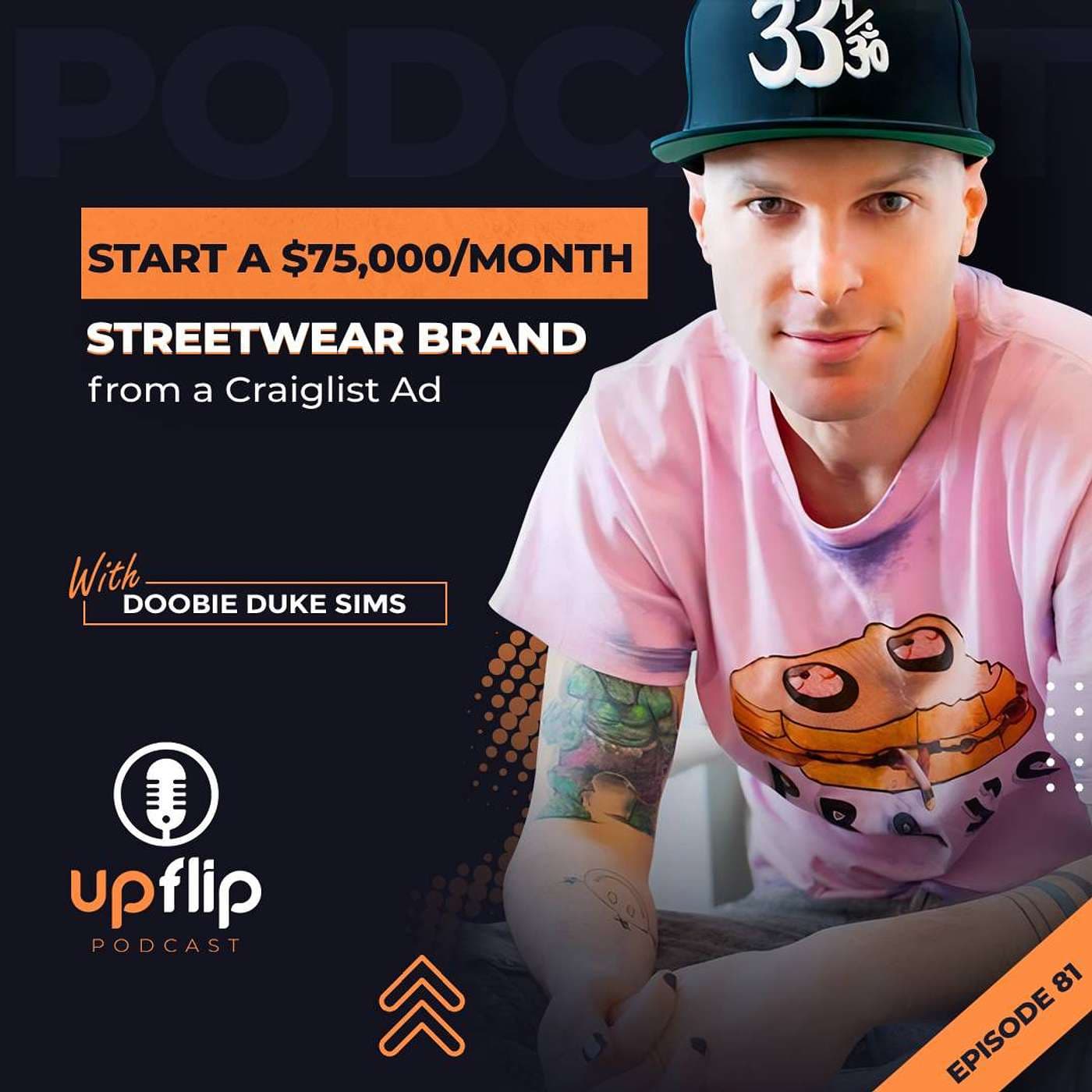
UpFlip Podcast Episode 81 Summary
Episode Title $75K/Month Clothing Business Started From a Single Craigslist Ad
Episode Description In this episode, Doobie Duke Sims shares his journey from being a musician with no clothing business experience to running a successful clothing line named Snow Milk, generating $75,000 a month. The conversation delves into his motivations, challenges, and strategies to engage customers and grow his brand.
Key Themes and Concepts
Background and Motivation
- Transition from Music to Fashion: Doobie was a guitarist in the band Shinobi Ninja and initially sought stability after the birth of his daughter. He decided to buy a print shop to create merchandise for his band.
- Craigslist Ad: His journey began when he answered a Craigslist ad for a t-shirt printing business, despite having no prior experience in fashion.
Building Snow Milk
- Self-Education: Doobie learned the intricacies of screen printing and fashion design through online resources, emphasizing the importance of self-education in entrepreneurship.
- Business Model: Snow Milk focuses on creating a unique product line with a strong emphasis on positivity and sustainability, including upcycled clothing.
Initial Growth and Strategy
- Selling Directly: Doobie participated in street fairs and festivals where he directly engaged with customers, leading to initial sales and brand visibility.
- Customer Engagement: Observing customer reactions and preferences helped refine his designs and business strategies.
Business Operations
- Team Building: As demand grew, he hired people to assist with production and sales, comparing the process to managing a band where each member has a specific role.
- Sales Strategy: Doobie emphasizes the importance of having a diverse product range and a strong consumer approach. His method is akin to adapting the best-selling items to the current market needs.
Sustainability and Creativity
- Upcycled Clothing: He sources thrifted items for his clothing line, highlighting the environmental benefits of reducing waste through upcycling.
- Creative Process: Doobie tests new designs based on customer feedback and market demand, adapting quickly to what resonates with consumers.
Mindset and Philosophy
- Positive Outlook: Doobie maintains an optimistic perspective, believing that anything can change at any moment. This philosophy underpins his entrepreneurial journey.
- Balance: He emphasizes the importance of balancing family life and business, ensuring that his work aligns with his personal values and intentions.
Key Takeaways
- Start with Passion: Engage in business ventures driven by passion and intention.
- Adapt and Learn: Be open to learning and adapting based on market feedback and personal experiences.
- Build a Support Network: Surround yourself with a reliable team that enhances productivity and creativity.
- Sustainability Matters: Incorporate sustainable practices into your business model to appeal to conscious consumers.
Resources Mentioned
- [Start a clothing line today](https://bit.ly/4hgAEtB)
- [Snow Milk Official Website](https://realsnowmilk.com/)
Conclusion Doobie Duke Sims' story is a powerful testament to the potential of self-directed learning, positivity, and adaptability in entrepreneurship. His journey from musician to successful clothing entrepreneur highlights that with the right intentions and a willingness to learn, anyone can build a thriving business.
Listeners are encouraged to leverage social media for business growth and to stay attuned to their creative instincts while making decisions.
Connect with UpFlip
- [YouTube](https://www.youtube.com/@TheUpFlipPodcast/)
- [Instagram](https://www.instagram.com/upflip/)
- [Facebook](https://www.facebook.com/upflipofficial)
- [Twitter](https://twitter.com/upflipofficial)
For more insights on starting and growing your business, visit [UpFlip.com](https://www.upflip.com).
Written by AI. May contain mistakes. Listen to the episode to check what was said.
Transcript
Automatic transcript. May contain errors.0:00A New York City streetwear brand that brought in 75k in a single month and it all started with a Craigslist ad and numbered t-shirts. Just know that anything can change at any time and keep that with the most optimistic perspective. Once you have one retail store, do it again. Like anything that H &M or Journeys or Zoomies or any of these places have done, like it's the same blueprint. So I really have narrowed it down to certain designs. Be like, yo, this is tried and true, tested. Like this is Big Mac McDonald's cheeseburger. It is so standard. It's always going to work. If you're just starting out, just make sure your intentions are correct.
0:36really marinate and get in touch with your intentions, and then check yourself on your discipline and consistency. I never went to business school, but I would just really sum it up and like, come up with something awesome, sell it, sell more of it. Done. I'm your host, Alex Freeman, and today we're joined by Doobie Duke Sims. This is how this former band guitarist with no business experience built Snow Milk. Doobie Duke Sims, welcome to the show. Thank you so much for joining us. Big blessings. Thank you for having me. So to get things started, can you just kind of give us a bit of your story and how you ended up starting Snow Milk?
1:10I answered a Craigslist ad for a t-shirt print shop business that I didn't know anything about. And I walked down the stairs of this print shop in Williamsburg. And long story short, I taught myself how to print, built a recording studio in there. COVID happened. I had a vision. Milk made from the snow in a time of many milks. We have many milks now. We have almond milks and oat milks and rice milks and soy milks and hemp milks. I said it would be great to have Snow Milk, which is just a concept for a print, like a t-shirt print or just an image. And then long story short, I became a fashion designer, started Snow Milk as a brand and came up with different ideas and just boom, just been off and running for the last real good 365 days.
1:49It's incredible because as you kind of alluded to there, you kind of accidentally became a fashion designer, but that wasn't where you started. you started as a musician. So can you talk about your experience as a musician and how that ultimately helped you as you got Snow Milk off the ground? For sure. So I have done music since I was a little kid. I first started playing saxophone in third grade, and I was really good at the saxophone. And I settled the saxophone all the way through high school, ninth grade, then I dropped out of high school. Certain circumstances in life pushed me in a certain direction.
2:18And then I started playing guitar. I got an eight track, taught myself how to record guitar, bass, started writing songs. Eventually I went to music conservatory. I graduated music conservatory, went out in the world, started as a session musician, then, you know, audio engineer, music producer. And then I started a band called Shinobi Ninja. And we had a good amount of success in the band. I toured and, you know, I had songs in video games and movies and I was on television and different magazines and played a lot of big shows and a lot of small shows, a lot of small towns, slept on a lot of floors, a lot of people's couches, you know what I mean?
2:47So I just lived the whole journey. And then when I became a fashion designer, the thing that really helped me for sure was the structure of being in a band and having your position and knowing your role and what you need to do. So being a fashion designer, I knew what my role was as far as being the visionary. And then as you build the team, the guitar player, the drummer, the DJ, the lead singer, like everybody has to have a position. So building the infrastructure of the business that was growing, that's where the band element helped me because I already know how to lead a band. Now I can lead, you know, as a fashion designer instead of the songwriter.
3:17So as you went to kind of build out the band of the business, how did you go about finding people to bring into those spots? You know, it's a slightly different process than auditioning a new drummer, I imagine. Yeah, I mean, it was just like at first I was doing all the prints and then I had sellers. People would sell. I would make the prints. And then we were doing so many sales. I couldn't make all the prints. So to hire somebody to do prints and then hire more people to sell. because now I had more prints. I had more production. I had more manufacturing, more sales, get more sellers, more production, auxiliary pieces.
3:50You know, each piece is individually numbered. So I need a heat press and that's like another position. I remember one time it was like in the business, like I've only been doing it for a year. So it's super young and I can really like reflect on it, enjoy it. It's like the taste is still in my mouth, but it's like, there was this one worker, Julio. I love Julio. He's a great worker. I hadn't met him for three weeks and everybody knew him. And then like, once I finally came to New York and to like met him and like everybody had this bond with him. I hadn't met him and I was like, oh, things are changing.
4:14This is a different animal now. Tell us more about that. What was that experience to kind of like have somebody in the business for a decent amount of time, actually, before you'd even met them? I mean, it was just trippy, man. Like this whole thing is trippy to me. Like I was just like in awe of it. I'm like, I can only be of like service to it. Like I feel like in somehow, some ways I'm like separated from it. And like my job is to like really be of service to this role because this has never been my dream in my life to be a fashion designer. I didn't even know who a fashion designer. I could not have named you a fashion designer.
4:43I didn't know how t-shirts were made. I didn't know any, right? I had to learn everything from YouTube. And the fact that I did learn it, you know, it was really to sustain my family, to be able to earn and support my family and my visions as an artist, which is really about freedom. Like I really feel very blessed to have carved out something that allows me to be free and to be as awesome and strange all at the same time. Yeah, it's like, it's trippy, man. Like I didn't meet him for three weeks. Like what's happening? But the clothes were piling up. You got to put another Craigslist ad. You got to hire somebody, you know what I'm saying?
5:11Like, or else you're going to have a bottleneck in your business. And it's just trippy, man. It's just trippy stuff. I want to take us back to that initial Craigslist ad that got you into the screen printing business and the screen printing shop. Why that ad? What attracted you to it? And why did you kind of enter into it? Because you didn't have screen printing experience before you ended up buying into a screen printing shop, right? Yeah. I mean, the thing was, it's like I answered this Craigslist ad because my dad sat me down. My dad and all his great wisdom, super stand up guy. Like he was like, listen, man, like, you know, I just didn't have any money, man.
5:41Like I had like maybe$500 in my sock draw. You know what I mean? I didn't even have a bank account. Like this wasn't prepared. And my daughter was about to be born in like three months. So it's like I had to figure it out, man. And like, you know, that's what your parents do. Like, you know, hopefully that's what your parents will do. Sit you down when it's time and be like, listen, like I've already been here and I see what needs to be done here. So let me give you a little wisdom. And he was like, bro, you need to figure it out. So I went to Craigslist, which I had done before. I mean, the whole reason I was even in a band was because I answered this Craigslist ad right when I was about to get out of college.
6:10I started working at this recording studio in basically Times Square and met all these people. And that's how I first got on the road and played with people and just like all these life experiences for this Craigslist ad. So I was like, I'm going back to Craigslist. Thank you, Craig, for making the list. And I'm going back to the. So when I saw it, it was just like I marinated on it for a second because it said like, you know, like you said, it was like T-shirt print shop, blah, blah, blah. I didn't know any of that stuff. But what I did know in my mind was I know merch because I've been on tour and I make the designs for the band merch as simple as it might be.
6:38Right. Image just on the front band rock band shirt. But I know that I'm good at Photoshop and I know people who needs who needs merch, who needs clothing, bands, singers. I have a whole like index of that because I've been doing this for a decade. And, you know, so I know a lot of people. So I'll just be a middle person. That was my concept. I'll come in, I'll be a middle person and I'll just make a certain percentage on the deals I bring in. That's how I'm going to make my money. That's why I answered that ad. And I came into that ad with nothing. I had no money and no knowledge. Like the only thing I could really bring to the table was just like fire.
7:09Do you know what I'm saying? And I told my guy, Will, I said, Will, man, if you give me the keys, like I know what to do. And I did know what to do. Like I had been recording. I'd been in many recording studios. I knew the recording studio business as an audio engineer and music producer. I knew what to charge per hour. I knew how to build a studio. And that's exactly what I did. When I first came in here, it was a dark room. And I said, no, we're going to clean out this dark room and stick it in the closet. It's big enough closet, big enough for the dark room. And I'm going to build a recording studio.
7:32And then I had two businesses. I had a t-shirt print shop slash recording studio. And I was running both of them. You know what I mean? To the point where I was like, man, I can't run both of these at the same time. And then I had to get people for that. And that was before Snow Milk. I already was like a business. Before Snow Milk, I was already doing business because I had to. I had to figure out money. Yeah. As you look back on that time, what advice, knowing what you know now, might you go back can offer to yourself in those early days? I don't know if I would have given myself any advice.
8:00I think I really have always kept like a good energy. Like I didn't make too many mistakes. The only thing was I was separated from my family. You know what I'm saying? Like I was, sometimes I was just here in New York for a long time and my family would be, you know, my girl's mom was helping us and watching the kids and, you know, all the wonderful things that grandmas do. So I would be gone for like weeks at a time, but I would just be marinated on artistness. I'd be in full artist mode for two weeks, like literally just drenched in paint and life, engineering sessions and hustling and meeting every, I tell everybody to come see me, come see me at studio.
8:31I would meet everybody. I was just like super hustler. So I wouldn't change it because like I always had the right intention. My intention was never wrong. So my decisions were based on a very positive intention, which is to support my family and to bring a certain lifestyle to the family that I, you know, have chose to start. So any advice is just like, I don't know, make sure you stay hydrated. I don't know what else. Yeah. No, I mean, that's probably the best advice anybody can give or take is to stay hydrated. Can you talk about balancing the business with your family, being a father? How did you work through that in those times when you had to be away from the family for kind of weeks at a time while you marinated in the business?
9:08And how has that balance shifted now? The balance is good now. You know what I mean? I see my kids. I've established the energy so it can sustain and live. Like I set the infrastructure. Really what I did, bro, when I came down here, like, is I just curated the energy, which sounds like a really, like, silly bunch of words. Like, if you were to put it on, like, a subject of, like, memo or something, but curation of energy is a very strong aspect to building anything on top of it, right? Same thing with martial arts. You have to have the horse stance. You have to have your foundation first. If you don't have your foundation, anything you build on top of that is going to be wobbly.
9:40So for me, it was just curation of energy. You know what I mean? Now I have a good balance. I'm with my kids, with my wife and family and I go into artist mode. And now for me, it's just a different balance of like, then all I was doing was art all the time, right? There wasn't a necessity for hundreds of pieces of manufacturing every day and thousands of sales and things like that, where it's like, maybe I spend 80 % of my time on business and or a small percentage on artistry, but I'm always thinking about art. Like I live in as an artist, you know, when I walk down the street, my thoughts are my own, you know what I'm saying?
10:09So it's a good balance. Quick reminder for our listeners that UpFlip's courses are taught by real-world business owners who share the strategies they used to grow their businesses in a step-by-step blueprint. If you're ready to start your business, UpFlip's courses will help you grow it faster. You can find those at upflip.com. I want to learn a little bit more about the business model that you're employing. Can you talk about kind of the structure of the business as it is today and kind of walk us through how you built that structure? All right. So the first thing you have is the product, right?
10:37Which is the clothing, making clothing. So you have the product and then you have the consumer, right? So if you have a product that the consumers really like, there's more demand for it. So as more demand happened, I just found more real estate to reach new consumers. And the way to fill that real estate was more salespeople. So the product, it changes and I have different ideas, but just like in music, how coming from music is like, you got your hit song, like U2 is going to play with the without if we go to the YouTube concert and they don't play that song, I feel like, you know, you got gypped a little bit.
11:11Like I got to hear one. I got to hear, you know what I mean? The hits, you know, you're going to make the hits. Once you've established that they love it, you know, you change the color, they love it. They just love it. You know what I mean? It's a great print. It's a great song. So I really have narrowed it down to certain designs. Be like, yo, this is tried and true tested. Like this is Big Mac McDonald's cheeseburger. It is so standard. It's always going to work. So sales, consumers, and I'm really just in New York. I started doing wholesale now, servicing the world, but I'm majority selling product in New York.
11:41So it's like so much more space out there to continue to just expand and just spread the goodness. You know, all the clothing I make is really about positivity, optimism, goodness, oneness, kindness, togetherness, just like love, just like really just put in a good energy. You know what I'm saying? So the world needs good energy and we just manufacture clothes and the clothes we make are upcycled. A strong amount of it is upcycled clothing, which is like, you know, thrifted vintage clothing that you print on, which then saves the earth by not manufacturing and going through all the resources of constantly manufacturing new clothing.
12:15Though we do new clothing as well. It's a balance of it. But that's pretty much the infrastructure, man. Came up with an idea. Sell it. Sell more of it. You know what I mean? I mean, I don't know what else. I never went to business school, but I would just really sum it up and like come up with something awesome. Sell it. Sell more of it. Done. I want to ask about the thrifted and upcycled clothes that you use. What are some of the pros and cons of that approach? And also, like, how do you go about sourcing those clothes for the design? So the number one thing you're looking at is price, right?
12:41So when you're dealing with sourcing, like, you really want to get your price as low as possible. So if you have, like, a used red sweatshirt or used red crew neck, whatever you want to call it, like, it's going to kind of look the same wherever you buy it, right? You know, in good condition. So you want to get that at the cheapest possible price. That's how you source it. And you just get it the most that you can. You know, the more the business has grown, the bigger the vehicles have got. Start with the, you know, duffel bag, fill up the duffel bag. That's how I started going to thrift stores, filling up my duffel bags.
13:07I'm like, I'm 42 years old. I can't be running around here with a duffel bag. You know what I mean? Build a business on the duffel bag. So then you get a car, you know, start taking lifts. And then you get to a point where you start renting trucks and you're just buying the clothes. Same things that you love. You know, I want this jumpsuit. I want this trench coat. I want t-shirts. I want hoodies, you know, but I want them in bulk. So I want to pay the cheapest possible price for them. at the same time, uplifting the earth by instead of having to buy only wholesale hoodies, only brand new manufactured hoodies, right?
13:34And the old ones, what happens to the old ones? They become landfill or they somehow, it doesn't just, it doesn't help the earth to constantly use the resources and the water and the power to manufacture new things. When there's a red crew neck right there, that's just all it needs is a good positive star on it. You know what I mean? What a cool drawing. Now you can sell it for more than it was even originally manufactured for. I mean, that's like the biggest blessing involved to be able to make something on something that was manufactured for a certain price. Now you're selling it for X amount more of it.
14:02And then the other side, the drawback is you can't go super specific with it at this level. At least I'm not able to do it at this sorting level. I can't say like, oh, I got a whole set order for red crewnecks. You know, I need 500 size medium and 500 size large. That's going to be tough. I could get 500 hoodies. I might be able to sort them by size, but I won't be able to get the exact color. So if somebody wants Walmart or Macy's and like, I want this very specific design just like this. And I need 10 ,000 of them. Now you got to shift to a wholesale. And talk to me about how you test out the different designs.
14:34How do you go about, I have this idea and then we test it and now, okay, we should make more of this idea. What does that process look like for you? If you were in the ice cream game, right? And you were testing ice cream, like say you didn't have chocolate, right? Say he just coming in the ice cream game. There's no flavors. You got to be the inventor of flavor. So you start with chocolate and you go, I got this idea. It's called chocolate ice cream. Let's see if people like it. You give it to them, you sell it to them and they go, I love this chocolate ice cream. You say, great. Hold on to that one.
14:59I got this new one. It's called vanilla ice cream. Let me see if you like this one. They say they love it. All right. So you come with the next one and you say, well, this one is a different vision. This one's going to be, you know, sardine ice cream. They say, we don't like this at all. This is terrible. You never make sardine ice cream again, ever. Do you know what I'm saying? Okay. You got chocolate, you got vanilla. What's the next one? Strawberry. And you just, once you lock it down, you're looking at people like, once I was able to see what people look like, what age they were, what sex they were, like their whole vibe, what they bought, what the design was, what the Garmin type was, then you could just really just use data.
15:29You know what I mean? My dad's a computer programmer. I just grew up with data and computers. So once you get into the analytics game and I'm doing it without a computer, I mean, I have a computer, right? But I'm not pressing the AI button that's telling me exactly what people want. Like I'm looking at pictures and I've been watching them. Like I'm the analyst of Snowmilk since day one, like watching the first person buy that trench coat and being like, wow, that's what that person looks like. So that's how I do it. I just look at them and I know and I get the feedback from the sellers. If they tell me that, bro, like nobody wants this.
15:56I did a baseball one. I did a basketball one. I did a football one. I love baseball, basketball, and football. There's millions of baseball and basketball football fans, but they didn't sell. Maybe nobody wants to wear a picture with a football that says football and some drawings of some football players. They didn't want it. I'm cool with the ego, man. Just don't make that anymore. What was that first breakthrough moment for you with Snow Milk where you really felt like, oh, this goes beyond just like a small kind of business? This is something that this could be big. I just knew I could just see the smiles on people's faces.
16:26I don't know if it's because there's not something else in the marketplace. I'm not going to say that, you know, the clothing is numbered. And I think that is also an interesting aspect. I don't see that in the marketplace. I don't see people printing on the clothes the way that I kind of like did it just because I didn't know. Like, I just didn't know. I was just like, man, I want to print on these sleeves. I want to print on the side, like I want to print everywhere. And I just got these visions, man. I just put it down. And once I put it down, it was like people really like this and they're buying it and they're buying it so consistently.
16:55You know, I'm coming from no fun. So it's like it's a constant flip, right? Just like the name of the podcast, like a constant flip. And once you flip enough times, you're like, damn, we flip this many times from like this one T-shirt. This is crazy. So I just kind of can see it. You know what I mean? Like even when I was in the band, I just knew I knew we were great. Like I knew it, you know, like did we have like millions of Taylor Swift record sales? No. But like when that super famous, most powerful people, many most powerful people in the music industry were like, oh, you guys are amazing.
17:21I love it. In my mind, I was like, I already knew this. I didn't even need external validation. I don't need external validation to understand, you know, simple things like why are the Beatles so great? Like, why does it just transcend, let it be? Like, why does a four-year-old hear it and be like, that's really great. I love that. Things just work, you know, and I draw like a kid, man. I draw like a nine-year-old or a 10-year-old. So it's like, it's just tapped into something. And outside of the ego, it's just like, nice, good job. Like, I feel really blessed. And I just got to just keep watering the plants so that they continue to grow correctly.
17:52How did you go about attracting those first few customers? How did you start making those sales? And where did your sales strategy kind of grow from there? Okay. So what happened was in 2021, I came up with Snowmobile in 2020 and the first image and the concept of it, but it wasn't until 2021. Maybe I sold one thing in 2020. I probably sold something on like Depop. You know what I mean? Something like some website like that. But in 2021, Mayor de Blasio wanted everybody to come out of the COVID thing. So during the summertime, long story short, they started doing these street festivals right outside our studio for whatever reason.
18:25It was like another circumstance. Legit, like hundred hipsters drinking tall boys right outside the studio. like, what else can you do? It's like, yo, we need to take this rack, our one rack of clothing and go upstairs. And while these bands are playing, just stand there with the rack and be like, yo, we're selling clothes, Snow Milk. Like it says it on the clothes. That's the brand. No pull up banners, no stickers, anything like that. Just the clothing that said Snow Milk on it with the designs that existed at the time. And the first day thing we made 300 bucks and it was like just eye opening, man.
18:53Like I said, I saw somebody with the clothes. I saw what they look like. And I was just like, wow. Then one day I was walking through Washington Square Park and it was like a party that I hadn't been invited to. Like, I didn't know what was happening. It was like a party, man. It was like a club. And I was like, yo, we need to be out here in Washington Square Park. And once we started selling in Washington Square Park, those$300 days became$400,$500,$600,$700. And that first year, the most we made was$900 in a day. But to make$900 in a day and see 10, 11, 12 people, you know, wearing your clothes, buying your clothes consistently, it's a wrap, man.
19:24And we've just been on it since then. And how do you now determine where you should be selling the clothes? Do you have regular spots? How are people finding you? Yeah, we do a lot of street fairs. We do a lot of pop-ups and markets, right? We're at Grand Bazaar, Brooklyn Museum, any Clearview Street Fair. We're all over the city, Queens, New York, Manhattan, and every day we're in the Chelsea market. So every single day from 11 a.m. to 7 p.m., we're in the Chelsea market, Artisan Fleas, right here in Manhattan, 16th Street and 9th Avenue, I believe it is. on 10th Avenue is Artisan Fleas. And yeah, I mean, it's just like, wow, like just keep building it out, you know, franchising, licensing, more places like retail.
Read the full transcript
20:03That's the next move is retail, doing a retail store and having like the first flagship snow milk store and doing that in its own special way. And then once you have one retail store, do it again. Like anything that H &M or Journeys or Zoomies or any of these places have done, like it's the same blueprint. And you're at Chelsea Market every day with these other fairs and festivals and things going on. that can be a lot of ground to cover. How many people do you have selling for you on any one day? And how did you bring them into the company? So like if you look at Instagram, like on any given Saturday or Sunday, we'll have four to five pop-ups per day and Chelsea Market being one of those.
20:38So in addition to Chelsea Market, we'll either have three to four additional pop-ups at this juncture in time. Like that's the growth at this time. And it's really just a money game, man. I mean, money talks, you know what I mean? Like if I can pay people more than anybody else, then they'll do it. You know what I mean? I got a good vibe. I'm good at talking to people. You know what I mean? I'm a people person and I have a strong vision. So when I'm preaching this vision to you of like, you're going to make more money you ever made before. And you're going to sell this really positive product.
21:05I think it just works. It hasn't worked a hundred percent of the time, but strong enough that we have like six, seven, you know, five, six, seven sellers that are like, put me out there. Like I'm ready to sell. Like, and the numbers reflect that, you know what I'm saying? Like they're able to earn and we're able to sell. And then the more that we sell, the more consignment stores we get and more wholesale DMs we get. Like, hey, I had a customer come into the store today. They were wearing this thing. They said it was snow milk. I love it. I want 20 hoodies. More business. And then from those 20 hoodies, what happens?
21:32It's like a compound interest effect at this point. You just made mention of your Instagram. Can you talk to me about your social media strategy? What channels are you on? How are you utilizing them? And would you recommend that for somebody else looking to get into the apparel game? Yeah, you got to have social media. I mean, that's just a no brainer. You know what I mean? But the numbers on social media are just like, I'm so interested. I feel like I'm a student of the game. Like I started way back AOL. You know what I mean? I went to MySpace and, you know, Facebook and Twitter. I was strong on Twitter.
21:59I had a crazy vibration. That's for like a whole nother interview of like what I had going on with Twitter. Like it was monumental. Like to understand social media, you know, YouTube. I've been a YouTuber for a minute. TikTok, a lot of followers on TikTok. Social media is just a very interesting game. I used to play a lot of video games when I was younger, you know, I would smoke weed, play video games. I didn't have all these different responsibilities. I just love playing video games and I love the scores and I love learning different levels. And I feel like life is the ultimate video game. Social media is the video game inside those numbers and how that hits you in real life.
22:32You play it just like any game, right? But it's the content you create is the quarter that you put in the machine. And if you have more quarters, you get more lives, you get more chances to go around until like one day, man, you beat Pac-Man. It seems like it's really hard. Like, but if you just sat there and played Pac-Man long enough, you'd be like, oh, strawberry level. Here's orange level. Like, got this. No problem. So I feel the same thing with social media. It's just like the strategy I have is just like, I'm just excited and I just watch things. There's an aspect now in social media of copying things.
22:58And that's something I've always rejected just by nature. I always want to do things that other people like weren't doing. So it felt weird to do what exactly what they're doing. But the concept of social media of like 100 % duplication is I'm fascinated by that as well. So this is going to bring us to a section of the show that we call our Fan Blitz questions. These questions come from our YouTube community. Listeners, you can go join that YouTube community by going to youtube.com slash upflip. And you can post questions to future podcast guests. Doobie, we're going to try and get through about six questions in about a minute here.
23:29Are you ready? Sure, I'm ready. All right. First one up. Fernando de la Cruz would like to know what really made a difference for the brand to become relevant and people start buying it? Being awesome. Biscayne Supercars wants to know, are you open to collabs? I am. All right. Slide into those DMs, Biscayne. What's the biggest purchase you've ever made? Computer. What's the biggest purchase you regret? Sushi. If you could sell your clothing to one celebrity, who would it be? Eddie Vedder. Last one here. What's the worst name that you could have given to your business? Sucky McSucks clothing line.
24:05That is going to do it for the Fan Blitz questions. Listeners, let us know what you think of the Uflip podcast by leaving a rating and review on Apple Podcasts. It really helps other people find the show and unravel how great businesses are built. A few more questions for me before we close here. I'm curious about the ongoing expenses for the clothing line. What do revenues in an average month look like? And what are kind of some of the average expenses that you're dealing with and someone should plan for if they want to get into this business? I mean, the thing about the business, it's like you can have a pizza business or you can have a pizza franchise.
24:37Either way, you're selling pizza. It's just scale of pizza sales. You know what I mean? So the numbers can grow as much as you want them to grow or as much as you can grow them if you want to keep growing them. So I'm looking at a lot of money, man. I mean, a lot of money for me, for some other people, they'd be like, oh, it's nothing. It's no problem. Just add zeros. It's just a game of zeros. Alex, that's all it is, man. It's a game of zeros. So I added a zero from this year to last year. And I just want to continue to add zeros across the boards. That means that you got to spend more money, right?
25:05And so you can make more money. You cannot make more money if you don't spend more money. Like, imagine if I was just like, no, I'm just going to make a lot of money. I'm gonna stop spending. Like, bro, we need a t-shirt. Give somebody a t-shirt. We need to print on a t-shirt. More t-shirts you could buy, more, you know, hoodies you could buy, the more money you can make. So it's a beautiful game. How do you kind of make those growth decisions of, are they driven by, we have hit X number of revenue, now we have to add a team member? Or are they just like, we have this opportunity to take advantage of this opportunity, we need another team member?
25:33Yeah. I mean, it's just like, I watched a lot of YouTube videos, you know, getting into this space because I had no knowledge of it whatsoever. So I really had to just see what people are doing and like even shipping out online orders, right? Like I'll sit there and I'll ship out online orders. I love the online orders. They're great, but I'm printing them out from a printer, you know, and I'm cutting them and I'm taping it. Right. But the next level up from that is like, you might get one or two a day. Then you add a zero to that. You're getting 10 or 20 a day. And at a certain point, you just, you have to hire somebody to just service online, right?
26:00Then you go to wholesale and you're like doing more wholesales. Well, you can't have the online person that you hired now also doing wholesale. So now you need another person for wholesale. One, two, maybe three people. So like as you grow these like little departments inside, you got to hire accordingly or you won't be able to scale. You know, imagine being like, yeah, we're doing great, but we're going to shut down the online store. We can't do online sales. We're just going to stick to this, you know, on ground floor, guerrilla warfare. Like you just have to scale to the business, like the business really dictating what you're going to do.
26:28There's no point in where I'm laying down at nighttime going like, I cannot wait for the next hire. I can't wait to hire this next person. But it's like, there's going to be another Julio. You know what what I mean? There's going to be another person that I just never met before. It's part of the game. Now, one thing that I hope has become clear to our listeners at this point in the interview, and it's certainly become clear to me, is that your mindset game is really strong, that you're a very positive and energetic person. And I'm curious how you go about maintaining that even as you face various struggles that certainly come up in the business.
27:00Imagine you got to do it all day long and all you had to do was draw and get people excited and make clothing. You know, like I'm not even making the clothing. Now I have to like carve out time for myself in the schedule to be like, I still have to be able to create. Like there's such a production behind me that if I don't carve that time, I won't be able to create. You know, how do I stay positive, man? I just do what I want to do. And I just feel so blessed to do it. You know what I mean? I'm good at canceling out any external opinions, right? Because there's just, everybody has an opinion. I don't really get caught up in those things.
27:29And I just service the business. Like I just do what the business asks of me. Also, I'm not into struggling. I'm not into like scaling faster than possible. I'm cool with like steady wins the race type of energy. I don't need to be the fastest person. Like I don't want to take on more than I can handle so that I falter and feel under that weight. Just living a certain lifestyle fluidity like is just very important for me. I don't meditate. You know, I like listening to YouTube videos. I like learning things. I like people. Like I really just really enjoy and love people. Sometimes I can't be around everybody all the time, but like in a general sense, like I really love and enjoy the earth and I wish nothing but the best for everybody out there in the world, for all the animals, for the trees, for all the universes and galaxies that are beyond us.
28:13I also don't feel I'm not taking it too serious. Like I know we're here and gone. I just personally feel it's my own personal opinion, but that people will forget Michael Jackson and Beethoven and Michael Jordan, whoever you want to put in that sentence. Think about a hundred thousand years ago or however long I have to do a Wikipedia to tell me how long humans have been on the earth. But I guarantee that somebody got forgotten. That was really, really awesome. So I just want to just do my best and spread the most joy in my time here. And then when I'm gone, it's just like a mist. I'm out of here.
28:40You know what I mean? So I'm not taking it too seriously. You know what I mean? I could say that in a really like kind way. I'm not taking it too seriously where I'm stressing out. I don't like stress. I am not with that. It's not something that's good for me personally. So I just like avoid it. You know what I mean? Yeah, I do. And I'm curious. I would assume that there are aspects of the business that maybe do cause you stress. And so have you brought in people to deal with those things? How does that work as an entrepreneur running a business? Man, the other day I was heat pressing, right? And I'm doing my heat press thing.
29:07I'm heat pressing this clothes and putting the numbers on. All of a sudden is this big pop and the lights went out. Lights went out in the bathroom. Lights went out in, you know, where the seller's room, where the racks are. Lights went out where the heat press, heat press wasn't on. Like those are the type of moments where it's just like maintenance with the capital M. You know what I mean? Just like that's where the patience game comes in. It's not clear sailing all the time. You know what I mean? You got to really maintain. And sometimes it's like one step back to take two steps forward. But you got to love the step back, too.
29:33You know what I mean? Like the mere fact that I can even have finance to even like solve these problems is amazing to me. Because like I said at the beginning, like I had five hundred dollars in my sock drawer. Like I knew how to live on like dollar pizza. You know what I mean? Two slices in a Coke, three dollars. Like I would be in the recording studio all day, like writing songs, like loving like off that money. So to be able to even solve things and be like, man, we need a new AC. Fuck it. Here's five hundred dollars. Like we got to do what we got to do. Like we can't have our people like, you know, in the sauna.
30:01So like those type of things, like even though they feel like they're like, oh man, but you also got to love it though. Or else it's like, why do you own a business? Do you know what I mean? We could just be at the worker clocking in and out and have less responsibility. So it's really like, you know, heavy is the head that wears the crown, but I'm happy to be in the game. As we kind of wrap up here, I'm curious what the most valuable piece of advice is that you've ever gotten and how did it help you when you got it? That's a tough question. And best advice, I can only tell this story. Back in the days, I'm going to put you here.
30:30Bensonhurst, Brooklyn, the year 1999. All right. PlayStation 1, I believe, was the system at the time. My buddy's dad lent me NFL 99. He lent me NFL 99 for the PlayStation 1. Took it home. I played it. Had a great time. On the day it came for me to bring it back, I brought him back his NFL 99. And I believe PlayStation had the black bottom. So it had a scratch in it that I couldn't see, nor could he even. But he told me, he called me Larry at the time, Larry Davis. My government name is David. So he called me Larry Davis. He was like, Larry, I put it in my PlayStation, but it doesn't play. Now I'm like 18 or 19 years old.
31:06And I said, I don't know what to tell you, bro. Like it was working in mind. He said, no, no, no, Larry. He's like, when I gave it to you, it worked. And when you brought it back to me, it didn't work. He's like, you have to make this right. Where I grew up in Bensonhurst, like the mob was all around us. Like there was a level of respect that we all understood. We weren't in a mob, but Brooklyn people understand a certain level of respect. So he said, Larry, no, when I gave it to you, it worked. Now it doesn't work. You have to make this right. So I begrudgingly took my whatever$20 that I had, walked down the block to the video game store and purchased another NFL 99, right?
31:36New NFL 99. Brought it back to him. I said, here you go. So here's your NFL 99, right? He said, Larry, you know, you really made me proud today. And he takes this NFL 99 and he puts it to the side, right? He starts up the PlayStation and up comes NFL 2000, right? I said, bro, why did you make me go to the store to get you NFL 99 when you already have NFL 2000? He said, that's not the point. You know what I'm saying? And so that was just like a life lesson about really doing what's right and making people whole. Do you know what I'm saying? Like your relationships are very important. You know, like how you treat people, how you leave them feeling.
32:11You know, the NFL 99 was meaningless, but it was the fact that when I brought it back, it didn't work. And when he gave it to me, it did. So, you know, he was older than me, man. And he taught me that lesson. So I always appreciate him for that. What's the number one piece of advice that you could give someone who is starting their journey as a creative entrepreneur? I don't know. You just got to love it. You just got to love the journey. You got to stay disciplined. You have to have consistency and you have to have a correct intention, right? Because you can be driven and have talent and be consistent and have discipline.
32:41Not everybody has discipline. If you can have discipline, but your intention is not right, right? We see it a lot in rock music, like a lot of the idols that we looked up to, like we look at their success like, Like, oh, look at, you know, this person, like they're super successful, but, you know, they died at a super young age. Well, like that's not in the grand scheme of humanness. Like that's not success. You know what I'm saying? So you have to have the correct intention. You got to be doing it for the right reasons. So if you have that correct balance, so you're going in the right direction, then you can adjust the speed.
33:08But if you're going in the wrong direction, it doesn't matter how fast you go. You're not going to go where you want to be. So if you're just starting out, just make sure your intentions are correct. Like really marinate and get in touch with your intentions and then check yourself on your discipline and consistency. You know what I mean? If you have all those three things and talent is great, but it's not the number one thing. Like if you have those three, you can maybe get away with not being the most talented. But if you have all four, I think you're going to win. It's a great combination. If you could pick the one thing that people take from this interview, what would it be?
33:36I don't know. That just, there's people out there that are just having fun and doing awesome things. And that wonderment exists. Like anything can happen to you in your life. and it just takes one Craigslist ad or one moment, you know what I mean? Like for your whole thing to change into something that you didn't even know was possible. I'm living a life that I just didn't even know anything about. You know, I might even be living somebody else's dream and that's why I got to respect it so much. But just know that anything can change at any time and keep that with the most optimistic perspective.
34:04What's your favorite business book and why? I've never read a business book, but I can tell you some of the YouTubers that I like. Yeah, I love it. Let's do that. I like Alex Hermosey. learned a lot from Alex Ramosi. I like Tony Robbins. I like Deepak Chopra. I like the other guy who Oprah really likes with the bald head. He died. I forgot what his name is, but love his stuff. I really like to just YouTubers, man. People that pass out information, world and vision have taught me a lot about, you know, t-shirts is the guy from Canada. I forgot his name. You know what I mean? Like I like the YouTubers, man.
34:32Anybody that's out there really providing value and service. I like Earl Nightingale, the OG of positive thinking. It was a time I had to reprogram my mind. Earl Nightingale, great videos. Do you know what I mean? All the positive speakers out there. I enjoy them. And where can people find out more about you and Snow Milk? You could go to the Instagram, Real Snow Milk. You can go to the website, realsnowmilk.com. You can find me on Instagram, doobiedooksims.com. You can go to my website, doobiedooksims.com, but you should probably go to realsnowmilk.com. That's where the real action is. At this point, you could Google Snow Milk and I think you will come up with all the links.
35:05It's Real Snow Milk on every social media platform and YouTube. CNBC did a really cool piece on me. And that kind of led to this interview. So if you want a good seven minutes, just straight to the point produced by a major brand company, just go to YouTube and type in Snowmilk CNBC. And it's just a really cool mini documentary. It was great. That is a great piece. I would definitely recommend that people do that. And listeners, you can find more advice for how to start a grow business the right way on the Upflip Hub. And if you like this episode, make sure you let us know by leaving a review on Apple Podcasts or wherever you are listening right now.
35:40Doobie Duke Sims of Snow Milk, thank you so much for joining us. Thank you, my brother. I appreciate you. God bless America. God bless the whole world. Appreciate you. Thank you so much, man.
From the publisher
Doobie Duke Sims didn’t know anything about making clothes when he bought his print shop in 2018—but that didn’t stop him from growing a $75,000 a month clothing line. Find out how he started and grew his clothing business in this interview.
Doobie always liked thrifting when he was touring with his band, Shinobi Ninja. When his daughter was born, he started looking for a job that would let him get off the road and spend more time with his family. He’d always been an artist and had already been making the band’s merchandise, so buying a print shop with a silk screen setup was a logical next step.
The only problem was, Doobie didn’t know how to start a clothing line. In this interview, he’ll share how he overcame that lack of experience as he grew his clothing business. We’ll also learn how he connected with customers when he launched his brand and hear his advice for other entrepreneurs looking to get into the fashion industry.
Resources:
- https://bit.ly/4hgAEtB Start a clothing line today
- Snow Milk - Learn more about Snow Milk on their website
Ready to be your own boss without starting from scratch? Grab our FREE Franchise Guide and unlock the secrets of proven business models that have already created thousands of success stories.
Connect with UpFlip:
- On Youtube
- On Instagram
- On Facebook
- @UpFlipOfficial on Twitter
For more insights to start, build, or grow a business, check out the resources on UpFlip.com or head to the UpFlip YouTube channel to see more interviews with business owners and experts.
Thanks for listening!


