
In short
The UpFlip Podcast - Episode 85 Summary
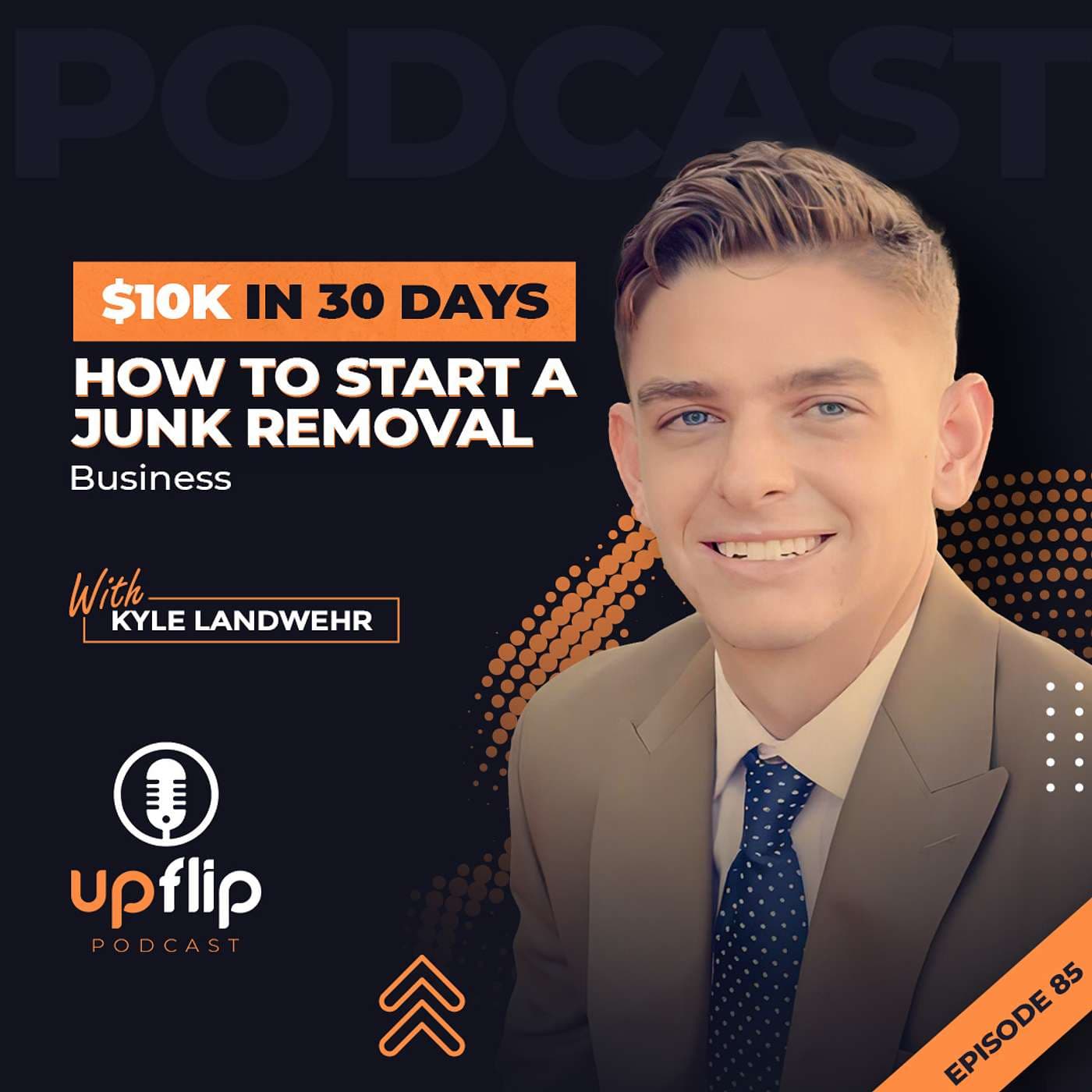
Episode Overview Title: From $15/Hour to $10K in 30 Days | Junk Removal Host: Alex Freeman Guest: Kyle Landwehr, Founder of Slam Dunkin' Junk and The Junk Academy Date: [Insert Date of Episode Release]
Kyle Landwehr, an entrepreneur who transformed his life from earning $15 an hour to generating over $2 million in revenue through his junk removal business, shares his inspiring journey and practical advice for aspiring entrepreneurs.
---
Key Highlights
Kyle's Background
- Early Life: Started with a $15/hour construction job.
- Turning Point: After experiencing the death of his grandfather and seeing a junk removal business clear his grandfather's home, he was inspired to start his own company.
- Initial Investment: Launched the business with $6,000, which he considers relatively low for startup costs.
Starting the Junk Removal Business
- First Month Earnings: Made $10,000 in the first month.
- Profitability: Emphasizes the potential for quick profitability if started correctly.
- Initial Equipment Needs:
- A truck (rented initially).
- Basic equipment (dolly, trash bags, etc.).
- Marketing through organic efforts.
Challenges and Mindset
- Lead Generation: The primary struggle for entrepreneurs in the junk removal industry; emphasis on patience and consistent marketing efforts.
- Physical Demands: Discussed the tough physical work involved and the necessity of having a strong team to manage labor-intensive tasks.
Growth and Expansion
- Incorporating Real Estate: Found opportunities via junk removal leads, allowing him to buy properties and flip them, thus diversifying income sources.
- Business Scaling: He advises focusing on perfecting one business before exploring other opportunities, ensuring identification of potential problems and solutions.
Mentorship and Coaching
- Importance of Mentorship: Stresses the value of hiring coaches and mentors to expedite learning and avoid costly mistakes.
- Coaching Business: Created The Junk Academy to teach others how to start their own junk removal businesses, helping over 265 businesses launch successfully.
Marketing Strategies
- Social Media Use: Strong emphasis on organic marketing, particularly on platforms like Facebook for local outreach.
- Building a Personal Brand: Kyle highlights the importance of establishing a strong personal presence online as a means to attract business.
Financial Insights
- Revenue Figures:
- Junk removal business averages $80,000 to $100,000 monthly.
- The Junk Academy is projected to reach $200,000 to $300,000 per month.
- Profit margins varied from 20% to 70% depending on the business segment.
Final Thoughts
- Advice to Aspiring Entrepreneurs:
- Start simple and replicate successful business models.
- Utilize social media effectively.
- Overcome insecurities and focus on consistent content creation.
---
Key Takeaways
- Entrepreneurial Journey: Transitioning from a low-wage job to a successful business requires resilience, adaptability, and a keen eye for opportunities.
- Immediate Action: Entrepreneurs can see success quickly with the right systems, marketing, and lead generation strategies.
- Continuous Improvement: Focus on solving larger problems within your niche can lead to greater financial rewards.
- Value of Community: Building relationships and networks locally can significantly enhance lead generation.
---
Resources Mentioned
- Junk Academy Course: [Link to UpFlip Academy](https://bit.ly/3YBuj4x)
- Kyle Landwehr's YouTube Channel: [Kyle Landwehr YouTube](https://www.youtube.com/@kylelandwehr)
---
Connect with UpFlip
- [YouTube](https://www.youtube.com/@TheUpFlipPodcast/)
- [Instagram](https://www.instagram.com/upflip/)
- [Facebook](https://www.facebook.com/upflipofficial)
- [Twitter](https://twitter.com/upflipofficial)
For more insights and resources, visit [UpFlip.com](https://www.upflip.com).
---
Thanks for listening! If you enjoyed this episode, consider leaving a review on Apple Podcasts to help others discover the show.
Written by AI. May contain mistakes. Listen to the episode to check what was said.
Transcript
Automatic transcript. May contain errors.0:00Backed into a corner with not much in terms of a future, this 22-year-old raked in$10 ,000 within just 30 days of starting his junk removal business. These junk removal leads would actually, you know, they'd turn into$5 ,000 jobs and to$70 ,000 flips. In my business, I always look for different problems. And, you know, the bigger problems you solve, the more money that you're actually going to make. Our biggest months and kind of what we're on pace for is anywhere in between$200 ,000 to$300 ,000 a month in revenue. Anybody who is more successful than me, the first thing I always tell myself is, what do they know that I don't know?
0:40I'm your host, Alex Freeman, and I'm here with Kyle Landwehr, founder of Slam Dunkin' Junk and the Junk Academy, who ditched his$15 an hour construction job to earn millions removing junk. Stay tuned as he reveals how he did it and how you can do the same. Kyle, welcome to the show. Thanks, man. I really appreciate you having me here. So to kind of kick it off, give us the overview of how and when you started the junk removal business. So back in 2020, I was working a nine to five job, we'll say in construction. I was making$28 ,000 a year. My grandpa passed away around that time. We had to hire a company to clear out his home.
1:17Long story short, I found out that company was doing around$500 million a year in junk removal, otherwise known as 1-800-GOT-JUNK. and basically I got the idea of, hey, this seems like a simple business that I could start. I mean, do it with fairly low budget and I ended up starting my junk removal company in 2020 and it's been about four years now. Wow, talk us through that kind of like startup with low budget. Like what was the kind of initial investment? If somebody else is interested in getting into the business, what should they be planning on? So when I first started the company, I had no entrepreneurial experience whatsoever.
1:49So I could have started with less. I also could have started with more. I ended up starting the business with$6 ,000, which I think is pretty low for really any business out there. But if somebody was to come into the business and they were looking to get started with little to no money and they were maybe completely broke, I would say a comfortable amount would be$3 ,500. And that's going to give you enough to at least start building capital to where then you can go ahead and start investing into the business and buying the right truck or the website or tools that you may need. What are some of those like must have pieces of equipment that you would get with that$3 ,500?
2:26So first off, I would say you obviously need a truck, right? So if you had little to no money, I always tell people, if you're not sure if you're even going to like the business, I suggest that you do a ton of organic marketing. You rent a U-Haul on the weekends, you promote through the weekdays, you rent a U-Haul on the weekends and try to knock out as many jobs as you can. You can usually rent a U-Haul for 30 bucks a day and$1.30 a mile. I also suggest getting like a landing page. You know, that's very simple. That will cost a few hundred bucks as well as like an LLC, maybe a liability policy, you know, for insurance to protect you.
3:00But you really don't need much other than that, like a dolly and some trash bags, maybe a Saul's all, that sort of thing. It sounds like a business that is able to be profitable pretty quickly. Would you say that's accurate? Yes. Yeah. Basically, you know, I already had my$6 ,000 out of pocket that I didn't have to get a loan on. So I was profitable the very first month. Anybody, if they start the correct way with the right guidance, they can be profitable, you know, within the first week. You also mentioned that you maybe started with too much or not enough. Can you talk a little bit through what kind of mistakes maybe you may have made in the early days of the business, even if they weren't necessarily, you know, obviously not fatal mistakes to the business?
3:37Yeah, I would say, you know, there's just certain corners that I could have cut when starting my company. For example, the first one that comes to mind is starting an LLC, right? In Missouri, you can start one from anywhere from like$50 to$100 if you were to do it yourself. Now, coming from a guy who didn't have a lot of money at that time, it probably would have made sense to go that route instead of hiring an attorney to make an LLC for me for$850. So I could have, you know, saved a few hundred bucks there and started the business with less. And then there's also companies out there that will help you start an LLC that are$550.
4:10So I've also used those in the past where I could have saved a few hundred bucks. Or instead of going out and buying brand new tools, I could have just bought used. Or long story short, you know, you end up finding a lot of these on the job site as well. That actually makes a lot of sense that as you're removing stuff from people's houses, there might be useful items in there. You've laid it out so easy so far, you know, advertise through the week, rent a U-Haul on the weekends, do the jobs. What are we missing? What's the hard part of starting a junk removal business? So truly, you know, the hard part is generating the leads.
4:41You know, I've consulted for 265 junk removal companies this year that I've helped launch from zero. And the biggest bottleneck between everyone is finding enough leads, right? Anybody can make, you know,$5 ,000 a month,$10 ,000 a month. But to scale this thing to what you really want to and make multiple five figures, most people are going to struggle with getting leads. And when you first start a company, nobody knows who you are. Right. So it's going to take time. You need to be patient and you need to do what you know needs to be done right and be patient to get those leads and they will come.
5:14And I also want to ask about mindset or outlook or maybe even just like personality type to succeed in this industry. I assume it takes a certain type of person that can stick with the physical labor aspect of hauling junk. Can you talk about what is required of being a junk remover? Yeah, absolutely. I mean, you definitely need to be able to carry junk or you need to have people willing to carry the junk out for you. This is not easy work whatsoever. You know, it might seem simple and stuff like that, but, you know, a lot of these homes you might go into, it could be, you know, we're located in St.
5:47Louis. We might be in the third floor of a house that was built in the 1800s that doesn't have air conditioning and it's 120 degrees and we're clearing out a hoarder house, right? So it's very hard work. Now, there's jobs that are very easy and it's a curbside pickup and it takes 10 minutes, but there's also those house clear outs that could be, you know, five figure jobs and they take a long time. It's a lot of work. You're carrying a lot of heavy stuff. I've been hurt on a couple of job sites as well. I broke my ankle on a job site. I had to get stitches on a job site as well. A toilet, you know, basically broke and went into my leg.
6:21So it's very more blue collar work. You need to be willing to do the labor or find somebody who's willing to do the labor and continue to do it, or you'll have a high turnover rate within your company. Listeners, the proven business blueprints on the Upflip website can help you start and grow a business in any industry. If you're thinking about following in Kyle's footsteps, make sure you check out those resources to learn how to start your own seven figure business. Kyle, I do want to ask about that broken ankle a few months into the business. Obviously, it could have been a massive setback, but you were able to turn it into an opportunity.
6:54Can you talk about how you utilized that moment to grow and diversify your business interests? Absolutely. So about five months ago, I was going to talk about how you started a business business. months into the business, me and one of my employees, we misbid a job, right? We were out super late at night doing this job. And I basically stepped off the truck. I ended up breaking my ankle and I was extremely disappointed because I went from making$28 ,000 a year to quitting my job, finally feeling like I got traction. And I was doing about$30 ,000 to$40 ,000 a month in revenue at the time with pretty high profit margins.
7:25I broke my ankle and I felt like I had two options. One would be shut the business down for two months until I'm healed or hire people to be able to do the business for me while I was basically resting and getting better. And that made a turn for my company because what I realized was I should have been focusing 80 % of my time on lead generation and sales rather than actually doing the labor. And then that's what scaled my company past that$40 ,000 month mark. And basically we ended up getting into real estate and other aspects of the business as well to increase income. Talk to me about real estate because you weren't a real estate mogul before you started the junk business.
8:03So how did you start to get into real estate deals? Yeah. So I always wanted to get into real estate, but it was a higher barrier to actually get into the business, right? Compared to a junk or mobile company, which would be low barrier. I saw opportunity within the business because we deal with clients on the day-to-day basis who call us and they say, hey, we have this property, we want to get cleared out and we want to sell it, right? But the first thing's first is they have to clear out the property. So I would go in there and I would say, hey, we could do it for, we'll say it's five grand.
8:34And I give them a quote for five grand and they thought that was a lot, right? That's not what they expected to where we wouldn't land all of those jobs to where I wanted to ensure that I started making some money or capitalizing in some ways. So what I did was I I started jacking up my junk removal price a little bit to where it was actually less appealing. I would give them an offer on the home because I said I was interested in buying it. And I'd use that deal and I would basically wholesale or flip the actual property. And sometimes they would say, hey, we don't know if we want to sell it yet.
9:04So go ahead and clear it out. We would end up getting paid more than we should have to do the clear out. And then they would call us two weeks later and say, hey, you know what? We will go ahead and sell the property. And then these junk removal leads would actually, you know, they'd turn into$5 ,000 jobs and to$70 ,000 flips. How many deals like that did you do when you first started getting into it? And how much of the business is that today? So basically, I started doing this really in 2021, 2022. Roughly, it'll do about 8 to 12 deals a year is what we're on pace for. And that's specifically junk removal leads.
9:39That's people calling us wanting junk removed and then we turn it into a junk removal lead. So in terms of the amount of jobs, you know, it's a very small percentage. But in terms of income, you know, I would say our net profits are matched with the real estate. So we do just as much net profits with, you know, the real estate, if not more than the junk removal, doing a lot less work. Are you only flipping properties that you find via the junk removal business or are you also out there looking for properties? And I guess when something comes to you as a junk removal lead, how do you evaluate that it's going to be a good property to flip?
10:14So at the end of the day, you know, to evaluate if it's going to be a good flip, you're going to really know if it's good deals don't last long. So that's the first thing I look at. Right. Numbers don't lie. If I can get it at the right price and it makes sense, then I'll go ahead and purchase it. But it also needs to be in a good area. So we look for these good areas in St. Louis and there is deals that I don't even want. I've offered as little as$2 ,000 for a property, and that's how much I did not want the property whatsoever. But yeah. I also want to ask about this seems like an out of the box thought process to bring in a new revenue stream to the business.
10:49I don't know that someone who's like, oh, I'm going to start a junk removal business is instantly thinking, oh, now I'm going to flip houses. How do you think entrepreneurs can spot those kinds of opportunities in their businesses? At the end of the day, you know, you need to focus on perfecting what you're already doing, right? Focus on one thing. And once you can perfect that one thing, you always need to have an open mindset and find problems within your own business, your own culture, all these sorts of things, right? And once you see these problems, see if you can actually provide a solution.
11:20So in my business, I always look for different problems. And the bigger problems you solve, the more money that you're actually going to make. So once I identify those problems and see if it's something I want to go after, that's really when I decide if I'm going to pursue getting into real estate or other things like that. So what I'd suggest for anybody else is just focus on perfecting the one thing that you're doing and those other opportunities will fall in place. And you just need to have an open mindset when those things do come. You mentioned the coaching aspect of your business as well.
11:54So can you talk to me about when did you start offering coaching and why did you decide to kind of ultimately make that your main focus? Yeah, absolutely. So I actually started hiring mentors back in 2021, the end of 2021, and they sold me on how I needed to build my personal brand. Right. So I started posting on social media and about 100 videos in on TikTok. talk. I posted a video and I woke up the next day and there was a couple thousand emails and text messages, you know, really just so many messages. It was crazy. Our DMs as well. And all these people were like, hey, will you show me how to start this type of business?
12:29Well, me being an entrepreneur, you know, I figured, hey, there there's a business here. And I started slowly, you know, coaching a handful of people. They'd fly out to my office. And just in 2023 alone, we've launched 265 John Kermitle companies around the United States, Canada, and also Australia. Wow, that's an incredible growth in that business in such a short time. I want to ask you about the benefits of hiring a coach or hiring a mentor, both from the perspective of somebody who does it on the coaching mentor side and somebody who has hired mentors and coaches in the past. Why is that important for an entrepreneur to do?
13:07Absolutely. Yeah. I mean, at the end of the day, If somebody is farther ahead of you in life, right, they know more, which is why they're in that specific spot, right? So anybody who is more successful than me, the first thing I always tell myself is what do they know that I don't know, right? And at the beginning, right, when you have a limited mindset, you don't want to invest into those things because you look at it as an expense rather than an investment. When I can tell you I've learned from people who are eight figure entrepreneurs and they've helped me scale my business a lot quicker. You know, for example, for people who were to come into junk removal, a lot of these things, they took me a few thousand jobs to actually learn.
13:47And the chances of somebody else coming in and getting the same exact results, you know, could be pretty slim. Maybe they don't do it in the same exact time frame. So at the end of the day, you're paying for speed, right? You're paying from somebody who's already experienced what you're going to experience. So all that's going to happen is you're going to get where you want to go a lot quicker than you would do it on your own. And the process of picking a coach or a mentor, what should somebody be looking for to make sure that they're investing in the right mentor for them? So I would say find the right lifestyle, find the right business, find the right person that you look up to.
14:21Right. And you need to ask yourself, would I want to switch lives with this person today? And if you would want to switch lives with that person today, I would consider that a good mentor. I recommend finding somebody in your specific niche that you look up to who has gotten the best results. And that's the exact person that I would go after. So this is going to bring us to a section of the show that we call our Fan Blitz questions. These questions come from our YouTube community. Listeners, you can join the YouTube community. Go to YouTube.com slash UpFlip and you can pose questions to future podcast guests.
14:52Kyle, I've got about seven questions we're going to try and get through in 90 seconds. Are you ready? Let's make it happen. Let's do it. This sounds like fun. All right. First one up comes from Random Scenes, who wants to know if 10 more people started doing the same thing in the same city, would they also succeed like you? I wouldn't say they would get as fast as results or as good of results, especially since they're all in the same exact area. But if they follow the right plan and they get the right guidance and they don't give up, they all can succeed to some extent. Yeti wants to know, how do you get recurring revenue from a junk removal business if you're in a small geographic area?
15:27So I would say recurring is the wrong word because recurring isn't a great word for junker-ribble. But if you're wanting ongoing work, I would find the best relationships and the best relationships are going to give you that ongoing consistent work. Riot Clan Shield wants to know, what are the best, most cost-efficient ways to get jobs and leads? Social media, cold calling, networking groups, and door knocking. Alex would also like to know, So how to advertise your junk removal business. Alex is specifically asking about in New York City, but I guess are there location specific things to keep in mind when it comes to marketing your junk removal business?
16:05Every single area. It's, you know, all the lead generation techniques are very similar, if not the same. I would say social media being Facebook, LinkedIn, Instagram, TikTok, all of those. I would say bandit signs, cold calling, door knocking, door hangers, Google local service ads, Google AdWords, Thumbtack or Angie's List. Those are all great ways to grow your business. Where do you dump the trash? We go to landfills, transfer stations, scrap yards, and we even resell some of the junk. At this stage of success, what advice would you want to give to your teenage self? I would say start sooner and take advice and listen to the right people, right?
16:43Listen to the people that you actually look up to and want to switch lives with today. Listening to the wrong people held me back and I also had too many excuses to be able to start sooner. So I would have just started sooner in general and not let anyone get in the way of my success. Last blitz question here. Tell me one thing about your business you wouldn't want me to know. A lot of stuff that you're going to pick up are probably stuff that might be a little nasty that you never thought that you'd pick up whatsoever. And that can range from a lot of different things that probably aren't publicly should be announced on here.
17:14Just know that you will come across those things on job sites. That's going to do it for the FanBlitz questions. Listeners, let us know what you think of the Upflip podcast by leaving a rating and review on Apple Podcasts. It helps other people find the show and unravel how great businesses are built. Kyle, I want to go into the marketing lead generation side of things. When you were first starting out, what did you do to kind of find those first customers? I went all in on social media. So Facebook specifically, I just connected with people locally in my area. And it's amazing that we can actually use social media to grow your business because back in the day, people had to do a lot of organic stuff to grow their business.
17:52They had to go to a lot of different, you know, businesses and, you know, real estate offices, stuff like that. Right now, you could post a picture and, you know, you could get a few hundred engagements. A few hundred people could actually see that. So I was just connecting with as many people as I could on Facebook in my local area, posting in local groups, posting content. And that did wonders for my business. Now, is Facebook still kind of your best lead generator for the junk removal business? And is that different for the real estate side of things and the coaching side of things? I would say Facebook is one of the best organic techniques.
18:26It is the best organic technique to grow a junk removal company in a local area. In terms of the coaching, it's a bit different. It is a big lead generator on Facebook. We have a couple of Facebook groups that we own, but also Instagram does very well for the coaching as well, because it attracts more nationwide people. And once you have those leads, how are you nurturing them into sales? What is your top advice for converting leads into paying customers? So you really have to get that person on the phone, right? You have to get on that person on the phone. You have to figure out if it's somebody you can even help, right?
19:01A lot of people, they try to sell somebody they can't even help. So you need to find out if you can even help the person, right? If you can offer a solution to them, get them on the phone, have a friendly conversation. And then junker bubble business specifically, you want to try to book these jobs basically in person to where you can go bid them in person. And that's going to help you close more deals. Let's talk about employees and management. You started off with one employee. How did you find them? That can always be one of the biggest hurdles for a business is finding that first employee.
19:31So some of my first employees, especially the first one was actually my friends from high school, right? They listened to me for probably a year straight talk about how I was going to become a real estate investor or start a business or start a junk removal company. And they heard me being all talk. And once I actually committed to doing it, I asked them, hey, are you guys interested in actually working for me? And they one ended up coming to work for me, which led into two. And now those guys actually own the company today and have helped me scale the business through the past three years. How big did the team get before you left Slam Dunk and Junk?
20:06So at our most, you know, in terms of full time employees, we were at about seven full-time employees, but we did have a lot of part-timers that subbed in, you know, here and there throughout the weeks. We had as much as about 10 employees, you know, really on our busiest times, right? And those people were working roughly eight to 12 hours a day. When you're running multiple business interests, how do you keep track of all the different things that need to happen without getting overwhelmed? You got to learn to give people in your company, right? Other roles. Like I want everyone to grow. I want everyone to make more money.
20:41I want to fulfill their dreams as well. So you can't be scared to give away some things off your plate. You also need to learn how to systemize your business and put it on paper and make everything very systemized and corporate style. When you lack systems, you know, it's hard to scale a business. So we try to systemize everything as much as we possibly could and also train managers and supervisors to be able to coach other people to write and have to do everything. What are some of those particular challenges and hurdles that come with scaling a junk removal business? You know, every single situation is different, right?
21:16Every phone call is different. Every person is different that you're going to talk to. Every couch is different. Every house is different. All these different things, right, that go into place. So you need a lot of experience to be able to learn how to perfect all of these things. And once you have the experience, right, you need to make sure you document it. And when things go wrong within the business, you need to make sure that you learn from those things and you show everyone the learning experience of what you're going to change to make sure that those things don't happen again. And all of those things helped us systemize the business better and make things run a lot more smooth.
21:51What was the kind of total revenue in an average month in the junk removal business? And how does that compare to the Junk Academy? me and what sort of profit margins are you seeing on those various businesses? With Slam Dunk and Junk specifically, we did roughly average of about$80 ,000 to$100 ,000 a month on average. Now we did months that were a lot less than that because there would be times that would snow here in St. Louis where we wouldn't be able to put up as much numbers, but we also did months that we would do upwards of$170 ,000 between the junk removal, the real estate. And we also offered a little bit of demolition as well.
22:27In terms of Junk Academy, you know, our biggest months and we're kind of what we're on pace for is anywhere in between $200 ,000 to$300 ,000 a month in revenue. And then basically in terms of the profit margins with my junk removal business, you know, the first year we were roughly running about a 50 % profit margin with very little to no overhead. The following year we ran about a 35 % profit margin. And then And the following year, I hired an operation manager to run the location for me. So basically, it was a completely hands-off business for me, required little to none of my time. And we operated about a 20 % to 25 % profit margin doing that.
Read the full transcript
23:06And then with Junk Academy, we've seen profit margins around 70%. How did it feel when you hit the seven-figure sales milestone? It felt amazing. I will say that it was so important to me to cross the two-comma club. But, you know, it didn't really it didn't fulfill me that much, to be honest with you, because, you know, I'm just getting started at the end of the day. And now I have goals of doing 10 million a year, you know, in the next 12 months or so is kind of the goal. So that a million dollar mark, you know, it seemed like a lot at one time until I hit it. And then I realized how, you know, it wasn't anything crazy.
23:40It's not like my life was set at that point. So now I'm looking for bigger and better things. Did you do anything to celebrate hitting seven figures or did you just immediately say, all right, let's hit eight? So, I mean, I probably splurged on a couple trips, you know, going to St. Lucia and other places like that with my girlfriend, you know, also doing multiple seven figures. You know, I did buy a Lamborghini Huracan as well for my 23rd birthday this year, actually. So that was another splurge due to us doing over seven figures in sales. Obviously, that seven figures, you know, coming with a couple of different revenue streams.
24:14Do you think that someone could grow to the$1 million mark just focusing on junk removal? I think they definitely could. At the end of the day, anybody can do it as long as they're in a decent area, a well-populated area like St. Louis, Houston, Dallas, all those bigger, well-known areas. You could create a seven-figure junk removal company. I would expect it to happen in roughly five years. You could do it in less, but you got to understand it takes time. That's in sales a year. To make net over a million a year, I recommend adding additional sources of income through there, or it's going to be a couple of years, but you can definitely do so.
24:54And what are some of those ways to grow your revenue as a junk removal business? You know, you've obviously talked about adding kind of the house flipping side of things, but what else could somebody be doing to make sure that that revenue number grows, maybe without raising too much on the cost side of things? So you could do, you know, the house flipping and wholesaling, which is going to be a big one. You could also start like a dumpster business. So you could have dump trailers. You could have just dumpster cans and start offering that within your company as well. You could do demolition where you, you know, tear down decks, tear down the interiors of homes.
25:26You could also do cleaning. You could do moving. There's so many different ways that it will supplement to your junk or middle business that will help you make more money. Looking back on things, what do you think was your smartest business move? I think my smartest business move, you know, and I'm very confident to say this, is building my personal brand, right? I would be nowhere near where I'm at today without posting social media content and not giving up on that. That has completely changed my life and I can't imagine where I would be without it. And for anyone watching this or listening to this, if you're on the fence about posting content, if you don't think it's the right time, you're wrong.
26:02And you need to start today because it can change your life. Gary Vee says something along the lines of, you know, you being in a garage in the middle of Ohio in the middle of nowhere, right? Right. And you post a video in your grandma's garage and one video could change your life. Right. And that's a fact. How do you step out in confidence to do that? So the first things first, you got to be confident in yourself. You got to overcome, you know, what the reason why. Right. So if you're, you know, maybe if you're insecure about yourself or whatever, figure out why you're insecure. Right. And start solving those problems.
26:34So then you don't have that confidence. Right. Make sure that you actually work on yourself. and if I were you, I would just not worry about what people think of you, right? Just focus on yourself, focus on what needs to be done and focus on quantity, right? Nothing needs to be perfect. Just post the content. And once you post the content, listen to your audience and see what they say, see the engagement on the post. And that's going to help you to determine, you know, what you should continue to post on. If you could pick the one thing that people take away from this interview, what would it be?
27:03I would say you could start a business that would be very simple, right? It doesn't need to be very complex and you can make a lot of money. You could also start a business that's already been done, that's already made a lot of money and replicate the process. What that's going to do for you is that's also going to create another source of income for you. And you could also start this business with little to no money. So I recommend that you look into the junk removal business, start one as a side hustle to make, you know, an extra five or $10 ,000 a month. And I also suggest that you start using social media and learning ways it can benefit you.
27:38What's your favorite business book and why? My favorite book is Obsessed or Be Averaged by Grant Cardone. There's plenty of others that I do like, but the reason why I like it is because it really paints the picture of what it takes to have a successful business, right? If you're not obsessed with what you're doing every single day, you're just not going to be as successful as you want to be, right? So I recommend that you find a way or a business that you can be obsessed with, right? And what that's going to do is keep you motivated every single day to be successful. Kyle, where can people learn more about you and what you're up to?
28:10So I'm on Instagram at KyleLandware11, K-Y-L-E-L-A-N-D-W-E-H-R 11. I'm also on Facebook. Look me up, just my personal name. I'm on TikTok with the KyleLandware11 as well. And I'm also on YouTube. Just look up my name and you should be able to find me. Listeners, you can find more advice for how to start a grow business the right way on the Uflip Hub. And if you liked this episode, let us know by leaving a review on Apple Podcasts or wherever you are listening right now. Kyle Landwehr, thanks so much for joining us. Thanks, man. I really appreciate it. It's amazing. You know, I never thought I'd have the opportunity to be on here.
28:44And that just shows you what a short amount of time and discipline can get you.
From the publisher
Kyle Landwehr’s junk removal business has brought in more than $2 million in revenue in the past 3 years. Now, he teaches other people how to start a junk removal business at The Junk Academy, with a system that can grow a remote trash hauling business to 6-figures in under a year.
Maybe the most impressive thing about Kyle’s story: he’s only in his early twenties, and became a millionaire by age 22. He got the idea to start a junk removal business while he was working a 9-5 construction job. He started hauling trash as a side hustle and ended up making $10,000 his first month. That was when he decided to quit his job and focus on junk removal full time.
Starting his junk removal business also gave Kyle the money and time he needed to invest in real estate. He’ll share how a trash hauling business helped him find great real estate deals and his strategy for buying properties he finds through junk removal. You’ll also learn how he gained sales confidence to negotiate deals and how his mentor has helped him achieve such impressive success so quickly.
Resources:
- https://bit.ly/3YBuj4x Take our course in UpFlip Academy
- Kyle Landwehr YouTube channel - Learn more insights from Kyle’s videos
Ready to be your own boss without starting from scratch? Grab our FREE Franchise Guide and unlock the secrets of proven business models that have already created thousands of success stories.
Connect with UpFlip:
- On Youtube
- On Instagram
- On Facebook
- @UpFlipOfficial on Twitter
For more insights to start, build, or grow a business, check out the resources on UpFlip.com or head to the UpFlip YouTube channel to see more interviews with business owners and experts.
Thanks for listening!


