
In short
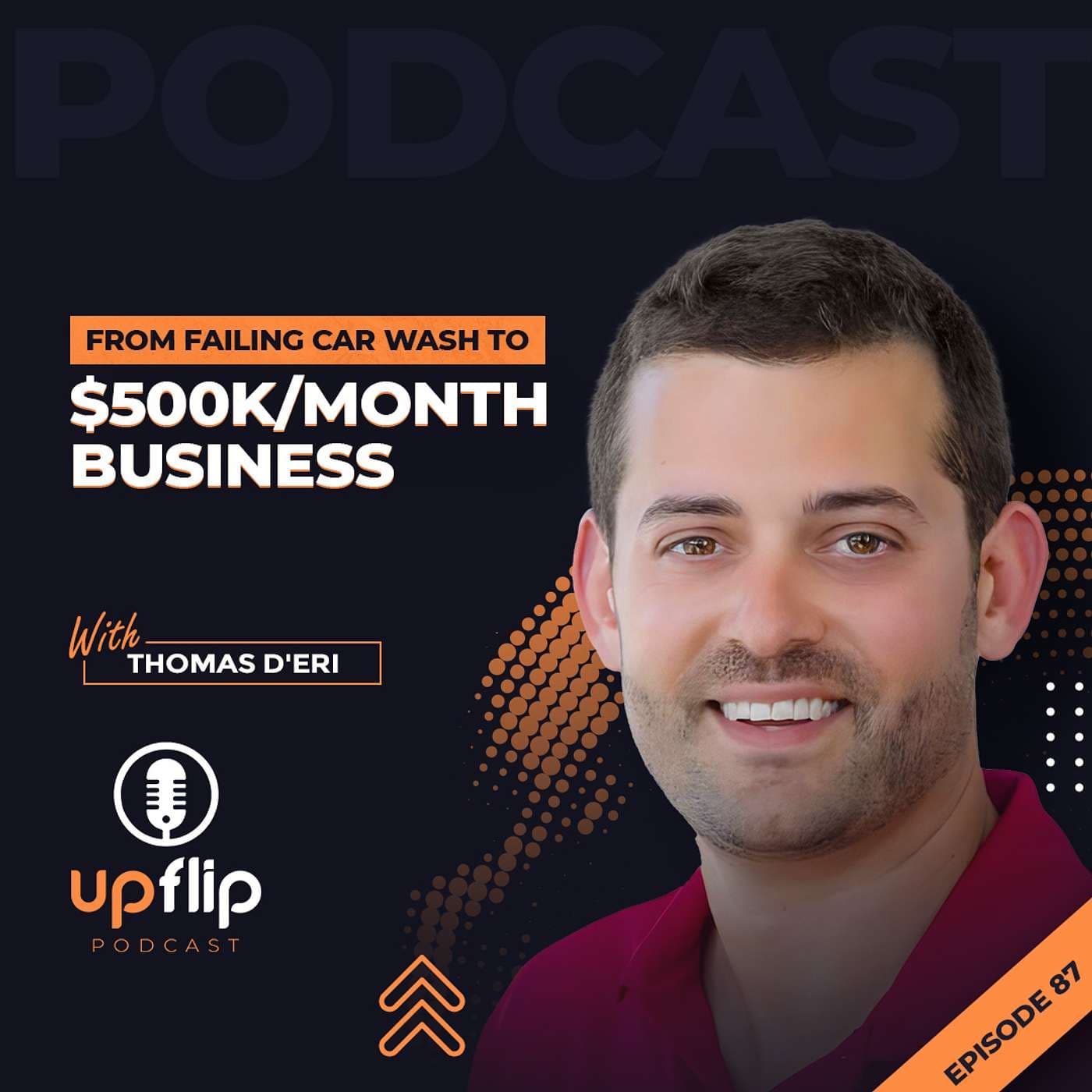
UpFlip Podcast Episode 87 Summary: How To Start a $500K/Month Car Wash
Episode Overview
- Title: How To Start a $500K/Month Car Wash
- Guests: John D’Eri and Thomas D’Eri, founders of Rising Tide Car Wash
- Theme: The episode focuses on how Rising Tide Car Wash was established to create job opportunities for autistic adults, achieving over $500,000 monthly revenue across two locations.
Key Concepts Mission-Driven Entrepreneurship
- Background: The D’Eri family’s commitment to creating employment for individuals with autism, particularly inspired by Andrew D’Eri, John's son.
- Value Proposition: The business is not only a car wash but also a platform to demonstrate the capabilities of neurodivergent individuals in the workforce.
Business Model
- Acquisition of Existing Business: The D’Eris purchased a struggling car wash instead of starting from scratch, allowing for quicker operational setup.
- Growth Strategy: Expansion involved acquiring failing businesses, renovating them, and implementing a unique service model focused on community and inclusivity.
Operational Insights
- Cash Flow Management: Emphasis on watching cash flow as the primary financial metric for success.
- Hiring Practices: Traditional hiring practices are often flawed; the D’Eris advocate for inclusive hiring practices that prioritize skills and values over conventional metrics.
Steps to Starting a Car Wash
- Identify the Right Business Model: Evaluate the potential for a successful car wash in a community.
- Gather Expertise: Partner with industry experts and disability employment consultants.
- Prototype Services: Test the business concept with a pilot location before full-scale operation.
- Financial Preparation: Use SBA financing and ensure personal financial stability to support business risks.
- Implement Systems: Create robust systems for operations, employee training, and customer service.
Employee Management
- People-First Culture: Shift towards a management style termed "disciplined compassion" where accountability is balanced with support and understanding.
- Training Programs: Develop comprehensive onboarding processes tailored to neurodivergent employees, ensuring clarity and success from day one.
Unique Challenges and Solutions
- Communication Needs: Recognizing that neurodivergent employees may require more explicit feedback and structured environments.
- Adjusting Hiring Practices: Fostering an inclusive environment that can adapt to various employee needs, ultimately enhancing operational effectiveness.
Marketing Strategies
- Community Engagement: Building relationships with local advocates and educators to establish a supportive hiring pipeline.
- Media and Social Outreach: Utilizing earned media and social media ads to promote the brand's mission and attract customers.
Metrics for Growth
- Key Performance Indicators (KPIs):
- Cash flow
- Year-over-year volume trends
- Revenue per customer
- Strategic Goals: Focus on gradual, integrity-driven growth rather than aggressive expansion driven by external pressures.
Takeaways
- Social Impact and Profitability: Integrating a social mission into the business model can create a successful enterprise while contributing positively to the community.
- Adapting to Change: Businesses must be prepared to evolve their strategies in response to market conditions, particularly in high-demand locations such as South Florida.
Conclusion The episode emphasizes that entrepreneurship doesn’t solely need to focus on profit; it can also center around making a difference. John and Thomas D’Eri provide a compelling case for how creating inclusive job opportunities can lead to business success and community enrichment.
Resources
- [Rising Tide Car Wash](https://www.risingtidecarwash.com/)
- [UpFlip Academy](https://bit.ly/3NCfEQv)
- [SBA Financing](https://www.sba.gov)
Connect with UpFlip
- [YouTube](https://www.youtube.com/@TheUpFlipPodcast/)
- [Instagram](https://www.instagram.com/upflip/)
- [Facebook](https://www.facebook.com/upflipofficial)
- [Twitter](https://twitter.com/upflipofficial)
Additional Insights
- Book Recommendation: "The Power of Potential" by Thomas D’Eri.
- Key Challenges Ahead: Navigating the rising costs of real estate and construction for future expansions.
This episode provides not only a roadmap for starting a car wash but also a broader insight into the significance of inclusive hiring in today’s business environment.
Written by AI. May contain mistakes. Listen to the episode to check what was said.
Transcript
Automatic transcript. May contain errors.0:00This$500 ,000 a month car wash operates in a way and scale you've probably never seen before. So always, always, always cash flow is king. We are always going to be watching the cash flow more than anything else. There's really unique ways to differentiate your brand as well as have positive impact. I got smacked in the face real hard in those first few months thinking that, okay, I'll figure out the car wash. It'll be easy. How hard could it be? But as anybody knows who operates a business, there's a lot of details below the surface. I had to learn those really fast because I didn't spend the time necessary before the business to do so.
0:38We have this notion that there is a labor shortage or that we just can't find good people. People just don't want to work anymore. They don't want to do these jobs that I have for them. And the truth is, is that is much more often the case is that the hiring system itself is broken. I think that oftentimes people are all trying to emulate other businesses. So there you see a lot of copying going on instead of trying to do things that are differentiated. I'm your host, Alex Freeman, and I'm joined by the Forbes 30 Under 30 social entrepreneur Thomas De 'Arie. Let's dive in and uncover exactly how Thomas turned a failing car wash into a thriving business.
1:18Thomas, thanks so much for joining us. Alex, it's a pleasure to be here. Thanks for having me. To get us started, can you tell us your story and how and why you opened a car wash business? Yeah, so I never expected to be in the car wash business. We really were looking for a way to find employment for my brother, Andrew, and Andrew is on the autism spectrum. So this was back in In 2011, I had just finished my undergraduate degree and Andrew was turning 18, 19 years old, and we were really struggling with what he was going to be able to do with his career. And it became really clear really quickly.
1:53In order for him to lead the full adult life that we knew he was capable of, we were going to have to take action. So he looked at a bunch of different businesses and we really liked the car wash business at its root when it's done well. It's very process-driven and routine. It's an asset-backed business. We figured that if it all didn't work, we'd still at least have an asset to be able to sell. And that we really felt at the end of the day, Andrew would be great in this business. He'd do a really good job. So that was why we got into the car wash business. And luckily, it's been really successful so far.
2:25So that particular mission-first search is a little bit different than a lot of entrepreneurs. how did that impact your decision-making process as you kind of looked at what business or niche to enter into? So at the time, all the best research, and there really wasn't a lot of it, so saying the best doesn't mean much, but the research that was available as far as what people with autism would be good at in the workplace was all kind of centered around process and detail oriented work. Today, we know that there's a much broader skill set of neurodivergent people and people with autism more specifically.
3:00But what we were looking for really was a business that was going to benefit from a workforce that could be really process and detail focused. We were also looking for a business that was out in the community so that we could really communicate more to a wider audience that individuals with autism really bring wonderful skills and strengths to the workplace. And it's not just a disability that requires sympathy, but actually a really valuable diversity. And then we really were looking for a business that was fairly undifferentiated, meaning that there wasn't a lot of brand power in that business.
3:35So we thought that by telling this unique story, it would be a real advantage from a marketing perspective. So we looked at, like I said, a few different types of business concepts, and the car wash really stuck out and checked all those boxes for us. So once you made that decision that it was going to be a car wash, What were the next steps in the process to get you from that decision to opening? How long did it take and what steps did you take? Yeah, so it took a little over a year from inception of the idea to actually operating. And the first thing we had to do is we were really clear and honest that there was a lot of things we didn't know about what we were trying to do.
4:13We didn't know anything about employing people with autism. We didn't know anything about operating car washes. So we really needed to find experts who could help guide us in this journey as well as really fill these knowledge gaps. We went on a search for partners. We found a wonderful disability employment consultant by the name of James Emmett, who's still doing this type of work out there. And he kind of guided us on the employment side of what we were trying to do. And then we found a great partner who we still work very actively with called Sunny's Enterprises, which is the largest manufacturer of car wash equipment in the world.
4:48and also obviously experts in this business. So we kind of put those two together and decided we were going to run a proof concept. So to really test this idea out before we went in, we made an investment in actual car wash ourselves. And luckily, really by God's grace, the owner of Sunny's Enterprises, Paul Fazio, had one car wash that he owned that they essentially tested equipment at. And he was willing to let us operate there for the summer to test this idea. This was in Homestead, Florida. And we spent eight weeks kind of testing our assumptions around, you know, could we recruit and train enough people with autism to be able to staff these car washes?
5:29How would customers think about this idea? Would they be positive to it or would it be too stigmatized or whatever have you? We really tried to spend a summer validating that stuff, and it was all went very positively. So we started searching for an actual car wash to purchase in the fall of 2012. And we found one in Parkland, Florida, which was this kind of struggling old car wash that was in a really good location, a wonderful community, but just needed some love. And, you know, so we bought that one, renovated it and started operating our new business model in April, 2013. Why the decision to buy into the first location versus finding a new spot and building a car wash from scratch?
6:10What were kind of the benefits and challenges of going that route? It was really speed. We wanted to do this quickly. We wanted to get going. And to build a car wash takes years. And our second two car washes are both ground up. So we built them. We bought raw land and developed them. That takes generally two and a half, three years from the time you put a purchase offer out to the time you're actually washing cars. So we said, okay, we'd like to buy one and get going quicker. That was really the reason there. I mean, there's benefits and disadvantages to both concepts. Certainly when you buy one, And it's a story you're inheriting all of the mistakes that previous operators, as well as the previous people who actually built it, made.
6:51So you come to our Parkland location and you see that it's not designed at all like the other two stores because we didn't build it. So certainly there's that aspect of it. But I will say it was very fortuitous for us because we took this car wash that was struggling and therefore not valued particularly well as business. And once we turned it around, the business ended up with a lot of equity in it, which allowed us to refinance multiple times at this point, which provided us with capital we needed to build the other two locations. On the capital question, obviously, you know, once you have the first location, there's the ability to refinance and do all of those kinds of things.
7:26But leading up to buying the location, getting started in the new business, what were you doing to prepare your personal finances for the risk that was about to be involved? Yes. I mean, this was mainly my dad, right? So he's my partner in this business and our CEO. And this time I was like 23 years old, so I didn't really have any personal finances to speak of. So he always keeps really clean personal finances. He had just sold a business to do this with me and for Andrew in February of 2012, I think is when that closed. So I kind of took that money and put it into this new business. For people listening, the most common practice in our industry, and I think there's probably a lot of them that are similar, is getting SBA financing, which to my knowledge, you don't have to have a ton of assets yourself to get SBA financing, but you do have to personally guarantee these loans.
8:16That's how we did our startup, as well as how we've funded our other locations so far is SBA debt component. Now, when you first bought the car wash, did you come in and just kind of clean house and say, we're inserting this concept now? Or was there a transition period? How did that all work of actually getting the new concept up and running? So we bought it and we closed it and we closed it for, it ended up being a little over four months because we had to renovate it significantly. Frankly, we needed to renovate it more than we did. And we just didn't really know what we didn't know at that point.
8:48So that aspect of closing the business, really all the staff that was there found other work. I think we ended up one of the previous team members came back and reapplied once we were ready to start going again. And he's actually still with us, which is wonderful. But for the most part, it was that renovation period was a break and caused a kind of a natural transitionary period. The whole business concept comes from a place of definitely people first, of managing your people and meeting them where they need to be met. So can you talk to me about people management skills that business leaders need to have and how you went about developing those?
9:24Yeah. So when I started, I had pretty poor people management skills. I really believed at that point that the boss had to have all the answers, that I had to give directives. And if people didn't listen, I just needed to speak louder. And that was really kind of my method of people management early on. And it worked very poorly. you know, when I learned and fairly quickly, specifically because I was comfortable being in service to our employees with autism, which make up 80 % of our staff, that I needed to take a different approach. I needed to take an approach that we now we call disciplined compassion.
9:58So I needed to hold people accountable. But in order to do that, I have to be really clear about my expectations. I have to be willing to develop people, coach and train them and not expect them to simply know what I want or how to do those things without a lot of support to start. And that when people are struggling, instead of looking to blame the person, we really look to understand the situation first. So Amy Edmondson, who's an early researcher of psychological safety, has this concept within that called the failure spectrum. And so that goes from blameworthy failures to praiseworthy failures.
10:39And only in her research, maybe two or three percent of failures out there are really truly blameworthy. So the vast majority of these types of failures, we need to recognize are opportunities for growth for the organization and for the individual. So when we see someone struggling, what we want to do is we want to understand why they're struggling. We then have this organizational habit of building systems around those struggles. So once we identify where someone's struggling, we're actually You're going to try to build that system or process or tool to make it where that person who's struggling the hardest is now able to do the job more effectively.
11:13And that's been a really poor strategy in how we build psychological safety within our workplace, as well as build just really good systems in order to allow us to scale and provide better service to our customers. Ever wonder how top investors consistently beat the stock market? It's simple. They jump in on opportunities before companies go public. But investors like you and me are typically left out of these lucrative opportunities. Today, it's all changing. StartEngine, led by Howard Marks, previous co-founder of Activision, which was acquired later by Microsoft in a record$67 billion acquisition, is now democratizing investing.
11:48On StartEngine, you can invest alongside 1.7 million other users, where you can potentially be investing in the next Uber or Airbnb for as little as$100. And here's the best part. Not only are you invited to invest in startups, but as an UpFlip viewer, you also get to join StartEngine's live fundraising round. This gives you the opportunity to own shares of this revolutionary platform for as little as$500. With$1.2 billion raised, including$71 million for themselves, StartEngine is reshaping what's possible in startup investing. Click the link in the description to jump on board before their investment round wraps up.
12:22I want to ask a little bit more about those systems. What has been your system design process? And I guess, when do you determine if a system is working or not working and how long do you kind of give it to unfold before you maybe retweak it? Broadly speaking, we try to use a human-centered design process, a loose human-centered design process in building our systems and processes. So we're going to take it from the user's perspective. And whenever we're doing this, we're going to first really try to understand the needs of the people who are going to use the system, really try to be clear on what success, looks like for that particular system.
13:01And then we're going to go into a prototyping phase. So whether that be actually going out live into the work environment and trying to do what we're setting out to do and documenting that, that way we can kind of see on paper the steps that it takes to do a certain thing. And then we can tweak that and see, okay, well, there's a friction point at this step. So maybe we need a different tool or a different way to do this and really analyze the tasks that way. And then we're going to keep iterating. And we're going to iterate really until we feel like the system is really operating optimally. And at least an annual basis, we try to go and audit all of our core functional systems.
13:39So maybe the way that we clean the inside of a car worked well for us two years ago, but now we're starting to see that there's holes in it. So we need to revamp that. We do that really regularly, but I will say that the beacon that really alerts us to flaws in our systems are our team members. They are often pretty open when a system isn't working well. And even if they aren't telling us directly like this sucks, you'll be able to see in a lot of our newer team members' actions, like if they're really struggling with a certain process or system. So using that new employee experience as a way to refine our processes in the systems is something we do really frequently too.
14:20I believe the number you mentioned was 80 % of your employees are neurodivergent. And can you talk to me about what some of the unique challenges come from having a largely neurodivergent workforce versus what someone who maybe is running a business without that focus might run into? Yeah. So generally speaking, a good way to think about our staff is that they have the same needs as everyone else, they're just often more apparent. So everybody wants clarity in their role, but people with autism really need this. Everybody wants managers who are going to give them feedback and be clear about if someone's meeting the expectations or not and what they need to do to meet them if they're not meeting them.
15:02But people with autism really need this. So I would say that the difference is just that the issues are more pronounced and kind of force solutions quicker than a typical staff. A lot of times, typical team members will try to appear confident even when they're not competent and just kind of sweep problems under the rug or just kind of soldier on through less than ideal circumstances where our team isn't going to do that so much. They're going to be a lot more forthright. So we look at that as a real benefit, which allows us to really refine our systems and our processes and run a great operation.
15:36But it could certainly be looked at as, well, this is more work because we have to fix all these things in our organization in order to support these staff members. The truth is, you probably need to fix those things either way. You just aren't aware of it because most of your team members aren't going to bring that to you for fear of looking like they don't know what they're doing or they're not capable of doing their jobs. I mean, you talk about that in your book, The Power of Potential, how those inclusive hiring practices can solve a lot of common business problems like what you were just describing.
16:05First, I guess I'll ask, are there other problems that are holding businesses back that inclusive hiring can help address? Yeah, I think the first one, and it's been so salient over the last couple of years for many business owners, is we have this notion that there is a labor shortage or that we just can't find good people. People just don't want to work anymore. They don't want to do these jobs that I have for them. And the truth is, is that as much more often the case is that the hiring system itself is broken, right? We're hiring from the same pool as everybody else. So of course, that can feel like there's scarcity of labor sometimes.
16:42We're doing what's essentially a glorified airport test in the interview. Do I like this person? I get this feeling of if this person's a good fitter or not, but not a lot of data to support that. So when we flip that around and say, okay, let me be really clear about what actually matters for this role. What are the core skills and values that someone brings to this role that's successful? If you're operating a business already, you can simply look at the people who are doing really well in certain roles. And oftentimes you can say, okay, well, this person has a certain skill or a certain mindset that is really valuable and that that's what I need to find.
17:21And for entry-level roles and a lot of the roles that we hire for, that's generally a value set more than it is any actual skill. So we're looking for people who display grit, who are assertive, who have a growth mindset. And we ask interview questions to ferret those things out. We try to ask in a lot of different ways. So we ask kind of how would you handle a situation like A, B, and C or tell me about a time where you faced this type of dilemma and how you worked through it. Asking both those types of questions is kind of what if as well as historical question is also more inclusive because it allows people who are comfortable with either of those kind of really show you their values.
18:02Makes it easier for people for a wide range of backgrounds to answer them. And when we build this type of clarity into our hiring process, it automatically makes it more inclusive because we're no longer using kind of arbitrary data to determine whether or not someone's a good fit. Things like a certain work experience background or a certain educational background or just some sort of social thing that you value. Things like eye contact or handshake or a lot of times we're biased even by things like tone of voice. we tend to kind of extrapolate these things about people to their actual ability to do a job.
18:38And that's generally very inaccurate. So I think that's the first thing that is really critical, that clear hiring can make you more inclusive. But then also looking at these different barrier groups of people, there's a lot of people who really do want to work and be really grateful for the opportunity to work that simply don't get an opportunity because they've been turned down a lot of times and aren't actively on Indeed or things like that. Or when you interview them, they interview a little differently. And if you're, again, doing an airport-style interview, well, you might not think that they're great talent.
19:11For us, we've got three car washes here in a five-mile radius in Southern Florida. And we employ over 90 people and we have a wait list. And I've almost always had a wait list of people that want to work for us, where most car washes, most restaurants, most of these service-based, community-based organizations are chronically understaffed and simply can't find people when they do their leads pretty quickly. We have a turnover rate that's over five times lower than the normal car wash. So these methods, while they're different and they may feel maybe a little unique, they're fairly effective. And I would really encourage people, if you're struggling to find talent, to really look at your hiring process before blaming the labor market.
19:58I think you have laid out a really, really strong case for inclusive hiring practices, but I understand that some entrepreneurs and business owners might still look at it and feel daunted by the prospect of layering it in. So what advice would you give to a business leader who is definitely intrigued and interested, but maybe feels a little unsure about actually doing it in their own business? Yeah, and I understand that. And this can be scary, it's different. Certainly we hear from entrepreneurs like, I don't want to hire someone and then have to fire them if they were a bad fit. Like having to fire someone with autism or with a disability is very scary.
20:32And I get that. So what we really recommend is approaching this like a prototype, just like we do with our products and our services. And the best way to do that, in my opinion, is starting with a training program. So let's say there's a certain role in your organization that you really just are chronically struggling to find talent for. That's a good place to start. And you bring people together, the managers of people in that role, maybe people from HR, if you have an HR department, or maybe it's just you and people who are directly overseeing this role and try to determine, okay, well, what makes someone successful in this role?
21:09What are the core things that they need to do? Do we have good processes for these things? And if we do, great. And if not, let's build some just basic processes. How would I teach someone who knows absolutely nothing about how to do this? How do I teach them in a curriculum-based way? And what does success look like? Do they have to be able to do this task in a certain amount of time? Do they have to do it at a certain amount of quality? What are the clear and objective ways to measure if someone's able to do this job? And once we have those things, we can now invite people into our organization, let's say people with autism into our organization, as trays, right?
21:46So if it doesn't work, as you're fumbling your way through this, you're learning, you're prototyping, you're refining. If you bring people in that aren't a good fit or you just kind of messed up and you have to pull back or whatever the reason, you haven't made a long-term commitment yet and you can walk away. It kind of de-risks it for the employer and it allows you also to run a few iterations before you actually go live with this hiring process in a way that's, again, pretty low risk. That's typically what we recommend when we're trying to revamp the hiring process. Start it with this kind of mentality that we're going to prototype it and use a training program as the vehicle to do so.
22:23You know, you mentioned the wait list of people wanting to work for you and the outside growth of the company as well indicates that Rising Tide has a particularly strong brand. So what tips do you have for solidifying brand identity and then raising awareness for the brand in the community? There's a few things that have been really helpful for us. And one is building relationships with the people in the community that really care about the mission. So, you know, our recruiting process is very grassroots. We go into the community and we find people who know and love specific individuals with autism.
22:59So those are things like your special education teachers, your parent advocates, your community liaisons at the local nonprofits. benefits. And while that's really helpful for us to build a pipeline of applicants, these people also end up being our brand evangelists when we go into a new community. So they're talking about it. They're excited about it before we ever open the doors. And that was really helpful early on. And it continues to be really helpful. People in the schools talk really highly of us. People in the community care about this cause. So there's really positive word of mouth associated with it.
23:31But getting the fodder is what I just laid out. And then the second thing, we really rely a lot on earned media. So getting news segments, getting videos made online, these little mini documentaries, which we had a couple go viral has really helped us. That's been a really great way to build credibility and to share our story effectively. And then kind of secondarily, but also important is the use of social media ads. So we try to tell our mission-based stories through ads as well to get deeper brand exposure in the community. Beyond that, what kind of marketing strategy are you deploying? Are you using any paid marketing or not?
24:08Or is it really the earned media and finding those brand ambassadors? Yeah, we use some paid marketing. Generally, again, it's digital ads, whether it be for our type of business, search ads through like Google or Waze or Bing. Those are very helpful, as well as doing ads on Instagram and Facebook and TikTok. All of those have been good ways for us to spend our marketing dollars. We'll also do things like the school banners. Simply, you know, it's just brand awareness. It's also a good way to build relationships with the PTA because that's typically who's running those type of banner things. If we can get a nice banner on a main road, that's advertising that we'll usually spend money on.
Read the full transcript
24:46But really, since we're a local business, those digital ads for us kind of go the furthest. This is going to bring us to a section of the show that we call our Fan Blitz questions. These questions come from our YouTube community. Listeners, you can join that YouTube community by going to youtube.com slash upflip and you can post questions to future podcast guests. Tom, I've got about five questions. We're going to try and do them in about 90 seconds. Are you ready? Ready. All right. So Oscar Camacho wanted to ask about onboarding and training for adults with autism that enable them to best perform their jobs.
25:16Yeah. So we really spend a lot of time making sure our new hires are prepared and they understand what's expected of them and they're ready to go day one. So we have an onboarding training series, video training series that we give them before they start. We do a what we call pre-hire training. So they have to be able to do our passenger side process, which is about a 50 step process. They have to be able to do that three times in a row under seven minutes. So that way, now we know that they can do the most core function of their role. They know they can do it on their first day. And then when they come in on the first day, they're assigned a pure mentor that works with them for the first couple shifts to get to know people, as well as they're assigned a series of drip training throughout that time.
25:56So those are the core ways. We also love a pizza party for a new hire is a great way to bring people into the team. If you could go back in time and tell your younger self, don't do this thing, what would it be? Don't pretend like that car wash is an easy business or your functional business is the easy thing. And your special sauce, in our case, our mission is the thing you need to focus on. I got smacked in the face real hard in those first few months thinking that, okay, I'll figure out the car wash. It'll be easy. How hard could it be? But as anybody knows who operates a business, there's a lot of details below the surface.
26:28I had to learn those really fast because I didn't spend the time necessary before the business to do so. What do you do with your profits? So most of the time we're reinvesting to build new locations. That's what we've done over the last couple of years. Of course, you know, we're making good livings as a family right now, but beyond that, we're really reinvesting to build new locations. Given the chance, what's the one thing about businesses in general that you would like to change on a fundamental level? I think that oftentimes people are all trying to emulate other businesses. So there you see a lot of copying going on instead of trying to do things that are differentiated.
27:06We really try to go into a business with the idea of how are we going to be different than our competition? And I think that that type of innovative thinking is really needed. Last one here. Why should someone not do what you are doing? So from an autism employment perspective, if you're trying to quickly flip a business, buy a business, roll them up, and then sell them, this is really more of a strategy. This is a business you're going to really try to build and grow and nurture over a period of time. And then as far as car washes go, this is a brick and mortar, customer-based business. It is certainly not a set it and forget it business, even if that's what people tell you it is.
27:43This is a hands-on type operator driven business. So you have to want to be in there and get dirty. That's going to do it for the FanBlitz questions. Listeners, let us know what you think of the UpFlip podcast by leaving a rating and review on Apple Podcasts. It will help other people find the show and unravel how great businesses are built. Tom, just a few more questions from me. I'd love to hear about your best practices in motivating employees to unlock their full potential and how that differs or doesn't for neurodivergent and neurotypical employees. Yeah, don't think it differs too much because it's really all based on understanding what that person wants in life.
28:19There's no one size fits all to motivating people. We're all different. We all have different objectives and different things that drive us. So I think if you're really dedicated to trying to motivate your team, you need to get to know them on an individual level and then align your values with that person, right? So if I need you to do something in your job, I need to relate it to something that you care about. So oftentimes, you know, when we're teaching people basic sales, the car wash, that can be jarring for people, scary. So trying to relate to people, well, this is what it's going to help you in your life.
28:54Learning basic sales is going to teach you how to get your message across and your human beings are always selling something, even if you're just selling where you want to go to dinner tonight. These are skills that are really important for you to learn in your life. So we try to really focus on explaining to people how this benefits them beyond just the job, as well as really taking feedback in a meaningful way. I think people want to feel like they're really a part of the workplace and that they have a say. And I think the most effective way to do that is to really listen to your team when they're struggling and then make changes based on when you're getting good feedback, actually do something about it.
29:32I'd also love to hear about the leadership and management structure of the business and how you have gone about developing managers within the company. Yeah. So we've spent a lot of time working on this and the most fundamental thing that we do is we're very much a coaching driven culture. So that as basic as the way that we set up our interior cleaning departments is we have one, what we call a base supervisor for every two to three teams. So every four to six team members that are working and actually doing the production work of cleaning the interior of cars. And their job is to coach the team and make sure that they're doing quality work.
30:11The team members are responsible for doing a really good job themselves. These base supervisors shouldn't have to touch the cars, but they're really there to coach. So this is a role that we have. Most fundamentally, everybody who starts with us, that's their first really foray into management and leadership, and it's through coaching. So we then wrap that around with really good training on how to give feedback and how to give effective coaching. Next step up, we continue to build on that. So you have a departmental manager and then they get an additional wraparound training. And we build this throughout the organization to where when someone passes our management training program and is ready to be an assistant manager at one of our stores, they've gotten through hundreds of training modules and they've gotten a lot of coaching themselves and they feel really well prepared for that.
30:56So our whole organizational structure, as you may have gathered by now, is really focused on developing our team. We expect people to come in with no knowledge of car washes, no knowledge of employing people with autism, and we're going to teach you all of that. It's something that constantly evolves. Every week, we're putting out a new training module. We're continuing to build and invest in this program. Why is having that company culture so important for a service-based business? It's almost a cliche at this point, but the way our team members interact with our customers is our whole business.
31:26And you have to have people that A, know what they're doing in their role, so they're competent to deliver our service. But B, and at least as important, if not more important, is they have to want to do it and they have to want to care about doing it. And people only really care if they care about A, you show that you care about them, and then they in turn care about you. And that's generally a manager to team member relationship more than it is anything else. And then B, they care about what the company stands for and what we're trying to accomplish here. And by doing those things, our customers walk away with good experiences.
32:04And without that focusing on developing our team, I don't think the relationship would be the same with our business. I want to talk a little bit about that customer experience. What does it mean to you to have a frictionless customer experience and how are you going about providing that? So what we try to do is we try to really make sure that every touch point in the customer experience is really thoughtfully designed where we don't have people struggling with the same things over and over again, whether that be where to pay for a service, how to choose a service, how to put your car into neutral when you get onto the car wash conveyor, how to get called back from when your car is done, so on and so forth.
32:42And most of that, again, is informed by trying to build a really good employee experience first, because our employees are interacting at each of those touch points, too. So let's make it super effective for them. And that generally dovetails really nicely into a great customer experience. You've got both one-time wash options and membership options for customers. Why did you add the membership option? And what percentage of your customers are members versus one-time wash buyers? Yeah. So the membership is something that gives us consistent revenue, even when it's rainy out. South Florida gets quite rainy in the summer.
33:18So it certainly helps us when we don't have a ton of volume going on. It's also something that I think is a real benefit to our customers. Having the three car washes within such a close proximity allows them to really easily access all three. And that gives us the opportunity to provide value to our customers that someone, a competitor brand might come in and not really be able to provide that same level of value. value. I'd say right now, on average, this is about 25 % of our customers are subscription members. And that's something that's growing pretty regularly. Now, you mentioned adding that value.
33:50So every wash comes with a free vacuum. What's the value of offering free services to customers and what types of services or products make the best kind of free add-ons? Yeah. So, I mean, it has to be a value adding, right? And many of our customers just want to get in and out of here as quick as possible and just want to do a quick little touch-up vacuum in their car. And we certainly didn't come up with that. This is now a widespread industry trend, but we saw it early on when we were building in 2012 and we knew it was a critical component because it really brings a lot of customers in. In fact, I think it's one of the larger reasons why the business is successful.
34:28About 80 % of our customers are these exterior only customers. So they're buying exterior only car washes and then driving away. And to be able to afford them this amenity that really is a, you know, completes the service, essentially, these complimentary vacuums is really critical. You're up to the three locations right now. Was it always the plan to open multiple locations? Or as the first location got rolling, you said, hey, I think we've got something here. Let's open another location. I think as a lot of entrepreneurs can attest, when you start, you have these grand divisions of what you're going to do.
34:59And that for us was, oh yeah, we're going to have a hundred car washes and the car wash empire. And then you start operating that first store. It's like, oh my God, how could I even think about having another one of these? And within time, I think for us, probably after the first 12 to 18 months, we felt strong enough operationally because we were really dedicating all of our time to learning how to operate this business effectively, we thought we could do additional stores. And so it went from this like grandiose vision to, no, can't do anything more than this. Can't even think about anything more than this to that more realistically, okay, we'll do one, then we'll do two.
35:40And now we're at the point where, you know, we feel like we could do two or three at a time and continue to grow and maybe grow a little bit more aggressively than we have in the past. What are some of those extra challenges that come from running a multi-location business? Well, you can't be everywhere, right? So when you're running the one store, you're able to kind of fill all the holes. If there's holes, you can just insert yourself in and fill it in that. That works. It's effective. But when you're at two, certainly at three locations or more, you really can't be there anymore. It's not possible for you to do that.
36:11So you have to really focus more on building your organizational infrastructure. And luckily for us, our business model and this methodology of trying to design everything so our team members can be empowered really lent itself to allowing us to scale a little bit more effectively because we were always focused on building those good processes and systems, which then as we grew, really made it where I didn't need to be anywhere specific at any given time to the point where now we've got a really strong organizational infrastructure and I can really focus most, if not all of my time on trying to acquire new locations, as well as how do we improve and actually work on the business instead of having to work in the business at any given point.
36:52As you have made that transition, what are some of the key financial metrics that you're keeping track of? And why are those the important metrics for you? So always, always, always cash flow is Kate. We are always going to be watching the cash flow more than anything else. I think the other things that we really watch closely are our year over year trends for our actual car wash volume, as well as our revenue per customer. So those for us can really inform, you know, is the business growing? Is it retracting? Is there an issue? Is one store growing while another store is retracting? Okay, that tells us there's an issue there and you have to dig a little deeper.
37:29We tend to watch those metrics more closely than anything else. And then how are you going about setting growth goals? What makes an effective goal for a business? And how do you go about setting goals and deadlines to push the business to new heights? So for us, I don't take a really ironclad approach to this. This is something that we want to be patient. I think one of the advantages we have of being a family-owned business and not having outside investors to really report to is that we didn't say, we're going to do five stores in the next two years and you're going to give us the money for it, we can kind of pick and choose our opportunities a little bit more one at a time.
38:07I think that's allowed us to grow with integrity as well as really maintain the brand and the culture, which is so important to everything that we do. What's the biggest struggle you have in the business today? Well, I don't know how many of our listeners here are familiar with South Florida, but the real estate market down here has been totally on fire for the last couple of years. And now we're getting to the point where we're really going to have to come to the realization that these stores are going to start to cost significantly more to build, or we're going to stop growing, which really isn't an option.
38:36So I think there's been a little bit of coming to this new reality that car wash isn't going to cost to build what it did three years ago. It's going to be maybe 50 plus percent more to do so. And then we have to work within our margins and work on our business model to make sure that that's still a viable option. If you could pick the one thing that somebody takes away from this interview, what would it be? I hope that people take away from this that there's really unique ways to differentiate your brand as well as have positive impact. I think we're all kind of getting into business generally because we want to make a great living and we want to do something meaningful.
39:12And trying to really integrate a social mission, a real social mission into the business doesn't have to be like just a marketing thing. As you can tell, this fully permeates all of our operations, right? And it also feeds the marketing engine of the business. So it's really hand in hand. And I think that if more businesses really tried to take that approach, not only would the world probably be a little bit of a better place, it would also really, I think, help businesses be more successful. Now, I'll give you a chance to plug your book in just a second, but what's your favorite business book and why?
39:44It's still a classic and it's The E-Myth Revisited by Michael Gerber. And I think for me, it's just one of those books that I picked up at just the right time. We were kind of just starting. I was really struggling to understand how to operate the business. And I picked it up at the right time. I was like, geez, this is like answering all of my questions. I'm so happy I got this book. And to me, that's the great thing about always reading is sometimes you have those moments where somebody's talking about exactly what you need and you can really learn from it. Now, Tom, tell our listeners about The Power of Potential and also where they can connect with you and learn more about what you're up to.
40:17Yeah. So The Power of Potential is a book I just launched with HarperCollins. And the goal of it is really to be able to show small, medium-sized business leaders that this idea of employing people who are neurodivergent and building a business around their skills is a really transformative strategy for almost every aspect of the business, from the way that you hire to the way that your leaders lead to the way that you actually design the operations and get ready to scale the organization to the way that you build relationships with customers. We find that there's a lot of small businesses that really struggle to find great talent and differentiate themselves in the market.
40:53And that this is a strategy that you're probably not thinking of, but is a really dynamic one. It has really worked great for us. And as far as getting in touch with me, we've got two websites. So we've got risingtidecarwash.com. That's our main business. We're all about it. I think my email is on that website. If not, you can go to risingtideu.com. And that's essentially where we have all of our educational material about how do you do the types of things that we're talking about doing. So that's a great website to take a peek at. We're also on Facebook, Instagram, TikTok. We want to say hello there.
41:23That is going to do it for this episode of the UpFlip Podcast. Listeners, you can find more advice for how to start a business the right way on the UpFlip Hub. And if you like this episode, let us know by leaving a review on Apple Podcasts or wherever you're listening right now. Tom Deary, Rising Tide Car Wash, thank you so much for joining us. Thank you, Alex. This was a pleasure.
From the publisher
John D’Eri and his son Thomas started Rising Tide Car Wash to provide employment opportunities for autistic adults. Ten years later, they’ve grown to 2 locations that bring in more than $500,000 a month in revenue, both a thriving car wash business and proof positive that neurodivergent employees have a lot to offer in the workplace.
Providing opportunities for people with autism is an idea near and dear to the D’Eri family. John’s son, Andrew, has autism, and Andrew’s challenges finding a place he could thrive inspired John to start Rising Tide. The truth is, autistic adults have a ton to offer as employees, and Thomas will share how their diverse workforce has helped their business grow in this interview.
John and Thomas didn’t start a car wash from scratch. Instead, they bought a failing car wash and turned it into a thriving business. In this episode, you’ll learn the steps of this transformation, what it cost them to purchase and improve it, andother details of how to start a car wash business.
Resources:
- https://bit.ly/3NCfEQv Join UpFlip Academy and launch your business
- Rising Tide Car Wash - Connect with the company on their website
Ready to be your own boss without starting from scratch? Grab our FREE Franchise Guide and unlock the secrets of proven business models that have already created thousands of success stories.
Connect with UpFlip:
- On Youtube
- On Instagram
- On Facebook
- @UpFlipOfficial on Twitter
For more insights to start, build, or grow a business, check out the resources on UpFlip.com or head to the UpFlip YouTube channel to see more interviews with business owners and experts.
Thanks for listening!


