
In short
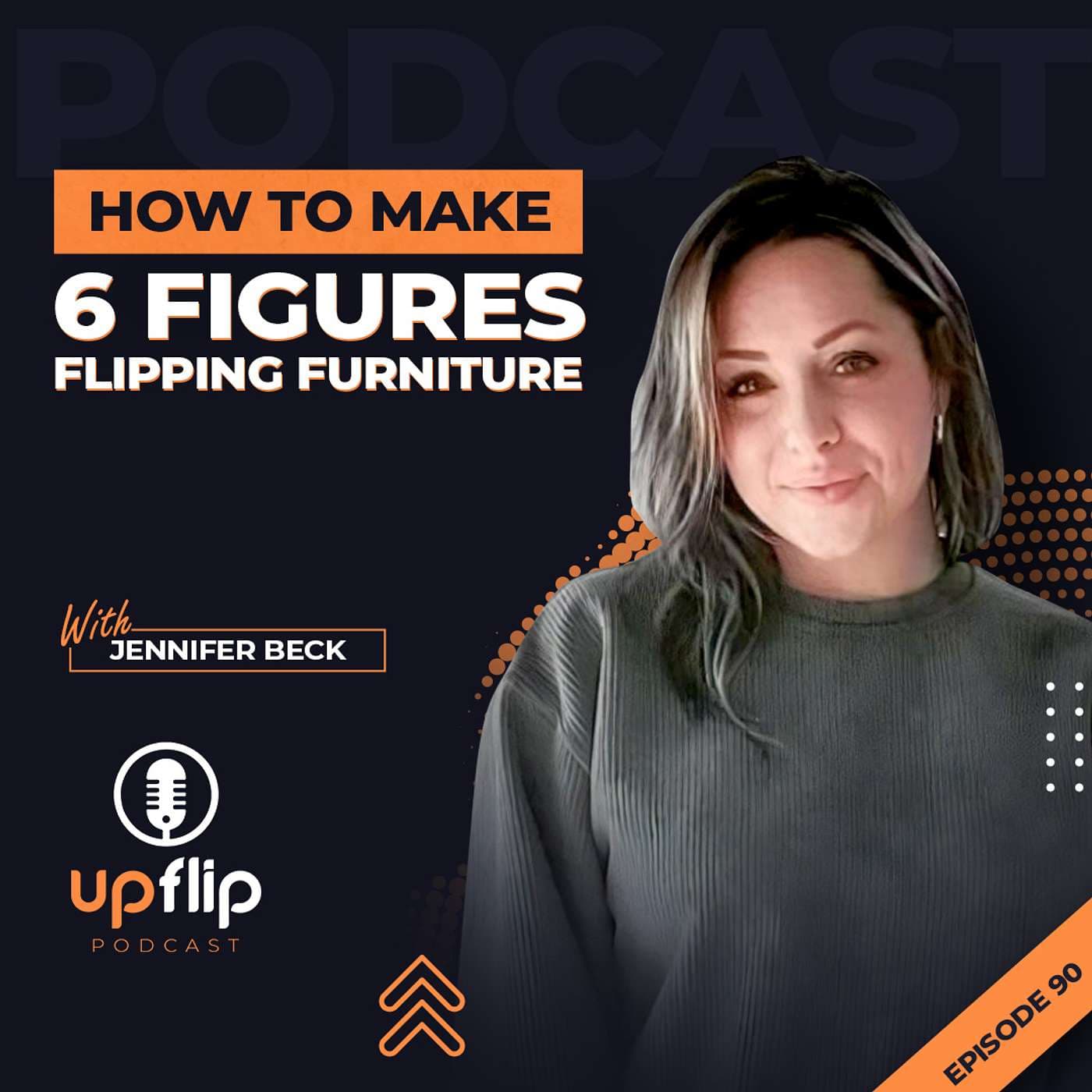
UpFlip Podcast Episode 90: The Six Figure Side Hustle: Furniture Flipping 101
Episode Overview In this episode of the UpFlip Podcast, Jennifer Beck shares her journey of transforming her passion for furniture flipping into a successful, debt-free business called Saved By Design. With a background in retail furniture sales, Jennifer discusses the challenges and strategies she encountered while building her business alongside her daughter. This episode provides valuable insights for aspiring entrepreneurs interested in the furniture flipping niche.
Key Concepts and Takeaways
Jennifer Beck's Background
- Formerly at the pinnacle of corporate success in retail furniture sales.
- Transitioned to furniture flipping after experiencing burnout in the corporate environment.
- Launched Saved By Design in 2019 as a response to the need for a change.
Starting the Business
- Financial Freedom: Living frugally and saving money beforehand enabled Jennifer to start her business without debt.
- Minimal Planning: Jennifer admits a lack of extensive planning; her frugal lifestyle provided a safety net.
- Passion for Restoration: Blended interests in history, antiques, and sales led her to explore furniture flipping as a viable business.
Challenges and Strategies
- Transitioning from Corporate to Small Business: Overcoming fear and self-doubt through necessity helped her leap into entrepreneurship.
- Family Dynamics: Operating a business as a mother-daughter duo requires clear boundaries and communication.
- Education and Support: Jennifer emphasizes the importance of self-education on legal aspects of business and the value of seeking advice from trusted individuals.
Business Mindset
- Optimistic Approach: Jennifer maintains a positive, adaptable mindset, focusing on the big picture rather than day-to-day stresses.
- Persistence: Stresses the idea that business owners can't fail if they continue to persevere.
Financial Insights
- Startup and Operating Costs: Jennifer started with under $1,000, using existing resources and avoiding debt.
- Revenue and Profit Margins: Generated around $12,000 monthly revenue with approximately 80% profit margins.
- Debt-Free Philosophy: Emphasizes the importance of maintaining a debt-free model for sustainability and peace of mind.
Marketing and Customer Engagement
- Word of Mouth: Leveraging personal networks and relationships as a primary means of gaining initial customers.
- Social Media Presence: Actively engaging on platforms like Instagram to build community and promote work. Consistency and quality of content are crucial for growth.
- Targeting Ideal Clients: Focuses on attracting clients who value quality and design over price, allowing for higher profit margins.
Customer Service Approach
- Building Trust: Stresses the importance of reliability and honesty in client interactions.
- Handling Unhappy Customers: Advocates for ownership of mistakes and maintaining calm communication, while also setting boundaries.
Advice for Aspiring Furniture Flippers
- Start with the Basics: Research thoroughly before investing in tools or materials; focus on skills rather than flashy equipment.
- Long-Term Profitability: Building a furniture flipping business takes time; expect a year to establish profitability, especially if starting as a side hustle.
Recommended Resources
- Saved By Design: [Website](https://www.saved-by-design.com/)
- UpFlip Academy: [Join to launch your business](https://bit.ly/4hh6Ixv)
- Franchise Guide: [Unlock proven business models](https://bit.ly/4aWuGvc)
- Financial Peace by Dave Ramsey: Recommended reading for developing a debt-free mindset.
Conclusion Jennifer Beck’s story serves as an inspiring example of how passion, careful planning, and a strong mindset can lead to entrepreneurial success. The episode provides practical insights for anyone looking to venture into furniture flipping or small business ownership, emphasizing the importance of financial freedom, customer service, and continuous learning.
Written by AI. May contain mistakes. Listen to the episode to check what was said.
Transcript
Automatic transcript. May contain errors.0:00Jennifer Beck, once at the pinnacle of corporate success, now channels her passion into the world of furniture flipping. Take$20, go to a thrift store somewhere, pick up something that's a good quality, but a low cost. Usually we make around$12 ,000 revenue each month. And believe it or not, this number is probably going to surprise you. Make sure you're providing content that your followers want or need to see. Don't be throwing something out there just because it's what you like. It needs to be consistent with what your followers want and it needs to be of good quality. You can't fail as a business owner if you don't stop trying.
0:39I'm your host, Alex Freeman, and on the Upflip podcast, you get to learn how great businesses are built, how they are run behind the scenes, and how you can replicate their success. And today, we're about to discover the art of turning worn-out furniture into gold. Jennifer, welcome to the show. Thank you so much for joining us. Oh, absolutely. I'm happy to have any opportunity that I can to talk about making money and then also my love of design. So this is great. I love it. I love it. So let's dive into it by kind of starting with when and why did you decide to start a furniture flipping business?
1:11Absolutely. Well, I never had any intentions of doing so. But in 2019, I was at the top of the sales ladder with a billion dollar furniture company, retail sales, you know, the whole game of the rat race. But what a lot of people don't talk about is that the mental stress of being in that type of environment can lead to burnout so quickly. So after just going through just your regular, you know, trial and error issues and having some transition with company ownership and so on and so forth, I just told myself, I was like, if I'm going to do anything else in my life, I'm only going to invest the time and energy that I have for this company into myself.
1:50And from that point, that is where Saved by Design was born. And we'll definitely delve more into that. But it really was just a necessity for me to find an escape from the corporate rat race. I'm interested there because like you describing it as a necessity, did that help you to overcome the fear of kind of stepping out of the corporate world and into the small business world? Yeah, absolutely it did, because I feel that if I had not had that pressure of having to find something that gave me some relief with the mental stress, I think it would have been a lot more hesitation for me. But again, the word necessity is so key here is that it became necessary for me to find a different option.
2:31And if you're ever in a situation like that with anything in life, you just find that the need to make a change overcomes the fear. So it just drowns all of the hesitation and all of the doubts that you have. And you just go for it and you just, you know, take a leap. And usually it works. What kind of planning did you do so that you could hit the ground running? I'm glad you asked that. I didn't. Honestly, I know that sounds crazy, but I didn't. Mainly what I had done is over the years, one thing I did know is that I didn't want to be in that situation forever. I didn't want to be in that corporate world forever.
3:06So the number one key for me, and this applies to all areas in my life, was financial freedom. So I have always lived on a budget and lived very frugal on all of my investments and all of my spending, which allowed me to have a really well-built nest egg that I knew that whatever I decided to do, I could take that step and not have to worry about whether my house was going to be paid for or whether my lights were going to be on that allowed me that freedom to do so. As far as planning for the business, I can truthfully say I did not put enough planning into it prior. Thankfully, it worked out.
3:40I've been blessed. I've done a lot of praying about that. But truly, the biggest thing for me was knowing that I had the financial ability to take that risk. And I believe that applies to all areas in life opposed to just business related. Yes, certainly having the financial freedom to pursue something that you're passionate about without kind of the it's got to make money from day one pressures. Exactly. That that made all the difference for me was I went into it and I said, you know, I feel like this can work. But I also didn't have that added stress of saying, well, it has to make, you know, X amount of dollars by this date and so on and so forth.
4:17So I think that in any aspect, especially though when you're starting a small business, is don't let there be so much financial stress that it encourages you to make poor decisions based on that. And so building from that place of passion, I guess, begs the question of where does your passion for furniture restoration come from? Oh, absolutely. So I felt like there was a point where I needed to find something that I was good at. You know, there's the old saying, you find something you're good at, something that you love, and then something that people are willing to pay you for. Then that's the sweet spot.
4:46So I knew that I had a love of history and antiques and I knew I was great at sales. And then I knew that I enjoyed like DIY around the house. You know, I had dabbled here and there. And I said, there has to be a way to combine these things. And I started doing a little bit of research online and I noticed that I had seen some people flipping furniture and they seem to be making a decent income at it. And I said, well, you know, I think I can do that, but I think I can improve that as well. Because unfortunately, so often when you find businesses that are in this industry of furniture flipping, they only focus on that portion.
5:20They don't bring in the marketing and sales background with it. And you really need that to be able to bring in that extra boost in the income. And having my passion for sales and customer service, which is a weird passion to have, but I do. And then also knowing that I could bring that design aspect into it. I wasn't great at it at the time, but as I decided that that's what I wanted to do, I was really able to grow and learn. And then it developed into a passion for me. At this point, I could talk about design all day long. So it was more, again, something out of necessity that I allowed to grow and blossom into what it is now.
5:54And it's my understanding that the company operates as a mother-daughter duo. Can you talk about the pros and cons of being in business with family? Yes, absolutely. It's not something that I would say is an ideal situation for everyone, But the pros are we know each other so well. We know what the other person is going to do. We know what to expect, not what to expect from them. And we know that we have a similar work ethic, which plays well together. But there are some boundaries you need to put in place to have a healthy working relationship, whether it be with family or with a close friend.
6:28You know, you have to say, you know, have that discussion up front about what you expect financially and what you expect as far as responsibilities from each person. And by having those conversations with each other up front, you can avoid a lot of issues that you could run into when it's too late. You have to make sure that you both are on the same page of saying, you know, we realize that when we're here and we're doing this, this is business. This is not personal. And we cannot allow those things to get in the mix and mud up all of those things. How successful are you at doing that? I can honestly say it has done very well for us.
7:03But again, I don't know that it would be successful for everyone. It's just our personalities. We both are more introverts. So we respect each other's space. When we are not at work, we give each other plenty of room. We don't talk on the phone every day or anything like that. That way we can have a break from each other because with anyone, whether it's a co-worker or a family member, anyone. When you're around each other too much, you can start to nitpick a little bit at little things that'll drive you crazy. But I think overall, honestly, it's worked really well. And I was hesitant about that, but almost five years in, and I can honestly say we've had no major disagreements because we addressed all of that stuff up front before we even got into it.
7:45I think that's a key part. Looking back at the early days of the business, what was the most difficult part of getting it started? And how did you overcome that difficulty? I think that's an excellent question. My difficulty was in not being educated enough in all the legal aspects of owning a business and also me never wanting to ask for help. So that came down to me just diving in and educating myself as much as I could and reading everything that I could possibly find about the ins and outs of just owning a small business itself. And I think that when I finally took the step to reach out to people that I trusted and valued their opinion on and allowed a little bit of control to be released from myself and get inputs from other people, I think that was really where I was able to overcome that.
8:33And I think it's important for anyone that's considering this to know that no matter how much you do know or don't know, we all need a support system. And whenever you release that little bit of control, you'll find that the success will flow much smoother for you. How would you describe your own mindset as a business owner? You obviously sitting in this interview, you seem very positive, bright, energetic. And so I'm just curious if that carries through in the business owner and if that's how you kind of see yourself. I do think it does a little bit because also there's kind of two aspects here.
9:06The one aspect is I am a very reliable person. So I feel like that has carried through with success for the business. But also I try not to sweat the small things. I am a very it is what it is type of person. So I try not to focus in on my new day to day problems that will not make a difference in the big picture and just let it go. and I may just go home and I may be stressed like every other person, but I'll just sit down, I'll meditate on it a little bit. I'll just say a prayer and I literally just let it go. And it has taken me a while to get to that point. But I do think that that has allowed me to focus on the big picture of the business and not let the small things get you down.
9:49Because you can't fail as a business owner if you don't stop trying. But if at any point you let those daily stresses get to you and take you down, it's going to distract you from the big picture. And so I think just having that mentality of, you know, it is what it is, you know, we're just going to go with the flow, then I think that has helped to lead to a more successful business for us. Hey, Upflip Podcast listeners, if you want to hear more stories on how companies are built and what it takes to grow at a particular market, you got to check out Found and Equity from the TechCrunch Podcast Network.
10:21Found takes a peek behind the scenes of building a company with first-hand accounts from founders themselves. Every Tuesday, Becca Skutak and Don Midori Davis chat with a founder about their journey from ideation to launch. Equity will keep you up to date on the world of startups, technology, and venture capital with news rundowns and expert interviews led by co-hosts Alex Wilhelm and Marianne Azevedo. Equity drops every Monday, Wednesday, and Friday, so if you're not sure where to jump in, check out episode 704. Yeah, but is that venture backable? Tune in at techcrunch.com slash podcasts or wherever you get your podcasts.
10:53Jennifer, I want to kind of get into some like nuts and bolts for our listeners here. If somebody is listening and saying, man, I want to start flipping furniture, what were kind of the startup costs for saved by design and what kind of startup expenses should people budget for if they're looking to get started? I do want to preface this by saying I'm a little bit old school. I do things out of the norm because most people would say, OK, I need to get a business loan or I need to make this initial investment, so on and so forth. But again, like I mentioned earlier, I operate on a debt-free mindset.
11:22So for us, our initial cost was relatively low. I would truthfully say we invested less than$1 ,000. I would have to go back and really look, but I would say it was less than$1 ,000 because our thought was we're going to use what we already have. So we went around and we, this sounds crazy, but we talked to family and friends. We're like, you know, if you have any old tools that we could use that you don't mind getting rid of, anything like that, A lot of our first tools that we used, we sourced either by thrifting or by having them gifted to us. And I don't mean brand new things. I mean, you know, we started with the basics.
11:57I think it's very important for people that are starting in furniture flipping to remember to start with the basics. You do not have to have the latest saws. You don't have to have the latest products that you see advertised on any social media influencer page. You really need to focus on your skill set. I think it's entirely possible for someone to take$1 ,000, make a few small investments and start from there and build their way up. What we did was after we just started with those, you know, those gifted items and sourcing things that we already have, and we were working in our living room. So that's something to keep in mind.
12:32We didn't go out and rent a space or anything like that. But we also at that point would take our profit and we would take 50 % of that profit and invest it into other tools that we needed to add to our supplies. And that allowed us to invest each month into new tools without going into debt for those things. Of course, that did cut into how much profit we made early on. But for us, that's what worked best. Again, that goes back to us having that nest egg door. We knew our bills were going to be paid and we could build this in a way that we weren't committed to something with a lot of loans or credit cards or anything like that.
13:09Why is the debt free model so important to you as a business owner? I think that's I'm going to share a little bit of personal information with you here. So I am in my mid-30s now. When I was 20 years old, it was in, if anyone's familiar with like 2008 and the whole recession and all that stuff, I decided to buy a home completely unaware of what I was doing and had no business doing that. Long story short, I ended up filing bankruptcy at 22 and I told myself, I will never be here again. I will never be in this position or have this stress or be dependent on anyone again. And from that point, which I was going to mention anyways, I adapted the financial peace mindset by Dave Ramsey.
13:53I'm sure you've probably heard about that. And it just became a lifestyle for me because I never wanted to have my success be dependent on a bank or an investor or anything like that. I'm not saying there's anything wrong with that, but for my small business and my lifestyle, that was no longer an option. So I always wanted to make sure that my financial security was dependent on me. So it's just truly a mindset for me. A lot of the entrepreneurs that we talk to as we get to kind of like the growth conversation, obviously there's usually debt financing, some kind of credit wrapped up into that.
14:29How have you been able to grow the business while maintaining that kind of debt-free mindset? Two things. So first of all, we handle our business the same way we do just our regular everyday life and we are frugal with what we spend. We won't spend extra on areas that are not necessary. Where we will spend money is in the supplies that we put into the pieces we sell so that we're able to provide a better quality and therefore make more money when we do those. But also, we always adapted that mindset of where we were originally, you know, taking 50 % of our profit and putting that back into the business.
15:03We have toned that down to about 10 % each month. That has allowed us each month to grow in our supplies and to always make sure that we're investing where we need to, but that investment is coming from the profit. We never dig into our pockets, ever. That is not something we ever have to do. And again, it is a conscious decision and mindset. I'm not saying that it's for everyone, but it is possible if everyone wants to take that route to have a business without having debt. It really is. And I think that is something that I could never preach enough, but it is about being frugal and making smart choices and avoiding all of the so-called bells and whistles.
15:44Were you profitable right away? We were actually not by much, but we were profitable our very first month in business. We were profitable and we just said, you know, we're just going to say a prayer about this. And if we continue to be profitable each month, we'll know that this is what we're supposed to be doing. And if it's not, we'll figure out something else. And every single month since we started almost five years ago, we have been profitable. And of course, that profit has grown significantly as we worked through trial and error, what did work and what didn't work and what made more money and what made less money.
16:16The key to that was finding a higher quality client for sure. But yes, we have been profitable every single month since we started. Congratulations on that. Thank you. It's a huge achievement. What are the typical revenues in a month today? And what are the sort of average margins that you're seeing on that revenue? So right now, and of course, this is just based on a typical month. Holidays, of course, are usually more. But usually we make around$12 ,000 revenue each month. And believe it or not, this number is probably going to surprise you. Our profit margins are usually around 80%. So it's yes.
16:50And that's again, that's what I mean about being frugal. So there are going to be things that we could invest in that could make our job easier, but it's not worth it when we put it on paper to make those investments where we can be making more profit if we just put a little more effort in with our physical work. So, but I would say that it really can surprise people the profit margins you can make off of furniture flipping as long as you're willing to be a little more frugal with what you spend and put a little bit more time into it. And what are the ongoing expenses for furniture flipping business?
17:23I would say ongoing is going to be mostly focused on just your basic supplies. So your paints, your stains, top coat, stuff like that, hardware, drawer liners. It's just mainly your supplies that's going into each piece. All of your main tools, your saws, your sanders, your sprayers, your spray tents, all of that stuff, those were more initial investments that you don't really have to worry about and they last you for years. It's all going to be about the supplies. And then the one big thing is the furniture itself, finding the pieces that you want to invest in. That's probably where we invest more money than even on our supplies because we seek out quality products.
17:59One of the things that a lot of small businesses struggle with is finding that first customer. How did you find yours? Hello. Like I said earlier, I'm old school. So I, and in my sales background, I will never downplay the importance of word of mouth. So I think whether you're in real estate or whether you're in banking, it does not matter. You always need to rely on the relationships you already have in place. So your friends and families, your, you know, coworkers, whatever that may be, spread the word by word of mouth first. I believe our very first customer found out about us from a friend that they worked with.
18:34That was our very first sale we ever made. And then, of course, we also opened up some social media pages and we had to go through trial and error on how to operate those the most efficiently. But word of mouth is still to this day our biggest referral point. And most of those word of mouth referrals come from return plots. I'm actually really excited to ask you about this because not just your work with Saved by Design, but your career before. What advice do you have to build those relationships in a way that people then want to go tell other people about your company? I have said this for years and it actually took me a while when I was in my previous career about trying to understand what I was doing that was so different from some of the other sales reps.
19:14And then I finally realized it is the most simple answer in the world. It's follow through. When you get clients and you tell them you're going to do something, do it. Always make sure that you are building a genuine, trusting relationship with those clients and under-promise and over-deliver. It's that simple. Clients just want to keep coming back to someone they know they can trust and that they know is going to be there, that they're not a fly by night business. When you can establish with someone that they can believe what you say, everything that comes out of your mouth, and they know that you're going to be honest with them, whether it is good or bad news, they will continue to come back to you always.
19:53Like that is always where I got most of this and this was from return clients. And I tell people that all the time, do not focus on just making one sale. You need to focus on getting that client, building a relationship with them because that is where it's going to continue to come from over the years. Who's the ideal client now for Saved by Design? For us now, we focus on what I would describe as a high quality client. We want someone that appreciates design, appreciates history, and is more worried about quality as opposed to cost. So we do, like when we do all of our listings and everything, we target our pictures, we target our descriptions on the pieces, and then we target where we list on the demographics we're looking for.
20:35We want someone that has more of a disposable income. And whenever you do that, you get a higher quality client. And we also raised our prices to get that higher quality client. I want to touch on that really quickly because it's so important and I have conversations with other flippers all the time about this and encourage them whenever you price too low and you show your audience that you undervalue yourself, they are going to undervalue you. So by raising those costs a little bit, I'm not saying just rip people off, but by raising those costs to reflect the quality that you're providing, you're going to get a higher quality client that way.
21:10So that's something for everyone listening to remember, but I do. I focus mainly on demographics and I target someone that I know is going to be more concerned about quality as opposed to cost. I am not targeting a budget hunter. I am a budgeter, but I'm not targeting myself. I want someone that's not so concerned about that. This is going to bring us to a portion of the show that we call our Fan Blitz questions. These questions come from our YouTube community. Listeners, you can join that community by going to youtube.com slash upflip and post questions to future podcast guests. Jennifer, I've got five questions we're going to try and do in about a minute.
21:44Okay. All right, here we go. This one from Tony. How long can it take to start profiting in a furniture business? I would say at least a year. I would say at least a year to get full-time profit. But if you were not financially able to make that step the way I did and go all in at once, start it as a part-time gig and do that for at least a year before you're going to see real profit. MPF would like to know, how do you stay on trend? Oh, that's easy. I research the current trends of the major retailers each season. So all your big box stores. And then I also rely heavily on feedback that I get from clients and what they're searching for.
22:19Carlos would like to know, do you have training available? I do not. I do not have a designated training course. However, on our Instagram, we address a lot of the common techniques that are requested on all of our reels. Savant Moore, posing a question that we have touched on quite a bit, but I'm curious to hear a little bit more about it as well. So how do you run a business in a society that preaches using leverage? Oh, it's mindset. It's absolutely, it's a choice you have to make up front and set your mind to that and tell yourself you're not going to take the easy way out and that you are not going to be influenced by others' opinions.
22:53Simple. Last one here from Zeno Craft. How do you find out that your idea is worthy and trustworthy? Well, honestly, I just go off of my gut. And I know that sounds crazy, but I trust myself. I trust that if I feel that it's something that needs to be out there, then others are going to find that need as well. That is going to do it for the FanBlitz questions. Listeners, you can find more advice for how to start a business the right way on the UpFlip hub at upflip.com slash learn. Jennifer, a few more questions here for me. How does social media factor into your engagement with customers and marketing strategy?
23:28I would say at this point, it's a huge platform for us because we utilize Facebook, Instagram, TikTok, YouTube, all of those things, Instagram being what we use most because we find that we get the most engagement from there. But I think in our world, I mentioned earlier about word of mouth. It's important to know that word of mouth is now often through social media. It's through shares from friends and comments and such. So we just treat that as if it would be a community if we were engaging with people in person. It is a huge necessity for us at this point to reach everyone all at once. And how did you go about building that following on those social channels?
Read the full transcript
24:05What was effective for you in building up your following? I'm glad you touched on that because honestly, when I first started, I think I had mentioned, you know, that it was like trial and error. I really didn't know what I was doing with social media. Most I knew was just, you know, the way we would use it with friends and family. So the first year that we had social media, I really didn't put a lot of energy into it. I would post pictures of things and, you know, list some things for sale, but I wasn't utilizing it the way that I could. And then I started following a few people that were talking about how to consistently grow your audience.
24:36And I found that there were three things that made the most difference for me. It was absolutely finding my niche and not trying to be so widespread that I was touching on everything for everyone. Posting consistently all the time is absolutely the number one key to growth. There's no doubt. All you have to do is start posting and be consistent with it. It might be three months before you see something and then all of a sudden it's just going to grow. And then the last thing would be quality. Make sure you're providing content that your followers want or need to see. Don't be throwing something out there just because it's what you like.
25:09It needs to be consistent with what your followers want and it needs to be of good quality. And when you do that, it grows like wildfire. So with that social following and word of mouth, what kind of advertising spend are you making in an average month, if any? This is going to be another interesting answer. Going back to my debt free, I actually don't. And I do believe in advertising. I want to say that I do believe in advertising. It is important. However, we have been so successful through word of mouth and following through and building those relationships with clients that I have found the only advertising we've needed to, I don't even know if we needed to do it, but we did, was we do have apparel made that we give to our clients with purchases, but we do not advertise anywhere else.
25:54I'm not saying people shouldn't, but for us, we've not had the need to. I want to kind of dive into a little bit more services and products types questions. So I guess, can you give us a very quick overview of the types of services and products that Saved by Design offers? Oh, yeah, absolutely. So we have like two main components there. We provide custom commission work. So that's where a client will contact us about a piece that they have. And we will redesign that for them and charge them the cost of refinishing. That honestly is not as profitable as the other side of the refinishing. And that's where we actually source our own pieces and we refinish those and we flip those to sale.
26:30You're going to have a much higher profit margin when you go that route because you can charge not only for the cost to refinish, but also the market value of the piece and so on and so forth. So for the customer brought projects, the restoration projects or redesign projects, how did you set the prices on those? Those are basically priced on what our hourly shop rate is, the price that we've set for ourselves for the shop rate per hour, and then the cost of the supplies. So you're really just factoring in your time, whatever your designated hourly rate is, and then the cost of the products. That's why it's not nearly as profitable.
27:05What's the most unusual thing that someone's had you work on? It wasn't even a piece of furniture, actually. It was a 1949 International Harvester refrigerator. And they were like, we don't know anyone else that we would trust to do this. And our response was, well, we've never done it, but we'll try. and it turned out beautifully. So, and I really enjoy opportunities like that because it pushes us and it makes us get out of our comfort zone. And we find that we have a whole new skillset we knew nothing about. Have you ever had to say no to somebody because the scope was out of your range? Frequently, frequently.
27:44And it's not, it's usually what I have found is I'll have people come to me and they'll be like, you know, can you do this? And I'm like, it's not so much about, can I do it? It's about if it's worth it being done. And a lot of times people will have a piece that is either so far gone that you cannot justify the cost of it for what it's going to take to repair it. Or if it's a really low quality piece, like if it's MDF or something like that, we just don't touch it because we don't want to. And we're kind about that. And we explain that to the clients and they are appreciative of that honesty.
28:16But yes, we turn down pieces on a regular basis. And then you mentioned that that's obviously a lower margin side of the business. So how do you balance the time of having that service available to your customers with, you know, working on and making the kind of signature furniture that is the much higher margin? Absolutely. I'm glad you touched on that because our first year, that was one of the trial and errors we made. We focused primarily on commission work. And I think that is important because that is where you build a name for yourself. So it's kind of falls into that category, just paying your dues.
28:47But after that first year, when we realized how much profit we could make by going the other route, we started scheduling out everything to where, for instance, we usually do about 12 pieces a month. We only had about a third of that going towards commissioned work and the rest going towards what we were designing. So that really allowed us to still provide to that need for our client base, but also them understanding that the wait list was going to be much longer and the turnaround time would be longer because in order for us to stay in business, we had to focus on the other side of it as well.
29:20You mentioned your passion for customer service. So I want to make sure we tap into your expertise in the area. So how do you approach providing excellent customer service as the kickoff question to that this phase of the conversation? Like I kind of touched on before, it's just about trust. It really is. So when a client first comes to me, like say they just emailed me, they've never met me before, anything like that, I will just send them back a story conversation. Of course, thank them for reaching out to me. And I actually tell clients up front, I'm like, what you'll get with me is you'll always get honesty.
29:53I will always be here to reply to you. And I will make sure that if you tell me you need something and I can't provide that, I'm going to let you know up front. And by me just kind of giving that little bit of an intro, it helps to relax them and know that I'm professional and that I'm there to help them in any way that I can. And that opens up for a much more relaxed conversation. And they can really be honest with me about what they need or what they don't want or what their budgets are and so on and so forth. And then, of course, from there throughout the process, I just follow through. As I've said before, I do what I say I'm going to do.
30:26I tell them the truth all the time and I'm reliable. They don't have to worry about me vanishing. They don't have to worry about me being inconsistent with quoted amounts, so on and so forth. It's so simple when it comes to client retention. It's just allow them to trust you and follow through for them. I feel really confident that that goes a long way to make sure you have very few unhappy customers, but I'm sure you have some. So how do you handle unhappy customers? So yes, we have had unhappy customers, definitely. And I have dealt with those, of course, in my previous career too. But you are right.
30:59Honestly, I can say that nine times out of 10, I have a great experience with my clients. And I can honestly say that most of the times I've had an unhappy client, it's actually not been anything that we've done. But here's the two things. Number one, if you do have a client that is unhappy and it is a mistake you've made, own it. Admit that, you know, say this is my mistake. I apologize. Here's how I can correct it. Or what do you need from me for it to be corrected on your end? So own it. Again, that goes with the customer service. So don't try to blame it on them. Don't be frustrated with them if it is something you've done.
31:33On the other side of that, sometimes you will have clients and if you've ever been in customer service or anybody out there has, they're going to know sometimes people just want to be mad. And that's just the honest truth about it. And anytime I've had someone that was just belligerently unhappy, not due to anything we had done, I just remain calm. I communicate with them clearly. I will offer them solutions, even if it's not really anything I should have to offer a solution to. You still want to remember that, you know, you are always the face of your business. So still try to make them happy, even if it is a little bit inconvenient for you.
32:08And then if you continue to offer options and they don't want a solution, you just simply tell them, clearly we cannot come to a resolution here. So we are going to agree to disagree. But these solutions are still here for you if you want to reach back out to me in the future. But you got to set healthy boundaries. You can't get too stressed out about it. Like I said earlier, it is what it is. And you just have to roll with the punches. Simple as that. Running a small business itself can be a challenge, especially when there's just two people. How do you manage the workload and keep the business running?
32:40Well, what we did, like I mentioned earlier, was when we started this, we kind of sat down and had a really in-depth conversation about whose responsibilities would be what and so on and so forth. So we make sure that each of us carry the designated workload. That way we don't have to worry about the other person having to pick up slack. But we also set hard boundaries for ourselves on work hours. You know, when we are working, because we touch on that the way any business would operate, you know, we're there from designated hours, morning till evening, a certain amount of days. and we work. And when we are not there, we live our personal lives.
33:14We do not allow that to creep in to anything else that we have going on. We do our very best to not try to come in on our days off to work or anything like that. No, we're human. We're not perfect. Occasionally, we'll have things that we're like, you know, we have a deadline. We have to get this done. But it's all about setting boundaries for yourself and making sure you approach that the way you would any other job instead of with the mindset of, oh, I'm on my own boss. I can do what I want when I want to. That's a surefire way to end up failing at some point or being extremely stressed, one of the two.
33:45Any regrets about the business? I don't think so. No, but I'm not a regretful person. So I always feel like you learn from anything that you do. And if you don't learn, you need to do it again so that you do. But I'm just not a very regretful person. I feel like there have been times in my life where I'm oh man, I really wish I had to go through that, but I wouldn't go back and change it at this point because ultimately it's formed how I operate as a person, as a business owner, as a woman, anything like that. So I think that you need to learn and embrace those mistakes and just move forward with it.
34:20Wash your hands of it. What's the smartest business move you've made to date and how did it help grow the business? Starting with basics. Like I said earlier, starting with basics. By me carrying that mindset in, I will always, always, always believe that that is why we have been successful. And by not trying to get ahead of ourselves, not trying to keep up with the Joneses, so to speak, starting with the basics is the reason we have been successful. There's no doubt. What's the day-to-day look like now? What is an average work day for you? So right now we work Monday through Friday because I worked enough weekends and holidays in my previous job to last a lifetime.
34:57So we work Monday through Friday. We work eight hours a day. So we work 40 hours a week. And when we are in the shop, we are doing physical work. We go in, we demo pieces, we contact clients. There's always some communication with clients each day, just touching base with them, letting them know where we're at, what to expect. We also do all of our pickups and deliveries ourselves. So we're a two woman show. Everything needs to be done. But most days we are actually in the shop with our hands on the furniture, redesigning, filming. I do a lot of filming for our social media. So we each wear a lot of hats.
35:33And yeah, that's our typical day in the shop doing hard work. What's the number one piece of advice that you could give someone who wants to make their first $10 ,000 from scratch in the furniture flipping business? I'm going to go with what I've said before. I love it. Start with the basics. Like if they wanted to make their first$10 ,000, say in a year, you need to first research. I need you to get on the internet and I need you to look up every possible thing you can about furniture refinishing. And then I need you to decide what you think works and what doesn't work. Take$20, go to a thrift store somewhere, pick up something that's a good quality, but a low cost.
36:13Do not spend on a bunch of tools that have bells and whistles. Use your hands. Let your body do the work and don't make investments that are not smart for profit you've not made yet. That's the only way I know how to describe it. Start with the basics. Do not follow what every influencer out there says because most of them are being sponsored. I just had a consultation call yesterday where I told someone that. Don't focus on the highlight reels you see online. Get down to the basics and learn from what you're doing. That's where it's at. What's your favorite business book and why? No, that's easy.
36:49Dave Ramsey's Financial Peace. That's it right there, which I actually read probably 10 years ago. So that is what formed my foundation of a debt-free life, which has absolutely fed into my business and which I will tell anyone is the reason we've been successful. There's no doubt. It's worth the read. Please read it. Jennifer, where can people learn more about you and Saved by Design? Oh, they can find us on social media everywhere. where usually Instagram is going to be where we have the most content available for anyone. We got posts, we got videos, we got links to products. And on any social media platform, we are savedbydesign.tn for Tennessee.
37:27Savedbydesign.tn. That is going to do it for this episode of the Upflip Podcast. Listeners, if you like what you heard in this episode, send it to someone who wants to start their own business and make sure to let us know what you think of the Upflip Podcast by leaving a rating and review on Apple Podcasts or Spotify. It really helps other people find the show and unravel how great businesses are built. Jennifer Beck, Saved by Design, thank you so much for joining us. Absolutely. It was great. I hope that it helps some people out there.
From the publisher
Flipping furniture is Jennifer Beck’s passion–and she’s turned that passion into a thriving business that operates completely debt free. We’ll learn how this mother/daughter duo built a six-figure furniture flipping business in this episode.
Jennifer had a successful career in retail furniture sales before starting Saved By Design. When she reached the number one sales position at her billion-dollar company, she felt like she’d hit the peak and wanted to do something new. That was when she decided to leverage her furniture expertise and sales skills into her own business, bringing new life to forgotten furniture.
Now, Jennifer is sharing her knowledge of how to start a furniture flipping business with our listeners. We’ll find out about the main challenges she’s faced while launching Saved By Design, the strategies she uses to connect with customers and grow revenue, and everything else you need to know to get started in this niche.
Resources:
- https://bit.ly/4hh6Ixv - Join UpFlip Academy and launch your business today!
- Saved by Design - Learn more about Saved by Design on their website
Ready to be your own boss without starting from scratch? Grab our FREE Franchise Guide and unlock the secrets of proven business models that have already created thousands of success stories.
Connect with UpFlip:
- On Youtube
- On Instagram
- On Facebook
- @UpFlipOfficial on Twitter
For more insights to start, build, or grow a business, check out the resources on UpFlip.com or head to the UpFlip YouTube channel to see more interviews with business owners and experts.
Thanks for listening!


