
In short
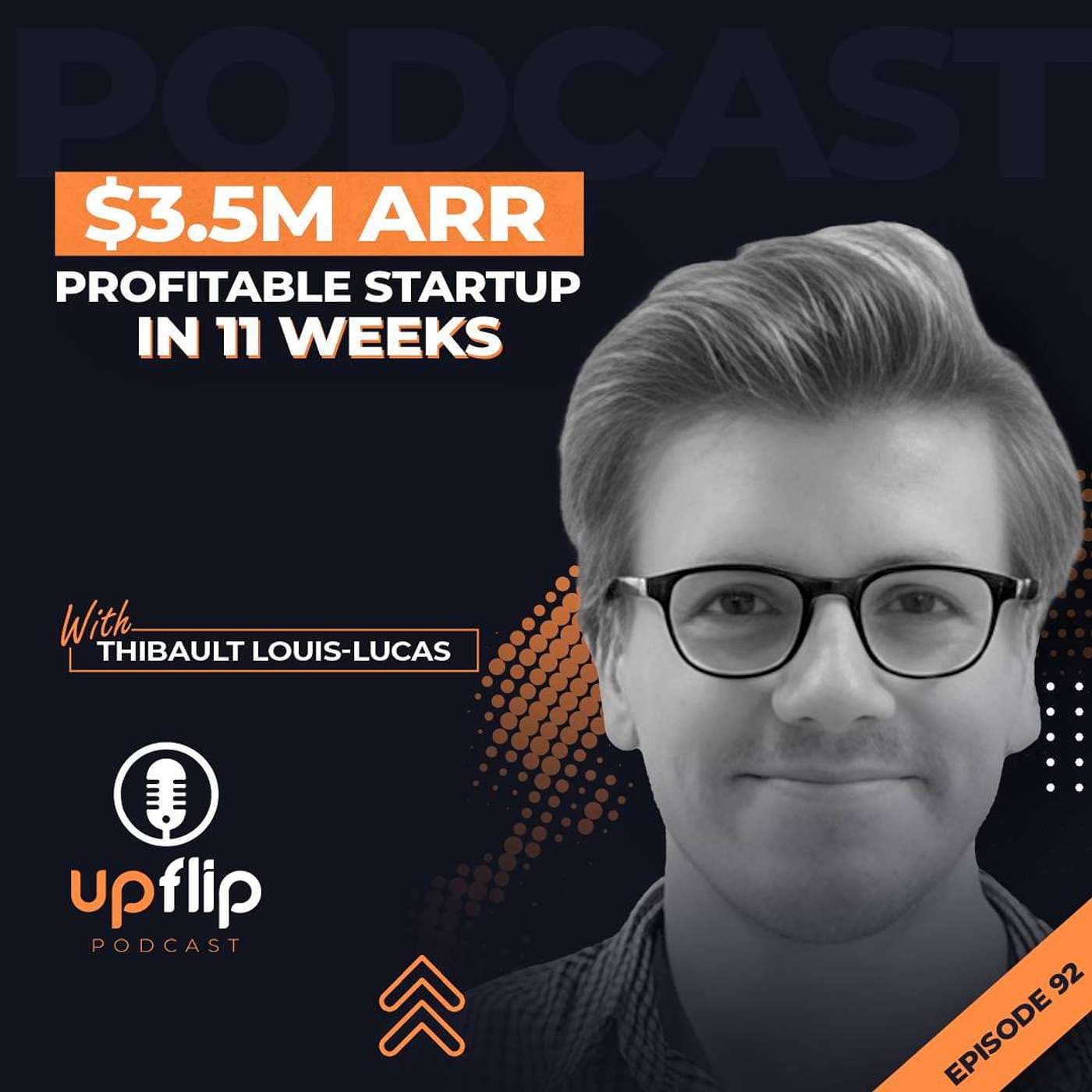
The UpFlip Podcast Episode 92: How He Went from Failure to a $12 Million Business
Podcast Overview The UpFlip Podcast aims to unveil the processes behind building successful businesses and provide practical advice for aspiring entrepreneurs. With a rapidly growing audience and numerous resources, UpFlip focuses on making entrepreneurial knowledge accessible.
Episode Details
- Title: How He Went from Failure to a $12 Million Business
- Guest: Thibault Louis-Lucas, Founder of Pony Express Studio
- Key Insight: Thibault shares his journey of launching multiple startups, many of which failed, before achieving success with Pony Express Studio, which now generates $3.5 million in annual recurring revenue.
Key Themes and Discussions
Thibault's Journey
- Initial Failures: Thibault launched 9 unsuccessful startups before finding success with Pony Express Studio.
- Rapid Prototyping: He adopted a "fail fast" mentality, aiming to quickly identify which products resonated with users by launching one product per week.
- Background: He has experience as a web developer and served as CTO for a marketing automation company, both of which informed his entrepreneurial journey.
Product Development Insights
- Creating for Yourself: Thibault emphasizes the importance of building products that he personally finds valuable. This provides a competitive advantage due to a deep understanding of the problem being solved.
- Tools and Success: Thibault developed tools like Tweet Hunter and Taplio, initially without a clear vision, but adapted based on early user feedback.
Entrepreneurial Mindset
- Adaptive Learning: Thibault stresses the need for founders to pivot ideas based on market feedback rather than clinging to original concepts.
- Feedback Loop: He highlights the importance of not becoming emotionally attached to a product, advocating for a mindset focused on validation rather than mere approval from peers.
Overcoming Challenges
- Handling High Churn: With a consumer product, Thibault faced challenges related to user retention but managed to maintain growth by focusing on product quality.
- API Challenges: When Twitter made significant changes to their API, Thibault navigated a critical situation by leveraging community support and quickly adapting.
Marketing and Growth Strategies
- Building in Public: Thibault advocates for transparency in the development process, sharing progress on social media to build a following and engagement.
- Organic Growth: Instead of relying on traditional advertising, he focuses on content creation and community engagement to drive user acquisition.
Key Takeaways
- Iterative Process: The path to success often involves numerous iterations and rapid prototyping.
- User-Centric Design: Understanding the user’s perspective is crucial for developing successful products.
- Embracing Change: Adapting to feedback and market conditions is essential for sustaining a startup.
- Community Engagement: Building a supportive community around a product can significantly enhance growth prospects.
Recommendations for Aspiring Entrepreneurs
- Act Quickly: Aim for a bias towards action, focusing on building and shipping products rather than overthinking ideas.
- Stay Agile: Embrace flexibility in your business model to quickly adapt to changes.
- Seek Feedback: Regularly validate your ideas with potential users rather than relying solely on approval from your network.
Resources Mentioned
- [Pony Express Studio](https://ponyexpress.studio/)
- [UpFlip Academy](https://bit.ly/4hnkr5N)
- [Franchise Guide](https://bit.ly/4aWuGvc)
Connect with Thibault
- Twitter: [Thibault underscore maker](https://twitter.com/thibault_maker)
- LinkedIn: [Thibault Louis-Lucas](https://www.linkedin.com/in/thibault-louis-lucas/)
---
This episode is a testament to resilience in entrepreneurship and the importance of community, iterative development, and user feedback in achieving business success.
Written by AI. May contain mistakes. Listen to the episode to check what was said.
Transcript
Automatic transcript. May contain errors.0:00Imagine launching, then failing, launching, then failing, and repeating the cycle nine more times before your startup hits it big. And I'm talking about$3.5 million in annual recurring revenue big. That's exactly what happened to today's guest, Thibaut Louis-Lucas. After launching one product a week, his 11th knocked it out of the park. The good news is that right now, with the tools that we have right now, we can be actually 10 times more productive than what we were 10 years ago, thanks to ChatGPT and the other very cool technology we have. In every creation, There is a lot of emotion in what you've built.
0:38And I think that's the key point. You need to avoid falling in love with what you've created. Basically, an important feedback or an important idea, an important thought is going to come back at least two or three times if it's good. Everyone not actively changing is a way of working to integrate Charged EPT and Generative AI. is going to be non-competitive in a very short period of time. I'm your host, Alex Freeman, and I'm joined by Thibaut to discover the intricacies of the startup world. From launching your first product to selling your business. Thibaut, thank you so much for joining us. Thank you very much for having me.
1:20Like, what an intro. Perfect summary. Oh man, I'm so glad to hear you say that. And hopefully the conversation lives up to the intro. We can do it. To get us started, I'd love to kind of hear your story. What's your background and how did you start Pony Express Studio? I started doing startups right after college and I had two big ventures, which both of them didn't really work. And both of them required like two years to realize that it would not work. And when I started again, and I think it was in 2021, we had this deep thought that if we were going to fail, it would need to be like quick, like a quick fail.
1:59And so that's kind of why we decided to have this crazy challenge where we just ship one product per week until something realistic. I really, really love that. And I want to kind of ask about some of the various products and launches that you ran with. So talk to me first about Tapleo and TweetHunter. What were those? What was your vision? What are they? Talk to me about them. There was absolutely like no vision behind them because like the process was like we defined the targets which basically creators and the problem help creators to get more business and to get more revenue in their businesses and we basically iterated and create a product over products realize why each of them didn't really succeed and it was a bit random that we realized that on each of the products our number one acquisition channel was Twitter.
2:52Twitter was amazing to find very early adopters. And so basically we started to want to grow an audience on Twitter and for our own purpose in the first place. And to do that, I started creating a product for me. Like I started just fetching a huge number of tweets and tried to find the one that's talk about startups, basically the topic that I wanted to talk about. just in the goal of inspiring me to write better contents. And this turned out to be a Greek product. That was like the basic, very first version of TweetHunter. It was basically a search engine for viral tweets, which we had the unique spin to analyze your Twitter accounts and to retrieve tweets that would talk about the same thing in kind of the same way as you do to inspire you to write great contents.
3:46I want to focus in on something you said in that answer, which was you started to make a product for you. How much of that thought process has been the generation of iterating different products of something that you feel like you need versus doing a bunch of market research to try and uncover something that people need that maybe you personally didn't need? I truly think that it would be my number one advice to anyone. The huge competitive advantage that gives you the deep understanding of the problem when you are creating something for you, it basically changes everything. If you are the buyer, you really understand why you would buy this thing and why it would stick or not.
4:25I saw it myself. Like at some point in the journey, I started stopping using Twitter and I realized why and we just adapted and improved the product even more to just make it basically super useful for like any stage in your Twitter growth. So yeah, the competitive advantage that it gives you, It's just insane. I would do it again and I would make sure that I am the user on each of every one of my products from now on. Now, you have an MBA and I'm curious how that education helped you start and grow these businesses. What point in your journey did you get the MBA? So right after my engineering school, I realized that I would not want to be the classic IT consultants working for big firms.
5:10I did this kind of MBA, which is definitely not the MBA that you would expect as an American guy in the way that, first of all, it doesn't cost 50 grand or even more. It's very intense in the way that it's just six months and it's fully dedicated to build your own startups. And the number one outcome of this MBA is that I met my co-founder there with whom I created my first startups. We then took other paths because this first startup just failed. And we met again and started working again together in early 2021 on Pony Express, TweetHunter, and then Tapio. Can you tell us about that experience?
5:47What did you learn from the experience of Pistache? What did you learn from that? And how did it then ultimately help you when it came time for Pony Express, TweetHunter, etc.? The idea basically was like to build a game to help and motivate kids to do their daily chores. I think it's the typical idea that you could have when you are not into the industry and you don't really know about your customers and you don't really know about the problem that you are trying to solve. In the way that it seems good, when you are pitching it to others, everyone out there is going to tell you that it's an amazing idea.
6:20I really need that. I would buy that when it's going to be out. And the thing is, so many people were telling us that it was a good idea, that we built it, we raised money, we hired a big team, and just nobody paid for it. And we had a few companies doing basically the same thing, and they all failed. The idea is good, but there is so many intrinsic elements that make the idea a bad idea. Something that I really learned there is that in every pitch I gave, in every interaction I had, I was trying to sell the idea and I was not really trying to validate the idea. And those are completely different things.
7:01And I did the opposite like with Twitter, like trying to validate first instead of saying. I'd love to actually dive in a little bit more on the distinction there between selling the idea and revalidating. Can you talk about like what you see as the key differences? The thing is, when you are just like right out of university and like at every family dinner, when you say that you are managing 10 people and when you say that you have raised some money, it's like you've made it and your parents are very proud and they tell their friends about that. But basically, you are not having any revenue. It's not something that could last long term.
7:36You need to sell. And you totally forget about this because you have this kind of approval from people in your social circle, which in the end doesn't really help. Like after one year or two years, if you don't get revenue, you don't have any more money and you have to go bank route, basically. So that's kind of what happened. And when I started again in 2021 with this very different approach, I felt way more confidence not having to prove anything to my family because in between I had like very successful employee position. I was a CTO with very big scale of startups. It was like I was very more confident with myself.
8:15I had nothing to prove. So I was willing to say that we didn't know that if we had great ideas, we didn't know if we would make it. And I think at the end, it really helps. So you mentioned that CTO experience. What's the biggest difference between being a successful startup founder and being an effective leader in someone else's ultimately startup? I would say that the total range of skills are totally different. What makes me a good startup founder, I think, is I basically ship first and think after that. I have a very high biases for action. I basically do first. it's very often that i will build something i will code it and i will ship it on twitter and then tomah my co-founder will tell me that it's a bad idea and we should kill it and we actually do we do kill it and i don't think that's something you can do in big corporation or even like scaling up startups you have to think more you have to organize people and you have to be very disciplined about not putting people from projects to the new shiny projects basically people need to have like a vision to stick to.
9:24And yeah, that's totally different from start-uping. Something that I learned in the last two years is it kind of counterintuitive, but when you are starting with new ideas, it's very likely that the first idea you have is not going to be a good one. It's very likely that you need to pivot and to slightly change the problem solution or maybe the target or the way you work. And it's in my first startup with a 10 people team, it was very hard to not appear like a visionless startup founder. And so every time we have to pivot the idea and to go in a new direction, I was spending more time explaining why we would need to do this and why we are not lacking vision.
10:12And it's like normal process in startup. Whereas right now, if you have a very very small team and even like just the two others with toma it's like super agile every time we understand that there's a new opportunity there we can just go and think after that the agility that you get it's making you so so much faster i'm curious about the ability to be so brutally honest with yourself that you can kill something quickly or like with your partner that you can kind of understand, oh, we should kill this. Whereas I feel like a lot of founders and would-be founders get so enamored with the idea that they are unable to do that.
10:52So how do you and your team accomplish actually being able to kill things when they need to be killed? It's very, very hard when there is a team involved. And it's really not something that I would do with a team. Every time we give something to an employee, because we have a right now, we are making sure that we're pretty sure the project is not going to be killed. And so when there is something that is very experimental and that's a very high chance to be killed, I will do it myself because I don't want to assume telling another one to kill his work, especially because it's very hard. Like in every creation, there is a lot of emotion in what you've built.
11:31And I think that's the key point. You need to avoid falling in love with what you've created. Of course, everything that you've created is an asset and you need to think about them as an asset. But a lot of time, I think we overestimate the value of what we've created instead of just starting over and just do something else. Just one example. We talked a lot about all the very successful stuff that we've created on Twitter. But there are a bunch like this huge marketplace for Twitter creators that would make them able to be paid by brands for sponsored tweets. It seemed like a very good idea. So I built it.
12:11It was a good idea. It was getting a bit of traction. But at one point, we realized that it was not Twitter compliance. And so we just didn't want to take any risk. So we just killed the project. It was like a 10 minutes decision when we realized about it. and we just really didn't want to be in bad terms with Twitter. Reminder for our listeners that if you're looking for more advice on how to start a successful SaaS business, check out episode 65 of the Upflip podcast, where I interview Nick Jordan of Workello about how he pivoted his content agency into a$70 ,000 a month SaaS company. Deboe, I want to dive into some of the mindset stuff.
12:47Your journey to where you are today is, I don't want to say failure, you learned a lot from them. So while they may have been failures in the moment, they were obviously important in getting you to where you are. How did you stay motivated through products and companies not working out to get to where you are now? It's very hard for me to answer because I have never really felt demotivated. I was not really making efforts in being motivated because I love so much building new things. I love so much being on my computer and just coding new stuff that I think it's a game for me. And that's why I'm just not counting hours when I'm working.
13:26So yeah, I would have a hard time giving very good tips for your audience. I love that it feels just innate to who you are. Something that I can tell you is when building Twitter, we kind of adapt our marketing strategy in a way that it would be fun to work on. An example is this mini tool strategy where we basically shipped, built and shipped a lot of very small independent tools that would be like a SEO based in a way. Like one example is a super mini tool that would just tell you what's your Twitter accounts worth. It's just one page, one input. You just input your Twitter accounts and it's like a calculator and it's going to give you a price on your Twitter accounts.
14:11And it's just something we have a lot of fun making. It's totally not the code base. So you don't have all the heavy codes running and slowing you down. It can easily be done in like one or two days. And we did a lot of that. A lot of them, we ship them on product hunts. And a few of them are ranking very high on Google right now and are a big part of our acquisition for Twitter. hunter. You mentioned that it's nearly a game for you, the creating of new products and new companies. What is the most difficult part of founding a startup and how did you overcome the challenge? I think it would be the skating.
14:51And that's why Twitter was created and born to be sold. That was the initial plan. Like the initial plan would be to build something, reach 10k AR and set it in a year, trying to range from five times to 10 times AR. So like from 500, to 1 million and just start again. Of course, it really didn't work that way, but we built this plan, especially because the part that we didn't really enjoy was hiring people because with the hire, you don't realize that, but you basically, you lose your entire freedom. You want to be entrepreneur and to build your own startup because you want to optimize for freedom, but having employee and having a big team is total freedom killer.
15:35We are experiencing this right now because like with the acquisition of Sweet Hunter and Tapio, there is like this two years period where we are working with the buyer to make the transition. It's something that we are learning to live with. And I'm surprisingly enjoying it because the acquire is really a very big match in terms of culture, like ways of working. And we are building so many great stuff that is pretty exciting. So if somebody is listening to this and is saying, I want to start doing this as well. Like what are the budget items that they should be thinking about and planning for?
16:11It's basically a thousand, thousand dollars. And like, I think half of that went to the actual creation of the startup, the company behind it. I think we spent something like a hundred or two hundreds before actually getting money and not earning money in a full month. Again, you see my point? You know, you talked about like TweetHunter, it was built to eventually be sold, which was the plan initially maybe didn't quite work out in that way. How much planning are you doing ahead of things or at least goal setting for stuff? And how does that help you analyze whether or not things are going, how they should be going and in what direction you want the company to go?
16:47That's a super interesting question because we did very differently this time compared to our first and second startup. In those cases, like a few years ago, when we were working on those all startups. We had these huge backlogs of tasks. It was nicely prioritized. We had this roadmap. This time with Twitter Hunter, when we started, we basically had something like a one week plan and that's it and nothing more. It's crazy how reactive you can get, how fast you can get and how fast you can grab opportunities. The thing is on Twitter, Twitter is really like a news base or mood-based, you have trends.
17:27And if you can jump on those trends, you can go viral or you can really take advantage of the situation. So this time, basically what we did is basically have a week of topic to work on for Toma and I. And the crazy thing is we don't have backlogs. Like we don't write ideas. We don't write feedback. And I learned that it's actually makes us way more efficient. basically an important feedback or an important idea an important thoughts is gonna come back at least two or three times if it's good the anxiety generated by a never-ending backlogs is something that i really don't want to live with again so yeah we basically don't plan well of course like right now with the team expanding we have to plan a little bit more and think about like think ahead especially in terms of hiring.
18:21But in the first 18 months, we really didn't do any planning. Is not maintaining that backlog how you avoid idea paralysis? And is that something that you would recommend to new startup founders? Or do you need a specific personality type to kind of operate that way? This is exactly what I meant. Like avoiding idea paralysis is, I think, the most important. I truly think right now with the thousands of opportunities that are out there, you cannot know which ID is good or not. You need to build stuff. You basically need to build 10 times more than before. And it's a good news. Like the good news is that right now with the tools that we have right now, we can be actually 10 times more productive than what we were 10 years ago, thanks to ChatGPT and the other very cool technology we have.
19:10So build more, ship more and think a little bit less. I think it's a good thing. How then do you identify that you have what appears to be a winner? Or is it just that the opportunities in that arena keep presenting themselves until you just keep heading deeper down that path? That's a super good question because we needed to think about that. I think TweakHunter was like the 11th project of the one product per week phase. So for our first startup, Pistache, basically every people telling us that the idea was good was enough for us to just move forward and continue on the project. What we would do this time is only look at revenue and revenue only.
19:52If the product is not generating any revenue, even after like one or two weeks, we would just kill it. And I think out of the 10 first products, three or four generated revenue. One of them even grew to like 400 in monthly revenue. Churn was high, so we still decided to kill it. What was really different with TweetHunter is that it got revenue very early on, subscribers very early on, and we stopped doing marketing at some point. Like we stopped just tweeting or posting on Reddit. And still, we had some new customers coming and just discovering it by themselves or just someone sharing about the tool somewhere.
20:34We just didn't know where. And that was the ultimate truth for us that we had something interesting. And so we decided to go all in on this one. So this is going to bring us to a section of the show that we call our Fan Blitz questions. These questions come from our YouTube community. Listeners, you can join the YouTube community, go into youtube.com slash upflip and pose questions to future podcast guests. I've got five questions we're going to try and do in about a minute. Are you ready? Yep. All right. First one being, would you do business with yourself if you were a customer? Yeah, definitely.
21:05I am basically. And I'm advising my friends to pay for my products. So yeah, I truly think Twitter and Twitter are good investments. How would you feel about working for someone who knows less than you? That's a tough one. I guess it depends. Like I have to admit that it's hard for me right now to work for someone, no matter the degree of knowledge that he or she has. If he or she has less knowledge than me, yeah, it could be a problem. What are your strengths as an employee if you were to have to work for somebody? I think I would bring some like a fresh perspective, given what I've gone through in the way that this biases for action.
21:48That thing makes me very high contributor to a project. Something else is like I work daily on AI tech and I've tested a lot of AI APIs. So I'm quite good right now at just playing with GPT APIs and trying to build AI stuff, basically. What's one thing about your business you don't want us to know?
22:13I'm not prepared for this one. Something that's general. Yeah, okay. I can tell you one thing is, so one of the reasons that we sold Twitter is that we had this very early on with Twitter. We did this partnership with a Twitter influencer. We had quite a good audience, but not huge. But he really contributed to the success of Twitter. Hunter. And he got up to 25 % in equity of Twitter in exchange for his help in the communication and development of the products. Working with him was easy because he was good at what he was doing. But in terms of human values, we were seeing things very differently.
23:02We were not aligned in the way we see lives, basically. That's basically something that pushed us for the acquisition because it was hard to see a path where we could just get a long, long-term on the projects. Last one here in the FanBlitz questions. If you were given the chance to wave a magic wand and change one thing about business fundamentals, what would it be? I guess that would be the fact that very often you have ideas that appear to be grid ideas because that's how you want the world works. One example is ideas where you want to just make CEOs and CTOs to meet. That's the basic idea I think every entrepreneur has at one point.
23:50And you would like your ideas to organize a meetup where they would meet and they would happily work together and start their own startups. The thing is like very often ideas that you really like are based on something that people are not doing like they were just not doing this way because it's weird because they don't have high incentives for that and the thing is ideas that work are ideas that are touching the very deep willingness of people basically health money and sex like that's the three most important pillars and sometimes i think that it's a shame that it works this way but it does that's going going to do it for our fan blitz questions.
24:34Listeners, make sure you let us know what you think of this episode by reviewing it on Apple, Spotify, or wherever you're listening right now. Thibaut, you mentioned that you've never really felt demotivated, but what has been your lowest point as an entrepreneur and how did you bounce back from it? The hardest is it happened quite recently, basically. It's about two months ago, Twitter announced that the API would go from free to very expensive, like 40K per month. And that's people like developers, so people like me would have 30 days to transition. It was not, it was not yet the ultimate down points.
25:15They said 30 days to transition. And we were very lucky. We were very lucky in the way that we had the money to just pay for that. Like we had the monthly revenue that would cover the costs. A lot of our competitors and other Twitter tools simply do not. So very early, we filled the form, we sent an email, and we just waited. And I guess that we should have been more proactive in the way. I don't really know how. But just four days later, our API was just cut off. Nothing works anymore. Paying users start to ask about that. We just couldn't do anything. It was one of the worst moments in Tweakenter, and you have absolutely no idea about what to do.
25:59Hopefully, like it didn't happen to only us, like a lot of other Twitter tools were affected. Just four days after the announcements, their API was cut off too. Some of our competitors too. So those 48 hours was super stressful because during those times, I was trying to build ways to bypass the system and to use like some kind of internal API that I'm not allowed to. So I'm super happy that I even had to do that. Yeah, worst moment ever. And I was super happy to see that even between some of our competitors, we had a lot of conversation and one of them found the email of an indifferent people at twitter.com and we reached out and we found a way to get by the API access and eventually we just started paying for the API.
26:51But yeah, this moment was awful. Now, when you launch a new product, what's the best way that you found to build awareness and attract customers to that product or service? Honestly, it's building in public. That's what we started when we were very, very early before Twitter. It's basically sharing everything you do on Twitter, sharing everything you learn, every new platform that you discover, sharing the problems you have and how you solve them. People just get very interested in your journey. And if you do something that's a little bit interesting and worth following, you will get a few people looking at what you do.
27:30And when you ship a good product, they will be interested in and they will support you. And I think that's one of the reasons that we've been quite successful on Product Hunt too. It's people just want to support what you do if they know you and have been following your journey from the very start. So every time we just launched on Project Tense, we had the support of a lot of Twitter people, which was super helpful. So, yeah, I think I would re-advise for reading in public, in social media, and trying to have like very true connection with people there. Connection with people that would be supportive and could give you like good advice, feedback, or anything that would help you.
Read the full transcript
28:09Are you doing any kind of advertising spend in a typical month or is it all sort of organic content getting out there? We would love to, but it doesn't really work for us or we just do it the wrong way. We do Google ads because like we have to and our competitors are paying on our brand name, like Twitter. But except from that, we don't really do anything else. No, we would love that because it seems like when it works, it's simple. You just raise the budget when you want more customers. But for us, it's way more effective to just ship content, tweet a lot, build mini tools, and that's it. And I mean, the strategy seems to have worked.
28:47You've grown remarkably fast in the last two years. What have some of the challenges of that kind of rapid growth been and how did you overcome them? Just one thing before I answer that, I think that's true. The growth has been very strong. One very good advantage that we had is since our users are influenced because they are growing their audiences, we could focus very much on the products. Like we could think less about doing marketing, focus on the products and let the users themselves do the marketing since they are influenced. Does that make sense to you? Yeah, it does. And actually, before we kind of go to the challenges of growth, tell me more about how did you connect with those influencers?
29:28Was there a concerted effort to connect with influencers? Or what did it just kind of happen organically from what you were doing? We did it in a few ways. So one way that I'm very proud of, and I would do it again in all my projects, is the support button in TweetHunter redirects to my Twitter DM. And I think that was the case up to a million in annual revenue. So even very late in the project, all the support tickets would get to my Twitter DMs. And I would answer to them individually. That would let me have a very good knowledge of what users think about the product. So perhaps something else that we did is we created this group of very influential people.
30:11We call them like the creative investors. Investors because we gave them equity of the project, 0.20%. And in exchange for that, we put all of them in the group. And quite often we used to ask a lot of questions to them in how we can help them in better ways. And of course, also when we were launching Feature Room, asking them for their support. And just having this community around us was really helping us shaping the products. I love that. Now let's get into that growth question. What have been some of the biggest challenges of the rapid growth and how did you overcome those challenges? I think one of them is since we have a consumer product, which is like, it's not very clear if it's B2C or B2B.
30:57Basically, we have a very high churn. It's not a definitive problem in the way that the new customers and new revenue has always been bigger than churn. But it's still crazy to have more than 10 % of your revenue going away because of churn. And I think it's happening because on Twitter, you have everything. You have very high quality people. You have the founders of the best company on the world. And you also have very crappy people asking refunds after refunds and testing all the tools and with stolen credit cards. So, yeah, having to handle the very high quality people and low quality users is a tough challenge.
31:35Customer support when you scale is very hard. I just want to make sure I ask you about generative AI and how that's affected the business. And as someone who is working in the space actively most days, what are some trends that you're seeing that people should be aware of and how it's changing the SaaS industry? It's funny that you ask that. It's crazy because I realize that being very hands-on in this makes me totally unaware of what I am aware and other people are not. So it's super hard for me to answer. But yeah, basically, I see a lot of people saying that it's like crypto or it's like NFTs.
32:11I really think it's nuts. It's deeply changing everything in the world. And at the same time, I've read recently that only 15 % of people in the US have actually tried ChatGPT. I think it's crazy. For me, this is the future. And everyone not actively changing his way of working to integrate ChatGPT and generative AI is going to be non-competitive in a very short period of time. And I think that for developers too, like I see it in our teams, you have developers doing the shifts and using generative AI like GitHub Copilers or TARGPT, and you have others not putting the efforts and working the old way.
32:53And I think for a short period of time, it's going to be fine for them, but they are not going to be able to sustain the productivity boost that the others are getting. And would you recommend that somebody just kind of dive into trying to integrate it into their own workflow? Or are there educational sources that you might recommend if somebody wants to start to make that transition? I would say that the most important thing is to force yourself to use it. Honestly, that's the number one thing you should do. And that's it. And then if you feel you're struggling, yeah, just trying to consume content, that would help you.
33:26But like for me, the need for content is trying to escape the fact that it's really just the need to change your habits. The most difficult is changing the habits. It's not learning how to use Chalchipity because honestly, it's quite easy to use. Is there anything that you wish you knew before you launched your startups and what would you have done differently if you'd had that knowledge from the start? One thing that I would always do right now is having me as the customer. Yes, of course, it gives you a very high knowledge of the user's issues and it gives you a deeper knowledge, but it also gives you an insane daily motivation to have to improve the products.
34:12Like you don't want to use crappy products. I don't want to use a product with ugly buttons. I don't want an ugly tools. So I will need it to be gorgeous, to be super fast. Basically, your intention is totally aligned with what a user will need. I truly think that it makes a huge difference in the outcome. If you could pick the one thing that people take away from this interview, what would it be? Just what I've just said, plus try to just train your brain to be biased toward action. It's in today's world is much more important to do things, to build things, to ship things. And to like, when I say ship, it means putting them out to the world, tweeting about them.
34:56It's much more important to do that and to do it for a long time than just think for a very long time about what you should do. because you probably will never do it or never do anything. What's your favorite business book and why? I really like The Mom Test because it's like it's exactly this. It describes exactly why we failed in our first two startups. It's exactly this concept that people will say that it's great and it's going to be enough for you to continue working on things, but they actually don't pay for it. So you have no value here. The Mom Test. But where can people learn more about you and connect with you and keep up with everything that you're working on.
35:37My number one platform is Twitter. So you can find me at Thibault underscore maker, Thibault maker. I also try to be more active on LinkedIn. You can find me at Thibault Luis Lucas. And yeah, I try to answer to all the DMs that I have. So feel free to reach out to me. I try to avoid calls, but I'm always here to answer to my DMs. That is going to do it for this episode of the Upflip podcast. listeners. You can find more advice on how to start a business the right way on the UpFlip Hub. And if you like this episode, make sure you let us know by leaving a review on Apple Podcasts or wherever you're listening right now.
36:16Thibault Louis, Luca, thank you so much for joining us.
From the publisher
Pony Express Studio is a company built by makers, for makers. That concept has driven their success, to the tune of $3.5M in annual recurring revenue. Founder Thibault Louis-Lucas shares insider insights on how to launch a startup with this kind of potential in today’s episode.
Thibault didn’t hit on this 7-figure startup idea right away. He launched 9 other products that failed before he found success with Pony Express Studio. He’s also worked as a web developer and the CTO of a marketing automation company. He’ll share how these past experiences (and failures) helped him find success with tools like Tweet Hunter, Taplio, and ProductLift.
As an active maker, Thibault is an expert in how to launch a product. We’ll find out how he designs and builds the products for Pony Express, how he markets them once they’re launched, and the metrics he tracks after launch to gauge its success. Anyone who wants to bring a new product to market the right way will want to hear Thibault’s story and advice!
Resources:
- https://bit.ly/4hnkr5N Join UpFlip Academy to start your own business today
- Pony Express Studio - Learn more about Pony Express Studio on their website
Ready to be your own boss without starting from scratch? Grab our FREE Franchise Guide and unlock the secrets of proven business models that have already created thousands of success stories.
Connect with UpFlip:
- On Youtube
- On Instagram
- On Facebook
- @UpFlipOfficial on Twitter
For more insights to start, build, or grow a business, check out the resources on UpFlip.com or head to the UpFlip YouTube channel to see more interviews with business owners and experts.
Thanks for listening!


