
In short
UpFlip Podcast Episode Notes
Episode Title
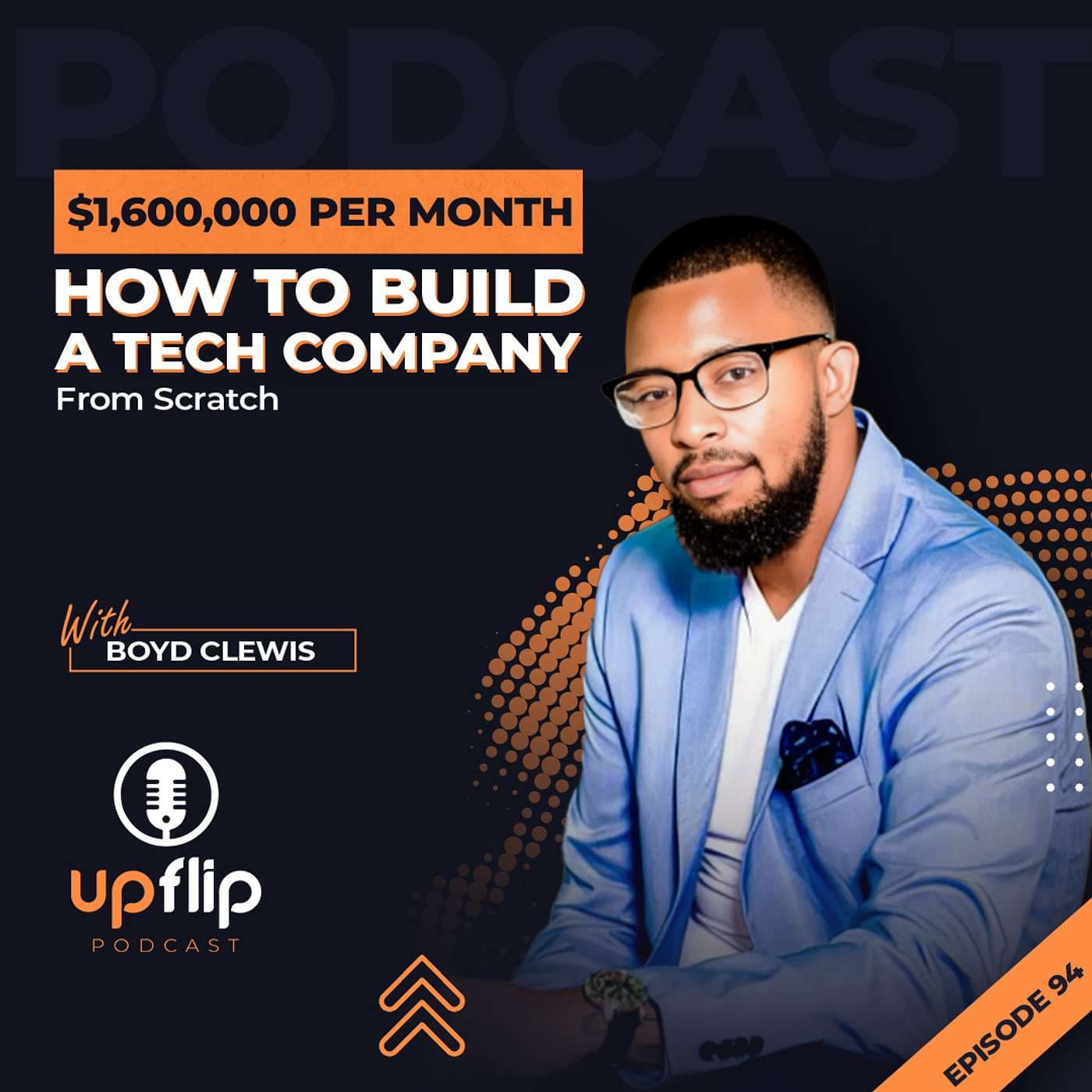
How to Build a $1.6M/Month Tech Company
Episode Number
94
Podcast Summary In this episode of the UpFlip Podcast, Boyd Clewis, co-founder of Baxter Clewis Cybersecurity, shares his journey from starting a tech company to achieving impressive revenue milestones. The discussion covers the challenges he faced, strategies for success, and key insights into the cybersecurity industry.
---
Key Themes and Insights
Introduction to Boyd Clewis
- Background: Boyd Clewis is a prominent cybersecurity entrepreneur serving Fortune 500 companies.
- Business Overview: Baxter Clewis Cybersecurity generates approximately $1.6 million/month with profit margins exceeding 50%.
Starting the Company
- Launch Timing: Founded in December 2019, right before the COVID-19 pandemic.
- Initial Challenges:
- Difficulty in hiring qualified cybersecurity professionals.
- Struggled with service sales and client acquisition in the early months.
Key Lessons Learned
- Understanding Market Demand: Recognizing what clients need is crucial. Boyd stresses the importance of identifying market desires rather than assuming what they might want.
- Mindset on Failure: He reframes failure as a learning opportunity, stating, “I wasn’t failing at business; I was understanding what my market didn’t want.”
Transition to Digital Marketing
- Adapting to Changes: The pandemic forced a shift from B2B speaking engagements to digital marketing, which was initially challenging.
- Marketing Strategy:
- Emphasizes the importance of knowing your audience and adjusting marketing tactics accordingly.
- Transitioned from B2B to B2C marketing effectively.
Importance of Pre-Selling
- Sell Before You Build: Boyd emphasizes the necessity of gauging interest before developing a product or service to ensure market fit.
Building a Network
- Utilizing Existing Connections: Boyd leveraged his pre-existing network, particularly through LinkedIn, to grow his client base.
Customer Trust and Service
- Building Credibility: Trust is established through visibility and reputation, including media appearances and personal vulnerability in sharing his story.
- Customer Service Philosophy: Excellent customer service is defined as making clients feel like family, emphasizing the importance of their success.
Marketing and Sales Techniques
- Video Sales Letters (VSLs): Boyd finds success through brief video pitches that explain service offerings and direct potential clients to landing pages.
- Converting Sales: His sales strategy includes speaking at industry events to directly engage with potential clients.
Advice for Aspiring Entrepreneurs
- Key Takeaways:
- Believe in your ability to succeed.
- Seek mentorship from successful individuals in your field.
- Be prepared to step outside your comfort zone.
Insights on Industry Trends
- Cybersecurity Challenges: Ransomware remains a significant threat in the industry, highlighting the need for ongoing training and vigilance.
- Emerging Technologies: Concerns about AI in cybersecurity, particularly regarding data privacy and security risks.
---
Conclusion Boyd Clewis shares a compelling narrative of resilience, adaptability, and strategic thinking in the tech industry, particularly in cybersecurity. His story illustrates the importance of market understanding, proactive marketing strategies, and the cultivation of trust in achieving business success.
---
Resources
- [Baxter Clewis Cybersecurity](https://www.baxterclewis.com/)
- [Join UpFlip Academy](https://bit.ly/3YCr5xJ)
- [Franchise Guide](https://bit.ly/4aWuGvc)
---
Connect with Boyd Clewis
- [LinkedIn](https://www.linkedin.com/in/boydcluess)
- [Instagram](https://www.instagram.com/boydcluess)
- [Facebook](https://www.facebook.com/boydcluess)
---
Additional Notes This episode serves as a valuable resource for aspiring entrepreneurs, particularly those interested in the tech and cybersecurity sectors. Boyd’s candid reflections on entrepreneurship provide actionable insights for listeners looking to navigate their own business journeys.
Written by AI. May contain mistakes. Listen to the episode to check what was said.
Transcript
Automatic transcript. May contain errors.0:00Starting a tech company is a dream for many, but realized by a few. Boyd Cluess, who has become the go-to cybersecurity entrepreneur for Fortune 500 companies, is one of those few. So typically in a month, we do around$1.6 million. And profit is generally north of 50%. Because some people think in order to be successful in business, I've got to have a huge following. But it's not about having a huge following. It's about monetizing the following that you do have. I wasn't failing at business. I was understanding what my market didn't want. And it was a learning activity. And so it was time for me to launch something new to understand what they did want.
0:45So I don't see failure the same in that sense. And instead of looking at the people that are successful, don't be envious, but be inquisitive to find out how they did it, because you can do it. I'm Alex Freeman, and in this week's episode of the Upflip podcast, we unravel Boyd's path from conception to success. If starting a tech company is also a dream of yours, this episode's for you. Boyd, welcome to the show. Thank you so much for joining us. Thank you so much for having me, Alex. I'm super, super excited about it. I love it. I love it. Let's start with your story. When did you start Baxter Cluess Cybersecurity and what made you decide to start your own firm?
1:25You know what? I actually started Baxter Clue with cybersecurity December of 2019, right before the world went boom. What timing. And, you know, I actually ended up starting the company because I had experienced so many challenges working as a cybersecurity consultant. And the challenge that I primarily had was, number one, I couldn't find qualified people to hire to work on my team because I was a security assessor specifically in the realm of credit card data security. And I had like all these contracts for these large corporations. I can't even say their names right now because of NDAs. And I had four open recs,$150 ,000 base salary.
2:14I could not find people to fill the job. So I decided I was going to start creating those people. I love that so much. So then I want to ask, what are some of those key steps if someone wants to start their own company, perhaps in the cybersecurity space, definitely on the tech side of things? What should they be doing to make sure that they're setting themselves up for success? That's a really good question that people ask me all the time. And my thing is I can only speak for my experience and what worked for me. And what I've seen people do is they get lured to certain industries because of the potential of how much money they can make.
2:51And so in my case, I was capitalizing on something that I was already doing. Right. So my thing is, if you're doing something, you're doing it well, then that puts you in position to start a company. But oftentimes people will just see like the shiny object, the new shiny thing, and then start create a company from there. But then you're having to learn the skill and then try to build the company at the same time. I had already been in the cybersecurity space for over a decade before I decided to start the company. What was the biggest challenge that you faced in getting the company off the ground?
3:26And obviously, you know, three months into the company existing, there was obviously a big world shift. So, I mean, feel free to answer that as part of your answer. Believe it or not, the big pandemic, the world shift was actually a blessing for my company because it forced me to get creative in ways that I hadn't before. Because primarily my mode for getting B2B clients was to speak on stage. And then from the stage, people would come talk to me naturally as a speaker. Then I would book appointments and close deals from there. But I was making this shift to a B2C company and I was using B2B tactics that weren't working.
4:04But when you are forced to take everything online, I had to learn a new method of client acquisition and that was through digital marketing. And so the biggest challenge I had was starting the company because like in the first six months of the company, I think we made like$500 because I did not understand digital marketing at all. I mean, we're going to get into some of the marketing questions a little bit later in the episode, but I do kind of want to ask about that mindset shift of going from B to B to B to C. Can you kind of describe what some of those differences were? Yeah. So it was, this was a mental barrier that was very, very tough for me because I'm used to businesses dealing with like executives, CIOs, chief information officers, CEOs that had the budgets, the right checks because we were solving problems.
4:57But now I have to switch to everyday tech professionals that want to upskill and try to convince them that this new path is the way for them and to open up your wallet and spend the money. It took a different level of psychology and I really had to sit back and reevaluate why somebody would want to do this in the first place. So it was just like completely foreign to me. And I literally failed the first six months in trying to do it. Aside from that little mindset shift that it took you a minute to kind of make, I'm curious if there were any other mistakes that you feel like you made early on with the company and what you might have learned from those missteps.
5:35Outside of the marketing failures that I had, the other thing that I felt that I teach this all the time is I built an entire online training program school that nobody wanted. Right. And so what I learned from that is sell before you build, because if the market doesn't want it, then you haven't wasted your time developing a product or solution that they don't want. And at that time, what I was offering, what I had built, people did not want it. So I wasted months of my time, time that I'll never get back. I mean, fortunately, I was able to gain the lessons and grow from it. But that's the biggest advice that I give to people that want to start new businesses is get buyers or at least people to raise their hand and say that they're interested before you ever actually create it.
6:27You got to pre-sell it. What advice do you have for doing that or at least market testing an idea before you start to take those steps? I would recommend doing it as low cost as possible. And again, when I started this process, we're in a pandemic, so I couldn't go out and shake hands and kiss babies and meet people. I had to find a way to do it digitally. So I'd recommend first looking in your local network, your local sphere of influence, whether it's LinkedIn or Facebook, and just be honest with people about what you want to do. It's like making a message and saying, hey, guys, I'm thinking about starting this new tech company where I help business owners do X, Y, Z.
7:05And I'm thinking about putting together a six week program. Would anybody be interested in this? I'm looking for beta testers right now. And if you get some feedback, you get some people that are willing to join in. Because my thing is, like, if I could get people, I don't mind giving a service away for free to be able to get the feedback to improve it. Because the last thing I want to do is charge people for something and they don't get the result that they're looking for. And so putting yourself in position to get people to raise their hand, say, yes, I'm interested, actually buy the product or use the service.
7:38And then that gives you the ability to refine it, ask questions about what did you like about this? What didn't you like about it? And then you can actually create a marketing campaign or plan and then scale it to start making money. And I think that really speaks to what you were saying earlier about how this business grew out of, you know, you'd been in the space for a decade before you kind of started the company. Did you find yourself needing to further build out your network or were you pretty reliant and to a successful degree on the network you had built in just your time in the industry?
8:11So my network has naturally grown because of the success of the company. But when I was first launching, I leveraged the people that were in my network, primarily with LinkedIn. I talk a lot about personal branding because my philosophy is people should manage their career like a business. And what successful business do you know that doesn't have sales and marketing? So LinkedIn was my billboard. I was always marketing. I was, I am always marketing what I do and who I am. So when I came out with this offer, people were not surprised. Like, who's this guy? What is he doing? They weren't surprised.
8:48So it made that transition a little easy for me. But what I found out is if you don't have a big social media presence, you can use paid ads, whether that's LinkedIn ads, Facebook, Instagram ads, YouTube ads to reach a broader audience, which is why it's important to have the right target audience and messaging dialed in so you can get to the right people so that you aren't limited by your immediate network, if that makes sense. How has the market research component of your business changed as the company's grown? So the way it started was like to this day, the people that I serve, I was them.
9:25So it was easy for me to connect with the pain that they had, the anxiety that they had in the results that they wanted. I was a low paid IT guy getting every certification imaginable, trying to get to this mythical six figure position that they said this certification would get me. And it was not working. So I could speak directly to the heart of those people where when they would see my content or my videos, I'm like, dude, it's like you're living in my head. You know exactly what I'm dealing with because I was you. So the market research now isn't so much of how to acquire new clients because that at this point is an automatic thing.
10:03It's more about how do we dial into the psychology to get them better results. If you've listened to Upflip long enough, you may have noticed a common theme between successful entrepreneurs. Digital marketing. Almost every guest talks about it. It's the engine that drives growth, the spark that ignites success. So if you're looking to up your digital marketing game, we highly recommend our friends at the Digital Marketing Podcast. These guys are the real deal, offering insights and strategies that are both practical and powerful. It's like having a backstage pass to the digital world, and trust me, you don't want to miss out.
10:37Search for the Digital Marketing Podcast or click the link in our show notes. Happy listening. Boyd, I want to ask a little bit more about the actual launch of the business. Now, I hope I have this right. You worked with a business coach as you launched the business. Is that right? No, I wish I had. That came later down the line. Okay, then great. Then I'd love to hear what you later learned from the business coach and why maybe you would recommend it to somebody who's launching a business. Oh, man. Yeah. So the beautiful thing about having a business coach, number one, having a business coach that has been successful in this space that you aspire, not just someone on the Internet that say they're a business coach, changed the game completely for me because my marketing was messed up, but I didn't know it was the marketing.
11:25What business coaches are good at is helping you identify the problem so you can actually address it. Because most people, they stay on the surface and they end up addressing symptoms and the problem never changes so they don't see different results. And so with me having a marketing problem, again, I thought it was a sales problem. I thought it was a Facebook ad problem. It wasn't that my message was reaching the people, but it wasn't the right message. So I ended up working with a business coach, shout out to my man, Joel Orway, and he introduced me to something that he offers, which is called the Power Offer.
12:01It is a very direct, irresistible craft offer that invokes a yes or no response from people. Because a lot of times when people go to sell products, they just immediately try to hit you with the pitch. Do you want to buy this? You should buy this. Are you interested in this service? Blah, blah, blah. And it's just like noise. But this power offer structure helped me deliver a target message to people where they were actually responding. Yes, I want this service. And that was a game changer for me to start actually getting my client acquisition process. If an entrepreneur is listening to this and says, oh, I should get a business coach.
12:37What advice do you have for finding the right coach for somebody? My advice would be to check out their track record. Depending on what kind of business you're in or that you would like to get in, all you have to do is go to Instagram, Facebook or just Google business coaches in that space. And if you click on one of those things, you will see ads from all the Googles. Right. But it's important to select the person that's right for you. A personality standpoint, a faith, believability standpoint, their best interest is serving you and not money, because there are some coaches out there that will take your money.
13:14or give you advice to just capitalize on people instead of actually serving them at the highest level. My thing is I like to work with people that share the same values as I do because that just makes the relationship a lot better. So I would definitely dig in to what this person's track record is before actually just signing up with a business coach. And also you gotta be prepared to invest because if somebody's gonna help you grow a business, their time is worth being compensated. How do you figure out your own pricing for the products? How do you realize that you're at the right amount to charge a customer?
13:50It's simple. People buy it. That makes sense. So there's really logic behind this. So number one, I like to see what the market is doing. And then I like to see what is like my competitive advantage. What can I do better? So like we had a pretty low price when I first started Baxter Clueless. We were enrolling so many students that it was starting to overwhelm the company. And because we were selling so many that told me that my price was way too low. So then we raised the price. We even got to a point where the price was too high because the inflow started to slow down. So now we have a sweet spot right now.
14:28So I like to make decisions based on data. I love analytics, man. So it just takes the emotion out of everything. It really comes down to doing data analysis and seeing what's going on inside of the industry. And then also, how do you feel about your brand? Because you could buy a Toyota that may cost you$30 ,000 or you could buy a Ferrari. It's like 300. They're both cars, but one has a brand and an advantage that allows them to command that. So it's ultimately how do you present your brand and is it commensurate with the price that you want to charge? What are some of those key figures that you're keeping an eye on as you watch the data for the company?
15:11So in terms of key figures, I like to look at really the conversion rate of my sales guys, which is always important. Conversion rate in comparison to what the price is and then student results in comparison to the enrollment rate. Those are two things that I monitor because it really just hurts my heart when people enroll at BC and they don't finish and they don't get the result. I do not like it. So I have invested significant resources and staff, extra tools and resources to ensure that our clients have the best possible advantage to achieve their desired career goals. Why is that so important to you?
15:56I guess both from a personal perspective and from a business perspective, why is it so important to make sure that people are finding success with the program? There's a few reasons behind it. Number one, the company has my name on it, right? So Baxter is my wife's mate name. Cluess is my last name. And anything that's associated with me is going to line up with my company's core values, which is integrity. We're a Christian organization. And so we're going to make sure that we're serving people at the highest level possible. The other thing is, if we're not serving our clients at the highest level and they're not getting results, then more people are not going to come.
16:38I don't deserve their money. So I think about my time at the University of North Texas. I was there for about a year and a half. I ran up a bill of$40 ,000 with no degree to show for it. And that stung a lot. And I don't want people to have that negative association with me and my company because they made a significant investment and they didn't have anything to show for it. I'm sure some of what you just spoke about is going to factor into the answer to this next question, which are, what would you say have been some of the key drivers of the growth of the company? The key drivers for the growth, number one, our clients are like the biggest sales team possible.
17:17When you have people that are doubling, tripling, and quadrupling their income, it's hard to for them to keep silent about where they learn the skills and the ability to do that. And number two, I like to tell my other people in my business masterminds, I'm quite compelling on camera. Great social media presence, PR and constant marketing has led to the awareness of people knowing what we do and how we're helping people. And the niche that we're in is so specialized and me being an industry leader in the payment security space, it's a blue ocean business venture for me. What are the typical revenues in a month and what did the profit margins look like on that?
17:58So typically in a month, we do around$1.6 million and profit is generally north of 50%. And what are some of those main ongoing expenses that somebody should be considering if they want to get into kind of the same business that you're in? So number one at the top of the list, it is staff. I have about 50 employees, success advisors that walk through the program with our clients to ensure that they are finishing the content and the program, the online material. I have a talent development division, which is our intern programs. I have employees there, customer service employees, operation teams and executive team.
18:44That is a significant portion of the budget, but also advertising. Because if people were to look at me, I don't have a large social media following. I don't because some people think in order to be successful in business, I got to have a huge following. But it's not about having a huge following. It's about monetizing the following that you do have. And since I don't have a huge social media presence, I use social media advertising, Facebook, Instagram, and YouTube. And I spend anywhere from$25 ,000 to$50 ,000 a month on advertising. So what's the number one piece of advice that you could offer to somebody who wants to scale a tech company to a million dollars or more in monthly revenue?
19:25The biggest thing that I would offer them, and it's like three part. Number one, believe that you actually can. Number two, find a mentor that's done what you're looking to do and prepare to invest. And number three, get comfortable being uncomfortable. I want to ask a little bit about customer service as well, because you made some mention of your customer support team, of your student support team. But in this field, in this space, especially, you know, even just education broadly, trust is such a crucial thing within the tech space, within cybersecurity, within education. How have you gone about building customer trust?
20:04That is actually something that's done before the client acquisition process. Because like the business motto is people buy from those that they know, like and trust. So I get people to know me through my social media presence, my vulnerability, talking about the challenges that I had in my career, my upbringing, my family. Generally, they like me because of my personality, but then they trust me not because of what I say, but what reputable sources are saying about me. And so I'm on TV interviews, Forbes magazine, Forbes books. All those things add to the credibility because you never know. I was telling one of my business friends, I was like, let's be real about this digital marketing thing.
20:49We're expecting people on the other end of the computer to spend thousands of dollars with some random guy they met on the internet. If you don't have a strong brand that shows you are a trustworthy individual, that's going to be extremely difficult. So I make it a point to put myself in position that shows, number one, I'm an authority in the space, but I am actually who I say I am, a decent human being. So what does that journey look like when somebody finds you on the internet? They say, hey, maybe this is the guy. What is the customer journey from finding out about you, getting through the funnel, and finally getting onboarded?
21:28So we've got a couple entry points. If it's on YouTube, I usually do a call to action on my YouTube channel. They click the link. They go to my opt-in page. They see how we've helped transform the lives of more than 500 people. Watch this eight, 10-minute video and then they apply to join the academy. Or if they found me on LinkedIn or social media, they send me a message. I have a conversation with them and the private message about where they're located, what their career goals are. And then based on what those goals are in their geo location, then I would send them a link to have a conversation with someone on my team so that we can ensure that they are indeed right for our academy because we don't work with everybody.
22:12How do you define excellent customer service? The way that I define excellent customer service would be, it's actually hard to articulate that in words because most of the time when I'm talking about excellent customer service, I know what I don't want, which is like bad reviews, people being upset. So I guess the inverse of that, excellent customer service to me, which I know what it is now, it's where our clients actually feel like family. I love that. This is going to bring us to a section of the show that we call our Fan Blitz questions. These questions come from our YouTube community. Listeners, you can go join that community by going to youtube.com slash upflip and pose questions to future podcast guests.
22:54Boyd, I've got six questions here. We're going to try and do these in about 90 seconds. Are you ready? Let's go. All right. First one here from Peter Hero. Did you have any self-imposed beliefs or fears that held you back from making your first step? And if so, how did you overcome them? Absolutely. And I still deal with that to this day. Fortunately for me, my brother happens to be a mindset coach. In my life, I was always the last pick when it came to sports, bench rider and basketball. I was never good at things. So I'm like, this is going to carry over to adulthood and business. I'm not going to be good at this.
23:33But working with someone that helped me change those negative thoughts that I had about myself to positive ones was the game changer for me. And this is something that has to happen every single day. H.S. wants to know, how do you find the right people to work with to start a tech company? And how many people did you start your company with? Ooh, so I started the company with just me. And then six months in, I was like, my wife, please help me because she's a genius. So she decided to help me. But my thing is the way I find the right people is generally speaking, they're already in your network.
24:07My first, I don't know, 10, 15 employees actually came from my church because I had already built a working relationship with them because I work in the media department there. So I was able to work alongside these people for years and observe them knowing that their skill sets would be assets to my company. And so then I brought them in. Scott would like to know if you could talk about insurance costs in the event of a security event. Oh, man, that is expensive. So if you're going to start a tech company, you definitely have to have your errors and omission insurance. Definitely. And, you know, depending on the type of policy you get, the more coverage you have, meaning the more things that it covers and the amount that you are covered, it could cost anywhere from a thousand dollars a year up to like, I don't know, outrageous costs.
24:58But some contracts that you may want to get with different companies will require a certain level of insurance. It's important to find out those things before you try to get that first agreement. So that doesn't create a bottleneck for you. Hugo is asking if it's a good idea to open a tech company without a degree in the field. Easy. Yes, I don't have one. Next question. There we go. That one was super easy. Both Fosley Raman and Mary Eyes want to know about if a doctor could start a company like yours. You know what? I don't have the expertise from a medical perspective because like we help people get high paying tech jobs without certifications, but I know doctors are governed differently.
25:40So if there's a specialty that a doctor can achieve that doesn't require a specific type of certification, but if it's skills based, then absolutely. And 1755 Cat would like to know about licenses and protections of rights since there are so many tech companies? And how do you implement that with no office and people management? Oh, man, that is a challenge. It definitely is a challenge. So number one, I have great HR team. And number two, I have a great wealth management team that manages our insurance assets. It's what they call a family office. And so it's important to get people that are experts at those specific things because one person can't know everything.
26:24And me trying to be an expert on insurance and rights and all that stuff, I would never have time to run my company. So fortunately, they procure those resources for me and then give me the recommendation on which option to go with. Those were our FanBlitz questions. And listeners, if you've been listening to the Upflip podcast for some time and you like what you're hearing every week, help other aspiring entrepreneurs discover our show by leaving a rating and review on Apple Podcasts or rating our show in the Spotify app. Hit pause and do it quickly now. Boyd, I want to kind of ask you a few more of those marketing type questions and think more towards currently because we've sort of covered the beginnings of your sales and marketing.
Read the full transcript
27:03What are currently your most productive advertising or marketing strategies? The most productive marketing strategies for me are what we like to call VSLs, which is a video sales letter. It's generally me walking and talking about this new opportunity that people aren't aware of to get a high paying job in tech and sending them to my landing page. Those videos are generally about actually 60 seconds long. Just quick pitch, call to action, sending them to click the link to go over to my landing page have been working very, very well for the past few years, actually. Now that you have worked both the B2C and B2B side of the streets, what advice do you have for people looking for B2B clients?
27:50How do you go about advertising to and landing those? I actually use a very interesting strategy because I actually have a B2B company as well that is primarily a way for me to get my clients jobs through cybersecurity services that we offer. I like to use the people that I train because they understand my methodology. But my thing is, since I am a public speaker and my target audience is generally at conferences and trade shows, I will register myself as a vendor. And generally, when you register yourself as a vendor, they have pitch opportunities. And so that is my sweet spot right there. Quick 15, 20 minute pitch, call to action, calendar appointment.
28:31And then we make the sales from right there. It is important to get the conversation started with the decision makers instead of, you know, there's nothing wrong with cold calling or anything like that. That's just speaking from stage and pitching is just my zone of genius. And it has worked for me for a very long time. How did you land your first Fortune 500 client? Speaking. Speaking at a conference. It's funny because I tried my first B2B company that I started back in 2010. in, it failed because I didn't have a B2B client acquisition system. I was going door-to-door, cold calling, and that stuff just never worked for me.
29:11It just never worked. But when after working at American Airlines, where I was a senior security architect there, I got so used to speak from stage, training and understanding what executives want because I was oftentimes debriefing or discussing what was going on in the cybersecurity landscape with the execs at American Airlines, it made that transition easy for me when I became a consultant. And so now, like my presentations are not just for information. I'm giving value, but also giving people the option to let them know I am available to help them out if they're having the problem that I was talking about.
29:49One of the challenges I imagine of working in the tech and cybersecurity space is how quickly things evolve and change. How do you keep the company current on the latest trends and developments? I am a huge proponent of continuous improvement and development. I like to tell people all the time that get into tech, like if you're looking to do training one time in your life to get a job, like this is not the space for you. You have to become a student of the occupation. And so I encourage my team members to do exactly what I did in my career is seek training every single year. Make sure that you're subscribing to the news feeds around cybersecurity events.
30:33Check out Brian Krebs, et cetera, sources like that to understand what's going on in the threat landscape because things change and we have to be able to pivot with it. And that's also how we find new opportunities. What advice could you offer to a small business owner on keeping their systems and customer information secure if they're not a tech expert and maybe don't have the budget to bring one in? The best advice I could give there is rely on service providers that are providing the service. Because generally speaking, small business owners, they're using payment processors that either provide payment terminals, for example, or hosted websites that manage their infrastructure.
31:16It's important to them to do due diligence before they actually just sign up with one of those vendors to ensure that they are compliant with certain regulations like PCI DSS, which is payment card industry around credit cards or the SOC 1, SOC 2 type of security assessments. And most reputable companies will proudly display that information on their website. And so it It lowers the risk profile because these companies have large reputations and therefore they take security seriously so they don't end up on the front page news for a breach. It's almost like offsetting the risk. What's one emerging trend that you're seeing now that other tech business leaders should be aware of?
31:57And how do you see the industry changing over the next five years? One of the trends that I'm seeing, it is it's not necessarily new, but it keeps working and that's ransomware. And ransomware is where malicious actors will encrypt all the data on a computer network device and they will attempt to extort the company for a fee to give them the key to unlock it. This keeps happening over and over and over and over. And companies generally are not putting in the right countermeasures until it's entirely too late. And so that's something that I don't see it going anywhere anytime soon, because at the end of the day, we have to contend with people that are clicking links and misconfiguring systems.
32:48It really comes down to being a training problem. But one of the things that are on the rise now is a lot of companies and tools are releasing products that are using AI. And the truth to be told is it scares me. What particularly scares you about it? What scares me is the lack of control and what potentially is connected to that engine. Because I look at it like this now, it's like just about every web-based service or platform I'm using, they're introducing these AI modules. And so like who's actually governing? Is this AI module connecting me and another client? And if there is a security incident through this AI module, does that impact my company?
33:33So there's a lot of questions that haven't been answered. And I would imagine in the near future, there will be some type of security standard that comes out to audit or at least secure AI. But right now, I feel like it's the wild, wild wits. If someone wants to get into cybersecurity but doesn't have a degree, what steps should they be taking? First step is to identify your potential, what your key strengths are and abilities, because depending on what you do well, that would determine what specific niche of cybersecurity that you can go into. Because there are some people that are extremely analytical, like those type of people will be great as auditors.
34:14There are some people that are very conceptual, like the dream things up, come up with some cool solutions and whatnot. Sometimes those guys are really good pen testers. So it really comes down to your number one, your learning profile and what you actually enjoy doing and find specific roles that will give you that ability to thrive. Because when you put yourself in the position to do what you enjoy and it doesn't feel like work. Have you ever lost faith in yourself or the business? And how did you overcome that feeling? Yeah, I definitely did. Those first six months that I spent all this time recording all these videos, putting together all this training and nobody was buying.
34:54And the two people that did buy asked for a refund. I was like, man, this just is not for me. I had a pretty low moment and I talked to my brother about it. And he was like, man, let's just get away for a day and talk about it. And my brother, mindset guru, and he took me through this little mindset activity where I sort of evaluated the biggest failures or disappointment in my life and helped me actually reframe what was actually happening and what lesson I learned from it so I could tell myself a new story. And that story that came out of that is I wasn't failing at business. I was understanding what my market didn't want.
35:37And it was a learning activity. And so it was time for me to launch something new to understand what they did want. So I don't see failure the same in that sense. But before we had that conversation, I did. As you look back, what would you say has been your smartest business move? The smartest business move was connecting with my buddy, Cole Gordon. Cole Gordon runs a company by the name of Closers.io. He helps train, recruit, and place salespeople at companies and does business coaching. I was completely unaware that there were people making seven and eight figures a year with online training programs and courses, completely unaware.
36:19It didn't reach into my imagination because I grew up extremely poor and I just could not mentally conceive of it. But getting in that environment and being surrounded by those people allowed me to see what was possible. And that's when we actually started to scale. How has your life changed since becoming a business owner? It's changed. Number one, I can't control my schedule so I don't miss events with my children. I have four kids. And when I had a full-time job working for other people, I mean, I could be on the other side of the world. I was not in control of my own time and it bothered me a lot.
37:02And so now being able to be there for my children as well as be the first person in my family to start this new path of generational wealth has been just life changing. So we've been able to give more, serve more and show my kids that they can accomplish anything that they put their mind to if they just come up with a plan. If you could pick the one thing that people take away from this interview, what would it be? That one thing would definitely be no matter what your current environment is or where you grew up, you can do better because someone else is. And instead of looking at the people that are successful, don't be envious, but be inquisitive to find out how they did it because you can do it.
37:53I have this philosophy that I call the unicorn theory and unicorns don't exist. If I can do this, so can you. Simple as that. What's your favorite business book and why? My favorite business book is from Mike Kalowitz and it is called Profit First. And the reason why, because following the strategies from Profit First allowed me and my wife, number one, to not be in a position where we panic about taxes at the end of the year, but it actually taught us how to manage profit in a company. It was a significant game changer for us. Boyd, where can people connect with you and learn more about all the great stuff you're up to?
38:36I am at Boyd Cluess everywhere. LinkedIn, Instagram, Facebook, go to boydcluess.com. Got a new website launching soon. Listeners, if you like this episode, make sure to check out the show notes for the link to episode 45, where you can learn how to start a 45k a month software development business. If you're a new listener and want to hear more of the Uflip podcast, make sure to hit that follow button and tune in every Monday. Boyd Cluess of Baxter Cluess Cybersecurity. Thank you so much for joining us. Thank you for having me. I appreciate it.
From the publisher
Some of the largest Fortune 500 companies trust Baxter Clewis with their cybersecurity needs—but building that kind of reputation isn’t easy. Hear co-founder Boyd Clewis’ insights into how to start a tech company with big growth potential in this episode.
Boyd doesn’t just help companies with their security needs. As a leading cybersecurity expert, he also coaches other tech professionals, helping them land high-level tech roles with a 6-figure salary. His industry expertise is at the heart of his tech business success, but that alone wasn’t enough to grow his business. He struggled to sell his services when they first launched. He’ll share why, and how he unlocked Baxter Clewis’ full potential by rethinking his marketing and honing in on what his target market needed.
Today, Baxter Clewis makes a 7-figure monthly revenue with profit margins over 50%. In this interview, Boyd explains not just how to start a tech business, but how specializing in a niche helped him scale his cybersecurity firm to these impressive heights.
Resources:
- https://bit.ly/3YCr5xJ Join UpFlip Academy
- Baxter Clewis Cybersecurity - Learn more about the company on their website
Ready to be your own boss without starting from scratch? Grab our FREE Franchise Guide and unlock the secrets of proven business models that have already created thousands of success stories.
Connect with UpFlip:
- On Youtube
- On Instagram
- On Facebook
- @UpFlipOfficial on Twitter
For more insights to start, build, or grow a business, check out the resources on UpFlip.com or head to the UpFlip YouTube channel to see more interviews with business owners and experts.
Thanks for listening!


