
In short
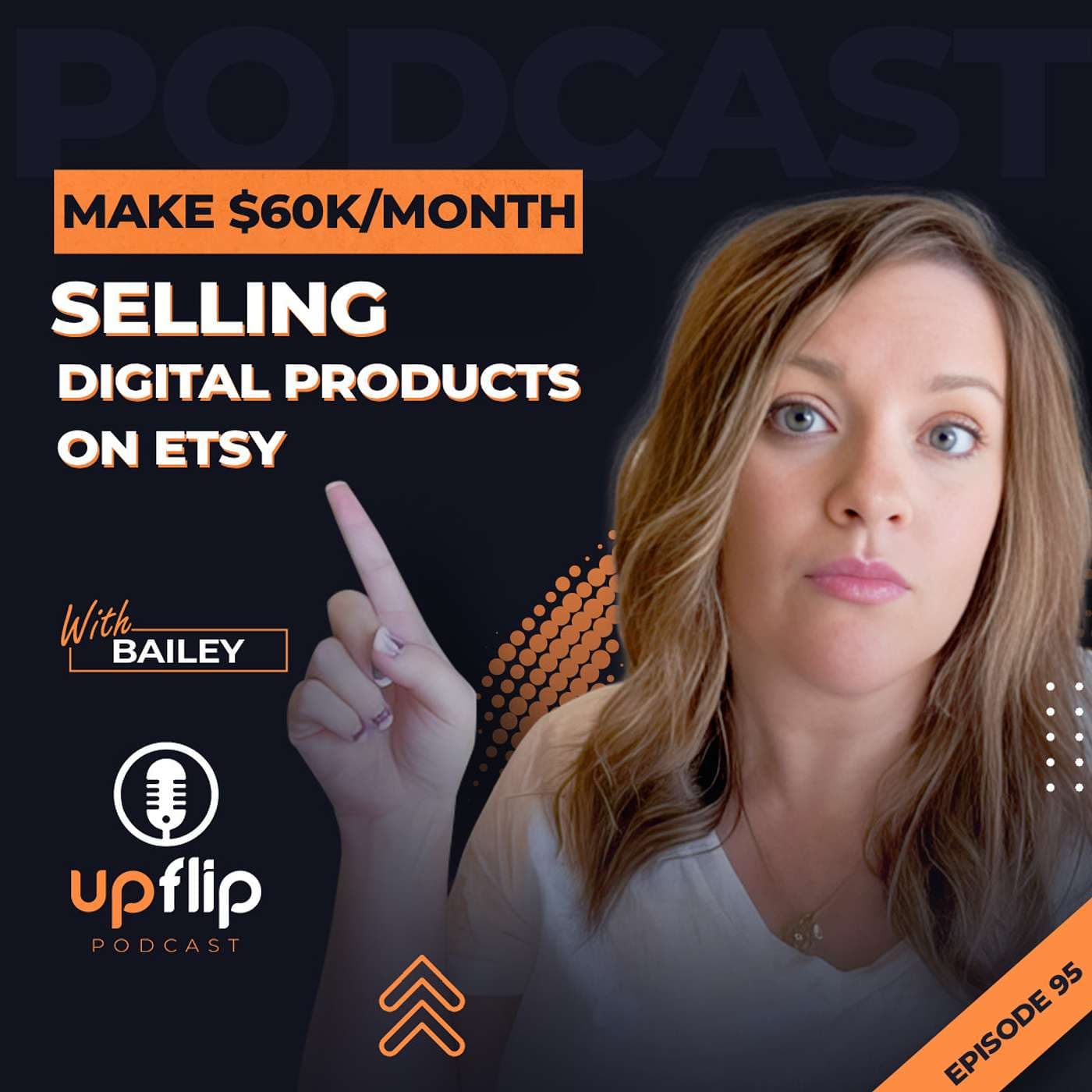
UpFlip Podcast Episode 95: Make $60K/Month Selling Digital Products (on Etsy)
Episode Overview In this episode of the UpFlip Podcast, host Alex Freeman interviews Bailey, a successful Etsy seller who transitioned from selling handmade items to digital products. Bailey shares her journey of growing her Etsy shop to an impressive average monthly revenue of $60,000, alongside practical advice for aspiring Etsy entrepreneurs.
Key Themes and Takeaways
Transition from Handmade to Digital Products
- Initial Motivation: Bailey started her Etsy shop in late 2020 to replace her 9-to-5 job, allowing her to spend more time with her young children.
- Frustration with Sales: Initially, Bailey struggled to generate sales with handmade products (glitter tumblers), leading her to pivot towards digital designs.
- Niche Research: She emphasized the importance of conducting thorough market research to identify trending products.
Marketing and Customer Engagement
- Effective Marketing Strategy: Bailey discusses her marketing tactics, stressing the significance of understanding customer needs and adapting her products accordingly.
- Feedback and Reviews: She highlights the importance of engaging with customers to ensure satisfaction and garner positive reviews, which significantly contribute to sales.
Profit Margins and Revenue Differences
- Financial Comparison: Bailey shares a stark contrast in profit margins:
- Handmade products yield about 30-35% profit margins.
- Digital products boast margins around 90% after processing fees.
- Membership Model: She introduced a subscription-based model for customers needing ongoing access to designs, responding to market demand.
Overcoming Challenges
- Initial Setbacks: During the first few months, Bailey faced the risk of giving up but persisted by comparing her situation to her previous 9-to-5 job.
- Learning Curve: Bailey committed significant time to self-education through online courses and YouTube tutorials to develop her design skills.
Practical Advice for Aspiring Etsy Sellers
- Start Selling What’s in Demand: Focus on trends rather than solely on personal preferences for product designs.
- Research Your Market: Use tools to stay informed about what products are trending to avoid wasted efforts.
- Consistency is Key: Regularly create new designs (Bailey adds 80-100 new designs weekly) to keep the shop fresh and relevant.
Managing Work-Life Balance
- Time Management: Bailey shares her structured schedule, which helps balance work and family time. She utilizes time-blocking techniques to maximize productivity during her working hours.
- Outsourcing: To maintain efficiency, she hired two virtual assistants and a video editor to delegate tasks.
Final Thoughts Bailey concludes with a motivational message for aspiring entrepreneurs: take action, even if it feels messy. The key to learning and growth lies in consistent effort and responsiveness to market needs.
Resources Mentioned
- Digitally Purposed: [Learn more about Digitally Purposed](https://www.digitallypurposed.com/)
- Etsy Shop Creation: [Start your own Etsy Shop](https://bit.ly/4hlMQJG)
- Franchise Guide: [Grab our FREE Franchise Guide](https://bit.ly/4aWuGvc)
Connect with UpFlip
- [YouTube](https://www.youtube.com/@TheUpFlipPodcast/)
- [Instagram](https://www.instagram.com/upflip/)
- [Facebook](https://www.facebook.com/upflipofficial)
- [Twitter](https://twitter.com/upflipofficial)
Conclusion This episode provides valuable insights for anyone interested in launching or scaling an Etsy business, emphasizing research, adaptation to market demands, and the importance of effective marketing strategies.
Written by AI. May contain mistakes. Listen to the episode to check what was said.
Transcript
Automatic transcript. May contain errors.0:00How do you become a top rated$60 ,000 a month Etsy seller while spending time with your family and staying at home with young kids? just learn to sell what is in demand versus just creating what you want to create at the point that i'm at in the game it takes me about five minutes to create one and then it can sell thousands and thousands of times we're usually around 90 profit margins on a digital product versus 35 on a handmade physical item. I would say just stop overthinking it and really just start creating whatever it is that you're creating. I'm your host, Alex Freeman. And on today's Upflip podcast episode, I'll find out how Bailey pivoted from a handmade shop to digital design, propelling her business to the top of Etsy rankings and how you can do the same.
0:53Bailey, welcome to the show. Thank you so much for joining us. Thanks. I'm glad to be here. So to start things off, can you just give us kind of the overview of when and why you first started your Etsy shop? Sure. I first started my Etsy shop in the latter end of 2020. And it was primarily at the time I had two young kids and I just wanted to find a way just to be able to work from home so that I wouldn't have to put the younger one in daycare and stay at home. and also just wanted to be able to travel whenever I wanted to. And that had always been a lifelong goal. So I was looking at opportunities that would allow that.
1:33And among all my research, Etsy was pretty much the top choice, just given the ease of availability and entrance into the particular marketplace I was going for. I love that. What were kind of some of those startup costs to getting the shop launched? And can you kind of tell us a little bit about what the shop was at the beginning? Sure. So if anybody knows what like the glitter, resin, very sparkly tumblers are, that is initially what I created. And it was kind of by accident. I had found a bunch of YouTube videos and I just wanted to start making the resin type craft. And the more research that I did, I found that people were selling them for a lot of money.
2:16And I was pretty interested in creating something that I really enjoyed making and be able to potentially earn income from it. So that's how I found the tumblers. And it did have quite a bit of an upfront cost just because as you can imagine, there is resin or epoxy. There are particular types of tumbler spinners to create them on. You have to have literally hundreds of glitters in your inventory. You have to have vinyl and all types of crafting supplies that go along with making those specific types of tumblers. And kind of with that bit of upfront cost, do you have any recommendations for someone who maybe doesn't have the capital immediately available to kind of dive right in?
2:59What should they be doing to kind of get started in the Etsy space? If you are interested in making a handmade craft like that, what we did to kind of not get around the upfront costs, but we utilized things like pay in four, whether that was through PayPal or Sezzle. And as we got orders, we would just immediately turn around and pay those off so that we could order more supplies and inventory as far as the actual cups. It did take about three months to get a positive get back in the green after starting that because as you can imagine, we were just kind of flipping the money until we got that much ahead with the amount of tumblers that we were selling.
3:44So that can be a scary leap for some people. What steps did you take before you kind of made that transition to life as an entrepreneur to get yourself ready to kind of like take that risk and take that leap? I think just a lot of knowledge consuming. I did scour YouTube for just any type of videos on that particular craft. I really just spent every waking minute working on it until it was basically, well, as perfect as it could be for that type of craft. And then I did. I purchased a lot of different types of courses for running a business on Etsy, running a business on Shopify. I purchased so many of them.
4:25I don't know. I should know everything at this point. So I think just I put a lot of effort into learning everything that I could, both free and paid online, about running businesses online. For Etsy specifically, it's kind of just a trial and error until you actually start doing it and selling on the platform. You don't really know what types of mistakes you're making until you're actually doing them. And then you can kind of work your way back from there to fix things. You started the shop. One of the goals, spend more time with your family. Was that the case with the handmade shop? What was the time commitment?
5:00No, absolutely not. We were working 12 to 16 hour days. And I say we because I guess I just did not expect it to do as well as it did. But when you are receiving 20 to 30 orders a day on this particular type of cup, that takes, in essence, two weeks from start to finish to create. It is impossible to do it yourself. So I hired my mom. I hired one of my brothers. My husband would come home after work and do what he could in the evening. So for me, I was out there literally from sunup to sundown, and then other people were helping me at different parts in the process. So it's a pro that we made a lot of money and we saw a lot of success, but we did not have one minute to ourselves.
5:46I mean, obviously, we know the end game here already. There was then a transition to a more digital business. How long until you made that switch? And why did you ultimately decide that that was the right pivot? Right. So while I was making these cups, I stumbled upon another semi-related niche, which is the sublimation tumblers. Those were at least a few steps easier than making glitter tumblers. And so I really started focusing on learning how to make those ones, which we did pivot the shop in that direction and we're doing kind of half and half, still totally handmade, but a lot easier where it would take you 20 minutes to make the product versus two weeks.
6:31But still, then we go back and whereas we were getting 20 orders with glitter tumblers, now we're getting 40 orders with the sublimation tumblers just because they're a lower price product. There's a lot more demand for those. So then we move into a space where yeah, we're getting way more orders, but we're still losing that time because it's still handmade. We still have to physically make it, pack it, ship it. And so at that point, I was like, okay, well, somebody makes the designs for these physical tumblers. I want to be the person who makes that part where I can make a design in five minutes, upload it, and that's the end of it.
7:11There's no more physical fulfillment or really customer service on my end. And that is when I decided to make the full switch. So then how did you make that switch? Because obviously, you kind of built up this Etsy business that was pretty successful. It was, you know, a lot of work, but it was making money. And then now you're going to go into this new direction. So like, how did you actually go about making that change? So for the three months before I turned off that part, every extra minute that I had, I would just be on the internet or on YouTube, really looking at design tutorials in different types of programs like Photoshop and Canva and Kittle and really trying to figure out how these hundreds of other types of sellers were making these designs because I have no graphic design background at all.
8:01So then I pivoted my learning to trying to teach myself how to design. I think I only bought one course at that point for design specific and it was for Procreate to learn how to actually draw them. And that was very helpful in the beginning. So I kind of took half the time to learn about it while still filling orders the best that I could. And then in January of 2022, yes, is when I just went ahead and turned off everything that was physical. And for the next three months, I just dedicated every single day, hour that I had to just putting as many designs up as I could. Now, you've made reference to a lot of the courses that you took and a lot of the learning that you did.
8:45When I personally think of Etsy shops and handcrafts and handmade things and also the design element now of the digital business, that seems like a lot of artistic and design skill. Is that something that you learned along the way? Have you always had an artistic ability? And is that something that somebody needs within them to succeed in this field? I think you definitely have to have some sort of creative side. I think anything can be taught as far as software or the tools that we use because I'm self-taught and I have learned everything myself. But I think you do have to have some type of eye to see what is or be able to identify what is actually trending design-wise within a specific niche or category or be able to listen to your customers and make that type of style if it's a particular style.
9:36So I mean, it definitely can be learned and you get better at it the more that you do it and you can hop on trends easily or more easily as you grow and practice and really just see what sells and you know that you can identify that right away when you see a new trend or a new opportunity. So just, I don't know, have the ability to learn and grow with it, even if you're not creatively inspired originally. Listeners, if you want more insider insights on how to start a top seller Etsy shop, go to the Upflip blog where we're sharing tips and strategies we learned from Vlad Kucenko of TagPup, the number one pet product shop on Etsy.
10:15The link is in the show notes. Bailey, was there ever a point that you felt like giving up and walking away from the business? Oh, yes. Pretty much every day within those first three months. How did you get through that? I just kept in the back of my head thinking I did not want to go back to my nine to five. And was this better than working there? And it was whether I was seeing success as fast as I wanted to or not. And that is kind of what kept me pushing forward because I would just take a step back, compare, say, oh, well, I am working from home. I am making some money. It is enough to support us right now or my part.
10:56So I am one of those people who wants to see success immediately and I'm not a patient person. So I think just being able for myself just to take a step back and say, well, I am making progress. It might not be as fast as I want it to be, but it's still progress is what kept me going. Particularly in fields that have are at least artistic adjacent, if not full on art and design. There is, I imagine, a great debate between what people want to buy and your own like personal preferences and desires and designs. How do you balance that things that you like you find beautiful and lining those up with demand?
11:35But then also, how do you learn what customers want? So originally I did. I would only create things that I thought were beautiful, pretty, trendy, something that I thought I would want to buy. And I was not putting myself in the customer's shoes. And so originally, I think that's why it took a little bit longer for me to get going because I kind of was ignoring what was already in demand and selling. So I think the way I finally got around that was just by utilizing market research tools for Etsy specifically, find what was trending and in demand, and then look at similar competitors within my marketplace and take inventory of what was actually selling.
12:25Honestly, with the niche that we're in, it changes pretty much every season because design trends change every three to four months, if not more soon. So something that is popular last year is not going to be popular this year. And that is just very much based on our industry that we're in. So I think it's learning to adapt to what is currently trending and then apply those types of designs to whatever it is people are actively searching for, whether that's a nurse cup or a teacher cup. It's all about just finding what's trending currently now and applying them to those same... It's the same thing over and over again, just finding new opportunities with the designs that trend.
13:06Along that same line, can you talk us through the kind of differences that you experienced in revenue, profit margin between the handmade Etsy shop and now the digital side? Yeah. So with the handmade, we were only ever seeing about, if we were lucky, 30 to 35 % profit margins after everything. And with digital, I mean, you're basically just minusing Etsy's processing platform fees. And if you do include any marketing, so I mean, the difference is about well, we're usually around 90 % profit margins on a digital product versus 35 % on a handmade physical item. You also offer a membership model for the online design store.
13:51Can you talk us through why you decided to add that and what kind of the benefits are to the business? Sure. I mean, it was basically created out of request. In the industry that I'm in, a lot of people will offer lifetime access to their designs or monthly membership type things, but they don't offer something that's just a subscription-based month to month. They get it. I don't offer anything lifetime. So it's for the people who are actually running a business as well and they need basically unlimited designs or they need designs with every holiday season and occasion that you can imagine. So they operate as a business and therefore need hundreds of designs.
14:33So it was created for them out of request and that's kind of the way that that came to be. And now I offer it both monthly or they can buy a yearly option as well. How often are you adding new designs or products to your shop? Every week. I design four days a week. And on those four days, usually put out about 20 designs a day. So it can be anywhere from 80 to 100 designs per week. Wow. Is that the way to scale revenue for this kind of store? Or is there other things that you're also doing that have helped revenue grow? It is for this type of industry, just because like I've mentioned, it's very seasonal, very occasion driven and very trend based.
15:18So like we're about to move into the, we've already passed the Halloween that should have been designed for months ago. So we're always about three to four months ahead of whatever's coming up. So right now I'll be moving into all types of Christmas and new year related designs. And once again, that will change from last year's designs because those trends and typical styles are going to be different. So that is with this very specific industry. it's very much going to always change. So you're continually making new designs. So it's going to bring us to a section of our show that we call our fan blitz questions.
15:55These questions come from our YouTube community listeners. You can go to youtube.com slash upflip, join the community and post questions to future podcast guests. Bailey, we're going to try and get through about six questions here and maybe about a minute. Are you ready? Yes. All right, here we go. Tectonics asks, How do you stay competitive in a saturated market? Have you ever changed your niche in Etsy? And if so, what did you do to make it successful? I think to stay ahead in any saturated market, you have to be continually researching. And that goes back to utilizing tools or just researching on the Etsy platform itself to try and stay ahead of whatever is trending.
16:34Because if you're in a saturated place, theoretically, you want to be first on the top of that trend. I have changed my niche because originally it was B to C, so B to a customer and or business to a customer. And then now it's more so up towards a business owner themselves. So to make it successful, once again, I just really researched the differences between the two and the pain points of what I was moving into. And that's how I believe I was successful. Strikers Hub asking, have you faced any Etsy suspensions? And if you have? How did it affect you and how do you deal with it? Or I guess the extension, how have you avoided Etsy suspensions?
17:16I have not had any suspensions. So I would think that avoiding that is just by being very careful with your copyright trademark, especially if you're in a design field. It's very easy to check everything first and then also utilize tools again that have trademark checker or copyright things built into them if you're not sure. But it's pretty easy to keep on track of that. If there's anything that you're not sure about, or if you're second guessing, then that's probably the point where you should go check if it is something that could potentially get you in trouble. Muse would like to know if there's anything you can do to protect your designs before uploading.
17:56Unfortunately not. And this is really sad for most Etsy sellers because there's just really not a way you can watermark it to your heart's content and they will find a way to remove the watermarker. There is also tools that will remove it for you. So that's not an ultimate guarantee of protection. So at this point, once you reach that level, it's kind of, you have to pick and choose your battles. It's just not worth it for me to sit on Etsy and monitor that or else I wouldn't get anything else done. Ava wants to know if creating an LLC is a good idea right at the beginning. I believe it is just because to protect yourself and it's fairly simple to do.
18:35I've always had different ones for different businesses. And we always start them right at the beginning. And Amber asking, how soon did you get an accountant to help manage the finances? I think we did after the first year because it was over a hundred thousand that we did the first year. So yeah, after the first year, I mean, I would think that as soon as you can afford one would be a good answer. And the last one here from ThreeCoreDave, what advice would you give yourself on day one of starting on Etsy? I would probably just set myself a goal and whatever that goal is, just the advice would be, I'm just going to complete my goal, whatever it is each day, whether that is to create a certain amount of listings or conduct a certain amount of research time, just stick to some type of consistency goal, because that's the fastest way that you're going to see results if you just continue to keep doing something over and over again.
19:28That is going to do it for the FanBlitz questions. Listeners, you can find more advice for how to start a business the right way on the UpFlip hub at upflip.com slash learn. Bailey, you've become one of the top 0.1 % of Etsy sellers with Bailey Tumblr Designs. What's your top advice for people who want to sell more digital products on Etsy? Just learn to sell what is in demand versus just creating what you want to create. How much do you spend on paid advertising in a typical month? And what platforms are you using to get the best ROI on that investment? Usually it ranges from$3 ,500 to$4 ,500.
20:10And that is all done on the Etsy app itself. We don't do any external. So that's using Etsy ads. Do you utilize social media at all in your kind of marketing funnel, whether, organic posting? We do have a private Facebook group that is close to 10 ,000 people. So yeah, they have to join the group, but it is still marketing within that Facebook group. And we do very heavily market every single day in there. So talk us through the steps of the lead funnel. How do you convert those leads into customers? We have a typical lead magnet where we give away something of value for free, which in this space, it is usually more designed to sign up.
20:52I have two. One is to sign up for that private Facebook group, and one is to sign up for an email list. And so the email list is about twice the size of the Facebook group. So close to 18 ,000 people or 19 ,000, I think now. So it's much easier to get people to join an email list. And both are just operated the same way. And then they go into an automated sequence on the email side. And then I also send out like a weekly newsletter with any new products or designs, as well as any type of discounts or tips and tricks in that weekly newsletter to the email list. And then on Etsy, you've got a really impressive star rating, 4.8 and thousands of positive reviews.
21:36What's your strategy for getting five-star reviews from customers? Probably just being able to create what they are asking for in the first place. So this goes back just to listening to the customers. I take a ton of requests from them. And I noticed that the majority of my reviews do come from the people who have asked for things specifically, and they're just repeat customers. So they just come back over and over again. In the beginning, I would message people to ask if there was anything that they needed or help with with the particular design that they had bought and if they were completely satisfied, if they wouldn't mind leaving a review.
22:17So that is something that I did in the first six months. Let's talk about the course. Let's talk about digitally purposed. Why did you decide to add the course as another aspect of your business? Again, it was added out of request. I was getting so many people asking me to teach them how to make designs either personally or to make their own business for different types of digital products on Etsy. It's not so much as knowing how to create specific digital products, more so how do you actually sell and rank on Etsy. So it was created out of request primarily. I love that. And then how long did it take you to design the course?
22:59It took me about three months. I started that in October of last year, and I worked on it October through December of last year. And as you put it together, are there any tools or programs that you might recommend if there are entrepreneurs listening right now that also want to start offering online learning? I would say just try to look for a tool or software that is more all-in-one. As somebody who was at the time a solopreneur, I didn't want to have 10 different types of things doing different things for me. So I went for a software that would include my course hosting. It would have my blog site.
23:39It had my email marketing. It had my funnels. It had a CRM in there and everything. So it was all in one place and really beginner friendly. And there's lots of different types of them out there. So I would recommend looking for something like that if you're just starting out instead of trying to piece together a bunch of tools and software if you're not really tech savvy like me. You've also got a lot of free educational content on the digitally purposed blog. As a course creator, how do you make the choice between what goes into the paid course and what's going into the free content? I think it really just gets down to what can actually be explained correctly in a blog form content way.
24:21There's only so much that I can type out without actually visually showing someone the actual steps to get something done. And so there's not really any gatekeeping per se. And I will give overviews of everything that I can on my blog or on the YouTube channel. But like I said, there's only so much you can actually explain in a written form. Same with a video. I can't explain something in an eight minute video or in a three minute blog read versus hours of training or Q &A time. So I think it just really gets down to how specific is the training or the topic that we're covering versus how far I can go into it in a particular article.
25:03So one thing that I think has probably, it's certainly abundantly clear to me at this moment, but I hope it is also clear to our listeners. You've got a lot going on. You've got a lot of different kind of like business aspects to the business, multiple digital product businesses. How do you keep things organized and manage your workflow to keep yourself from getting overwhelmed? I had to eventually hire two VAs. I was in the very beginning, well, not very beginning, still earlier this year, trying to do as much as everything that I could myself because I sometimes can fall into a perfectionist role and think that if I can't do it, then no one can.
25:42So I think I kind of learned that lesson the hard way where I needed to get more organized so I could free up my time again by outsourcing the majority of everything that I did not need to be doing. So that's where two VAs came in and a video editor. And then a software that I use for myself is kind of like a time blocking software or project management based tool, I guess. It operates a little bit more than a calendar and I can block out my day exactly by 30 minute little blocks and kind of have a bird's eye view of everything that I need to do and then kind of see what everyone else is doing at the same time.
26:25And with your kids at home, you know, a lot of entrepreneurs find a hard time balancing the family with the demands of their company. Obviously, that was one of the goals that you had going into starting this company. So what advice might you have for working parents who are listening and trying to find that balance? I would say that just find a schedule that works for you and your family and then dedicate your time to work only during the time blocked that you have available. So in the beginning, two of my kids were still home and I was still working from home. So I only was able to work very early mornings during their nap time and then at night when my husband was home later.
27:06So given that time, it was six hours total. It was just broken up throughout various parts of the day, but it still worked. I was still able to get what I needed to done. It wasn't ideal, but it was a schedule that worked for the time and the place. And now it's a different story since every kid is in school and I can have a set amount of time. And I've just learned that there is a time for work and not a time. So after the schedule is done for the day, so say two o 'clock or whenever it is time to go pick up the kids, I kind of just turn off the notifications on my phone and I don't go back to the computer anymore.
27:44In the beginning, I know it is hard, but it is just about finding those little blocks of time where you can work, whether you do have a nine to five, if that's dedicating more time on the weekends or at night to dedicate your side hustle or your small business, then just really commit to whatever schedule you can actually do. On the schedule front, what is your schedule? How many hours a day are you working on the business? And what does your time look like on those hours? Well, now, again, the kids are all in school. I mean, I get up, I get them all ready. They're all out the door by 7. And so that 7 to about 8.30 timeframe is the time that I have for myself.
Read the full transcript
28:26So usually work out, eat, that type of thing. And then at nine is when my business day starts. So I'll start at nine and I work till two, which is the school schedule pickup. So about five hours a day, that is very much time blocked into these little 30 minute schedules to keep me on task with the basically three different things I'm doing. If you could wave a magic wand and change one thing about your business, what would it be and why? Oh, it would probably try to find a way to solve the Etsy marketplace issue with copycats and people stealing other people's designs. And that is just back to that question from one of your listeners.
29:09It's very hard to watch all of your hard work be duplicated. And in a way, you know that you've kind of made it or seen success because you are being mirrored on so many different levels. But the way that the platform is set up now is you do have a way to report and to get the listing taken down, but it's only for a very small time period. So my magic wand would be just to find a way to work with Etsy to fix this for all types of sellers, not just for digital sellers, because it happens to physical handmade sellers as well. And just find a better system or a way to work this out for everyone in general.
29:48What are your core principles for starting a successful online store? And why are those the important things for someone to do or keep in mind or put in place? I have two that probably just really, and it goes back to researching. And that is just to know your industry, your niche, or your audience. And that is just done by really studying and researching. And I know that's not really glamorous or people don't think that's the fun part. But if you don't know or study or look at what your competitors are doing, you're going to wind up creating products that are not a fit for the customers. So it just winds up being a waste of time.
30:28And then you'll just have to start over in the long run. And then the second thing would be just to, once you know that audience and the niche and what they want, it's just to create high quality products because especially in the design space, there's lots of people and they fall more on the copycat side, but a lot of things are stolen off the internet or they're created improperly. So digital products sellers kind of get a bad rap on Etsy sometimes because they're just like, oh, everything's poor quality. But the reality is they probably just bought it from the wrong seller. So you'll be able to stand out a lot more if you just really do your research and then create products that are actually high quality.
31:09Right now, I'm sure somebody is listening to this podcast who has gotten really excited about everything that they've heard. They want to jump in, they want to start their own business, but they're afraid to take that leap. What's the number one piece of advice that you would give that person right now? Just to take action, whether it is messy action or not, because if not, you'll just get stuck in an endless little hamster wheel of overthinking and overcomplicating and you won't learn anything. And so when you take action, especially in the space that we are on, on Etsy, you'll learn right away from your mistakes.
31:47You'll learn right away what's working, what types of products sell and don't sell, because the more that you create and the more that you list and put out there, the more opportunity you'll have for feedback, whether it's good or not. So I would say just stop overthinking it and really just start creating whatever it is that you're creating. What's your favorite business book and why? Well, right now it's the I Will Teach You To Be Rich only because I saw the Netflix show, which then led me to find the actual book. The book is better than the show. So I think I like the book just because it kind of teaches you to really look and understand how and why you prioritize money differently, usually based on how you were brought up and then how you can implement different ways to manage your money more effectively, which I've definitely needed.
32:38Bailey, where can people connect with you and learn more about digitally purposed and everything you've got going on? The site is just digitally purposed.com, or you can also find me on YouTube, the Digitally Purposed Bailey YouTube channel. You can also join the big free Facebook group if you'd like to see on the inside of what goes on in a very design heavy sphere on Etsy. That is going to do it for this episode of the Upflip podcast. Listeners, if you like this episode, check out the link section in the show notes and check out episode 10 featuring Vlad Kukcenko of TagPup, Etsy's number one pet product store, and hit that follow button in your podcast app to get new episodes every week.
33:19And we will see you next Monday, Bailey, digitally purposed. Thanks so much for joining us. Thank you so much for having me.
From the publisher
Bailey started selling handmade items on Etsy as a way to replace her 9-to-5 and spend more time with her kids. Pivoting to selling digital goods on Etsy took her business to the next level. She’ll share her steps to creating an Etsy shop that averages $60,000 a month in revenue in this episode.
This kind of growth doesn’t happen overnight. When she first started, Bailey was frustrated by the lack of sales and nearly stepped away from the business. Researching the right niche for her Etsy digital products helped her to overcome this problem. We’ll learn how she conducted this research and adjusted her products to meet the market’s demands.
Effective marketing is critical, too, when you’re selling through an Etsy shop. We’ll learn about Bailey’s marketing strategy and how she connected with customers to grow sales and memberships in her digital products business. Anyone who wants to start or grow an Etsy store will definitely want to hear Bailey’s insights!
Resources:
- https://bit.ly/4hlMQJG Start your own Etsy Shop
- Digitally Purposed - Learn more about Digitally Purposed on their website
Ready to be your own boss without starting from scratch? Grab our FREE Franchise Guide and unlock the secrets of proven business models that have already created thousands of success stories.
Connect with UpFlip:
- On Youtube
- On Instagram
- On Facebook
- @UpFlipOfficial on Twitter
For more insights to start, build, or grow a business, check out the resources on UpFlip.com or head to the UpFlip YouTube channel to see more interviews with business owners and experts.
Thanks for listening!


