
In short
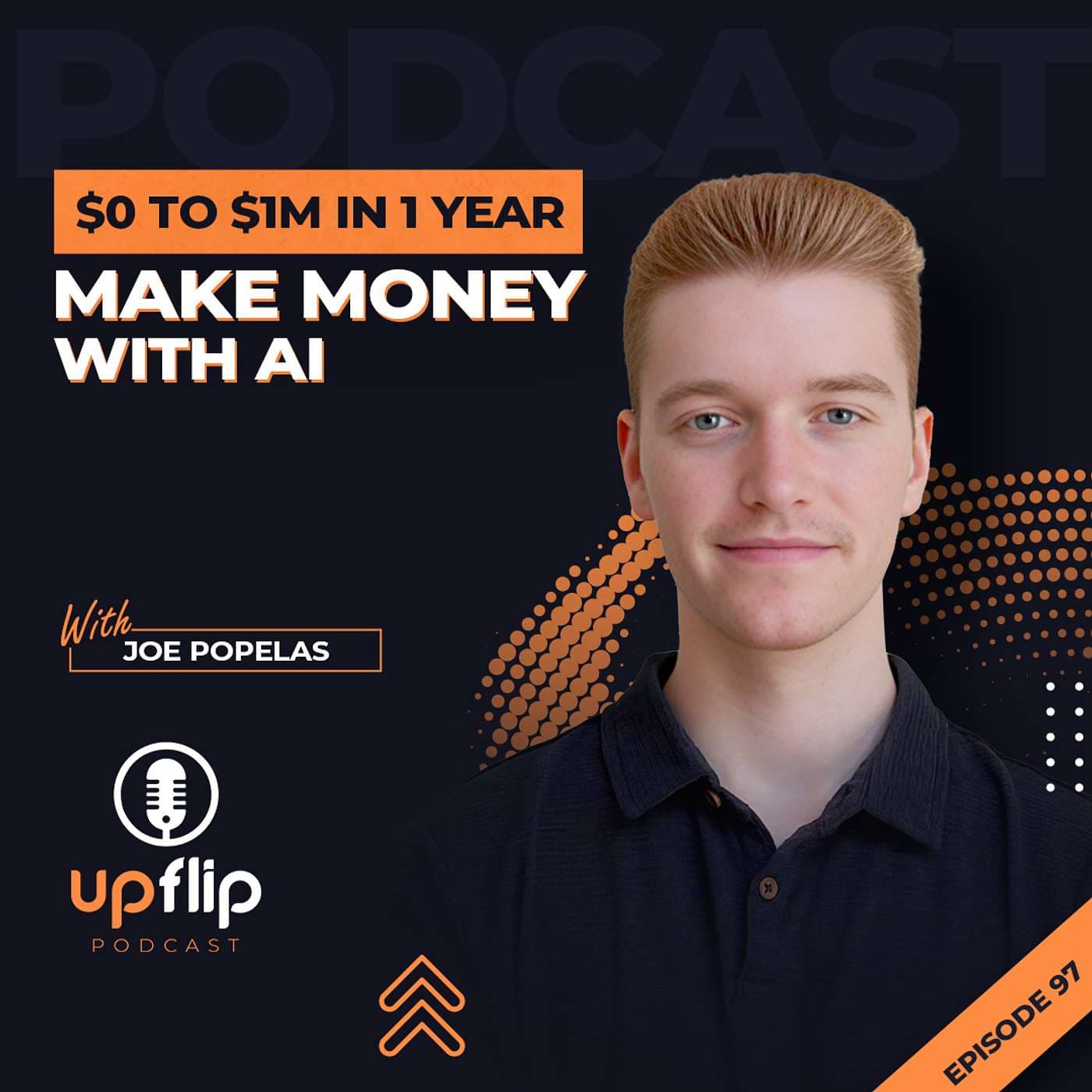
UpFlip Podcast Episode 97 Summary Title: Make Money with AI: Zero to $1M in 1 Year Guest: Joe Popelas Host: Alex Freeman Air Date: [Insert Date]
Episode Overview In this episode of The UpFlip Podcast, Joe Popelas shares his remarkable journey of building a million-dollar AI-generated book brand within a year while managing college and a part-time job. Utilizing his background in computer science and knowledge of AI, Joe discusses the strategies that propelled his success in the relatively untapped market of AI books.
Key Highlights
Joe’s Background
- Early Interest in AI: Joe began working with AI technology, specifically OpenAI's GPT-3, in 2020. By mid-2022, he had established a foundation for his business.
- Consulting Experience: He gained consulting experience by helping companies integrate AI into their operations, which led to valuable connections.
Business Launch
- AI Book Brand: Joe launched his book brand with no prior book-writing experience, leveraging AI to create and publish books efficiently.
- Revenue Model: A unique aspect of his business is that he generates more revenue from ads than book sales, highlighting the importance of brand awareness and audience targeting.
Key Strategies for Success
- Target Audience: Joe identified his target market by analyzing platforms like Pinterest, which led him to target primarily female demographics aged 24-54.
- Marketing Tactics:
- Pinterest Advertising: Joe spends around $20-$30k monthly on Pinterest ads, focusing on low-cost customer acquisition.
- Email Marketing: Essential for nurturing customer relationships and increasing lifetime value (LTV).
- Content Creation: He emphasizes providing high value in his books, differentiating himself from competitors who rely on traditional methods.
Learning and Growth
- Skills Development: Joe advises aspiring entrepreneurs to build a diverse skill set before starting a business. He believes that one's income potential is directly related to the uniqueness and demand for their skills.
- Challenges Faced: Joe discusses early missteps, such as ineffective ad targeting and underestimating the power of email marketing, which he learned to optimize over time.
Business Operations
- Time Management: Joe shares how he balances his business with school by prioritizing tasks and scheduling effectively.
- Outsourcing: After achieving initial success, he hired a proofreader to improve efficiency and ensure quality in his book production.
Future Prospects
- Scaling and Innovation: Joe is exploring new niches and platforms for advertising. He emphasizes the need for continuous innovation as competition increases.
- Investor Engagement: After receiving offers for part of his business, he learned the potential of asset sales, which can provide significant capital for further growth.
Key Takeaways
- Embrace AI: Leveraging AI can significantly enhance productivity and open new business avenues.
- Focus on Value: Providing quality content at competitive prices builds a loyal customer base.
- Continuous Learning: Acquiring new skills and adapting to changing markets is crucial for sustained success.
- Strategic Marketing: Understanding and interacting with your target audience through effective marketing channels is vital.
Resources Mentioned
- [Join UpFlip Academy](https://bit.ly/4hlQgMA)
- Connect with Joe on TikTok: [@joepopelas](https://www.tiktok.com/@joepopelas)
Conclusion Joe Popelas exemplifies the potential of combining technology with entrepreneurial spirit. His insights on the AI-driven business landscape provide valuable lessons for aspiring entrepreneurs looking to harness innovative tools for growth. Tune in next week for more insights from industry leaders on the UpFlip Podcast.
Written by AI. May contain mistakes. Listen to the episode to check what was said.
Transcript
Automatic transcript. May contain errors.0:00Lots of people are talking about the potential of AI for business. But Joe Popolis is living proof. He started working with ChatGPT in 2020, and today he owns an AI book brand valued at$930 ,000. And the most impressive part? He's only 20. If you want to learn how to harness the business potential of AI, stay tuned to hear how this computer science student built his AI-based business in less than a year, and how you can follow his model. I can create these books so fast that literally none of my competitors can keep up with me. Just recently, a few months ago, I explored selling assets instead of equity, and that's when I got a really solid offer for$675 ,000 USD to take 40 % of my book brand's assets.
0:40I give out free books like they're hotcakes, so it just differentiates me from all of the competition. Our monthly revenue is, I'd say like$70 ,000 to$80 ,000 per month. I'm your host, Alex Freeman, and welcome to the Upflip podcast, where we learn how great businesses are built. Joe, welcome to the show. Hey, Alex. So an AI book business, where'd the idea come from and how did you get going? Yeah. So my journey really started back in 2020. In 2020, I worked on OpenAI's GPT-3 beta. And then in May of 2022, companies started reaching out to me asking for advice on how AI could be used in their business.
1:21So I started doing that for a while. And then in July of 2022, I met with a large publishing company that was referred to me. And at the time, they were doing about$2 million in revenue every month. When I was on the call, I thought to myself, why are they not just generating the books with AI? I had a bunch of ideas on how AI could be used in their business. And the main thing that was holding them back at the time was the cost it took for them to create a book. I thought to myself, I could just replicate the process with modern software and AI. And that's how I came up with the idea. So if someone is listening to this saying, okay, let me, you know, listen closely and I'll go launch my own book brand.
1:58How much experience with AI do they need to have to kind of start down this road? I wouldn't say you need a lot of experience with AI. You should, however, learn how the models work and what the model parameters do. The more you know, the better always, but you really don't need a lot of experience with user interfaces like Claude, Cohere, and OpenAI is like ChatGPT. Interacting with these models has never been easier. So yeah, and also the steerability of these models is so good that it's extremely easy to get the output you want compared to the models back in 2019. So you really don't need a lot of experience and interacting with these models has become extremely user-friendly.
2:34Where should somebody start to kind of understand how the models work? I would say just watching videos on YouTube. I learned a lot from YouTube back when I was just learning about AI models, but also just interacting with them. A lot of the time when you have experience interacting with the models, you just know, you start to understand how to tweak your prompt in order to get the output that you desire. So I'd say some of it comes just from researching online, figuring out what the parameters do and just watching YouTube videos. But another big part of it is just actually using the models and seeing what kind of output they output when you put in like a certain prompt or tweak a certain prompt, that kind of thing.
3:10This question sort of is a modified version of a question that came from Starlet5350. in the Upflip community on YouTube, but how important is computer knowledge? Like, should you learn a programming language to get started in AI? What like skills should you go develop? With AI, if you strictly just want to use AI, you're not using it for any kind of like AI books or anything like that, then I would suggest Python. Python is used for a bunch of ML tasks. You also have libraries such as like PyTorch where you can develop and train your own AI models. It's a pretty extensive process and it definitely takes a lot of knowledge to code and build up these neural networks.
3:47But in terms of programming languages in regards to just using AI, building AI models, Python is definitely the way to go. Now, obviously, you had extensive AI experience before you got started down the book road, but didn't really know the book business. So how did you learn that side of the business? So making books at face value is pretty simple. When you break it down, you got your title page, disclaimer page, and then you have your main content. And you might have a conclusion and maybe a wrapper at the bottom of the page. A lot of it comes down to just the creative side of things. And I always say the main thing that I focus on is really value.
4:24But in terms of just learning how to build a book, format a book, really at the starting, what I did is I just searched up Amazon KDP tutorials on how to format books. And that gave me a very solid understanding of how to basically just build a book in general, where I should be putting different topics, how I should structure my content. But after that, I always say, I'll go back to my first point, that the value is the biggest part because at the starting, I had maybe two different chapters that were different font sizes and it wouldn't really matter because I was providing so much value on my book.
4:57So I'd say in terms of building a book, Amazon KDP tutorials on YouTube, but the biggest thing is literally just providing value. If you provide enough value, people won't care about your formatting. I want to kind of take a quick look back at your time as a consultant, as a business consultant. How did you initially start to connect with those contacts and ultimately customers? And how did that experience ultimately help you when you started the book business? When I was doing a lot of consulting, businesses would reach out to me through LinkedIn. So when businesses would search up OpenAI on LinkedIn, looking for OpenAI employees to consult with, my profile popped up.
5:31And I think at one time I was like rank 15 on the OpenAI search on LinkedIn. And what would happen is these businesses would see that I worked with OpenAI and worked on OpenAI as GPT-3 beta. And then I would consult with them. I proved that I was a valuable consultant and I started getting referrals. I started getting inviting to consulting networks as an AI and web development expert. And then a few months of that and the highest I got paid for one session, which was an hour, was$500. So I just grew from there. Now, most 20-year-olds aren't thinking about starting a business or, you know, diving into a book business in particular, but what in your background gave you that kind of entrepreneurial drive?
6:08I actually don't suggest a lot of 20-year-olds start up a business. There's a lot of sacrifices that you have to make, and many people my age don't have the skill set it takes to run a successful business. So in terms of entrepreneurial background, I learned very early on that having an extensive and unique skill set is all you need to be successful at life, and that the world compensates you based on how unique and in-demand your skill set is. So when I was around, I'd say like 16, I started learning every skill I could. So when an opportunity came my way, I knew that I would be able to execute on it perfectly.
6:43So if I started out my book brand with no pre-existing skills, I'd be in a very different position today. And I probably wouldn't have made a million dollars. A lot of people think that, you know, I'll start when a good opportunity comes my way, but that's the completely wrong way to think about it. You need to start acquiring skills now. So you'll be ready for the next business opportunity that comes your way. What was the biggest mistake that you made when you were setting up the business? When I started out, I wasted$2 ,000 on Pinterest ads because I went way too broad with my targeting. And I always suggest to people that you need to find a balance.
7:12I went way too wide. I mean, my target audience was over 30 million, which was pretty insane per ad group. And if I started off testing narrower, I would have profited way sooner. And also at the starting, I didn't understand the power of email marketing. Email marketing and nurturing my customers skyrocketed my LTV. and then subsequently my profit. Also after running email marketing, I realized how powerful email marketing is. But yeah, those are like two of the biggest mistakes. I know you just asked for one, but those are two big ones. Yeah, that was great. Aga, also from our YouTube community, wanted to know, what are you doing differently from your competitors that really set your business apart?
7:47I provide so much value at such a low price. So it's hard for my competitors to compete with me. A lot of my current competitors are kind of stuck in the old ways, which is really just writing books normally with a ghostwriter. I can create these books so fast that literally none of my competitors can keep up with me. The businesses I compete with are selling outdated PLR books or paying a ghostwriter thousands of dollars and waiting a full week to get a book. So I can't lose. I'm just so fast to enter niches and I pretty much always beating my competitors when I release a new bundle. Listeners, you can find more insights into starting a profitable e-commerce business on the Upflip blog.
8:22Just follow the link in the description below to learn how Ecom Crew founder Michael Jackness makes nearly$1 million in profit from his online stores. Joe, you started the business while you were in school, working a part-time job. How did you manage your time to handle all of your responsibilities without getting overwhelmed? Biggest thing for me was just knowing my priorities. I write down all of the tasks that I have for a day. It's very easy to get sidetracked if you don't refer to a list of tasks each day. So writing down the tasks I have for each day, it literally changed my life. I also created like a very strict schedule that allocates different time blocks for different responsibilities.
8:59So most of the days I have are two time blocks. So school during the day, and then side hustle kind of during the night. Yeah, it's also important to avoid burnout. If I ever get super stressed, I just go for a walk in or work on my music. So that's kind of how I manage it. You mentioned the time blocking. Can you talk us through kind of what a typical day ultimately looks like in your life today? Yeah, sure. I usually start up, I always like to have So the biggest priority that's kind of in my life right now is school and also kind of partially the business. So the business is really working.
9:31It's on autopilot right now. So what I do is I have five hours in the morning that I dedicate to school if I have to catch up on anything. I have all asynchronous classes. And then I dedicate six hours in the afternoon working on kind of just upkeep. My schedule has kind of shifted since school started. So I do that upkeep in the afternoon now. And then in the night six until 11, I'm just kind of relaxing, maybe doing a few hobbies, making music, that kind of stuff, going for a walk. So I kind of have three blocks right now, I guess. I'm curious. You talked about the business kind of being on autopilot.
10:02How passive could this business be potentially? Is it something that someone could set up to be truly passive or is it always going to be requiring hands-on attention? I think it'll always require hands-on attention. I think there's always going to be that. there's always some small things that I have to go in and fix myself. There's not something that I can just outsource. But in terms of checking in on it, it's so minimal compared to when I'd started up the business. So I might be checking in with my book brand like one hour out of the whole day. I won't necessarily need to spend that whole six hours creating new assets or anything, but I still have a lot of time out of my day to it in case I do have some bigger tasks I need to work on.
10:42But really, it's about an hour a day, I'd say on average. So it's very passive. It's very, very passive. It wasn't passive at the start. I obviously had to do a lot of front loading, but now it's been, I mean, it's great. It's great. I don't have to do a lot of work. Now, I also understand you recently brought a proofreader onto the team. Why was that the first role you hired somebody into? I'd say just because I was pretty lazy. And also, I just didn't have a lot of experience proofreading. It seemed like a very valuable addition to the team. And it also takes quite a lot of time. These books that I'm generating with AI, they can be up to 60 ,000 words.
11:16So when I'm spending like 30 hours reading through an AI generated book, it's tough. And then the editing and all that stuff. I haven't been an author, I guess you could say, for a very long time or just like, I guess, a book generator. I haven't been a book generator for a long time. So it's great to hire someone that knows how to actually edit the books. And it's also extremely time consuming. So I think that was just me delegating something that took a lot of time away from the business when I could just be doing something else that's more valuable. And where did you go about finding the proofreader to hire?
11:46And then how did you assess that they were the right fit? I originally got reached out to the first proofreader that I hired, he reached out to me, which was total fluke. And he actually ended up being an amazing hire. He referred me to his Upwork profile. And then I took a look at his Upwork profile, and it was very impressive. So I ended up hiring him. I would say Upwork is really good. I haven't had a bad experience with Upwork. Yeah. So it's been good in terms of finding like proofreaders, ghostwriters, all that. You can find some very, very solid people on Upwork. How long did it take before the business was profitable?
12:17About two months. So I started at the end of July and then August, I didn't do too much. This was in 2022. And then I generated, I had about 40 books by September, October 3rd, 2022. That was my first profitable day. and then I had my second profitable day on October 4th. So it took about two months, two months for me to really figure it out. And where are you now today? Where's the revenue at in an average month and what are kind of the profit margins on it? Revenue, I made an asset sale recently, which I dropped down the quantity of bundles that I'm selling. So our revenue today is over 500 ,000, just peaked over 500 ,000.
12:55Sorry, not revenue, that's profit. Our revenue is close to a million now, so that's good. And then our monthly revenue is, I'd say like 70 to 80 ,000 at this point. That of course varies depending on how well my email sequences convert. But I'd say that's a good estimate or average per month. And then my profit margins, some are better than others. Depends on the niche that I'm selling in because higher CPMs cut into my profit, but 70, 60, around there. The revenue growth has been really remarkable. What would you say is the main factor driving that quick growth? And how can a new online entrepreneur scale as fast as you?
13:33The main driver in my revenue growth has been my email marketing and scaling into different niches. So I'm able to nurture basically my customers with free books so effectively that they convert like crazy in my email sequences. So if, say, if you want to scale your revenue fast, focus on your LTV because there's a lot of money. There's a lot of money that you can squeeze out of customers, especially if they're satisfied with their initial purchase. You've recently sold a portion of the book brand to an investor. Can you talk about how that opportunity came about and why you decided to start working with investors?
14:05I originally listed my business for sale on a marketplace to see if I get any interested buyers because I wasn't sure if my business was super sellable. And I also didn't know if investors would be open to the idea of these AI books. So I put it, I listed it, we got verified and then I got an offer for$930 ,000 USD for the entire thing. And so at that point, I became super protective of what I had built. And I took down the listing and just kept building it because I knew I could build it to more. My revenue growth had been crazy and I hadn't put in a crazy amount of work compared to these other business models that I had tried.
14:43So yeah, I took down the listing, I kept building it. And then just recently, a few months ago, I explored selling assets instead of equity. And that's when I got a really solid offer for$675 ,000 USD to take 40 % of my book brand's assets. So, I mean, I only started working with investors out of curiosity, and then I realized how much money I could make in just selling assets. Lucas wanted to know how you're differentiating yourself and creating moats to protect the business since barriers to entry are relatively low. That's a good question. In terms of motes, I've copyrighted on a majority of my books now since we've modified the text enough to make it copyright enforceable.
15:19People still, unfortunately, pirate my books though. So I've tried to stay kind of as secretive as possible. But I don't think it's hard to differentiate myself. I mean, the business model is new and I'm able to provide so much value at such little cost. I can really focus on providing my customers with the best experience possible. So yeah. And also I give out free books like they're hotcakes. So it just adds to a pleasant customer experience. I have repeat customers, gratitude emails. So it just adds to the experience and just able to write so much value to these customers that it's differentiates me from all of the competition.
15:48So this is going to bring us to the actual FanBlitz questions for this episode. A reminder to our viewers that these questions come from our YouTube community. You can go over to youtube.com slash upflip, join the community and post questions to future podcast guests in this section and also throughout the episode, as I've been doing with Joe on this week's episode. So, Joe, we're going to do about five questions. We're going to try and do them in about a minute. Are you ready? Sure. Yeah, let's go. All right. From Brainwashing Detergent, how can I use AI to improve the overall performance of the restaurant I own and run?
16:17Most common way I've seen it. So AI can analyze your historical data, like your table turnover rate. I'd probably look into that. And then AI chatbots for reservations. I'd definitely be doing like online orders and reservations, that kind of stuff. And then inventory management is also a huge one. From Easy Eats, can you use AI for restaurant advertising? You could probably with like cold outreach, but you need to be careful with different platforms in terms of service. League of Rebellio asking, what are the advantages and disadvantages of having an AI-based business? The advantage is that you can move really quickly.
16:50AI accelerates a lot of processes that, yeah, you wouldn't be able to accelerate just with humans. And the disadvantage is, I'd probably say the unpredictable laws and regulations. ZoomTech wants to know how to get AI to talk like me in my scripting process for videos. The best way and easiest way to do that is probably one-shot learning. And then if that isn't good enough, then train ChatGPT on past scripts you've written. And last one here from Kian. What was the first thing that came to your mind before starting the business? I thought to myself, if I become successful with this, how controversial the business model will be.
17:24I had that in the back of my mind. That's going to do it for the FanBlitz questions. Listeners, if you're enjoying this episode, if you could quickly leave a rating in the Apple Podcasts or Spotify marketplaces so that other entrepreneurs can more easily discover and benefit from this valuable knowledge. Joe, talk to me about the target audience for your books. Is that something you decided from the start or is that something that you learned as you grew the business? I'd honestly say it's a mix of both because at the start, I searched up Pinterest's demographic and it was mostly female and I immediately knew that I was going to be targeting female.
17:58I just didn't know which age demographic to target. So it's been about 24 to 54. I'd say that's where I get the most conversions on these books. So it was kind of a mix. I knew that I was going to target female. And then the demographic was kind of just learned as I had progressed for the age. Why Pinterest? Because I know you do most of your marketing through Pinterest. What was it that drew you to that platform in particular? The biggest thing. So I originally tried dropshipping and I had a bad taste in my mouth from running ads on Facebook. I also got my account banned while I was running ads, dropshipping.
18:31So I was like, okay, why don't I just give some other ad platform a shot? Pinterest, I knew that the CPC or even the CPMs would be pretty low. So I went on there just to give it a shot. And it just ended up working out. People were buying the books and I had a good target audience that was interested in the products, the offers that I was creating. So I just stuck to it and I ended up making it work. But it was definitely wasn't the first kind of option I went to. I definitely checked out Facebook before I went to Pinterest. Can you talk to us a little bit about Pinterest ad campaigns? What does the platform look like?
19:03What are the different types of Pinterest ads? And where are you finding the best ROI? So there's consideration campaigns. And then there's also conversion campaigns. Consideration campaigns is just another word for like a traffic campaign. The same thing you get on Facebook ads. So with consideration campaigns, all you're doing is you're just finding the interest and the demographic that resonates with your offer the most. And also your creative. So with the consideration campaign, you're just trying to figure out basically what demographic you're going to be targeting with this offer, what demographic resonates with your offer the best.
19:31And then with conversion campaigns, that's where you get super, super granular in detail and optimized. So you basically move over your demographic, the demographic that worked the best during your consideration campaigns, move it into conversion campaigns, and then you basically tweak your whole offer until you get super solid conversion rate on your landing page. How would you describe your brand identity? How did you go about developing it in a way that would appeal to the target audience? The biggest thing I did was researching just female interests. Female interests, I really had to get in the mind of a female because it would be super easy.
20:08It'd be great if I could sell the male-oriented books or whatever, but I had to get into the pastel color palette, all of that. I need to understand what the women that I'm selling to really, really care about, what they're passionate about, what they'd be willing to purchase a book on. And so I really had to get in their head. And so my brand identity really just centered around just the female audience, just females in general. So feminine colors, stereotypical feminine colors, topics such as traveling for moms, budgeting for moms, all of that. Yeah, that's basically how I appealed to the target audience.
20:41What are you spending on advertising in a typical month and where are you spending beyond Pinterest or if anywhere? I've only really been spending a lot of money on Pinterest. We've tried a little bit of Google ads and Facebook ads, see if we can get some traction there. I think there's potential there, but we've really just stuck to what works right now. I spend about 20 to 30 grand on Pinterest each month. So yeah, a decent amount. It's like close to a thousand dollars a day, but yeah, that's what we've been doing on Pinterest. What are those key metrics that you're tracking related to your advertising and marketing?
21:11And what are those telling you about the business? The main metrics that I like to look at is, so you have conversion rates. So this is when you're in the kind of like the testing phase, you got conversion rates and then your CTR. So click-through rate. Click-through rate is how many people click on your ad, interested in your ad, and then your up on clicks. Up on clicks are really important. You want to make sure that people are actually taking action, going to your landing page instead of just staying on Pinterest. That's super important. And then also you want to get a lot of add to carts. Add to carts are pretty good, especially when you're testing, but they're not super necessary.
21:43When you're in doing conversion campaigns, I mean, the biggest thing is how well your landing page converts. By the time you get to conversion campaigns, you should already have your creative dialed in and people should be flowing to your landing page, but you should have a very optimized landing page. So I'm basically looking at the bounce rate. I'm seeing how many people bounce right away, how many people are staying on the landing page for over, let's say like a minute, depending on the length of the landing page. Those are my big key metrics. How then do you use that data to refine the marketing strategy?
22:14And I guess, how often are you tweaking things? Yeah, that's a good question because I tweak a lot, especially when an offer isn't working. I would say that when you're working with creatives, creatives are fine. You can limit the amount of variables that you have to change. You can maybe just have like one headline, that kind of stuff. With a landing page, it's much more complicated. There's a lot of stuff that you can change. I like to use heat maps. So there's like Microsoft Clarity, Hotjar, and just seeing where people's cursors are going, what people are most interested in on your landing page.
Read the full transcript
22:42That allows me to know where I should be making tweaks. So if someone's eyes isn't drawn to a certain area on the page, I'm going to spice up that page a little bit and add some peeling copy and that kind of stuff. So yeah, that's how I kind of make my tweaks. A lot of it is on the landing page. Carvideography wants to know how you are planning to innovate as the AI book market gets more saturated? I wouldn't say it's really saturated right now, but it's 100 % saturated on Amazon KDP though, but it's nowhere close to saturated on Google ads like our meta ads or Pinterest. I haven't really had to innovate that much since I started and my monthly revenue is still growing.
23:20So the biggest way though, for me to innovate once I kind of get to a point where I need to is basically just creating more bundles and moving to multiple different ad platforms. How has it changed your life to make this kind of money at such a young age? It's had a very profound impact on my life. I think more that I'm kind of be willing to admit. I think it's like the financial freedom that I have now has really like provided me with the safety net. You know, I don't need to worry about my basic needs for a while or quite a long time. And, you know, I can order in food whenever I feel like it's sleeping, however I want.
23:53So I have a lot of freedom now that I didn't have before. I was stuck to an extremely strict schedule of school, working, all that. So just, I think the freedom, the freedom is the biggest thing. You mentioned earlier that not a lot of people your age are in a position yet as humans to own a business. So I'm curious what the downsides might be to being a young entrepreneur. The biggest downside is isolation. I sacrificed a lot of time with family and friends in order to build my business and I can't get that time back. But I'm really hoping that I can make up for the last time now that I'm more freed up.
24:25Despite your young age. You've been involved in AI longer than a lot of people listening to this podcast. So as AI continues to emerge as a field with so much potential, what are you seeing as the biggest opportunities for entrepreneurs in the AI space over the next five to 10 years? Well, I used to help businesses integrate AI into the workflow. So that was very lucrative in itself. So I would definitely suggest helping businesses adopt AI into their systems. Another one is AI education. That's going to be massive. It's hard to tell now. I mean, we're just in the early stages, but I've been working and I'm just kind of in the know-how now.
24:59And I've just been seeing so much AI education stuff. So eventually, you know, our kids are not going to be learning from human teachers. They're going to be taught by AI virtual teachers that are tailored to their specific type of learning. And that's going to be huge. I mean, that's going to be a huge industry. The education industry is massive. And as soon as you cut out teachers and you have tailored learning experiences with AI, I mean, the possibilities are just endless because everyone needs to learn. So that's another massive one. AI doesn't come without its own set of concerns. And Salma wants to know how you are dealing with plagiarism and copyright issues for AI generated books.
25:33I've spoken to so many lawyers about copyright and being able to actually copyright my books because again, like what I was talking about earlier with the whole moat, you basically have to have a certain percentage of content in your book that has been added by you or edited by a actual human in order to copyright the book. So you really need to make the book your own. You need to basically just have AI assist in the writing of the book, but it really should just be your content. That's a big issue for kind of this business model because you want to be able to copyright your books. It is your work once you get to a certain point of editing.
26:06But the laws and regulations, they're just so vague right now, such a gray area that it's also hard to deal with plagiarism. Plagiarism is a big issue, but the right amount of editing and the right checking and the right proofreading, you can get to a solid place. But yeah, it's definitely something you need to pay attention to a lot when generating these AI books. You've also started working with other new business owners, building book brands. What's the most valuable thing that you've gotten from this kind of coaching? The biggest thing when I've been mentoring people is, I guess, just seeing how other people learn and seeing how other people go through marketing.
26:40When I'm teaching people, these people have different skill sets, all of that. They're at different stages in their entrepreneurial journey. It's super, super interesting seeing how they tackle different problems. Now I'm of course there to help them out if they run into any crazy problems, but a lot of the time they're pretty self-sufficient and I'm able to see what's working well for them and just different tactics. People that have started up different businesses and completely different industries are coming in, trying this out, I'm mentoring them and they're showing me these crazy marketing tactics, whether it be email campaigns, you know, specific way of running ads, all that.
27:14It's been very insightful teaching people. What's the most common question that you get when you have a student start working with you? The biggest thing is probably my email sequences. I mean, I sell a lot during my email sequences and the emails that I send out. People love to see my email sequences. I think that's where the most mystery is. They love to see like my landing pages and that kind of stuff. I'd say a lot of my email marketing and my landing pages are simple, but executing it well is difficult. But yeah, A lot of people ask about my landing pages and my email marketing, more so email marketing.
27:43Do you have a mentor or a coach? Where are you turning when you have questions? I have three mentors and they're all equity-based mentors. So I talk to each of them in varying degrees and I try to keep them as separate as much as I can because they all have their own roles. Yeah. And I mean, they're always there for me if I have questions. Some are more active than others. I mean, one of them, for example, is pretty big. So he's busy with his own thing, but I'm always able to go and ask him questions whenever. Have you ever lost your motivation or wanted to step away from the business? I lose my motivation sometimes, but I've never lost my self-discipline.
28:14Even if I lose my motivation, I still do what needs to be done. I'd say I lose motivation in regards to posting on social media sometimes. Sometimes I feel like I should have stayed silent about what I've been doing with AI books. Yeah. I mean, there was literally no need for me to post on social media other than finding a mentor. So sometimes I feel like I should have cut it off right after I found my mentor and just kind of deleted social media. When you are feeling kind of less motivated, what keeps you going? I always think back to like five years ago when I was just dreaming of starting up my own business.
28:44And I would say, you know, old Joseph would dream of being here. How could I not continue? So I always think back to my old self and what my old self would do if he was in this kind of position, this crazy position. Let's think back to that old self. You got someone that's sitting there, maybe they're working a minimum wage job. They want to start a business. What's your number one piece of advice for them? Build up your skill set. The only reason why you're at a minimum wage job is because your skill set is worth minimum wage. So I'd say invest in yourself and learn skills like marketing, web development, accounting, high value skills.
29:15That's what I was doing while I was at my minimum wage job. So just build up your skill set. You can literally learn hundreds of high demand skills for free on YouTube. And then once your skill set is built up, direct all the skills you've acquired into a business model. What's your favorite business book and why? Oh, it's a hard one. There's a book called Peak by Anders Ericsson. I mean, it goes over deliberate practice and the science of skill acquisition. When I read it, it changed a lot of my beliefs for the better, which is why it's my favorite. Another one is actually Mindset by Carol Dweck.
29:46And it goes over kind of fixed mindset versus growth mindset. It's basically the idea of like fostering a willingness to learn. And that's huge in entrepreneurship. Joe, where can people connect with you and learn more about what you're up to? Yeah, so I'm on TikTok. I'm also active on my Instagram and I also am on YouTube as well. So feel free to reach out to me anywhere. That is going to do it for this episode of the Upflip Podcast. Listeners, you can get more insights into growing an online business in episode 88, where David Thomas Tao shares how he grew Bar Bend into the go-to online destination for strength training with more than 31 million users.
30:20And don't forget to leave us a rating in Apple Podcasts or Spotify, and we will see you next week. Joe, thanks so much for joining us. Thanks, Alex. tour Alison
From the publisher
Joe Popelas has made more than a million dollars his first year selling AI-generated books. He’ll share how to start a business with AI in this podcast episode.
Reaching 7 figures in a single year is no easy feat in any business, but Joe’s story is especially impressive. He started his book brand while attending college full-time as a computer science student. Even more remarkable: he’d never written a full book before launching his brand. In this episode, he’ll explain how he learned the ropes of publishing and leveraged his knowledge of AI to grow his business in an untapped niche.
One of the secrets to Joe’s quick revenue growth: he makes more from ads than from book sales. Building brand awareness in the right niche has allowed him to maximize his profit from all sources. He shares his insights on finding and reaching the right target audience, along with his tips for utilizing AI effectively, in this interview. If you’re wondering how to make money with AI, Joe’s tips are an excellent place to start!
Resources:
- https://bit.ly/4hlQgMA Join UpFlip Academy today
- @joepopelas - Connect with Joe on TikTok
Ready to be your own boss without starting from scratch? Grab our FREE Franchise Guide and unlock the secrets of proven business models that have already created thousands of success stories.
Connect with UpFlip:
- On Youtube
- On Instagram
- On Facebook
- @UpFlipOfficial on Twitter
For more insights to start, build, or grow a business, check out the resources on UpFlip.com or head to the UpFlip YouTube channel to see more interviews with business owners and experts.
Thanks for listening!


