In short
Sculptor Anish Kapoor discusses influences on his creativity, arguing that art creates “space” for viewers to complete meaning, rooted in Buddhism, childhood displacement, and recurring themes of void/emptiness, darkness, and color.
Guest backgrounds
Anish Kapoor (born 1954, Mumbai) grew up with a hydrographer father and clothes-designer mother; parents were cosmopolitan and secular. At 16 he was sent to a kibbutz in Israel, suffered a nervous breakdown, then hitchhiked to London to pursue art. He studied at Hornsey College of Art and Chelsea.
Key claims
He “has nothing to say” in the sense of not delivering explicit messages; instead his work invites independent thought. Earth from India placed under his bed became a lifelong “magic material,” shaping his use of red pigment. Buddhist practice (meditation, “going beyond I”) informs studio process. Vantablack enables near-absolute absorption, intensifying void effects.
Notable examples
Cloudgate (Chicago), Orbit (London 2012), Temenos (Middlesbrough), and protest work Butchered (2025 Greenpeace collaboration on a North Sea oil rig). Voidworks like “Descend into Limbo” (Prussian blue) and “Adam” (stone window painted Prussian blue). Discussion of Barnett Newman’s “zip” as a portal to the void.
Written by AI. May contain mistakes. Listen to the episode to check what was said.
Chapters
Tap a time to open that second in VOThe Artistic Philosophy of Anish Kapoor
0:45 to 3:19
Anish Kapoor discusses his views on art, meaning, and the role of the viewer.
“and the 110-metre-long structure of giant rings and connecting wires known as Temenos in Middlesbrough.”
Growing Up in India
3:19 to 6:12
Anish Kapoor shares his upbringing in India, his parents' backgrounds, and the impact on his art.
“Your father was Hindu and your mother was Iraqi Jewish.”
Disorientation in Israel and the Path to Art
6:12 to 8:38
Kapoor recounts his challenging experience in Israel and how it led him to embrace art.
“Initially through taking Valium or whatever it is that one took in those days.”
The Power of Earth and Memory
8:38 to 10:15
Discussion on how a gift of earth from India became significant to Kapoor's artistic journey.
“I was living on the kibbutz at the time.”
Cultural Identity and Artistry
10:15 to 14:00
Kapoor reflects on his identity as an artist between India and Britain, and the role of Buddhism.
“You know, in India, we were always the Jewish boys at school.”
Understanding Homelessness
14:00 to 14:17
Anish Kapoor reflects on his sense of homelessness.
“Your next choice for this cultural life, Anish Kapoor, is Buddhism.”
The Influence of Buddhism
14:17 to 16:04
Kapoor discusses how Buddhism influences his art and daily practice.
“When did you first become a practising Buddhist?”
Exploring the Void
16:04 to 17:16
He shares the experience of creating a bowl and its significance.
“One day I went into the studio and I made a bowl.”
Meditation and Art
17:16 to 18:29
Kapoor contrasts the processes of meditation and artistic creation.
“And then over the next years, I'd started, just started making some works in stone.”
The Power of Vantablack
18:29 to 21:02
Discussion of Vantablack and its implications for Kapoor's work.
“So you never have the great idea when you're at home meditating?”
Show all 19 chapters
Challenges of Using Vantablack
21:02 to 24:43
Kapoor explains the technical difficulties of working with Vantablack.
“Yes, you would have, but, John, that is not a Vantablack.”
Influence of Barnett Newman
24:43 to 28:06
Anish Kapoor speaks on the influence of Barnett Newman on his art.
“I hate things in cases, but there's no choice here.”
Exploring the Void and Color in Art
28:06 to 29:20
Discover how the void and color influence Anish Kapoor's monumental works.
“And he was the start of that, along with the Buddhist.”
The Process of Creation and Collaboration
29:20 to 31:28
Understand Kapoor's collaborative process and the significance of his materials.
“Your current exhibition at the Hayward Gallery in London is one of, I think, six major shows around the world in 2026, all showing different work.”
Art, Value, and the Market
31:28 to 33:32
Examine the relationship between monetary value and artistic integrity in Kapoor's work.
“And I discovered it completely by chance.”
Reflections on Artistic Success and Regrets
33:32 to 35:40
Kapoor shares insights on his most significant works and the nature of artistic regret.
“I mean, the works are now shown around the world.”
The Orbit Tower and Public Reception
35:40 to 37:28
Discuss the mixed reception of Kapoor's public works, specifically The Orbit Tower.
“Is it possible to look at all of that work?”
Art as Activism: Kapoor's Political Statements
37:28 to 40:04
Explore how Kapoor uses art as a form of political protest and environmental commentary.
“But I have a rule, which is never to let anything out of the studio for at least six months, unless it's a big work.”
Future Directions and Artistic Exploration
40:04 to 41:38
Kapoor hints at future projects and the evolution of his artistic practice.
“Just to clarify, that's not you at the top of that platform spray.”
Transcript
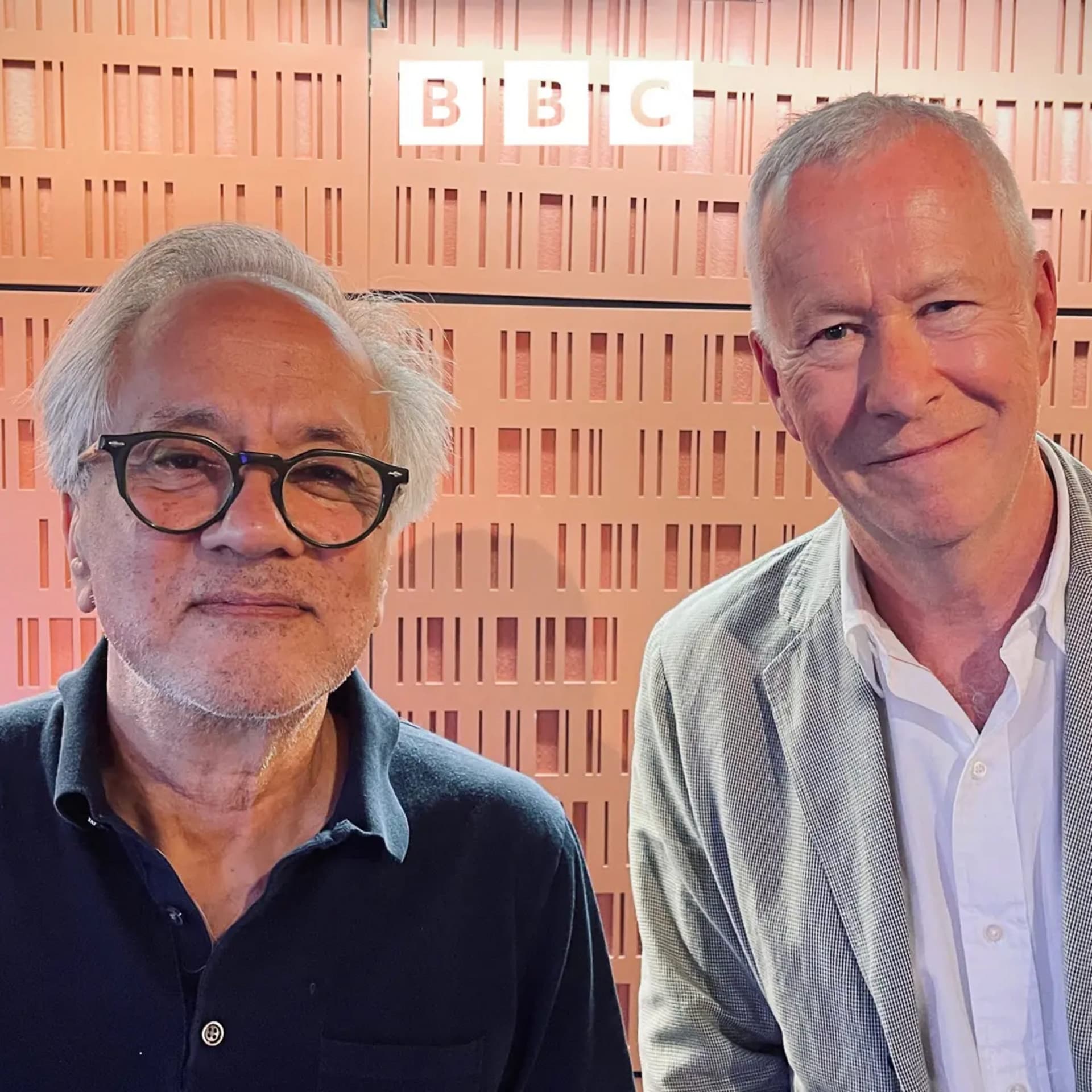
Automatic transcript. May contain errors.0:06Welcome to This Cultural Life, a series in which the world's leading artistic figures reveal the influences and experiences that most inspired their own creativity. I'm John Wilson and my guest in this episode is the sculptor Anish Kapoor. Renowned for his innovative, often monumental works, Kapoor gained international recognition in the late 1980s. He represented Britain at the Venice Biennale in 1990 and won the Turner Prize the following year. Sir Anish was knighted for services to art in 2013. His public works include Cloudgate in Chicago, the Orbit sculpture next to the London Arena, commissioned to mark the 2012 Olympics, and the 110-metre-long structure of giant rings and connecting wires known as Temenos in Middlesbrough.
0:52In 2025, a piece called Butchered, a collaboration with Greenpeace, was installed onto an active shell oil rig in the North Sea as a protest against the fossil fuel industry. The Hayward Gallery in London is one of several cultural institutions around the world that's hosting major exhibitions of the work of Sir Anish Kapoor in 2026.
1:17Anish Kapoor, welcome to This Cultural Life. Thank you, John. I'm really pleased to be here. Many, many times over the years, you have claimed in interviews that as an artist, you have nothing to say. So let's get that out the way before we start. What do you mean you have nothing to say? I think it's really important that my views of the world, which I have very strong views on the world, of course, especially nowadays, don't get in the way of the poetic project. Paul Valéry, the great French poet, said, a bad poem is one that falls into meaning, falls into meaning, no less. therefore one must assume that a good poem is one that sits between meaning and no meaning the implication there i think is that the viewer then comes along the reader the listener the whatever they are comes along and fills that place makes the meaning or helps make the meaning It's not that the work sits there completely passive.
2:32Of course it doesn't. But it allows the space for the poetic project to be completed. So you're passing the responsibility to us, to the viewers. Yeah, it's more than just responsibility. It's engaging, if you like, a cultural life, to use your title here. But by making work which seeks to elicit independent thought, response, strong feelings, emotions, I mean, that is what you have to say in effect, though, isn't it? Totally. Of course it is. But it isn't saying that, I don't know, fascism is bad or that whatever else we might, you know, there's a big difference. Why do you make art, do you think?
3:12What is the primary motivation? Gosh. Maybe that's what we're going to explore over the next 40 minutes. Maybe it's because I don't know how to do anything else.
3:27on this cultural life anish kapoor my guests reveal the most important creative inspirations and influences on their own work and your first choice is growing up in india you were born in in mumbai formerly bombay in 1954 so what did your parents do my father was a hydrographer A hydrographer. Which is ocean map making. And your mother? And my mother was a clothes designer. So science and creativity there. Exactly. Your father was Hindu and your mother was Iraqi Jewish. Correct. So was either religion practiced at home? No. My parents were superbly cosmopolitan and open, modern human beings. You know, this is post-independence India, just post-independence India, one must say.
4:18And they had a very broad, wide view. Even though my father's family were, you know, they ran away from Pakistan. So they were kind of refugees. You know, it was difficult. And my mother's family ran away from Baghdad in the 1920s. Tried to go to America, hated it. and then went back to Baghdad and came east rather than went west, came to India. But they were poverty-stricken. My grandfather was the cantor in the synagogue in Bombay and then in Pune. So even though there was this religious background, my parents somehow were modern human beings. Would you describe them as secular? Yes, I would.
5:02When you were 16, you went to Israel to live in a kibbutz to study there as well. What took you there at the time? Well, we'd grown up in the context of, I don't know, 30 ,000, 40 ,000 Iraqi Jews in Bombay. That was the community. The Israeli agency wanted to bring Jews from all over the world to Israel. And I don't know, much to my horror, my parents decided that it was what my brother and I should do. He was 15 years old, my brother Roy, and I was 16 years old. And we were sent off. It was terrible. It was terrible in what way? It still gives you the shivers to think about it. It still gives me the shivers.
5:48I had the most awful nervous breakdown. I mean, being real, it actually happened. At 16? 16, because somehow it felt completely disorientating. It's as if I didn't understand what was happening or why. It took me a while to recover, but I did. How did you overcome it? Initially through taking Valium or whatever it is that one took in those days. And then I engaged in psychoanalysis. But the main thing for me was I hitchhiked with a friend. We could only afford to get to Istanbul. So we flew to Istanbul and we hitchhiked from Istanbul to London. I wanted to come to London. I wanted to go to art school.
6:40By then I knew I was going to be an artist. I was probably 17 and a half, maybe 18 years old. I was absolutely clear, this is what I'm going to do. I tried to go to art school in Israel, they wouldn't have me, which is great. But sorry, in the midst of this profound unhappiness, that's when you decided being an artist was your calling. and that I wasn't going to listen to my parents, to my father in particular, who wanted me to be an engineer. I understand why. He wanted me to be able to earn a living. What are you going to do as an artist? You'll never make a living. OK, well, I'll take the risk for now.
7:11What to do? So this unhappiness, was it homesickness? Was it missing India? I mean, was it missing your mother, possibly? Possibly. I don't know. I think it was my own, how can I put it, psychic instability. which you know many of us have to to live repair struggle with i think i felt that that was vital for me a awful difficult experience but one i wouldn't give up but was this instability was it only apparent when you were in israel had you had you been a happy child what was the upbringing in india i was a reasonably happy child you know i had my troubles of course with my papa but one of the amazing things that happened in israel was that i had an aunt who lived there already in tel aviv um and she was a kind of strange visionary she had these sort of sense of things and she said to my mother hilda you must go back to india and you must collect some earth from a place that matters to Anish and bring it here and put it under his bed.
8:29I could almost cry, to be honest. And she did it. She went to India, brought some earth, and put it under my bed. I was living on the kibbutz at the time. Ever since then, earth has been one of the magic materials for me. I've come back to it again and again and again. And it's rather overwhelming at one level. Anyway. I can see that this memory is still so strong for you. It is. Do you know where she took the earth from? Was it a particular place? I think it was Deiradoon, in the garden. And what did you do with that earth in Israel? I put it under the bed and then, you know what? I have no idea what happened to it.
9:19Was it a source of solace? Did it give you some strength? Yes, yes it did. So it worked? It worked. Perhaps it was about belonging. Perhaps it was about, you know, at some level inwardly tying oneself to something. And it's weird because it's nebulous, isn't it? It's a bit of earth from India. But I've come back to this thought again and again and again. It's one of those primal materials. Yeah, and that soil took you back, I guess, in a primal way, to childhood, to upbringing. You say, I mean, just give me a sense of that childhood. You say you were reasonably happy. Yes. But at the time, no obvious artistic ambitions apart from just being generally creative.
10:06Well, I was always making something. And my mother would forever be making a painting or rather copying Matisse or whoever it was. She had this strange thing. She would never finish them. And I would. And I would take them somewhere else. You know, in India, we were always the Jewish boys at school. Even though we were Jewish, you know, it wasn't a big, big feature in art. But we were the Jewish boys. So we were slightly outside. We spoke English at home. Most of my friends spoke either a regional language, of which there are so many in India, or Hindi at home. But everybody spoke English. English was at school.
10:44I went to the Doon School with my brother Roy in Derudan and the Doon School was, let's say, I don't know, the so-called Eton of India in those days. I was going to say, this is a very privileged school. It's a very privileged school. And, you know, my father earned a pittance. We went there because there was privilege for high-ranking naval officers who were allowed to send their children to such a school. We could never have afforded to go there otherwise. So you're regarded as the Jewish kids in India at school. How were you regarded when you went to Israel? Oh my gosh, that is a hard part.
11:15That's a hard thing. It was the time when Ethiopian Jews were coming into Israel in the early 70s. And suddenly we were called Kushi, Kushi meaning black. I mean, I'm brown. My brother's much fairer than I am. we were shocked shocked at how it could be that here we supposedly coming home the homeland of the jews we were suddenly set apart again and it was clear this was a term of abuse totally but it was weird and frightening remember we were kids so i knew by 73 before the war I didn't know the war was coming obviously but there I had to go and that's when I set off with this Swedish friend of mine and we hitchhiked to London Well you studied at the Hornsey College of Art and then also at Chelsea as well Yes Many people were introduced to your work around 1990 when you represented Britain at the Venice Biennale and then the following year I think it was you won the Turner Prize and you talk about the soil which links you to India But the other constant over the last 35 years or so since then has been your use of raw powdered pigment and a material which is so associated with India, of course.
12:37Is that where it started? And is that a direct reference, do you think? Yes, I think that's absolutely right. You know, that earth that was under my bed was red and I keep returning to it. And I've often pondered why. Red, of course, it's a colour of vibrance. But, of course, it's the colour of the inside of our bodies. It has this double association. Ritualistic, if you like, internal. Red makes a kind of darkness. There's a particular kind of crimson red. It was there right from the start. The very, very early pigment pieces were all red and white. And that is a reflection of the redness of the soil that you've said.
13:15Precisely. When you were first shown at the Venice Biennale in 1990, I think you were still an Indian citizen. I was. And billed at the time as a British Indian artist. Now that you are a knight, you are Sir Anish, and your work is represented on British passports, what is your relationship to India now? Oh, gosh, it's very important to me. I've lived in Britain for 50 years, but I return to India all the time. Whenever I'm there, I'm with my eyes wide open like that. It's full of magic for me. I can't think of another word. Perhaps being away from it is an important step in maintaining magic.
13:58But I do have a very strange relationship to the idea of home. I don't know where my home is. I'm homeless. I've always felt that.
14:16Your next choice for this cultural life, Anish Kapoor, is Buddhism. When did you first become a practising Buddhist? About 40 years ago. I went to the Buddhist society and felt deeply drawn to what was there and then got involved with the Zen group. Do you meditate every day now? I do. It's very, very important. The essential question here is, is perhaps about going beyond I, going beyond me. The world I inhabit, the art world especially, is full of ego, ego, ego. And this is something, this is a practice that says, uh-uh, it's beyond. Something else must occur which is not just driven by my wish, my desire, my will.
15:12Hard stuff to hold, especially in today's world. And how does that process of silent inward contemplation, how does that inform so much of the works? especially those spaces that are often hewn from rocks, from the walls, from the floor underneath our feet? I've always been very playful, and especially in the studio. I don't see it as a place where one just goes to make things. Who cares? I don't believe in that. I have a practice. I go to the studio every day. It's rather like meditation, if you like, the same kind of thing. I go there every day, and I try to let whatever has to happen happen and not direct it because I've got this thought.
15:58Let's see. Of course, you've got to get the thoughts out of the way. That'll happen first and then something else happens. One day I went into the studio and I made a bowl. It was about a metre and a half, a metre 20, let's say, deep and equivalent wide. So a big bowl, empty bowl, carved out of polystyrene. I coated it with a bit of resin and then put it on the wall and decided to paint it Prussian blue, a colour I'd hardly used until then so I put it up and painted it, say, late in the afternoon and then I went home and came back to the studio in the morning it had dried by then and to my astonishment, I thought I'd come back and it'd be a blue bowl on the wall, you know, okay it wasn't a blue bowl on the wall it was a space full of darkness different things it was not an empty space it was full rather like some of the works in the show at the Hayward so suddenly I thought what is this?
17:01Well you say full, full of what? Full of depth, ideas? Full of darkness It was literally brimmed to the top with darkness That polystyrene bowl was the start of one of the overriding recurring themes of your work which is the void The Void. The Void. And then over the next years, I'd started, just started making some works in stone. And I wondered if I made a negative space in a stone and painted it in this way, could it hold the weight of the stone? Could it have an equivalence, if you like, with the majesty, the weight, et cetera, of the stone? And I made a work called Adam. Of course, the title comes afterwards, as always.
17:46So it was a block of stone with a window in it carved in this particular way and painted the Prussian blue. And suddenly it felt to me like, wow, that negative space is as powerful, as present as the stone. Then I slowly, as I reflected on that over the years, of course, that relates to, if you like, the space inside of ourselves and the space that sits there in meditation. meditation in, all you have to do is close your eyes, you know it's there. And do some of the work start at home during the practice of Buddhist meditation? Or is it distinct and separate? Do you then have to go to the studio and think about your work and meditate on your work in a separate, in a different way?
18:30It's the second of those. So you never have the great idea when you're at home meditating? Hardly ever. Mostly it's something that occurs out of the process of playing, I like to call it, in the studio. So I've tried to work with this notion of the immaterial parallel of the material object. And it's something I've stuck with and gone to again and again and again and again. Some of the most remarkable void pieces that you have made, especially in recent years, have been using Vantablack, this substance. Well, for those who don't understand what it is, Just explain what is Vanta. OK. It's a name.
19:09Vanta Black is a name invented by the company that makes the material. I read an article in, I think it was Guardian, 15 years ago, in which a man called Ben Jensen claimed to have discovered the blackest material in the universe. And he literally said 99.8 % of all light is absorbed by this material, blacker than a black hole what that's impossible so i don't know how i got his number called him up and i we had a chat and he said oh and he's oh come on i'm nothing to do with artists you know i'm making this for space technology for defense industry and so on so forth so i said ben let's give it a go anyway eventually we gave it a go and at the time we could make little panels uh five, six, eight centimetres square.
20:03And slowly we've been able to work together and take it to other places. And just to be clear, it's not pigment, it's not paint? No, it's not. It's a technology. It's a coating that's put on a normally metal surface and then that's put into a reactor. I'm not allowed to know what the reactor is. I know that it's very high temperature. I don't know what else, though. And the particles, which are nanoparticles, stand up, rather like a piece of velvet. And what happens is that the light, as it hits the object, gets trapped between the standing particles, and most of it's absorbed. And the effect is absolutely astonishing.
20:42There's one piece in the Hayward Gallery show that's on at the moment, which is a black circle on the floor of the gallery that appears to be a perfect circle, but it looks like a black rug. There's no sense of depth, and yet I was assured by people in the gallery that there is a hole there, and if I'd walked into that hole, I would have probably disappeared up to my head. Yes, you would have. Yes, you would have, but, John, that is not a Vantablack. That hole is actually painted in Prussian blue. What? Yep. So there are two black objects in the show, in cases. Which are three-dimensional objects, which look from the front on, look like they just disappear.
21:21Exactly. Those are the two Vantablack objects. There's a little sphere, was the first one I ever made, and the other one, which is a big zigzag form. But the other works in the show are all either Prussian blue or black, a different black, not vanter black. But let me tell you a little further, if you like, fictional reality, because art is all about fiction too. In the Renaissance, there were two great discoveries. One we know about, of course, it's perspective, and the other is the fold. The fold, or early Renaissance painting, has this amazing fabric all over it. Of course, the fold is a sign of being.
22:00If you put this black material on a fold, it disappears. Now, put that to one side for the moment. Think of the great Russian painter Kazimir Malevich, who painted a black square in 1915. his proposition also related to hinduism in a sense because he's he was a theosophist was that the black square was a four-dimensional object so it's an object that if you like went beyond the three dimensions we know into some other metaphysical dimension somewhere else right now let me come back to the fold my proposition is alongside malevich that what this material does or can do is to take the object somewhere else.
22:51Let's call it the fault dimension because that's a good way of putting it. That's why I say it's fiction and reality. Yes, it is and no, it isn't. But those parallel things always live with the poetic object. That, I think, is the point. After discovering Vantablack, you secured an exclusive contract to use it as an artwork, a deal which caused outrage amongst some fellow artists. Can you understand why? No. Did it feel like that? Was it not sort of gatekeeping? No, no, no. It was, you know, we were in the middle of a very, very difficult process. Highly technical. It's not a paint. It's much, much more than that.
23:32And there's this silly fellow who's made his name from it. Bless him. I've just tried to not engage. You're talking about Stuart Semple, who's the artist who was so outraged he decided to create the pink as pink, I think. Exactly. And everybody was allowed to use it apart from Anish Kapoor. And Anish Kapoor did use it. He did use it. Somebody sent it to me and I stuck a middle finger up in an Instagram post somewhere or the other just to be silly and naughty. So you don't regret that? I mean, that is a deal that you stand by. It's not restricting artistic freedom of expression? Not at all. There are many, many places in the world that you can use, that you can get hold of this black, black material now.
24:13MIT makes it. All sorts of people make it. This is fiction. If you really want to do it, it's not cheap. It's not easy to use. It's a bloody difficult process. And I've been engaged in it. You know, it's a technical nightmare. Well, and it's incredibly delicate, isn't it? Because looking at this Hayward show and these objects that you have behind glass, so they have to be protected because it would literally fall apart. It would ruin the artwork if we brushed past it. And the material isn't good for your health. It's also extremely fragile, as you say. I hate things in cases, but there's no choice here.
24:54Your next choice for this cultural life, Vanneesh Kapoor, is the American abstract expressionist artist Barnett Newman, who's best known for these very large paintings in which a single colour, like a colour field, is divided down the middle by a bold stripe of paint. He used to call them the Zips. Where and when did you first come across Barnet Newman? I came across Barnet Newman when I was a student at Hornsey. And at first, I must say, I was completely baffled by them. What is this? Yeah, OK, it's a monochrome. Yeah, OK, it's, you know, following on from Mondrian and following on from a certain tradition of abstract painting.
25:40and then I understood that the zip, so-called, was exactly what I'd been looking for. It's a place. What it does is cite the viewer very particularly. What it does is indicate it's normally not a coloured strip, the zip. It's often a blank piece of canvas. And what it does is indicate that there's a space beyond the painting. And it does this in a very, very interesting confrontational way, forcing the viewer into a field of color. So you have, you know, let's say it's a red canvas, because I like red, but they often are red. He liked red as well. Exactly. You know, which is when you stand at the right place, beyond 180 degrees of your eyes focus.
26:32Then you're immersed. So you're immersed in the color. and then there's this zip in front of you, which is a space beyond, a space through, a space somewhere else, the void, in other words. So I've come back to this physically and metaphysically again and again and again. You know, if we compare a contemporary of his, Rothko, I feel Rothko's much easier to understand than is Barney Newman. Barton Newman is pushing that concept of spatial uncertainty to a much more difficult place. Intellectually, I also feel Barnett Newman's really challenging. What art can be? One of the questions that arises, you know, why isn't this just a decorative piece of...
27:18Why is it art? Love that question. That's a great question. But had you already seen Mark Rothko at this point when you came across Barnett Newman? I probably had. Because he would have been the bigger artist even then. Absolutely so. So Rothko, who'd already died and bequeathed the paintings, the ones known as the Seagram series, to the Tate, which are big and red throbbing paintings. Well, they're very, very dark. They're not red, but yes, OK. But there was a crimson aspect to that. Correct. What's really interesting, though, is when you sent this list through to us and Barnett Newman was on there, I initially thought that's interesting because I can't really see the relation.
27:55The way you're describing your initial reaction to a Barnett human painting, the field being immersed and then the zip being almost a portal. So it is the void. And he was the start of that, along with the Buddhist. Yeah, without realising it. Yes. How does the sense of scale of his paintings as well, because often they are very large canvases. They're big. How does that relate to your own often very monumental sculptural work in particular? Yes. I'm interested in colour as a condition, not as a coating. And one of the things that happens with Barnett Newman is when you stand in the right place and it's the right painting, of course, always has to be the right painting, you're immersed in colour.
28:43It is, you know, Yves Klein does that too at a different scale. And that is fascinating, fascinating. And that's what I've returned to. I've often talked about it as saying, you know, that I want colour to be almost as if you're going into a shower. You get completely wet. If you're looking at something red, I want you to get completely red. Colour as a condition? As a condition. Is that a form of synesthesia are you referring to? In a way, yes. So the colour itself is affecting the condition, the thought process, the emotion. Correct, correct. And I've returned to that again and again. Your current exhibition at the Hayward Gallery in London is one of, I think, six major shows around the world in 2026, all showing different work.
29:30So this is a real, it's almost like an industrial operation now, a production line. How do you ensure that with such a massive team of assistants as well that there is enough Anish Kapoor in a Kapoor work? OK, OK, OK. Now, wait a minute. I don't have a massive team of assistants. I have about 12 people who work with me in the studio and eight or nine people who work upstairs in the office. Administrative stuff is huge. Sure, that's in the studio, but then there's all of the people that are involved in the construction. Indeed. So at the Hayward, for example, on the terraces, there are stainless steel works.
Read the full transcript
30:07I've worked with the same fabricator in California for the last 30 years or more. and it's taken us him and me a long time to understand how to make these things well enough shiny stainless steel if you have it on a convex form the images on the surface are reduced in scale but on a concave surface which is most of my surface everything's enlarged the images are huge And the surface itself is so present. So we're looking. It took us, I don't know, 10 years to understand how to make those surfaces pure enough so the surface didn't get in the way because it's concave. And we can now, I mean, there's the work at the Hayward called Tsunami.
30:57I mean, technically, it's a masterpiece. I say so myself. But technically, this is Ethan Silver, this man in California who made it for me. I mean, what a job he did, my God. I'm amazed at it, frankly. And it's only then, in that condition, that it does what I'm after. So here again, the void pieces are spaces, I say, full of darkness, and the mirror pieces are spaces full of mirror. They're not just empty mirrored surfaces. They're full of mirror. That's really important, this sense of the space of the object being full of this mirror. And I discovered it completely by chance. when I was making the Voidworks, I wondered to myself, I wonder what would happen, stupid idea in a way, if this is a mirrored space.
31:45And so I made the first one, I made it like this big, you know, I don't know, a foot in diameter. And I was astonished that it worked. So when that idea strikes you, how do you follow that through? Because you say it's a stupid idea. Yes. I mean, are they often the most random, stupid ideas? Yes, they often are. And that idea that starts as a kind of sort of random, stupid, kind of maybe madcap scheme, do you then work alone for a while in your studio? Is there a notebook? Is there sort of a pinboard of ideas before you take it to that not so massive team of assistants? I normally draw on the wall in my studio.
32:23I have notebooks, of course, but I normally draw on the wall. So the studio walls are covered in drawings. and I find that process very important because often I think I'm looking at this and then over there out of the corner of my eye I'm looking at that and oh, oh, there it is. So there's all kinds of statements written on the wall, there's all sorts of things. I have written on my wall and have had since I was, you know, disobey, disagree, disavow. Three words written huge on the studio wall. I've always felt that was really important. That's kind of an artistic mantra to you, is it? It is in a way.
32:57and the other one is don't believe your own bullshit which I wrote on my studio wall a long long time ago in 1983 I did a show in New York and every work sold and everyone told me I was a genius oh my god you're incredible wow wow wow I was a kid I then came back to London and tried to go to my studio I could do nothing I spent six months making nothing because I had this crap in my head So one day I wrote this on my wall, don't believe your own bullshit. And it was a huge help. I mean, the works are now shown around the world. Your work is collected in museums and galleries and in private collections.
33:38They are fetching, you know, regularly six-figure sums. It's incredibly expensive to buy an Anish Kapoor work. What does the monetary value do for the inherent value that you're seeking in that work or that you're wanting us to seek in the work? Very good question, very difficult question. It's as if almost everything in the cultural world has been taken over by capitalism, by capital, especially in the art world. Was that not the case in Renaissance Florence? No, it wasn't. It wasn't the same at all. When I left art school, there couldn't have been ten artists in the UK who made a living from their work.
34:21You know, Henry Moore, David Hockney, Lucian Freud, etc. Almost everybody taught to make a living and then did their work. And that's what I thought I would do. So my generation is the one older than the YBAs, the one before the YBAs. The art world changed and suddenly it became possible to sell objects. We made a living from our work, amazingly. That has taken over to such a huge extent that it's hugely problematic. Now, I've been very, very, very lucky, may I say. But I have two sides to my work. I make certain works that are in the market and that, as you've just said, are there and do very well for me.
35:05And then the other side of my work, which is, for me, the true adventure, I've almost never sold a single one. So a wax piece, there's maybe one in a museum. And is that money that you're making from the market reinvested? Precisely. In effect, underwriting the more experimental works. Precisely. And that's what makes it possible, in a sense. This highly geometric, perfectly made, very classically conceived thing that I feel is important. And then the messy, visceral, whatever, the other side. Is it possible to look at all of that work? I mean, almost impossible question, I'm sure. Is there a favourite work of yours?
35:48Oh, my God. I'm afraid there might be. It's descent into limbo, which is the void in the floor that you don't know whether it's a carpet or a hole. But it's in fact Prussian blue. Prussian blue indeed. Prussian blue. And does descend, what, six feet down, something like that? Or do you never tell people how deep is it? It goes to the centre of the earth. Come on, John. Do you know, when I first showed that work, It was at Documenta, which is one of these big biennale shows in Germany. Those things, there's always a line, huge line, especially at the opening. And this gentleman came into the room, and I happened to be in the room at the time, and he was furious.
36:30He said, oh, I've done all kinds of things in the name of contemporary art, but I've never stood in a line for 45 minutes in order to look at a black carpet on the floor. And then he was wearing sunglasses. He took his glasses off and threw them at this thing, thinking it's going to land on a carpet. I'll pick my glasses up, I presume. And, of course, they disappeared. He was horrified. He withdrew himself like that, saying, oh, what is this? And, of course, that for me is, if you like, a real measure. You know, Polonaire's proposition that you take the viewer to the edge and then push them over.
37:08So this, the Kantian sublime, sitting both in wonder and in fear, I think that's the key. Another difficult question. Are there any of the works that you regret or wish you hadn't made, put on public, that you look back now and think they just don't work in the same way? Inevitably. Inevitably, there are works that work better than other works. But I have a rule, which is never to let anything out of the studio for at least six months, unless it's a big work. I can't do that with a big work, but I'll make something, work on something. It'll sit in the studio. Once again, I'll probably view it through the corner of my eye.
37:46Often it's much, much more than six months. I mean, I'm prolific. I make lots and lots of things. But this process is really important. It's a questioning of the work. Is it good enough? Difficult to do that if it is a large-scale work. It's impossible. And you're only working and looking at a maquette. Impossible to do that. I mean, one of your most publicly visible works is The Orbit Tower, which stands alongside the London Arena. It was commissioned for the 2012 London Olympics. I think it's fair to say it's not one of your best-loved pieces. I do understand. Do you stand by it? I stand by it.
38:18Of course I stand by it. But at the same time, I do understand that it's, if you like, an engineering feat. I made it with a great engineer, Cecil Balmond. Cecil Balmond, who you've worked with a lot. Who I've worked with before. But to remind people this is the tower, it's wrapped with a sly, like a helter-skelter slide, which is designed by Carsten Holler. Correct. And then your sort of almost double helix shape wrapped around it. Yes. It's not just one artwork. It's sort of two artworks and one piece of engineering. Exactly. A bit awkward in that way. Perhaps.
38:53I'm going to return to the thing at the beginning. You have nothing to say with your art. And yet you have used your art as a form of political protest. recently there was a massive i think it was a 12 meter by 8 meter canvas which was hung from a north sea oil rig and then sprayed with fake blood was that art or activism it was both i hope i mean i'm i'm horrified at what we are doing to our environment but i'm also horrified by what our governments are doing to people who stand up and protest. How dare they? It is our democratic right to speak out, to go on the streets, to, I mean, arrest people for protesting for Palestine.
39:41I mean, honestly, honestly, it's atrocious. So anyway, the site, the oil rig, wow, what a great site in the middle of the ocean. Oh, wow. You know, I've been a long admirer of Greenpeace and what they've been doing for generations to bring our attention and to point the finger at these polluters and so i felt that first of all it's a great site we tried to do this the summer before but the weather was terrible so we couldn't so we practiced and practiced they practiced i should say these incredible climbers and sea captains and incredible because they hoist this canvas alongside the oil they put up a huge frame then they hoist the the canvas on it and then they And somebody opens the nozzle at the top and the red paint, or it's not paint, but it's kind of a red dye.
40:28Exactly. Just to clarify, that's not you at the top of that platform spray. No, it's not me. No, no, no. I'm afraid of that. I couldn't do that. I wish I could, but I couldn't. And then, of course, the wind came along just at the right moment and blew it across the canvas the most beautiful way. So at one level, it's a great sight. It's a work that I stand by as a work. And it's a form of proper protest. It's interesting that Shell didn't dare sue Greenpeace. They threatened to, but then they didn't. What drives you on creatively? I don't know how to answer that question, except that I feel I have a huge amount to do.
41:06That there is a sense that this exploration I've begun of the void object has a parallel with other interior inner spaces. In this exhibition at the Hayward, there are much more visceral, bloody inner objects, if you like. And I feel there's a whole lot to do there. Quite what it is, I don't know, but we'll see. So these large-scale pieces, the sculptural pieces, which are like blood and guts, that is a sort of departure for you, and that is almost a hint at the next direction then, is it? I think it is, yes. Anish Kapoor, thank you very much indeed for sharing your cultural life with us. Thank you, John.
41:47It's wonderful.
41:56Well, I hope you enjoyed that conversation with Anish Kapoor, who's just one of many of the world's leading artists who have been on This Cultural Life, including Tracey Emin, Anthony Gormley, Marina Abramovich, Anselm Kiefer, to name just a few. You can find them and every other guest from all the previous series on BBC Sounds or wherever you get your podcasts internationally. And please do subscribe to the series so that you never miss an episode. From producer Edwina Pittman and me, John Wilson, thank you very much indeed for listening to This Cultural Life.
42:31So, Alice Loxton, I'm here for the history. Well, Ben Henderson, I like the formality. And that's perfect because we have a lot of history to share. Why did tea become such a British obsession? How did English turn into the language we speak today? And yes, why do women's clothes still not have pockets? Well, in our new podcast, Here for the History, we're investigating how stories from the past shape everyday life today. Basically, the things we've all noticed but never stopped to question. Listen on BBC Sounds. Or watch on YouTube. Just search for Here for the History.
From the publisher
The artist and sculptor Sir Anish Kapoor talks to John Wilson about his career and cultural influences. Renowned for his innovative, often monumental works, Kapoor gained international recognition in the late 1980s. He represented Britain at the Venice Biennale in 1990 and won the Turner Prize the following year. His public artworks include Cloud Gate in Chicago, the Orbit sculpture next to the London Arena, commissioned to mark the 2012 Olympics, and the 110m-long structure of giant rings and connecting wires known as Temenos in Middlesborough. In 2025 a piece called Butchered, a collaboration with Greenpeace, was installed on to an active Shell oil rig in the North Sea as a protest against the fossil fuel industry. The Hayward Gallery in London is one of several cultural institutions around the world that is hosting major exhibition of the work of Anish Kapoor in 2026.
Producer: Edwina Pitman