In short
Author Michael Frayn discusses the influences behind his writing across genres—comedy, novels, journalism, translation, and major stage works—linking childhood reading, school encouragement, wartime-era ideas, and research into nuclear physics and history. He also reflects on memory’s uncertainty, the gap between intentions and outcomes as a source of comedy, and how characters “take on a life of their own.”
Guest backgrounds
Michael Frayn (born 1933) is a novelist, playwright, journalist, translator, and memoirist; known for Noises Off, Clockwise, Headlong, Democracy, Copenhagen, and Chekhov translations. Interviewer: John Wilson.
Key claims
Chekhov is funnier than people assume; farce depends on contagious laughter; Scoop’s humor comes from helplessness in rigid behavior; his childhood “spy” game became Spies; learning Russian began via National Service and led to Chekhov translation.
Notable examples
Arthur Ransome’s Swallows and Amazons; Shelley’s Ode to a Skylark; Spies’ mistaken-identity memory; Chekhov’s late plays; Scoop and Fleet Street; Noises Off backstage insight; Copenhagen’s Bohr/Heisenberg uncertainty/complementarity; Headlong’s missing Bruegel idea.
Written by AI. May contain mistakes. Listen to the episode to check what was said.
Chapters
Tap a time to open that second in VOMichael Frayn's Diverse Career
0:46 to 6:00
Exploring Michael Frayn's extensive work across various genres and themes.
“He's also renowned for his stage adaptations of Russian classics, including several works by Anton Chekhov.”
Childhood Influences
6:01 to 8:25
Frayn reflects on his childhood memories and literary influences.
“And maybe that's what put the seed in my head.”
The Impact of Family Tragedy
8:26 to 11:21
Discussing the effects of his mother's sudden death on his life and writing.
“The book's very much about the imagination and the uncertainty of memory.”
Learning and Writing
11:22 to 13:20
Frayn shares his experiences in learning Russian and its influence on his writing.
“Would I have put it on the shelf and forgotten about it or would I have persisted?”
The Art of Translation
13:21 to 14:00
Exploring Frayn's work as a translator and his relationship with Chekhov's plays.
“I read that Alan Bennett was also on that same course.”
The Journey into Chekhov's World
14:00 to 17:43
Explore Michael Frayn's unique approach to translating Chekhov and his insights into the playwright's comedic nature.
“And that's what we were really being trained for, interrogating prisoners.”
The Influence of Scoop on Journalism
17:43 to 21:24
Discover how Evelyn Waugh's Scoop shaped Michael Frayn's perspective on journalism and the challenges of reporting.
“Rather smaller checks than Alan has got from writing his own works.”
Noises Off: A Farcical Journey
21:24 to 23:29
Learn about the inspiration behind Noises Off and the creative process of writing farce in theatre.
“Somebody told me that you based a character on me.”
The Evolution of Michael Frayn's Theatre Perspective
23:29 to 26:36
Delve into Frayn's changing views on theatre, from disdain to acclaim, and the impact of his early experiences.
“And now, of course, you are regarded as one of our greatest living playwrights.”
Collaboration with Claire Tomlin
26:36 to 28:00
Uncover the collaborative writing process between Michael Frayn and his wife, Claire Tomlin, emphasizing their mutual influence.
“We're trying to advance our own careers.”
Show all 19 chapters
Collaborative Writing Process
28:00 to 28:50
Learn how Michael Frayn and his wife evaluate each other's drafts.
“Do you and your wife, Claire Tomlin, read each other's first drafts as you go along?”
Inspiration from Thomas Powers
28:50 to 29:41
Explore how Frayn's reading influenced his play about nuclear physics.
“Or when she was writing about Jane Austen, we walked around a lot of Hampshire together.”
Heisenberg and Bohr's Meeting
29:41 to 30:28
Discover the historical context of Heisenberg's visit to Bohr during WWII.
“I have to say that I'm not in any way a scientist, but I did study philosophy, and if you study philosophy, you can't help but come across quantum mechanics because its philosophical implications are so weird.”
Uncertainty in Science and Life
30:28 to 33:04
Understand the parallels between Heisenberg's uncertainty principle and human intentions.
“He was known for the uncertainty principle.”
The Idea Behind 'Headlong'
33:04 to 35:03
Learn about the unique inspiration for Frayn's novel 'Headlong'.
“Your novel Headlong is about an unscrupulous art historian who thinks he spots an unattributed Bruegel on the wall of a country house.”
Character Development in Writing
35:03 to 36:57
Explore how characters evolve during the writing process for Frayn.
“And you might, of course, make a reputation from it, make a bit of money out of it.”
Reflections on Aging and Writing
36:57 to 39:23
Frayn discusses the challenges of aging and the writing profession.
“Muriel Spark says just start with the title of a book, and then once you've got the title, then start writing.”
My Father's Fortune
39:23 to 40:45
Hear about the personal connection Frayn has with his book 'My Father's Fortune'.
“so you've done pretty well to continue well past retirement age yes I told one of my children the other day that I was feeling 90 years old and they said, oh, that's good news, because you're 92.”
Influence of Frayn's Father
40:45 to 41:50
Discover how Frayn's father impacted his career and writing journey.
“And I think I gave him a belated thank you in that book.”
Transcript
Automatic transcript. May contain errors.0:06Welcome to This Cultural Life, the series in which leading artistic figures reveal the influences and experiences that most inspired their own creativity. I'm John Wilson and my guest in this episode is the author Michael Frayn. Over a seven-decade career, Frayn has been acclaimed as a novelist, a playwright, a journalist, translator and memoirist. From his comedies, including the stage farce Noises Off, a screenplay for Clockwise starring John Cleese, and the novels Headlong and Skios, to the complex political, historical and scientific themes of his stage plays Democracy and Copenhagen, he's been prolific in a diverse array of genres and subjects.
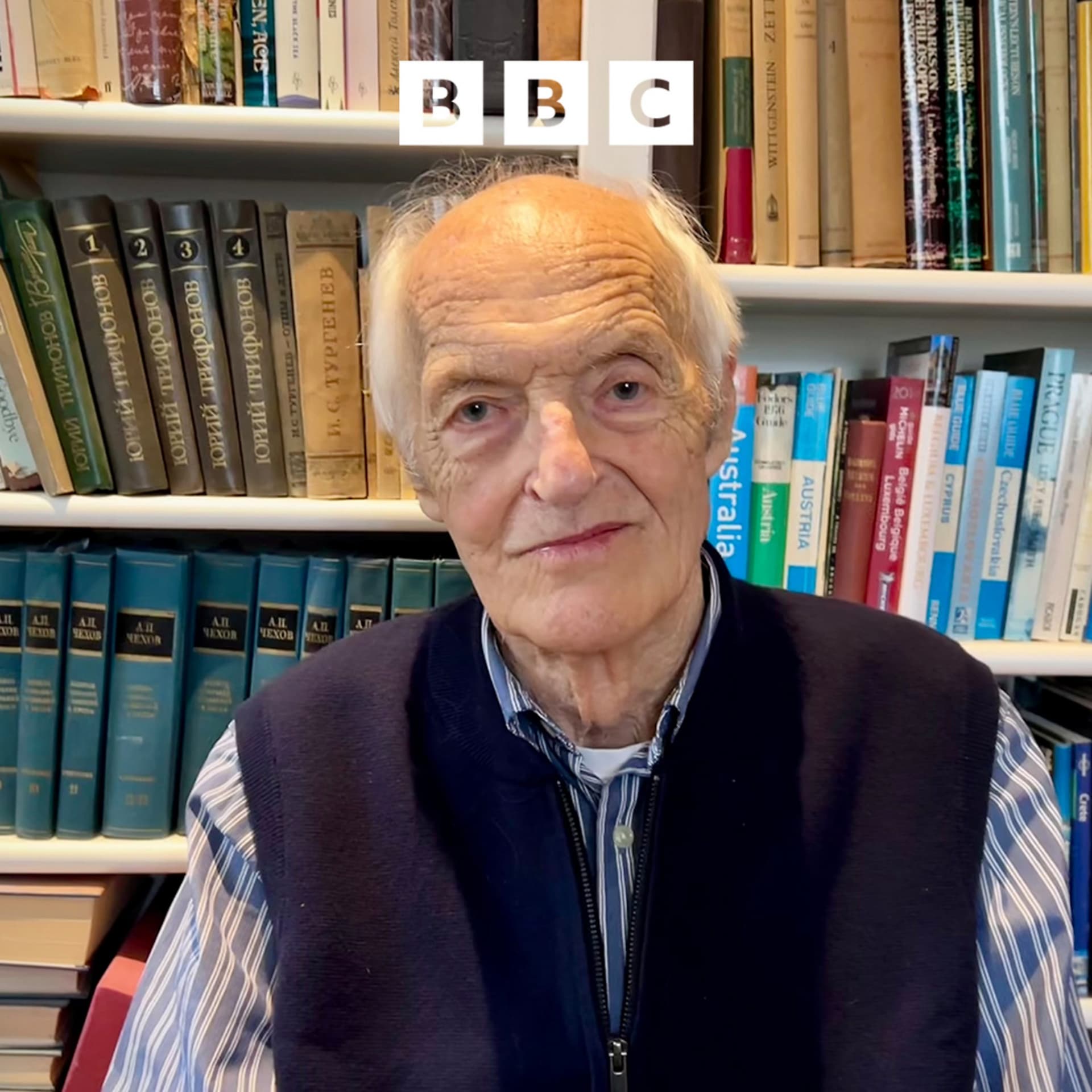
0:46He's also renowned for his stage adaptations of Russian classics, including several works by Anton Chekhov. At 92, Michael Frayn advised on a recent revival of Copenhagen at the Hampstead Theatre. Michael Frayn, welcome to This Cultural Life. Or I should say, thank you for welcoming us into your home. Well, thank you very much for coming here. I'm really interested, Michael, looking around your library, looking at the shelves. Just as there are so many facets to your writing, so many different themes, they seem to be ordered by theme on the shelves. So there's nuclear physics down here. There's lots of travel.
1:21There's a philosophy section clearly up there, isn't there? Yes, and there's a Cyrillic section here. What about at home as a child? Can you remember books at home? We had the complete works of Shakespeare, which I think my father must have won in a competition or something, but he didn't throw in much books. That was about it. Really? I wish I could remember any other books. No, I had quite a lot of books, but I don't think my parents did. You were born in 1933. 1933. What are your earliest memories of home life, family life? Well, we lived in the suburbs in Ewell, which is not all that far from here, the other side of Kingston.
2:01My father was a rep for a firm that made asbestos building components. And he always said he thought he could get me into the firm to train as a rep. I would have been the worst rep in the world. Also, it turns out that the asbestos industry was a rather less secure form of living, even than literature. Did you have asbestos in the house? Did you bring samples home? Yes, he used to bring samples home, and I used to saw them up and fill the air with asbestos dust. And about 15 years ago, my sister got a mesothelioma, which is the cancer of the lung lining, specifically associated with asbestos.
2:46and the only asbestos she could remember being exposed to was the stuff that I was throwing up in the garden. That's terrible. And it comes on often very, very late, often after 20, even 30 years. In your 2010 memoir, which was called My Father's Fortune, you explored your family backstory and it also recalls the tragedy of your mother's death when I think you were 12 years old. She died very suddenly, didn't she? Yes. What do you remember of that day? I just remember we were all about to go out to a party to celebrate either fireworks night or VJ Day, I can't remember which hour. And she was walking across a room downstairs and she had a heart attack and dropped dead halfway across the room.
3:35And I just remember my grandmother who lived with us running upstairs calling for my father. And I knew from the way she was shouting something awful that happened.
3:48And after a few years, very grey years after she died, life began to improve. And at a time when a lot of teenagers' lives were getting worse, mine was getting better.
4:09On This Cultural Life, Michael Frayne, my guests choose the influences and experiences that have most inspired their own creativity and the first choice on the list that you sent us is arthur ransome author of the swallows and amazon series so when did you first read him and and those stories oh probably eight or nine and i read them all over and over again i was actually obsessed with them and when i was about probably about 12, I decided I would write a novel myself about children who went sailing in dinghies in the Lake District, in spite of the fact that I'd never been to the Lake District, never sailed in a dinghy, never even seen a dinghy.
4:51So it was all pure cultural influence from Arthur Ransom. Inspiration or plagiarism? But I've never been writing stuff ever since I could write sketches for my puppets and for my sister and myself do at Christmas. Puppets. You had puppets as a child. Yes, because my friend David, who was clever with his hands, built a beautiful puppet theatre for himself. So I had to build a puppet theatre. I had no skill in my hands and my puppets couldn't stand up. They fell down all the time. It's also very difficult to keep puppets on their feet. If you're reading the text of your play behind the screen, they tend to float.
5:28And who's written the script? You? Of course, yes. Of course, so your first plays. My first plays, yes. So did you know as a child that writing was the future for you, do you think? Yes, I sort of knew that what I wanted was to be a writer. My father was an influence as well because I remember I wrote an essay on the house I would like to live in one day. My father read it and he was not much given to encouragement. It wasn't the way then. But he said, it's very good, maybe you ought to be a journalist. And maybe that's what put the seed in my head. So I also wanted to be a writer, but I also did want to be a journalist.
6:08In your notes, you also mentioned a teacher at school called Mr Brady. Mr Brady, yes. It was a particular encouragement. Well, I had a rather bad patch after my mother died. I had to move schools and move from class to class. It started by being more or less top of the class. and rapidly sank to being bottom of the class and everything because I discovered I could get the approval of my classmates by mocking the teachers, which was probably quite a good professional training, as it turned out in life, but with very bad effects at the time. But we had one teacher, Mr Brady, who taught us English.
6:48He didn't really teach his English. He taught us in the periods marked English on the timetable. and he used to mark my essays, all 30 out of 30, and read them out to the class. I was tremendously cheered by this, very encouraged. So, of course, I worked very hard at pleasing him, writing the essays. And one day, when I was about 15, I think, he read us Shelley's Ode to a Skylark. And I, I think the whole class, actually, were absolutely enraptured by it. I'd never heard anything so beautiful in my life. It was just wonderful that the world suddenly seemed a much wider, more amazing place than I'd realised.
7:30In the golden lightning of the sunken sun, or which clouds are brightening, thou dost float and run like an unbodied joy whose race is just begun. The pale purple even melts around thy flight. Like a star of heaven in the broad daylight, thou art unseen. But yet I hear thy shrill delight. keen as are the arrows of that silver sea. That set me off writing poetry. And the friend I made at school, who was called Michael Lane, we were Michael Frame, Michael Lane, no one can tell us apart. We were very close friends. We discovered music and literature together. Between us, we wrote enough poetry to fill the Oxford collection of English verse.
8:12Was it good? No.
8:16No, they were terrible poems. In your 2002 novel Spies, your elderly protagonist looks back on childhood events in which he and a friend become convinced that the friend's mother is a spy. The book's very much about the imagination and the uncertainty of memory. So how much did it owe to your own uncertain memories of childhood? Well, it starts off with a very clear memory. The two central characters, the little boys, are very much based on myself and my closest friend at the time. and he was the leader in all our games. And what I remember clearly is his saying at some point, out of the blue, my mother was a German spy.
8:59And it was obviously the start of another game. And I think we followed his mother around for an hour or two and she didn't get in touch with the German high command or steal any plans for secret aircraft or whatever. And we got bored and gave up. But I just started to think, what would have happened if we'd been a bit more persistent and we followed around? What would we have made of an adult life? Particularly if there turned out to be some sort of discrepancies in it, as there is in most people's lives. That afternoon, when Keith's mother has retired for her rest, we enter the sitting room and glide silently across to the desk.
9:40Keith bends down and peers at the blotter through the magnifying glass from his stamp collecting kit. I think I can make out a few odd letters, and perhaps even one or two syllables. Thurs, possibly. And if you could, whispers Keith. Those two central characters are based on memories, and my friend's parents are very much based on my friend's real parents. A funny thing occurred towards the end of writing the novel. It occurred to me that if I was still alive, my friend might still be alive, and he might not like the picture I painted of his parents. So I tried to get in touch with him. I couldn't find him anywhere.
10:27But before I finished the book, out of the blue, I got a letter saying, you won't remember me, but we used to play games together when we were children, and we had a camp in a hedge from where we fought the Third Reich. In case I still didn't remember who he was, and of course I did, he said at the bottom, the one with the terrible father. So of course I had to get in touch with him and tell him that I was writing this book and when I finished I showed it to him. I don't know what I'd have done. If he'd said, I really find this very offensive and I'm very hurt by what you've said about my father...
11:10We should just explain, the father in the book is incredibly controlling and the friend's mother is clearly living in fear of him. Yes, absolutely. So that was based on real events. It was a brutal twist, his son. What would I have done? Would I have put it on the shelf and forgotten about it or would I have persisted? Anyway, he was very generous about it. He very much liked it. and what he particularly liked was the picture of his father and his father, he said, had simply ruined his life by his coldness and cruelty. What an amazing coincidence that he found you while you were still writing the book.
11:46Yes. Well, as he said, I've been thinking about the past and I've been thinking about the past and he said, I think it's called old age.
12:03Your next choice, Michael Frayne, is learning Russian. In the early 1950s, you did national service and you joined the Army Intelligence Corps and were selected to learn Russian at Cambridge University. So were you being trained to become a spy? I wanted to... I tried to teach myself Russian at school because my friend and I were the sort of private branch of the Communist Party and I knew everything was wonderful in Russia and I wanted to know more about Russia. I didn't get very far with teaching myself Russian but when I did National Service, I discovered that there were various courses for translators and interpreters.
12:44So I applied for them. And in the middle of basic training, another man and I were sent for by the personnel selection officer. I was rather tall. He was very short. We stood there in our very scruffy work denims and the personnel selection officer said, I see you've both applied for the Russian course. I suppose you think this is a skive. Well, I can tell you that if you learn Russian, you may be dropped behind Russian lines at any point. So we said, yes, I understand, sir. And off we went to learn Russian. Well, in fact, our Russian never got good enough to be passed. I read that Alan Bennett was also on that same course.
13:24He was on the same course, yes, yes, yes. And we were friends. film. Really? You can't imagine Alan Bennett being a sort of trained for espionage? We weren't really being trained for espionage. It was the time of the Berlin Air left, and it seems as if there might be a war with Russia. People realised that the only people who spoke Russian in the country were ex-Russian nationals. And there's always, of course, a question mark over their loyalty, as seen by the authorities. Yes. So they hastily began these schemes to teach linguists in order to interrogate prisoners, to listen to enemy broadcasts, read enemy propaganda and so on.
14:05And that's what we were really being trained for, interrogating prisoners. One of your many literary achievements is to have become a preeminent translator of the work of Anton Chekhov, including all of the late plays, The Seagull, Uncle Vanya, Three Sisters, The Cherry Orchard. To what extent can that love of Chekhov be traced back to learning Russian, do you think? Certainly to learning Russian and reading Chekhov. But I started translating him because the National Theatre asked me to translate Goldoni. And I said, I don't think I'd do it because I really seriously know any Italian. And the dramaturg at the National Theatre said, oh, good heavens, you don't need to know Italian to translate Goldone.
14:52We just go out and buy some standard translations and you take them home and you lash them together into your own version. So I was really eager to be produced at the National Theatre, so I took a lot of the Goldone translations home and read them. But I couldn't feel what the original was like through these different versions. So I said, why don't you ask me to translate from a language I do know, Russian? I don't think the dramaturg had ever thought of that before. He was rather stuck by the idea. So that's how it began. How are your versions different from many of the others that had gone before?
15:29Well, everyone translates Chekhov. I'm sure you've translated Chekhov. No, there can't be many citizens left, and you haven't, because everyone knows what Chekhov said in his plays, and you don't need to look at the original. But I think sometimes, if you look at the original text, you get a bit of a surprise. It's not quite as you've supposed from all the versions you've seen. You said that your translations of Chekhov, your versions are more direct, they're more conversational, they're possibly funnier than a lot of other adaptations of Chekhov. Do you recognise that? I think for years people didn't realise that Chekhov was a funny writer.
16:08And all the early translations of Chekhov were just sort of strange and about these remote, weird people who had a completely different view of life from us. And it's not really like that. Chekhov was a comic writer long before he was a playwright. And he wrote an enormous amount of comic stuff. And there's always comedy in his things, however serious. And his characters are not really all that different from middle-class English people. A lot of what people thought was strange was the kind of self-deprecating humour that English middle class people use to protect themselves, and so do Russians.
16:53Michael Frayn:Are you serious about her? I call on her nearly every day. I make conversation, I endure the boredom, I put her mother to some expense in coffee, and there we are. Quite what draws me back each time. Whether it's love or whether it's boredom, I don't really know. All I know is that I miss her quite painfully after lunch sometimes. So it's love then. I'm just going to wrap up this thought about Chekhov by throwing a quote back at you from your fellow Russian translator, Alan Bennett, who once said that Michael Frayn is the man who drew the cheque from Chekhov.
17:37Fair enough? Rather smaller checks than you get from writing your own works. Rather smaller checks than Alan has got from writing his own works.
17:53Your next choice, Michael Frayne, is Scoop by Evelyn Waugh, his 1938 satirical novel about newspaper journalism, which you say is the funniest book ever written. So when did you first read it? I suppose when I was in late teenage, I've read it several times again since. I think it's the funniest book I've ever written. Maybe there are funnier ones, but I haven't come across them. Lord Copper was at his desk. Come in, Mr Boot. This is a great pleasure. I wanted to meet you for a long time. You may sit down too, Salter. Is Mr Boot all set for his trip? Up to a point, Lord Copper. Excellent. Remember, the Patriots are in the right and are going to win.
18:41The Beast stands by them four square, but they must win quickly. A few sharp victories, some conspicuous acts of personal bravery on the Patriot side and a colourful entry into the capital. That is the Beast policy for the war. So this is well before your time as a newspaper journalist working for the Manchester Guardian and then the Observer. Yes. How familiar was Fleet Street, the atmosphere of the place, the working day, the sort of characters that you met there? How familiar was that, having read Scoop? Well, in Scoop, the characters are working for a version of the Daily Express, going out to cover the war in Ethiopia.
19:19I have to say that reporting, serious reporting, is some of the hardest writing I've ever done. Actually describing the world that's in front of your eyes is very difficult. It's harder than fiction. In fiction, the thing falls into place in your head. If a story is working, everything seems to fall into place and the characters seem to invent themselves. If you go out and look at real people and real situations, you're constrained by what you see. And getting what you see into words is extraordinarily difficult. and journalists who can really do it are remarkably talented. You wrote your own Fleet Street comic novel towards the end of the morning in 1967, so you were still working at The Observer then when you wrote that book.
20:12Yes, I was, yes. Did colleagues recognise fictionalised versions of themselves? The central character towards the end of the morning was a man called John Dyson and he was very closely based on the leader page editor of the Observer who handled my copy. I was very fond of him. He was a rather extravagant man, extravagant in his praise and extravagant in his views of the world. People would say things like, oh, Michael, you write like a darling. Anyway, I was fairly free in borrowing a lot of his characteristics for the book. Congratulations, everyone, the Observer read it and they all came up to me one by one.
20:55They said, is that supposed to be... I don't know what his real name was now, or was just a bit of a fictitious character. And did he know himself? Did he know himself? Never mentioned it. And he was the kind of man who could never keep anything to himself. If he'd thought of it, he would have burst out at once. And he never said anything about that. And then finally, about ten years after the book came out, as we walked back to the office. He said, Michael, I know. There's something we need to ask you. Somebody told me that you based a character on me. I thought, oh, well, I'll just have to...
21:36I've thrown up. And he said, but I saw that play and the character was nothing like me at all. And you've got the wrong character. Wrong work, wrong genre. Throughout your writing career, there has been not only a huge range of writing genres and themes, but the tone as well, from the very serious, the scientific and the political works, to the deeply farcical. Let's talk for a moment about your most famous comedy, Noises Off. Inspired by watching the very first play that you wrote, The Two of Us, watching it from backstage in a theatre, so how did that experience inspire Noises Off? Well, my first play was in fact four short plays, and one of them was a farce, because I adored farce.
22:22and it wasn't terribly good. None of the plays were terribly good. And one night, I can't remember why now, I went and watched it backstage and saw the characters running desperately from one door to another, doing quick changes as they went, and I thought, this is funnier than what's going on around the front. And it turned out to be a very easy thought to think, but an extremely difficult thing to do. And I wrote many, many, many drafts and attempts at it before I had a workable version. Even then, I didn't think anyone would ever perform it. It's been performed all around the world ever since.
23:01It's gone everywhere, yes.
23:02Michael Frayn:This is such a nice company to work with. It's such a happy company. Wait till we get to Broadway in six months. If. Wait till we get to Cleveland in three months. Lloyd, my darling, are you all right? I'm starting to know what God felt like when he sat out there in the darkness creating the world. And what did he feel like, Lloyd, my dear? Very pleased he'd taken his Valium. The first play that you mentioned, The Two of Us, in 1970, I'm not sure if it was a massive success initially, but then it went on to become acclaimed, didn't it? And now, of course, you are regarded as one of our greatest living playwrights.
23:33But in the notes that you sent us, you said, I despised theatre when I was younger. Why? And what changed? Well, when I was at Cambridge, I wrote the Footlights Review, the annual review. and every year we did the Footlights review in Cambridge for a month, I think, and then it was done for a few weeks in the West End and we were all very ambitious and it was a good chance to get your plays or your sketches, your writing or your performances seen by professional agents and producers. The Footlights that I wrote was the first one that didn't go to the West End. It didn't go to the West End because it wasn't very funny.
24:16And I'm afraid, like the fox and the grapes in The Legend, I turned against the theatre and decided that theatre was ridiculous and was just full of people who are going to forget their lines or drop their props and be embarrassing one way or another. Because you've been personally slighted then. Because I've been personally slighted. I'm afraid it was a shameful reaction. Like Evelyn War's Scoop, one of your later novels, Schios also uses a mistaken identity device for comic effect. What's the difference between writing a farce for the stage and writing a farce for the page? Yes, well, Schios is a bit of an experiment to see whether you could do a farce for the page because one of the things that makes farce possible in the theatre is that you have an audience, a live audience, and if you can get them laughing, they set each other off.
Read the full transcript
25:13hard to get them laughing in the first place. But it has been scientifically demonstrated that the most powerful trigger for laughter is the sound of somebody else laughing. It's contagious. It's not someone's trousers falling down or mother-in-law joke. It's the sound of somebody else laughing. So if you can get the audience laughing, then they set each other off. But it's hard on the stage. I can't remember who the actor was on his deathbed who said, dying is hard. Not as hard as fast. We started this section talking about the influence of Evelyn Waugh's scoop. In the notes that you sent us, you said it took you a long time to see that you didn't share the view of mankind that was the source of Evelyn Waugh's humour.
25:59What did you mean by that? Well, I think the source of most of Evelyn Waugh's comedy is that people feel themselves helpless in the grip of particular styles of behaviour that they're committed to. They have to remain polite. They have to stick by their religious principles and so forth, even though it makes life impossible for them. And it took me years to see that I didn't really see the defining characteristic of human beings as being helpless. It seemed much more that we're all trying to do things all the time. We've all got a project. We're trying to do good things. We're trying to do bad things.
26:39We're trying to advance our own careers. we're trying to be kind to other people or whatever and often we make a mess of it and we're we're frustrated by the difficulties of the real world university of norwich thank god look i'm calling long distance and i've only got 110p so could you please take a message and pass it on to
26:57Michael Frayn:the secretary of the headmaster's conference university of norwich yes our annual meeting's being held there it starts at five would you tell him i was supposed to be there at three Hello, University of Norwich. Can't you hear me? I said, would you tell him I'm going to be slightly... Put your money in the box, caller. I've put thy money in the box. It's eaten the money. I haven't got any more money.
27:24I think that's more what I see as a source of comedy. The gap between intentions and what we actually manage to achieve.
27:41Your next choice for this cultural life, Michael Frayn, is your wife, the eminent literary biographer Claire Tomlin, whose books, you say, helped turn you towards the big historical themes that are explored in your plays in Copenhagen and Democracy and in your 1999 novel Headlong, which was nominated for the Booker Prize. Do you and your wife, Claire Tomlin, read each other's first drafts as you go along? And I should say that because I know she's sitting next door in her office, which is almost adjoining your writing room. I don't think we see each other's first drafts. We like to get to what we think is a finished draft and then show it to each other and then make comments on it.
28:25And I've certainly made a lot of changes as a result of what Claire said about what I've had regarded as a finished draft. So you are each other's first reader? Yes, absolutely. And I think it was just the sort of ethos of her writing seriously about real people. And the fact that we used to do some of the research together. I used to drive to places she needed to go to. Or when she was writing about Jane Austen, we walked around a lot of Hampshire together. And she came to Copenhagen with me when I was writing the play called Copenhagen. And somehow it's sort of osmosis. It sinks into your bones somehow, the way somebody else works.
29:07That's really interesting because I was wondering, she's known for her best-selling biographies of Jane Austen or Dickens, Thomas Hardy and many others. And I was wondering how those books or the research that she put into those books led you specifically to a play about nuclear physics and the mysterious wartime meeting between two great scientists, Niels Bohr and Werner Heisenberg. Well, what set that off was reading a book by the American writer Thomas Powers called Heisenberg's War. It was the first time I'd read anything about that meeting in 1941 in Copenhagen. I have to say that I'm not in any way a scientist, but I did study philosophy, and if you study philosophy, you can't help but come across quantum mechanics because its philosophical implications are so weird.
29:55So I knew something about what Heisenberg and Bohr had been up to in the 1920s and 30s. And then reading about the visit that Heisenberg made to Boer in 1941 during the war, and the difficulty of knowing why he did it, in spite of the fact that Germany had occupied Denmark, it was going to be very embarrassing for a Boer to receive a visit from a German citizen who persisted in doing it. What was it he wanted to say? And there seems to me to be a certain parallel between the uncertainty that Heisenberg has introduced into physics. He was known for the uncertainty principle. The uncertainty principle, much disputed by a lot of physicists now, but if it's right, suggests we can never have complete knowledge of the physical world.
30:49and what seems to me the case, that we can never have complete knowledge of people's thinking and intentions, even perhaps of one's own thinking and intentions.
31:03Michael Frayn:Couldn't be something about fission? Fission? Why would you want to talk to me about fission? Oh, because you're working on it. Heisenberg isn't. Isn't he? Everybody else in the world seems to be and you're the acknowledged authority? He hasn't published on fission. But if the Germans were developing some kind of weapon based on nuclear fission... My love, no one is going to develop a weapon based on nuclear fission. But if they were trying to, then Heisenberg would be involved. There's no shortage of good German physicists. Oh, there's no shortage of good German physicists in America and Britain.
31:44The Jews have gone, obviously.
31:45Michael Frayn:So Heisenberg would be in charge of the work? Margrethe, there is no work. There's nowhere in the foreseeable future in which fission can be used to produce any kind of weapon. Then why is everyone still working on it? So you explore all the different possibilities. There are different scenarios laid out over the course of the play. But how did you go about immersing yourself in the concepts of nuclear physics and those historical details? at the time behind the race, in effect, the race to build the atomic bomb? Well, I had to do a lot of research. I looked at my book list when I knew I was going to do this programme.
32:25I see that I've got 50 books on it that I read and I also talked to physicists about it. It's difficult, but physics is difficult, particularly quantum mechanics. And I still wouldn't like to give you any account of the physics. I've got this afternoon the director and my Niels Bohr and Werner Heisenberg are phoning me to ask me to explain the section about complementarity. I'm rather dreading it. I don't think I can now say anything coherent about it. I could have done what ten years ago when I wrote the play. Complementarity. I can't even say the word little in it. Understand the concept. Your novel Headlong is about an unscrupulous art historian who thinks he spots an unattributed Bruegel on the wall of a country house.
33:20Again, huge level of historical and artistic detail in that book. What led you to the Bruegel in the first place? Well, most ideas for books and plays, they come on rather slowly. It's like having a cold. You sometimes get a tickle at the back of your throat and you can't think what it is. and then gradually it resolves itself into, oh, of course, this is a cold, I've got a head cold again. And that's how it is with most ideas for things. You've got some sort of uneasy feeling about something that isn't quite resolved and then you gradually begin to give it some shape. But with Headlong, I can remember the exact moment the idea came to me.
34:03It was standing in the Quincy Starks Museum in Vienna, where I've been many times, and looking at the picture that everyone knows of Bruegel, of the hunters in the snow, and the two next to it. And for some reason, reading for the first time the sign on the wall next to it, I never bothered to read before, which said, these three pictures are part of the series that Bruegel did to illustrate the seasons of the year. and one is missing. And I thought, even as I read the sentence, supposing you thought you'd found the missing Bruegel, where would it be? Well, it would be in the possession of some man who didn't understand its value, didn't know much about art.
34:50And if you thought he was unscrupulous and would just sell it for the highest price he could get regardless of it ending up as financial assets, you might feel you had a moral duty to acquire the picture and then discover it was a Bruegel. And you might, of course, make a reputation from it, make a bit of money out of it. Right. So mixed motives. Mixed motives are always interesting to explore. You've written in such a huge range of genres and styles, from the novels and the plays and the translations. But does it very often, an idea for a new Michael framework, work does it often start with that kind of sense of journalistic curiosity about a story about a person about a historical event a what-if moment i think it starts with some idea some there's a feeling that there's a story here before you know what the story is and gradually the characters who embody it begin to take take on some shape in your mind so they're sort of characters who just lodged themselves there and they're kind of living in your head for a while.
36:01Well, the wonderful thing about writing fiction is that once you've done all the research and the work and got the story going, the characters do seem to take on a life of their own and do, to some considerable extent, write their own story, say their own words and do their own thing. It's a great help, of course, but it can also get in the way of the plot who've so carefully thought out for them. I sometimes feel that characters ought to be more respectful of their creators and think, you've brought me into being and you've given me all this stuff so far. I should behave myself and follow me with your ideas for the plot.
36:42That suggests they're disrupting the plot. The plot has to change as you go along. The plot always changes as you go along because they do disrupt it. I like to feel that I've got some ideas about how the story is going to develop before I start writing. Famously, some writers don't. Muriel Spark says just start with the title of a book, and then once you've got the title, then start writing. One of the people who inspired us when we were all reporters on The Manchester Guardian was Howard Spring, who'd been a reporter on The Guardian and became a very successful popular novelist. and he says in his memoirs the first novel he wrote all he had in his head when he started was the first sentence which was the woman flamed along the road like a macaw so he wrote that down and he wrote another sentence to go after that That's a great opening line Seems so easy Are you still writing?
37:42No, I think I've finished I'm writing all bits and pieces but I don't think they'll ever come together into anything. I really think, sadly, it's over. I mean, you say sadly. Was it a hard realisation, or is it something you've sort of just had to come to terms with? Well, writing has been my life, of one sort and another. And I've been completely absorbed by it. And when you're writing something, you can't think about anything else. or completely, completely absorbed in it. It's hard work. Of course it's hard work. But it's enjoyable too. And I've enjoyed writing things. And to find myself without a profession, without this occupation that I've had all my life, is disconcerting.
38:36But I've been rather ill in the last few years. And being ill is a very time-consuming business. and being old is a very time-consuming business. They're both less interesting activities than writing. But having been so creative throughout your whole life, what happens to that kind of creative energy? I don't know. I do try to write some little bits and pieces, but I think you know when you're finished. some writers have gone on into deep-oriented age writing but not always to their best advantage I think most writers probably knock off at about retiring age don't they so you've done pretty well to continue well past retirement age yes I told one of my children the other day that I was feeling 90 years old and they said, oh, that's good news, because you're 92.
39:43You must take some quiet pride or great pride in your work over all of those years. Is there one particular Michael Frayne work that you are most proud of? I think My Father's Fortune is one of my favourite books. I can remember how that was set off. That was my eldest daughter, Rebecca, saying, we don't know anything about our past and I remember her phrase we feel we've arisen from an unknown place with she and her sisters why don't you write about what you remember of your childhood and your past before you forget it and I started it as rather a pious chore but I got completely overtaken by it and I found it a very moving experience thinking about my father and the problems he had he was set in life.
40:36I never really thought about what his life was like from his point of view before. But when I thought about it, I thought he had a pretty good go at life. He was a good man. And I think I gave him a belated thank you in that book. So I'm still quite fond of it. Did he live to see your literary success? yes he wasn't particularly interested in it the first thing i can remember of mine i'd like him was a television play and he phoned up and said i knew all those characters i knew them all you ought to do more things like this and then he read one of the first pieces of serious journalism i went back to after i'd been writing novels for years which was a series about cuba and he rang and said but that was very good we'll do a bit more work like this and I didn't like to tell him it was what I've been doing for that Well he was the one who first encouraged you towards journalism Yes absolutely And with that discussion of your father we've come full circle Michael Frayne thank you very much indeed for sharing your cultural life with us Thank you very much for coming and talking to me
41:59And if you enjoyed that conversation with Michael Frayn, there are dozens more award-winning authors to be found in our archives. Novelists Maggie O 'Farrell and Julian Barnes, playwrights David Hare and Lucy Preble, screenwriters Aaron Sorkin and Armando Iannucci, to name just a few. All the previous episodes are on BBC Sounds or wherever you get your podcasts internationally. And please do subscribe so that you never miss an episode. from me, John Wilson, and series producer Edwina Pittman. Thank you very much indeed for listening to This Cultural Life.
42:32Michael Frayn:If you've got a scrolling problem, then this is the podcast for you. It's called Top Comment with me, Matt Shea. And me, Marianna Spring. We both investigate social media for a living. Whether it's disinformation, conspiracy theories, internet culture, memes. We're going to be getting behind the stuff that is popping up on your feed on this podcast. That's Top Comment on BBC Sounds.
From the publisher
Over a seven-decade career, Michael Frayn has been acclaimed as a novelist, playwright, journalist, translator & memoirist. From his comedies – including the stage farce Noises Off, and a screenplay for Clockwise starring John Cleese, and the novels Headlong and Skios – to the complex political, historical and scientific themes of his stage plays Democracy and Copenhagen, he has been prolific in a diverse array of genres and subjects. He is also renowned for his stage adaptations of the works of Russian writers including Anton Chekhov. At 92, Michael Frayn advised on a recent revival of Copenhagen for the Hampstead Theatre.
Producer: Edwina Pitman
Archive used:
Extract from To A Skylark, Percy Bysshe Shelley, read by Timothy West, BBC Radio 4, 27 April 1998 Extract from Spies, Michael Frayn, read by Martin Jarvis, BBC Radio 4, 29 April 2002 Clip from Wild Honey, Michael Frayn/Anton Chekov, BBC Radio 4, 20 January 1989 Extract from Scoop, Evelyn Waugh, read by Robert Hardy, BBC Radio 4, 3 April 1998 Clip from Noises Off, Peter Bogdanovich, 1992 Clip from Clockwise, Christopher Morahan, 1986 Clip from Copenhagen, Howard Davies, 2002