In short
This Cultural Life: Podcast Summary
Episode Title
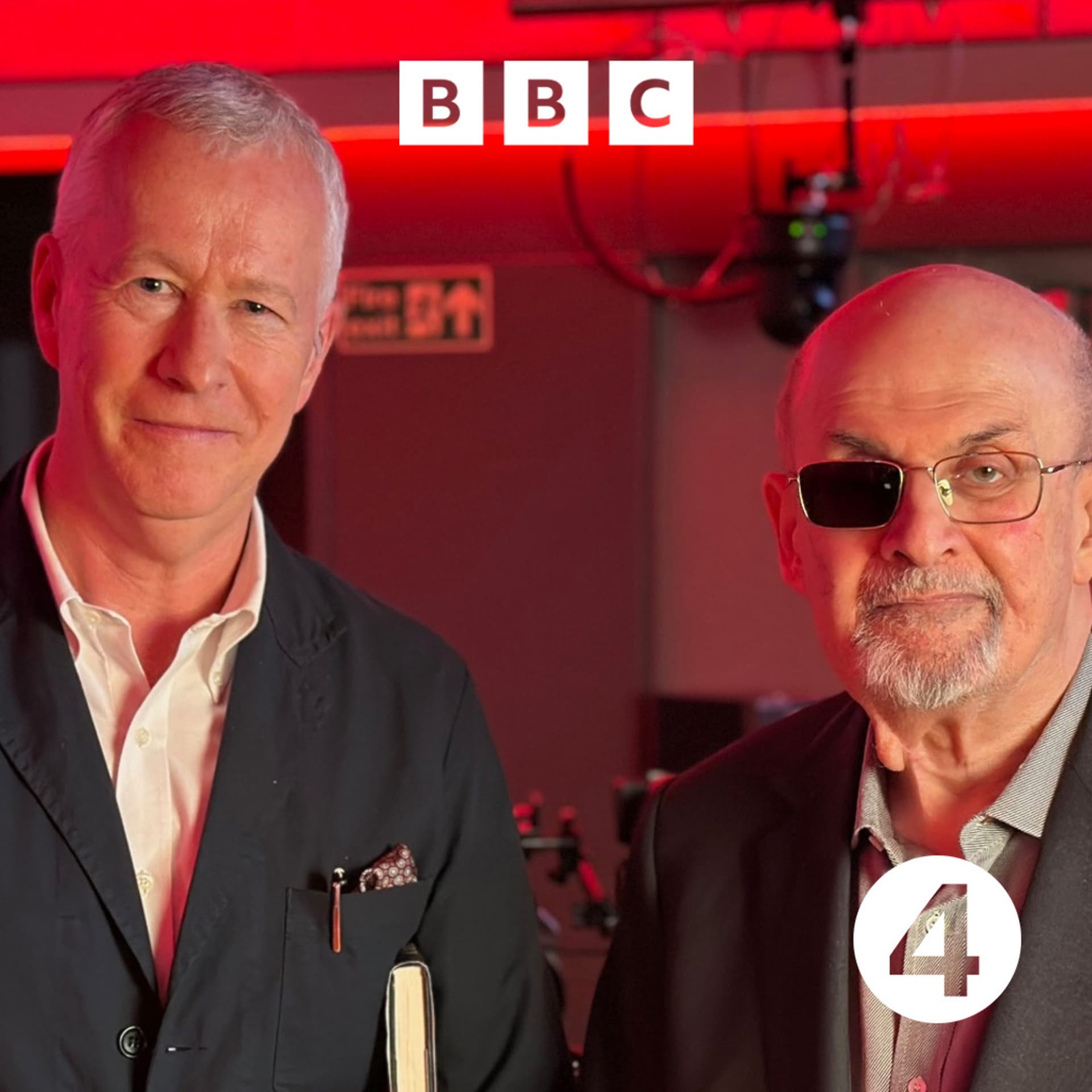
Salman Rushdie
Episode Overview In this episode of "This Cultural Life," host John Wilson engages in a profound conversation with Sir Salman Rushdie, one of the most celebrated novelists in contemporary literature. Rushdie recounts his experiences from childhood in Bombay to his life as a critically acclaimed writer, reflecting on the influences that shaped his work, including migration, Indian independence, and the impact of blasphemy accusations.
Key Themes and Discussions
- Childhood and Cultural Background
- Early Life in Bombay: Rushdie discusses his upbringing in a secular Muslim family amid the vibrant cultural landscape of Bombay.
- Influence of Independence and Partition (1947):
- Rushdie identifies Indian independence and the partition as pivotal moments in his creative journey, serving as a backdrop for his novel *Midnight’s Children*.
- His family's decision to stay in India during partition influenced his identity and storytelling.
- Migration and Its Impact
- First Migration: Rushdie reflects on moving to England for school at age 13, noting the cultural shock and feelings of being an outsider.
- Second Migration: After living under police protection due to threats following the publication of *The Satanic Verses*, Rushdie moved to New York, where he felt a sense of belonging and freedom.
- Writing and Literary Influences
- Surrealism and Fabulism: Rushdie describes how surrealism and mythical storytelling inform his work, allowing for multiple interpretations of truth in art.
- Cultural Fusion: He emphasizes the interconnectedness of cultures, particularly through music and storytelling, using *The Ground Beneath Her Feet* as an example of merging Indian and Western narratives.
- The Fatwa and Its Consequences
- Life Under Threat: Rushdie details the profound effects of the fatwa issued against him, including living in hiding and the long-term emotional impact.
- Recent Attack: He shares insights into the near-fatal stabbing he survived in 2022 and how this experience influenced his latest memoir, *Knife*.
- Reflections on Indian Politics
- Current Political Climate: Rushdie expresses concern over the political shift in India, criticizing the current regime's attempts to reverse secularism and promote Hindu majoritarianism.
- Literary Relationship with India: Despite political challenges, Rushdie notes a strong literary connection with India, with his recent works receiving positive responses.
Key Takeaways
- Artistic Resilience: Rushdie embodies resilience, using his experiences to fuel his writing, demonstrating the power of storytelling in the face of adversity.
- Cultural Identity: His works reflect a deep engagement with themes of migration, identity, and the blending of cultures, offering rich narratives that resonate globally.
- Humor as a Coping Mechanism: Rushdie highlights the importance of humor in enduring hardships, suggesting it stands against fanaticism.
Conclusion The conversation captures Salman Rushdie's profound insights into life, art, and the complex landscape of international relations. His reflections on migration, identity, and the resilience of the human spirit underscore the enduring power of storytelling in navigating personal and cultural histories.
Producer and Archive Acknowledgments
- Producer: Edwina Pitman
- Archive Sources: Various BBC News segments, historical broadcasts, and literary recordings used to enrich the episode's context.
Final Notes For those interested in exploring more conversations with leading creative figures, visit BBC Sounds or your preferred podcast platform.
Written by AI. May contain mistakes. Listen to the episode to check what was said.
Transcript
Automatic transcript. May contain errors.0:00BBC Sounds. Music, radio, podcasts.
0:11Welcome to This Cultural Life, the series in which some of the world's leading creative people choose the most important influences and experiences that have inspired their own work. I'm John Wilson and my guest in this episode is the author Sir Salman Rushdie, one of the world's greatest novelists. He's won many prestigious international literary awards and was knighted for services to literature in 2007. He won the Booker Prize in 1981 for Midnight's Children, a novel that was also twice voted as the best of the all-time Booker winners. In 1989, the Iranian leader Ayatollah Khomeini declared that Rushdie's fourth novel, The Satanic Verses, was blasphemous and pronounced a death sentence against its author.
0:55For over a decade, Salman Rushdie lived in hiding with close security, a period of his life that he wrote about in the 2012 memoir Joseph Anton. His most recent book Knife details the horrific stabbing that he survived in 2022. Salman Rushdie, welcome to This Cultural Life. Thank you. I'm so glad to be able to say that because we were meant to have this conversation in August 2022. Yeah. And just a week before we were due to record that interview. Today at six, author Salman Rushdie has been stabbed during an event in the United States. Oh, my God! He's being treated in hospital for what police describe as a stab wound to the neck.
1:40A man has been detained. After more than three decades of living under an Iranian death threat, he is tonight fighting for his life. You survived a near-fatal attack on stage in upstate New York. You've undergone multiple surgical operations and rehabilitation and recovery. So I've got to ask, how are you now? I'm surprisingly well. I think I surprised myself, but I think I also surprised the medical profession. Because quite a lot of the army of specialists who had to sign off on various pieces of me have expressed the feeling that I've recovered better than expected. I remember, for example, the hand specialist saying that given the extent of the injuries, He said, it's really amazing that your hand has recovered as it has.
2:24So I think I'm what they call a medical miracle. How have your injuries and survival itself affected your writing, both on a practical and emotional level? Practical, it's harder, you know, because one eye is harder than two, and one and a half hands is harder than two hands. So that makes everything slower. As far as in terms of what I write, But I just hope it doesn't get in the way of what I do next. I just want to do something completely different. Was writing knife cathartic for you, though? It was not exactly cathartic, but it was a way of handling it. It was a way of dealing with it. I feel now as if I've kind of dealt with the subject.
3:08Was it something you felt you had to do rather than you really wanted to do? Yeah, I didn't want to do it. And then I discovered that there was no alternative because it was just in the way of everything else, this subject. I thought the only way of getting past this is to go through it. And so let's go through it.
3:30On This Cultural Life, my guests choose the most significant influences and experiences that have inspired their own creativity. And your first choice is the independence of India and partition in August 1947. On this historic day, when India takes her place as a free and independent dominion in the British Commonwealth of Nations. I, Jawaharlal Mehru, do solemnly affirm that I will do right to all manner of people after the laws and usages of India. You were born in Bombay just a few weeks before independence. So just first of all, tell us about family and home life. Well, my parents, when they got married, when they were first together, they lived in Delhi.
4:17My father's family had lived in Delhi for some time. And then as the independence and partition approached, they decided that they did not want to go to Pakistan. That even though it's a Muslim family, they were very secularized and they didn't want to be in a kind of theocracy. They felt more Indian than Muslims, so they wanted to stay in India. But they felt that Delhi, which historically is quite volatile, Delhi might be more problematic in terms of trouble, sectarian trouble. And so they decided to move to Bombay, as it then was. And so my father sold up his business and they moved to Bombay at really the end of 1946.
5:00I think actually when my mother must have been already pregnant with me. So I moved to Bombay as well. And you say Muslim family, but secular family. Yes. My father was entirely lacking in religion. And my mother, as far as I know from my mother, she didn't like to eat pig. That was about the extent of her religion. So I was brought up in a very secular atmosphere. In a city that, and by the way, my parents were right, which is that when independence happened and all the so-called partition riots began, began. Delhi was quite bad. There was a lot of trouble in Delhi. And in Bombay, almost nothing happened.
5:39That's a prescient and wise move on your father's power. Yeah, so people from Bombay were always proud of the fact that sectarian trouble didn't really happen there. And so I was brought up in this, I mean, the most cosmopolitan city in India, a city going through a very good moment in its history, very open and diverse. Like in my little neighborhood where I grew up on a little hilltop. I had friends who were from the north of India, the south of India, from England, from Scandinavia, Hindus, Muslims, Sikhs, Parsi's, Christians, you know. It must have felt like a whole world in a neighbourhood.
6:17And it did, and we all shared everybody else's culture. So we would have everybody else's festivals, just meant more parties. So when it was the Parsi New Year, we would have that. And when it was Diwali, we would have that. And when it was Eid, everybody who was not Muslim would join in with that. So we just each shared in. For example, the biggest, one of the most popular gods in Bombay is the elephant-headed god Ganesh. And the Ganesh festival, Ganpati, was always the biggest party of the year. It's huge crowds bringing effigies of the god to wash in the sea. and then we all used to think that it was our party too even if we weren't of Hindu background now it's kind of changed now the Gunpati festival has become a kind of Hindu nationalist event and being politicized being politicized but it wasn't like that then and so I grew up in that really joyous intermingling of cultures and that became very much a part of how I saw the world And what about storytelling?
7:21How important was storytelling in your family? And who in particular was telling stories? Well, both my parents were good at it, but they had different kinds of stories. My dad would tell us as little children his versions of, you know, Arabian night stories, things like that. But obviously in his parental, somewhat sanitized versions, because the Arabian nights is full of, you know. They're pretty rude, aren't they? Pretty rude. Filthy, in fact. Yeah, filthy and wicked and all of that got sanitised out. But we did, I mean, the first time I heard stories like Aladdin and the Wonderful Lamp or Ali Baba and the 40 Thieves were in my father's versions.
8:01So bedtime stories. My mother, well, the best thing to say about her storytelling is that she was world-class gossip. She knew where all the bodies were buried. Like world-class gossip, she couldn't resist telling you. Neighbourhood gossip. neighborhood, family, friends, all kinds of naughty stuff. And then at a certain point, she told me that she was going to stop telling me things because I put them in my books and she got in trouble. But, of course, she didn't stop. In your 1981 novel Midnight's Children, you're telling an allegorical tale of post-partition India. Your protagonist, Salim Sinai, is born on the stroke of midnight at that very moment of independence.
8:47And along with all the other children born in that hour, he's bestowed with superpowers, special powers. How much of the Bombay setting in the early part of Midnight's Children is based on, you know, directly on your own childhood memories? There used to be a joke in my family that was told slightly too often. My parents would say, you know, Salman was born and eight weeks later, the British ran away. so I mean not that funny the first time but certainly the hundredth time less funny but it gave me the idea about supposing there wasn't the eight week gap supposing it was exactly that moment what would that lead to and yeah Salim is basically brought up in my house and in my neighborhood as we were describing it quite a big house then yeah and some of it my parents would rent out.
9:40But it was, yeah, it was quite a big house. And he went to my school. And some of the friends with whom he hangs out, they're not exact portraits, but they're kind of composites of people that I knew, which led to at least one funny moment that I was back in Bombay doing an event. And one of the characters in Midnight Children is a boy who's nicknamed Hair Royal. He's called Hair Royal Sabarmati. And after this reading I was giving, this man came up to me and said, hello, Salman, I'm Hair Oil, which was strange for many reasons. First of all, it had not been anyone's actual nickname when we were kids growing up.
10:18So he was using the novel's nickname to apply to himself. And he was completely bald. But he had recognised himself. But he recognised himself, correctly recognised himself, and identified himself by the name of the fictional character. Midnight's Children follows the fate of India through the eyes of Salim for 30 years and charts the gradual decline of optimism in India in the post-partition years. You were writing, of course, in the late 1970s when the then Prime Minister Indira Gandhi had declared a state of emergency. She was ruling by decree. So were you writing largely in response to the situation in India at the time?
10:59Well, at the end, in the later stages of the book, yes, because the emergency began while I was writing it, began in about 1975. While all over India, policemen were arresting people, all opposition leaders except members of the pro-Moscow communists, and also schoolteachers, lawyers, poets, newspapermen, trade unionists, in fact anyone who had ever made the mistake of sneezing during the madame's speeches, and when the three contortionists had brought the baby out for its father to see, at exactly the same moment, the word emergency was being heard for the first time. And I remember thinking that I didn't want the book to end in this moment, you know, with a kind of semi-dictatorship, sort of authoritarian rule.
11:46But I thought, I can't end it in the book if it hasn't ended in real life. And then Mrs Gandhi made the mistake of calling an election, which she had been advised that she would win and her calculation was that by winning it would kind of legitimise what she'd done. But instead she lost by a landslide. I felt like sending her a letter of thanks because she kind of gave me the end of my book. But you wrote about her, a version of her in the book. There's a character known as The Widow who is clearly Mrs Gandy and she sued you for libel about a particular line. There was a line, there was a thing in there about her relationship to her son, Sanjay, which actually was a thing that had been published many times before in newspapers and all that.
12:33And so I wasn't saying anything new, but she felt that it was libelous. And so, yes, she did initiate my first run-in with political power, I guess. How did you feel about that libel suit? Because, I mean, in a way, it sort of confirms the power of fiction and particularly of sort of fabulous storytelling and the genre that you're working within. I thought it was quite impressive, you know, but that's not how my publishers thought. They weren't happy about it. They were quite scared of it, I think. But then it ended tragically because soon after that whole libel business began, she was murdered by her bodyguard.
13:12Did you take the line out? I think it got taken out in some editions, but then, you know, you can't libel the dead. What has been the lasting impact of Indian independence on your creative imagination and the themes of your work? I think it's the foundation, I think. Although my books have gone away from India and come back, I've always thought of it as maybe the deepest inspiration. I feel that at rock bottom, I'm still that boy from Bombay. And everything else has just been piled on top of that, but that's the kid underneath. Is that because you draw strength from that character who grew up in those streets?
13:50Yeah, and I like the world that he learned about. I like the shape of it, its diversity, its collegiality, and in many ways, its happiness. And, of course, Midnight's Children is about, as you say, in a way, a kind of betrayal of the optimism of independence. There's a moment near the beginning of Midnight's Children when optimism is described as a disease. You can be infected by it, and sometimes lifetime infection. I think I got infected by it. I think that optimism disease, I still to some degree have it. How is your relationship with India now, four decades on from writing Midnight's Children?
14:30Well, my literary relationship, I'm happy to say, is pretty good. Let's say the last novel, Victory City, was wonderfully well received in India. Maybe the best received novel of mine since Midnight's Children. It always means a lot to me that books go down well there. So a healthy literary relationship with your home country. But what about it otherwise? Politics, not so good. I mean, my generation is the generation whose thinking was shaped by Gandhi and Nehru and that India. And that India is very much in retreat now. I mean, figures like Gandhi and Nehru are criticized heavily by the current powers that be.
15:11and the secularism to which they were committed is now something which the current regime wishes to reverse. The Indian constitution contains the words secular and socialist, both of which are not good words for the current regime. And of course to change the constitution is a very difficult thing. You need a big majority and they don't quite have that yet. But I think they are trying to de-secularize the country and create a kind of Hindu majoritarian culture. Have you ever met Mr Modi? Nope. Would you have any interest in meeting him and having that kind of conversation? I don't know that it would go very well.
15:50I mean, yes, of course, I'd be interested to meet him. I mean, he is a very important figure. And I have to say, very popular figure. But I don't know that we'd have much of a meeting of minds. Did you meet Indira Gandhi? No, I didn't. I got once invited in London. She was visiting London. And I got invited by Margaret Thatcher's office to a lunch for her. And I said to the person who called me, I said, are you aware of the fact that this novel that I just published is quite critical of Mrs. Gandhi? And there's a sort of silence on the phone. And then the gentleman on the other end said, oh, no, but, you know, the Foreign Office recommended you.
16:33You'd have thought they'd have read it, wouldn't you? then they essentially said don't come
16:45your next choice for this cultural life Salman is something that has profoundly impacted on your creative output and that's the theme of migration you now live in New York and you were born in Bombay but your first migration was when you were sent to an English public school as a teenager, what were your first impressions of England? Well, first of all, I should say that I wanted to come. I wasn't made to come. It wasn't my parents exiling me. My mother certainly didn't want me to come. And my father left it up to me. He said, there's this school that says they'll have you if you pass the exam, and do you want to go?
17:21And I don't know, for some reason I said yes. And I arrived in London en route to rugby in January of 1961. and I'm a boy from the tropics. It was cold. It was really cold. So how old were you? 13 and a half. Oh, really? Yeah. So my first impression was just terrible weather. And then at rugby, I really didn't have a good time. I mean, I had, in one way, I had a very good time. I remember being very well taught. There were a lot of teachers, you know, in the way that you have teachers that you remember all your life. I had quite a few of those. Did you have preconceptions of what England was all about, having read a lot of English novels.
18:01Yeah, I mean, I thought I knew where I was going. I'd read all these books, you know, Arthur Ransom's Swallows and Amazons, all that kind of thing. Had you read Tom Brown's School Days? I had not read Tom Brown's School Days. Maybe that would have prepared you. Might have done. But when I got to rugby, it was the first time in my life that I'd been made to feel, not exactly like an outsider, but like an other, like somebody else's other, not part of the group. Were you reminded constantly that you were an immigrant? Yeah, I was foreign. That was not good. I was really bad at games. That was extra not good.
18:38And there was bits of racism. On a couple of occasions, we had these little cubicles which were called studies. And I came into the little cubicle and found a kind of racist slogan written on the wall. About you? Yeah, kind of wogs go home. I think that's what it was. and on at least two occasions I came in and found that somebody had been into my room and torn up my essay that I'd written. So that was hard to deal with. And it got better as I got older. It was worst in the kind of first year or year and a half. You went to Cambridge and you studied history. Were you already writing or did you have ambitions to write fiction?
19:19I had ambitions. I hadn't written anything really worth reading. I was more involved in student theatre than in student magazines. But my great piece of good fortune was that I met E.M. Forster, who was, I was at King's College and he was in residence there. So, I mean, he wasn't my best friend, but I met him a few times. And he's very open and accessible, you know, to students. And, of course, his love of India meant that he was extra interested in me. and I finally did kind of shyly confess to him that I had thought I might try and write something and he was very, very encouraging and I've always remembered that.
19:59Did you show him any writing? So it was just the idea that you might have... Yeah, no, I did. Anything that I had, I would have been deeply ashamed to show him. You might have a couple of stories in me. Yeah. You must have known you had some kind of talent for writing because after Cambridge you worked as a copywriter for a big advertising agency, I think for about ten years. So what effect did that job have on the fiction that by that time you must have been writing? I was writing, yeah. Well, first of all, it paid the rent while I was working on books. But what it did give me, I think, was it gave me real discipline.
20:33Because in advertising, you can't wait for the muse to descend. If the client is showing up at 2.30 on Thursday, you've got to be ready at 2.30 on Thursday, and you've got to have something that he wants to buy. So that, you know, just sit down and do the job approach, which actually I would probably have learned from journalism as well. Yeah. But advertising certainly gave me that discipline to treat writing just as the job you're doing and get it done. And that lasts to this day then, does it? I mean, do you set yourself deadlines? Do you have a sort of a working day and you set the clock? I have really well-developed writing discipline.
21:08You were responsible for some very memorable ad campaigns in the 1970s, Aero chocolate bars, and also there was one for fresh cream cakes. Yeah, the way these cream cakes thought themselves, it's enough to lead a girl astray. Give her now a chance. Fresh cream cakes, naughty. But nice. Yes, naughty but nice is me. And I remember they were very reluctant to accept the idea because they thought we were telling them that cream cakes made you fat. I tried to get them to focus on the but nice part. Anyway, it lasted for a long time, that campaign. And the chocolate bar, the arrow, I came up with these bubble words, you know, irresist a bubble.
21:52Adore a bubble. Yeah, bus signs saying transport a bubble. I mean, I remember growing up with those campaigns. Signs on a door saying avail a bubble inside. One of those things which writes itself the moment you've had the idea. Do those ideas come because the deadline is looming and it forces the imagination into a kind of critical point of thinking? That happened because it wasn't actually my account, Arrow. He was a friend of mine, and he was stuck. And so I sort of brainstormed with him. And while we were having terrible ideas, he got so worked up that he stammered, and he said, impossible bubble.
22:25And I thought, ding! And I started writing bubble words. Wow, inspiration from a speech impediment. Yes, adore a bubble, delect a bubble. Advertising at the time was, I mean, it was a pretty macho, boorish culture. Was it also a racist place to work? There were one or two clients that I found to be like that. Not so much in the ad agency, but sometimes the people you have to deal with. There was an airline campaign, I guess I will not say what airline, where we were featuring actual members of the airline staff. And there was an ad in which there was two members of cabin crew, one of whom was black.
23:05And the client said, well, we can't have that. And I said, but she works for you. She actually is flying on your planes now. And she said, yeah, it doesn't matter, we're not having that. Look, this was a long time ago. This was in the 1970s. It's not that long ago, though, is it? But, I mean, I would hope that things are different now. Going back to the idea of migration, how much did some of your early experiences in the UK feed in to the writing of the Satanic Verses, in which one of the protagonists, of course, like you came from India, was at an English public school and then lives the immigrant life in London.
23:41Well, what happened is a lot of the time in the 70s, I did a lot of voluntary work in race relations, mainly with a thing called the Camden Commission for Racial Equality, and it was involved in the life of the primarily Asian community in North London. A lot of it Bangladeshi, a lot of it involved in the restaurant industry. Drummond Street. Yeah. So I had quite a detailed knowledge of what was going on inside the Asian community at that time. And in the Satanic Verses, a lot of which is about Asian immigrants in London, a lot of that came out of the knowledge that I'd gained through that work.
24:21You know, the 80s, the racial situation in London was much more tense than it is now, perhaps. And in the middle of the book, the largest section of that novel is a section called a city visible but unseen and what i meant is to say you know these communities you know i know where they live i can take you to those streets but somehow nobody's paying attention and again that's different now but it was like that then it felt like a very unexamined you know ignored community places like brick lane and south hall and wembley parts of london which had large asian communities that's so interesting because your work is so often associated with fabulism or, you know, magical realism often it's called, but you're talking about reportage there.
25:06It's realism, isn't it? I'm talking about, you know, a decade of knowledge, of working with communities. Know that the satanic verses has caused deep offence and threatens the future.
25:24The Ayatollah Khomeini has ordered Muslims to kill a British author. attack and his virtual order to Shiite extremists to attack Mr Rushdie was reported on Tehran Radio this morning. The World at One broke news of it to Salman Rushdie. I asked him whether he was taking the threat to him seriously. I think I have to take them very seriously indeed. Will you be looking to the British authorities in any form for any kind of protection as a result of this threat? I think I must. I think, honestly, I've just heard the news and obviously that is something Something I may well have to think about, yes.
Read the full transcript
25:56And obviously it's horrifying that people are willing to proceed in this way against what is, after all, one novel in the face of the entire... Of course, the Satanic Verses is now so closely associated with the fatwa decreed by the Iranian Ayatollah Khomeini. Is it frustrating for you that it was in a way overshadowed as a work of literature? Yes, and in particular that what happened around it gave people a wrong idea of the kind of book that it is. Because really what I thought, I still think, is that it's my novel about London. And that's not how most people would think of it. Because the religion part of it, the dream sequences, are a relatively small part of this quite big novel.
26:38There's two chapters, probably totaling 70 pages out of a 550-page novel. And I thought, first of all, they're dream sequences. Secondly, the religion is not called Islam. The prophet is not called Muhammad. And the city in which it takes place is not called Makkah. And I thought this is what we call fiction. You start from a real source and you reimagine it and you tell a story. So it really didn't ever occur to me that anything on the scale of what happened would happen. Good morning, Mr Rushdie. Good morning. Clearly, I'm not going to ask you where you are. But can I ask you a little bit about the sort of days that you spend?
27:15How do you how do you spend your life? Well, I spend my life reading and writing. It's a simple life, but it's all right. I get up in the morning and I work, and then I do whatever you might do if your life were confined to the interior of a house. But you must regard that house as a prison. Well, yes, I do, in a certain respect, yes, because obviously the fact that I can't leave the house is a colossal restriction, and, I mean, is indeed a loss of freedom. so while you were talking about you know one's rights to free speech being protected but at a cost but can you carry on indefinitely i don't know i'll let you know well of course that book changed your life the fatwa changed your life you had to go into police hiding live with police protection for around a decade and then you moved to new york so this is the second migration in fact why new york well i you know i'd fallen in love with new york when i was very young i mean i I went there before I published a book.
28:15And I was in New York City, very different New York City. Those were the days when the city was quite broke and kind of dirty and very exciting. It was also very cheap. You would see young creative people of all kinds. You'd find musicians and filmmakers and poets. And I thought, this is very cool. And it just gave me this feeling that one day I would like to just come and put myself here and see what happens. and then you know then life happens to you and that didn't happen for a very long time and eventually I remember thinking to myself okay if you're going to do this you'd better do it because you're getting older and so I when I did make the move I didn't know really if I was going for six months or the rest of my life and ended up I got stuck I stayed.
29:03But you talk about arriving in England and that sense of being an outsider the sense of displacement was the second migration easier. Yeah, New York opens its door. You arrive, you put your bags down and you're a New Yorker. Also, it's a city made up of migrant communities. That huge multiplicity of cultures in New York is just endlessly fascinating. In New York, your life became freer, you became more of a public figure. What effect do you think did that freedom have on the writing that you were doing in New Well, it just took away a kind of negative pressure. You know, I mean, in England, in those years of the police protection, I mean, that was really very stressful.
29:43And it was an effort to put that to one side and write a book. But in New York, that just wasn't there. So it was easier to go back to being the person that I always thought I had been. And then it also gave me an extra subject, you know, and it gave me another place to write about. and the first book I wrote there was this novel called Fury, which was a kind of portrait of New York at the turn of the century. And then it had this extraordinary fate. Its publication day was September 11, 2001. Very bad day to publish a book. Where were you then, Dave? I was actually on book tour in Houston, Texas, and I'd agreed to do a radio interview from my hotel room, and the journalist called me early, and he said, I'm sorry to call you early, but because of what's happening in New York, obviously we can't do the interview.
30:33And I'm not the kind of person who switches on the TV first thing in the morning. So I said, what's happening in New York? And he said, switch on the damn television. And I turned on the television, like many people, just in time to see the second plane. And then was just horrified, standing there and staring at the TV. There's two things happening there, though. Your adoptive city is under attack, but also it must have had an added resonance for you personally, because this is an act of terrorism by Islamic extremists. No, I mean, I kind of knew exactly what it was. That must have been traumatic, wasn't it?
31:05It was horrifying. And it was as if the thing that happened to me, which was this big, had been magnified to something of global scale. When I wrote Joseph Anton, my memoir, I compared it to the scene in Alfred Hitchcock's film, The Birds, when the birds slowly amass on the climbing frame outside the schoolroom. And when it's just one bird sitting on the climbing frame, it doesn't mean anything. It's just a bird. It's only when there's a thousand birds that you think, oh, yeah, there was that first bird. And I think that was my fate was to be the first blackbird. Afterwards, in New York, when I was back in New York, some quite senior eminent journalists said to me, oh, now we understand what happened to you.
31:50I thought, really? All those thousands of people have to die for you to understand? But then I thought, no, that's not what he's saying. What he's saying is now it happened to him.
32:07Your next choice for this cultural life, Sarman, is surrealism, fabulism and mythical storytelling. And you said in an email that you sent to us, learning that truth in art can be arrived at through many doors. What did you mean by that? Well, I mean that realism is only one convention. And if you look at world literature, it's not even the dominant convention. Many cultures, many literatures have preferred the language of myth and fable, fairy tale and, you know, highly imagined work. and it seemed to me that that was always something I had a very instinctive desire to go towards because of again starting in India, growing up surrounded by the kind of fables and myths of that country, the Ramayana Mahabharata, the animal fables of the Panchatantra, the Thousand and One Nights, all of this stuff.
33:04It showed me a simple fact which is that stories are not true. somebody made them up. And that, you know, a flying carpet and Madame Bovary are both untrue. They're both things that somebody invented. And once you accept that, it kind of sets you free to fabulate, to make things up. And I think that it's in a way just another way of talking about human nature and sometimes a more enjoyable way. And I also think another thing, which is that the world has ceased to be realistic. The world is now surreal everywhere you look. So maybe surrealism is a better way of describing the truth of it. As you say, you're introduced to the myths and the complex stories as told by your father in your childhood.
33:48Was it the same sort of literature and films, possibly, that you were drawn to when you started developing your own tastes? Yeah. I mean, for example, my books have often been compared to Gabriel Garcia Marquez. And I remember when I read 100 Years of Solitude, one of my favourite books of all time. But one of the things I felt reading it for the first time was strangely how familiar it felt, even though I'd never been to Latin America at that time. I thought the world of this book is not unlike the world that I came from, that we have dictators too. We also have very powerful religious forces at play.
34:26And other things, the gulf between wealth and poverty is there in both worlds. The kind of quarrel between the urban and the rural worldview is there in both worlds. So I thought a lot of this is like the world I know translated into Spanish. And I felt a kind of fellow feeling for it. I thought, I get it. I see how this works. And to borrow your verb, you are an author who fabulates. But, I mean, are you a magical realist or is that a term that you resist? I think the problem with the phrase magic realism is that when people use it, they only hear magic. And they don't hear realism. whereas actually it has to be very, very deeply grounded in a sense of the real, which also means emotional real.
35:09There's a wonderful moment in 100 Days of Solitude where one of the characters is shot and his blood makes a journey through the town and arrives at his mother's feet. And when she sees it, she screams because she knows her child is dead. Now, of course, that's a completely fabulous image, the blood trailing, going to the city, turning right, turning left, going upstairs. but it's completely powerful because it's an emotional truth. I think that's the secret of this kind of writing, that it has to be rooted in a kind of truth. You have often drawn on the past, on the myths, on the great tales, the great Greek story of Orpheus and Eurydice.
35:48You borrowed for your 1999 novel, The Ground Beneath Her Feet. Why did you want to retell that tale in a contemporary setting with these two superstar singers as the protagonist lovers? Well, a couple of things. One is that it's a really great love story. And the other is that this is a kind of rock and roll novel. And the reason why it is is because I was trying to write a book which united these three worlds of India and England and America. And I thought, you know, rock and roll music is really the first cultural phenomenon that crossed all these cultural boundaries. I remember growing up in Bombay with listening to Elvis Presley singing All Shook Up.
36:26And the first record I ever bought was Heartbreak Hotel. And what was interesting about how far that music spread was that it did it before there were the mechanisms that now exist. I mean, now everything spreads everywhere in five seconds. But in those days, it didn't. And yet this thing did unite the world. So I thought to tell a story about these three countries using the music as a bridge is a way of uniting the narrative. And I thought this story of Orpheus and Eurydice, you can actually tell the story in 100 words. It contains such power because it unites three great things, which are art, love and death.
37:06And depending how you look at the story, you can say that it means that love, through the agency of art, overcomes death. Or you could say, more pessimistically, that death, in spite of art, overcomes love. It tells you very profound things about our life on Earth, you know, and you could expand it into a 500-page novel. So that's what I did. You said after writing your memoir, Joseph Anton, that you longed to return to some wildly fantastical fiction. Having just written Knife, your memoir, of surviving that brutal attack in August 2022, Do you now have a similar hunger to return to fabulous fiction?
37:52I certainly think fiction, yeah. I don't actually know what the next book is at this precise moment. I don't really have it in my head. But is that sense of the real and the reportage that you did in Knife, does that drive you into kind of ever wilder imaginative? Yes, do something, do the opposite. Because, you know, one of the things is when I first thought about becoming a writer, the last thing on my mind was to write about myself. I had absolutely no interest in doing that. I wanted to make things up. I wanted to make up stories and tell them. Now that I've written two books about myself, it's more than enough.
38:27And you say you don't know thematically what the next book might be. Do you think the attack will impact somehow on whatever emerges? I don't know. Stay tuned. you've spoken in the past about how you found it important to remain visible in new york to reclaim your life after years in hiding you know you were seen out and about and we saw you in cameos in bridget jones's diary and w1a here at the bbc and in curb your enthusiasm you've heard about i heard about your problem and uh i thought if there's anybody who could understand what i'm going through it's you and to tell you the truth i'm at my wit's end let me tell you something it can be scary it could be bewildering etc but there are things that you gain there are a lot of women who are attracted to you in this condition really yeah even with me they would like it it's not exactly you it's the fatwa wrapped around you like kind of sexy pixie dust can you imagine taking on those sort of comic cameos now, though, given what's happened to you?
39:34Oh, I don't see why not. I mean, I'm a frustrated actor. It's the only other thing that I ever wanted to do, so... How important was comedy in helping you to endure the situation? Very important. I think I'm kind of fortunate in that I have a sense of humour. And I do think that humour, in a way, is an answer to fanaticism. It's difficult to imagine a funny fascist. Also, humour is a thing. Laughter is a thing we do together. It's important. As we've discussed, migration has been one of your big themes throughout your writing life. Have you considered returning to the UK to live? Well, I mean, I return all the time.
40:15To live? Oh, to live. You know, I've done uprooting so much in my life. It gets a bit harder when you're older, you know, just too much effort. What drives you on creatively? Just what else would I do? I have no other talent. But I've always thought that writing has been, for me, my way of understanding the world, which is to say my way of understanding the world is to tell stories about it. And the world still needs understanding, including by me. So this book is the 22nd book. I mean, there's certainly not 22 more, but I hope there might be one or two. You've talked about how important comedy is to you, to keeping you going.
40:59But it does strike me how incredibly upbeat you are, given everything that has happened. Yeah, I don't know, it's... The resilience. I think I discovered that I was more resilient than I would have believed myself to be. You know, let's say, if you had told me in advance the following things are going to happen, how do you think you'll deal with them? I would not have bet on myself to do that well. but it turns out turns out that I'm tougher than I thought And do you think that is as a result of having such a near-death experience? Yeah One of the things my editor in New York said to me when I was first talking about writing this book he said, you know, very few people have the experience that you've had which is to get this close to death and then come back from it He said, so tell the story and so I did Keep telling stories, Sarman Thank you Thank you very much indeed for sharing your cultural life with us.
41:55Thank you.
42:02Well, I really hope you enjoyed that conversation with Salman Rushdie. He's just one of several Booker Prize winners that we've had on This Cultural Life, including Bernardine Evaristo, Penelope Lively, Douglas Stewart, Ian McEwan and Margaret Atwood. To hear them and dozens more leading creative figures, Head to BBC Sounds or wherever you get your podcasts to subscribe to This Cultural Life. From me, John Wilson, and producer Edwina Pittman, thank you very much indeed for listening.
42:34I'm Kavita Puri, and in 3 million from BBC Radio 4, I hear extraordinary eyewitness accounts that tell the story for the first time of the Bengal famine which happened in British India in the middle of the Second World War. At least three million people died. It's one of the largest losses of civilian life on the Allied side and there isn't a museum, a memorial or even a plaque to those who died. How can the memory of three million people just disappear?
43:0980 years on, I track down first-hand accounts and make new discoveries and hear remarkable stories and explore why remembrance is so complicated in Britain, India and Bangladesh. Listen to 3 Million on BBC Sounds.
From the publisher
One of the world’s greatest novelists, Salman Rushdie has won many prestigious international literary awards and was knighted for services to literature in 2007. He won the Booker Prize in 1981 for Midnight’s Children, a novel that was also twice voted as the best of all-time Booker winners. In 1989 Iranian leader Ayatollah Khomeini declared that Rushdie’s fourth novel, The Satanic Verses, was blasphemous and pronounced a death sentence against its author. For over a decade he lived in hiding with close security, a period of his life that he wrote about in the 2012 memoir Joseph Anton. His most recent book Knife details the horrific stabbing he survived in 2022.
Talking to John Wilson, Salman Rushdie recalls his childhood in Bombay, and the folk tales and religious fables he grew up with. He chooses Indian independence and partition in 1947 as one of the defining moments of his creative life, a period that formed the historical backdrop to Midnight’s Children. He discusses how, having first moved to England as a schoolboy and then to New York after the fatwa, the subject of migration has recurred throughout much of his work, including The Satanic Verses. Rushdie also explains how "surrealism, fabulism and mythical storytelling” are such an influence on his work, with particular reference to his 1999 novel The Ground Beneath Her Feet which was inspired by the ancient Greek tale of Orpheus and Eurydice. As Rushdie says, "truth in art can be arrived at through many doors”.
Producer: Edwina Pitman
Archive used:
BBC News, 12 Aug 2022 Newsnight, BBC2, 12 Aug 2022 BBC Sound archive, India: Transfer of Power, 15 August 1947 Nehru: Man of Two Worlds, BBC1, 27 Feb 1962 Midnight's Children, Book at Bedtime, BBC Radio 4, 27 August 1997 Advert, Fresh Cream Cakes, 1979 BBC News, 14 Feb 1989 The World At One, BBC Radio 4, 14 Feb 1989 BBC News, 28 May 1989 Today, BBC Radio 4, 27 April 1990 Clip from Curb Your Enthusiasm, Season 9, episode 3