In short
Podcast Summary: This Cultural Life - Zadie Smith
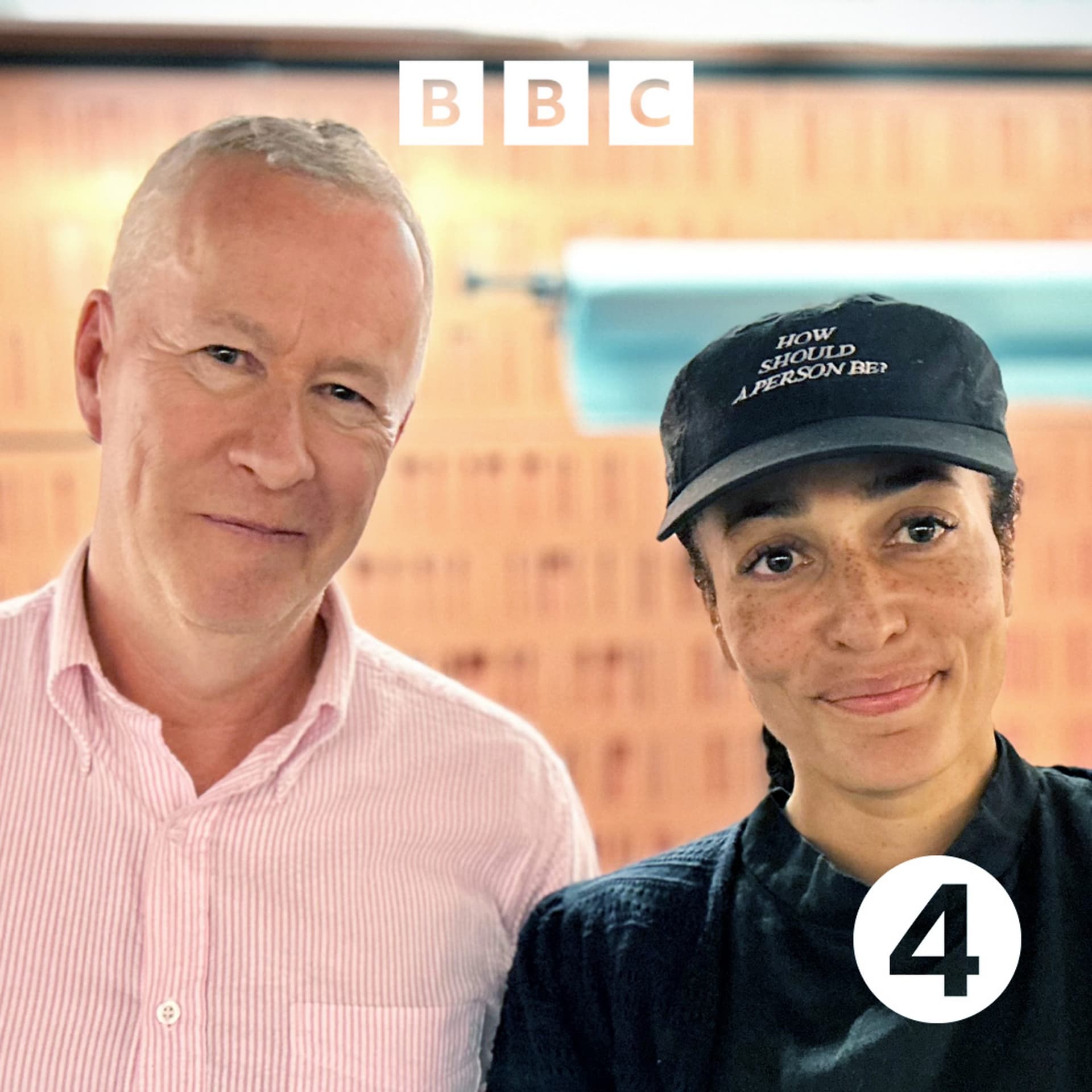
Episode Overview In this episode of This Cultural Life, host John Wilson converses with Zadie Smith, a leading novelist known for her keen explorations of cultural identity, class, and sexuality. Smith reflects on her upbringing, literary influences, and her journey to becoming one of the world's most renowned writers.
Key Topics Discussed
Early Life and Family Background
- Childhood in Willesden, North West London:
- Born on the same street she currently lives on.
- Grew up in a household marked by marital conflict.
- Parents:
- Mother: Jamaican immigrant, raised without her parents.
- Father: White Englishman, who struggled to find work, aspired to be a photographer.
- Noted the significant age gap (30 years) between her parents, affecting family dynamics.
Literary Influences
- Formative Reading Experiences:
- C.S. Lewis’ *The Lion, The Witch and The Wardrobe* as a crucial influence.
- Discussed themes of danger, power, betrayal, and moral choices.
- Mother’s Influence:
- Introduced Smith to a wide array of literature, particularly African-American and feminist texts.
- Cultural Influences:
- Family’s engagement with comedy and jazz music played a role in shaping her literary voice.
Writing Journey
- Early Writing Experiences:
- Started writing stories as a teenager, initially without considering it a career.
- Gained recognition with her first publishing experience in the May Anthologies.
- Debut Novel: *White Teeth* (2000):
- A critical and commercial success, leading to a bidding war among publishers.
- Explores multicultural London and familial legacies.
- Subsequent Works:
- Notable titles include *On Beauty*, *NW*, and *Swing Time*.
- Her latest book, *The Fraud*, marks her first historical novel.
Personal and Political Reflections
- Cultural Identity:
- Discusses the impact of growing up in a racialized society and the complexities of identity.
- Prefers to identify with the African diaspora, focusing on cultural lineage rather than race as a scientific category.
- Influence of Personal Relationships:
- Talks about her marriage to poet Nick Laird, highlighting the importance of creative collaboration.
- Reflects on how Laird’s poetry has influenced her prose.
- Political Commentary:
- Shares her thoughts about the current social media landscape and its effects on public discourse.
- Emphasizes the importance of maintaining independent thought outside the influences of digital platforms.
Insights on Craft and Creativity
- The Role of Essays:
- Transitioned into essay writing after being encouraged to explore topics beyond fiction.
- Discusses her experience writing for the New York Review of Books and how it has shaped her writing approach.
- Creative Drive:
- Expresses a continuous desire to write, stating that people remain her primary subject of interest.
- Reflects on the journey of growth as a writer and the importance of confidence in her craft.
Conclusion Zadie Smith’s conversation with John Wilson reveals her multifaceted identity as a writer shaped by her family, cultural experiences, and introspective thoughts on society. Her journey from a childhood in London to becoming a literary icon is marked by a profound engagement with complex themes surrounding identity, race, and creativity.
Key Takeaways
- Cultural Background: Smith's upbringing in a diverse and challenging environment significantly influenced her literary voice.
- Literary Influences: Key childhood texts shaped her understanding of ethics and moral dilemmas.
- Writing Evolution: From a young reader to a celebrated author, Smith's trajectory reflects a deep commitment to exploring human experiences.
- Social Commentary: She advocates for independent thinking in an age dominated by social media algorithms and external influences.
This episode provides rich insights into Smith's life and work, offering listeners a deeper understanding of her contributions to literature and thought.
Written by AI. May contain mistakes. Listen to the episode to check what was said.
Transcript
Automatic transcript. May contain errors.0:00BBC Sounds. Music, radio, podcasts.
0:11Welcome to This Cultural Life, the series in which leading creative figures reveal their most significant influences and experiences that inspired their own work. I'm John Wilson, and my guest in this episode is the novelist, essayist and playwright Zadie Smith. Having grown up in northwest London and winning a place at Cambridge University, she found herself at the centre of a publisher's bidding war when she was just 21. Her debut novel White Teeth became a huge critical and commercial hit on publication in 2000, and it won several awards, including the Orange Prize for Women's Fiction. Since then, with books including On Beauty, NW and Swing Time, Zadie Smith has established herself as one of Britain's most successful living novelists, renowned for her witty dialogue and explorations of cultural identity, class and sexuality.
1:01Her most recent book, The Fraud, is her first historical novel.
1:10Zadie Smith, welcome to This Cultural Life. Thank you for having me. You were born and grew up in Wilsdon in northwest London. Take me back to the family home to early childhood memories. Well, actually, I was born on the same street I live on. So it's not that hard to cast my mind back. You live on now? Yeah, I live on now, yeah. Wow. I mean, maybe one street away, and then at some point very early on, we moved to Athelstan Gardens, which is a council estate. In Wilston? On the corner of the street I live on, yeah. And, you know, marital war, I guess that's my earliest memory. So I was kind of born into a marriage that wasn't going very well, to say the very least.
1:51But if you think about those early childhood memories, is that there are the sounds of arguments. Yeah, I mean, that is really all I remember for a very long time. Tell me about your parents. Well, they're very unlikely. My mother had come from Jamaica, aged about 15. She was left alone originally, like that whole generation. It's kind of unspoken part of Windrush, which really interests me, that a lot of people came to work and they left their children. So in my mother's case, my grandmother was working as an orderly in a hospital and she left my mother and I think five other children with my mother's grandparents.
2:29So I think my mother grew up, you know, basically without parents and she was very, very poor. So they came from kind of rural Jamaica, a one-horse town which no longer exists actually. And my father, who was 30 years older than her, was different in every way, I guess, except also very poor. So they were kind of Suffolk people. His father was also completely absent. His mother was a servant in a big house, a maid. And was he working when you were growing up in that household? He was trying. His big dream was to be a photographer, but it didn't work out. So by the time I was born, he was working, I think I put this detail in White Teeth, in basically a paper company like you get in the office, like in that Ricky Gervais show.
3:15But my dad's job was folding the paper, you know, the kind of direct mail you get through your door. that was his job to design the folds. And there is a character in White Teague who has that job, of course, isn't it? It's Archie, isn't it? So did your father recognise himself in that character? He read about 30 pages of it and then he was like, that's enough. That was his reaction. And I don't blame him. I'm now almost 50 and the thought of somebody turning my painful and intimate life into a comic novel, you know, it's just terrible. I didn't think about it that way. You know, you think it's your life.
3:51And of course, it wasn't my life. It was my parents' life. And it was obvious to him reading it that it was based on him. He had a very obnoxious boss, like a salesman, who bullied my father a lot. And I think there's a scene in White Teeth where that happens. And I think that's the bit that upset him and that people from his work had phoned him and they recognised that scene. So, I mean, he wasn't... My father wasn't really a reader anyway. You know, my mother is the reader. My father had aspirations to be a reader. Like, he thought of himself as a reader, but he didn't actually do it very often.
4:20And you say there was a 30-year age gap between your mother and your father, which probably impacted on the marriage. Did it impact on you, do you think? Yeah, I mean, now it doesn't seem strange. I guess people have children older and older, but in that community at that time, you know, it's a working-class community. Most of the parents are young, really young. My mum, I think, was 20 or 21 when she had me, and my dad was 50. I think it formed the way I thought, because first of all, it connected me with the past in a way that was unnatural. And then also you think about death a lot when you have an old parent.
4:51You can't help it. Oh, because you were aware that he was... Yeah, yeah. He was really... I mean, he looked old. He was old. I don't think it's a negative thing particularly. It just puts the idea of death in your head. What about his cultural influence on you? There's a kind of ethical influence of the Second World War, which was kind of foundational to me. I guess both my parents had given me the idea of the worst that is possible. So on the one hand, chattel slavery. On the other hand, the Holocaust. course so I had these two kind of ideas in my mind of how bad it can get basically so that was maybe the largest influence and then culturally my dad it was a lot of old movies old music he loved jazz I love jazz he'd had two lives you know he'd gone he was born in 1925 so he went through 40s and 50s culture that was him as a young man and then in the 70s he gave it another shot he tried again and new wife, new music.
5:47He sounds extraordinary. He didn't seem extraordinary at all. He seemed completely dull, but in retrospect, he does seem quite extraordinary. Your books are often very funny. There are often comic passages. Was he a funny man? He loved comedy. Everyone in my family loves comedy to the extent that my brother became a comedian. He had a good sense of humour. I don't know if he was funny exactly, but we watched all the comedies, and he really liked comedy that was close to making you cry. Bittersweet stuff. Yeah, really. And that's what English specialise in. You know, they're really good at it. And what about your mother?
6:21What about her cultural influence? You say that she was the big reader. So she led you towards books. She just bought an enormous amount of secondhand books and a lot of African-American literature, which I don't know if I would have come across otherwise, certainly not in the schools, you know, and a lot of feminist literature. She was trying to educate herself as I was growing up. So she's becoming a social worker. and she was reading a lot of pretty hardcore feminist texts coming out of Berkeley and coming out of America and France and Africa. It was all interesting. That was maybe her main influence on me, a kind of broader perspective, like not so parochial, not so English.
7:00And if there's a lot of your father in the character of Archie in White Teeth, is that very much your mother in the character in your 2016 novel Swing Time, the mother of one of the two young girls who are the protagonists. I actually think that mother, my mother said it is more like me than it is like my mother. She's wilder and she's fun and she's not a control freak and I'm all those things, but my mother is not those things at all, actually. She's a much more expansive character than I am. You know, if you walk down Kilburn High Road, everybody knows my mother and talks to my mother and they wouldn't talk to me in the same way.
7:38on this cultural life sadie smith i asked my guest to choose the most significant creative influences and experiences that have inspired their own work and your first choice is reading the lion the witch and the wardrobe by c.s lewis as a child so why have you chosen this book in particular i think childhood influences are the strongest on writers and you are obviously influenced as an adult but you're formed by these things in childhood and I know that I'm a writer of ethics in some sense like I'm interested in what people do and how they do it and the effect of that I don't even think that is the best way to write a novel but I know I was made that way partly because of the stuff I read as a child and The Lion, the Witch and the Wardrobe which of course is a kind of sublimated Christian text apart from anything else but what amazed me about was the idea of these children making decisions, making choices, and really feeling the consequences of them.
8:34I mean, I still think that book is extraordinary, and its effect on me was extraordinary. Like, I really believed it. I was one of those kids opening wardrobes just in case, just to check. Well, it's a book about danger and power as well, and betrayal largely. Absolutely. And there's a moment where Lucy comes out and tells them the story and no one believes her. It's also philosophical as well about what reality is, you know, what it actually consists of. And then she goes back in and Edmund goes in, bumps into her, comes out. And as a kid, when you read it, you think, oh, here is the moment where she will be vindicated and the truth will out and justice will be served.
9:12And Edmund does this incredibly snake-like, servile, pathetic thing of lying in that moment. I remember being so horrified. Like it's the first realisation that, oh, people don't always behave as you would wish them to behave. And people have their own agendas and people are attracted to power because Edmund does it because he's been offered this thing by the white witch. That's a very interesting like political and personal lesson for any child. I remember being really horrified by it. How old were you? I first read that book when I was seven or eight, I'd say. And how did you come across it?
9:45Was it a school book or was it the one that you're on? That would have been one of the many that my mother either purchased or got out of the library. You know, we had a small flat, but it was drowning in books. And even now, my mum lives in a nicer flat, but still in Wilsdon. You still can't move for books. They're practically bringing down the house. So that's always been her way. Did you read the other Narnia? I read every single Narnia book. I think the library, the reason I'm so addicted to libraries and believe in them so much is because of their kind of shadowy borders around the taxonomy.
10:16People are always saying, you can get whatever book you like online, but of course you don't know what you don't know. And a library is a kind of physical place where you stumble upon things. So in my memory, I would just read alphabetically, which led you to all kinds of strange books. I just went through A and then B and then C. Through the shelves? Yeah, just through the shelves. And at that period at Wilson Library, you could take out about 12 or 15 books at a time. So generous. I wanted to read everything without borders. Was that unusual, spending all the time with your nose in a book rather than hanging out on the street corner?
10:50I mean, I made some time for hanging out. I think I was unusual. I think that kind of reader is always unusual and not particularly to be recommended. It's not a judgment. To me, it's just a kind of psychological trait in some people and I think it is about escapism, you know. A lot of it was about if everybody was screaming downstairs, at least I didn't have to be in that. When did you start writing your own stories? I never really wrote. That was never... I would type things out. I did a lot of that. So retyping stories that I admired or poems that I admired on a typewriter my mother had got me.
11:28I didn't write that much. And I certainly had no idea of it as a profession or a job. You know, that was such a distant concept. What was school like? And what sort of cultural education, artistic education did you get there? You know, I'm part of the last generation who benefited from this incredible state school system. And my kids are in state school right now, but the state schools right now are suffering, you know, unbelievably with this minimal funding. But the schools I went to, they're the same schools my kids are in, but they were different schools. Yeah, there was more money. I remember in my primary school, I lost count of how many instruments I learned.
12:07They had a massive closet where you could just choose an instrument and then you would get lessons for a minimal fee, like maybe it's£2 a week and you're learning violins, clarinets, pianos, anything you want to learn was provided. So, you know, sometimes I feel like the ancient mariner walking around England saying, did you know? You used to be able to. So for me, it was an incredible experience. I loved my school. I don't know what private school is like, but my school was incredibly mixed, incredibly vibrant, really interesting and full of opportunity. How many kids went to Cambridge? Oh, in my secondary school, about, I think maybe four, in my year, my year was particularly good.
12:52Four went to Oxford and maybe two went to Cambridge. That's not bad in a city comprehensive. Yeah, in 2000 kids. But of course, when you get there and you talk to these kids from the other parts of England, and they tell you that one third of their school turned up at this university, you're like, oh, OK. So, you know, I lived in a bubble where I thought the way I lived was the way everyone lived. And when I got out and saw, oh, no, this is a system which is determined to make the crack for us as narrow as possible and as wide as possible elsewhere, you know, that was a big learning experience.
13:25In your novel, Swing Time, there were two young school friends, the protagonists, who were obsessed by classic dance routines, tap dancing in particular. So that was one of your creative outlets, was it? Yeah, I love to dance. I still love to dance. It's like one of the few things that brings me just joy. I guess because it's not cerebral, it's just pleasure. And I'm good at it. I'm a good dancer. I like to dance. Do you mean sort of club dancing? Any kind of dancing. Because the interesting thing about that is the two girls sit down and they watch classic movies. They study Fred Astaire and Ginger Rogers.
13:59She would not press play until she had Fred and Ginger exactly where she wanted them, on the balcony, among the Borgonvillea and the Doric columns. At which point she began to read the dance, as I never could. She saw everything. That sort of takes me back to that conversation we had about your father and his watching old films. Is that a link to him? I mean, yeah, but it was another part of that England which has disappeared where Channel 4 at that time, early 80s, if you came home from school, there was just an endless stream of amazing Hollywood movies from the 20s, 30s, 40s, 50s. So you'd watch all kinds of things.
14:39You could watch Neighbours, of course, if you're feeling like you just want to watch Neighbours. I did that all the time too. But there was this kind of open university theory about British television that you should be able to access these cultural things. My interest in them, of course, I think came through my father. I'd look at these movies and think, oh my father was 20 then or he'd tell me things like going to see Casablanca in the cinema or hearing Ella Fitzgerald sing in the Kilburn High Road and these kind of things which seemed to me like extraordinary. Well he saw her live. Yeah he saw her live.
15:09So that kind of stuff would blow my mind. So watching those old movies and you know in those days it's such hard to construct now but spotting black people on television was one of my main activities when I would sit on TV and wait for a black person to turn up and the whole family get very excited. And in those old movies, you would see black people, often in demeaning and annoying roles, but they were there and it was curious to me, like I was just interested. Who were they? What were they doing? Sometimes it was incredible, like you'd see people like Fats Waller or Lena Horne, like jazz musicians I knew.
15:43Don't know why There's no sun up in the sky Stormy weather For me it was like news from another world, I guess, news from America, which was a place I was already pretty interested in. How did you face racism growing up? How aware of racial division were you? I never know how to answer that question because it's not... Racialised thinking is the water you move in. So I think when people ask you the question, they're saying, did anybody ever call you a bad... That's not the point. The point is that you're entering into a racialised system in which everything about you is overdetermined all the time.
16:24So, yes, I grew up in that system, which was called England. And it's, you know, tiring a lot of the time. It was very tiring sometimes. And mostly what it is, is being subject to a series of projections. Especially as a child, I remember it either being implied or being told that, you know, you must have got your brains from your father. I was told that so many times, you know, you lose track of how many times you're told it. You're dealing with other people's projections. So that really is what racialized thinking involves. And of course, to be unracialized, as was the case for white people back then, though I think it's no longer the case, is to be free of those projections, is to say, you know, my name is Jeremy and to walk through the world as Jeremy.
17:02But there's another way of thinking about, you know, this artificial category race, which I prefer to think of the African diaspora than race, which is a fake eugenic category. I'd rather think I am part of the African diaspora. It has this noble and interesting history. That's what I like to think about. I am part of this community, a very small part, but part of this incredible wave of people who were forced to leave somewhere and then spread out all over the world. I'm so delighted to have whatever connection I have with the African diaspora. That's part of the meaning of my life and the beauty of my life.
17:38Other people's racialized thinking is very, very boring and sometimes deeply aggressive, but I have suffered much less of it than my brothers and I'm sure my brothers suffered much less of it than darker skinned boys of the same generation. You know, there are so many versions of it. You grew up in a part of London which has an NW postcode. You wrote a book called NW. Even your latest novel, The Fraud, which is a 19th century historical novel, is partly set in the fields of rural Kilburn. So your neighbourhood has been a source of inspiration for you. It's almost a recurring character of the books.
18:13isn't it? It is. I never planned it that way. I think there's probably a sociological explanation like when I think of my brothers and their music when they were rappers. And I mean, it's an evidence of hip hop music when you don't have a lot. The streets become the thing you think you own and you speak about it as if they're your streets and they have that role in your imagination. And I think that must be part of it. But I also think it's to do with the neighborhood itself, which just happens to be I just happen to have been very fortunate to be born in this square mile, which contains the entire history of my country in miniature.
18:48It has the whole of, you know, rapid industrialisation, immigration, gentrification, whatever you want to know about England, you can find in that zone. And to me, that is one of the amazing things about England, the historical distance that you can travel all the time in your mind and as you're walking the streets. That's always inspiring.
19:14Your next choice, Sadie Smith, is a very personal one. It's meeting the poet Nick Laird, who is your husband. He is my husband. And you met at university. How did you meet? Well, it is sort of a funny story because he was editing this thing called the May Anthologies, which was an Oxford and Cambridge short story and poetry competition. You put a story forward and then if the editors liked it, it went in a little book and it was the first time I was published. I was like completely thrilled. And I asked my dad to come up. My dad was, you know, coming up to his 80s for the book party for this little book.
19:50And we went to the party and Nick was there. And Nick's Northern Irish. And he came up to us and he said, in a kind of Northern Irish way, I just want to ask for your daughter's hand, meaning to shake my hand. And my father said, well, you'll have to ask me for that first. It's a very strange joke. But that's the first time I ever met him. And then we were friends for years, for a decade. We didn't get together for a very long time. But I always thought that was a strange foreshadowing. Like, you wouldn't put it in a novel. It's so cheesy. And how aware of his poetry were you at that time? From the beginning, yeah.
20:22We exchanged writing from the beginning and in different ways felt, you know, very much outsiders in that scene. Like, he was the only kid from his school to go to Cambridge and the first one, I think, in a decade. And also he was Northern Irish, so put up with a lot of, you know, tough abuse. Like it was unbelievable the kind of things people would say to him in Cambridge. So we were kind of joined by that, I think, by like a deep interest in words and also an awareness that we were not, let's say, in our natural milieu. How much was his poetry part of the attraction? I always advise young people not to fall in love or date for reasons of genius or talent.
21:03It seems to be one of the dumbest reasons you could ever get together with anyone. and yet you know he is a very great poet but I think for me the more important thing was that it's in some ways easier and more practical to be with someone who doesn't mind that you're always thinking about writing so we're both always thinking about writing and we write together a lot a lot of the way he writes it was extremely you know inspiring to me in that it's much more open and instinctive and he's not so much of a control freak and the way poets use language is so interesting, you know, it's such an intensification.
21:37So he stopped me being so sloppy, I think, as a writer and thinking more about what language actually does. Is he your first reader of every first draft? Yeah, and vice versa. But, I mean, he doesn't take my views seriously on poetry, which is fair. His poetry has appeared in some of your work, particularly in On Beauty, where there are sections of verse which are attributed to a poet called Claire, but actually are... Yeah, that's Nick. Well, because sometimes I have a long time thinking about an idea and I have all these theories and then I read a poem of Nick and I'm like oh well that's the same thing but just said in a much briefer way and I guess that's what poetry does it's an intensification so sometimes I have used it.
22:16Tell me about the line time is how you spend your love. Well I mean this line which on the internet I believe is attributed as my most famous line is unfortunately not written by me it's Nick's line. It's from a poem called The last Saturday in Ulster, isn't it? Yeah, and to me it's a very profound idea and as I've got older it becomes more and more true. Time is the most precious thing you have and to spend it on people and with people is really an expression of love. I mean, it's just that simple and Nick is particularly good at understanding what's important. Time with people is what people really want.
22:51Time, attention and care. Whereas my time is always divided into how much writing can I do in this hour, how much reading. And I think if I hadn't met Nick, I would have done that my whole life and it would have been a shame. It's a beautiful line. How did you feel about you borrowing it, giving it to one of your characters? I think he found it extremely annoying. Once we were out in Brooklyn and some girl showed it to us tattooed on her arm and said to me, look, your line. I was like, oh, my God, no, that is not my line. Stop tattooing yourselves, guys. Wow. How does it work at home? Do you have separate writing rooms?
23:24For some reason, Nick has always got the better room wherever we've lived. We used to just write at the end of a sofa, both of us together. But when we moved into the house in Wilsdon, he got like a shed at the end of the garden. And I'm in the house, which seemed perfectly reasonable until we had kids. And I was like, oh, wait a minute. I'm in the house with the kids and you are out in the garden. But the truth is, I really don't. It's irrelevant to me where I write. So that's the thing. For a poet, it matters. Like he wants to see things and be in the world. I could write anywhere. I suppose he's in the garden, isn't he?
Read the full transcript
23:59Yeah, he's in the garden. He's got nature around him. Yeah, he's got nature. That stuff matters to him. I am a philistine. I don't care about... I love... You know, I want nature to continue. I'm not anti-nature, but I don't need to see anything or be around anything beautiful or anything when I'm writing. I just need some brown noise in my ears and to be left alone. You said earlier that you hadn't thought about writing seriously as a kid. When did it actually start, given that you got a publishing deal when you were 19 years old? I remember writing... I definitely wrote half of a novel when I was about 15 and the main character was called Keanu, which probably tells you all you need to know about that novel.
24:32And then, to my memory, the first piece of serious writing I did was for the May anthologies, really. I wrote a story each year and I got in three times. And that led you to the publisher then? Yeah, and then I started writing White Teeth, yeah. This has been the century of the great immigrant experiment. It is only this late in the day that you can walk into a playground and find Isaac Long by the fishpond. Danny Rahman in the football cage Quang O 'Rourke bouncing a basketball and Irie Jones humming a tune children with first and last names on a direct collision course names that secrete within them mass exodus cramped boats and planes cold arrivals medical checks it is only this late in the day and possibly only in Wilsdon that you can find best friends Sita and Sharon constantly mistaken for each other.
25:25Because Zita is white, her mother liked the name, and Sharon is Pakistani. Her mother thought it best, less trouble. That deal was offered by Andrew Wiley, or brokered by Andrew Wiley, super agent. So did you target, did you send it to him? No, no, I didn't know anything about anything. I literally didn't... I don't think I'd ever met a living writer. I didn't know anything. but there was a kid in my in college with me Josh Opinionese who's still a very good friend of mine whose mother was Lisa Opinionese who was very much in the literary world she was a writer herself and I went to dinner there and she's the one I was about to give it to someone who'd offered me a thousand pounds which seemed to me an extraordinary amount of money and when she heard that she said that doesn't seem right you should get an agent you can't just sell a book without an agent and she is the one who said Wiley and so that's how that all happened but I haven't been with Wiley for 24 years or something.
26:21But he opened the door. Yeah, he did. Or Lisa did, rather. Yeah, Lisa did. It was all, that was an incredible, and it's a good example of what working class kids don't have. Apart from lack of access and money, you don't have these connections. It's the network. It's the network. That's exactly what, and even when I got into university, I don't think I would have got in unless there was a middle class parent at my school who had been and did fake interviews with me. So told me, you know, how you talk, You don't just answer a question and stop talking, try and have a conversation. Why would I have known those things otherwise?
26:53It's like a kind of cultural capital that can be passed down. You can help kids in these kind of schools by giving them interview prep, but it's not formalised in this country. You have to be lucky. I was lucky. It was a huge amount of money offered to you. It was a lot more than£1 ,000, in fact, wasn't it? Was it£250 ,000? It was, and it was less than that, but it was very large. Was it a surprise? I mean, surprise doesn't really cover it. My father had never made more than, you know, 30 grand a year. It was like an insane situation. So my parents couldn't really comprehend it. My dad did keep on sending me 20 quid a month, even after I got my deal.
27:35I was like, Dad, I think the emergency is over. You can stop doing that now. But it took a minute. It took a minute to comprehend it. And I did, I felt guilty and I felt, of course, when I grew up and then, you know, you sit next to bankers at dinner and realise they get this as a bonus every year and don't think twice about it. But for me, it was, it seemed overwhelming. And the first thing I understood is that this doesn't make sense. This is what has happened to me, but that doesn't mean I deserve it or that. So I got very blue stocking. Like I was remembering recently, I think the next year, someone invited me to be judge of Cannes.
28:11Can you imagine? Age 26. and I was like, no, thank you. What, at the film festival? Yeah, at the film festival. I was like, no, got work to do, like blue stocking insanity, we refuse. And now I'm like, girl, go to Cannes, what is wrong with you? But at the time I just thought, I have to justify this to myself, I have to work, yeah.
28:31Your next choice for this cultural life is visiting Liberia and the Gambia in 2007. So was that your first visit to West Africa? Yes, I think I'd been to North Africa, but I'd never been west. And it was the beginning of this kind of idea of the diaspora because I think growing up I felt quite isolated. I knew Jamaica and England and that was about as far as my mind went. And then Africa in the public imagination was, you know, world aid or it was like this place of distant need without history, without specifics, in the 80s without countries. It was just a place called Africa. And I'd grown up in that kind of blankness.
29:09So I went to Liberia for a journalism thing, an Oxfam, a piece of journalism. And first of all, it was just amazing to be there. And Liberia is a very particular example because it's a kind of strange American colony made by ex-slaves. So it's a fascinating place. And it was the first sense of really seeing how geopolitics functions in many different countries in Africa. In Liberia's case, I wrote about Firestone, which is the tyre company. That was just fascinating to me. I'd gone to report on a country and what I ended up reporting on was a company whose GDP was almost bigger than the country it was in and what kind of distortions that can create.
29:55So that was amazing. And a country which is recovering from civil war, an atrocity. It was absolutely, it was in that turning moment. It had a new prime minister. It was a place so wounded, suffered so much. and then there were moments of just absolute joy. Like the thing I will never forget is going up into the forest, basically, in the middle of nowhere, being led to this small village. And when we arrived, people were dancing, I'm sure dancing for us because we were coming. But the dance was, and I wrote about it in swing time, the dance was to me immediately recognisable. And I joined in with the dancing and it was just an amazing feeling.
30:34I know it's a sentimental feeling in part, but I thought there is such a thing as cultural continuity. I may not believe in race as a scientific concept. I'm not an essentialist. I don't believe in determination in that way in the genes, but I do believe in culture. And it was just so amazing to look at these women dancing in a way that had spread from every corner of the globe, America, my little corner of Wilsdon, into all the islands, all the British colonies. I thought what an incredible achievement, what an incredible persistence of a cultural practice. So that really was kind of the seed of swing time.
31:11I want to talk about a diaspora as a persistence. There are so many incredibly vivid scenes in swing time. I mean, the dancing, the women in the villages, the driving through the night in four by fours and in particular the girls being taught in classrooms and being taught very badly as well. I mean, those sort of experiences that you were seeing at the time, you were there for journalism, you were going to write a piece, but were you also thinking, right, here's a novel for the next few years? No, I never thought about a novel because I couldn't imagine it like that. I know so little about these places, but then I realised that's what I wanted to write about.
31:45Like, the character who turns up in Gambia is a tourist. She goes as a tourist. She's going as an assistant to one of the world's biggest pop stars who is there with a charitable mission. So she doesn't know. She goes with her baggage of half-baked European ideas about this place, and then she's there. So I wanted to write about that. And I wanted to celebrate exactly that idea of that this diaspora, though it's gone through such incredible pain over the past 600 years, persists and is culturally extraordinary. But everywhere they have gone, they have created different cultures. You know, to be black in Germany is different from being black in England or Ireland or Sweden.
32:26It's the variety. That's the world that interests me and being there kind of opened it up.
32:36Your next choice is being asked to write about Kafka. Yeah. By Robert Silvers, who's the editor of the New York Review of Books and this was whilst you were living in Italy. So that's a commission. Why have you chosen that as a creative influence? Because up to that point I was a novelist and I'd never thought about writing essays. And when I was in England, just after I published White Teeth, obviously people would ask me to write things, but they always ask me to write, you know, they send me a novel about multicultural London and say, why don't you write a review of this book? And I'd be like, well, you know, I love multicultural London.
33:07I grew up in it, I wrote a book about it, but I don't want to only think about that till the day I die. Is there any chance you could send? But they never, I found it kind of narrow and I thought I need to get out of wills and I need to see the world. I need to like have a different experience. So I went to Italy because I wanted to learn a language and no offence to Italians, but that was the easiest one I could find compared to French and German and everything else that was on. And you lived in Rome. I lived in Rome and I went to a writing retreat there. And while I was there, Bob Silvers, who was the editor of New York Review, phoned this writing retreat and I happened to answer the phone.
33:43He'd heard of me. I was still quite young, but he said, well, do you ever want to write about anything? And I said, I don't know. I'm not I'm not that kind of writer, I don't think. He said, well, what about Kafka? And it was such an unusual request. I was like, OK. Were you a fan of Kafka? Yes, I'd written one kind of, he must have heard about it, some kind of half lecture about it about a year before. I love Kafka. But I didn't think anybody else knew that or would care or would think that, you know, a 25-year-old girl had any right to be in the New York Review or any of that stuff. It was such a vote of confidence.
34:17And so what did the essay form offer you as a writer? And how different was it to creating the fiction that you had been doing up to that point? To me, it was never about expressing an opinion. I don't think my opinions are very interesting, but it was about demonstrating what clarity might look like, how to think better about whatever you want to think about. And Bob was such an amazing editor. It was a real lesson in certain words he really hated, like context. He'd be like, this doesn't mean anything. You just say context. There's context everywhere. What do you mean? It was that kind of editing.
34:49So he made you a better writer. A far better writer. You are now such a prolific essayist and called upon to write about not just literature, but politics and society and race. That's very different from writing about Kafka, of course, and I think that was based on a book. I mean, it was ostensibly a book review that you were doing. How comfortable are you in that role of sort of global commentator now? I mean, I am not a political thinker at all. That is not my set of talents. I know that everyone on earth thinks they are a political thinker right now. But I am the one person who doesn't, I am not qualified.
35:26That's not really what I'm interested in. I'm interested in how people are thinking. And I guess over the past 15 years, my main instinct has been one of resistance to the medium they are thinking in. So for me, the thing with the internet, don't get me wrong, I like the internet, but this particular version of the internet, this social internet, from the very beginning, one of the first big essays I wrote, which was about Facebook, was the idea that the actual algorithm is not neutral. It is ideological. And I don't mean that it radicalizes you to a particular politics. I mean it is a behavior modification system.
36:05And I really believe that. It's not people's politics I object to. It's that they're doing all their thinking through this medium, which they seem to consider neutral. And it isn't neutral. It has like literal colonial plans for your consciousness. It wants your brain all the time. It is funded by some of the richest people in this world. It wants your attention and it has rules of engagement. And all I'm trying to say over and over again is have all your views. But have you tried having them independently of this machine, which is manipulating you day and night? Because my main experience is, I guess, because I'm not on it.
36:42It's like when you're not on heroin and everyone's on heroin, nobody thinks they're behaving any differently. But I can see that you are. You're not on social media. Yeah, because I'm not on heroin. So I can see you're acting strangely. I can see that if I said to you, person X, do you remember who you were in 2002? That they would not recognise themselves. And that's everybody. That's everybody on every angle of the political spectrum is not who they were. They have been modified day in, day out by this machinery. So for me, amongst all the different kinds of resistance we can practice, I'm so excited, and I think it's beginning to happen, by a generation who say, no more of this.
37:19And you made that choice some time ago. I made it at the beginning, and I've never regretted it, even though the price is to be, of course, out of touch and not to be in the swim of things and not to know what people are thinking every day. Is that a luxury of being a novelist as well, though, because you can spend eight hours of a day? Absolutely. But many, many of my fellow novelists also have that luxury and do not take it. So you're absolutely right. It's a privilege of my life. And that's the other thing we should resist, that all of our lives, all of our work lives, parking, whatever you do goes through the same medium.
37:48It doesn't have to. And there is another form of the internet that can exist and I believe will exist. But do you recognise, though, that when you had your success with White Teeth, social media wasn't the thing in the same way and maybe you have the luxury that a lot of young novelists now have to make their mark in the world by putting... But again, I'm not the only novice. There were thousands of us and many of us could have resisted a little bit more than we did. And I don't even mean having a dumb phone or whatever. You don't have to do that. I just mean, let's not wake up at 8am and take our running orders from Elon Musk.
38:20Like, decide what you want to think about. What I'm talking about is mental resistance. For young writers, I absolutely get it. You need to be online. You need to sell your books. But I think even more important than that is you need to protect your consciousness so that you have something to write about. How frustrating is it then that even though you make that conscious decision to step out of that, be away from that medium, you are still dragged into it, your name is dragged into it. And I'm thinking about some of the articles that you've written which have been met with hostility. One was about a painting of Emmett Till.
38:49You wrote about that and that was criticised, that article. Another more recent one about the language used to discuss the Gaza conflict in particular. You know, you're not on social media, So how aware are you of those criticisms that are playing out online? I mean, you always have lovely friends who email you to explain to you how awful things are going online. Look, one of the things we might be able to model for young people, if nothing else, is the sense that it won't kill you. It's OK. It's OK. You know, I believe in freedom. These people are absolutely free to say whatever they want to say about me.
39:21The essays as they exist will exist in their long form. They won't be paraphrased on the radio or anywhere else. all you have to do is go and read them if you disagree with them that is absolutely your right of course that is part of free discourse and I think the worst thing to happen is that people write things then get engaged in looking at the reactions and then become increasingly right-wing and reactionary and you feel none of that is going to happen to me I'm going to remain a socialist and someone who is against the dehumanization of humans that's it so I'm not going to drift further to the right.
39:55I'm not going to get manically depressed or feel persecuted. And it's fine. People are free to say whatever they want. That is also a principle. But I'm asking them if they're interested, what would it be like for your brain not to be on this 24-7? Let's just try it. Maybe you'll think differently. Not about your most strongest felt politics. No one's trying to move you out of your positions and your feelings. But how you express them, how you deal with other people, how you consider other people, that might be modified. How different are you as a writer and as a person to that young girl who got a publishing deal at 19 and won all the awards and all the accolades for a debut novel with white teeth?
40:34I mean, I think I'm still very childish. I think the job keeps you in a childish position because you don't have colleagues, you don't have the daily adult life. You're just doing the same thing for decades, just going to library, writing, going home or staying in your office, writing. so I'm self-conscious about it you know I'm self-conscious about having arrested development in some way that that worries me a lot but the difference is I think I got a little bit of confidence like I don't think anymore I don't know what I'm doing and I thought I don't know what I'm doing for most of it but recently I've thought no I I don't know many things like most things I don't know but I do know something about language and about the way people use it and what it can be used for.
41:20And so I feel more confidence about that. And when I'm writing now, I feel like I know what I'm doing. I know what I'm writing and why I'm writing it. And what drives you on creatively? I mean, that's a bit, I mean, about childishness. To me, it seems like I just started. I can't believe it. Sometimes I look in the mirror, I look at the evidence, I think, oh, yeah, I'm almost 50, like I'm not a kid anymore. But I feel like I have so many things to write, so many novels in my mind and so I'll just keep just keep going people are my subject and they don't stop being interesting to me. Zadie Smith thank you so much for sharing your cultural life with us.
41:57Thank you.
42:04And if you enjoyed that conversation with Zadie Smith we've had many other brilliant prize-winning novelists on this cultural life including Margaret Atwood, Penelope Lively, Ali Smith, Ian McEwan, Leila Slimani and Abdel Razagirna. You can hear all the previous episodes and subscribe to the series on BBC Sounds or wherever you get your podcasts internationally. From me, John Wilson, and producer Edwina Pittman, thank you very much indeed for listening to This Cultural Life.
42:35She needs to see this. She needs to see Paddington 2, apparently, so keep it brief. Nobody, comma, in the country, comma, can access any of their money. Full stop. Money Gone. A new fast-paced satirical thriller from BBC Radio 4. What does everyone need in a zombie apocalypse? Baseball bats. Health kits. A world in crisis. He's signalling to us. He might need help. Yeah, he could be a hijacker for all we know. Look at him. After our petrol or our bodies. How thin are the barriers between civilisation and chaos when no-one can access their money? I am a law-abiding citizen. I haven't done anything.
43:16This is it now. They have started the cult. Your money's gone because you're redundant now. I don't need you. You doesn't need me. The powers that be.
43:32Money Gone Available on BBC Sounds It's The Great Reset
From the publisher
Zadie Smith grew up in north west London and studied English at Cambridge University. After a publisher’s bidding war when she was just 21, her debut novel White Teeth became a huge critical and commercial hit on publication in 2000 and won several awards including the Orange Prize, now known as the Women’s Prize for Fiction, and the Whitbread first novel award. Since then, with books including On Beauty, NW and Swing Time, Zadie Smith has established herself as one of the world’s most successful and popular living novelists, renowned for her witty dialogue and explorations of cultural identity, class and sexuality. Her most recent book The Fraud is her first historical novel.
Zadie Smith talks to John Wilson about her upbringing in Willesden, North West London, with her Jamaican born mother and white English father. She chooses C S Lewis’ The Lion, The Witch and The Wardrobe as an early formative influence and remembers how its themes of danger, power and betrayal were intoxicating to her as a young reader. Zadie talks about the creative influence of her husband, the poet Nick Laird, and of the cultural impact of a trip she made to west Africa in 2007 which inspired much of her 2016 novel Swing Time. She also reflects on her role as an essayist who in recent years, has increasingly written about global political and social issues.
Producer: Edwina Pitman
Readings from: Swing Time, Zadie Smith, 2016 White Teeth, Zadie Smith, 2000