
In short
The UK’s delayed Defence Investment Plan, shifting from expensive destroyers to smaller “common combat vessels” and large numbers of autonomous drones, and why this may make British waters less safe.
Guests
Deborah Haynes, Sky News Defence and Security Editor; she discusses MOD/Treasury funding disputes, Ukraine drone lessons, and NATO readiness.
Key claims
The plan is a “complete mess” because it was meant to fund a June Strategic Defence Review, but the Treasury settlement was unaffordable, forcing cuts and compromises. The UK lacks long-range missiles and advanced air defence; Type 45 destroyers are currently the main ballistic-missile defence but are limited. The plan gambles on untested uncrewed systems and not-yet-ordered hybrid vessels. NATO ranking is cited as near-bottom (31st/32).
Notable examples
Ukraine’s drone use; Type 45 ballistic-missile defence limits; “Type 83” destroyer ambition dropped; NATO “NATO 1st vs NATO 31st” criticism by Admiral Sir Tony Radican; NATO summit pressure from Donald Trump.
Written by AI. May contain mistakes. Listen to the episode to check what was said.
Chapters
Tap a time to open that second in VOOverview of the Defense Investment Plan
1:01 to 1:34
Discussion on the controversial strategy and its implications for the UK military.
“I'm Mari Arora in for Neil, and the defence investment plan looks like it's finally upon us.”
Evolving Warfare: Lessons from Ukraine
1:34 to 2:15
Exploration of modern warfare and the shift towards drones and autonomous systems.
“Well, I'm with Sky's Defence and Security Editor, Deborah Haynes, to find out.”
The Hybrid Navy Concept
2:15 to 3:12
Analysis of the UK's shift to a hybrid navy and the implications of new combat vessels.
“weeks ago as Armed Forces Minister, he sort of left really sort of slating this defence investment plan for not learning enough lessons from Ukraine and being too focused on expensive, large legacy platforms.”
Budget Constraints and Compromises
3:12 to 4:00
Discussion on the financial limitations affecting the UK's defense capabilities.
“under the surface and also flying around but you know China the US Russia other large countries with big navies are investing both in large warships and drones so there really does need to be a mix.”
Strategic Defense Review and Its Importance
4:00 to 4:52
Insight into the Strategic Defense Review and its significance for the armed forces.
“And there's been this big fight in Westminster, hasn't there, about the way that we're not learning from Ukraine, we're not learning lessons from conflicts that are happening at the moment.”
Relying on Unproven Technology
4:52 to 5:56
Concerns about the risks of using untested technology in defense plans.
“So the review is the thing that's the underpinning document.”
The UK's Defensive Capabilities
5:56 to 7:12
Evaluation of the current state of the UK's military capabilities.
“And so there you go, queuing months of wrangling between the MOD and the Treasury, which resulted a few weeks ago in John Healy resigning extraordinary as Defence Secretary saying the money just isn't enough.”
NATO's Expectations and the UK's Position
7:12 to 8:36
Discussion on the UK's standing in NATO and the implications for future commitments.
“And so you are gambling that capability with currently untested, uncrewed systems and these new common combat vessels, which haven't even yet been designed or ordered.”
Increased Defense Spending and Its Implications
8:36 to 9:32
Analysis of the proposed increases in defense spending amidst ongoing challenges.
“And it's also dangerous, because it means that our ability to deter threats is now clearly very weak.”
NATO Summit and International Relations
9:32 to 11:15
Anticipation of discussions at the NATO summit and the UK's role in the alliance.
“there's incredible instability, uncertainty, lack of the rapid investment that needs to happen.”
Show all 13 chapters
Keir Starmer's Defense Strategy
11:15 to 13:29
Critique of Keir Starmer's defense policies and his potential NATO aspirations.
“NATO allies and the US are going to really take this seriously?”
Evaluating UK's Defence Spending and NATO Role
14:00 to 15:27
Discussion on the UK's defense spending reductions and NATO responsibilities.
“That's a completely meaningless benchmark, because since the end of the Cold War, the UK has systematically reduced its defence spending.”
Concluding Thoughts on Political Leadership
15:27 to 15:47
Reflections on Keir Starmer's leadership potential within NATO.
“Do get in touch with your ideas for future episodes by emailing y at sky.uk.”
Transcript
Automatic transcript. May contain errors.0:02Sky News, the full story first.
0:10The PM is set to announce funding for drones and autonomous vehicles over traditional frigates and destroyers. And this is why.
0:23How does a banana trigger a CIA-backed coup? Do AirPods herald the arrival of a new global order? What do LED lights say about the future of humanity? I'm Ed Conway, and in each episode of my new podcast, Stuff Matters, I take an object, crack it open, and reveal the world-shaping forces hidden inside. This is economics told through the things we think we understand. Search Stuff Matters on your podcast app to listen and follow.
1:01I'm Mari Arora in for Neil, and the defence investment plan looks like it's finally upon us. A delayed and controversial strategy that triggered the resignation of the defence secretary John Healey just a couple of weeks ago. The UK will replace a fleet of big expensive destroyers with smaller budget warships and drones, with the aim to rearm the military for less cash than officers say they need. And with the NATO summit taking place next week, this could be Keir Starmer's parting gift to the man who looks certain to replace him, Andy Burnham. So what's expected to be in the plan and what does it tell us about the government's future priorities?
1:39Well, I'm with Sky's Defence and Security Editor, Deborah Haynes, to find out.
1:49Debra, thank you so much for being with us today to try and make sense of all of this. We've been talking about the defence investment plan for a long time. Start us off with what the MOD is looking to invest in. The Ministry of Defence is obviously having to evolve its thinking to reflect the sort of modern nature of war. and obviously Ukraine, you've seen lots of drones being used there. When Al-Khans resigned a few weeks ago as Armed Forces Minister, he sort of left really sort of slating this defence investment plan for not learning enough lessons from Ukraine and being too focused on expensive, large legacy platforms.
2:28And actually, there should be a lot more cheap, expendable, autonomous equipment. And that's not just drones that fly around in the sky. It's also drones that float on the sea, under the sea, roll around the ground. However, it's always a balance. And people are very quick to notice that while, yes, there's an announcement that as part of this investment plan, the Royal Navy is ditching, buying a next generation of very expensive, very powerful destroyers, and instead going to get budget warships. They're calling it a common combat vessel, which is going to be a replacement for a large destroyer when they come out of service.
3:06and it's going to be part of what's been called the hybrid navy so you're going to have these budget warships that will be able to command lots of uncrewed boats that will be on the surface under the surface and also flying around but you know China the US Russia other large countries with big navies are investing both in large warships and drones so there really does need to be a mix. And it's maybe a reflection also of limited budgets as well as the need to evolve. So you'll see a plan that will contain a lot of compromise. And I think there'll be a lot of effort to make the UK sound as though it's investing in hard power.
3:48But it will be important to look at what's not in the plan, what is being cut, and where the compromises are. You talk about the fact that this is, to an extent, modernisation, looking forward to the the way that warfare is changing. And there's been this big fight in Westminster, hasn't there, about the way that we're not learning from Ukraine, we're not learning lessons from conflicts that are happening at the moment. So how much of this is potentially a really positive move toward the future, the way that things are going? And how much of this is a money-saving exercise? The whole thing is a complete mess.
4:24I mean, everybody's fixated on the defence investment plan. It's taken on a sort of a mythical status, when actually, what it really should have been was the funding settlement for the Defence Review. No one's talking about the Defence Review. So the Strategic Defence Review was supposed to be this landmark document that was published a year ago, that came out in June. And a few months later, the Defence Investment plan, which is what it's called, should have set out the funding to deliver this defence review. So the review is the thing that's the underpinning document. And that set out plans to transform the armed forces, so the Army, Navy, Air Force, also Space and Cyber Command to meet the current threats.
5:11Everybody focused on the potential for Russia to launch an attack on NATO by 2030. But this plan was always restrained by money. And the Prime Minister was initially being pushed to give a date for lifting defence spending from around 2.3 % of GDP spent on defence to 2.5%. And that review was really predicated on a much smaller defence budget, with the reviewers unhappy with that, and saying that their plan was designed to be ramped up if the money got increased. but the fundamental point is the plan was not affordable so when the guys had to come along and draw up the investment side of things it became very evident it was evident right from the start that the money wasn't there which means that if you were going to deliver this transformation as set out in this review with the money that had been made available by the treasury there would have to be significant cuts which would not be a good look for the UK when it puts itself out as a leading member of NATO.
6:15And so there you go, queuing months of wrangling between the MOD and the Treasury, which resulted a few weeks ago in John Healy resigning extraordinary as Defence Secretary saying the money just isn't enough. Deborah, as a country, are we putting ourselves in danger by relying on new and to a certain extent unproven technology and making these compromises in spending? So the UK really lacks in its long range missiles and its air defence systems and its ability to wage war with uncrewed systems. People say, and I agree, that it's dangerous to shift purely driven on fiscal constraints to cheap stuff at the expense of the expensive stuff.
6:58You want to have both. And the question is that balance. There is a real problem when you're looking at, for example, the Type 45 destroyers. Currently, they are the only bit of kit that we have that can defend against incoming ballistic missiles. And even that capability is limited because it hasn't got the most advanced weapon systems on board those ships. And so you are gambling that capability with currently untested, uncrewed systems and these new common combat vessels, which haven't even yet been designed or ordered. One naval expert, Tom Sharp, was saying to me, it does seem a bit defeatist to be giving up the ambition that it was going to be called the Type 83 destroyer, which would have been the next generation of that kind of powerful warship, giving up that vision for an untested hybrid concept.
7:47concept. What we heard from Admiral Sir Tony Radican when he said, you know, this is more like NATO 31st than NATO 1st. He was trying to kind of almost point the finger at Keir Starmer, I suppose. But actually, I mean, this is going to be Andy Burnham's problem now. On the Tony Radican point, that's the former chief of the defence staff. And he was just underlining the reality that at the moment, NATO has a league table of ranking its 32 member states for how they're doing with their pledges to rearm. And right now, the UK is second from the bottom, propped up only by Iceland, which doesn't even have a military, which is woeful, given that the UK presents itself as the leading European member of NATO.
8:29And NATO first is the mantra that rides all the way through the Defence Review. So it is a terrible position. It's embarrassing. And it's also dangerous, because it means that our ability to deter threats is now clearly very weak. And also our ability to support our allies is not where it needs to be. So in terms of the stability question, everyone in defence knows that right now, the defence investment plan, and we haven't seen it yet, but as we expect it to be, is not good enough. If we are serious, and Keir Starmer himself said this, that we need to be ready for a potential war with Russia, between Russia and NATO, by 2030, which is four years from now.
9:08And by 2030 means it could happen at any point between now and then. Just thinking we can incrementally increase defence spending rather than make the fundamental kind of reprioritisation that would be needed were we to take not just actual hard defence, but wider national resilience more seriously. It's just not credible at the moment. So no, there's not stability. Instead, there's incredible instability, uncertainty, lack of the rapid investment that needs to happen. Let's talk about the money for a second. Now, the reporting is that Dan Jarvis has got an extra billion or billion and a half more than John Healy had, still nowhere near as much as the MOD wanted, of course.
9:48Do we know yet whether that is actual real uplift or kind of what they call treasury trickery? Do we know any of that yet? I think it's really important to talk about the numbers because there's a figure that's bandied around about£28 billion, which is the gap in what the Ministry of Defence was originally scheduled to be purchasing compared to the actual budget over the course of four years. But that doesn't count for the transformation that the Defence Review is supposed to bring. And it also doesn't count for the idea of needing to be ready for war by 2030. And so the actual deficit is much, much bigger than£28 billion.
10:32That's the first thing to say. So when you put it in that context, an extra billion or a billion and a half, it just doesn't touch the sides. It's just not serious money if you're talking about a serious fundamental shift in reprioritising the UK's defences. And I'll make the point again, in terms of NATO countries, all 32 member states, and their committed declarations of what they are intending to do in terms of rearming and rebuilding hollowed out armed forces. The UK is 31st out of 32, which is a terrible position to be in. When it comes to this NATO summit coming up in just a matter of days, how much do you think NATO allies and the US are going to really take this seriously?
11:19And actually, how do you think they're going to feel about this little uplift? Well, I think the UK is going to come under a lot of pressure again. So last year's summit in The Hague was this really big high pressure moment for NATO. It was Donald Trump's second term in office. He already berated the alliance during his first term. And there was all of this concern about him making good on threats to pull the US out of NATO, which would be the end of the alliance were that to happen. And so on the second time around, Mark Rutter was like bending over backwards to sort of charm and woo the US president.
11:55You remember that whole daddy stuff that he sort of was mocked about saying. And it was quite excruciating to listen to the fawning of the US president, but it did keep Donald Trump on side. So there wasn't like some nightmare moment of Donald Trump not turning up or walking out halfway through, which was what people had been wanting to guard against. This time around, Donald Trump is angry with the UK and with Europe over their, in his view, failure to back the US on Iran, and angry at what is still a fairly feeble European capability to defend themselves without the US. And so the UK, given that it is placed and it places itself and has always been, it's a nuclear power, it should be a leading member of NATO.
12:42The number two military commander in NATO has always been a British officer. Given all of that, the fact that the UK is doing so woefully in rearming is a particularly bad look. It's a particularly bad fact. And I do think it means that for Keir Starmer, it's going to be pretty uncomfortable when he meets with Donald Trump and everybody else next week. Okay, I have a bonus question for you, Deborah, just because I am so curious about what your perspective is on this. There's been reporting that the Prime Minister Keir Starmer, not for much longer, is looking to potentially become the new NATO Secretary General.
13:20What do you think of that when he has presided over a government that, as far as NATO and the US is concerned, hasn't really funded defence enough? I mean, it's completely delusional. If it's true, I don't understand why he thinks he would be a good fit to be the next Secretary General of NATO. I genuinely don't, because I've not seen, and this is just my opinion, I've not seen anything from him to demonstrate that he truly understands what it means to be a country that's ready for war. There is a massive gap between his rhetoric, and he keeps on talking about how this government has presided over the biggest increase in defence spending since the end of the Cold War.
14:04That's a completely meaningless benchmark, because since the end of the Cold War, the UK has systematically reduced its defence spending. So, yes, OK, it's going up again now, but it's not going up fast enough. He's just lost his defence secretary over this. And then much more broadly than that is the fact that being part of NATO is not just being part of an alliance where all allies come together to defend one member state that's under attack. It also involves each member state having their own national defence plan and their own plan for wider national resilience. Keir Starmer hasn't even been able to initiate a promised conversation on defence, which is something that he actually made.
14:46And also, when the alliance last year, and people inside the alliance will remember this well, if Sir Keir Starmer really is bandying his name around to become their leader, they will remember when allies in 2025 were trying to come up with an agreement for increasing defence spending to meet Donald Trump's demands. They wanted to increase it from a baseline of 2 % of GDP on defence to 3.5 % of GDP on core defence. The UK under Keir Starmer was one of the laggards that were like pushing for the furthest possible timeline out to 2035, meaninglessly far in the distance. So the idea that he now sees himself potentially as being a leader of the alliance, I just think is laughable, not serious and won't happen.
15:35Fair enough. I asked for your opinion and I got it. Deborah, thank you so much. Do get in touch with your ideas for future episodes by emailing y at sky.uk. And we'll be back tomorrow.
15:55How does a banana trigger a CIA-backed coup? Do AirPods herald the arrival of a new global order? What do LED lights say about the future of humanity? I'm Ed Conway, and in each episode of my new podcast, Stuff Matters, I take an object, crack it open, and reveal the world-shaping forces hidden inside. This is economics told through the things we think we understand. Search Stuff Matters on your podcast app to listen and follow.
From the publisher
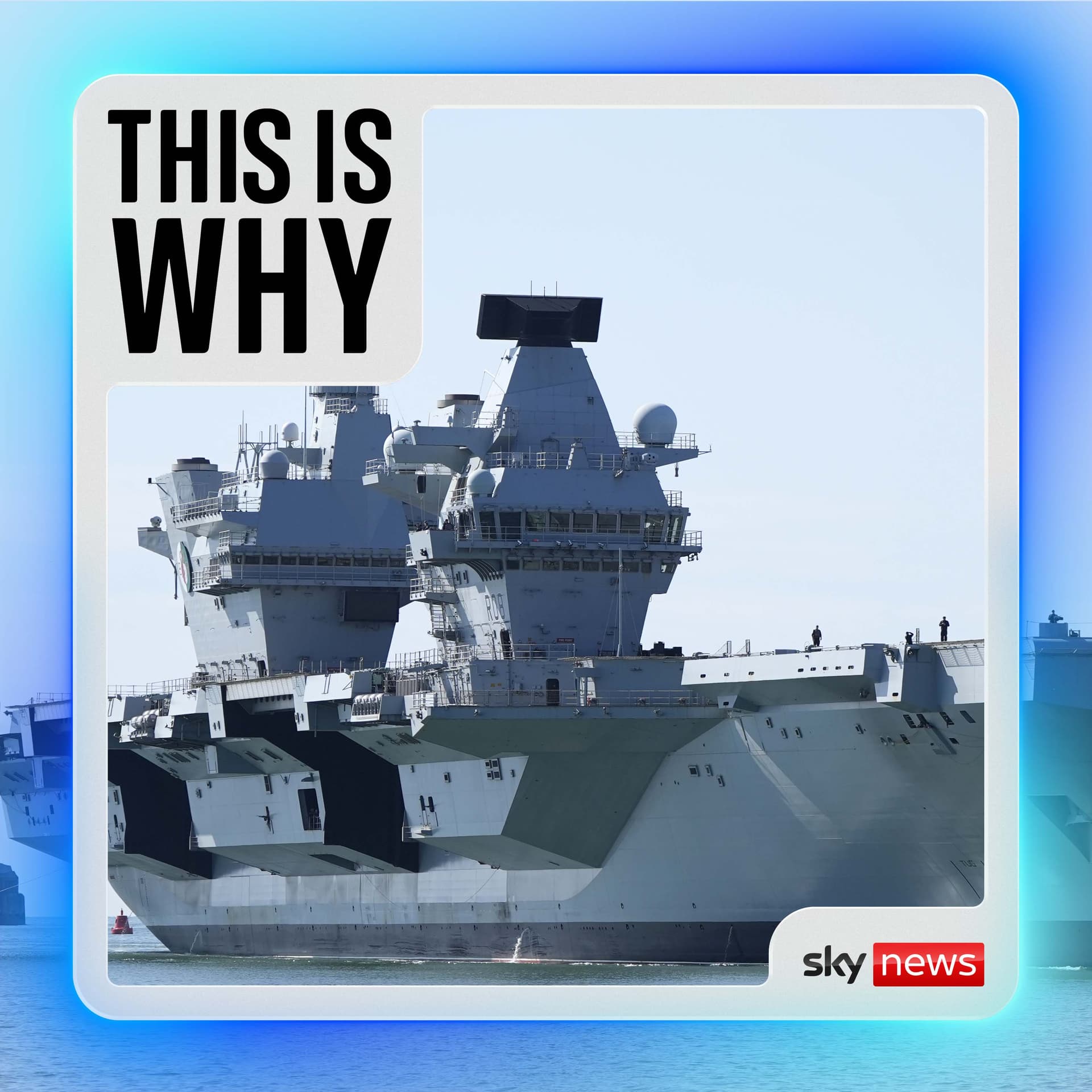
Drones in, destroyers out. The Royal Navy looks set to be the biggest losers when the Defence Investment Plan is finally published.
Instead of building a new fleet of state-of-the-art warships, we will have to rely on cheaper ‘common combat vessels’ to serve as hubs for a hybrid response to the threat from Russia.
How will the change in military spending be received when Sir Keir Starmer makes his international swansong as prime minister at the NATO summit? And could he really be the next NATO secretary general, despite a mixed record on defence readiness?
Mhari Aurora speaks to Sky’s security and defence editor Deborah Haynes.
Have you got a question for the podcast? Email us: why@sky.uk