 Ask ChatGPT


A “Friday the 13th” cascade of failures—especially U.S. air-traffic outages caused by a misconfigured industrial router during FAA infrastructure upgrades—plus a broader look at major tech outages (Microsoft 365/Outlook) and “Black October” cybersecurity incidents.
Daryl Campbell, aviation reporter at The Verge (writes about aviation). Lily Hay Newman, senior writer at Wired.
The FAA’s patchwork system (old 50s–60s tech plus later replacements) can’t safely assume new equipment factory settings; a router left in factory mode flooded the network, causing packet loss that can endanger flight operations. Infrastructure upgrades take years, but political funding cycles and shutdowns can halt training and projects. Microsoft’s Outlook outage stemmed from a flawed infrastructure update that proliferated for months before triggering widespread disruption.
national flight ground stop; Outlook/Teams/Word/Excel/Copilot outage; “Black October” PHP vulnerabilities; Iranian fridge hacks; Binance hack (~$6B); U.S. bank outages (Bank of America, Chase, Wells Fargo).
Written by AI. May contain mistakes.
Unpack the details of the aviation ground stop and its causes.
“And there's a contractor called L3 Harris, and they're doing what they hope is routine maintenance on a dinky little part of the aviation infrastructure backbone for data in the middle of nowhere, Arkansas.”
Explore the complexities of upgrading aging aviation infrastructure.
“Or fighting over it because the government shut down and causing these delays.”
Examine how other countries manage aging aviation infrastructure.
“And it's really because there's nothing else that we can do to stop it.”
Discuss how funding and fees affect aviation infrastructure improvements.
“Europe probably has a very similar system in terms of the age of its components, but they do a lot of their, what would be the equivalent of domestic travel, so short haul trips through trains.”
Discussing the recent Microsoft 365 outage and its implications.
“Yeah, Microsoft 365, so all the productivity platforms, had a massive outage.”
Exploring parallels between air traffic control issues and tech outages.
“And so that it was the interplay of multiple factors that made it so hard for them to recover, they say.”
Analyzing the tech breakdowns and vulnerabilities from October incidents.
“We have an interstitial that's like, meanwhile.”
Detailing the Iranian cyber attack and Binance hacking incidents.
“And so there was this big industry wide effort to make sure that everybody was patching.”
Understanding the cyclical nature of tech outages and incidents.
“So, you know, the fridge hacks, for example, the vulnerabilities that are being exploited there are actually kind of go back like numerous years.”

Get the gist, explore an idea or ask about something said.
 Claude
On Today, Explained, what are the key points of this episode?
Searching your listeningAutomatic transcript. May contain errors.
0:00It was Friday the 13th.
0:04Microsoft Outlook was still struggling. But we had a new problem. The government ordered a complete ground stop of flights. The president was nowhere to be seen, but he sent his Homeland Security Secretary Mark Wayne Mullen out to ease the fears of the nation. The last time I believe that we've had a national ground stoppage was 9-11. Not helpful. Actually, the president posted about a golf course renovation project in DC about 13 times before he said anything about the ground stoppage affecting millions of Americans this weekend. Again, not super helpful, but we did eventually find the culprit, an industrial router that was being upgraded, which leads one to ask, what is going on in this country that a single industrial router could take out our entire aviation system?
0:53That and everything else that's broken coming up on Today Explained from Vox.
1:00Black Friday is happening now at the Home Depot and we've got just the tree for your style, space and budget. Keep it merry and bright then make it yours with ornaments and trimmings for every holiday style. With festive favorites starting at just$49, shop for the perfect tree at the number one Christmas tree retail. Find the tree that feels just right with low prices guaranteed at the Home Depot. Exclusions apply. Visit homedepot.com slash price match for details. Support for today's episode comes from IM8. IM8 is the way to simplify your supplement routine once and for all. IM8's Daily Ultimate Essentials has 16 supplements in one drink for$2.61 a day.
1:43That covers 90 ingredients across 9 major organ systems. Go to im8health.com slash explained right now or click on the link in the description and use code explained for a free welcome kit, 5 free travel sachets plus 10 % off your order. That's code explained at im8health.com slash explained. Code explained at im8health.com slash explained. These statements have not been evaluated by the Food and Drug Administration. This product is not intended to diagnose, treat, cure, or prevent any disease.
2:21What a day, right? Today Explained, I'm Sean Ramos. I'm here with Daryl Campbell, who writes about aviation at The Verge. So let me take you to Friday the 13th. And there's a contractor called L3 Harris, and they're doing what they hope is routine maintenance on a dinky little part of the aviation infrastructure backbone for data in the middle of nowhere, Arkansas. saw. So because they think it's this little tiny place, they do it during the day on a Friday, which is usually not when you want to be messing with this massive data infrastructure, because, you know, what if something happens? But, you know, they think, well, we're going to do it anyway.
3:03So they plug in this router for the first time. They're basically pulling out an old telephone switch that is using copper cables, and they're installing one that has these new fiber optics. It's super fast and all this good stuff. Except they leave a factory setting on. And the factory setting starts pinging the network hundreds of times every second. Now, if you're on a normal kind of massive new infrastructure, that's not a problem. But the thing is, the FAA's data backbone is this kind of patchwork system of old school technology from quite literally designed in the 50s and 60s to some replacements in the 80s and 90s.
3:46So kind of like if you remember cable modems in DSL from the late 90s, early 2000s to some of these brand new fiber optic systems. and they all have to play nice together. And so that means you can't force the old parts of the system to work at the same part of the new one. But the problem is this factory setting assumes that you're plugging it into a brand new system and it quickly starts overwhelming the data flow with all of these requests and kind of causing packet loss in the same sense of like what you would get if you're on a FaceTime call with someone and your Wi-Fi signal isn't very good.
4:23So you start losing bits, the audio gets a little bit choppy. Now the difference here, again, because it's an industrial scale thing, is that a FaceTime call doesn't really matter if you start to lose data. But if you're tracking hundreds of flights and you need up to the second audio feeds that are perfectly crystal clear with absolutely perfect data, once you start to lose some of that, then you can actually cause a plane crash. And so that's something that you really, really don't want to happen.
4:56Now, Sean Duffy did partly blame the Biden administration, as did President Trump. However, they also had the decency, at least Duffy, to say this goes back a very long time, many administrations. And I think on some level there, he's right that these are like very old problems. Why is it so hard to fix these problems that it's going to take decades and generations of suffering? Yeah, I mean, the weirdest part about it all is even though everybody flies, it's a critical system, the timeline for doing these kinds of upgrades is really out of sync with the political timeline. So you think you have a major party change, a presidential change every four and eight years.
5:40But if you're going to do a large scale system upgrade, I mean, you literally have to be digging hundreds of miles of cables, ripping out systems, replacing them without causing the whole system to go down for months on end. So it really is a complex logistical ballet. And that's why it takes 10, 15, 20 years to do these kinds of step change upgrades. And then if you've got, you know, these political parties pulling funding one year and then reinstating it another. So I'm calling on Congress, as soon as they come back, to pass a clean extension of the surface transportation bill, along with a clean extension of the FAA bill, to give workers and communities across America the confidence that vital construction projects won't come to a halt.
6:23Or fighting over it because the government shut down and causing these delays. We're not going to be able to address it overnight, but we now have 2 ,600 air traffic controllers in training. A government shutdown would stop that training. Even a shutdown lasting a few weeks could set us back by months or more. It can easily turn, you know, a short-term project, short-term in the sense of, you know, three to five years, into something that takes 10 or 20 or just never happens. Duffy says he can't guarantee this won't happen again. You will have more of these. You will have more of them unless the American people in the Congress tell us to build.
7:02Does that mean it's going to happen again? Because it seemed pretty bad on Friday. I mean, it was. And if I were Sean Duffy, I would definitely be saying this is probably going to happen again because honestly, it is. Ironically, we've gotten so good at kind of kicking the can down the road and making the best out of these systems for so long that we're now to the point where all of these Band-Aid fixes are just falling apart all at once. And so if we had done a little bit more to cause failures five to 10 years ago, then we probably would be in a better place today in a weird sense. But yeah, I mean, it's pretty clear that we've seen the pace of these aviation infrastructure and equipment crises kind of accelerating over the last three to five years.
7:48And it's really because there's nothing else that we can do to stop it. You just have to take the pain at some point. And we could have done it earlier with better political will. But now the equipment itself is telling us it just can't go on anymore. Darrell, we famously aren't the only country with planes. And certainly we can't be the only country with aging infrastructure. How are the other countries fixing their aging infrastructure without having to ground all their planes on a Friday night? Yeah, well, there's a couple of ways. Europe probably has a very similar system in terms of the age of its components, but they do a lot of their, what would be the equivalent of domestic travel, so short haul trips through trains.
8:30So the load on the aviation system is substantially less. U.S. airspace is the most crowded in the entire world. And it's because we really just rely on flights to get from point A to point B. Like outside of the Northeast, there's really no alternative if you want to go more than 200 miles and you don't want to spend a whole day driving. Obviously, if you were redoing the system today, like, for example, is happening in China, you would just put in this fancy fiber optic stuff. Now, obviously, it's a lot easier when you've got, you know, a single political system that you can, you know, rip up entire hundred mile runs of cable without having to go through all of these permitting process and use eminent domain, et cetera, et cetera.
9:11But the main problem is still there. Europe famously across the pond. But what about, dare I ask, Canada? Well, Canada has about 8 to 10 percent of the volume of the United States in terms of air. In fact, Canadian airspace is partially controlled by American air traffic controllers. And the other thing, too, is that Canada actually requires people to pay fees for the infrastructure. And in the U.S., we've decided that aviation is essentially a right for people. And so the pressure is to push down costs as much as possible. So in Canada, you're not going to get your$70 airfares to wherever. Airfares are a lot more expensive, partially because they're putting some of that money back into the system.
10:02So are you saying we could have fixed this with fees? Well, I mean, partially, yeah. I think the big infusion of cash required to do these big infrastructural projects would have taken acts of Congress. But like some of the day-to-day maintenance would certainly have been a lot easier if you have a lot of fees just coming in on a regular basis. So famously, some radar systems in the United States are held together with duct tape, an aluminum foil. Did you just say that our radar systems are held together with duct tape and aluminum foil? Oh, yeah. I again wanted to interrupt you, but I didn't because I was trying to be polite.
10:35I'll text you a picture afterwards. But I really do think that the big stuff, like this kind of upgrade, is only going to happen with this kind of political, congressional funding, these infusion of billions and billions of dollars that you're really never going to get through just simple fee structures. Does the fact that it went so bad on Friday and that people are so mad and it looks so awful for our country, does that help with the politics of all this? I hope so. And I do think that Sean Duffy is smartly deciding to use this as a way to get at least some of his upgrade budget and agenda over the line.
11:14I want Congress to give us emergency funding. This is bipartisan. This is American. I want$50 billion. President Trump is a builder. He's going to build this network and deliver for the American people. But the president can't deliver for America unless the Congress delivers the money to make it happen. Regardless of political persuasion, we really do need tens of billions of dollars of investment in our air infrastructure in order to make things not collapse spectacularly before. But I really think that it's a systemic problem that if it gets solved this year for a year or two, that would be great.
11:53But people just tend to forget about these things, especially if you're going into a season where you're going to have winter storms. It's just so complex and so hard for an individual person to understand all the parts that happen that, you know, you only have a little bit of time to really capitalize on these kinds of things. And like I said, it takes years and years of sustained attention to really solve some of these problems. OK, but do we think they'll stop doing updates on like Friday nights or like, I don't know, the Wednesday before Thanksgiving or like, I don't know, the week before Christmas?
12:26Yeah, I think that was easily avoidable. I mean, it's just a stupid move to do that kind of thing on a Friday. Like, do it like Sunday night. There's nobody flying. But Friday afternoon, it was a bad idea to begin with. And then just a lot of bad decisions cascaded on top of that.
12:54Okay, that covers the planes. But when Today Explained is back, we're going to ask about all the other outages. Outlook, the banks, finance, everything. Thank you.
13:33track of, and chances are your team isn't growing nearly as fast as you need. Plenty of compliance tools promise automation, but then you still find yourself buried in manual work, tracking down screenshots, validating controls, scrambling to get everything ready for the next audit. Vanta takes a different approach. Its agentic trust platform is designed to grow with your business, not hold it back. With more than 1 ,400 automated tests against 400 plus integrations, Vanta continually collects evidence and monitors your controls throughout the year, helping reduce audit prep time by 82%. And the Vanta agent is available wherever you work, whether your team spends its days in Vanta or uses tools such as Claude or Cursor.
14:15It's why more than 16 ,000 companies, I'm told, including Ramp, Ryder, and Harvey, trust Vanta to save time, free up resources, and keep security moving as their businesses grow with Vanta. Learn more at vanta.com slash explained spelled V-A-N-T-A dot com slash explained.
14:36Support for Today Explained comes from Vanguard to all those financial advisors listening today. Let's talk about bonds for a minute. Finding value in fixed income isn't always easy. Bond markets are enormous, complex, constantly changing. Keeping up with all of it is a lot for any team. And that is where Vanguard can help. Vanguard has decades of experience navigating fixed income markets and their scale gives them a distinct advantage with the ability to invest across sectors, maturities and geographies. They can identify and pursue opportunities that might otherwise be overlooked. Some investment managers chase higher returns by taking bigger risks, but that can also mean volatility for your investors.
15:13Vanguard takes a more measured approach. Rather than relying on big, concentrated bets, they focus on disciplined investing, thoughtful risk management and consistent execution. Might not be the flashiest strategy, But when it comes to helping clients navigate the bond market, dependability and consistency can go a long way. So if you're looking to give your clients consistent results year in and year out, you can go see the record for yourself at Vanguard.com slash audio. That's Vanguard.com slash audio. All investing is subject to risk. Vanguard Marketing Corporation Distributor.
15:50support for the show today comes from granola but hold the cranberries because we're talking granola ai understanding something takes more than simply writing down the facts it's about absorbing information and creating that light bulb moment the same is true at work your best ideas don't usually come when your nose deep and note-taking they come from talking through problems out loud and spitballing with colleagues keep your spit to yourself colleague granola makes that possible granola is an ai powered notepad that makes your meeting notes useful it captures what happens in your meetings and turns it into clean structured notes with decisions and action items pulled out and made easy to find they say once you use granola in your first meeting you'll never want to take manual notes again you can try it totally free head to granola.ai slash explained That is granola.ai slash explained to get your time back.
16:38Go to granola.ai slash explained and try it on your next call. See what happens. Scream granola from the rooftops. Enjoy.
16:55This is Today Explained. I'm Lily Hayne Newman, and I'm a senior writer at Wired. Lily, we spent the first half of the show talking about the issues with our air traffic control systems. But last week, of course, also brought chaos to a lot of people's inboxes when Outlook was not so good. Tell us what happened there. Yeah, Microsoft 365, so all the productivity platforms, had a massive outage. And it really dragged on for like a full day, which is very noticeable when it's a set of products that are as integrated in everything as 365 is. That means you just like can't work, right? This was like probably billions of dollars of productivity lost.
17:44Yeah, this is the cloud version of Microsoft Office. So, you know, Outlook, Word, but also Excel, but also new sort of generations like Copilot, you know, the AI integration and Teams. If that's your productivity platform, then yeah, it can't work. That's everything. Outlook and Teams is down. This is our snow day as an adult. We're so sad Microsoft isn't working, right? I know, very sad. We want to win. Devastated. Microsoft, right, is so enmeshed in the tech ecosystem for decades, like from even before all the cloud platforms, because they're the Windows maker, right? So they're in everything.
18:34Now, we heard earlier in the show that our planes were grounded across the country on Friday because of like essentially a faulty router. What happened with Outlook? Yeah, so Microsoft, you know, a few days later on Monday, what they were saying was, one, was that they had sent out an update. It's a Windows update, but it's only really for their infrastructure. It's not an update in consumer Windows, so it's not something like your laptop would have gotten or something. But it has been out and proliferating through their infrastructure for about three months. but it actually had a flaw in it that wasn't caught by their testing.
19:19And then at the same time, they say cloud infrastructure is all about managing traffic and managing different regions of data centers. The issue with that three months of proliferation of that update started triggering, and that's why it was such a sort of intractable issue or so difficult for them to get. Because at first I saw it, I thought, OK, it'll be a few hours, you know, three hours or something and they'll fix it. And then waking up Friday morning, everybody's waking up in their mornings and it's still not fixed. And it's like, whoa, so something is really going on, you know. And so that it was the interplay of multiple factors that made it so hard for them to recover, they say.
20:05Okay, very different situations here between air traffic control and Microsoft 365. However, both kind of have a similar origin story in that they're about patching systems and upgrading systems. True, yes. We've heard from Sean Duffy, transportation secretary, that he cannot guarantee what happened on Friday the 13th. Won't happen again. Won't happen again in the near distant future. Very ominous. Have we heard something more reassuring from Microsoft? Well, yeah, Microsoft would definitely say, you know, this isn't going to happen again. We want to give you all assurances. We are so sorry. Sometimes problems arise because of sort of cyber attacks or exploitation of vulnerabilities.
20:50And then it's kind of like, well, why weren't all those systems patched? Like there was a patch out. But a lot of times patching is slower than we would like because the ramifications of a bad patch or like an unforeseen consequence of an update can be really severe. And so organizations tend to be very nervous. But it's never the last time. There's, you know, these types of outages and failures happen in all technology systems and they will continue to. But, you know, people try to learn as much as they can from each incident and make things more and more robust. Maybe a good time to ask you about all of the other breakdowns we've been having in our technology and elsewhere over the last few weeks.
21:41We have an interstitial that's like, meanwhile. If you were wondering why a third of the Internet is burning right now, this is why. I'm about to read you the list of 19 incidents that have occurred between October 19th and 22nd. What the hell is going on with Black October and why are there agents inside of bank accounts? I mean, people may not have even realized they just lived through something called Black October. What is Black October beyond like, you know, Halloween? I think in October there were like a few things going on, including the widely used web scripting language or web programming language, PHP.
22:17And there were these two vulnerabilities in it that researchers were really concerned that, you know, if they were exploited, they could cause like remote access takeovers of all different websites and all different platforms. And so there was this big industry wide effort to make sure that everybody was patching. Speaking of patching, like we got to patch this right away. Don't wait type of thing. So there's Black October and then there's the vulnpocalypse. People have been talking about this for maybe about a year now. Just kind of this idea. Like everything's vulnerable? Right. Or that AI tools.
22:53We need a better name for that. Look, it's not my thing. I'm just doing air quotes here. You know, heavy air quotes. But, you know, this idea that agentic AI and AI models are becoming more and more powerful and adept at finding bugs in software and in helping both researchers and potentially attackers figure out how to exploit those vulnerabilities and essentially weaponize them. So there's this sort of fear that, you know, cybersecurity is always this cat and mouse, people call it, again, I'm doing the air quotes cat and mouse game, or like an arms race is another phrase that's often used. And so that in itself is not new, but the idea that AI in the mix just really accelerates for both sides and how to manage that dynamic.
23:49Okay, so that was one with a quasi-happy ending, but then there were a couple that weren't so happy, like this Iranian cyber attack on supermarket fridges or Binance getting hacked for, like, I don't know, I think, like, the most money I've ever heard about in any kind of hack or heist ever. Like$6 billion? It was. Yeah. And crypto, I thought we were meant to believe that crypto was like unhackable. And here we are getting hacked for$6 billion. Okay. I just want everyone to know, like, you can rest easy. Things were already really bad before. Like, great. So, you know, the fridge hacks, for example, the vulnerabilities that are being exploited there are actually kind of go back like numerous years.
24:39French officials like publicly, formally in a whole document have pointed to Iranian actors as having been behind at least some of those. This is targeting the food supply chain. And same with the Binance situation. Like North Korean hackers stealing cryptocurrency, including like large sums of cryptocurrency, is a narrative that reporters have been following. And, you know, the researchers, everybody has been following for, you know, years and years and years. And then on Monday, we had this bank outage across banks across the United States, Bank of America, Chase, Wells Fargo. It just feels like everything is kind of breaking at a time where we're on like the precipice of driverless cars and like AI running everything.
25:30Like, is it getting worse or is it just a rough few months here? To me, this stuff feels more cyclical. Like, people may remember like eight to ten years ago when there were like a ton of DDoS attacks taking down, you know, huge services. There was even like basically an East Coast Internet outage. DDoS attack that disrupted Internet was largest of its kind in history, experts say. Users reported sporadic problems reaching several websites, including Twitter, Netflix, Spotify, Airbnb, Reddit, Etsy, SoundCloud, and The New York Times. So for me, it feels like we're in another round of those. Like one of those moments where a lot of stuff starts to pile up and incident responders are really overworked and really, you know, exhausted.
26:25And then like other things are happening and just like nobody has as much sort of elasticity or bandwidth because there's so many things piling up at once. Especially right now, you know, in this new era of sort of ubiquitous AI and access, you know, more and more access to more and more capable AI systems. Again, it's not to diminish that feeling. It's just maybe helpful to have some context that it's not like truly, truly unprecedented right now.
27:00Lily Hey Newman, Wired.com Earlier it was Daryl Campbell, author of Fatal Abstraction Why the Managerial Class Loses Control of Software Seems relevant While we were making the show, CNN reported that a highly classified U.S. national security communications network is down Good thing the president isn't hanging out with the leaders of China and Russia this week What's that? Oh, no. Ariana Spru produced with Denise Guerra. Feel better Denise. David Tattashore mixed with Bridger Dunagan, who feels fine. Gabriel Donatov fact-checked with Kelly Wessinger, who is well-rested. And Miranda Kennedy edited for Today Explained.
27:58Right now, when you buy more carpet at the Home Depot, you save more. For a limited time, upgrade your carpeting with the top brands and save up to 15 % off installed carpet projects. Installation starting at just 69 cents per square foot. Let us get you started with a free measure. Purchased by December 6th for installation by Christmas. Offer valid November 12th, 2026th through December 6th, 2026. Base price for standard installations only. excludes Traffic Master and Stock Carpet. For licenses, see homedepot.com slash license numbers. Are you ever shopping online and suddenly a discount that helps you save pops up?
28:34It makes your day, sometimes even your week. Want that feeling month after month? Well, new customers who save by switching their home and auto insurance to Progressive save hundreds. Cue your happy dance. Get your quote today at progressive.com. Progressive Casualty Insurance Company affiliates and other insurers. not available in all states.
It’s not just air traffic control going down. It’s your email and your bank and crypto and…
This episode was produced by Ariana Aspuru and Denise Guerra, edited by Miranda Kennedy, fact checked by Gabriel Dunatov and Kelli Wessinger, engineered by Bridger Dunnagan and David Tatasciore, and hosted by Sean Rameswaram.
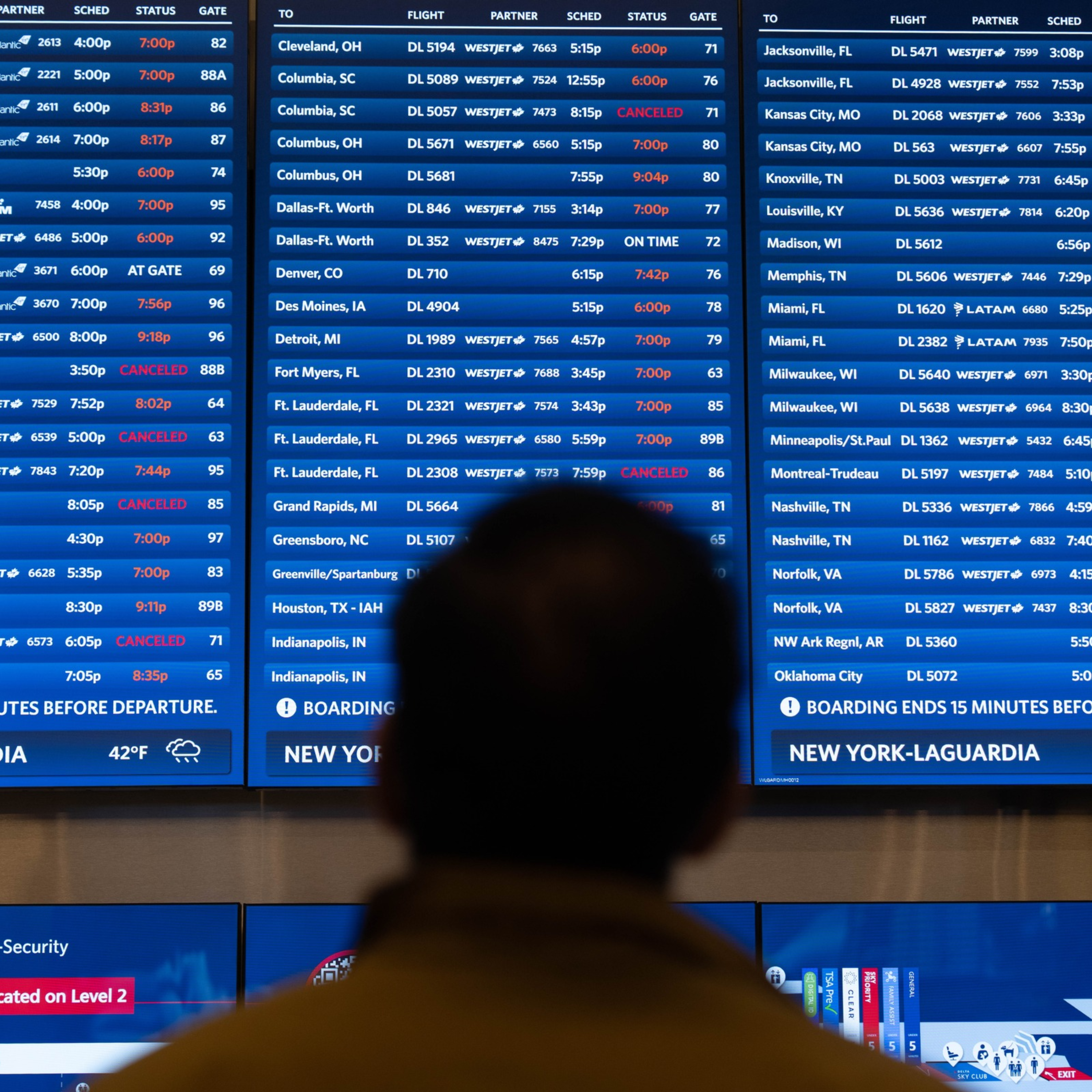
A person looks at a departures board showing delays and cancellations at LaGuardia Airport on Nov. 13, 2026 in New York City. Photo by Adam Gray via Getty Images.
Listen to Today, Explained ad-free by becoming a Vox Member: vox.com/members. New Vox members get $20 off their membership right now. Transcript at vox.com/today-explained-podcast.
Learn more about your ad choices. Visit podcastchoices.com/adchoices