 Ask ChatGPT



A tense Labour Party rebellion in the UK Parliament over the government’s welfare bill, focused on major cuts to Personal Independence Payment (PIP) eligibility and payments. Disabled protestors gather outside Westminster; Labour MPs split between supporting the government and voting against.
Helen Pitt (Guardian presenter). Emma Lewell (Labour MP for South Shields; won 2013 by-election). Peter Princely (Labour MP for Bury St Edmunds and Stowmarket). Dr Simon Ofer (Labour MP for Stroud; practicing GP). Kieran Stacey (Guardian political correspondent). Additional MPs interviewed: Josh Fenton-Glynn (Calder Valley), Kat Eccles (Stourbridge). Keir Starmer is discussed as PM.
PIP cuts could push 150,000 people into poverty; eligibility changes (including a “four points in any one category” rule) would deny support for people unable to fully wash/cook. Government rationale is framed as short-term savings and “financial sustainability,” not employment. MPs say they were misled and excluded from consultation.
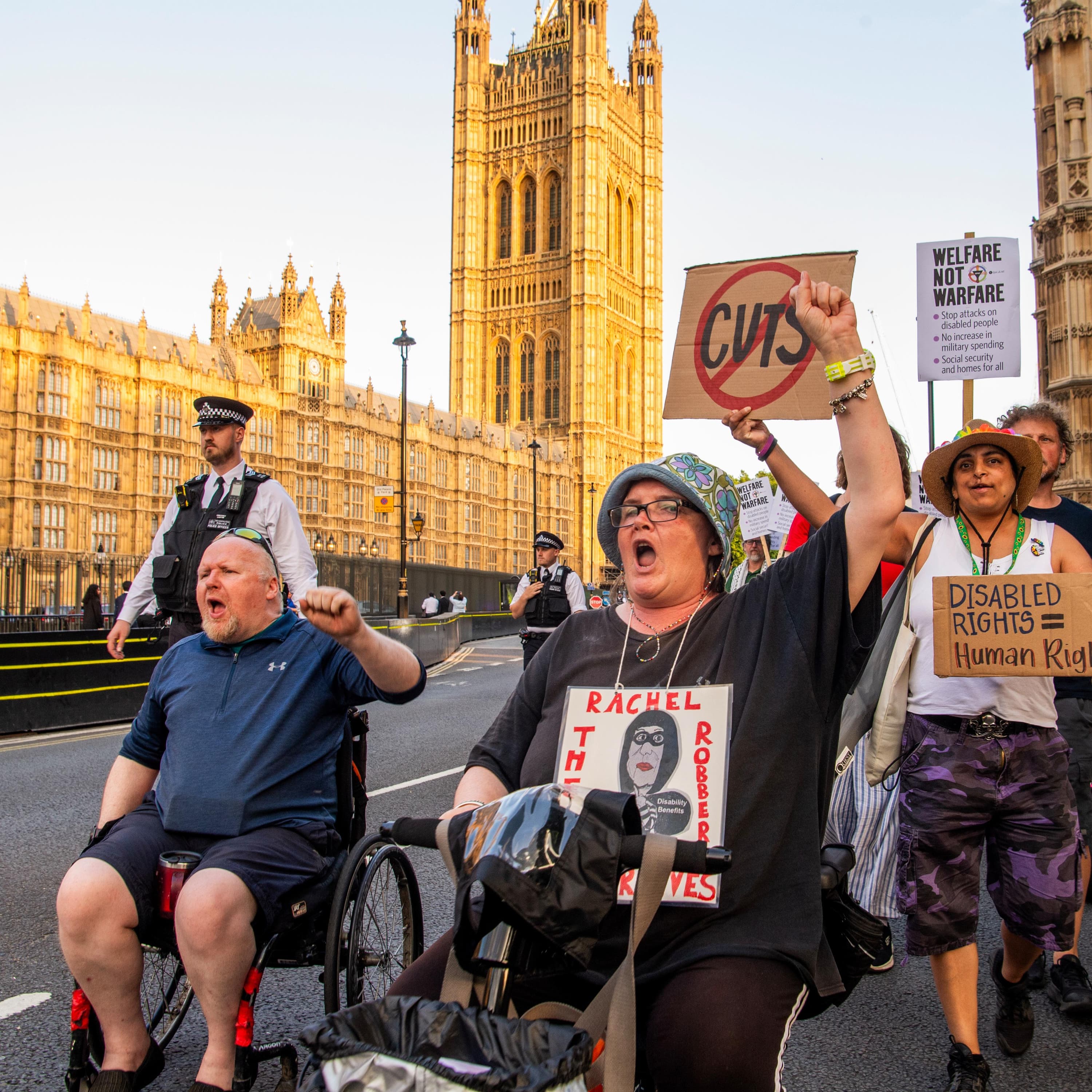
protest signs (“Rachel the Robber Reeves,” “Labour don’t take the PIP”); Resolution Foundation estimate of ~1 million affected; PIP standard rate about £73/day. Final outcome: clause five (PIP cuts) removed at committee stage; vote passed by 75, but critics say promised £5bn savings vanished.
Written by AI. May contain mistakes.
Discussion on Keir Starmer's challenges with Labour MPs over benefit cuts.
“unhappy at the government's plans to substantially cut disability benefits.”
Interviews with disabled individuals expressing their concerns about the cuts.
“So I am in the office of Emma Lewill, who is the MP for South Shields in the North East.”
Emma Lewill discusses the implications of proposed benefit cuts.
“And do you think they're going to learn from it?”
Various MPs share their stances and feelings about the upcoming vote.
“But before we go into that, this bill was first announced back in March by the Work and Pension Secretary Liz Kendall.”
Overview of the government's proposed changes to disability benefits.
“So to create a level playing field, essentially, is it?”
Exploring the backlash from Labour MPs and disability charities regarding the bill.
“So that argument has been tried frequently over the last few weeks, including by Liz Kendall, the welfare secretary, on Monday in the Commons.”
Discussion on why Labour MPs oppose the benefit cuts and their implications.
“But going back again to March, it was immediately controversial, wasn't it?”
Explore the Labour Party's internal reactions to proposed benefit cuts and their implications for disabled individuals.
“You're saying that you believe these cuts in their current form could cost lives.”
Listen to the perspective of various MPs as they grapple with their decision on the controversial bill amidst concessions.
“So anybody who claimed before that would be on the old rules.”
Delve into the debates occurring in Parliament and the significant concessions made by the government to ensure the bill's passage.
“I wouldn't normally ask somebody about their own disability, but I think it's kind of relevant in this conversation.”
Explore the chaotic parliamentary debate surrounding the controversial bill.
“I mean, basically, they gutted their entire bill.”
Discuss the immediate consequences of removing a key clause from the bill.
“And now there's nothing in there about personal independence payments.”
Analyze the implications of the day's events on Starmer's leadership and party direction.
“And there were Labour MPs standing up on the floor of the Commons today after Stephen Timms made his announcement saying, what are we voting on here?”
Examine the importance of a clear narrative in government policy and its absence in recent actions.
“Maybe I could say that in their last days of the Rishi Sunak government, I mean, Liz Truss was something else altogether.”

Get the gist, explore an idea or ask about something said.
 Claude
On Today in Focus, what are the key points of this episode?
Searching your listeningAutomatic transcript. May contain errors.
0:00This is The Guardian.
0:06Today, a hot and fractious day in Parliament as Labour MPs revolt over plans to cut disability benefits.
0:24It is a very muggy day in Westminster and I am spending the day not in the park or in the Lido. but in and around the Palace of Westminster, where Keir Starmer is facing the biggest challenge of his premiership so far. It's kind of hard to believe, but it's not even quite been a year since his enormous landslide victory. And yet today he is facing a major rebellion of his own MPs, unhappy at the government's plans to substantially cut disability benefits. I have sought some shade opposite the House of Parliament, where groups of disabled people are gathering to show their opposition. There is a woman in a mobility scooter wearing a sign that says Rachel the Robber Reeves.
1:04There are other people whose signs say welfare, not warfare. And another one says Labour don't take the pip. What's your message for the government today and the MPs who are going to vote on this bill? They better make the right decision. This is people's lives they're playing with. Disabled people are being so forgotten that their benefits and their lifelines are being used as an ATM machine. Any of you can become disabled at any point, and this benefit doesn't only help us, it helps any one of you in the future. How are you feeling at the prospects of these changes? Angry. The Labour Party, a party for the people, is targeting the most vulnerable of the people.
1:51Did you vote Labour? Yes, but I was mistaken. I am so annoyed. There's nothing Labour about them. These people are those who are most likely to be affected by these dramatic changes, but they're not the ones making the decisions. That will fall to MPs, who later today will be going into the House of Commons and going through the voting lobbies to decide whether this vote should pass. From The Guardian, I'm Helen Pitt. Today in Focus, Labour's big benefits rebellion.
2:30So I am in the office of Emma Lewill, who is the MP for South Shields in the North East. She won a by-election in 2013 after David Miliband, remember him, went off to try his look outside of politics. So Emma, tell me, it's a big day in Parliament. How are you feeling? I mean, I feel really sad that we've got to this point nearly a year into a Labour government and we're asking MPs to walk through the voting lobby today to put 150 ,000 people into poverty and tighten eligibility criteria for those who need support the most. And I don't know if you remember, but the last time you were on our podcast was when you were abstaining on the bill, which was cutting the winter fuel payment for almost all elderly people.
3:13And I see how that one turned out for Labour. Well, yes, I mean, this is the thing. You should really listen to your members of Parliament because we're the voice of thousands of people in our constituency. There isn't a single person in South Shields who's contacting me to say, please vote for this today. There's a reason why there isn't a single disabled-led organisation supporting this bill and why 138 of them have come out today and said, please do not vote for this. So I know we've met you before, but could you introduce yourself, please? I'm Peter Princely, the MP for Bury St Edmunds and Stone Market.
3:45Have you decided how you're going to vote? Yeah, I will support the government. I was pleased with the modifications which were suggested at the end of last week, and I'm now content that this is something that we should pass. And has it been a difficult decision for you? You know, it's not really a difficult decision. It's a decision that's required a bit of thought. but we have to do something to deal with the massive problems we've got. The fact of the matter is that very large numbers of our young people have been particularly affected by mental health problems and that seems to have shot up particularly since the pandemic.
4:27And what I'd like to see is a much greater investment in treatment for people with mental health difficulties. And how do you feel about all the controversy swirling around this bill? Does it feel to you that it has been poorly managed by the government? Well, what I would say is that the communication between the government and the parliamentary Labour Party could have been better handled. I think that is not an unreasonable thing to say. And do you think they're going to learn from it? Well, I do hope so. I mean, I do see that quite by chance I have been invited for lunch with the Prime Minister tomorrow, which is the very first time I'll have been able to have a conversation with him.
5:11Perhaps that's a coincidence. Yes, so my name is Dr Simon Ofer. I'm the Labour MP for Stroud. I'm also a practicing GP as well. And have you decided how you're going to vote later today? Yeah, I have decided. I'm going to vote against the bill. I've never voted against a government before, but I just feel that this is a deeply flawed bill and it will not help disabled people. In fact, it will make 150 ,000 of them pushed into poverty. So I haven't got into politics to do that. So I will vote against. And you say this is the first time that you have rebelled or you're planning to rebel. How does it feel?
5:48It's really uncomfortable, actually. I'm finding it really difficult. I didn't sleep much last night because I kept worrying whether it's the best thing. You know, I really like this party. It's a great party. And loads of really good MPs have been saying, come on, Tom, and, you know, tow the party line and everything. And I understand what they're saying. But I do think that sometimes you have to vote for what you think. And this is one of those occasions.
6:20right so i am in the parliamentary broom cupboard which is stuffier than ever today with the guardians political correspondent kieran stacy it's a very busy day for you so thanks for taking time for us that's all right helen it's kind of the um lull before the storm later on so this is a good time to take the temperature i reckon yeah so i've been talking to MPs around the building this morning, it feels very tense among the parliamentary Labour Party. But before we go into that, this bill was first announced back in March by the Work and Pension Secretary Liz Kendall. Why did the government put it forward and what were they proposing?
6:55Well, the reasons for putting forward these welfare proposals in the first place were twofold. One was to try and get people back into work and one was to save money in the short term. Now, the bits that are about getting people back into work are things like a big employment support package, which would be worth over a billion pounds over the course of this parliament. That will include things like what's called the right to try, which is not taking people's benefits off them if they try and get back into the workplace and then fail for whatever reason. That includes things like having more work coaches in schools and in benefit centres.
7:29It includes a work or training guarantee for people aged 18 to 21. All of that, by the way, is not very controversial. Labour MPs love all of that stuff. It also makes some change changes to universal credit. But the key part of all of this, the bit that saves the most money, the bit that forms the heart of the bill that they're voting on today, is changes to what are called personal independence payments. These are regular payments made to disabled people to help them with basically their quality of life. So often these are used to pay for things like stair lifts or aids to get in and out of the bath, even sometimes cars and other forms of...
8:04So to create a level playing field, essentially, is it? To sort of to compensate for the extra costs involved. Conversate for the extra costs of being disabled. That's exactly right. The problem with it is that the costs of that entire system have been going up and up and up and have continued to do so even after COVID, when other countries saw their disability payments fall. What's happened is the government, which is also looking for ways to cut money to hit its own fiscal walls, has come along, seen this enormous and expanding budget and just said, right, we need to restrict eligibility for these payments soon.
8:32So as of November 2026, the idea is that it will become much harder to claim personal independence payments. And how does the PIP system work? So the system by which you get assessed before you claim your disability benefits is quite complex. There's basically a series of questions that you have to answer, each of which if you answer yes to, you get a certain number of points. So are you able to leave the house on your own? No, you get a certain number of points. Are you able to wash yourself? No, you get a certain number of points. Now, at the moment, you have to get a certain number of points overall across all these categories to be eligible.
9:08What the government is saying, as well as having an overall number that you have to get, in any one category, you will have to get four points. Now, what this really means is that there are people who will not be able to wash half of their body, say, or will not be able to cook themselves a meal. Because those questions don't give them four points, they will not be able to claim those disability benefits. So you'll end up with people exactly in that situation who can't cook a meal, who can't wash themselves fully, who are judged as not sufficiently disabled to be given these payments in the future.
9:39And there's a lot of money involved here, right? So at the moment, the daily living amount of PIP is about£73. Yeah, for the standard rate. For the standard rate. And the higher payments are worth over£100 a week, this is. So, So, you know, by the time you top that up, that's several hundred pounds a month. That's thousands of pounds a year that people are standing to lose because of this. And that means lots of MPs have constituents who are affected by this. I mean, the Resolution Foundation estimated that somewhere in the region of about a million people would be affected. And each of those on average would be losing several thousand pounds.
10:11And what the government essentially decided to do is pick one group of people and take a lot of money away from them. And that's the thing that Labour MPs are very upset about. And is it simply about saving money? I mean, that is the question I think that the government is really struggling to answer. Ministers will tell you, look, this is about helping people get back into work. But the argument really doesn't make any sense at all because personal independence payments are paid to people, many of them in work already. It has nothing to do with your employment status. This is not universal credit, which is an unemployment benefit.
10:46This is something to help people with their daily life. And in fact, many people on PIPs say that these payments help them stay in work because without their car or without their mobility aids, they wouldn't be able to get in and out or do the jobs that they do. So that argument has been tried frequently over the last few weeks, including by Liz Kendall, the welfare secretary, on Monday in the Commons. set out in our Pathways to Work green paper are rooted in values I know many MPs share, that those who can work must work, but often need proper support to do so. But it just feels very dishonest to a lot of Labour MPs.
11:27Now, the most coherent explanation that I have heard for why the government is doing this came from a minister who gave a briefing just after the measures were announced to the entire press pack. And this minister said, look, we're trying to do two things here. We're trying to help people back into work. Yes, that is why we're changing how universal credit is run. That is why we are spending more money on back to work schemes. But the changes to PIP are about what he called the financial sustainability of the entire system. And he said the costs are going up so much that by the end of this parliament, the entire welfare system will have collapsed under its own weight.
12:04That's the more coherent argument. The problem is it looks like what you're doing then is making a load of changes to people's lives because you have to save money in the short term. And initially, how much did the government say that these cuts would save? These cuts were originally supposed to save around£5 billion. Almost all of that came from the PIP changes. Right. But going back again to March, it was immediately controversial, wasn't it? Disabled people, disabled charities were immediately very alarmed by what they had heard. But when did it become clear that this bill was in real danger?
12:35Yeah, I mean, it's not surprising that cuts to disability benefits are going to trigger anger from disability charities. And I think that the government was expecting it and received it. And that was all fine. Then in the weeks leading up to the bill itself, we were told, our team was told that there were 170 Labour MPs who had expressed their opposition to this bill in one way or another. A lot of them had written private letters to the prime minister. But really, I think this all crystallized for us last week when there was a reasoned amendment, what's called a reasoned amendment, really it's an attempt to wreck the bill, was published.
13:13And it turned out there were over 120 Labour MPs wanting to sign that. And once that went public, the government was in a very difficult position. And it was particularly the people who were involved in drafting that amendment, right, that meant it was pretty serious for the government. So tell us about the people who were behind it. Yeah, well, this was not what the Labour leadership likes to call the usual suspects. This was not Jeremy Corbyn and his band of socialist campaign group followers. This was, I mean, the lead person on this amendment was Meg Hillier, Dame Meg Hillier, who is the chair of the Treasury Select Committee, very senior person within Parliament.
13:47And so her name was very powerful as the lead person in there. But you also had about a dozen other select committee chairs. You had people like Debbie Abrahams, the Labour MP who chairs the Work and Pension Select Committee, who really knows her stuff. You're saying that you believe these cuts in their current form could cost lives. There is that risk. And that is what I'm incredibly concerned about. We published the select committee. So you have people like Florence Eshalomi, who chairs the local government and communities select committee. That many disabled and sick people want to work, but the reality is cutting pit will not address the reasons why they don't.
14:27So quite heavyweights within the Labour Party. And I think it was, as you say, Helen, not just the number of people, but the kind of people who signed it that really rocked the government last week. And maybe it's obvious, but can you spell out for us why this went down so badly with Labour MPs? Why the bill went down so badly? Yeah. I mean, Labour MPs don't come into Parliament, as they like to tell us, to cut benefits for disabled people. I mean, this is exactly the kind of thing they hate doing, the kind of thing that they would have opposed in opposition. I mean, many of them in the parliamentary Labour Party actually come from disability charities, have worked in the sector.
15:03Several of them have disabilities themselves. I mean, some of the most powerful interventions over the last couple of days have come from Marie Tidball, who is one of the only visibly disabled MPs in Parliament, who feels very strong, has always campaigned on this issue. Having no public consultation of these plans excludes the voices of disabled people. This is not just about process. This makes disabled people worse off. Frankly, this is not what Labour MPs like to do. And I think what is added to that is that they felt, first of all, that they've been slightly lied to about the reasons for doing it.
15:36You know, the great lofty arguments about getting people back into work didn't really wash when it was so clear that this was to save money in the short term. Secondly, they felt patronised by the government's approach to them when they were raising concerns. So there were lots of letters written to Keir Starmer, who then didn't seem to have met any of these rebels before the recent amendment was published. And what about Starmer himself? He's obviously been quite busy abroad recently. How did he react to signs of rebellion in recent days? Keir Starmer did two interviews over the weekend, which I was just astonished by the tone of, because what he said in both of these interviews was, I was too busy with foreign affairs to really realise what was going on at home in my own party.
16:17I mean, it was quite an amazing thing for a prime minister to admit. Really, I think a lot of people in his party think it's essentially a dereliction of duty. You know, you were trying to do something controversial and you weren't even engaged with it because you were so busy. You know, I mean, understandably doing things like G7 and going to Ukraine and, you know, doing some important things on the world stage. But essentially, he seems to have taken his eye off the domestic ball, as it were. And then as he's coming back from his trips abroad, he then gets asked what he thought of the brewing rebellion.
16:46and he called it noises off. Is it tough going? Are there plenty of people and noises off? Yes, of course. There always are, there always have been, there always will be. Which I think just even at that stage, when he was flying back into the midst of this maelstrom, he was kind of describing it in those terms. I think Labour rebels just felt like you've completely misjudged us here. The problem is, every prime minister in a way, I think has an original sin, a fatal flaw maybe, an Achilles heel that ends up bringing them down. With Keir Starmer, it's the fact that he's come to power by taking on his own party.
17:20And so he thinks that in every conflict, the job is take on the party and defeat them. And that's how you get through to the next stage. And that's certainly the view of Morgan McSweeney, who was quoted in the Sunday Times as saying, I'm going to suspend 10 Labour MPs an hour until I get to 50 and then the rebellion will die. Yeah, McSweeney, of course, is Starmer's closest aide in government. Yeah, that is the mindset among a lot of these people. But when you're no longer dealing with a smaller rump of Corbynites, disaffected Corbynites, when you're dealing with the great mass of the parliamentary Labour Party, that approach simply doesn't work.
17:53Right. And he and his aides realised that they had made a fairly major miscalculation. And towards the end of last week, they put forward a package of concessions, didn't they, which would cost maybe as much as three billion of the five billion that they were looking to save. And the main concession was that the government announced that the new tighter rules about PIP eligibility would only kick in from November 2026 for new payments. So anybody who claimed before that would be on the old rules. Yeah. The problem with that is, as Labour MPs were saying all of yesterday, that it kind of creates a two tier system.
18:27It depends when you first started claiming your PIPs, how much you get. OK, so that's concession number one. Concession number two, they're bringing forward and they're spending a bit more on some of these employment schemes that I was talking about earlier. Fine. Concession number three is causing a lot of problems. This is to do with a government review that is already ongoing into what should the categories be that we assess people by before they claim their disability payments. This is called the Timbs review after Stephen Timbs, the welfare minister who's leading it. the original idea was Stephen Timms would do this review and at some point he'd report back and the government might change the categories um behind pip claiming now they're saying well what he'll do is instead of just doing this work on his own he'll do it as a quote-unquote co-production with disability groups we don't quite know what that means um and that whatever gets reported from that will be fed into the system the problem is Stephen Timms is not due to report back from that basically until around the same time that the new system is due to go into effect.
19:26There will then be a time lag. What you'll end up with in that scenario is essentially a three-tier system. You'll have the people who were always claiming PIPs before. They'll stay on that system. You'll have a group of people who start claiming PIPs after November 2026 when the new measures come in, but before the Stephen Timms recommendations come into force. Then you'll have a third group who start claiming after the Timms recommendations come into force. The government has set up this unbelievably complicated system. And there are even concerns that there are so many concessions here and so much wiggle room that they might not end up saving any money in the first place.
20:02So then why do it at all?
20:09So I've been in Parliament often on days when there is going to be a vote that's potentially controversial, but it does feel very tense in here today. And there are a lot of MPs who are still on the fence. and one of them is Josh Fentenglin, who is MP for the Calder Valley in West Yorkshire. Tell me, where is your head at right now? I have to say, it's really welcome how much the government moved on this. So I have constituents who claim pip, as everyone does, and there was real fear among that group. And I was on the market at the weekend, and one of the market storeholders said, you've saved my wife's pip.
20:47Now, I don't know if she'd have lost it or not, but the reassessment would have clearly caused a lot of anxiety. And we've got real clarity, I actually exacted slightly more clarity on it, in the Chamber that people in the current system will be protected. However, there are more questions about what the new system looks like and how we roll out those protections and also what happens to those people that fall between two stools. So I'm going to see what I can get out of ministers, see if we can get some clear messages which protect those people. And based on that, I'm going to decide my vote.
21:25So I could very much be persuaded either way. There's been some MPs saying that in the whole year that they've been an MP, they've never met the Prime Minister, that he's not in touch with his MPs, he's not touring the tea rooms, he's not on the terrace. Have you met Keir Starmer since you were elected? He's a very busy man. And I've met him at a couple of receptions. I've not had to sit down with him, but, you know, I'm also a backbencher that no one's heard of, so I wouldn't really expect that. I'm Kat Eccles, and I'm the Member of Parliament for Stourbridge. And have you decided how you're going to vote today?
21:59Yes, I'll be voting against the bill today. Even with the concessions on offer, my concerns haven't been alleviated whatsoever. And in fact, after Liz Kendall's statement yesterday, I'm left with even more questions. and uncertainty, it appears that we may be creating a potential two-tier system on PIP. And there also are concerns that have been raised by legal experts that it may breach human rights and international law. So I really feel that the government should pull this bill today, but if they don't, then I will be voting against it. I wouldn't normally ask somebody about their own disability, but I think it's kind of relevant in this conversation.
22:40you've talked out in the past couple of months about being autistic and I wonder how your own personal experience if at all has kind of influenced how you were voting. Well when Liz Kendall first stood at the dispatch box back in March the first question I asked was around how are you going to support employers to support people with long-term health conditions remain in work because as you mentioned I got autism but a few years ago I also suffered a blood clot in my lung and I was really poorly and it led to me being off sick long term and my employer managing me out of my job and I ended up on benefits and I'd only asked for a really small reasonable adjustment but it was refused so I'd say pretty much from day one I've been uncertain but no one's been able to alleviate all my concerns so yeah those are the reasons why as well as my personal experience and all the stories I've heard from my constituents, that's why I'll be voting against the bill today.
23:42And why do you think the government has misread the party so badly on this issue? As I said, we've all been raising it at every level possible, but in party meetings we've just been told, oh but it's popular with the electorate. And I think the party was so convinced that this was a popular policy with the electorate, and don't get me wrong, nobody disagrees that we need to reform welfare. It's just how we do that and whether we do it in the right way. But I think they were so married to this idea that it was popular policy for the public, that we've got to meet this saving and stick to Rachel Reeves fiscal rules as well, that they were just blinded to just how big the issue was amongst its MPs.
24:27So do you think they prefer to do something that's popular than something that's right? Wow.
24:37I mean, I guess you've always got to be thinking about the next election, but the way I see it, there's always got to be a middle road where you can do both things that you need to do. Do the right thing, but still find the savings you need to have. And that doesn't mean taking money away from people who most need it.
25:07I now call the Minister, Secretary of State, to move the second reading. Liz Kendall. Thank you, Mr Speaker, and I beg to move that this Bill be read for a second time. This Bill and our wider welfare reforms seek to fix the broken benefits system that we inherited from the party opposite and to deliver a better life for millions of people across our country. It is with a heavy broken heart that I will be voting against this bill today. As a matter of conscience I need my constituents to know I cannot support the proposed changes to PIP as currently drafted on the face of the bill before us today.
25:51These Dickensian cuts belong to a different era and a different party. They are far from what this Labour Party is for, a party to protect the poor, as is my purpose, for I am my brother's keeper. These are my constituents. MPs are debating the government's watered-down welfare reforms ahead of a vote tonight. Ministers say the proposals will fix a broken system. Well, the debate is underway in the Commons ahead of the pivotal vote on welfare, and the government is struggling to get its way. The debate is in full swing when a rumour starts to spread across Westminster that the government is so worried about losing the vote that it's going to make yet another major concession to ensure it passes.
26:32It is widely expected that in the final wind-up debate, which will involve Stephen Timms, who is the disability minister, it is widely expected that he will offer another concession. He will say that these new rules won't come into place until Till his review has reported. We've heard those concerns and that is why I can announce that we are going to remove the Clause 5 from the Bill Act Committee. That we will move straight to the wider... Coming up, a last-minute compromise, the vote and the aftermath.
27:20The eyes to the right, 335. The nose to the left, 260. So the eyes have it, the eyes have it, unlock. So Kieran, after all that drama, the vote passed fairly comfortably by 75 votes, thanks in no small part to some pretty major 11th hour changes from the government to the bill. And the concessions clearly persuaded quite a few of the would-be rebels. Of our interviewees earlier in the day, Josh Fenton-Glynn, who you'll remember was sitting on the fence, ultimately did vote for the much diminished watered down bill. Can you explain what these last minute concessions actually were? Some concessions.
28:00I mean, basically, they gutted their entire bill. They took out the main part of it. So it was really interesting because MPs started debating this bill, I think, about 1.30. Now, around that time, we're told Angela Rayner, the deputy prime minister, was engaged in this kind of shuttle diplomacy, heading back between rebel offices and the whip's office, trying to communicate messages backwards and forwards, clear at that point that they were worried. At some point, Angela Rayner seems to have turned to, sent a message to Downing Street. Keir Starmer was in Downing Street all day and said, we're not sure we can win this.
28:33You're going to have to offer something major. I suggest taking out clause five of the bill. Now, clause five of the bill are the pit cuts. That's what we've been talking about for the entire day. That's the main point of the entire bill that they were voting on. Keir Starmer then agreed, passed the message through to the House of Commons. We were picking up a sign that something like this could be in the offing, but we hadn't had it absolutely confirmed. And then suddenly Stephen Timms stands up in the Commons with about an hour and a half to go before the vote and says exactly that. We're going to remove clause five.
29:01We're going to consult on PIP changes. Any changes we make will come later down the line as a result of this Timms review. So essentially the main part of the bill is now, or they say at committee stage, it was too late to do it today, but will be withdrawn. And I mean, that was just greeted with utter disbelief on the floor of the House of Commons. So just so I've got this straight, the full name of this bill was the Universal Credit and Personal Independence Payment Bill. Yes. And now there's nothing in there about personal independence payments. They will, after committee stage, not have the references to personal independence payments.
29:32This seems bonkers. Have you ever seen anything like this before? No, I don't think I have. And look, on the proviso that I was abroad as a reporter for the Brexit years, and my colleagues tell me that some of this is a little bit akin to that. But you don't expect this level of commons chaos from a government with a 165-seat majority. This is, I would say, unprecedented for a government to have to essentially withdraw a major piece of economic policy less than a year after having won a landslide election victory. This is just an astonishing undermining of Keir Starmer's authority and also leaves Rachel Reeves, the Chancellor, with an absolute headache about how she fills this new black hole in her budget.
30:13Yeah, because as you said earlier, the£5 billion of savings that were supposed to come from this original bill, most of those presumably have just disappeared into the ether. Yeah, no, exactly. I've just got a quote here from the chief executive of the Resolution Foundation, which is one of the best think tanks when it comes to assessing the impact of measures like this. Their chief executive, Ruth Curtis, now thinks that those£5 billion worth of cuts that were promised in 2029-30 are now zero. There are no savings made by this bill. And there were Labour MPs standing up on the floor of the Commons today after Stephen Timms made his announcement saying, what are we voting on here?
30:47What is the point of this entire bill? And how do you think Keir Starmer is going to reflect on what happened today? He did turn up very briefly, didn't he, to cast his vote. He zoomed straight off again. Yeah, we heard the motorbikes revving up, didn't we, as we're sitting in our sweatbox of an office up here at the top of the House of Commons. I mean, he has little option now but to make some changes, whether that will be personnel changes, either in number 10 or in his ministerial team. Sacking, do you think, potentially? I mean, at some point we are expecting a reshuffle, certainly this summer.
31:18And the talk has been for much of this week about whether he will sack members of his internal team of advisors, including his chief of staff, Morgan McSweeney. Those calls are going to get louder now. There are people close to Keir Starmer who say that he's already decided to make a bit of a shift away from this kind of chasing of the reform vote and to be more of a statesman-like figure. It was someone more kind of encompassing, bigger tent Labour politics. I think the kind of sheer fact of the numbers now will mean that he can't do some of those harder edge things that he might have said or might have hoped to have done over the next few years.
31:53And finally, looking at all of this in the round, the mess of all of this, the other U-turns that we've seen from Starmer recently, do you think this looks like a government that knows what it's doing? No, clearly it doesn't. No, I mean, I've never seen a government so unsure of itself than what I saw today. Maybe I could say that in their last days of the Rishi Sunak government, I mean, Liz Truss was something else altogether. But this reminds me of a government without much of a majority on its way out, still desperately trying to cobble together majorities to get this thing through or that thing through and being willing to compromise on major things to do that.
32:32I think one thing that's going to have to happen is Keir Starman is going to have to say what his government is trying to do much more clearly and explain how each of the elements of his domestic policy build up to that. I mean, people in Number 10 talk about this all the time. They say we need more of a narrative. The problem is when you don't have a narrative, you end up trying to sell things like the welfare cuts without really explaining why you're doing it. And that's why he suffered what he did today. Kieran, thank you very much. Thanks for having me. That was Kieran Stacey, one of The Guardian's excellent political reporters You can read all of his coverage at theguardian.com And thanks to the whole political team for accommodating us in their airless Westminster office And that's all for today This episode was produced by Alex Zatak and presented by me, Helen Pitt Sound design was by Ivor Manley And the executive producer was Sammy Kent We'll be back tomorrow
33:24This is The Guardian You