 Today in Focus
18 Oct 2026 · 58m

 Add vo to ChatGPT or Claude to ask about everything you hear
vo listened to this episode to put together the overview and transcript, so there may be the odd mistake.
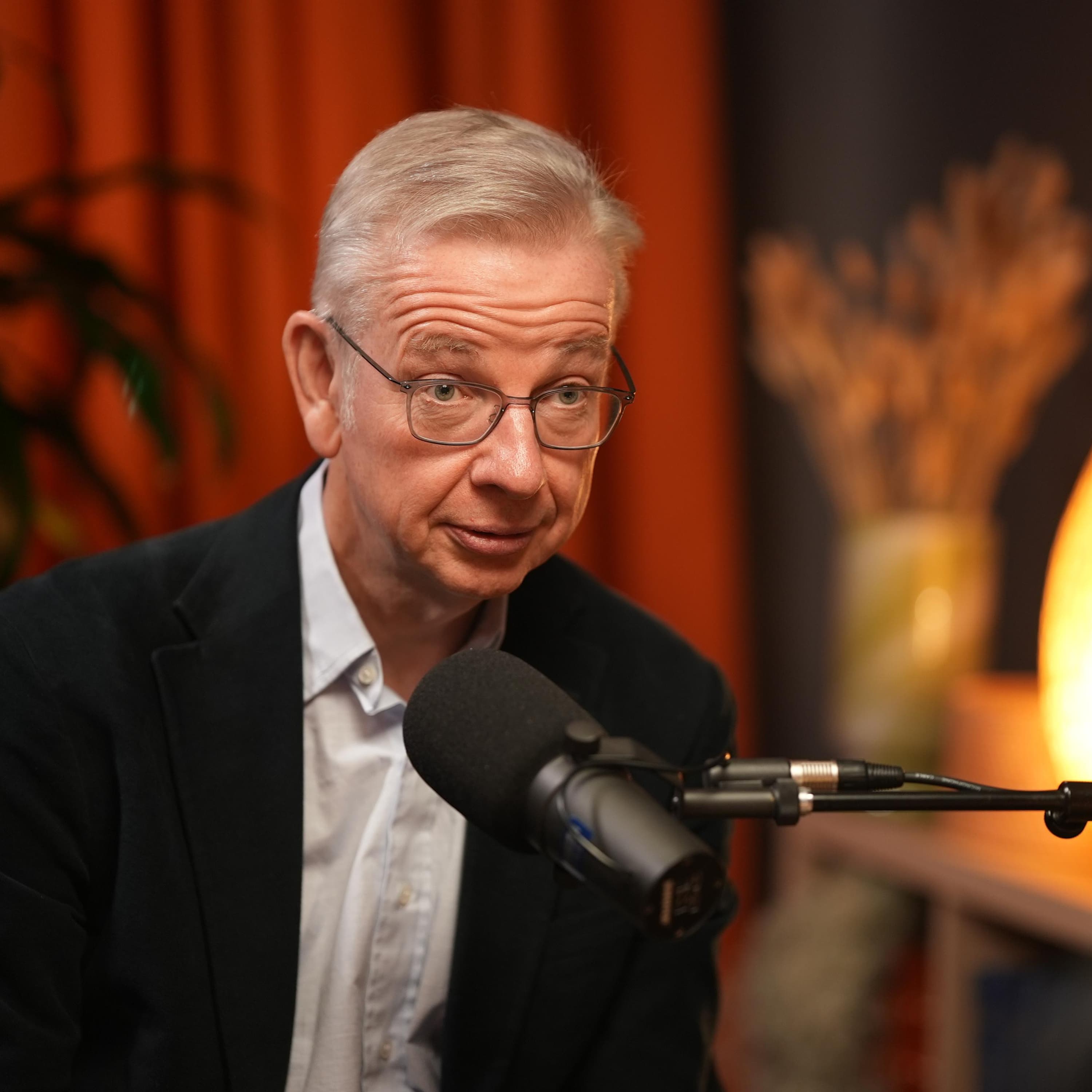
A debate with Michael Gove about how he justifies Conservative politics—especially austerity after 2008, Brexit as “democratic renewal,” and why the right has shifted toward identity/culture-war politics. The host challenges Gove’s claims that austerity and Brexit were necessary or beneficial, and presses him on The Spectator’s coverage of Muslims and “Islamism.”
Michael Gove, long-time British Conservative figure; served in government (including education secretary) and later became editor of The Spectator. Aditya Chakrabortty, Guardian journalist and host of Radical Thinking.
He says he entered politics to understand ideology seriously, and aims to “tackle inequality” using state power (education, justice, “levelling up”). He argues austerity was “inevitably painful” but required to repair weak public finances; he cites debt interest and a “thin tax base” as constraints. On Brexit, he claims the main gain was regulatory autonomy (examples: VAT on independent schools, tariff reductions, steel protections, AI leadership, gene editing/precision breeding). He says the right’s current nativism is partly a mirror of left identity politics and a response to economic uncertainty and weakened shared British identity.
Labour’s VAT on independent schools; tariff reductions on supermarket food commodities; defensive measures for British steel; regulatory autonomy for AI and gene editing; Gove’s “Weimarization of Britain” analogy; criticism of The Spectator article by Rod Liddle about Muslims and “Islamism” vs Islam.
0:00This is The Guardian.
0:58We'll be right back. at ShipStation.com, code audio.
1:07You said Brexit will be a galvanising moment of patriotic renewal. Yes. Tell me honestly, are you feeling galvanised? Around the world, the right are on the march. Let's take back control. So where did the right want to take the rest of us? We did change things, for the better. Through journalism, in government, and now as editor of Tory Bible The Spectator, for over three decades, Michael Gove has been a frontman of British conservatism.
1:37Michael Gove: There are some species of conservatism that have died out and others that need to adapt. In the 2010s, he was a compassionate conservative. But today, in the pages of the magazine he edits, he presents a harder and more extreme ideology. The identity that you are attacking is Muslim. No, what we're attacking is Islamism and political Islam. So where does Michael Gove think the right is going? And where does he think it's got it wrong? Confidence in a shared British identity has taken a bit of a battery. From The Guardian, this is Radical Thinking with me, Adit Chakraborty.
2:21Michael, welcome. Now, there are some members of our audience who will be horrified at the idea that podcasts about political thinking can give airspace to a doyen of tourism. But I'm going to surprise them because I've been doing plenty of research and sources tell me that you have had a dalliance with the far left. Picture the scene. It's 1998. Tony Blair has just secured his landslide. and a bunch of thinkers associated with the publication Marxism Today are having a series of seminars in London's then fashionable Stoke Newington. And you, Michael Gove, are one of the star attendees. Now, none of the assembled lefties are in any illusions that you're a fellow traveller.
3:07I've spoken to a bunch of people and they have memories of you turning up in a suit and tie, carrying a big briefcase. but you give papers you write an essay you also impress them an awful lot with your knowledge of left-wing thinking and traditions so comrade gove tell me where where does this interest in the left
3:32Michael Gove: come from uh well comrade in a spirit of fraternal collaboration i should say that i'm interested in ideas and ideology. When I was very young, a 16-year-old, I stood in the school election as the Labour Party candidate. I was a fully paid up member of the Labour Party at that time. And indeed, even as a callow, spotty 16-year-old, canvassed for the Labour Party in Aberdeen. But more broadly, as I've grown up, developed, worked as a journalist and worked in politics, I always want to know why people think what they think. And if you're either going to argue from, or in some cases learn from those who are not in your political tribe or organisation, then it's better to pay them the respects of taking them seriously rather than opting for the caricatures that others in your tribe may attempt to pin on them.
4:25Would the teenage Michael recognise any continuity of political values with the Baron Gove who sits opposite me now? I think some.
4:38Michael Gove: I realized that I was more right wing than I'd imagined or I grew, evolved or descended deliquest into being a right winger. By the time that I went to university, part of that, funnily enough, was even though I'm an English literature graduate because of literature. Again, Guardian listeners may be horrified, but reading Evelyn Moore, Jane Austen, George Eliot gave me a view of human nature, character and motivation that meant that I became very skeptical of utopian thinking. The 16-year-old, while they might have been horrified at some of the positions that I might have taken later, would have seen some continuity.
5:20Michael Gove: And of course, the arch answer is that in voting for Michael Foot in 1983, I was voting for the potential prime minister most determined to take Britain out of the continent. I just want to continue with this theme for a moment. When you joined government in 2010, you were school secretary. Yes. And at that point, your special advisor, Dominic Cummings, went to a conference, an education conference, where he declared in the green room that he, and by implication you, were not conservatives. You were revolutionaries. Yes. I think that my fate and Dominic's are inextricably tied because he worked with me throughout most of the time that I was education secretary.
6:09Michael Gove: And obviously we worked together on the Leave campaign. And then subsequently when he was working for Boris Johnson and so was I, I think there are differences as well as overlaps. Dominic has never been a member of any political party. and one of the reasons I enjoyed working with him is that there is an originality and candour about him that you don't often get from people in politics. But I do think that one of the reasons why I enjoyed working with him as well as the intellectual honesty, sometimes brutal intellectual honesty that he brought to the role, is that both of us have an impatience about making changes where required.
6:51So kind of revolutionary in this version becomes pushing at the state, getting to change things. You're not interested in the same old managerialism. Yes.
7:00Michael Gove: So I do think that if you are going to be in politics, you have to have an overarching mission, goal or aim. When people use the word narrative, that sometimes sounds as though you're attempting to create a fiction or to manipulate a story. But what it is properly is an understanding of what you're about, what it is that you mean to change. So tell me then, while we're talking about overarching missions, what's Michael Gove's overarching mission? Tackling inequality. Go on. So the most important things that I think I did in government were recognising in the education system, I hope successfully, in the Ministry of Justice very briefly and therefore not successfully.
7:50Michael Gove: And then laterally at the Department of what used to be called leveling up and now housing communities and local government with mixed results, some successes and some failures. And in every single one of those departments, I was convinced that we could use the power of the state to tackle impediments to people leading fuller lives. I used a phrase, a cliché, when I was at education about making people authors of their own life story. And that, I think, is one of the animating factors governing my approach when I was in office. Tackling inequality is often seen as being a left-wing goal, not a right-wing one.
8:33how come you as a conservative how come you've adopted that as your goal your mission I think
8:40Michael Gove: that if I go back and think about uh the wellsprings or the impetus behind being in politics one of them is inevitably a reflection on my own background and knowledge that I was fortunate being adopted to have parents who loved me and even more fortunate that they believed in the transformative power of education. And it's always weighed with me that different circumstances would have meant a very different fate for me. I think one of the things that makes me a conservative is I recognize that human nature is flawed, that things can go wrong, and that if government attempts to do too much, if it attempts to prescribe or to sketch out a utopian future, then it can end up creating a nightmare or at the very least it can create a path of good intentions that leads us astray from the real but inevitably limited good that government can do.
9:41Michael Gove: And I would stress, of course, that I'm sure there are people shouting at Alexa or wherever they're listening now saying that austerity, of which I was a part, hardly promotes equality and that the left's conception of equality is something very different from the rights and that we view equality in very narrow and attenuated terms. But I think it is undoubtedly the case that there is a tradition and there are people on the right who are concerned about addressing the inequalities that inevitably occur in a state of nature. Let's start with austerity. 2008, the banks crash. Yes. This is on Labour's watch.
10:24But the Conservatives, the government, which you were a leading light, they're the next in 2010. And their response to the banking crash is not to refound and start with a new political economy. It's saying, no, Britain is borrowing too much and we must now cut public spending. So it's in the middle of a global downturn and the Conservative response is to crush domestic demand. Businesses are already struggling to export abroad and now they're struggling to sell to Britons. And the idea is this will all lead to us being better economic citizens. We will save more, spend less. We will have more manufacturing.
11:08We will have less banking. All the rest of this stuff.
11:12Michael Gove: hasn't worked out like that has it well i think the first thing to say is i'm not sure that the um the intent in 2010 of the coalition was to have more manufacturing and less banking oh hang on the march of the makers from george osborne i think it was never again in this country should we have the fortunes of the entire economy tied to one small corner yes david cameron yes i think It was explicitly anti-city, pro-industry. I don't think it was anti-city. It was definitely pro-industry and pro-innovation. I think it was also the case that we saw, as a result of the steps that were taken, that at the end of David Cameron and George Osborne's time, Britain was a fast-growing economy.
11:55Michael Gove: Faster than most European competitors. Well, you had help to buy in quantitative easing. You threw a ton of money at the housing market. That's generally how you get the British economy going again, right? You had another housing bubble. There are many reasons why the housing market requires reform. You're absolutely right. But I don't think it's the case that one can look at the economic policies pursued by the coalition and the economic policies pursued by the Conservatives overall and say that this was a uniquely damaging approach. We could bat the statistics back and forth, but I don't really want to do that.
12:33I don't want to say you did austerity, therefore you're a bad guy. No, no, fair enough. I wouldn't say you muffed it. You Tories muffed it. You had the chance after 2008. See, these Labour people, they were in hock to the city. We want to lead you into a new future based around graphene in Manchester or whatever. You talked about all this. You did very little.
12:56Michael Gove: I think there are areas where we saw innovation and the development of new economic vitality outside financial services. But I do think that you make a fair point. And again, I just say two things. The standard conservative view would be that you don't strengthen industry by necessarily attacking the single most successful part of the British economy of financial services. I mean, you could direct financial service to help industry more, which is what you could have done. Yes. But then again, if one were to direct financial services, it's an open argument, then it might be the case that there's less finance in those financial services because those who have that capital take it elsewhere.
13:45I mean, if bankers don't want to lend as much to manufacturing because they think they can make more money out of lending on house prices, I'm not that worried about the bankers, am I?
13:53Michael Gove: Yes, or I'm not worried about the bankers per se, but I am worried about where the capital is and the capital may well find its way into other ventures abroad. I do think that austerity is inevitably painful. If you're reducing public expenditure on the scale that the coalition did, then there will be some examples of rough justice. Okay, rough justice. Some areas where you look back and you think, actually, that was the wrong thing to come. But the other thing is that we're in a perilous position at the moment because our public finances are so weak. And again, I know it sounds like the standard excuse that politicians make, whether they're, you know, if they've been in power at all in the last five or six years, they talk about COVID and they talk about the wars.
14:41Michael Gove: Both of those have had a huge impact on public finances, which mean that they require to be repaired. So you said you talked about rough justice. Yes. And earlier you talked about your passionate commitment to tackling inequality. Yes. A lot of people have suffered under austerity. Right. And people right at the bottom of society have suffered most. Right. The average British worker hasn't had a pay rise for nigh on 20 years. A lot of public services have been slashed to the bone. People who rely upon those public services, often those with less income, have suffered as a result. you can't be pleased by how much austerity has driven up inequality in this country right?
15:22Michael Gove: Well politics is always about trade-offs so it will be the case that unless you make sure that the public finances are healthy then your capacity to do other things is limited so the amount that we pay in debt interest is money that we are spending that we could have spent on education or health or welfare or defense. That's the first thing. The second thing related to that is in the UK, we have one of the most progressive tax systems in the Western world. And also in the UK, we have a heavy reliance, certainly when it comes to income tax, on a small number of relatively wealthy individuals. Both of those things mean that one has to proceed with a degree of prudence because of the scale of the debt and the thinness of the tax base.
16:18Michael Gove: And that means that you need to have the broad fiscal conservatism that I've outlined. But that also means in order to do so that some of the things that in a sunnier world that one would like to spend more money on, one cannot. And that is in the nature of politics. The religion of socialism is the language of priorities i'm really i'm really struck by the contrast in your language when you're talking about inequality and about helping people get forward and then you start reverting to this dry treasury speak about how you have to make sure you don't hit high earners and all the rest of it right let's just speak bluntly right poor people people who you might recognize from the kind of low middle class working class background that you've been sketching out the people that you knew in Aberdeen they suffered as a result of austerity and you talk about how we had to make all these sacrifices well public debt now is way higher than it was in 2010 exactly right and it was going up all the way through before covid before the wars began in Europe and in Iran right it was a failure and it was a failure that hurt the poorest people well the argument has to be in politics.
17:35Michael Gove: What are the alternatives? What is the counterfactual? When I reflect on why I'm a conservative, it's because of the need to deal with certain uncomfortable realities without losing a belief that government can, in those areas for which it's responsible, ameliorate the state of nature. I mean, I really want to hear what people at home think of the benefits of austerity and how it's boosted growth. If they're feeling the benefits of all this growth that you're talking about, they can have their own say in the comments. Of course, absolutely. But the key question is where in a comparable economy have we seen high growth rates in the wake of 2008?
18:24Michael Gove: Where are the alternative models that we might have followed that have proven to be successful? Where are the other economies from which we can learn? Okay, alternative models. That takes us neatly into Brexit. Yes. Okay, because this was meant to be the moment in which you had an alternative model for Britain, right? I must say, obviously, you would have known this was coming. You can't come to The Guardian and not expect to talk about Brexit. I know, because some of the most articulate supporters of Brexit are Guardian writers. Larry Elliott, my colleague. Larry Elliott, Seamus Milne. Both great writers.
19:00Yeah, indeed. Indeed. Again, I don't want to get into you did Brexit, therefore you're a bad man. But let's just start with a promise that you made. You said not long before the referendum, you said Brexit will be a galvanizing, liberating, empowering moment of patriotic renewal. Yes. So 10 years on, Michael. Tell me. Tell me honestly. Are you feeling galvanized, liberated, empowered? Yes. All of them? Yes. All at the same time? Yes. You lucky, lucky man.
19:30Michael Gove: Tell me how. Well, the most important thing about Brexit is that it is a moment of democratic renewal. At last we have in our hands the opportunity to shape our economic future. And economists have a phrase that I found useful, revealed preference. Yep. So look at people's actions, not necessarily their words. In the last two years of Labour government, we've seen enthusiastic exploitation of Brexit powers. So we've had the imposition of VAT on independent schools. That would have been impossible inside the European Union. Rachel Reeve's last fiscal event saw the reduction in tariffs on a variety of foodstuffs, the commodities in most people's daily or weekly supermarket basket.
20:21Michael Gove: that tariff reduction would have been impossible inside the European Union. It has been the case that measures, defensive measures have been taken to protect the British steel industry. Those defensive measures would not have been possible within the European Union. And it's also been the case that in two areas, one nascent and one more and more important, the nascent one, which is precision breeding and gene editing, and the more important one, which has been AI, Britain has used its regulatory autonomy in order to take a position of a relative leadership. And in both cases, Labour ministers have been clear that in whatever reset that we have with the European Union, they would like to maintain that regulatory autonomy.
21:11Okay, but let's go up to the big picture of what you were trying to achieve in Brexit and what people thought they might get from Brexit, right? Since you mentioned economics, I can't help but Just note in passing that nearly every economist of note agrees that since Brexit, the British economy has shrunk. And some say it shrunk by as much as 8%. But we'll leave that to one side, right? We'll leave that to one side. The argument I want to make is that Brexit offered you and your Conservative colleagues another chance to have a new economic model. Yes. And the voters were clearly up for it. You made this offer that finally Britain could move away from being this low wage, low tax, low regulation economy.
21:53And then you did very little of that. Before Brexit, our relationship to Europe was that we were the cheaper, poorer, slightly more loose neighbour. We were like the pound land of Europe. Right. You could come in and get everything done quickly and cheaply. afterwards we remained poundland except we no longer had the proximity to europe which people which international businesses want from us so my accusation moving away from numbers or particular details and tweaks is simply you and your colleagues you had no plan to change this and you hadn't the chops to change it so first of all i'd reject the
22:34Michael Gove: characterization of Britain as poundland, so it's journalistic genius to use that brand. Because, yes, Britain had and has a more flexible labor market. That's why, when we were in the European Union, we were importing labor from those areas that were going through periods of joblessness. It's why, still to this day, there are something like 4 million EU citizens living and working in the UK economy, more than we imagined in 2016, and a significant number, the overwhelming majority have remained. You make another fair point, but one that I would also quibble with, which is, was enough done to take advantage of the freedoms that Brexit potentially generated?
23:25Michael Gove: No. Now, some of that was due to personal failure. Some of that was due to events and the governing bandwidth being occupied by COVID and other factors. But some of it also, I think, was a misunderstanding on the parts of some of my colleagues about what Brexit was about. My argument was that the most important thing about Brexit was not free trade agreements. It was domestic regulation. and that one of the things that offered the greatest prize was regulatory autonomy and that that had not been grasped with sufficient seriousness or internalized by people. And again, without going into personalities yet anyway, many of those who became the loudest cheerleaders for Brexit were people who hadn't actually been its advocates or voted for it and to my mind were misunderstanding what it was about.
24:22Namely guilty men.
24:24Michael Gove: Well, principally Liz Truss. Go on. I think that Liz was successful as International Trade Secretary. She associated those free trade agreements and accumulating them, and Boris indulged her, as evidence of Brexit success. and that meant that there was a tendency to avoid the hard but necessary work of real regulatory change in everything from how we look at environmental regulation through to how we regulate financial services through to how we look at the changing world of technology. And in my own defense, I'd argue that in those areas for which I was responsible, even though I couldn't do everything that I might have wanted, we did change things for the better.
25:23Michael Gove: But I think the problem in other parts of the Conservative Party was that they were leaning into a particular model of what Brexit should look like, and indeed what globalization should look like uh that was a small and distorting part of the brexit story you're a man of ideas and we've just talked about two big political ideas that came from the conservatives austerity and brexit yeah the thing is to me they don't sound like ideas at all they sound like alibis and i think the michael gove who wrote for marxism today and certainly the Michael Gove I used to read in Times, would recognise them as such.
26:03And I mean alibis in two ways, right? One, the economy doesn't really turn around after 2010. It just keeps on doing the same old thing. And for most people, they don't see a turnaround. So you give them Brexit. Okay, so there's always another story we can tell the electorate. The things are going to get better. This one doesn't work, but we'll forget about that and do the next thing. That's one alibi, right? But the other alibis, you have and your colleagues presided over a great shift away from labour, from people who work and wage labour towards people who own. Yes, quite. And the figures on this are pretty emphatic, right?
26:46So it's something like since the beginning of the millennium, just a couple of years after you were doing these meetings in the flesh pots of Stoke Newton, up until now, 2000, 2025, wages gone up 100%. But property prices gone up nearly 300 % and financial assets 400%. Yeah. Right. So anyone who came into this economy owning stuff, houses, art, fine wine, whatever, they've made out like bandits. Yes. And the poor sod who relies upon their hourly wage. Well, they're really lost out. Right. How can you, as someone who feels so deeply about inequality, wants to help people get on? How do you feel about that?
27:26Michael Gove: Well, I blame Mark Carney. That's a flippant point, but it speaks to a broader truth, which is that what you describe is deeply regrettable. It is significantly, not wholly, a consequence of quantitative easing and the approach that was taken towards monetary policy, which meant exactly as you say, that those with assets grew richer, even as the return to labor either stagnated or diminished. I'd say, and you might consider this to be an alibi, but I think it's an important one for anyone who's serious about political economy. This was a phenomenon across the West. I'm not claiming that I was right about these things, but nor am I saying that I write about everything about these things, but nor am I saying that I was indifferent or blinkered.
28:22And the broader point, if I have a theme, is that in politics overall, there will always be errors.
28:35Michael Gove: Do you learn from them? And I think that, of course, we should learn from them. But when we're positing an alternative world in which everything was better in the UK, we have to ask, how might that have been achievable? Since you made a thing about Mark Carney, I would just note. Yes. Mark Carney was the central banker that George Osborne chased after. I agree. Personally recruited. Totally. Quantitative easing was done with the gleeful celebration of Conservative, your colleagues. Yeah, totally. George Osborne, the Chancellor, talked about having a tight fiscal policy and a loose monetary policy.
29:07Exactly. This was all done on the orders of Conservative government, right? It must offend the egalitarian in you, but it must also offend the capitalist in you. Because what we've ended up with is a really sick form of capitalism. Britain now looks like, yet again, like the sick man of Europe. I don't think that's quite true. I think that the sickness... When I started writing about economics, which is around the time you were in Stoke Newton, the Chancellor Gordon Brown would talk about reaching possibly 3 % growth. Now, the Chancellor John Healy would be glad if he got 1 % growth. But that's true broadly across the West.
29:44Never to the same depths as it is in Britain. Well, Germany, and there are specific factors in Germany. Germany has been kiboshed by Ukraine.
29:52Michael Gove: Yeah. And other factors. So, you know, the German economic model, the country at the heart of Europe, has been kiboshed, as you say, by a reliance on energy from one totalitarian country and selling manufacturing to another totalitarian country. But the malaise that you describe has been one that has affected almost all Western nations overall. That doesn't get the conservative government off the hook for the mistakes that it may have made. But I would argue that some of the decisions that were made were either, if not inevitable, certainly in the limited and constrained circumstances in which we operated, the right ones.
30:40But also, I'd argue that it's true of any administration that there will be different strands and elements in it.
30:50Michael Gove: So there are some aspects, many aspects of what the Conservatives did in government about which I remain enthusiastic and defiantly defensive and or supportive. others that I may have disagreed with at the time but collective responsibility meant that I kept my trap shut in an effort at honest accounting I think there are those three areas things I'd still defend energetically things I disagreed with at the time and things where I now recognize that either I was wrong or I believe I was wrong okay we've talked about principles let's let's move the principles into the present day we have a new prime minister in charge of britain andy burnham and his overarching mission as he would define it is very much to move britain to the left to to undo 40 years of neoliberalism as he says no one elected him to become prime minister but he is popular hugely popular at the moment partly because of a pitch he makes.
31:51He says, I want to turn back the clock on deindustrialization. I want to undo privatization, deregulation, austerity, Brexit. Basically, he wants to undo everything you and your lot did. Now, the reason why that argument is so popular at the moment is because there's an all-pervasive sense, whether you're on the right or on the left, whether you read the Guardian or the Daily Mail that nothing in this country works as it should. A load of things are broken, whether it's privatised water companies dumping sewage in your water or the weight you have for your underfunded NHS appointment, right? To what extent do you understand that anger is being directed at you and your fellow Conservatives?
32:35Michael Gove: I completely understand it. We saw it in 2024. The seat that I used to represent is now represented by a Liberal Democrat with a handsome 5 ,500 majority, the Conservative Party was routed at the polls and still languishes at around or just above 20 % in the polls. So I can't be unaware of the intensity of feeling and the fact that that feeling found an outlet in voting for almost anyone who would eject the conservatives. Linked to that, I recognise that there is both on the left and on the right, a sense of nostalgia, a sense that a wrong turn had been taken, whether that was post 2008 or post 2010 with austerity.
33:21I'm really struck by how dispassionately you talk about this turn in politics, because as you say, it's not only a turn which has cost you your job as an MP, force you out of frontline politics, it's also reflective of a deeper societal shift against the tenets that you have dedicated your life to fighting for. How does that make you feel? These are your principles, which are just on a bonfire.
33:48Michael Gove: Well, I think, firstly, there is no point allowing anger to cloud judgment, both as a politician and as a journalist, that you have to be as intellectually honest and open as you can be in assessing the power of a critique or ideology. The second thing is I don't believe that what we saw was a triumphant neoliberal reign. There are many on the right who would argue that the 2010 to 2014 government failed because it was insufficiently austere, neoliberal and right wing. We can get into that if you wish, why that critique is not persuasive to me, but why it's so popular. But also inherent in Andy Burnham's critique is not just a scathing criticism of the 14 conservative led years.
34:44Michael Gove: It's also a repudiation of Tony Blair as well. And it's a repudiation both of the accommodation that Tony Blair clearly felt that he needed to make with international capital. But Michael, you're an ideologue. You said as much at the beginning of this conversation, here is your ideology being torched and ridiculed by and to popular acclaim, right? So surely you must have some feeling about that. Well, the first thing is that I recognise that my ideology is in Andy Burnham's firing line or in his crosshairs. But I also think that he misunderstands both what we achieved and also certainly what I was trying to achieve.
35:33Michael Gove: And I would argue that what we were doing in education was not the application of neoliberal dogma. But I do recognize the force of the Burnham critique. I also recognize that some of the things that he now proclaims were neglected, ignored or derided were actually things that we were wrestling with. I'd argue that the efforts at leveling up that came after the Brexit referendum and that were associated with Boris Johnson were anticipations or recognitions of this. But it's undeniably the case that we're living through across the Western world what one might call a populist moment. And it's up for grabs whether or not that populism is either tamed or is used as fuel either by the left or by the right.
36:43Michael Gove: Hey, I'm running out to drop off a stack of letters and packages. Need anything shipped while I'm gone? Save the gas. Stamps.com lets you print postage and schedule pickups right from your desk. Sync your contacts into the address book, get detailed accounting insights, and get notified the moment your certified mail is delivered. All from my desk? All from your desk. Join the 4 million businesses using Stamps.com right now with code podcast and get your free welcome gift. Stamps.com code podcast. Taxes and fees apply. You save, you invest, you keep an eye on spending. So why do your finances still feel so complicated?
37:19Quicken helps you put the whole picture together and make sense of what to do next. Connect accounts from more than 14 ,000 financial institutions and see how all the different pieces of your financial life fit together. With Quicken, you can make sense of your options and decide what to do next. Quicken, know what to do next. See how at Quicken.com.
37:48okay we've done enough political accounting let's return to you kind of guiding us through this moment because you've been at the forefront of conservatism for so long and one of the things one of the pleasures about talking to you is it it reminds me of when conservatives under Thatcher and after really promote themselves as the party of the future. They had ideas for what to do with the country. And it was, I mean, you stated some of them in your essay for Marxism today. It was about low taxes, even flat taxes. Shrinking the state, liberating people. Now, I look across at the right, not just in this country, but across Europe and America.
38:31And it seems much more fractured than that. Yes. you do still have some of the liberationists who want to i know now they want to take us up to mars expose us all to data centers right there's still a bit of that kind of the growth but there's an awful lot more nativism there's an awful lot of arguing about who gets to be english nowadays rishi sunak apparently doesn't qualify suella braverman says she'd rather not and there's also a lot of argument who gets to stay in britain i have to confess as somebody who's watching and right for a long time. I don't get it. So explain to me what's going on in the right at this moment.
39:12Michael Gove: I think that it is not a perfect mirror image, but it is a mirror image of what's been happening on the left, the increasing importance of identity politics, the culture wars. If one looks at both left and right across most Western countries, it is the case that the animating an energetic force in politics on either side has increasingly been about questions of identity. To which tribe does one belong? You see in America, and you also see in the online debate that we have here, and you referenced the point about whether or not Rishi Sunak is English, of course he is. But you see in that debate that privileging, and you also see it going into the broader political argument.
40:04Michael Gove: So in the debate, I mentioned social housing, about social housing, you have people on the right who maybe five or 10 years ago would have been discussing whether shared ownership is the way forward, how to change planning regulations, now talking about rationing that scarce resource on the basis of citizenship, lineage, ethnicity, and so on. I regret that. I think that it's partly because at a period when, or in periods, when you have economic uncertainty, then people increasingly think about economics as a zero-sum game. And it's about protecting me and mine, however defined, rather than thinking about abundance.
40:52Michael Gove: The second thing I also think is that there have been a variety of factors which have meant that confidence in a shared British identity has taken a bit of a battering. And again, to be fair to Andy Burnham, I suspect that he would agree that confidence in that shared British identity has taken a bit of a battering. And he would say it was people like me who were responsible because he would say that it was the hollowing out of local democratic institutions, de-industrialization, a deal-take-the-hindmost approach promoted by Thatcherite individualists that had meant that any sense of solidarity and shared identity had been whittled away by agreed heads and cynics.
41:35Michael Gove: Now, that would not be my analysis and critique, but I don't think that you need to be a nostalgist either on left or right to acknowledge that both of those factors, an absence of growth and a lack of confidence in Britishness, have led to that, if not polarisation, certainly increased focus on identity. And other countries, which have been going through similar but not identical processes, have seen the same thing. Let me bring this back to you again for a second. When Thatcher was in charge of Conservatives and in those years afterwards, There was a sense that the British were the vanguard of conservatism across the world.
42:16It was Reagan and Thatcher who were set in tone for British conservatism. Who are the British right? Who should they learn from now?
42:25Michael Gove: I think that it's important to learn from those thinkers and those jurisdictions that are responsible for success. and are shaping the future in a successful way. But I do think that there is a broader challenge. You are absolutely right to put your finger on, which is that for much of the post-war period, there was basically a major party of the right. It could be a free market Republican Party or a pro-solidarity Christian Democrat Party, but it was one block. Now, in almost every jurisdiction, The right is split, often institutionally with two different parties or even in America between MAGA and what one thinks of still as the establishment Republican Party.
43:19Michael Gove: You've also got similar splits on the left, both institutionally, Greens, De Linca, Mélenchon and so on. One of the interesting things about Burnham is that, again, as we speak, it seems that he may be capable of reconciling some of those differences under one umbrella. And that is intriguing and also a challenge to the right. But it means that we're operating in a different environment, that we've moved, you know, from a Jurassic to a Cambrian or is it from Cambrian to Jurassic Age? You know, there really has been political climate change. And it may be that there are some species of conservatism that have died out and others that need to adapt.
44:06Well, I want to talk to you because as someone who's actually helping to shape the next generation of the right, because after leaving politics, front-line politics, you're still in politics because you edit The Spectator, which is the House Journal of the British Rights. and I was listening to you earlier talking about culture wars and identity and his focus on who gets to be what and I'm thinking about the spectator that I read week in week out and it really does strike me that your magazine the magazine you edit goes in for an awful lot of anti-muslim prejudice I want to quote you just as a sample one article from last summer 2025 the year after the big race riots it's by the late Rod Liddle who you called and you paid tribute to as a genius of journalism absolutely and in it he says we might assume that the proportion of Muslims who want us dead has remained roughly the same over the past 20 years so there are now more than double the number of semi-literate virgin obsessed potential murderers among our midst what's a nice man like you doing publishing words like that the key thing about the spectator
45:24Michael Gove: is that we publish a huge range of opinion and what we offer our readers is the unfiltered views of our writers so we publish uh people on the left uh like nick kern and we've also published pieces which have been praising Keir Starmer or calling for Britain to re-enter the European Union. We've also published Laurie Penny, who was a New Statesman and Guardian contributor in the past. The whole point about The Spectator is that it is, in that sense, a speakeasy. What we say to our readers is you will encounter views in The Spectator that you may profoundly disagree with. But what you know is that what we don't attempt to do, unless what they're saying is going to break the law, is to silence what our writers are arguing for.
46:26Michael Gove: And Rod, whom I miss terribly, was someone who sometimes with Swififian exaggeration, and sometimes with heartfelt passion articulated a particular worldview. And he was adored by our readers. Semi-literate, virgin-obsessed potential murderers. Do you see a link between words like that, depictions of one minority, and the pictures that we see of men in balaclava and black uniforms shutting down roads in Dover and Portsmouth? No, because I think that it's important to draw a distinction between what Rod was drawing attention to, which is the particular ideology of Islamism, and also the activities of individuals who are engaging in street protests, street protests that the magazine itself warned about.
47:29Michael Gove: But in a piece that I wrote myself, a cover piece for the magazine, I talked – it's become a bit of a cliche and I certainly wasn't the first to do so – about the Weimarization of Britain. And in it, I explicitly said that both the people responsible for the Gaza marches through London and the people responsible for Tommy Robinson's Unite the Kingdom rally were in danger of replicating the red and brown black marches of the 1930s in Germany. I mean, I made the point, of course, that one has to be very, very careful about invoking that uniquely evil period in our history. But it's certainly an analogy that a number of us have deployed because what we're seeing is street activity rather than debate being the focus of increased political action.
48:31But Michael, you've spent decades working in the media and in politics. You know how this stuff works. You know that a magazine cover story gives license to a thug on the street. You will know as well as I do that when the hate crime monitoring group Tell Mama say that there's a direct link between the bile spouted in Westminster against Muslims, that that then leads to women in hijabs and headscarves being abused, attacked on their way home while pushing their kids.
49:00Michael Gove: No one should be abused with their children. But I think a broader question is that...
49:30Michael Gove: of their dignity as individuals. The second thing is that political Islam, Islamism, is one of the most misunderstood and under-analyzed forces in our society. And it's vital that we do so. And one of the concerns that I have is that unless there is clear, analytical, sometimes robust, and sometimes eye-catching reporting and analysis of that, then the only people talking about it will be people who are not interested in drawing distinctions between Islam as an elevating faith and Islamism as an ideology, but people who want to lump everyone with a brown skin in together. And I think that if one looks at the output within our magazine and one also looks at the things that I have said consistently, then there is an effort to draw important distinctions, which if blurred in one direction, lead to unhappy consequences, but also if ignored altogether, lead to unhappy consequences.
50:48I'm really aware that when I read articles about Muslims in your magazine, it tends to treat them as an alien group who just won't integrate. that is the accusation you constantly make against them
51:00Michael Gove: I don't believe that's the case someone can look at the material overall what we do is scrutinise in a way the fissile effect of identity politics overall and in particular the way in which political Islam poses a danger to us You do identity politics, except the identity that you're attacking is Muslim. No, what we're attacking is, or more to the point, critiquing, is Islamism and political Islam. And it's an important distinction. And again, as we were discussing right at the beginning of the broadcast, you need to pay people the compliment of looking seriously at their worldview. And also one needs to pay British Muslims the compliment of not assuming that millions of our fellow citizens are effectively represented by hardliners or by ideologues who have a position that has been taken as influential by successive governments when it's not truly representative.
52:16again I'd really be interested to hear what our viewers have got to say about the spectator and its coverage of muslims do you agree with michael or not let us know in the comments I have to confess michael you've been in my head for quite a number of weeks while preparing for this interview I can only apologize it's been provoking and I have an appointment with a therapist lined up for afterwards but I formed a theory of you and I want to run it by your theory of michael go okay so it strikes me that you are a genuine believer in what you say you're not just somebody comes along and says any old stuff for the sake of it and that you really believe in the promises of thatcherism you really believed in shrinking the state making the economy more dynamic pushing people to get on and in your case and people like you people who are bright and able to work hard well in your case you did get on very well and you were always there behind people who weren't as bright as you didn't have the same interest in ideas whatever you say about Boris he's not got any interest in these ideas at all David Cameron you know he has the kind of polite arrogance that sometimes people mistake for charm these people who went to eat and they're in charge not you you're the runner-up factorism in the case of your biography gets you so far but doesn't get you all the way is that fair well i think one of the things is i i actually feel
53:49Michael Gove: relatively fortunate in that for the 14 years that we had conservative prime ministers for 13 of them I was allowed to be in the cabinet and in areas that I cared about, I was able to work with fantastic people. And the Tory truth is that any attempt to explain the world with a thesis, however elegant, doesn't do justice to the complexity of the world, the chances, the contingencies, the nature of the political journey. Another cliche, out of the crooked timber of humanity, no straight thing is ever made. And so if you are arguing that Thatcherism is certainly an incomplete explanation or an ideology with flaws and lacunae, that's certainly true.
54:50Michael Gove: But that's true of all ideologies. But in your case, Michael, I'm thinking about what your former wife, Sarah Vine, said about never really being part of Notting Hill set because you couldn't quite afford a postcode. I'm thinking, too, of the episode recounted by David Cameron in his own autobiography when he talks about phoning you up and barking at you as though you're essentially a servant. Why aren't you going along with us on Brexit? I'm thinking about the way in which Boris Johnson talks about you stabbing the back and deals with such fury with you that he doesn't talk about you anymore in his own memoirs.
55:22they wanted you to serve a purpose for them. They weren't interested in giving you the room to take charge, even though you were far more able than they were. How does that make you feel?
55:33Michael Gove: Everyone has an ego. Everyone has a degree of pride in some aspect of their life or career. I look back and I think I was fortunate to be in government, to do things that I believed in and to learn from it. So I think there's an Irish phrase, which is don't mix tears with spilt milk. And I agree with that. Okay, final question. This is a podcast about radical thinking. Yeah. So we can do something radical and I want to hear what you think about it with you. Imagine that tomorrow morning you wake up and you're a billionaire for the day, for the day only. what do you do with the money and the power?
56:22Michael Gove: For a day I would talk to my fellow billionaires about the vital importance of better regulating artificial intelligence and the dangers that it poses and then I'd give the remainder of my money to the multi-academy trusts that are making the biggest difference to children in this country. Michael Gove, thank you so much. Thank you.
56:48Would you really? Yeah.
56:55For a career politician, Michael Gove actually isn't much of a careerist. He's a gambler, really. He likes to take big bets on big issues like Brexit. So it's worth seeing what he sees ahead. And what he foresees is a new, nasty age of politics. Most notably on the right, what he sees coming down the track is a harder-edged nativism. Now, he seemed uncomfortable talking about that with me, even when I put it to him that the magazine he edits, The Spectator, is at the forefront of these culture wars. But he clearly accepts that this new nativist right is a response to the failures of his own generation.
57:35that the achievements, as he once thought of them, of him and David Cameron and even Margaret Thatcher are now up for critique and that Andy Burnham's on to something when he attacks them. What really surprised me was a comparison to Weimar Germany. It's quite unusual for a leading politician to say that he sees modern 2026 Britain as being like the darkest age of Europe, especially when he then goes on to admit that he had a part in bringing it to this pass. Now, that's all pretty gloomy, but if you're looking for a bit of hope out of all of that conversation, perhaps it's this. There, at least, is a bit of self-awareness from a member of the so-called political class.
58:18We could all do a bit more of that. And before you go, can I recommend you check out NASA, our new award-winning documentary? From two of the Oscar-winning directors of No Other Land, NASA reveals the secret systems used by Israel's military in the mass killing of Palestinian civilians in Gaza. Produced by The Guardian, it's a documentary that the Israeli government doesn't want you to see and it's on now in cinemas around the world. Go see it. This episode was produced by Frankie Tobey and Luke Smith. The executive producers were Maz Eb-Tahaj, Kirsty Major and James Tindell. Thanks for listening.
58:57We'll see you next week.
59:03This is The Guardian.
59:30Everything your operation needs, all in one place. Right now, qualified shippers get a real dedicated person to get you set up and switched over for free. So when peak season hits, you're ready to go. Switch today at ShipStation.com, code audio.
Scan the code with your iPhone camera
Listen in the app.