 Today in Focus
3 Nov 2026 · 43m

 Add vo to ChatGPT or Claude to ask about everything you hear
vo listened to this episode to put together the overview and transcript, so there may be the odd mistake.
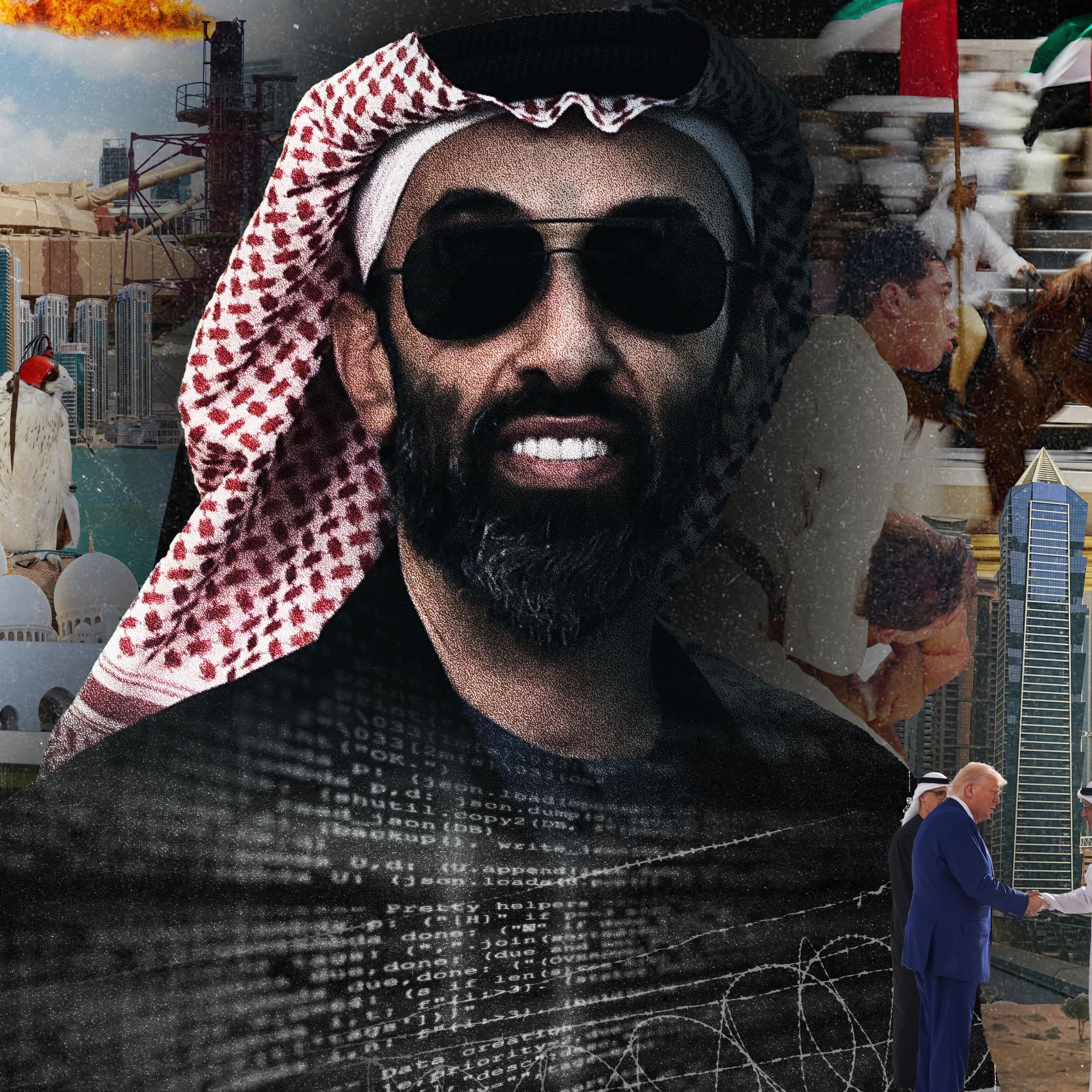
The Guardian’s Today in Focus investigates Sheikh Tahnoun bin Zayed (UAE), portraying him as a largely hidden but highly influential financier, national security figure, and architect of the UAE’s cyber-espionage and AI ambitions.
Jack Schenker is a Guardian journalist who has reported extensively on the Middle East and previously worked for the paper in Cairo. Annie Kelly hosts.
Tahnoun (born 1968, son of UAE founder Sheikh Zayed) controls about $1.5 trillion in international markets via Royal Group (Bloomberg valued at ~$300bn in 2022). After 9/11, the UAE built internal cyber intelligence, including Project Raven (staffed largely by US contractors). By the mid-2010s, Tahnoun became deputy national security advisor (2014) and national security advisor (2016), overseeing scaled surveillance and alleged torture of critics. The episode links Pegasus spyware access to UAE-Israel cooperation after the Abraham Accords and claims G42 (Group 42) is state-embedded AI infrastructure.
Matt Hedges’ 2018 detention and alleged torture; targeting of activists (e.g., Ahmad Mansour, Lujain Al-Hatul) via Pegasus; Project Raven later moved under Dark Matter and was shut down; G42’s Totok app alleged as spyware; Iran’s 2024 attacks on UAE AI data centers and a reported Abu Dhabi deal with Iran’s Revolutionary Guards.
0:00Jack Shenker: This is The Guardian.
0:07Jack Shenker: Today, the most powerful man you've never heard of.
0:30Gusto is online payroll and benefits software built for small businesses. It's all-in-one, remote-friendly, and incredibly easy to use. So you can pay, hire, onboard, and support your team from anywhere. From automatic payroll tax filing to simple direct deposits and benefits options for nearly every budget, Gusto helps simplify the process. Plus, enjoy unlimited payroll runs for one monthly price with no hidden fees or surprises. And with automated tools for onboarding and offer letters, you can focus on what matters most. Try Gusto today at gusto.com slash tech and get three months free when you run your first payroll.
1:05That's three months of free payroll at gusto.com slash tech. One more time, gusto.com slash tech.
1:15Jack Shenker: Before we start, just a warning that this episode contains references to suicidal thoughts and torture.
1:26Jack Shenker: When we think about the world's most powerful people, a few names would inevitably spring to mind. We have more munitions than we could ever possibly even think of. Trump. Slava narodu, putin. Putin. Maybe some of the tech bros, Elon Musk or Sam Altman. I think AI will probably lead to the end of the world. But what about the people we don't see? The ones who prefer to stay in the shadows? Who pull the strings and shape all of our lives without any of us really knowing they exist? To journalist Jack Schenker, it's this kind of power which most needs to be investigated. And over the past few years, his reporting has led him back time and time again to one man.
2:16This is a guy who's one of the richest financiers on the planet. He controls$1.5 trillion on the international markets. He is his country's spymaster. He is one of the most influential diplomats in the entire Middle East. He also runs the security services in one of the most politically authoritarian countries on Earth. And yet almost nobody outside of the UAE knows his name.
2:48I can honestly say that I've never focused on a subject matter that is wrapped up in so many layers of secrecy, mystery and misdirection as Sheikh Tahnoun.
3:06Jack Shenker: Jack quickly found out that trying to dig into Sheikh Tahnoun and his vast web of wealth and influence was complicated. What's most striking is the disconnect between his power, which is vast, and his public profile, which is relatively non-existent. He projects this quiet, enigmatic image. It's almost cartoonish, the degree to which this guy wants to remain out of the public gaze. He basically is a behind-the-scenes individual. So many times during the reporting for this story, people would suddenly clam up when Tahnoun's name was mentioned. Should I be worried about Sheikh Tahnoun hacking into my baby monitor?
3:49And I think he quite enjoys that dichotomy, the sense of nobody quite knows who he is or where he is, but everybody can sense his power and influence.
4:04Jack Shenker: But all of that power and influence What does he want to do with it? The way I think about it It's kind of as if the villains in James Bond movies Have stepped out of the screen and now rule the world That's the world in which we now live And it's not a world that frankly I want to leave to my children From The Guardian, I'm Annie Kelly. Today in Focus, the shadowy world of Sheikh Tachnun.
4:38Ready?
4:39Jack Shenker: Yeah. Jack, Shenko, welcome to Today in Focus. Thank you. I think this is your first time on Today in Focus, but you're definitely no stranger to The Guardian. You used to be our man in Cairo. So let's kind of dig in into what you did learn about Sheikh Tahnoun and in your reporting. Take us right back to the beginning. Who is he? Where was he born? What's his kind of origin story? So Sheikh Tahnoun is born in 1968. The land is most arid, unattractive and sparsely populated, providing a bare existence for tribes of nomadic Bedouin Arabs. In what were then known as the Truchel States, which were a British protectorate in the Gulf.
5:21Britain offered to protect the states from outside... And that's three years before independence from Britain was achieved. He was the son of Sheikh Zayed, who is the founding father of the UAE. He's an Arab sheikh who was born in an old Arabia and will die in a new one. Sheikh Zayed was, I mean was is the wrong word, he still is very much a beloved leader and a father figure in the United Arab Emirates. So one of the people I spoke to for my reporting is Meera Al-Hussein, who's an Emirati sociologist based at the University of Edinburgh. Oil has ended the centuries of Arabian isolation. Now, although Gulf states, including the UAE, were emerging as economic powerhouses due to their oil wealth, he recognised early on that in order to be seen as a serious regional player, he needed not only wealth, but also military strength and strategic leverage.
6:16Now, what distinguishes his approach was this realisation that the UAE's vast economic resources could be harnessed to build exactly that kind of power, a strong military that is sustained by an even stronger security and intelligence apparatus. Sheikh Zayed married seven times and he's believed to have fathered at least 30 children. But it was the children of his third and favourite wife, Fatima, who became the sort of favoured princelings. She managed to set up her sons basically in positions of power, ensuring that they are well positioned to inherit influence and their father's power and wealth long after he's passed.
7:05There are six brothers. Tahnoun is one of them. They had the time and money and resources to pursue their own independent passions. um tahnoon for example becomes completely obsessed with uh things like chess things like cycling and you know when tahnoon becomes obsessed with something it's different from you and i uh you
7:29Jack Shenker: know he really goes for it he really goes for it and he becomes sort of the best in the world i mean in chess he he ends up financing uh the development of a supercomputer which at the time was the most powerful chess engine in the world right only one person could use it at a time and for hours at a stretch, day and night, that person was Tathnoon, using it to help him beat grandmasters from all over the planet. So, you know, that's how Tathnoon likes to carry out his hobbies. Right, you're getting quite kind of main character energy here. Very much so. Well, on that note, him and all of his brothers were obsessed with a computer game that many listeners might be familiar with called Age of Empires, which is a historical simulation.
8:13You build up resources and you overpower opponents in an attempt to achieve world domination. And he actually hired one of the game's developers over in America to come and coach him on winning tactics. So on one level, you have the pampered princeling. But Tachnun really was genuinely recognised by the Emirati state at that time as a talented and smart human being.
8:40Jack Shenker: So tell me about what Tachnun's role became as the UAE developed and as he grew up into a young man. So in the mid 90s, Tachnun comes back from studying at university in America and he quickly becomes his father's money man. Initially, he's put in charge of his father's own array of palaces and farms and overseas properties. But quite quickly, he's promoted into running the whole of his family's financial affairs. He founds a firm called the Royal Group.
9:20Jack Shenker: Royal Group was set up by Sheikh Taknoon in the 1990s. And it then grows into this vast network of companies and investments that make up the royal family's private business interests. Everything from Rihanna's lingerie line to SpaceX rockets blasting into orbit, the Ivy restaurants in the UK, as well as, by the way, lots of healthcare assets. In 2022, Bloomberg values World Group's asset at$300 billion. I think you actually saw this firsthand, didn't you? I think you went to a wind farm in the UK, which was actually owned by the family. That's right. I visited a wind farm in the Lake District.
10:09And I spent some time with a choir, a community choir there, who were funded from grants made by the wind farm company. You know, quite often big companies or big infrastructure assets have a local development fund or a community fund and they make grants to local organisations. and it was such a head-spinning experience sitting in this tiny little village hall with this choir of largely elder local ladies who were singing beautifully and then sharing homemade cakes afterwards and I said to them in the break in the tea room so do you know where that money that your choir received ultimately comes from?
10:50Jack Shenker: I have no idea. And of course they had no idea And I said, well, it's a man called Sheikh Tahnoun, who is the brother of the Emirati president. And he controls one and a half trillion dollars on the international markets. This guy owns one of the biggest super yachts in the world. Which point the choir leader said, I know he's worth more money. Can we get a bigger grant next year? Well, he could give us a few bob more then, couldn't he? And it was just a really interesting insight into just how far Tachnun's influence, in a very subtle and often very invisible way, spreads around the globe. So back in the late 90s, early 2000s, Tachnun was running his dad's business, Empire, just as the UAE is going through this huge boom period.
11:42Jack Shenker: What happens next? So we understand that a plane has crashed into the World Trade Center. When 9-11 happened, when the news filtered through that these planes had struck the towers. Another explosion, another plane. Two of the 9-11 hijackers turned out to be Emiratis. The Justice Department releasing more information about the alleged hijackers and the terrorists. Marwan al-Shahid from the United Arab Emirates. And that seemed to kind of realise the darkest fears of the Al Nahyan family and Tahnoun and his brothers. You know, this sense that there were enemies kind of lurking within. And so the country became obsessed with ramping up its internal security.
12:25And because it's not a country that could command a large army, and it's a nation very reliant on the work of foreigners, it decided that it would make cyber espionage. It's USP. And so by the mid-2010s, this huge security intelligence apparatus is already well established in the UAE.
12:48Jack Shenker: And this was internal extent? Was it just on Emiratis at this point? Well, that's a very good question. I mean, there was a major secretive spying unit called Project Raven, which was technically an Emirati initiative. This was set up in the late 2000s, but it was actually staffed largely by Washington contractors, ex-employees at the National Security Agency, US spies, people involved with the Pentagon and the CIA. and the way it was pitched to the world was that this would be a key cog in the global war on terror that the Emiratis would help spy on their own citizens and on the locality and they would feed that in to their allies to support kind of global anti-terrorism efforts And this was all the kind of the origins of this was that attack on 9-11 and so that was almost like the justification for setting this up Absolutely but what became apparent very quickly is that Project Raven's energies were actually being directed very differently.
13:49In Cairo's Liberation Square, rage fuelled revolt. In 2011, we saw pro-democracy uprisings erupt across the Arab world.
13:59Jack Shenker: It was the year of people power of revolution. In the UAE, there were no street protests. The form of protest that that country's Arab spring took was a very mild-mannered letter signed by some judges and academics and sort of intellectuals calling for very, very slight democratisation moves, such as the creation of an independent parliament, because at present in the UAE, political parties are banned. There is no opposition politics. All of the signatories of that letter, some immediately, some over the coming months and years, were swept up, arrested and thrown into jail. Some of them are still in solitary confinement today.
14:46And what we now know is that Project Raven was intent on hacking, surveilling, intimidating and often arresting and in some cases torturing anyone who was critical of the al-Nahyan regime in any context.
15:13Jack Shenker: But Tachnun was still running the royal group at this time, and he didn't have any kind of formal role in the security apparatus. But when did that change? So by the mid-2010s, Tachnun is in some ways living a really comfortable life. He's obviously an incredibly wealthy man, a very well-respected financier on the global stage. He's married now. He's got two kids. He could live a life of quiet luxury, but that's not Tannun's way. And he begins to rise up the ranks. Alongside his financial kind of operations, he begins to rise up the ranks of the Emirati security apparatus. In 2014, he becomes the country's deputy national security advisor.
15:55And in 2016, he becomes the head honcho. And under his rule, the digital hacking and spying on citizens of the Emirates and critics of the UAE abroad scale up to industrial proportions.
16:25Jack Shenker: Jack, I believe you spoke to someone who has personal experience of coming face to face with the state security operation that Tachnun was in charge of. Can you tell me about that? Yeah, so it's really hard to get testimony from anyone who has been subject to the attentions of the Emirati security forces, partly because some of them aren't around to chat to, and partly because those that have been released are often afraid about reprisals against their families. But one exception is Matt Hedges. Matthew Hedges. I am a British academic. A British guy who in 2018 was a PhD student studying at Durham University.
17:06I had worked in the UAE for several years while undertaking my PhD at Durham University. And he was in the UAE conducting field research. His academic speciality was the security system in the UAE, which is obviously something that touches very directly on Tahnoun's domain.
17:31so in April 2018 Matt Hedges is on a research trip to the UAE I knew I was being followed I knew that something very strange was happening around me and to me but I simply put this down to paranoia because I had recently been diagnosed with depression so I just said you know if if They've let me into the country. They're still following me for whatever reason. Fine, but, you know, I know I've done nothing wrong. He heads to Dubai Airport with a view to going home, and he gets no further than passport control. I was stopped by the secret police of the UA. It's called the State Security Authority.
18:20And they had plainclothes. the men in the white, Kandora, and maybe up to 10 men fully in black with masks and guns. And I had to go with them. There was nothing I could do. There wasn't, I suppose there was the easy way and there was the hard way. I wasn't under arrest. There wasn't a charge. I couldn't call a lawyer because there wasn't a charge. And I thought, here we go. He alleges that he was then blindfolded, handcuffed and put in a stress position thrown in the back of an SUV in what was effectively a metal coffin in the back of a car and I was then driven to Abu Dhabi fundamentally I was put in a room not too dissimilar from the studio there was that sound insulating material on the walls there wasn't any furniture any equipment there was the big strong lighting and there was a big observation window and I slept on the floor and he was then accused of working as a British spy and held in solitary confinement he says that in that time he was subject to interrogations lasting up to 15 hours a day he says that he was made to swallow a cocktail of medications against his will.
19:44They would give me Ritalin, like an amphetamine type, when I was having a panic attack. They would then give me antidepressants, antihistamines, sleeping tablets, diazepam. In one case, he told me he was questioned in a room by officials and he could see bloodstains on the carpet as well as bloody footprints on the walls. He said that these footprints were above head height on the walls and he's more than six foot tall. So he said he could tell that somebody had been picked up and held up there. So that aspect of the torture is then alongside prolonged solitary confinement where I was for just under seven months.
20:35the stress and the impact of the medication was was intense and I was making myself vomit every day after meals but I was making myself vomit until I was vomiting blood so for a couple months I was vomiting blood every day and then I tried to commit suicide
21:06Jack Shenker: And this all just sounds absolutely horrendous. How was he released? How did he get out? Well, he ultimately confessed to a series of crimes, but insists that he did so completely under duress. And in November that year, following a hearing that lasted literally five minutes, at which there was no defence lawyer present, he was sentenced to life in jail in an Emirati court. What followed was a diplomatic row with the British government, and eventually he was granted a royal pardon. After his release, the UAE mounts a smear campaign against him that includes the release of a 19-page dossier of personal information, including a psychiatric report and photos taken of him whilst he was in captivity.
21:52And yet, compared to many others who passed through the country's interrogation cells, as mad as it seems to say it, he actually got off quite lightly.
22:02Jack Shenker: And these are really serious allegations that are being made here. How have the UAE responded to what Matt's saying? So, yeah, the UAE denies that there was any maltreatment of Matt Hedges. In a statement at the time, the government insisted that Hedges received, quote, entirely proper care. He was never subjected to or threatened with either torture or cruel, inhuman or degrading treatment of any sort. Did you know at the time who ultimately might be behind all of this, who the security chief was that was responsible for those kind of activities in the Emirates at the time? When it comes to the UA's security leadership and architecture, and who is responsible for what happened to me, if I was to go increasingly up and up and up, there is the UA's national security advisor.
23:07His name is Tahnoun bin Zayed.
23:16So, the time I spent in the UAE is something that I'll never forget. Now, in regards to Tannun and to the people that justified and approved and oversaw my detention, my torture,
23:44I'll ask them why? why did you do this? was it worth it for you? do you understand the impact it's had?
24:15So long after his release, Matt Hedges discovered that his entire ordeal began with the infection of his phone with a piece of software called Pegasus, which is the most advanced cyber weapon ever built. And when your phone is infected with Pegasus, you have no idea that it's happened and it turns your phone into a 24-7 real-time listening and recording device, capturing every moment of your digital communications and your private life. It's an Israeli product. One of the big roles that Tachnun has played within the UAE has been improving relationships with Israel. It's important to remember that the UAE was the first Arab country to break a decades-long taboo in the Arab world and normalize diplomatic relations with Israel.
25:08That's the Abraham Accords, which was signed in 2020. It was Sheikh Tannoun who led the negotiations over that. They now have diplomatic ties, the two countries, but also they share a lot of cyber espionage resources and strategies. And that deal with Israel has given the UAE access to Pegasus. And we know now because of leaks, and The Guardian covered this extensively at the time, that the Emiratis were using Pegasus on a major scale and using it to infect the Apple or Android devices of anyone they considered a threat. For example, we discovered that a UAE-based human rights defender named Ahmad Mansour had his phone targeted with SMS messages that contain links to NSO groups Pegasus spyware.
26:00When I was researching this part of the story, I spoke to Ron Debutt, and he's a researcher at an organization called Citizen Labs in Toronto, Canada. And Ron and his colleagues at Citizen Labs were part of the team who first undertook kind of technical analysis on Pegasus to determine what it is as a cyber weapon and who it was being used to target. Also, the targeting of Lujain Al-Hatul, a Saudi women's rights activist. We discovered her phone was hacked by the Emiratis with Pegasus spyware a few years later. Around the same time, we discovered the Emiratis had hacked a phone in 10 Downing Street.
26:43Jack Shenker: And Jack, when it broke that the UAE was using software like Pegasus to target activists and journalists and dissidents, it was received by a lot of condemnation around the world. especially here in the UK. How did people in the UAE see the whole episode? Well, you're absolutely right about the condemnation. I mean, in America, there was legal action launched against the US contractors who had worked with Project Raven. But Meera Al-Hussein, the Emirati sociologist, told me that internally in the UAE, it was actually seen quite differently. This was perceived as giving these countries and these people a taste of their own medicine.
27:26And it was a moment of pride, in fact, that the UAE was capable of doing this and was sort of playing big and standing there on top with the big players, able to kind of infringe on local politics in different countries the way we think of former colonizers doing the same to our country.
27:48Jack Shenker: So even though maybe the Pegasus story received a very different reaction inside the UAE than it did around the rest of the world, it did have an impact, didn't it, on Sheikh Tachnun? So what happened after that story was made public? So in early 2019, the operations of Project Raven fully come into the light and it's now under the control of an Emirati firm linked to the state called Dark Matter. And Tahnoun decides amid all the noise, all the media pressure just to shut dark matter down. And he spends the next year or two breaking it apart as an entity. But by this time, he's already nursing more ambitious plans.
28:33A powerful new frontier was opening up in computing intelligence at this time, namely AI. And Tahnoun knew that this new technology was going to require fantastical amounts of two things. firstly cash and secondly data and as one of the richest people in the world and one of the most advanced operators when it comes to hoovering up people's private information and getting into their devices he knew that he was in a unique position to supply both and that was the moment that a company like no other was born.
29:13So this company is called G42. And if you think that number sounds familiar, it's because it's a reference to... The secret of the universe, the great question of life and everything. The meaning of life as given in Douglas Adams' famous book, The Hitchhiker's Guide to the Galaxy. The answer to the great question... Yes. of life, the universe and everything is 42.
29:45Jack Shenker: Oh my God, this is so nerdy. It's so nerdy. And I think, you know, lots of people, whether they've read the book or not, will know that, you know, 42 is this sort of jokey revelation as the meaning of life. But they probably don't know what happens after that in the novel, which is that the computer program Deep Thought goes on to say that in order to explain the significance of the number 42 it's going to design another giant computer program and this one is called Earth and in this computer program human beings will be a key sort of operational component and they will unwittingly be servicing the computer in an effort to uncover the real meaning of life.
30:30So in this vision, the number 42 speaks to a world where ordinary people live out their days in the service of computers rather than the other way around.
30:39Jack Shenker: So chilling. It really is. And so in the late 2010s, when Tathnoon decides to refashion the ruins of dark matter into a new AI focused company, he calls it Group 42 or G42 for short. And, you know, G42 is basically the culmination of this dual identity of Tathnoon as a financier on the one side, as a spymaster on the other. And the scale of its aspirations kind of really is staggering. You know, it wants to reimagine AI, not just as a series of kind of products like ChatGPT, for example, but as a foundational form of intelligence, essentially infrastructure like water or electricity. And what it's offering is to supply that intelligence.
31:29When you go on its website, it's full of references to security capabilities, terms like real-time threat defense, suspect profiling, relationship mapping, behavioral pattern analysis. It's saying that we have the ability to peer into the binary code that is structuring our world and discern what people are thinking, what they're about to do, and we will sell that to you. One of their first public products was a popular messaging app called Totok. I think the similarity to TikTok there is deliberate. And that was later revealed by the New York Times to be a piece of spyware, and I quote here, designed to track every conversation, movement, relationship, appointment, sound and image of those who install it on their phones.
32:21We should say at this point that G42 has refused to comment on those claims. Okay.
32:26Jack Shenker: But how was it being marketed? What was the company saying it was doing differently? And how was it framing it to consumers and to governments around the world? So on one level, if you look at G42's website or you read its corporate press releases, it sounds like any other big AI outfit, very similar to its kind of Silicon Valley counterparts like OpenAI, XAI and so on. What is unique to G42 is the fact that unlike its rivals, it has grown out of and indeed is intricately embedded within a state's security and intelligence apparatus. Elon Musk and Mark Zuckerberg and Sam Altman are all very, very powerful figures, but none of them also run the CIA.
33:15Whereas Tannoon, who's running G42, is also in charge of his country's national intelligence operations. And that gives G42 such a structural advantage. It has capabilities which seemingly no other tech company can compete with. In fact, it's even at the heart of the kind of debate around the values that is going to shape AI technology in the future. Microsoft and G42 have together launched an organisation called the Responsible AI Foundation, which is going to determine the values and ethics which guide this technology going forward. It's headquartered, of course, in Abu Dhabi.
34:04Jack Shenker: Coming up, how Shaked Akinin is shaping the future we'll all be living through.
34:29Gusto is online payroll and benefits software built for small businesses. It's all-in-one, remote-friendly, and incredibly easy to use. So you can pay, hire, onboard, and support your team from anywhere. From automatic payroll tax filing to simple direct deposits and benefits options for nearly every budget, Gusto helps simplify the process. Plus, enjoy unlimited payroll runs for one monthly price with no hidden fees or surprises. And with automated tools for onboarding and offer letters, you can focus on what matters most. Try Gusto today at gusto.com slash tech and get three months free when you run your first payroll.
35:05That's three months of free payroll at gusto.com slash tech. One more time, gusto.com slash tech. When you're running a growing business, the right systems can unlock your full sales potential and make fulfilling every order effortless. Switch to ShipStation before peak season so you're prepped and ready before the rush hits. ShipStation connects Shopify, Amazon, TikTok Shop, and over 200 more marketplaces with one platform that does it all. You can manage orders, sync inventory, track returns, all automatically. Everything your operation needs, all in one place. Upgrade your shipping operations to stress-proof your biggest sales days and capture every bit of potential revenue.
35:38Go to ShipStation.com and use code AUDIO and get 30 days free.
35:46Jack Shenker: You know, this is the first time I've heard of G42. How does that company kind of relate or intermesh with those big Silicon Valley AI giants? Yeah, so I mean, if US tech giants are wary of G42's links to cyber hacking, they're doing a good job of hiding it. Microsoft has invested one and a half billion dollars in G42. Microsoft's vice chair now has a seat on G42's board of directors. G42 and a specialist AI investment fund that it runs are either direct investors in or major partners of Anthropic, XAI, OpenAI. Sam Altman, OpenAI CEO, calls Tahnoun a dear personal friend. Meanwhile, in Abu Dhabi, actually very, very close to the prison in which some of the Emirates most prominent political dissidents are being held in solitary confinement.
36:53The UAE is constructing an AI mega campus supported by OpenAI, which, if it is completed, will be one of the biggest in the world with the computing capacity in theory to reach about half the world's population. So for Silicon Valley, G42 is not a competitor to run away from or indeed a kind of moral stain to call out and condemn. It is an economic opportunity. And you can see why. If you're going to go into business with a cash laden golf autocrat, then picking one who presides over a heavily digitized state security empire and boasts a proven track record of hoovering up humongous amounts of personal data, which is the raw ingredient upon which your technology depends, makes sense.
37:46Jack Shenker: It's a marriage made in heaven, isn't it? It really is. And, you know, we've moved into the area of geopolitics here. At the start of the year, we saw Iranian drones begin targeting the UAE directly in retaliation for the war that the US and Israel launched on Iran. It strikes me from our conversation that a lot of Takhnoon's success has relied on this ability to keep the UAE separate from the kind of chaos and instability that has been affecting the rest of the globe. How was that shaken up by the events of earlier this year? Yeah, it's so striking. You know, in February this year, I think it was February the 27th, Tahnoun chaired a board meeting at MGX.
38:31That's the AI investment fund that's owned by G42 and a really important corporate player in the story of Tahnoun and AI. And that night, the sky above Abu Dhabi's seafront lights up with the flashes of US and Israeli missiles kind of raining down across the Persian Gulf, marking the start of the Iran war. And as you say, Tehran retaliated hard against the UAE, perceiving it correctly as a US ally and, of course, home to American military bases. One of its first acts of retaliation was actually not to bomb any kind of military bases, but it was to bomb AI data centers. partly in the knowledge that this is the big bet that the UAE is making.
39:19And, you know, Tanun's pitch to the world is we can be an AI superpower. Well, that doesn't look very promising as a claim if your AI data centers are reduced to rubble. I mean, soon after that, the Iranian government published an official list of so-called legitimate military targets in the UAE. And they included the Emirati offices of companies like Amazon, Google and Microsoft. And that prompted a raft of Western press commentary speculating that this might be the end of the UAE's AI ambitions. So you could think that Tanun is sort of panicking at this stage and seeing all of his hopes and dreams crumble to dust.
39:59But he manages to find the path out of all this. for a few weeks there are no references to him anywhere in the media even the official emirati media that simply in a very kind of pedestrian way report on the movements of the members of the royal family nothing he's disappeared off the radar so he goes dark he goes dark and what he's actually doing is shuttling between different middle eastern capitals using his diplomatic skills trying to get conversations going trying to find solutions according to reporting by Reuters, he actually hosts senior officials from Iran's Revolutionary Guards in his guest house in Abu Dhabi.
40:40And by mid-June, he reportedly strikes an agreement that is going to provide billions of dollars for the Iranian government. Lots of that money is locked up in Emirati accounts that have been frozen. They say, look, we'll unfreeze those accounts. We'll give you that money. But in return, stop hitting us and stop hitting our data centres. I mean, he's so wily, isn't he? He is incredibly wily. And, you know, at times you worry, you don't want to overstate one person's influence. You know, Tannun's triumphs or seeming triumphs are not just the product of one man. You know, they rest on an entire country's security apparatus, intelligence apparatus, military apparatus.
41:20And of course, you know, the fortunes of one of the wealthiest dynasties in the world. But there is no doubt that he is a very, very effective operator.
41:30Jack Shenker: I mean, in a way, it's a microcosm, isn't it, of a version of the world that is set for the future? Yeah. You know, there's a way you can read the story where it feels like it's about a cartoon villain. You know, the guy who never takes his sunglasses off. He's there on his super yacht conducting his spying operations, controlling his not just billions, but over a trillion dollars. And it's not that at all. This is a really prosaic story. It's a prosaic story about what those with power want and what those with money want and how they think they're going to get there. And Tachnoon is in the right place at the right time to offer not just a series of services, not just a massive pile of cash, but really an idea about how countries should be run and how the world should be run that fits with the needs of our rulers worldwide at the moment.
42:31This is a moment in which the world is very well configured for Tahnoun. You know, we're seeing in America transactional politics kind of rules the day, personality politics in the sense of kind of personal relationships between influential rulers. The integration of tech security corporations into kind of the highest reaches of the state. That's what's in vogue. And that's what Tahnoun is offering. And I think what really strikes me with the Tahnoun story is it intersects with so many big questions that are raging around the world at the moment. Who has the money? Who has the power? How are these technologies going to shape our future?
43:18When I turn these issues over in my head, it sometimes feels like all roads lead back to Tahnoun.
43:30Jack Shenker: well definitely a man of our times and jack thank you so much this has been absolutely fascinating and i guess the moral of the story is never trust anyone that plays age of empires too much exactly and listen i i used to play age of empires a lot so make of that what you will exactly thanks so much jack thank you
43:57Jack Shenker: that was Jack Schenker and you can read his brilliant long read on ShakeTachnoon called Fixer Financier Spymaster how the UAE ShakeTachnoon is setting his sights on AI dominance at theguardian.com. Just before you go, if you enjoyed this episode, perhaps you would consider leaving us a review. We all really enjoy hearing what you think of the show and it also helps other people to find us. Or if you'd prefer to correspond with us in private, we have a new email address for listeners. It's tiff, that's T-I-F, dot questions at theguardian.com. Ask us a question, suggest ideas for future shows or guests, we would love to hear from you.
44:43Jack Shenker: I also wanted to urge you to go and see NASA while it's still in the cinemas as well. It's directed by two of the Oscar-winning directors of No Other Land, and it was produced by The Guardian. It's an astonishing film. It reveals the secret systems used by the Israeli military in the mass killing of Palestinian civilians in Gaza. And if you can't make it to the cinema, then it will be free to view on The Guardian website from this month. And that's it for today. This episode was produced by Alex Atak and presented by me, Annie Kelly. Sound design was by Alex Atak and the executive producer was Khuma Khalili.
45:25Jack Shenker: And we'll be back later on today with the latest.
45:32This is The Guardian.
45:42Cash Now More Later from Opendoor gives you cash up front for your home, plus all the profit later. That's no chaos now, no cash left behind later. Skip the showings now, pocket extra profit later. This is so simple now, this is so awesome later. Or sell fast now and pop the champagne later. Cash Now More Later, now available nationwide. Start your offer at opendoor.com slash ACAST. Profits calculated after fees and costs, eligibility, and offer price may vary. Shipping, billing, admin, payroll, marketing. You're managing all the things. So why waste time sending important documents the old-fashioned way?
46:21Mail and ship when you want, how you want with Stamps.com. Print postage on demand 24-7 and schedule pickups from your office or home. Save up to 90 % with automated rate shopping. That's why over 1 million small businesses trust Stamps.com. Go to Stamps.com and use code PODCAST to try Stamps.com risk-free for 60 days. Are we doing enough with AI or are we already behind? The Intelligent Enterprise, hosted by me, Tom Stoneman, is the podcast for leaders who want to be able to answer those questions. On our latest episode, the generation growing up with AI and how they're using it at work. Like I wasn't just asking questions, but I was actually collaborating with it.
47:05Follow the Intelligent Enterprise wherever you get your podcasts.
Scan the code with your iPhone camera
Listen in the app.