 Today in Focus
13 Nov 2026 · 30m

 Add vo to ChatGPT or Claude to ask about everything you hear
vo listened to this episode to put together the overview and transcript, so there may be the odd mistake.
The episode profiles Hong Kong dissident Joshua Wong, tracing his rise from a 14-year-old organizer to a pro-democracy symbol and long-term prisoner. It argues that Beijing’s national security crackdown has effectively crushed organized activism, with Wong becoming both a “face” and a “scapegoat.” Key claims include: Scholarism helped block a national education curriculum in 2012; Wong became the public face of the 2014 Umbrella Movement demanding universal suffrage; the 2019 protests were more leaderless and online-organized; the 2020 national security law enabled mass arrests and “weaponized” legal persecution; Wong pleaded guilty in September to “colluding with foreign forces” and received another 10-year sentence.
100,000+ at early protests; umbrellas vs police in 2014; Telegram/airdrop organizing in 2019; prison letters referencing Mandela and teaching English.
Danny Vincent, a Hong Kong-based journalist; Nathan Law, co-founder of Demacisto and former elected pro-democracy lawmaker.
0:00This is The Guardian.
0:07Today, the teenage Hong Kong activist who made an enemy of Beijing.
0:30Now, pocket extra profit later. This is so simple now. This is so awesome later. Or sell fast now and pop the champagne later. Cash now, more later. Now available nationwide. Start your offer at opendoor.com slash ACAST. Profits calculated after fees and costs, eligibility and offer price may vary.
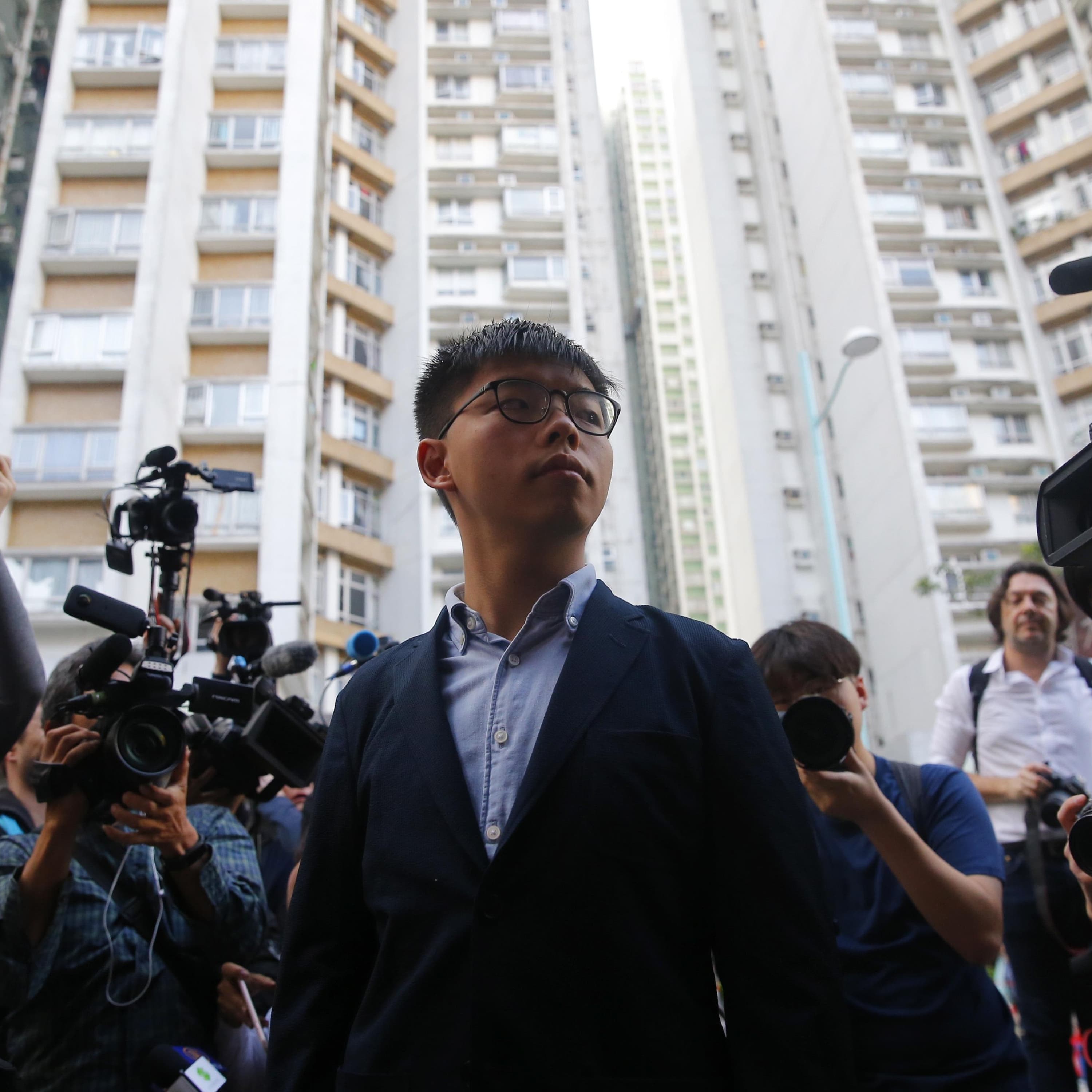
0:55You don't have to look like Che Guevara to be a political icon. Even so, when Joshua Wong burst onto Hong Kong's protest scene in 2011, he was an unlikely rabble-rouser.
1:10He had a bowl cut. His glasses were sometimes so wonky you suspected he might have sat on them. He often kept his rucksack on when he was surrounded by reporters as if they'd collared him on the way to class. And he was only 14 when he led a group of students fighting against China imposing a national education policy on Hong Kong.
1:36He was put on the cover of Time magazine before he was old enough to order a pint. Just 17 and hailed the face of protest for his role in Hong Kong's pro-democracy umbrella movement in 2014. We still believe that they need to continue to fight for democracy and freedom. But he's paid a high price for his fame. Still only 30, he's now spent most of his adult life in prison. Not just the face of the protest, but the scapegoat too. Declared a criminal separatist by the Chinese authorities. Last week he was sentenced to yet another 10 years in prison for colluding with foreign forces, an offence under Hong Kong's draconian national security law.
2:19And his detention poses a big, depressing question. From The Guardian, I'm Helen Pidd. Today in Focus, is this the final nail in the coffin of Hong Kong's pro-democracy movement?
2:38Danny Vincent, welcome to Today in Focus. Thanks for being here. Thank you. Hello. So you're a journalist based in Hong Kong and you've covered the past decade of Chinese crackdowns on pro-democracy activism, a story that Joshua Wong has been very much at the heart of. Can you just start at the very beginning? What was his early life like and how did he get into activism? So Joshua Wong was born in 1996, just a year before the handover. Of course, Hong Kong was granted to the UK for over 100 years, and it was handed back to China in 1997. Joshua was raised in a middle-class family. His parents were Christian.
3:18He says that his Christianity influenced not just his politics, but also his sense of being able to organize. The Bible told us that we need to contribute to the society, care the poor, and also fight for the justice. Now in 2011, when Joshua was just 14 years old, he created an organisation called Scholarism. This group were basically a bunch of students that were really against a moral and national education curriculum that the authorities were looking to introduce. It's the first day of school in Hong Kong, but for thousands of students, the term has begun not in the classroom, but on the streets.
4:02Critics at the time felt would lead to students being more patriotic towards Beijing and they managed to get thousands of people out onto the streets and essentially postpone or even stop the planned curriculum. So from a very, very young age he was very active, he was very astute, he used social media, he was also a very good communicator and that's how he entered into politics. Kind of incredible that he was only 14 when he organised those protests. I think at least 100 ,000 people were in attendance. But for those of us with slightly shaky post-colonial history, can you just remind us the terms of this handover from Britain to Hong Kong?
4:45Just before the flag came down by the Prince of Wales barracks, the prince had a few words for the incoming rulers from Beijing. Britain learnt long ago that Hong Kong people know best what is good for Hong Kong. Hong Kong was promised 50 years of essentially the same way of life. This meant that even though Hong Kong is part of China, when it was returned to China in 1997, there were certain freedoms that people in Hong Kong would enjoy that people in the rest of the country simply wouldn't be able to enjoy. This included things like freedom of speech, freedom of press, an independent judicial system.
5:24It wasn't clear exactly to many Hong Kong people what would happen in 2047, but some people aspired to greater democracy or even a full democracy at that time. And so I guess buoyed by the success of that early protest, his activism grew, didn't it? And a few years later in 2014, when he was just 17, he led arguably the biggest protests in Hong Kong since the British handover. People might remember these umbrella protests, but remind us, what were they all about? I think this was perhaps a key moment for Joshua. Using umbrellas to protect themselves from batons and pepper spray, pro-democracy demonstrators have clashed with police in Hong Kong.
6:06Thousands of people, young people, student protesters, sometimes students were in school uniform doing homework on the streets. They would occupy the central part of Hong Kong. They were fighting for greater democracy. They were looking for universal suffrage. I think that we have to do something to fight for it. At least we do something first. It felt like from their perspective that the authorities in Beijing were basically not holding up to the promise that they made. What was Joshua Wong's role in those protests and what happened to him there? Well, Joshua became the face of the pro-democracy student movement.
6:53He could speak to crowds of people in person. Also, he's been praised by his friends and his fellow activists for his strategic ideas. Hong Kong democracy activist Joshua Wong. Joshua Wong helped organize his students. He played a big part in the so-called umbrella movement. And he joins us now live. Joshua, let's talk about... But I think a critical point is that despite the protest, despite the demonstrations, the protest movement in 2014 wasn't considered as a success. The students essentially went back to school. They went back to the ordinary life. And the years that followed, it felt that people in Hong Kong were quite tired of politics.
7:37It was difficult for people like Joshua to be able to mobilize the type of people that he successfully did in the past.
7:58Before I became active in politics and student movement, Joshua was already a household name because he led a really big anti-national education movement in 2012. How old was he when you met him? Like 16, 17. and most of his time was like on study and campaigns. In the world of Hong Kong student protests, there are a few names that everyone knows. Joshua Wong is one of them. Nathan Law, only three years older, is another. The very first time that he sort of like bought a suit, I remember, there was like, I brought him to one of the chain store in Hong Kong because we were about to go to a trip and then meetings some like people that I think is good for us to to dress like a business attire and that was the first time that you walked into this like suit chain store and then I kept just like matching him thing and then he was so out of the place like he didn't know what he was supposed to pick so yeah we've got like memories like this where like you feel like oh you are not only like his workily but on the other hand like in life you're sort of like holding his hands like go through some stages yeah did he have the air of a kind of almost celebrity people close to joshua um including me myself we often describe him as a robot he is very mission-driven he is you can say very cold in terms of emotional expression um but very mission-driven very like yes i'm gonna do it I'm going to work 18 hours a day to do it.
9:40I want you to do it with me. I don't really care about anything else. To a degree that people feel like, oh, he's not like a friend to you. It's like a very dedicated work colleague. You have been playing a central role in the fight for democracy in Hong Kong for more than a decade. Just how important was Joshua Wong to this fight over the past 15 years? People often compare him as the Martin Luther King or Mandela of Hong Kong, just because they're equally dedicated. He has been impacting generations of generations of Hong Kong people. In every stage of Hong Kong protest since 2012-2014, he has had a really central role.
10:26And that's why people look up to him. That's why people feel like he embodies the spirit of Hong Kong's democracy and the relentless pursuit of freedom and democracy that we were promised. And how did he feel about comparisons like the one you just made, Nelson Mandela, Martin Luther King? I mean, was he embarrassed by those kind of comparisons? No, he's not like embarrassed. Rather, he felt like, yeah, this is something that he could utilize. This is something that he could make comparison and then explain the situation to the international community much easier because people have a resonance point to understand where he stands and what he represents.
11:21And Danny, I think that you first met Joshua not long after you'd moved to Hong Kong in 2016. And by that point, Joshua had co-founded a political party with other pro-democracy activists, including Nathan Law, who actually managed to get elected in Hong Kong's so-called mini parliament, which is kind of like the city's legislature. Yeah, I first met Joshua in 2016. His fellow activist Nathan Law had just been elected and his political party, Demacisto, which was founded by Joshua and Nathan Law, they had an office and they were basically really beginning to enter real politics. Joshua was 19 at the time, so he was too young to stand in any election.
12:05I remember he told me that he did have aspirations to one day become an elected official. I was, as a journalist, very keen to try to get to know him and try to understand him more as a person. So I'd ask him questions about things like what type of music he listened to and what songs he had on his iPhone. And I was really surprised to hear that even as a teenager, he had no songs on his iPhone at all. And I think that he was so focused on politics, so focused on strategy, so focused on political messaging, essentially, that even his interaction with the media and even his allies in the movement, it was almost all business.
12:50And in 2017, a film came out about him called Joshua Wong Teenager vs the Superpower. Hong Kong is the place that I born, I live and the place that I love. What happened in 2017 to Joshua Wong? The authorities obviously began to take note. He was charged with unlawful assembly and spent time in prison in 2017. So at this time, there was a number of leaders of the Umbrella Protest Movement, and the organisers all going through court. And I think because it was dragged out for a period of time, I think the public also became quite tired and quite wary of politics. I think at that time there was an acceptance that the reality was that Hong Kong was becoming increasingly influenced by Beijing.
13:52A few years after Joshua Wong was jailed for the first time, a new wave of protests broke out in Hong Kong in 2019. They were huge, people might remember them. What was the spark that led to so many people once again coming out onto the streets? Well, the authorities tried to introduce an extradition bill into Hong Kong. In the city streets, thousands clash with police. umbrellas and bottles versus shields and batons. What this would have meant was that Hong Kong residents could have been extradited to the mainland to face trial. Many Hong Kong people felt this was the strongest example yet of the erosion of the freedoms and rights that they were promised.
14:36And they feared that if people were to be extradited to mainland China, It could be used as a way to try to silence people that speak out, people like Joshua Wong. And where was Joshua at this point? So at the start of that protest movement, Joshua was actually in prison. At the height of the movement, he was released. And he immediately came to the streets and immediately began protesting. Joshua was considered very moderate compared to the protesters, many of the frontline protesters on the streets. Joshua wasn't calling for independence. He was only calling for greater democracy. So I think that it's clear that Joshua wasn't a leader of the movement at that time.
15:22But for the international media, the international press, he still had a role to play. He's obviously a recognisable face.
15:34But things had changed at this point. The Hong Kong movement in 2019, it had a different strategy. And people would say it was actually a leaderless movement. Much of the movement was organised online, on Telegram. You could get onto the subway and then somebody would airdrop a poster to the entire carriage. And then it would tell you where the next protest will be and then people would gather. And it had incredible momentum. And the idea that it was leaderless, at least the theory was that would protect individuals, people like Joshua Wong, from being targeted. But then at the same time, because Joshua was in prison at that time, by the time he came out, there was almost a moment where he was a little bit not quite in sync with the rest of the movement.
16:24Some of the young people were inspired by what Joshua did in 2014, but they also felt things had moved forward. And how did Beijing respond to those protests in 2019 and through to 2020? Beijing responded by introducing the national security law in 2020. Now, the authorities say that that law was needed to restore calm after a year of protests. But critics feel that the law, its intention was to target people that spoke up against Beijing. It's a weaponization of the legal system to try to punish people that challenge the system. There have been around 400 arrests since the law was introduced.
17:11But I think the law also spreads fear. I bet. Many people in Hong Kong, they talk about the idea of a white terror, that since the law was introduced, because they don't know exactly where the red lines are, it's really silence, dissent. tens of thousands of people have left Hong Kong. Some people would go as far as saying that it's changed the city even more than when Hong Kong was returned to China after British rule.
17:50And as Beijing started closing in on Hong Kong's pro-democracy movement, You, I think, quite understandably, managed to flee the country. What led you to go and Joshua to stay? Yeah, by then, Joshua, there was a logistical problem. By then, Joshua was arrested for other charges in relation to the protest. So I believe his passport was confiscated. And I think that was intentionally done by the government, because by the time the national security law was directly imposed by Beijing without any consultation or legislation process in Hong Kong. I think Beijing has determined to keep some people off the street and to be in jail for a long time.
18:33Yeah. Do you remember the last time you saw Joshua in Hong Kong? Yeah, that was before the implementation of the national security law. Those were the days where you can see that clouds hanging over everyone because you knew that there was going to be a big change in Hong Kong. A lot of things that we used to know, freedom of speech, freedom of assembly, the ability to criticize the government, the ability to demand democratic reform were going to be enormously disrupt. Did you tell him that you were going to leave or did you just have to flee without warning? I knew that if I fled and then government put me on the wanted list, which they did, the way that can keep everyone safe is to keep it from everyone else.
19:23So I just left. I think that was not like a shocking news to the general public or people in the activism circle, because people knew that there's going to be someone speaking up for Hong Kong and it's not going to be in Hong Kong.
19:42Coming up, what Joshua has been up to in prison.
20:11Or sell fast now and pop the champagne later. Cash now, more later. Now available nationwide. Start your offer at opendoor.com slash ACAST. Profits calculated after fees and costs, eligibility and offer price may vary. Shipping, billing, admin, payroll, marketing. You're managing all the things. So why waste time sending important documents the old-fashioned way? Mail and ship when you want, how you want with stamps.com. Print postage on demand and schedule pickups from your office or home. Save up to 90 % with automated rate shopping. Over 1 million small businesses trust Stamps.com. Get$20 in free postage when you sign up for the pro plan at Stamps.com slash Black Friday 2026.
20:53Terms and conditions apply.
20:59Danny, I know that you were at Joshua's sentencing last week when he was given another 10-year sentence. And let's not forget that he's been in jail for six years already, but he had been charged for the second time under the national security law. Can you just describe the scene in court for us? Well, because so many activists have gone through the legal system since the national security law was introduced, sometimes these court events feel almost like a, not quite a protest movement, but it's almost an act of defiance for some protesters or some supporters. I think people sometimes stay overnight to try to get a seat in court.
21:38With Joshua's case, there's a limited number of seats in court, but some of his supporters, they would rotate. They would come into court. They would acknowledge Joshua, who was standing in the dock before the hearing began. They'd wave to him. They would nod back. Then that supporter would leave. And then the next one would come in, occupying the same seat. And this would happen for maybe up to 10 minutes before the judge entered court. And I think that these are the type of acts of support that activists are able to do now. Right. The fairly subtle acts of solidarity then. It's not waving banners, blowing whistles, staging sit-ins.
22:21It's subtle now. I think attending court is almost seen as a type of activism. But I think compared to what it was like in 2019, it's almost unrecognisable. Hong Kong's almost unrecognisable. And what had he been charged with this time? So he'd been charged with colluding with foreign forces. What the court heard was that Joshua had travelled abroad to try to ask these foreign forces, as the law puts it, to sanction Hong Kong and China. But didn't he plead guilty? Help us understand why he would have pleaded guilty. That's right. He did plead guilty in September. Now, many pro-democracy activists that have gone through the legal system, many of them sometimes choose to plead guilty in order to get lesser sentencing.
23:15I think that many of his supporters were not expecting a lenient sentence, but I think there was still a level of shock. Outside court, some of his friends and supporters were holding each other and crying. But at the same time, I think that Hong Kong has transformed dramatically since the introduction of the national security law. It does feel this is the new normal in the city.
23:50What was your reaction last week when you heard that Joshua had been given another 10-year sentence? I think it's devastating. He was shot at the age of 24. Now he's 30. By the time he left prison, it would be 40 if nothing else changed in the span of a decade. and that that's basically his entire adult life to where like people normally they meet their partners they they they become married and they have a family and and they have a career and then by the age of 40 you pretty much figure out most of your life and Joshua is behind bars years and years and I think the the most cruel part in the whole like legal persecution is that the sentencing was issued two months before he was about to be released after an excruciating length of like six years imprisonment he was certain that oh he's going to leave after a few years of imprisonment before this case but now like everything changed he has been a very tough person.
25:05But you know, sexual imprisonment plus 10 years, no sane person can take that lightly. Like no matter how tough you are, you are going to be impacted in a miserable way. And you are, of course, watching all of this play out from afar, having fled Hong Kong six years ago. Can you tell us where you are now? Oh, I'm in London. You're in London. Okay. And do you feel safe? I read that there's a £100 ,000 bounty on your head from the Chinese authorities for your arrest? You can never be completely complacent about your security, your safety, etc. So, of course, there is this act of bounty. And then there was a case a couple of months ago where the Hong Kong representative office hired local investigators to look into us.
25:59I saw the investigative report of myself. The Hong Kong government wanted to know where I live, my network, what do I do in my daily life, etc. They've been spying on you? Yes. I'm curious, how would you compare the Hong Kong of 2014, the Hong Kong of the Umbrella Movement that you were so instrumental in, to the Hong Kong of today? Yeah, I remember in the Umbrella Movement when we were occupying the major runways of Hong Kong for democracy, people were joyful. People were like, yeah, it is tough, but there's hope. You saw middle school students, they were working on their homework on the roadside.
26:43You saw people volunteering themselves, cleaning the public toilets. People kept bringing all these supplies to make sure that things were run in a certain tidy way and that there was so much hope in Hong Kong. But now people are just feeling suffocated and there's no room for any optimism for democracy.
27:14And so as you say, Joshua will be 40 by the time he is out of prison. And you recently wrote a really fascinating piece about Joshua's life inside Hong Kong's oldest maximum security prison. You were given exclusive access to correspondence from friends and family on the outside. Paint a picture of what does his life look like in prison? What does he tell his friends and family in his letters? What I found so interesting about his letters is Joshua's ability to stay connected to the outside world. He asks his friends to take photographs or screenshots of social media accounts that he once followed when he was on the outside.
27:56He subscribes to a number of newspapers. He asks his friends to put questions to AI, to AI bots, and then they print out the answers. Even though he's so disconnected, he's also a man desperate to stay connected. The letters seemed mostly positive. He spoke about the books that he read. He read a number of biographies. He said that he found a copy of Nelson Mandela's biography in the prison library. He's also teaching other inmates English. And he makes a few jokes sometimes in letters. I think that it's worth noting that the letters that come out of prison, of course, would be read by the authorities.
28:42and he wouldn't be free to say everything that he likes to say. But I think some of the references he made, I think they're telling. I think references to Nelson Mandela, references to political events in Russia, in America, it shows that he's still very politically active, at least inside prison. And I've spoken to his friends, people that are now in exile outside of Hong Kong and people that are brave enough to still speak to me inside Hong Kong. And they say that it's actually now while he's in prison that they're almost beginning to get more of a sense of what he's like as a person or they say that he's almost become a better friend while inside prison because during the days when they were protesting, Joshua was so focused on his goals that he sometimes came across a little bit impersonable.
29:39Some of his friends that I've spoken to, they had always maintained that Joshua had always coped quite well in prison. He was always focused. He liked the routine. But I also heard reports that when he was arrested inside prison and charged with national security law charges for the second time, which he's now been sentenced for, I heard the reports from people that were in touch with him that he took that badly.
30:17I mean, you know, looking on from afar, it seems that the democracy movement has been shattered, really. You've got Joshua Wong facing another 10 years in prison, been inside for the last six years. You've got you and thousands of others who have sought sanctuary abroad, who have fled. What do you think the future of Hong Kong looks like? I often describe the state of the democratic movement or people who still have a pursuit of democracy as they're in a hibernation state. So there's a big winter storm and it's difficult to stand up, it's difficult to be active, and then they just lay low and wait for the moment.
30:56We don't know when the moment comes. It often erupts, it's often spontaneous, but I think the fire for democracy is still there. It's just not the time for people to display that. Well, that's a great metaphor and a nice way to end, I think. So, Nathan, thank you so much. And that is it for today. My thanks again to Nathan Law and to Danny Vincent. You can read all of Danny's coverage of this story, including his exclusive look at Joshua Wong's prison letters at theguardian.com. This episode was produced by Guy Zafman and presented by me, Helen Pidd. Standard Sign was by Brian McNamara, and the executive producers were Alex Atak and Sammy Kent.
31:35We'll be back in your feeds this afternoon with the latest.
32:08This is so simple now. This is so awesome later. Or sell fast now and pop the champagne later. Cash now more later. Now available nationwide. Start your offer at opendoor.com slash ACAST. Profits calculated after fees and costs, eligibility and offer price may vary. 500 orders a month was manageable. 5 ,000 is madness. Embrace intelligent order fulfillment with ShipStation, The only platform combining order management, warehouse workflows, inventory, returns, and analytics in one place. What used to take five separate tools, ShipStation does in one. Automate fulfillment and rate shopping to ship up to 15 times more with up to 90 % savings.
32:50Go to ShipStation.com and use code AUDIO to try ShipStation free for 60 days.
Scan the code with your iPhone camera
Listen in the app.