 Today in Focus
2 Nov 2026 · 36m

 Add vo to ChatGPT or Claude to ask about everything you hear
vo listened to this episode to put together the overview and transcript, so there may be the odd mistake.
Michael Lewis discusses his book Blockers, focusing on how Trump Term 2 and Elon Musk’s “Department of Government Efficiency” (DOGE) allegedly attacked the US civil service by using contempt, politicization, and legal intimidation to remove “blockers” who resisted.
Michael Lewis is a celebrated US writer known for accessible, narrative nonfiction (The Big Short, Moneyball). Host is Noshi Nikbal of The Guardian.
DOGE was staffed by young Musk-linked hires (“muskrats”) with little government experience but sweeping authority; it failed to cut costs (GAO verified only 4%); it targeted quasi-independent bodies and civil servants’ protections, including probationary workers.
Colin O’Brien (chief security at the US Institute of Peace) locked DOGE intruders inside; the Institute was later renamed after Trump. IRS chief privacy officer Kathleen Walters was pressured to release a 7-million-name undocumented workers’ tax-return database to ICE. Musk/X posts allegedly exposed an intelligence asset’s identity, leading to torture of relatives. DOGE emailed civil servants to submit weekly “achievements,” threatening resignation.
0:00Nosheen Iqbal: This is The Guardian.
0:08Nosheen Iqbal: Today, Michael Lewis on the damage of Trump Term 2 so far.
0:30Gusto makes it easier. Gusto is online payroll and benefits software built for small businesses. It's all-in-one, remote-friendly, and incredibly easy to use. So you can pay, hire, onboard, and support your team from anywhere. From automatic payroll tax filing to simple direct deposits and benefits options for nearly every budget, Gusto helps simplify the process. Plus, enjoy unlimited payroll runs for one monthly price with no hidden fees or surprises. And with automated tools for onboarding and offer letters, you can focus on what matters most. Try Gusto today at gusto.com slash tech and get three months free when you run your first payroll.
1:06That's three months of free payroll at gusto.com slash tech. One more time, gusto.com slash tech.
1:19Nosheen Iqbal: It was a cool, cloudy March morning in Washington, D.C. last year when Colin O 'Brien sent a memo to all staff, telling them not to come into work that day. If you saw him, if you met him, you'd think I'm meeting an American football player. He looks like that. He looks like a lineman on an American football team. He's big and burly. If you talk to him, you think, this sounds like a political scientist. O 'Brien was chief of security at the Institute of Peace. It's an organization trying to mitigate violence around the world. Basically, squashing conflicts before they can even happen. George Washington proposed it.
1:56He said, we need an institute of war and an institute of peace.
1:59Nosheen Iqbal: And historically, hundreds of people have worked there at any given time, doing quiet but life-saving work.
2:10Nosheen Iqbal: The HQ is a really grand building, all curved glass and steel that's supposed to symbolize American transparency and openness. But that morning, O 'Brien was locking it down. He was kind of preparing for war. Almost instantly after the inauguration, Doge rolls in to take control of the building. Doge, the Department of Government Efficiency headed by Elon Musk, planned for a hostile takeover. They were going to strip the building, they say, of wasteful spending, of pointless hires, of contracts they didn't see any value in. But O 'Brien wasn't going without a fight. So first Doge comes. He looks at these young men with contempt, turns them away, probably frightens them.
2:58They go away.
3:00Nosheen Iqbal: Doge didn't back down. The second time they showed up, they had armed security guards on their side. They physically invade the building. They have the guns and they come in the building. Colin notices that they're all in one. they've got themselves, not wisely, in one kind of atrium area. And he can hit a button on his phone and lock them in. He hermetically seals them in. They realize what's happened. They can't get in or out. They're prisoners. He's taken them prisoners. And he thinks then that I've got them. I'm going to call the D.C. cops. They're independent. And this is trespassing. What happens next throws O 'Brien for a loop.
3:38Nosheen Iqbal: He's been a cop. He's served in the Army. He knows the law. So he calls the Washington, D.C. police, and the Washington, D.C. police show up, and they've been flipped by the Trump administration. And this is kind of shocking. Instead of arresting the private security people, they march out Colin O 'Brien and they hand the building over to the Trump administration.
4:02Nosheen Iqbal: O 'Brien was fired. The Institute of Peace, which within months was renamed the Donald J. Trump Institute of Peace, was one of the first on the list of targets attacked by the administration. And it was far from the last. What is happening is a massive power grab, an assertion of raw power, just the raw elemental power. In his blockbuster new book, one of America's most celebrated writers, Michael Lewis, reveals how Trump has completely reshaped the government. the unseen myriad departments and organizations that do everything from making sure tap water is safe to protecting national parks and processing tax returns.
4:43One of the dramatic seizures of power that this administration is engaged in is turning the nonpartisan civil service, the two million person workforce, into a loyalist operation that serves the narrow interests of the president, whoever happens to be president. What does that mean for how we govern ourselves.
4:59Nosheen Iqbal: From The Guardian, I'm Nashi Nikbal. Today in focus, The Blockers, how public servants try to push back against Trump.
5:12Nosheen Iqbal: Michael Lewis, what a pleasure to have you here. A pleasure to be here. Now, for anyone not familiar with your work, it is not an overestimation to say that your books are something of an event, Not just for publishing, but also they're made into massive films like The Big Short, Moneyball. The whole housing market is propped up on these bad loans. They will fail. The housing market is rock solid. And you take, I guess, what seem like complex, unsexy subjects and make them accessible and gripping. And now you've turned your eye to the civil service. And your new book is called Blockers. It profiles about six people.
5:54Nosheen Iqbal: Michael, what first drew you to the story? It is not an obvious subject, you're right. And I would say what gets me excited and thinking that, oh, this is something worth doing, is precisely what you just described. It's like, oh, nobody's interested in this, but I am. And if there's a gap, the gap is big enough, I think, oh my God, I can drive a truck through this. What happened was Trump won. Trump gets elected the first time and he fires his entire transition team, He turns to the head of his transition team, Chris Christie, and says, we don't need to know about the government. We don't need these people teaching us anything.
6:29It'll take us an hour to learn about the federal government. I saw it in the newspaper, and I thought, there's at least some fun journalism to do here. We're going to go learn about the United States government, and the reader will know more than the president of the United States because he doesn't care to know. I was thinking, what does the Department of Energy even do? You know, is it as irrelevant as they say? and you wander in and oh my god they're running the nuclear arsenal and the people who were trying to brief the trump administration are just dying to tell someone how you run the nuclear arsenal because he's not listening he's not listening and in the course of that i kept meeting these characters who were so clearly literary characters and they were civil servants and their stories just don't get told they don't tell their stories they've learned from hard experience that you don't stick your head up, it gets chopped off.
7:16They aren't the kind of people, the kind of people who go into public service who are really looking to be famous or rich.
7:22Nosheen Iqbal: I mean, these aren't unsung heroes in this book. Well, they're certainly unsung. Now, if you think of the civil servant as someone comes in, punches a clock and works 40 hours a week and was waiting to retire. Which is the cliche, which is the stereotype. That is the stereotype. But I kept meeting these people who worked 80 hour weeks, who didn't have families because they were so obsessed with, I don't know, stopping coal mine roofs falling on the head of coal miners or figuring out how objects drift at sea so the Coast Guard can rescue Americans who go overboard. One thing like that after another.
7:53It was existentially important. The life-saving was going on left, right, and center. I did also think that if anything ever happened in the government again that was as interesting as what happened in Trump one, where there was just kind of radical neglect, that I would come and actually create the big narrative about them. And then something happened.
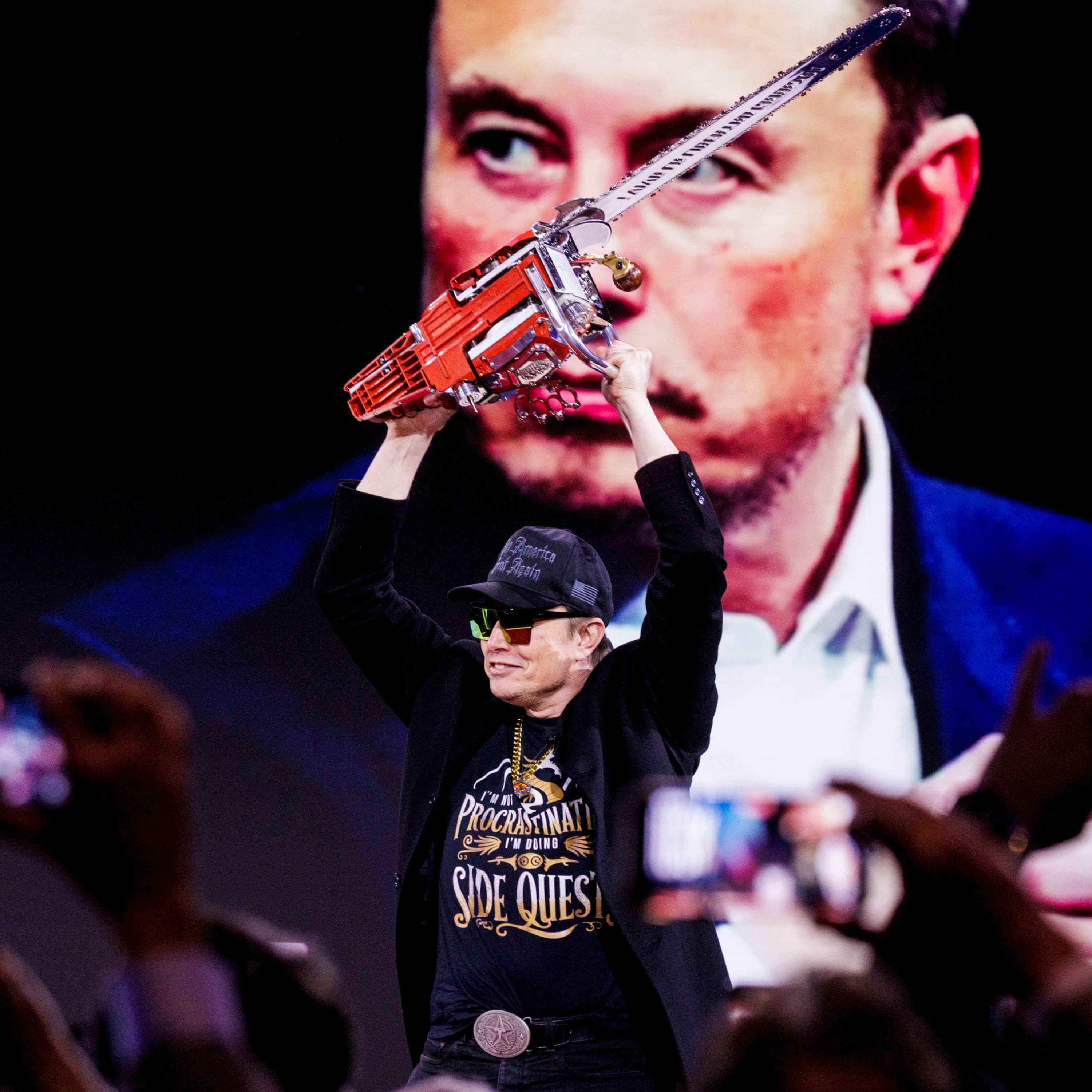
8:14Nosheen Iqbal: Yeah, well, you've taken us very neatly to Trump term two, where you essentially had this massive attack on the civil service, which is made up of about two million public servants, in which there was a creation of Doge. And to that end, I have created the brand new Department of Government Efficiency. Doge! Which was promised and delivered by Elon Musk to radically reduce waste in spending and inefficiency. Which is headed by Elon Musk, who is in the gallery tonight. And, you know, I started with this quite bonkers scene of Musk wielding this chainsaw. They're behaving in very erratic ways. The chainsaw for bureaucracy.
8:58Nosheen Iqbal: Chainsaw!
9:05Nosheen Iqbal: Michael, first of all, Just how did he set about installing this department? What was he going to do? Well, what he was going to do, he said, was cut$2 trillion out of the federal budget. $2 trillion out of a$7 trillion budget. The government is not efficient, and there's a lot of waste and fraud. So we feel confident that a 15 % reduction can be done without affecting any of the critical government services. How he was going to do it was to attract people who were attracted to him, a random collection of people who were basically a social network, young people who had worked at one of his companies, people who were friends of friends.
9:49It was that kind of thing. I heard about it at a drinks party. I'm 25 years old and I have a degree in computer science and this is my way to spend time with Elon Musk. What it wasn't was a collection of people who had any knowledge about the government, any experience in the government. I mean, there was this feeling that it was a horde of 19 to 28 year old men who were just learning there were three branches of government. I mean, they were kind of like my kid's age kind of thing, but they were really young people who said to me, like professed to me that they got there and were surprised to discover because they'd been brought in to cut the cut things that Congress can control spending.
10:29Nosheen Iqbal: Yeah. Now that that's something you kind of learn in sixth grade if you're paying attention in civics. So it was that level of ignorance. And yet they had super access and superpower. Oh, no, no. Power beyond. Power that no one has had, I don't think, in my lifetime in going into government agencies and just doing radical stuff. Elon Musk holed up in a government building called the General Services Administration at the top floor. He bunked there as if it were a startup. A dozen of these young men bunked there with him. So it's like a sweaty, smelly dorm for boys and laptops. It's all boys. It's all boys.
11:09It is all white men, basically. And how many people? I think we still don't actually know the exact count, but a couple of hundred. The people in Doge, I interviewed a dozen of them, but they didn't know exactly how many there were. What they did say is that Doge wasn't one thing. They were circles within circles within circles. And the inner circle were these very young men who were sleeping on the floor with Elon Musk. They go out every day and are told, like, bring back scalps. Come back having fired people and having cut contracts. The way they do both of them, I can give you, like, glimpses.
11:45At the Department of Veterans Affairs, it's got a budget of hundreds of billions of dollars. It's doing lots of things for veterans. Things that, like, weren't dreamed up by civil servants. The civil servants just carrying it out. Congress authorized the spending. The young man who was sent there had no experience. I mean, he didn't know where the building was. He gets there. He has a pass. He has total authority. The Trump administration gave him total authority to do whatever he wants to do. He demands the file that contains all the contracts. They're 90 ,000 contracts. And he, I mean, it would be bewildering.
12:17You kind of feel for him, right? Like, what is he going to do? And he starts plugging in words that he knows Elon will disapprove of. Bias, gender, woman. where he thinks that he's going to find woke things that if he cuts them, Elon will say, good job, young man, and cuts the contracts based on the words. Wow. So I know about the story because one of the characters in my book walks in two weeks later and the young Doge guy looks up and says, I'm so glad you're here because I'm not sure I should be doing this.
12:46Nosheen Iqbal: And yet he was doing it. He was doing it. Arbitrally just, you know. Young men will do things. but they found out pretty quickly when you go into their civil service protections they see how hard it is to actually cut like a civil servant who's been there for 20 years their actual protections again and it takes them a little while to do that but there are a group of people and there are tens of thousands of them called probationary workers yes and they're the young people they're the people who've only been there 18 months they're the future of the government if you can get someone to sign a letter saying that they're you're fired for cause that they have been doing a bad job, they can all just be wiped out.
13:23And they wiped out tens of thousands of people this way. And God knows at what cost, but that's the kind of thing they did.
13:30Nosheen Iqbal: So Michael, as you've described it, Doge is staffed by these young men, mostly these, well, basically these musk acolytes call themselves the muskrats. I call them the muskrats. You call them, sorry, you call them the muskrats. And they're willing to do his bidding in, you know, like a whatever it takes fashion, no matter the consequence for the workers that their firing, no matter the protocol they're breaking, the employment law that they've upturned. So let's look at one department, and it wasn't even actually a government department, as we'll go on to learn in your book, that they took aim at, which is the U.S.
14:01Nosheen Iqbal: Institute of Peace, which we've heard about a little bit at the beginning of this episode. Michael, can you explain a bit more about that organization and how it came to collide with DOGE? I'd never heard of the U.S. Institute of Peace until DOGE invaded it. Our Congress, the U.S. Congress, has a long history of chartering these kind of quasi-government organizations and funding them. I think the first was the Red Cross, the Smithsonian, the Kennedy Center, public broadcasting company. There are all these things that they reside in the executive branch, but they're designed to be outside the control of the president.
14:35So they're private public.
14:36Nosheen Iqbal: They're sort of private companies. They're private public. And in this case, it's a really interesting organization. It's small. It's a little nebulous. You could argue if you didn't know very much about it, this might be a waste of a few millions of taxpayer dollars. But if you go to, I don't know, David Petraeus, the general, he would tell you that this little organization, it had this odd effect, particularly in the Iraq War, where there were Iraqi tribal elders who didn't want to be seen to be dealing directly with the American government, but were willing to be organized by people who had connections to the American government.
15:09Right. who came in and actually shut down the institute piece organized the talks that quelled the violence in the so-called triangle of death and petraeus wrote a letter saying the billions you've saved us and the lives you've saved us in just this incident is worth the whatever millions we paid
15:26Nosheen Iqbal: for this thing but it's like a soft power it's a soft power thing and you could argue you know the other argument you make is it's an intelligence agency there are people they employed in in say Afghanistan, who the United States government would not want anyone knowing they were employing them kind of thing. So the character I tell the story through is Colin O 'Brien, who was the chief security officer. I love this guy, by the way. I mean, the way you tell his story. What do you like about him? Well, just his, I mean, like all those characters that you've, you've picked upon in the book, the pure dedication, the fact that, you know, he joined the army, but he wanted to be a cop, but he promised his mom that he'd go to college and he'd do that first.
16:05Nosheen Iqbal: And it's just like dedicated to a cause, let's say. And it comes out in the story. Yeah, he's dedicated because he knows who he is. So at the beginning of this episode, we describe this almost farcical scene of Doge coming into the Institute of Peace, trying to take the building, and in the end, being locked by Colin in an atrium until the cops arrive. The Doge guys have even talked about it. We've suddenly had some battles. Battles? Yeah, yeah. I mean, who should talk about Yusuf? A small agency called the United States Institute of Peace is definitely the agency we had the most fight at. We actually went into the agency and found they had loaded guns inside of their headquarters, Institute for Peace.
16:48Nosheen Iqbal: In the end, despite Colin's fight, they do take over the Institute of Peace, which is just extraordinary, isn't it? Well, Colin's take on this is so extraordinary, too. He says, you know, why? The question is, like, why us? Nobody even knows we exist. I think, and Colin thinks, that what they were doing is identifying the institutions that were furthest removed, that were within the executive branch, kind of, but furthest removed from legal presidential control and seizing it so that they could show they could take anything. They were testing the limits of their power right away.
17:29Nosheen Iqbal: By far the least peaceful agency that we've worked with, ironically. Of course. Additionally, we found that they were spending money on things like private jets. And they even had a$130 ,000 contract with a former member of the Taliban. Let's look at how that power then translates, because in a public facing way, obviously, you know, Musk is tweeting hundreds of times a day during this period. The department or Doge, rather, they're also they have their own account. And when they took over the Institute of Peace, they were basically what did they publicly post? that they'd revealed and canceled the Institute's funding to various things, including$132 ,000 paid to an ex-Taliban member and more than$600 ,000 wasted on private planes, which on the face of it, if you're reading this, you know, as a member of the American public, potentially sounds like righteous savings to make.
18:19Nosheen Iqbal: But what did the reality of those decisions look like? This is where it goes from being kind of a shocking but amusing story to being kind of dark, really dark. And part of a pattern of Doge and Musk just saying stuff that aren't exaggerations or hyperbole, but actually the opposite of the truth. So the money that was spent on the supposed Taliban member, it was actually an American, effectively American intelligence asset who had worked in person with the State Department in its negotiations with the Taliban, had flipped, was an enemy of the Taliban. And so it was actually was at risk of his life inside of Afghanistan.
18:59He was living in Germany or somewhere. When Musk publishes his name on Twitter, on X, the Taliban read that name and they realize how involved this guy's been in helping the United States. And they round up his relatives in Afghanistan and torture and beat them.
19:19Now, in any other time in American history, people would be throwing around words like treason, that you have just exposed an American intelligence asset and people are being punished brutally because of it. And nobody said a word. The $600 ,000 private plane, there was one flight and it was getting their assets, the people, a couple of hundred people out of Afghanistan when we pulled out. So it was just saving, they're all people who had been killed.
19:54Nosheen Iqbal: And what did Elon Musk have to say about all of this? I didn't talk to Elon Musk. He didn't want to talk to me. I think he's embarrassed a little bit by Doge at this point. Is he capable of embarrassment? I don't know. Is he embarrassed? Do you think he's embarrassed? Embarrassed as much as he has that emotion, I think that's right. I think it's like he doesn't want to talk about it. And he said he's announced it's a failure. But his circle of friends I was able to talk to. And what they would say kind of routinely in defense of Elon Musk was, what you have to understand about Elon is that he never lies.
20:25He thinks what he's saying is true. Then the question is, what's more frightening? Does he believe what he's saying? Or is he a cynical person? And I don't know. They were so convicted about this. It was like, he thinks this is true. I can't honestly say that as he's tweeting these out where it really lies. If he's living in a world where that's his reality and he thinks that he actually believes them. I don't know whether he believes it or not. But if he actually knew what he'd done and had any kind of conscience, he'd be so ashamed.
21:00Nosheen Iqbal: I guess one of the points at which people may have really paid attention, because I think this story, I remember it made global headlines, is when late on a Friday evening, someone from Doge sends out this email to around, again, those two million civil servants, asking them blithely to reply with five bullet points of things they'd achieved that week. The clock is quickly ticking for federal workers to respond to that email. The deadline is tonight at 11.59 p.m. Eastern time. And Elon Musk had warned that if employees failed to respond, he would take it as their resignation. The email asked employees not to send any classified information, links or attachments in their response.
21:42Nosheen Iqbal: Michael, how on earth did the civil service respond to this? dutifully, basically. I mean, that's the amazing thing. Now, it is true that if you work in a small private company, you might say, good on Elon Musk. I get asked what I did last week all the time. I have to explain what I achieved. These civil servants aren't doing anything in there. Let's hold them accountable. But the problem is the level of ignorance about what those people are doing that's required to send that email out is breathtaking. He's sending it to spies. He's sending it to people who are auditing people at the IRS. He's sending it to a lot of people who, if they put stuff in an email, they could go to jail.
22:20And so just for starters, that.
22:23Nosheen Iqbal: FBI Director Cash Patel has told his employees to pause any responses to the email. State Department employees have also been told not to respond. Many of those 2 million people, surprisingly, maybe surprisingly, don't have computers at work. People are doing all kinds of things. They're in the Forest Service. Then the second thing is, You're sending it to 2 million people. Who's going to read this stuff? How are they going to audit with this information, not having the expertise of knowing, okay, what does this even mean? What does it even mean? And there was a lot of hand-wavy stuff about, oh, we're going to use AI to analyze it.
22:54They never did. Nothing was ever done with this. It was just trolling the federal workforce. Now, in what world is it sound management practice to just insult your workforce like that every week? It's insane. So what is he doing? He's performing for the American public. Yeah, Elon. This is how Elon manages. Yeah, we're going to club the civil service like this. And Elon knows what he's doing because he's rich. I think it's as simple as that. The people who are actually trying to manage conflicts within the civil service or performance, we're pulling their hair out. I'm spending hours of my day trying to explain to the 200 people who report to me what they can and can't put in that email.
23:35What a waste. I mean, talk about creating waste.
23:37Nosheen Iqbal: Well, one of the key examples, actually, and you mentioned the IRS, I mean, where you can literally go to prison for looking at tax records that you're not authorized to do so. That was one department that came under particular fire with Doge, and they were under immense pressure to share their data. Michael, to what end and how did that play out? Well, the character here, we move from Colin O 'Brien to Kathleen Walters, who was the chief privacy officer at the IRS. Which means, I mean, basically she was a human being between my tax return and someone who would weaponize it against me. Had a spotless record, nonpartisan, been in the job, been in jobs in the IRS for 20 years.
24:15And right after the inauguration, she starts to get pressured every which way to release to the Department of Homeland Security and ICE, the immigration people, the cops. A database that had 7 million names in it, 7 million tax returns. And it was the tax returns of undocumented workers because those tax returns had the most recent home address of those people. And ICE was having trouble finding the people. Just for starters, it was illegal to release those tax returns. And, you know, it's funny. I didn't know until this that undocumented workers were paying taxes.
24:54Nosheen Iqbal: Well, yeah. I mean, that's one of the surprises in the book. It's not an obvious thing, right? I mean, you find non-obvious thing after non-obvious thing. But the United States Treasury has gathered since the 1990s when they created this program over$100 billion from this community. And they've done it by saying to them, look, you're not a citizen. We know you're here. If you file your tax return, you will be essentially demonstrating good faith. And if you apply for citizenship down the road, it will help your case. It's the definition of the good immigrant myth, right? I mean, they're doing their best.
25:27That's exactly right. And we have the IRS, the internal revenue, our inland revenue, has for 30 years told this population, your data is safe with us. So what Kathleen would say is, one, it's against the law to hand over this database. Two, it's a huge violation of trust. And who will trust us ever again if we do it? And three, it's brutal. It's brutal. And she's basically driven out of her job. And in fact, the tax returns are handed over.
26:04Nosheen Iqbal: I think at this point, a lot of listeners will be wondering, well, just how on earth did they get away with it? How did they intimidate sort of these veterans of the civil service and hustle them to break the rules? Why wasn't anyone able to stop them? Because the state was supposedly such a deep state, was actually quite a shallow state. that once you're prepared to break the law and fire or harass people who aren't willing to break the law, you run out the blockers, you eliminate the blockers. That's what Musk called them, right? The blockers. So they're there to get rid of the blockers and find whoever they can find to obey their orders, who would actually say yes to the bad things.
26:43Because you can find there's a kind of a character in almost every agency who was like 13 levels down, but happened to be a Trump fan who they would surface to sign the memo. They'd surface and say, you're now head of the agency. The Trump administration was very good at finding people who were not nonpartisan, people who were loyalists and thrusting them into positions of authority. So what they were doing right away was politicizing what was a not very political workforce. That's how they got away with it. And Congress was supposed to protect these people in many ways. Well, quite.
27:17Nosheen Iqbal: And the courts, I mean, they just seemed to not be able to catch up. up not play fast enough michael within four months of the department being created musk was out trump called him a drug addict he then alleged that trump was suppressing the epstein files because he was in them and that he should be impeached now they've you know they've made up again he's back in heading this or co-heading this workforce on warfare don't need to come on to that but in terms of doge it ceased operations i believe in july 2026 as scheduled now the impression that I largely had was that once its ideals made contact with reality, that it just absolutely crashed and burned, it imploded.
27:57Nosheen Iqbal: Maybe that's not quite the story you tell, but how successful would you say Doge was given its original premise? Well, failed utterly to cut costs, failed utterly to find much waste, fraud, and abuse. If Elon Musk was here, he might try to tell you, and you'd have fun arguing with him that they cut$100 billion in contracts or costs. However, independent analysis of it, the GAO, the General Accounting Office, has only been able to verify 4 % of it. It's fair to say like effectively zero cuts and some large number of costs by eliminating very useful people and functions that will have to be restored.
28:37So anything to say like didn't work, But maybe Doge was successful on other terms that we have not really taken into account. There was actually a big piece in the Washington Post just last week saying that what's become of some of my characters, what's become of the 25-year-old who went into the IRS? Oh, my God, he's got a new company worth a billion dollars, and it's all based on federal contracts.
29:00Nosheen Iqbal: Oh, wow. Oh, the sweet irony. The sweet irony. So I suppose in some ways, Doge was a success for the people who participated in Doge.
29:15Nosheen Iqbal: Coming up, how the legacy of Doge lives on in Britain.
30:03Nosheen Iqbal: We'll see you next time. and use code podcast to try stamps.com risk-free for 60 days. Running a small business means wearing a lot of hats. Between managing employees, handling payroll, and keeping up with paperwork, there's a lot to juggle. Luckily, Gusto makes it easier. Gusto is online payroll and benefits software built for small businesses. It's all-in-one, remote-friendly, and incredibly easy to use. So you can pay, hire, onboard, and support your team from anywhere. From automatic payroll tax filing to simple direct deposits and benefits options for nearly every budget, Gusto helps simplify the process.
30:38Plus, enjoy unlimited payroll runs for one monthly price with no hidden fees or surprises. And with automated tools for onboarding and offer letters, you can focus on what matters most. Try Gusto today at gusto.com slash tech and get three months free when you run your first payroll. That's three months of free payroll at gusto.com slash tech. One more time, gusto.com slash tech.
31:27Nosheen Iqbal: in Gaza. Time Out says, as a work of journalism, it is inarguable. As a work of cinema, it is exemplary. New York Magazine has called it one of the most important films of our time. NASA, the most critically acclaimed documentary of this year, is available in cinemas now.
31:54Nosheen Iqbal: Well, I wonder how much you know about how its influence has actually travelled. I mean, looking at one of our most right-wing parties in the country, Reform, led by Nigel Farage, they promised to doge the hell out of local government. We need some pretty big cuts in the administrative state in this country, which has grown out of all proportion. We need a British form of Doge as Elon Musk has got. And of course, you know, once reform took control of some of these councils in the May elections, they found out that, you know, as Doge in America did, it's very hard to find savings. And instead they had to raise council tax.
32:36Nosheen Iqbal: And so I wonder how much does the demonization of the civil service known as, you know, the blob, how much do you think it taps into this sort of conspiratorial thinking about the deep state that sort of just swept the world? You couldn't sell politically the idea that you're going to go make massive cuts in the government and it's going to make everybody better off. If people actually knew what the government did, if people paid more attention to what your civil servant was doing, they would realize that actually, mostly you want it done. And yeah, the things you could do to make it more efficient, but it isn't this.
33:12It isn't coming in with hostility and contempt. I mean, did that ever work anywhere? coming in with curiosity and understanding and trying to fix it that you know there is a version of doge in the states that could have worked and it's something like i elon musk understand that i've never been in government however i do understand technology and i do understand the government's very slow to sort of upgrade and find cost cutting that can be done with introducing by introducing new technology i can attract all these very bright young people who understand how to work a computer to go and, I don't know, create an app at the IRS so that people can pay their taxes on their phone.
33:50I would say that the general rule of our doge was nobody bothered to figure out why things were there in the first place. So when they started tearing things down, there were all these unintended consequences.
34:01Nosheen Iqbal: For a moment, I will do the whole devil's advocate thing because in your book you tell... Without a whole lot of conviction. I'm going to do it. Go ahead. Go do your best. And in your book, you tell the story of an IRS employee having to spend weeks sending countless emails trying to get a water fountain repaired, which sort of suggests exactly the kind of mindless levels of waste and bureaucracy that people associate with the civil service. So, Michael, if one multiplied that kind of efficiency across so many departments and millions of people, why shouldn't the government be run like a private company?
34:35There's a reason why the book is laced with examples of idiocy in the way the government runs. All the examples pointed to a pretty clear interpretation. And it wasn't that the individual civil servants who were behaving possibly in kind of dumb ways were doing it because they were dumb or they were inept or they were obstructionist. It was that there were all these rules that were imposed on them from Congress. It's definitely true that every place in the government, there are people who are not good at their jobs, who are too hard to fire. But you can't run it as a private business precisely because there's no -
35:14Nosheen Iqbal: Because profit's the imperative. It's not public safety. That's right. It's not standards. You're not trying just to make - You're doing the things that don't make money. You're not going to measure these things by profit and loss. The market is not going to eliminate failure. You have to dismantle what doesn't work. And that's hard when the market's not doing it for you. And you're not going to be able to see it when it's successful because so much of it is prevention. You have an enterprise that everybody needs to just chill about that is going to be inherently a little wasteful, a little inefficient.
35:42It's not designed for efficiency. It's designed for like safety. And that, yes, it should be managed better.
35:50Nosheen Iqbal: Michael, given everything that you've said, how much damage has been done in this Trump second term to the civil service? Is it reversible? And what is the impact on the American people? It's very, it's a very big question. If you froze the picture now, it's a depressing picture. But we're not a depressing people. People really care. And it's very easy to fix. I mean, in the sense that Congress created this nonpartisan civil service in the first place. They can go and do things. After the midterms, it may be a completely different environment in which to operate. There's so many ways forward that are positive ways forward, and it's possible.
36:27Nosheen Iqbal: This is good. You're giving us hope. No, let me just tell you, it's a silver lining. It's possible that they've created so much damage. And it's so obvious that and it's so counterproductive that there will be a stronger and opposite reaction. Essentially, what they've done is created an interest in civics again. And this is Trump has electrified this material. He's made people interested in the government by putting it like an existential peril. So we're just waiting for that pendulum to swing the other way. I think it's swinging the other way. Right. Michael, thank you so much for your time.
36:57Nosheen Iqbal: What a pleasure to talk to you. Love talking to you. that was michael lewis his book blockers is out now and that's it for today if you enjoyed this episode would you please consider leaving us a review we love to hear what you think of the show and it also helps other listeners find us if you prefer to write to us in private then you can now do that at tiff.questions that's t-i-f.questions at theguardian.com send us an idea for a new show tell us who you want us to talk to or just ask us a question. This episode was presented by me, Noshi Nekbal. It was produced by Saskia Kellett. Sound design is by Ross Burns.
37:38Nosheen Iqbal: The executive producers were Huma Khalili and Sammy Kent. We'll be back in your feeds this afternoon with the latest.
37:49Nosheen Iqbal: This is The Guardian.
38:26Nosheen Iqbal: We'll be right back. code audio and get 30 days free. Decisions made in Washington can affect your portfolio every day. But what policy changes should investors be watching? Washington Wise is an original podcast from Charles Schwab that unpacks the stories making news in Washington right now and how they may affect your finances and portfolio. Listen at schwab.com slash Washington Wise. NASA is the new award-winning documentary produced by The Guardian that the Israeli government doesn't want you to see. Directed by two of the Oscar-winning directors of No Other Land, NASA reveals the secret systems used by the Israeli military in the mass killing of Palestinian civilians in Gaza.
39:13Nosheen Iqbal: Time Out says, as a work of journalism, it is inarguable. As a work of cinema, it is exemplary. New York Magazine has called it one of the most important films of our time. NASA, the most critically acclaimed documentary of this year, is available in cinemas now.
Scan the code with your iPhone camera
Listen in the app.