 Today in Focus
25 Jun 2025 · 27m

 Add vo to ChatGPT or Claude to ask about everything you hear
vo listened to this episode to put together the overview and transcript, so there may be the odd mistake.
The UK government’s move to ban Palestine Action under anti-terror laws after the group vandalised two RAF aircraft at RAF Brize Norton using an e-scooter, and the broader claim that this reclassifies pro-Palestinian protest as terrorism, chilling the right to protest.
Harun Siddique, The Guardian legal affairs correspondent; Saeed Teji Faruqi, documentary filmmaker and Palestine Action spokesperson.
Home Secretary Yvette Cooper plans to prescribe Palestine Action, making support/affiliation a criminal offence and potentially treating it like groups such as al-Qaeda/ISIS. Critics argue this is a precedent that criminalises protest; supporters argue the actions target UK complicity in weapons supply to Israel.
Palestine Action campaigns against Elbit Systems (including “shut Elbit down”), alleged Barclays divestment after repeated targeting, and prior protest tactics (e.g., 2003 anti-war actions against US bombers).
0:00This is The Guardian.
0:09Today, the story of Palestine action and why the UK government wants to brand them terrorists.
0:22They came, they spray-painted, And they scooted off into the night undetected, having filmed themselves vandalising two planes at RAF Bryce Norton.
0:36National security compromised using an e-scooter, a serious breach at Britain's largest air force base. Palestine actions say they were protesting against the British military sending spy planes over Gaza on hundreds of intelligence gathering missions. Sir Keir Starmer said the act of vandalism was disgraceful. The backlash was swift and stark. In a written statement on Monday, the Home Secretary, Yvette Cooper, declared the government's plans to prescribe Palestine action. Come next week, simply coming out in support of this group could become illegal, putting them in a basket with terrorist organisations such as al-Qaeda and Islamic State.
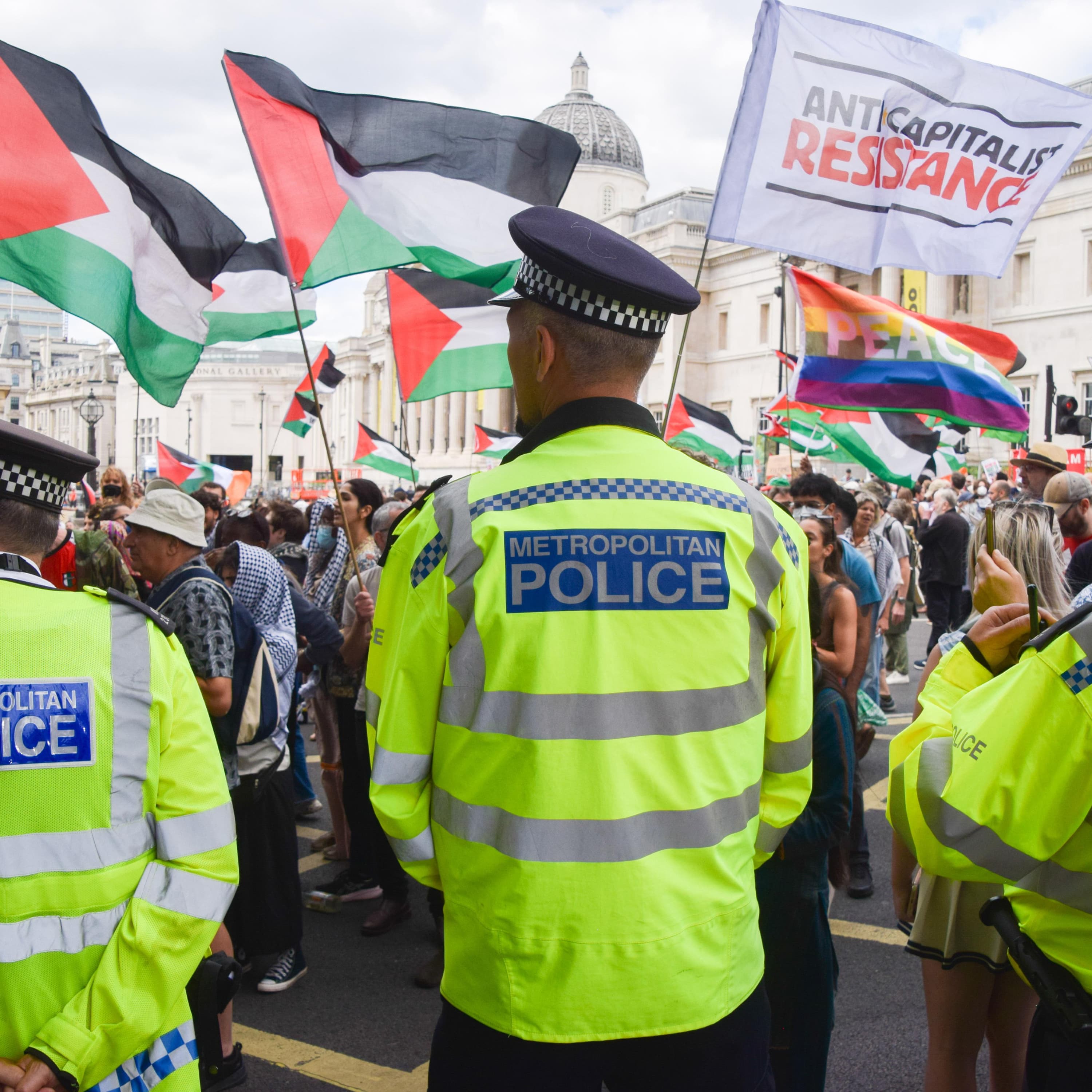
1:23Their supporters were banned from demonstrating outside the Houses of Parliament. And so they gathered at Trafalgar Square. This organisation is not a terrorist organisation, it is obvious. People forget Nelson Mandela was called a terrorist. Later on he was the president of South Africa. He stood for something that was right. It wasn't convenient for the narrative at the time, so they branded him a terrorist. And they're doing the exact same thing with Pell Action. And we will not remain silent.
1:53Where does it leave the right to protest in Britain? It's an attempt to strike fear. We are once again seeing the Palestine exception to free speech laws in this country. From The Guardian, I'm Nashin Iqbal. Today in Focus, why is the government cracking down on Palestine action?
2:17Harun Siddique, you're The Guardian's legal affairs correspondent. Now, the Home Secretary, Yvette Cooper, made an interesting statement on Monday. Can you talk me through what happened? Yes, so she announced that she was banning a group called Palestine Action under anti-terror laws. That came three days after Palestine Action broke into an RAF base in Oxfordshire and they spray-painted two military aircraft. It had been briefed that they were going to be banned on Friday after the incident at RAF Bryce Norton. But this was her officially telling Parliament what she was going to do. And who are Palestine Action?
3:04What can you tell me about them? Palestine Action was set up in 2020. They were started by Huda Amori and Richard Barnard. Huda Amori has a Palestinian father. And Richard Barnard, he's a Catholic and says he was drawn to the Palestinian cause because of his Catholic views. Since they were formed in 2020, they've essentially been targeting arms manufacturers owned by the Israelis in the UK, but also trying to disrupt the supply chain. So that means targeting companies that invest in them, some of their landlords, and essentially trying to stop weapons being made for Israeli defence forces to target Palestinians.
3:57Harun, can you tell me a bit more about the actions they've taken since 2020? I mean, what have they looked like exactly? And how much of a nuisance have they been in disrupting, as you say, the supply chain and the manufacturing of weapons for Israel? One of their campaigns in particular was shut Elbit down. Elbit Systems is Israel's largest weapons manufacturer. They have factories in the UK. In a world where innovation meets security, Elbit Systems leads the way. Cutting edge defense technologies. They've been targeted, but also companies which supply them have been targeted. Their landlords have been targeted.
4:41Companies which invest in them have been targeted. Yvette Cooper said that every police force in England and Wales had had some kind of involvement with Palestine Action. There are a lot of factories they've targeted in Bristol, Tamworth, Oldham, all around the country, really, Scotland. And when they get in, their intention is basically to smash things up and prevent those factories being used to put them out of operation for as long as possible. And how effective have their direct actions been? So they have been effective in the sense that they have occupied factories over long periods of time.
5:21They often target the same factory over and over again. So it's not just a kind of one hit and then they leave it alone. And that's obviously hugely disruptive for any business to have activists kind of targeting you over and over. They point to certain successes. So, for example, they say Barclays divested from Elbit Systems, Israel's largest weapon manufacturer, because they targeted its branches at more than 50 times. There was the closure of an Elbit subsidiary in Oldham, which Palestine Action also take credit for. You could argue that in the scheme of things, it doesn't disrupt the Israeli military.
6:07But at the same time, it would be wrong to kind of dismiss the impact they're having. And I should also add that this stuff is heavily publicised on their social media feeds, as well as causing disruption. I suppose it's drawing attention to the fact that the UK is, in their view, complicit towards what's going on in Israel. And I suppose they see that as educating the public. So a lot of public awareness raising and quite an effective thorn in the side. Can you tell me a bit more about the arrests? I mean, how many people have been, well, have gone to trial, have gone to prison for the actions they've taken?
6:44There have been hundreds arrested. Some of those will be individuals arrested multiple times and dozens have spent time in prison, although many of them have been in prison on remand. So that's when they're awaiting trial and haven't yet been found guilty or not guilty. When they've gone to trial, often they have not been jailed, they've not received prison terms, either because juries have acquitted them after they've heard the reason for their actions, or because they've been given suspended sentences or the like.
7:32So the Crown Prosecution Service has effectively used existing legislation to deal with the group and to deal with people taking these actions, you know, charging them with criminal damage, trespassing, causing public nuisance, that sort of thing. So why does the Home Secretary want to use terrorism legislation against Palestine action? I think that's the million dollar question. The action against RAF Bryson-Orton on Friday was obviously deeply embarrassing. It shouldn't really be possible for a group who, you know, they're organised, but they're not experts. They shouldn't be able to get into an RAF base.
8:10So that's embarrassing. But there's also been a lot of pressure on the government to ban them. And that's come from pro-Israel groups. So a group called We Believe in Israel started a campaign this month to ban Palestine action. The campaign against anti-Semitism also sent a kind of dossier to the government saying that Palestine action should be banned. And we know from Freedom of Information requests that there have been meetings between Israeli embassy officials and the UK government and Elbit systems. Well, I was just going to ask about that because you reported exclusively in April that there had been this contact with, as you say, Israeli embassy officials and the UK government over those protests.
9:00How much of a connection is there between what we're seeing now with the Home Secretary's statement and what's been going on in the background? I think that's what a lot of people will be asking and want to know. The problem is that most of those documents that were released under freedom of information legislation were very heavily redacted, which meant that one could only to some sense guess what those discussions were about. But we know they were talking about trials in the UK with Israeli embassy officials. And given the importance of Albit systems to the Israeli government and that Palestine Action had been targeting them, I think it's fair to surmise that Palestine Action were discussed in those meetings.
9:50But listeners will probably still be really surprised to know that Palestine Action, by prescribing them, the government is ranking them alongside ISIS or national action. How surprising do you think it is that that's been the category in which they've been put? They're the first direct protest action group to be classified in such a way. And whilst I've said that the action at the RAF base was very embarrassing for the government, it's far from the first time that a group has used these kind of tactics or caused such damage. For instance, we know that in 2003, people prevented US bombers from taking off from the UK to go to Iraq and bomb Iraq.
10:40Or at least they tried to do this. And they were in fact defended by Keir Starmer. The irony. Yes, exactly. And when it came to court, he said that they were trying to prevent war crimes, which is exactly what Palestine Action say they're going to do. And on that occasion, the courts cleared them. So it is really unprecedented for an organisation like this to be categorised in this way. The only reason I would say it is not surprising is because we do know that there have been these talks between the Israeli embassy officials and the government, and there have been pro-Israel groups lobbying the government to do this.
11:18Haroun, in Parliament, the Armed Forces Minister Luke Pollard said that Palestine Action are not a protest group. He said they're people who are increasingly using violence as part of their modus operandi. Where do legal experts and human rights groups stand on the government's position? Most of the criticism has come not necessarily from a legal perspective, but from a concern about elevating a direct protest action group to this level where it's categorised as a terrorist group. And that's why groups like Liberty have said it's a very, very worrying precedent. We've also seen some politicians voice similar fears.
12:01And what do you say to the fact that, you know, we've gone from a human rights barrister who would have defended activists like this and has in his recent past, to now becoming a prime minister who is criminalising protest. What do you think that says about the Labour Party and about the current landscape? I think it's not a good look for him. And it will increase the perception that Labour is willing to kind of pander to the right. Because I think after Friday, the Conservatives, you know, Kemi Badnock would have been very keen to say ban them. And he would have faced pressure from other groups.
12:43But the fact that Labour have moved so quickly to do so, I think... Of their own volition. Yes, exactly. I think it does. People will struggle to see the human rights barrister who's lurking there somewhere beneath Kirsten's skin. It has been alluded to that the Home Secretary may have other intelligence that only she was privy to that could justify a decision. What do you think that might look like? And how likely is it that we would ever come to know what it is? So Charlie Faulkner, who was the Justice Secretary under previous Labour administration, said that he couldn't see that the action on Friday was enough to ban Palestine action under anti-terrorism laws.
13:28He sort of said there must be something else or he assumed there's something else. I think we don't actually know that there is anything else. interestingly there was a times report which said that home office officials are investigating whether iran is funding palestine action right now now i don't know i don't know who funds palestine action they take donations but i think there's a few things to be said about that the first thing is if they really believed iran are funding palestine action then it would seem to make more sense to me to actually look into that and then decide whether they're going to ban them.
14:13Secondly, it wasn't mentioned at all in Yvette Cooper's ministerial statement. And thirdly, I would say we have to be very careful about things that government officials aren't prepared to say on the record, but brief to journalists. I mean, without wishing to labour the point, For example, we know that the catastrophic Iraq war was based on a lie that Saddam Hussein had weapons of mass destruction that he could deploy within 45 minutes. So I'd caution against relying on a sort of off the record briefing. And also, you know, you can say you're investigating anything, right? It doesn't mean it's true.
14:56You could say you're investigating Keir Starmer being funded by Putin, but it doesn't make it true. So I think you need to keep that in perspective. At the moment, there's just no evidence.
15:18Saeed Teji Faruqi, you're a documentary filmmaker by profession, and you're also a spokesperson for Palestine Action. Saeed, can you tell me about your own personal journey into activism? I've been involved in different forms of activism for about 30 years. So as a student, I was involved in environmental groups. I was involved with Amnesty International, for example. For years, I was very much invested in ordinary forms of protest, demonstrations, petitions, writing to MPs. In other words, invested, maybe even had some belief in the political system and in the ability for the political system to change.
16:00And in particular, in the ability of the political system to stop apartheid, genocide and dispossession against my people. I'm a Palestinian. My family was kicked out of Palestine in 1948. And over the years, I think I started to see not only that that form of protest wasn't working, not only that I had less and less faith. in the political process to deal with these overwhelming issues. But when I saw how deeply invested the British state was in defending Israel, I started to understand that there were very few options that could make a material difference in the lives of Palestinians and that could materially break the supply chain of weapons from this country to the Israeli military.
16:46Well, tell me more about Palestine Action then. How long have you been a part of the organization? I mean, it started in the beginning of 2020 and it started, well, it started as a network and it remains a network. It's not a group in the sense of having any kind of formalized structure. It's a network because it realizes that there are people all over the country and, of course, there are people all over the world who are so incensed by this genocide that they feel their only option is to get involved in direct action. Saeed, on Monday, the Home Secretary, Yvette Cooper, announced that she will ban Palestine Action.
17:23It will be considered a terrorist organization, and it will become a criminal offense to be affiliated with it or in support of it. How did you feel hearing that news? Well, honestly, I'm not surprised because the state has tried to reclassify Palestine Action several times before. So it's not a surprise historically, we've seen it before, but it's also not a surprise because it's an incredibly effective direct action group. It's absurd to think of raising Palestine action to the level of a terrorist organization where we would be on a list next to people like al-Qaeda and ISIS. I guess critics would say that, I mean, it's a criminal offense and direct action has resulted in prosecutions and acquittals.
18:10And Palestine action have threatened arms manufacturing sites, universities, public buildings, and perhaps, you know, the current law isn't enough to stop that. I mean, Keir Starmer, he called it a public disgrace. What do you say in counter to that? I think what we're seeing here is the government is deeply humiliated, first by the fact that the activists were able to breach security at a time when the country is trying to present a much stronger militaristic image to the rest of the world and to escape, you know, as yet unarrested. I mean, on e-scooters at that. And secondly, I think the government has been shocked by how effective the tactics of Palestine action can be and how much public support there is.
19:03So they're overreacting. And this is a knee-jerk, really panicked reaction. Of course, you said you're taking action against genocide and apartheid, which Israel denies. But what will the implications of all this be for you? If and when Palestine action is prescribed on 30th of June, what does it mean for you and your friends? What happens in the future so far, the group is not prescribed. So the strategies and tactics of Palestine action continue. The group is also not intimidated. As I said before, there are hundreds of people already willing to go to prison to stand up for this very basic principle of morality.
19:43On that, in terms of the strength of public feeling, without asking you to be a one-man focus group, but where do you think that currently lies? And how much of a gap is there, do you think, between how most people feel and how the government is acting? Well, I mean, I don't need to speculate. We've seen several polls that show, the last one I looked at was 65 % of the British public favour an arms embargo on Israel. So we know for sure the British public does not favour this country's involvement. But it's one thing to see a poll on the public arguing for there not to be arms sales. And it's another when people are presented with acts of public vandalism on prized military assets.
20:24That's true. And I don't know what the public's opinion is on whether these tactics, they consider them legitimate or not. I'd be very curious to see polls. But I think there are two important points here. One is that the focus of Palestine action is not to convince the public or to convince politicians. That would be campaigning, but Palestine action is not a campaigning group. It's a direct action group. The second important point is that even if the public disagree, I hope we can all agree on the fact that the framework for criminal prosecution already exists. To accelerate this to a prescribed group and terrorism is just irrational and absurd.
21:09I just find it ludicrous.
21:16Coming up, what impact does all of this have on the right to protest in Britain?
21:34Arun, this order is going to be debated in Parliament and then voted on. If it passes on Monday, what does that practically mean for Palestine Action? What does it mean for its supporters, for the likes of Sally Rooney, who wrote a really impassioned piece for The Guardian on Monday in support of the group? Yeah, I mean, if Sally Rooney wrote that piece on Tuesday next week, assuming the ban does go through as anticipated, then she could be charged under terrorism legislation, potentially wearing a Palestine Action t-shirt, wearing a Palestine Action badge. Liberty said sharing a social media post.
22:13The bar's really not that high for being accused of supporting a terrorist organisation. And the maximum penalty under the Terrorism Act is 14 years. Now, I'm not saying someone would get that for wearing a badge or T-shirt, but, you know, they could find themselves for a magistrate's court facing six months in jail or a fine. And, you know, ultimately, no one really wants a criminal record for supporting a terrorist organisation. Or for wearing a badge. I mean, it's an extraordinary place to be. And I wonder what you think this ruling would mean for other groups like Greenpeace, like Just Stop Oil, Extinction Rebellion, who've all used direct action to protest.
23:01You know, where does that leave them? I think that they're very worried about it. I mean, there were Just Stop Oil activists on the march or protest yesterday in Trafalgar Square in support of Palestine action. Greenpeace also released a statement in which I think they said it was a dark day for protest in the UK. There's been a crackdown on protest in, I should say, England and Wales in recent years. There have been new laws passed which make it easier for police to shut down and restrict protests. We've also seen particularly climate protesters gagged from giving their motivations in court for doing what they did, which makes juries less likely to acquit them.
23:51Because we know that when juries know of people's motivations, they often do acquit them. All that has had a chilling effect on protests, but this is a dramatic escalation. And I think it will make groups think twice, whatever the cause. Well, Palestinian activists already feel that their protests and their voices are being silenced more so than other groups. And this is only going to add to that perception, isn't it? So I think there's a level of criminal damage that Palestine action are involved in, which probably surpasses what's been done in the name of other causes. The fact of making them a terrorist organization is such a big thing that it's only going to be seen as linked to their cause rather than what they're actually doing.
24:39Because, as I've said, military bases have been targeted in the past and people have been acquitted of crimes. There's been no thought of charging them with terrorism crimes or banning organisations they were involved in. And I think it does speak to wider concerns. And Palestine Solidarity Campaign, who are not linked to Palestine action, they've sort of painted this as all being part of a bigger picture where there is suppression of Palestinian voices in the UK we know that there have been politicians and pro-Israel groups who called the marches that have taken place ever since the Israeli invasion hate marches and this is usually based on just a few people being arrested out of sometimes tens hundreds of thousands of people.
25:32So I think there is very much a perception that this is just part of a clampdown on a cause that the government doesn't agree with. And that's why they're taking action rather than any real threat. As has been suggested by the Home Secretary. We'll wait to see what happens next week. Haroun, thank you so much for your time. Thank you.
26:01That was Haroon Siddique, The Guardian's legal affairs correspondent. My thanks to him and to Geneva Abdul, our colleague on the ground at Trafalgar Square this week. You can read their reporting on this story and all of the latest updates at theguardian.com. My thanks again also to filmmaker Saeed Tajifruki, who spoke to us on behalf of Palestine Action. That's it for today. This episode was presented by me, Nashi Nekbal. It was produced by Lucy Hoff and Phoebe McIndo. Sound design is by Joel Cox and the executive producer was Huma Khalili. Thanks again for listening and we'll see you tomorrow.
26:43This is The Guardian.
Scan the code with your iPhone camera
Listen in the app.