 Today in Focus
10 Nov 2026 · 27m

 Add vo to ChatGPT or Claude to ask about everything you hear
vo listened to this episode to put together the overview and transcript, so there may be the odd mistake.
The episode “Escape from Eleshky” follows the evacuation of Ukrainians from Oleshky (Oleshki), a Russian-occupied city near Kherson. It describes families waiting in a border-town car park for buses, then reuniting with relatives after months or years of no communication.
life in Oleshky meant daily bombardment, no electricity/water, flooding after the Kakhovka Dam breach, confiscated aid parcels, and abuses including filtration camps and forced passport requirements. Notable examples include sisters Lisa (16) and Dasha (19) reuniting with their father, and 71-year-old Anna, exhausted after driving her sick husband to occupied Crimea.
Emanuel Chase, a freelance journalist reporting in Ukraine; Luke Harding, a senior international correspondent at The Guardian.
0:00This is The Guardian.
0:07Today, Escape from Eleshky, the Ukrainians who made it out of the Russian-occupied city.
0:31integrations with one platform that does it all. You can manage orders, sync inventory, track returns, all automatically. Everything your operation needs, all in one place. Right now, qualified shippers get a real dedicated person to get you set up and switched over for free. So when peak season hits, you're ready to go. Switch today at ShipStation.com, code audio.
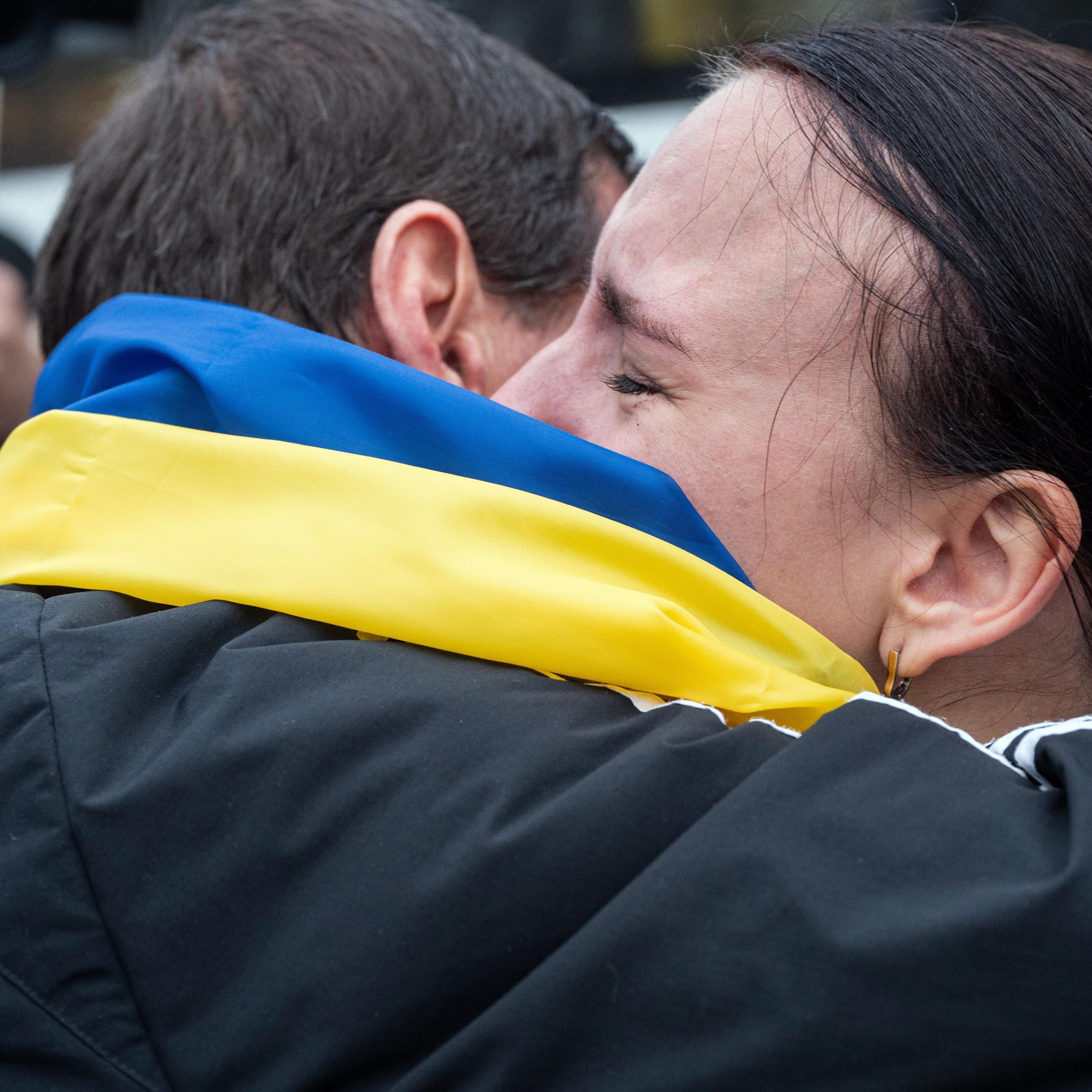
0:59One chilly morning in late October. Families draped in yellow and blue flags began gathering in a nondescript car park in a border town in northern Ukraine. All were anxiously waiting to catch sight of the buses that they desperately hoped would deliver their loved ones back to them. Evacuees from the city of Eleshki, which had been occupied by the Russians since the start of the war. And even in that moment, many of the families had no idea if their relatives had made it out or not. Freelance journalist Emanuel Chase was there with them. Most of them hadn't seen their relatives for years. They hadn't heard from them in sometimes months because of the lack of communication in Oleski.
1:45Among those waiting were two teenage girls, praying their father would have been one of the ones who managed to get out. 16-year-old and 19-year-old sisters, as well as the mother, had managed to escape Oleszki by foot in 2024. And the father had stayed behind because you have to imagine that people do not want to leave their home. They don't want to leave their pets. They don't want to leave their garden. And the father thought that at a later point he would be able to come. It wasn't the case. And up until the very last moment, Lisa and Dasha, the daughters, didn't know if the father would take the decision eventually to just leave Oleshky and come back to Ukrainian-controlled territory.
2:29Then, finally, a convoy of grey coaches slowly turned into the parking lot. So when the buses started to arrive, you could see a commotion. All the families were starting to get really emotional. They were looking at the windows. They were trying to spot their relatives. and little by little people are, you know, recognizing their relatives and running towards the buses. The buses pulled to a stop and the doors swung open. The Eleszki evacuees began slowly emerging from inside. And the ordeal they had suffered whilst trapped inside the city was painfully clear. You could see there was a number of people who were sick, mostly due to malnutrition, but also people, you know, also came with injuries, old or new, due to war.
3:18So people were looking quite frail. There's a netherly lady who just got off the bus and she fell into my arms. She needed some comfort, some relief, and I just told her it's all right. You cannot even ask, do you have someone here? Because sometimes people have also lost all their relatives. So there was nothing to do, essentially, just, you know, giving her a tissue and comforting her, patting her in the back. Then, amid the chaos, one of the sisters spotted their father. And, you know, she screamed, and it was really that sound of her daughter who hadn't seen her father in years, and I think everyone on the scene, you know, just was so startled.
4:04She ran towards her father together with her sister and mother, and they embraced and we could all feel really that moment of reunion. As the reunions continued around her, Emmanuel began hearing stories of the horrendous conditions those who escaped had suffered in the occupied city. Everyone said that it was very hard to get any sort of food. People were surviving on whatever they could grow in their garden. Some people told me they lost 15, 20 kilos. And they were sharing stories of some people having had to shot homeless dogs to try and get some meat to feed off homeless dogs. And even if they tried to leave the city, then they would be targeted by Russian drones or Russian artillery.
5:00Their return to their families was miraculous. For years, almost nobody had managed to escape the relentless bombardment and fighting around the city in this deadlocked conflict. Until October 27th, when the first humanitarian ceasefire of the war came into effect in Oleshky. People in Ukraine were very surprised that this ceasefire could happen at all because it's the first time that it actually holds enough time for a humanitarian mission to take place. And even more surprising was the unlikely broker behind the deal. Let us see Oleski as a spark in a world of darkness, capable of illuminating the best in humanity.
5:48The US First Lady Melania Trump.
5:59Today, peace talks kick off in Abu Dhabi. between the US, Russia and Ukraine? Could Melania's ceasefire deal provide the blueprint for breaking the deadlock in this war? And who really benefited from the pause in the fighting? From The Guardian, I'm Annie Kelly. Today in Focus. Does Eleshki really signal a glimmer of hope for peace in Ukraine?
6:33Emmanuel, you have been based in Ukraine for five years reporting on the conflict there. And we've just heard, you know, the really emotional story of the evacuation of residents from Eleshky, which was, you know, just an ordinary peaceful city before the war, but which has now been under occupation by the Russians since February 2022. First, could you tell me just a bit about Eleshky's geography and what it's been like there since the full-scale invasion? So Oleszki is located roughly eight kilometers away from Kherson city. So it's in the southern parts of Ukraine, and it's just on the other side of the Dnipro River.
7:12Pre-war, it had a population of 24 ,000 people. And during the years of occupation, this amount decreased to roughly 2 ,000. Now, you have to imagine that since 2022, there was no electricity in the city, no running water. And when Russians blew up the Karhovka Dam, the entire village was completely flooded. You might remember people standing on their roofs and calling for help. Water, seemingly the latest weapon in the war in Ukraine. President Zelensky said 80 towns and villages may be flooded after this attack, which he blames on Russia. They were being bombed daily because it's a city located on the actual front line.
7:58and people were completely cut off from the rest of the world. They had no more food supplies, no more medicine, no more electricity, no more water, no more means of communication with the outer world. There were Ukrainian soldiers who were trying to drop parcels of humanitarian aid with food, with medicine, and those parcels were confiscated by Russian troops. One of the residents who came back to Ukrainian controlled territory was saying that he didn't think it was a city anymore, that it was just, you know, a pile of rubble and that he was feeling really sorry for anybody who had to stay behind.
8:40Just to make sure I've got my geography right, Oleschke is right on a river, isn't it, that is essentially the front line between Russian and Ukrainian troops. Just the other side of the river is Kherson, which is obviously controlled by the Ukrainians. So the citizens of Eleski really have been like literally on the front line of this deadlock between the two sides for years now. Well, they were subjected to daily bombardments, be it by artillery. So, you know, huge explosions that destroy entire buildings, but also aerial bombs, also drones. And, you know, there's this silent danger, I would say, that happened when you live in cities on the front line.
9:21And it's the FPV drones, those first-person view drones. And those are the conditions under which people in Oleski were living. People in occupied territories who managed to escape, you know, share the stories of having gone through filtration camps, having undergone interrogation. There's a lot of people who have been abused in prison as well when they spend time. If you refuse to take a Russian passport, then basically you have no rights anymore, civil rights, no human rights. And that's life under occupation as described by people who can make it out. Could you describe who was left inside Eleshki before the ceasefire?
10:04So first off, you have people who, you know, no matter what happens to their city, simply don't want to leave home. Oftentimes, those are elderly people or people living with disability who cannot even leave their homes physically. You also have their relatives. If you have, you know, an ailing grandmother, an ailing grandfather, maybe you're willing to endure occupation just so you can continue to take care of your relative. People who don't want to leave their pets or their animals behind. You can think about the farmers, for example, who have cows, who have goats. They will also not want to be abandoning them under bombings.
10:51And the ceasefire in Oleschke came into effect on the 27th of October. It ended on November the 1st. Could you just describe the route that people had to take to get out during the evacuation? They've travelled more than 2 ,200 kilometres to get out of Oleschke, go to Krasnodar Krai, which is a Russian region. region. Then they flew into Belarus and then they crossed into Ukraine from the northern border. They could have just crossed a bridge to Ukrainian controlled territory that was only eight kilometers away. They were only five kilometers away from Ukrainian lines. So even after years under occupation, years under Russian bombings, they still had to go to that harrowing journey just to get to relative safety.
11:41And you met some of the evacuees. You've already told us the really moving story about the father reunited with his daughters. I think you also spoke to an older woman, Anna. I think she was 71. Can you tell me about her? Yeah, Anna came off the bus totally exhausted. She was crying, but she was still willing to share her story.
12:08She was also explaining that her husband had been very sick and that she had had to drive him to occupied Crimea for various operations and that that's one of the reasons why she hadn't undertaken the journey before. She was exhausted, she was very overwhelmed by the fact that she was back in Ukrainian health territory and I could really feel this sense of guilt she had for all the neighbors that she knew who stayed behind.
12:41The first concern of people coming back was what happened to people left behind and this is a trauma from which they might not recover.
13:00Luke Harding, you are a senior international correspondent at The Guardian. We have just been hearing about the really dire humanitarian situation in Leschke that has been going on for years until this brief and quite unprecedented reprieve during this partial ceasefire, which ended on the 1st of November. But the story behind the ceasefire itself and how it came about is also pretty extraordinary, isn't it? Could you go back and tell me the story of how it all happened and how it came to pass? It's one of the really most kind of curious and bizarre episodes since the full scale evasion almost five years ago, because of course, it's Donald Trump, who has been desperately seeking the Nobel Peace Prize, has cursed the Norwegians for not giving it to him.
13:48If anybody thinks that Norway doesn't control the Nobel Prize, they're just kidding. They have a board, but it's controlled by Norway. And I don't care what Norway says. And has been trying in a very one-sided way for the best part of a second presidential term to broker a deal. Ukraine has to want to make a deal because the United States has spent a fortune essentially pressuring Ukraine to capitulate. And if they don't make a deal, ultimately, it's just going to get, in my opinion, it's just really just going to get worse. You have a very big country in Russia. And then suddenly we have the first lady in the shape of Melania Trump credited with arranging the most significant pause in fighting that we've seen.
14:32That Melania Trump brokered ceasefire in the Russian occupied Ukrainian town of Oleski went into effect this morning. It's not entirely clear whether this generally was her initiative or not. But what we can say for certain is that she's been closely involved in the process. My role as an exclusive intermediary was memorialised in written agreements. Her aide talked every day to the Ukrainian ombudsman Dmitry Lubinitz. She studied the evacuation routes, looked at the deep mining areas, was involved in the logistics. It was certainly kind of briefed about the whole process.
15:19I think the key point is that it suits both Russia and Ukraine for Melania to take all the credit for this operation. Because, of course, both of them want to get on side with the White House and one Donald J. Trump, who happens to be Melania's husband. I commend both sides for your good faith efforts to define and implement all components of this sophisticated ceasefire. What is going on here? Like, why would the White House be pushing Melania as this peacemaker? Zelensky himself is, I think, has awarded or is awarding Melania Trump a national honour for her role in brokering this partial ceasefire in Oleski.
15:59Like, what's going on? I mean, as far as the award goes, you're right. I mean, the Ukrainians are all in. They've given Melania the Princess Olga Award, first class, which she got from Dmitry Lubinitz in the White House. I would like to give to you this state award for your leadership, for your brave heart, for saving. Meanwhile, the Russians have come up with their own award. As a token of appreciation, we'd like to give you a small gift. which is what they claim to be a drawing by a girl, you know, saved from Maleshki, who decided to go to Russia. And this beautiful drawing says just three words.
16:39I love Melania. I mean, I'm sort of checking my own tendency here to scoff. To be serious, I mean, Melania actually, she has done good things. I mean, she has previously helped reunite, kidnapped Ukrainian children, taken to Russia with their parents. And we have to acknowledge that that's a great thing. What is interesting about it is that the ceasefire held. I've spoken to Western diplomats in Kiev who said they were pretty certain the Russians would bomb or impede or drag people off buses or basically treat the whole exercise cynically. They didn't. Bearing in mind that during this period, more than 100 Ukrainian civilians have been killed elsewhere in the country in Russian bombing.
17:18So they kill civilians all the time, but they actually stuck to the ceasefire. As soon as the ceasefire came into effect, the Ukrainians then accused the Russians of entrenching themselves militarily. Could you give us a bit of context about what happened after the ceasefire was brokered? Yeah, I mean, what happened was Russian military vehicles were spotted by Ukrainian surveillance drones sort of trundling around Eleshky. Bear in mind, you know, previously, if a Russian military vehicle had gone to Eleshky, the Ukrainians would have blown it up. So by using these vehicles, some of them painted with red crosses, they could smuggle in a whole load of ammunition, food, diesel, rotate out exhausted troops, put new ones in, bring in lots and lots of drones of various kinds, and essentially kind of replenish their whole line on that front.
18:07Dmitry Peskov, the Kremlin spokesperson said, well, maybe we did, but of course the Ukrainians would have done the same. They were on the back foot militarily, and now on the front foot. And the Ukrainian military view is that the Russians have gained an advantage and their attempt to defeat them has gone back about two years because the road was demined, the access is there, the supplies are there. And that's because of the ceasefire. That's because of the ceasefire.
18:36I think probably at this point, it would be good if you could just give us a bit of an overview of the kind of state of the war in general, that the context in which this partial ceasefire in Eleschke happened? What else is going on? How does it all fit together? I mean, I think on the front line, it's stalemate, which is not the same as nothing is happening. I mean, it's incredibly kinetic. There are explosions, booms all the time. What you have to understand is the Russians are now losing, last month, according to the Ukrainians, they lost 54 ,000 soldiers. In a month. 54 ,000 in one month. And that may sound hyperbolic, but these drones that kill them, they're equipped with video.
19:21There's video of all that's happening. So the Russian losses are colossal. And Putin still hasn't managed to seize the Donbass, all of it, which has been his goal since 2014. Yeah, the Russian economy is being whacked, all refining, are burning and other military targets. But I would say Russia has the edge because Ukraine has run out of Patriot interceptors, which can shoot down ballistic missiles. And so it means that the Ukrainians can shoot down incoming Russian drones, some of them, but it can do nothing about these ballistic missiles. And just to tell you, they are terrifying. You know, when they land at three in the morning, the sky turns orange, you hear the most enormous explosion, the building vibrates, the smoke.
20:07it's the most terrifying feeling in the world and and this is what ukrainians suffer almost every night and then finally there's the war for international opinion the european coalition supporting ukraine is really robust i think the the problem is the u.s really despite all of the setbacks domestically is still all in for team putin you know in this horrifying war of attrition that you've just described, came this partial ceasefire in Oleschke, which was so unprecedented. We've got peace talks beginning in Abu Dhabi between delegations from Russia, Ukraine and the US. The Kremlin has confirmed that Russia, Ukraine and the US will hold trilateral peace talks in Abu Dhabi on November 10th and 11th.
20:50Could this provide us with any hope going into these talks? I mean, there's a short answer, which is no. There's a lot longer explanation really behind the no. I mean, I think the Ukrainian position, I mean, it's not unreasonable. They're basically saying the negotiations begin where the frontline currently is. And Putin's demands are as crazy and maximist as ever that NATO retreat from Eastern and Central Europe back to the borders than NATO had back in 1997. He wants to turn the clock back to a point where Russia had a zone of influence across Central and Eastern Europe. Again, what is extraordinary is that a bit like a sort of 28-point peace initiative floated by the Americans last autumn, which went nowhere, it looks as if the script for this talk is once again being written by Moscow.
21:41I think what will be discussed will be, you know, language around peace, around security guarantees, around reconstruction. destruction but ultimately this is about territory and and zelensky says look only i and putin can decide on on territory so i mean there will be talks but i think a breakthrough is impossible because the positions are just too far apart i mean you know one thing america of course could do would be to pressure russia and that's the one thing that that donald trump has not done at any point in in his presidential term
22:19Coming up Eleshki might not lead to a peace deal but can it lead to any other civilians being freed from their occupied cities?
22:33Hi, I'm Siobhan Maxuini the new host of the Guardian's Comfort Eating Podcast Have you ever wondered what celebrities eat when no one's watching? Well, this is the show for you. Each week, celebrity guests tuck into their favourite comfort food. And let me tell you, it's not all oysters and caviar. We've got People Just Do Nothing's Asim Chowdhury, former politician Ed Balls, and my good and darling friend from Dairy Girls, Nicola Coughlin. Listen wherever you get your podcasts or feast your eyes on YouTube.
23:07Running a small business means wearing a lot of hats. between managing employees, handling payroll, and keeping up with paperwork, there's a lot to juggle. Luckily, Gusto makes it easier. Gusto is online payroll and benefits software built for small businesses. It's all-in-one, remote-friendly, and incredibly easy to use. So you can pay, hire, onboard, and support your team from anywhere. From automatic payroll tax filing to simple direct deposits and benefits options for nearly every budget, Gusto helps simplify the process. Plus, enjoy unlimited payroll runs for one monthly price with no hidden fees or surprises.
23:42And with automated tools for onboarding and offer letters, you can focus on what matters most. Try Gusto today at gusto.com slash tech and get three months free when you run your first payroll. That's three months of free payroll at gusto.com slash tech. One more time, gusto.com slash tech. Still waiting in line? Again? That's time you will never get back. Save time and money with Stamps.com. Over 4 million businesses have skipped the line with Stamps.com. Join them to save up to 90 % off carrier rates from your computer or phone right now. Print postage for certified mail, registered mail, and packages in seconds.
24:21Get$20 in free postage when you sign up for the pro plan at Stamps.com slash Black Friday 2026. Terms and conditions apply.
24:33There was a lot made before the midterms, going back to Eleski, of what a political accomplishment this diplomatic breakthrough was for the Trump administration. And there has been, as you said, a lot of effort made by Trump himself to make this peace deal his legacy. What impact do you think his absolute political wipeout in the midterm elections last week could have on these talks? Could it strengthen Ukraine's hand? Could it weaken Putin in any way? I mean, I think the Ukrainians obviously were secretly absolutely thrilled and gleeful at the fact that Trump got walloped. I mean, who wouldn't be?
25:16I mean, this is the president who threw Zelensky out of the Oval Office, humiliated him on live TV, who cut American military aid. Of course, they were thrilled by that. So I think Ukraine's position has been strengthened. It's clearly a blow to the Kremlin. And I think Trump is going to face problems because he's going to be bogged down when the new Congress comes in. I mean, the Democrats will want to ask him and Elon Musk why, for example, Starlink was shut down last month, which meant that Ukraine could no longer shoot down Russian drones because the American internet system no longer works.
25:50So I think the peace negotiations will continue. and the ukrainians will will carry on taking part of course they will they've got no choice but an actual breakthrough which means that the bomb stopped falling on on the city where i am kiev and other parts of ukraine i i fear is far away yeah i think you know i fear we're looking at a long war i mean the only cheerful thing i would say annie is that is that those people stuck in aleshki some of whom by the way are recovering in hospital in kiev from from their ideal. I mean, they've been given another chance at life. They've been reunited by their loved ones.
26:23And I think that that is what Ukraine is focused on. And particularly the ombudsman, Dmitry Lubinitz, who with some personal bravery went to Oleschke and sort of supervised the evacuation. He is very keen to repeat that elsewhere. And do you think that that's realistic? Could that happen? Because that would be at least something, wouldn't it, that you could see other humanitarian ceasefires that can see citizens or civilians being evacuated. Yeah, I mean, I think the possibility of another Oleschki somewhere else in Russian occupied territory, I think that's possible. It's certainly more likely than any kind of conclusive deal ending the war, which I think is a long way off.
26:58And if Melania can come out and do this for Ukraine and the people of Ukraine, then that's nothing but a good thing, is it? Finally. And maybe Melania gets the peace prize instead of her husband who keeps starting wars, which he can't then finish in Iran or anywhere else. But I mean, just imagine that, Annie. Imagine Melania getting the Nobel Peace Prize with Donald next to her. You can see him snatching it from her hands. I was about to say, I wonder where that peace prize would end up. You suspect on his mantelpiece in the office. Well, Luke, really, I hope you take care in Keeve and thank you so much for joining us today.
27:38Thank you. Thank you.
27:44That was Luke Harding and Emmanuel Chase. My thanks to them. And that's it for today. This episode was produced by Saskia Collette and Ivor Manley and presented by me, Annie Kelly. Sound design was by Rudy Zagadlow and the executive producer was Alex Atak. And just before we go, if you enjoyed this episode, please do consider leaving us a review. we really enjoy hearing what you think about the show and it also helps other people to find us or if you'd prefer to contact us in private we also have a new email address for our listeners it's tiff that's t-i-f dot questions at the guardian.com ask us a question suggest ideas for future shows or guests we would love to hear from you and we'll be back later on today with the latest
28:43This is The Guardian.
28:57500 orders a month was manageable. 5 ,000 is madness. Embrace intelligent order fulfillment with ShipStation, The only platform combining order management, warehouse workflows, inventory, returns, and analytics in one place. What used to take five separate tools, ShipStation does in one. Automate fulfillment and rate shopping to ship up to 15 times more with up to 90 % savings. Go to ShipStation.com and use code AUDIO to try ShipStation free for 60 days. Cash Now, More Later from Opendoor gives you cash up front for your home, plus all the profit later. That's no chaos now, no cash left behind later.
29:37Skip the showings now, pocket extra profit later. This is so simple now. This is so awesome later. Or sell fast now and pop the champagne later. Cash now, more later. Now available nationwide. Start your offer at opendoor.com slash ACAST. Profits calculated after fees and costs, eligibility and offer price may vary. Are we doing enough with AI or are we already behind? The Intelligent Enterprise, hosted by me, Tom Stoneman, is the podcast for leaders who want to be able to answer those questions. On our latest episode, the generation growing up with AI and how they're using it at work. Like I wasn't just asking questions, but I was actually collaborating with it.
30:20Follow The Intelligent Enterprise wherever you get your podcasts.
Scan the code with your iPhone camera
Listen in the app.