 Ask ChatGPT


The episode argues that Israel’s war against Iran has diverted international attention from Gaza, where hunger and violence continue daily. It focuses on Israel-backed changes to aid distribution via the secretive Gaza Humanitarian Foundation (GHF), the resulting massacres at distribution points, and Israel’s alleged arming of criminal gangs (the Popular Forces) to undermine Hamas and manage Gaza.
Emma Graham Harrison, The Guardian’s chief Middle East correspondent.
GHF’s “aid distribution depots” concentrate desperate civilians into a few sites, guarded with armed personnel, leading to crushes and shootings; Israel justifies GHF by claiming Hamas steals aid without evidence; IDF denies responsibility and disputes casualty figures. The Popular Forces, led by Yasser Abu Shabab, are described as looters armed by Israel and possibly supporting GHF while fighting Hamas.
Reported weekly casualty counts (e.g., June 11: 57 killed, 363 injured; June 12: 21 killed, 294 injured); the March 2024 food-truck incident (118 killed); the story of Reem Zedan, killed while trying to reach GHF aid; claims of a 700 million shekel Israeli budget allocation for GHF.
Written by AI. May contain mistakes.
Discussion on the growing global condemnation of Israel's actions in Gaza.
“Last month, there was a sense that the tempo had shifted.”
Exploration of past conflicts and their impact on Gaza's visibility in media.
“There's been a couple of occasions during this war when tensions between Israel and Iran have escalated and there's been an exchange of missiles, not on the current scale.”
Examination of the Gaza Humanitarian Foundation's controversial new aid method.
“Now, obviously, the last few days have been dominated by Israel's war against Iran, which we have been covering on today in Focus.”
Discussion on the dangers and challenges faced in distributing aid in Gaza.
“portion of it is captured and exploited by Hamas.”
Details on civilian casualties in Gaza and the Israeli military's response.
“when tens of thousands of people are trying to get to a football stadium, those are people who are well fed and are going to have fun.”
Insights into the management and operations of the Gaza Humanitarian Foundation.
“So hundreds of people have been killed there, thousands more injured.”
A heartbreaking story highlighting the personal struggles faced by families in Gaza.
“The last time we spoke about the GHF on Today in Focus was in the wake of the resignation of its executive director, a guy called Jake Wood.”
Learn about the harrowing experiences of a mother struggling to feed her starving child amidst the conflict.
“And then she cooked, if you could call it that, what little food they had for the family.”
Discover the rise of the Popular Forces in Gaza and their controversial role in the current conflict.
“Emma, there was another story that was beginning to gain traction before this new conflict with Iran broke out, which was giving us some insight into how Israel is operating in Gaza.”
Examine Israel's historical and current strategies for manipulating Palestinian factions.
“how big it is, but that's probably quite a considerable number of them.”
Understand the devastating impact of the war on Gaza’s infrastructure and its population.
“powers in a way that would have seemed impossible a few years earlier.”
Evaluate how the escalation of war with Iran is affecting global focus and humanitarian concerns in Gaza.
“Gaza today is a place where both the physical and the social, emotional fabric of life has been ripped apart by this war.”
Listeners will hear final thoughts and acknowledgements from the team.
“The Guardian's chief Middle East correspondent.”

Get the gist, explore an idea or ask about something said.
 Claude
On Today in Focus, what are the key points of this episode?
Searching your listeningAutomatic transcript. May contain errors.
0:00This is The Guardian.
0:09Today, while the world's attention has turned to Iran, what is Israel doing in Gaza?
0:23Last month, there was a sense that the tempo had shifted. Global condemnation of Israel's offensive on Gaza was growing The UK, France and Canada issued a joint statement Opposing the expanding military operation The UN's human rights chief urged global leaders to wake up Israel's means and methods of warfare Are inflicting horrifying, unconscionable suffering on Palestinians in Gaza More and more, public figures began describing the scenes in Gaza as a genocide. For a moment, it seemed that Western politicians were about to exert meaningful pressure on Benjamin Netanyahu's government. And then, on Friday, Israel launched its war against Iran.
1:24People in Gaza have been here before. There's been a couple of occasions during this war when tensions between Israel and Iran have escalated and there's been an exchange of missiles, not on the current scale. What happened both those times was that Gaza just dropped out of the headlines, dropped off the diplomatic agenda. But the misery there, the attacks, the hunger, continued completely unabated. Starvation, killings, and now the arming of criminal gangs by Israel. From The Guardian, I'm Noshin Iqbal. Today in Focus, what does Israel's war with Iran mean for Gaza?
2:08Emma Graham Harrison, you're The Guardian's chief Middle East correspondent. Now, obviously, the last few days have been dominated by Israel's war against Iran, which we have been covering on today in Focus. but I want to talk to you about what's been going on in Gaza because before this audacious military escalation, the world seemed much more focused on the awful scenes unfolding there. Can you tell me more about what's been going on? So what we've seen is day after day, desperate hungry people being shot, killed, injured, just because they're trying to get food. This is all related to a new food distribution method backed by the US and Israel.
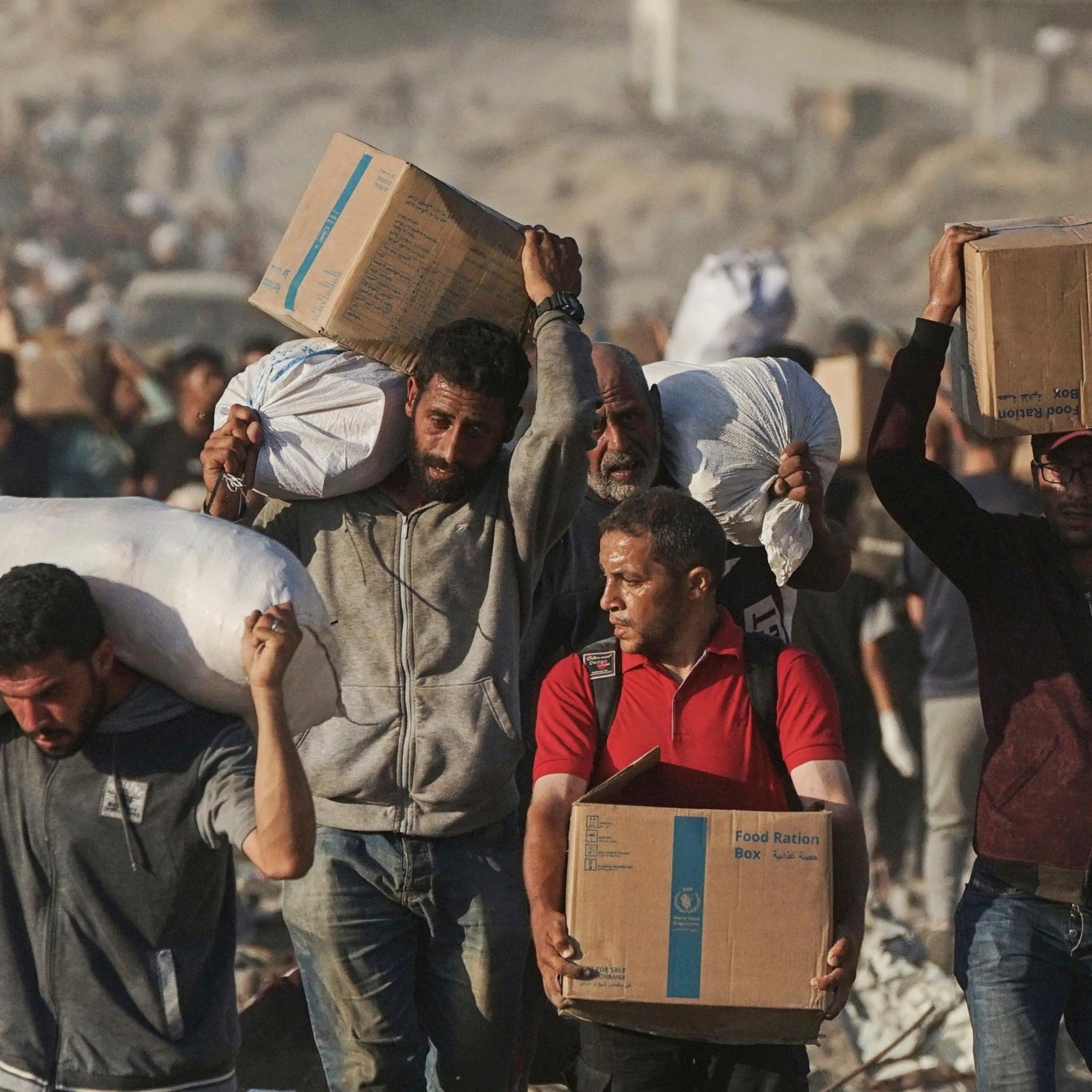
2:52There's an organization called the Gaza Humanitarian Foundation. It's hard to tell you that much about them because they're extremely secretive. The reason this mechanism was set up is because Israel is essentially trying to push the UN and big humanitarian organizations out of Gaza. their rationale for this is that the aid that these groups distribute is captured or a large portion of it is captured and exploited by Hamas. They've not provided any statistics to back up these claims, any hard evidence, but they say that this alternative distribution method was needed because of that. And so it's set up for militarized centers, which it calls aid distribution depots.
3:37and from there it's handing out food. From the moment when this idea was first mooted, the UN humanitarian organisations with decades of experience working in war warned that this would be deadly. That concentrating aid in just a few places when you have two million people who are now all hungry after weeks of siege and 20 months of war would inevitably lead to crushes, that putting people with guns around food distribution was extremely dangerous.
4:15You know, if you think about the type of crowd control problems you have, say, in a European capital ahead of a football match when tens of thousands of people are trying to get to a football stadium, those are people who are well fed and are going to have fun. You can see why it was always going to be impossible in a war zone to manage the number of people who are trying, through sheer desperation, to get to these sites.
4:47We have seen repeated massacres of people trying to reach GHF distribution points.
5:00These civilians are being shot by IDF soldiers who are essentially doing crowd control with live ammunition To give you a sense, just over the last week On Wednesday, June 11th, 57 people were killed, 363 were injured. On Thursday, June 12th, 21 were killed, 294 were injured. Across Friday and Saturday, the 13th and 14th, even though the GHF centres were closed, there was an internet blackout in Gaza, so people didn't know about that. 29 people were killed, 380 were injured. On Sunday, June 15th, 26 people were killed, 117 were injured. On Monday, June 16th, at least 23 people were killed. It's just utterly bleak.
6:02Yeah, it really is.
6:12So hundreds of people have been killed there, thousands more injured. What has the Israeli military said in response? The IDF has not admitted to killing anybody. It has repeatedly said soldiers opened fire at individuals who were approaching troops. They usually say things like suspects who are acting suspiciously and essentially that they open fire to control crowds and that they are investigating. They have also disputed the numbers of deaths and injuries which have been given by health authorities in Gaza. Well, we saw something similar to this in March last year when 118 Palestinians were killed, shot out by the IDF when they were trying to access this one food truck, this one delivery of aid.
7:03Now, that was reported as a major shocking news story at the time. How has it become that this is now a daily occurrence? I've spoken to a lot of humanitarians who've said to me that when something slips into a pattern like that, it's very hard to argue that it's not built into the system. And I think, you know, I've spoken to people who've worked, you know, humanitarians, very senior people who've had a whole career working in difficult, dangerous places where aid distribution was complicated, often very flawed. Martin Griffiths, who used to be the senior UN person until he retired in charge of humanitarian efforts, he said to me, this turns aid delivery into a weapon of war that's deployed against civilians.
7:52Not only through horrific killing and wounding, he said, this is a system that exploits hunger to drag desperate people south. So that's using hunger to speed up the displacement of Palestinians as well.
8:15The last time we spoke about the GHF on Today in Focus was in the wake of the resignation of its executive director, a guy called Jake Wood. He quit only two weeks into the role. Who's taken over since? So the person who's taken over is a guy called Johnny Moore, who is an evangelical Christian who is close to people in Trump's circle. I don't know if he knows the president himself. He does have a little bit of experience doing international charity work, but he has no track record of delivering food at scale in an active, extremely complex war zone. One of the many problems with the GHF is that they're incredibly secretive.
9:00They don't really have a functioning website. Their news about when aid is available in Gaza is posted on Facebook. This is for people in Gaza, very few of whom have access to regular electricity. The internet is often down if people have money to pay for phone credit, that is. We saw a three or four day long internet blackout last week. So the idea that people could get reliable information about how to stay safe by going to a Facebook page is either insulting or willfully negligent. One of the other big questions is where they're getting the money to pay for this food that they're handing out.
9:39And the private security contractors who are guarding the compounds, they certainly need to be getting that money from somewhere because all the existing humanitarian organizations who have funding to feed people in Gaza, whether that's the UN or major charities, have said that they're not willing to work with GHF because it doesn't have a secure model to deliver aid. They claim to be independent. It seems extremely likely that they've got Israeli financial backing. Johnny Moore is saying that Israel is not funding it. But you had a very interesting report on Israeli state radio that a large sum of money, 700 million shekels, has been allocated from government budgets for some quite nebulous category, I think, defence spending or something like that, which is in fact going to fund GHF.
10:25We should say that Netanyahu and Smotrich, the finance minister, have both insisted that the country is not funding humanitarian aid to Gaza. Smotrich, in fact, is an advocate of cutting aid off entirely to, in his view, force Hamas to surrender by collective punishment of the civilian population. So it's a secretive organisation with very little track record in aid delivery and from no track record. Absolutely no track record. You know, it's the most complex humanitarian situation. The idea that you could take a startup and put them into that, even if they could operate safely, it seems questionable that they would be able to operate effectively.
11:11They're not operating effectively. People are still very hungry in Gaza and they're certainly not operating safely. And what does Moore have to say about the killings and the injuries and the desperation that people are facing? So the GHF have repeatedly said that this is not their responsibility because the people killed are not being shot at the GHF sites or by the armed guards. What humanitarians would say is that while there's not a direct responsibility, because these people are being shot trying to reach the GHF sites, is that it's a design flaw, which means that the GHF operating model is partially responsible for their deaths.
11:56While you're trying to force 2 million hungry people to gather at just four points to try and get limited amounts of food. There's not enough food at those points to feed everyone who's hungry. You are going to see mass deaths. From all the experts that I've spoken to about this, the only thing that would halt these killings would be abandoning the GHF system and returning to delivering aid through the United Nations and through international humanitarian organisations that we all know, like Save the Children, Oxfam, who have a long track record of closely monitored, well-ordered delivery of aid in complex situations.
12:48Emma, you're describing a really horrific situation for Gars and families. It's a cruel choice between staying at home and starving or heading out to get food, queuing for hours, and then potentially risking their lives to access that food. What are they expected to do at this point? I think that's a really good, completely heartbreaking question, Ashim, because there really doesn't seem to be any answer to that. There's no decision that they can make that is safe for themselves and their children. I work with my colleague Malak, who's in Gaza, on the story of a woman who was killed, a mother who was killed in one of these massacres of people trying to get to food distribution sites.
13:39And her husband had tried six times to get to one of these food distribution points because their children were so hungry. So after the first couple of shootings, her daughter begged her not to go again. She said, this is too dangerous, mum. It's just not worth it. This is a sign from God. We shouldn't go. Reem, the mother who was killed, who was 42, agreed with her daughter. She said, okay, I won't go again. And then she cooked, if you could call it that, what little food they had for the family. She made a sort of soup with lentils, but there were so few lentils, it was basically just water.
14:17And her youngest daughter, Razan, who's five, had her sort of bowl of lentil soup or lentil water, and then said to her mum, I'm hungry. And Reem said, but you've just eaten. And Razan said, water doesn't fill my stomach. And so what was she meant to do? Her little girl was telling her that she was hungry, that she was starving and begging her for food. And so she decided to try again. And that time she was shot dead.
15:03Emma, there was another story that was beginning to gain traction before this new conflict with Iran broke out, which was giving us some insight into how Israel is operating in Gaza. Now, our colleague Lorenzo Tondo reported on a battle that took place between Hamas, the IDF, and another group called the Popular Forces. Listeners are familiar with the first two, but who are the Popular Forces? The Popular Forces, who certainly gave themselves that name, I don't think it came from their fans and admirers in Gaza, are a group that really grew out of criminal looting, led by a man called Yasser Abu Shabab.
15:45He's in his early 30s. At the start of the war, he was in prison, a Hamas prison, on suspicion of drugs, smuggling. Got out. It's not really clear how. And then he became known outside Gaza last autumn as a looter, essentially, a man who was organizing the armed systemic looting of trucks bringing aid into southern Gaza. You might have only just seen him in the news, but we've known about Abu Shabab for a long time. Lots of our drivers have been stopped by his gang. If the driver tries to escape, they shoot at his tyres or at him or they beat him. He once stalked a hundred truck in a single day.
16:33All our drivers have encountered him. These are basically armed criminals who have capitalized on a time of chaos and violence and disorder to set themselves up, essentially claiming to be a militia or an armed group. They are in the sense that they're a group of men with arms, but I don't think they have a cohesive political plan other than making money for themselves. And at some point, the Israelis decided that he would be a useful ally. And so they started arming him and his relatively small group of men. It is believed that the popular forces have been supporting the Israeli military as they work with the GHF.
17:26And according to Israeli media reports, there was a clash between Hamas fighters and members of his militia. Basically, Israeli soldiers intervened to stop Abu Shabab, the leader of this group, from being killed. But Hamas still killed about 50 of his fighters and he's not got that big a group. No one seems to know exactly how big it is, but that's probably quite a considerable number of them. Okay, so let me get this straight. The whole reason the Israelis justify the existence of the GHF is because they claimed Hamas had stolen the aid, despite not giving any evidence to support that. But this group, the popular forces, have been stealing aid.
18:09That's been very well documented. And now they're potentially helping in the delivery of aid. What is Israel's rationale for backing them? I think that's a very good question that nobody really has a serious answer to. I mean, the official line is that these are part of a battle against Hamas, that they're a way to defeat Hamas. But part of Israel's problem is that it doesn't have a coherent strategy for what Gaza should look like, how it should be governed when this war ends, which one way or another at will. There are members of the government who are messianically promoting, essentially, ethnic cleansing, the departure of all Palestinians from Gaza.
19:01But if that doesn't happen, they need a governing authority and someone to bring security. So they might say they're looking for credible Palestinian partners from everything that we know about Abu Shabab. It would be a vast stretch to call them credible. Most people would be reasonably shocked to hear that a Palestinian had allied with the IDF in Gaza. Why do you think it is he is working for Israel? What's his motive? I believe he has denied working for Israel, but I think the motives are probably pretty clear. They offer him guns, possibly money, military backing. He's entered a very dangerous game and they've got a lot of resources to offer.
19:44And what about in Israel? I mean, how widely known is it among the general public that Benjamin Netanyahu is funding and arming Palestinian criminals? You know, when news broke that Israel had been supporting this group, both providing weapons and apparently intervening on behalf of Abu Shabab in battles with Hamas, it caused sort of uproar here to the point where Netanyahu was forced to respond to reports that he'd presumably hoped would remain a secret operation. but he was extremely defiant about it. He said that he'd, quote, activated allies on the ground to fight Hamas, that he'd been advised to do so by security officials.
20:31And yeah, he was just very defiant. He said, what's bad about it? It's only good and it only saves the life of Israel Defense Force soldiers.
20:45Of course, this isn't the first time Israel has deployed this tactic. I mean, backing and arming one Palestinian faction to fight another. We've seen this before. You know, Israel supported and financed Hamas to try and weaken Yasser Arafat and the Palestinian Liberation Organization. And we can see where that ended up. So why would Israel be trying such a wildly risky strategy again? The strategy of divide and rule is one that's been tried and tested, not just by Israel. I mean, the British Empire used it in many places. it's a very effective one. You can either fight your enemy or you can try to set factions within it against each other and let them do some of the work for you.
21:27It's a strategy that Netanyahu has certainly sort of embraced enthusiastically prior to this war. He's under a lot of political pressure at home from his critics over the fact that he allowed quite a lot of money to be channeled to Hamas, payments that came, a lot of it from Qatar, with the blessing of the United States, it should be said, in order to essentially allow Hamas to flourish at the expense of the Palestinian Authority, the official Palestinian government for a future Palestinian state, which is based in Ramallah. And so this idea of essentially, you know, the West Bank and Gaza are physically separated, but trying to politically push them apart.
22:15Up until October 6th, many people would have said it was working quite well for Benjamin Netanyahu. Under Trump, they'd signed the Abraham Accords. Israel had normalized relations with several regional powers in a way that would have seemed impossible a few years earlier. There were very serious talks going on with the Saudis about normalizing ties. So it was a policy that appeared to be serving Netanyahu quite well. Until October the 7th. When it became clear that he and his entire government and security forces had misread and misunderstood Hamas, yes. Emma, the situation in Gaza now sort of defies any sense of comprehension.
22:53If you're armed Palestinian gangs fighting with one another, mass starvation, and a population still living in an active war zone, you know, there are layers of chaos here. Is that Israel's objective? If we look at Gaza today as a place where the physical fabric of life has been catastrophically damaged, the majority of buildings have been destroyed. There's over 650 ,000 children who have not been to school for 20 months now. Universities destroyed, school buildings destroyed, cultural sites destroyed, museums, buildings like mosques, hospitals are destroyed. Gaza today is a place where both the physical and the social, emotional fabric of life has been ripped apart by this war.
23:47The gangs, the lawlessness, the looting are really another part of that, another part of the assault on Palestinian life in Gaza.
24:05Coming up, what impact will the war with Iran have on Gaza?
24:21Emma, global condemnation was growing around those killings of Palestinians in recent weeks that we have been talking about. But now that Israel is at war with Iran, has that attention entirely shifted? Tragically, I think it has. You know, what we saw was that before Israel launched its strikes on Iran, there seemed to be real international momentum. It was too little, too late to alleviate the suffering in Gaza. People weren't even necessarily talking about stopping it, but France had organized a summit with the Saudis, which was meant to pave the way towards wider recognition of a Palestinian state by European countries.
25:03It was worrying Israel and the US enough that the US had sent out a formal diplomatic message called a Dimash to allies in Europe, saying that if they attended this conference, they would be considered to be opposing US foreign policy goals, basically to be going against the US. Europe was considering, for the first time, I think, in a serious way, deploying some of its economic leverage over Israel. The EU is actually Israel's biggest trade partner. You see in Israel the focus is always on the US, which is the biggest arms supplier, Israel's key diplomatic backer in forums like the UN. But a third of Israel's trade is with Europe.
25:44That's where Israelis go for holidays. That's where Israeli universities are integrated in the research programs that drive the economy. So actually, Europe, if it can act with one voice, is quite powerful. And all those steps that were being taken just basically dropped off the radar. The conference was postponed indefinitely. Macron played sort of lip service to continuing to focus on suffering in Gaza. He said, we must not forget Gaza when he announced the delay, but there is no new date for the conference. And given the statements we've had in support of Israel, when you're seeing images coming out of extreme destruction in Israeli cities, even though there's also extreme destruction in Iranian cities, but in European capitals, it's hard to imagine European governments backing measures to restrain Israel while it's in a war with Iran, at least as things stand.
26:42And so in practical terms, while that war is ongoing, will what's happening in Iran change what's happening in Gaza? So when Israel launched this war against Iran, a military spokesman said specifically that operations in Gaza will continue, quote, with extreme force. They have also said that Iran has now become the priority, not Gaza. That does mean there's likely to be slightly less intense operations there. But Gaza is so devastated and the scale of operations there was so extreme that even scaled back, they're going to be causing a lot of death and suffering. I think really what this war against Iran means for Palestinians in Gaza is just a continuation of death, a continuation of suffering with less global attention.
27:40and what little attempts were underway to force Israel to change course appear to have been completely abandoned.
27:51Emma, it's a really devastating account of everything on the ground there. Thank you so much for talking to us. Thank you, Nishin.
28:03That was Emma Graham Harrison, The Guardian's chief Middle East correspondent. Do read her excellent reporting on what's been happening in the region, including her story that we mentioned about Reem Zedan, the mother who was tragically killed trying to feed her children, as well as all the latest updates from our team out there, all at theguardian.com.
28:29That's it for today. This episode was presented by me, Nosheen Iqbal. It was produced by Eli Block, Natalie Khatana and Olivia Lee. Sound design was by Joel Cox and the executive producer was Courtney Youssef. We'll be back tomorrow.
28:55This is The Guardian.