Ask ChatGPT
 Uncapped | Benchmark Breakfast
12 Nov 2026 · 1h 3m · 25 chapters
Anthropic’s upcoming IPO (pricing range, valuation, timing, and S-1 updates), how AI lab stocks and the “AI trade” have been repriced (capex expectations, token demand, volatility), geopolitics around US-China AI and the alleged Jason Huang/spy episode, and downstream implications for open source, chips, data centers, and venture capital fundraising.
The episode is co-hosted by two Benchmark Breakfast speakers (no names or external guest bios provided in the transcript). They discuss investing perspectives from hedge funds and the startup ecosystem.
Anthropic’s IPO likely prices in the 70–78 range, could rise to ~1.5–1.6T valuation and “pop,” with strong demand from hedge funds. AI infra stocks fell because capex forecasts dropped (e.g., hyperscaler capex vs AI ARR mismatch) and ROI fears hit higher-beta players. US public sentiment is anti-AI/data centers (Gallup: 36% mostly help in US vs 93% in China), creating geopolitical disadvantage. The alleged Huang/China/open-source controversy could shift winners toward closed-source/Frontier Labs and away from open-source and NVIDIA-aligned narratives. Mega-funds raising 50–60B+ soon may outstrip proven returns outside frontier labs.
Anthropic’s Fable and Mythos 5.2; Anthropic run-rate revenue $81B (end of Oct). Nvidia stock down ~30% in a month. Meta’s Louisiana Hyperion data center project (teacher bonuses). Amazon HQ2 incentives analogy. Gallup AI sentiment numbers. Semiconductors ETF (SOX/SOX S) down 20% and CoreWeave down 40%+.
Written by AI. May contain mistakes.
Discussion of Anthropic's IPO pricing and market expectations.
“you know, synopsis of the situation so far.”
Exploration of market volatility and its impact on investor perception of AI companies.
“They had probably gotten through some of the churns and the distillation stuff that they were taking out and all that kind of thing.”
Debate on the importance of narrative in stock performance for tech companies.
“Yeah, it's a good reminder too because I think when you're in the fog of war in times of volatility, it's very hard just to zoom out.”
Discussion on the structural changes in the AI landscape and resulting stock volatility.
“And it should be like an insanely, you know, assuming that it continues to grow at a high pace, it'll be this unbelievably profitable cash flow generating business in like the most exciting area of technology maybe ever.”
Analyzing the US-China AI tensions and their implications for NVIDIA.
“And the one structural piece of narrative that I think is going to be really important for the AI labs, and as you've talked about, what would the stock price have done over the last four or five months?”
Speculation on how changes in NVIDIA's leadership could affect the company and the market.
“You know, there's a lot of interesting things about it.”
Discussing the implications of Jensen's departure from NVIDIA on the tech ecosystem.
“Because NVIDIA is so structured around Jensen.”
Analyzing which companies may benefit and which may suffer due to recent changes in NVIDIA's leadership.
“He can't vocally be, you know, like pro-China, pro-open source, pro-exporting chips.”
Exploring the critical role of American open source models in light of recent developments.
“And so I would think that the forces behind that will slightly not positive for American open source.”
Examining the shifts in the AI market and the factors influencing stock valuations.
“You want to talk about the AI trade unwind?”
Delving into the metrics and capital expenditures in the AI infrastructure space.
“And I think like stepping back and thinking about how these, you know, big up and down trends in markets sort of forms, like at the start of like a big stock market shock.”
Discussing the current economic viability of AI models and their future potential.
“and find some metric or a few metrics to use as like a barometer for how things should trade.”
Analyzing potential corrections in the market as AI CapEx dynamics evolve.
“We're far away from it replacing all of the white-collar work.”
Discussion on the potential future of AI investments and breakthroughs.
“on the ground information to believe that it will continue to be very strong over the next 12 months, 18 months, 24 months, whatever it is.”
Analysis of the recent midterm elections and their implications for tech.
“And obviously it was like a mega sweep for the Democrats.”
Exploration of public perception of AI and the challenges posed by data centers.
“You think about SpaceX and Andro and Palantir and these companies that really require the government relationship to be strong.”
Discussion on the geopolitical landscape surrounding AI competition with China.
“Which was like one of the lowest, right?”
Insights into the current state of venture capital and future fundraising trends.
“Yeah, and we basically came, for everyone listening's context, we came to one of our partner meetings, and we sort of just started tallying on our hands, like, oh, well, I heard so-and-so is raising$5 billion.”
Explore the emergence of megafunds and their impact on capital-intensive startups.
“No, this is, these are all firms that have raised in the last 12 to 18 months.”
Discuss how investment trends are shifting in response to market conditions.
“I think there's always room for new early-only funds.”
Understand how public market fluctuations impact private investment decisions.
“But if these funds keep growing, at some point, you are fully expressing the supply of dollars that's available and you're just taking it all.”
Learn about the alignment between Sequoia's identity, strategy, and fund size.
“merging early in growth as one team, no Monday partner meeting, and then some new funds and all of that.”
Discover how experimentation contributes to successful growth strategies in firms.
“And I think you can always tell when a fund has a misaligned identity to what they actually are.”
Explore the complexities of evaluating past growth strategies and decisions.
“And like, actually, you know, it's like, what are the best founders that, you know, we work with?”
Listen to the hosts share their favorite products and conclude the episode.
“Just for size relative to the normal laptop.”

Get the gist, explore an idea or ask about something said.
 Claude
On Uncapped | Benchmark Breakfast, what are the key points of this episode?
Searching your listeningAutomatic transcript. May contain errors.
0:00You know what's funny? Actually, I feel like you... What are you going to say here? I feel like you could actually... What are you going to say? You're like a very valid target. I'm a good spy target.
0:19Well, we got the food cleared out. We do. Now we just have all of our beverages left. The Holy Trinity left of beverages. It does feel... It is better this week to have had breakfast. I'm very thankful that we did that. I'm very grateful for that. It feels good. It feels good. We needed it. I'm glad the haters, you know, RL'd us into actually having breakfast. That's right. We're hill climbing on breakfast. That's right. And there's a lot to talk about. So actually, we got the, this is better for you. We got the Anthropic news this morning about the IPO. Yeah. So let's, maybe let's start with a little bit of that and what your sort of read and, you know, synopsis of the situation so far.
0:51Yeah. So this morning, this is Tuesday, November 10th. This morning, Anthropic came out with their initial pricing range for the IPO. So it looks like it's going to be 70 to 78 per share to start. They can always climb that. You know, oftentimes in the beginning of an IPO, a company sort of testing the waters on pricing with the plan as they get demand and as it gets oversubscribed to increase it. Yeah, you don't like to drop the price in the week leading up. No, it's all about, you know, these things are. They set it with a plan to either hold or move up a little bit. Yeah. And so my guess, I mean, this is what you're saying.
1:22Yeah. So the valuation of 70 to 78 per share is about$1.3 to$1.4 trillion. And so my guess is that they end up increasing the range, and the final price ends up at least$1.5, if not$1.6, when it's all said and done. With a plan to pop from there. Yeah, with ideally a plan to pop from there. At the high end of this range, it would be$60 billion of cash raised, so tons of cash raised in the IPO. And they have, what,$200 on the balance sheet or something like that now? Something like that. We can look that up. And right now it looks like they're going to do the final pricing on November 18th. It's only eight days from now.
2:00And then start trading on the 19th. So it's coming up. They amended their, the other big thing that happened today, they amended their S1 with the fact that run rate revenue was$81 billion at the end of October, which was up$10 billion from the previous month, which was a much better growth month sequentially month to month than they had seen in the past. Which, by the way, we kind of had that inclination like a week into October. Like we had kind of heard sort of data as October was unfolding that like that was the trend. Yeah. That people thought it was going to be a double digit billion month again, which is great.
2:33Yeah, the whispers were all like, oh, October is strong. And obviously, you know, it's like for Opus 5.5, there was a lot of momentum with model releases that they had. They had probably gotten through some of the churns and the distillation stuff that they were taking out and all that kind of thing. And people, and it's funny, it sort of happened exactly like people were whispering about, which was like they are going to almost have model releases in tandem with their IPO timeline. And so the other product update from them is that they came out with Fable and Mythos 5.2 this week as well. And so they're sort of like right in time for some fresh models out of the oven right in time for the IPO.
3:11What's funny is it's sort of like the week-to-week vicissitudes of the market and our temperaments are it's going to be up, it's going to be gone. But if you just didn't follow any of the news and you just kind of were like, well, they said this year the hope was to go from 10 to 100 in run rate. They said they were going to try to get out by Thanksgiving. It's going to be one and a half, maybe up to two, but that kind of range. And then in the meantime, it's like the whipsaws are crazy. But it kind of is all, if you didn't check the news, it would have just sort of been like what you thought it was going to be.
3:44Which is a good thing to know. Yes. Yeah, it's a good reminder too because I think when you're in the fog of war in times of volatility, it's very hard just to zoom out. Yeah. But it is, I think you can look back and remind yourself that zooming out is very, very helpful. Well, in a lot of these weeks, it's like the news is so vicious and strong. And people then either feel like the world is ending. And for example, we'll probably talk about this soon, but like, you know, the AI trade is fully unwinding and it's over and people are done with semis and power and data centers and it's all done. And then, you know, the next week it's AI overlords and$20 trillion companies.
4:29And it's hard to sort of stay sane when you're reading Twitter, to be honest, which you actually just deleted, which is good. I did. I went cold turkey. So now I only access Twitter through Buffer. It is making us stupider, I think. But it's hard because this is, somehow, increasingly, it's where all the news is. It is. It's where all this stuff is happening. I know. I need to find an alternative source for my news. Yeah. But on, so what do you think? Do you think, if you had to guess, do you think that the Anthropic IPO is moderate success, mega success, has a hard time going out? Like, what's your vibe on it, if you have any at all?
5:04my guess is within the first few months we will experience all of those things like my guess to this like if you if it had been public for example over the last three months what would the share price have done yeah there would have been a lot of volatility totally we've had so many moments of euphoria and disaster and if you were coming off looking at you know q2 you're like this is unbelievable then you see a hard summer you see these macro things happening you know we'll get into sort of the Nvidia stuff later. But my guess is it goes well, honestly. I guess my guess is it comes out in this kind of price range.
5:41There's going to be a lot of buyers. On one hand, it's a lot of capital, but it's not such an egregious amount of capital that I don't think it's available. We've talked about this, but the hedge funds love the Frontier Labs. They love Anthropic. Those are going to be the buyers and holders of the stock. So I think it's going to go fine. Yeah. Yeah, my smooth-brained take on this is that, I mean, again, we're in some group chats with very smart hedge fund managers and just, you know, some of our friends and peers that are either crossovers or invest in public hedge funds. And like basically every single one absolutely loves Anthropic.
6:12And the reasons for which we talked about last time, we had Benchmark Breakfast, which is like, again, like at its core, assuming that you believe that it continues to grow, it has like all these amazing properties of returning, increasing returns at scale and a ton of operating leverage. And it should be like an insanely, you know, assuming that it continues to grow at a high pace, it'll be this unbelievably profitable cash flow generating business in like the most exciting area of technology maybe ever. And so like people eat that up. I was, but it's funny, I was talking with a hedge fund friend about a different company.
6:44And I was like, oh, well, what about like this and like the earnings revision on this and this? And they're like, let me, let me like make something very simple. Do you want to know why stocks go up? I was like, well, why? He's like, stocks go up because people want to buy the stock. and ideally people like me want to buy the stock you gotta love the midwit meme it's just you know it's just keep it simple it's true it's true he's like the way that stocks go up is that more people more volume wants to buy it than sell it and so like in his point was around the narrative of these things and all of like like so much of it is you can look into the numbers and say well this is so cheap on this metric you know it's like you know sk hynix or micron trade it three times earnings like how could that happen like brah and it's like well people don't want to buy the stock And there's many reasons for that.
7:26But if people wanted to buy the stock, it would be worth more. It's amazing how much the narrative still matters when you're public. You know, there's a misconception, I think, that, you know, when a startup is early stage, it's narrative. And then as it gets later stage, it's numbers. The numbers enter the equation, obviously. But the narrative is still pretty, like, surprisingly dominant. And obviously people think the narrative is going to then sort of, like, parlay into numbers and, you know, competitive modes and margin structure and all these other things. But it's amazing the degree to which the narrative is driving the market right now.
8:01Yeah. And the one structural piece of narrative that I think is going to be really important for the AI labs, and as you've talked about, what would the stock price have done over the last four or five months? It would have been very volatile. I think there's almost like volatility is a structural component of the AI labs in some way because the switching costs seemingly are very low. Like OpenAI reduced prices on the API and very successfully for a few months, we don't know how it's continued to go, but for a few months, very successfully took share from Anthropic. And that was a portion alongside the distillation of what slowed down Anthropic's growth rate.
8:43So it's very clear that, especially in the API business, the switching costs are not high. And so there are things that can change that. but like having the volatility be a portion of the actual stories of the stocks yeah i think will make them relative to what you saw in sass where like there was always like relatively consistent stable uh sequential growth given that it was very like you know you hired your hundreds of sales reps they had a capacity model yeah they would hit some amount of quota it was just a more stable business um obviously until ai came along and like you know rugged the whole thing like a turkey on thanksgiving but um but but with with ai labs i think you don't have that same level of even stability as they're growing and if that doesn't emerge then you'll they'll probably always trade at a discount to what software like pure software businesses would have traded on a like for like basis well it's like um you know in some sense the volatility is sort of um it's sort of rational and it's rational because you think about like coca-cola of stock, it's like the bands of what that company is going to do are very narrow.
9:46Yeah. And so as a result, the stock is trading within some normal distribution that's tight. You think about the labs and sort of like, let's say, you know, Anthropics, you know, one and a half or whatever it is. That's not like, oh, we are pretty sure it's going to be, maybe it's going to be one three, maybe it's going to be one nine. You know, it's not that. Yeah. It's maybe it's going to be five, maybe it's going to be nine, maybe something terrible is going to happen. And so you have these extreme outcomes that can happen. And as you get data during the day, that can move you more in one camp than the others.
10:19Different than a Coca-Cola. Yeah. What are you smiling about? I was saying maybe Dario gets caught with a Chinese spy. He might. And that's – These are things that happen. I mean, man. Theoretically. Let's just go there because this has been crazy. I mean, obviously what we're referencing is Jason Huang and the Chinese spy. I don't even feel like I have to like, you know. Alleged Chinese spy. The alleged Chinese spy. Alleged Chinese spy. You know, there's a lot of interesting things about it. But to like get past the memes, which have been objectively funny, it does get to the US-China AI tension in a bunch of ways.
10:56And that's kind of what I'm most interested in. I mean, it's, you know, just for NVIDIA in particular, obviously it's hard, you know, he's sort of admitted, you know, to some extent of this. and NVIDIA stock, not only because of this, but it's been down like 30 % in the last month or so, which is from peak to where we are today. And that's obviously not an easy situation to ever be in. But Jensen has been one of the biggest proponents of open source software. And he's been a big proponent of China. And he's been somebody saying, we want to have a strong American AI epicenter. we should be exporting chips to China.
11:35And we should be using the models that they create. He's been kind of arguing that that makes a strong America. And I think now it will be hard for, A, it'll be hard for chips to make it to Singapore and to China and all of that. And I also think it's going to be hard for Jensen to be vocally supportive of China and open source in the same way. And so that combined with the fact that you've had anti-distillation pressure from the labs over recent months. And so that gets a little bit harder. It's, you know, to me, what I'm kind of looking at is, does it start to slightly change the landscape there?
12:10Totally. Yeah, I think, because, you know, Lord knows we're not geopolitical experts. Well, speak for yourself. I know quite a bit. But the thing that I think we can have a point of view on and we do care a lot about is, like, especially, like, how does this impact the innovation economy? And, like, how does this impact the startup ecosystem? him. And again, Jensen, as you mentioned, was an immense proponent, a huge investor in open source, both abroad but then also in the US. He's obviously invested in many of the neoclouds. He's been sort of the key figure to arm the rebels against the frontier labs.
12:47Which is super rational, and that's what NVIDIA would strongly prefer, of course. Of course.
12:53There's a very basic economic principle called commoditize your complement, which is if you have a complementary layer of technology, you want that to be commoditized so that your unit costs for that layer are cheap and that you can integrate the value on top. And so for NVIDIA and for GPUs, the complement is AI apps and inference. And it will basically just inference that's powering all the AI apps. And so you want there to be as many creators of models and inference players as possible all running on NVIDIA because then you are the one that has integrated the supply chain and the value chain, and you're the one that can charge the rents, whereas everyone else is competing on price with each other.
13:35So all of that is very, very true, and he's done an amazing job of being a proponent for open source. Again, not just in China, but in the U.S., and has funded a lot of amazing startups in the U.S. doing open source. And my fear, especially if it gets into a place where I have no opinion on whether this should happen or not because I just don't know enough, But if Jensen is removed from the CEO role, that is a huge headwind. Again, not just to China, not just to Chinese open source. So it's bad for? To open source writ large. Absolutely. Because NVIDIA is so structured around Jensen. Like Jensen is such a – drives so much of what NVIDIA is able to do that an NVIDIA without Jensen, it's sort of hard to even imagine what that would look like.
14:18And it's certain that it would slow down and they wouldn't be able to be as aggressive. and flawless in terms of their execution as they've been. And so I think it definitely sucks. It sucks for the startup ecosystem. It sucks for the open source ecosystem. It's super unfortunate. And I think obviously it's going to take some time for us to figure out the extent of everything that happened and everything that comes out of it. But one thing is for certain is he can no longer stand on any, you know, he can't stand on. He can't vocally be, you know, like pro-China, pro-open source, pro-exporting chips.
14:49It's just he's lost any form of legitimacy in terms of even though and I think there's many smart analysts like Ben Thompson that would argue that there's very rational reasons why Jensen would want to sell chips into China so that they also build on CUDA. But you can't break through the memeing that would happen anymore. And that stuff actually matters. And like what people are saying on Twitter and like those kind of narratives, like it's too hard to break through that stuff. Totally. And so if anything you say on that is going to get just sort of like joked into oblivion, you almost just can't do it.
15:19Yeah. So I guess, so maybe we do like a winners losers bracket for like post, like with this Jensen news. Yeah. So I think the obvious, I mean, the frontier labs trade up on this. Yeah. So, so you, so yeah. Who do you think the winners are? Well, I would think the frontier labs trade up because of just closed source in general. That seems like an obvious one. Yeah. I would think non NVIDIA chips companies would do well. I would think that that's, you know, just relatively speaking, that's probably a benefit. Who else? I think, let's see. So losers, I think both. Actually, an interesting one would be American open source.
15:56So obviously, one other aspect of this is American open source models have always trailed Chinese open source models for a myriad of reasons. One, maybe they aren't able to distill as aggressively, but other reasons as well. And so this puts an even greater impetus. If America cares about open source at all, if Chinese open source is going to be harder and harder and be more tenuous as a relationship and all these things, American open source has just become immensely critical. Yes. So I would think, I mean, what you'll have for American open source is you'll probably see from Frontier Labs, you know, more of a push of like, we just got to, we got to just trust closed source.
16:37We'll provide the cheaper models, but it's just, we just don't know what's happening. It'll sort of, it's a good moment if you're them to sort of push the importance of closed source. I would still on net take the side that this is positive for American open source, though. There's too many people. It's not just Jensen. There's too many people who want and care about and sort of like correctly intellectually believe that open source makes sense here. Of course. And so I would think that the forces behind that will slightly not positive for American open source. I agree. I agree. I just think the strategic imperative for American open source has gone up so much as this has unfolded.
17:15And it was probably already becoming more and more important. But this is like a light under, you know, lighting a match under all these companies. By the way, the open source, that's one big component of it. But then there's the actual just movement of chips. That's a big deal too. And like these, you know, so I haven't thought through exactly how that ends up playing out. But like the sort of, you know, the holding back of resources between the US and China around AI, like this is definitely now coming to light too. So that'll be interesting. So the whole thing is just, it's a big deal in a lot of ways.
17:50It's unfortunate in almost all ways.
17:56You want to talk about the AI trade unwind? Sure. And sort of how a couple weeks ago we got to a place where, you know, obviously this peaked over the summer. But when I'm talking about the AI trade, the public companies around neoclouds, around building data centers, around semis and memory and those kinds of things. So yeah, what was kind of your read on sort of that sort of pulldown that happened in Sox and everything? Yeah, so to put some numbers behind it, so the Sox or SOSX semiconductor ETF is down over 20 % over the last month, which is obviously a large move. And stocks like CoreWeave and others that are a little bit more on the higher beta range of the AI infratrate in public markets are down more than 40%.
18:43Yeah. And I think like stepping back and thinking about how these, you know, big up and down trends in markets sort of forms, like at the start of like a big stock market shock. So think of this as like the chat GPT moment or COVID when stimulus started happening and everyone was sitting indoors downloading Zoom. Like these random events that are very discontinuous from the prior times. Those moves are usually pretty illegible from investors and markets. Like they don't really know how to perceive or respond to the shock that happened to the market. like what we saw with ChatGPT and sort of the race to create these frontier labs.
19:28And so what happens in the months after that time or even years after that time is that companies across all these sectors can start beating and raising their plans really rapidly and stocks can go up 3, 5 or even 10x in rapid succession. So we talked about this last time on our last episode where you had the ChatGPT moment and then you had all these derivative trades basically tracking, you know, okay, well, if AI data center volume and demand is going to go through the roof, what are all the different areas of stocks that are going to be positively impacted? And there was like eight to 10 different categories where you had stocks go up like five X or more over the last three years.
20:06But eventually, analysts find, like they glom on and find some metric or a few metrics to use as like a barometer for how things should trade. And as soon as there's some metric, I forget what the, like, you know, that law is called, but it's like as soon as you can measure something, the trading becomes much more efficient because then everything starts trading on that metric or it gets very tightly correlated to that metric. And so the metric for the AI InfraTrade and for semis is how much data center capex will happen per year into the coming years, typically quoted in gigawatts. And so over the summer, or like the spring into the summer, when Anthropic was on an absolute tear, adding 8, 10, 12 billion of error every single month.
20:53With a crazy derivative on the growth. Crazy derivative on the growth. It looked like it was going to do... It's going to do a trillion of revenue next year. Yeah. At least like 400 billion. 500, yeah. People were like 400, 500 billion if this continues is not crazy. Yeah. When you're sitting there, folks were pricing in something like 70 plus gigawatts for next year outside of China of new AI data center capacity built. Now, it looks more like 40 to 50 gigawatts of data center capacity outside of China. And so you bring down that estimate. That's like a 40 % decrease on the low end of the new estimate.
21:32And that is a huge haircut to all the numbers in the AI infotrade. And at a deeper level, when you get down to it, the revenues from the AI ecosystem just aren't big enough at this point. And they're not growing fast enough at this point to justify the amount of CapEx that's being contemplated for the next two years. So that does two things. One, it brings down the overall CapEx numbers and estimates. And midterms, which we'll talk about, is also a part of this. But it also makes people doubt the ROI on all the CapEx that's happening. And so then for the players that are in maybe a more tenuous position relative to Microsoft and Meta and Google who have billions and billions of dollars of free cash flow and really strong balance sheets.
22:13So if you have a neocloud that is maybe financing a lot of their data centers with debt or having to and has maybe a more precarious balance sheet, if the ROI on this capex is getting called into question and the capital market starts seizing up and your cost of debt starts going up, then everything sort of gets questioned. It's like, okay, are these even businesses? Are these even viable businesses? You kind of have to start from the consumption of tokens, sort of like the way that hedge fund people, you'll sometimes see them standing outside a store and trying to assess what's actually happening in terms of retail demand.
22:47You almost have to start with the buyers of tokens, the consumers of tokens who at the end of the line are going to start. We started with sand, we got the chips, put it in a data center, put it through an AI model, we did the inference, and now what? And at the end of the line, you need economic value. And for a long time there, still, you are betting on future economic value as the models get better and as everything improves and the cost structures make better sense and all those things. We're definitely at a point now where AI is valuable. There are places where AI is, in fact, valuable. And you can point to it and there's data and all that stuff.
23:22We are still so far away from the doomerous takes where it takes over everything and all of that. we're far away from real job loss. We're far away from it replacing all of the white-collar work. It definitely can't do anything in the physical world in any sort of broad-scoped way. And again, when I say we're far away, I don't mean chronologically. It might come quickly. But we are just far away capabilities-wise from all those things happening. And so at some point then what you see is the buyers of tokens get to a place where they decide, okay, we're ready to rationalize costs. We have saturated the task.
24:04The last model was good enough. And we're now at a point where we don't need sort of 5.2 and 6.1 to do XYZ thing. And so we're going to start to use the cheaper thing. And so within the penetrated part of the market, in a lot of places, I do think within an account, let's say at, I'm just making up Stripe, you would see a huge exponential curve on AI consumption. And then at some point, you'd see it start to rationalize. And that doesn't mean it goes away. It just means they start to slow it down. They start to find the zone where they keep it flat. And they stop letting it eat 100 % of their margin.
24:43What we don't have yet is still a huge amount of penetration through the rest of the economy. And so that's probably the most obvious vector that will continue the growth. And then the other thing is I think as the frontier pushes, the stripes of the world will say, okay, you know what? We got to this place. We saturated XYZ tasks. Now we can go to the next one because this new model is so great. And we're going to 5X our spend again. But those things are going to need to happen. And my current feeling and sentiment is that that will happen at a fast by any normal standards rate, but it won't happen at this infinite exponential speed we're looking at.
25:15It seems like diffusion is going to take time. Yeah. Again, last time we were on air, we joked about how the AI trade was basically built on the month to month net new AR estimates from Anthropic and OpenAI, which felt ridiculous. But if you think about it, it's like these analysts have just gotten the market to a place where it's more efficient because what does AI Lab ARR represent? Well, like 90 % of ARR or revenue related to AI. And what does that represent? Well, how much CapEx can be built? What are the CapEx dollars? Well, it's GPUs. It's power. It's the shell. It's the semi-cap equipment that goes in the shell.
25:52It's like all of the semi-stocks are the dollars that goes into the CapEx figure. And so you have these two leading indicators. And we'll throw up a, now that we know that we can throw up charts, there's - You're kind of like a Sesame Street guy now, pointing at your triangle in the air. What is it? The count? One. One, two. The Big Bird triangle. There's a chart from Citrini Research that shows hyperscaler CapEx versus AI Lab ARR. And it's a little unfair because they're including all CapEx, not just AI data center CapEx. And so it's not apples to apples. But the visual is sort of insane and very stark where you have like, again, the combined AI lab ARR as of now is probably under$150 billion.
26:40And on an annualized basis, the hyperscalers alone are doing like a trillion a year of CapEx. And so even if you haircut that a lot to get to the AI part of the CapEx, there's just so much more CapEx than revenue that in a lot of ways, at some point we're always going to get to peak CapEx. And in those types of markets where you're selling hardware and your earnings is not like software where it just trends up and it can go up and down based on each year's demand, the trade was always going to at some point go down. I think maybe it was David Kahn at Sequoia wrote that post. Somebody from Sequoia wrote it a couple years ago that was basically saying, there's this insane at the time, maybe it was 600 billion, obviously now it's grown in CapEx.
27:20It's like the revenue's got to catch up at some point. And once people decide that we, the odds of a massive build out ending in a smooth situation are, I would say zero. I would say it's predestined that there will come a moment when everybody screeches to a halt and they say, we have just, we got to stop. We've overbuilt. everybody hit pause, take a breather, and it will come down in some big way. So that is at some point in the future. Relatedly to that, there will also be, we can't have the price per gigawatt going up forever. We just can't. And obviously, I think we all know enough on the ground information to believe that it will continue to be very strong over the next 12 months, 18 months, 24 months, whatever it is.
28:12but it can't forever. We can't have the price per gigawatt go 30 billion, 40 billion, 50 billion, 100 billion, 200. At some point it doesn't make sense. It can't be like that. That's right, 100%. A lot of these things are going to have to find some equilibrium in the future. It's like, okay, well, what could, if we do a bull bear, I think the main bear case is like, well, revenue outside of coding just takes a long time to find, so you have this air pocket. There's just a few-year air pocket or something that really slows down AI CapEx. It's hard to see the stocks go up much if there is that much of a slowdown.
28:46But the bull case is like, again, there's some of these recent releases from Anthropic. I mean, maybe it's IPO marketing, but they seemingly, and Meter also had a release that they believe that they're seeing more and more signs of RSI. And I think a lot of people in this zip code do believe that there's a pretty solid chance that over the next 12 to 24 months, we don't know what it is. But there will be some massive unlock in intelligence. There's going to be some unlock and it's going to be crystal clear when it comes out. And I don't know, right now it feels like copium because all the stocks are down.
29:16But I think it's very possible that with how quickly models are getting better, that there is some major breakthrough in the next 12 to 24 months, as a lot of researchers believe, that ends up adding to the next leg of the trade. And by the way, I think that's, you know, bitter lesson style. I think that's where a lot of the actual economic value of the future is going to come. You know, like as an example, If it just turns out that you just throw enough compute and enough size of model eventually at robotics, then Astra and Fable and all these guys, all of a sudden you've got good robotics. And then you're going to get the most epic S-curve of all time that will put coding to massive shame.
29:56Or you get the bio stuff like we've talked about or these other things. I think that's where it will come from. But I think probably it's just very hard to price. But this is why we'll see shocks up and we'll see shocks down. Because one day there will be a demo where one of the labs will show that they have perfect control of a robot. Yeah. Could be Tesla. Could be OpenAI. Could be Anthropoc. They will all get to a place where they've got perfect control of a robot. The companies are going to rip that day. Yeah. It will be an unbelievable up moment. 100%. So we're just in for a lot of that. Totally.
30:26Speaking of data centers and CapEx, maybe we talk about the midterms. Let's do it. And obviously it was like a mega sweep for the Democrats. They got the House and the Senate. Silicon Valley obviously has gone. I only got the House and the Senate. It was at no point was it close. It was not close. At no point was it close. Yeah. Which, by the way, I actually think in decisive elections like that, it's nice when at least the public is clear. Yeah. No. I love that there was no. Like even J.D. They stole the election. No. There was no stealing the election. Yeah. It was a big steal. Yeah. there was there was no big steal here yeah i mean like jd vance even like you know he had that big tweet that was you know just like hey we could talk but like he was like you know we heard loud and clear yeah the people who voted for us in 2024 you know voted against us in 2026 and we we've done the research and it's crystal clear why and um you know they want us to end the war they want us to focus on inflation they don't want us you know sort of being involved in all these geopolitical things around the world so you know i think that was obvious but i think you know as it relates to this last topic i think we're um you and i are both from i guess you could call colorado the midwest it's like adopted midwest yeah i'm from missouri you're from colorado like i think we might be like somewhat in touch with some of the sentiment stuff we're like america hates ai like big time and america hates data centers and you know to i think you see a lot of that you know this is in texas and other places but like people don't want the ai oligarchs to come along with their trillion dollar companies during the biggest wealth creation event probably in human history at least at that kind of speed and plop down a big you know ugly data center and say these are your jobs now yeah and you know i think a lot of that stuff is you know tech has not fully grappled with meeting America yet.
32:26I think we did, as an industry, a good job getting connected to DC and starting to get in touch with how DC works and making a real bridge there. But I think the next step that AI and tech as an industry has done a pretty horrific job at to date, maybe I think in recent months starting to try harder to do a good job with it, but is sort of connecting to America. Yeah, 100%. The thing I also worry about is that, But I mean, you even saw, and this wasn't every single representative or senator or whatever, but you had people on the Democratic side, once it was clear that it was a landslide, that were tweeting things like, you know, get ready for court, like prepare yourself, like just kind of like knives out commentary.
33:14And again, it wasn't everybody, but there was some of that. And so the thing that worries me is that there was a lot of inroads between Silicon Valley and D.C., but with, you know, obviously a very polarizing administration. An administration that I think had the greatest proportion of Silicon Valley representatives essentially in the White House and in Washington in important parts of the government. But it just so happens that that was also, you know, at a time where the polarization within D.C. is at a very, very high level. And it's like a very knives out, not a good relationship, not collaborative between Republicans and Democrats.
33:51And so you like you almost wonder, like, well, if the House, Senate and presidency are blue in 26 or in 28, rather, you know, what does that mean for all the progress Silicon Valley has made in D.C.? Do they start hauling everyone in front of Congress over every single deal that a defense tech startup made with the government? I don't know. You think about SpaceX and Andro and Palantir and these companies that really require the government relationship to be strong. But in my view, and I think in most people's view, America needs these companies to be strong. And so it'll be interesting to see how those relationships get rebuilt because it has, you're right, it's been so polarized.
34:33And Trump has been so polarizing in these dimensions in the other direction. The other silver lining coming out of the few days coming out of the election, though, was that, I mean, and there's like sort of a long history of candidates. You know, campaigning is more aggressive than they end up being. So you campaign as this radical for your cause, and then you get an office and you center. Or it's like a lot of times like you are more radical in the primary than you are in the presidential election. And so there was already some evidence of sort of moderation from some of the folks that won. So Gina Hinojosa, the new Texas governor, first Democratic Texas governor since the election in 1990.
35:15A lot of people were saying like, oh, my God, she got elected. Like AI data centers are dead in Texas. Like, no way. and actually what she said is there's a quote from her that said that work with AI companies has to be a partnership that benefits Texans and right now what has happened is that data centers have moved into mostly rural communities and there are no rules and laws to protect Texans and Texans are being taken advantage of so I don't know, I sort of doubt that there's no rules and laws to protect Texans but it reminded me and Ben Thompson on his show Sharp Tech recently brought up a it was like a fever i can't believe i had forgotten about this but if you do you remember the amazon hq2 sweepstakes back in like 2017 vaguely so they like amazon in 2017 basically like put their hq2 up for auction and you had like over 200 cities and municipalities basically bidding with you know tax exemptions and all these incentives to bring amazon because you had amazon sitting there basically like waving a dollar bill being like we have five billion dollars that we're going to invest in the community and 50 ,000 jobs that are going to come in here, now dance for it.
36:25And it's like, it was just so like, it was so crass and just like, it felt even at the time it was like, Ooh, like, you know, on, on your, a purely capitalist sense, like, yes, you are bringing this. So people should bid it out, but it just felt very hollow and it felt very transactional versus like actually investing in the community. And now there's this big role reversal where I think all of these cities and municipalities now feel like, well, guess what? But if you're a data center developer, given where public perception is where it is, now you can go ahead and dance for me. You can actually bid to us and you can figure out how to make it worth the public's time and public's money.
37:05Yeah, which I think is an okay thing. And there's been amazing case studies like Meta's Louisiana Hyperion Project. that was like the amazing case study where that project alone doubled the local tax receipts for that county and gave teachers bonuses that were equal to like their salary in many cases it was like a 400 increase in the bonuses that teachers got so like when it's done right I think like these can actually be extremely symbiotic it's not like you know it's not like an AI data center is like you know it's not like it's it's the worst thing in the world like I get that people don't like them and that there can be worries about air and water pollution, all those are able to be addressed.
37:47And I think that there's going to be a way that folks are able to make this very symbiotic. Yes. I mean, it does also all relate to just the AI sentiment stuff. If you can do your little Bert and Ernie pointing at the air thing, there was this Gallup poll that's like, the question is, AI will mostly help or harm people in this country, mostly help or mostly harm people in this country. Oh, that's right. In China, it got 93 % said mostly help. And in the US, it's 36. I was going to say Gatsby. I think I can understand. Can you remember what it was? But it was 36%. Which was like one of the lowest, right?
38:25It was the second lowest. Yeah, it's in the bottom five. And China's number one. Wow. That's bad. That is not the situation we want to be in. No. There is no real reason for that discrepancy between the two. it is not going to impact the lives of one country that much differently than the other that is sentiment and narrative yeah and you know i'm i'm always a believer in like the wisdom of crowds and so when people dislike something in broad swaths my reaction isn't oh they don't understand yeah it's oh there must be some threat or there must be some problem there's some reason there's the there's a logical reason and it drives me crazy when people in silicon valley are like oh people in the middle of the country don't understand i'm like no screw you i'm from the of the country yeah i understand what they're you know and it's like it is rational and logical but the truth is probably in the middle of these things like there are ways in which ai can be a big problem for people but to have 36 of the country thinking it can help what that tell when when you have that juxtaposed with our day-to-day experience of seeing the potential for it to help that tells you that there's just a humongous narrative problem and we've gone around telling people we're going to take all their jobs we're going to plop down a data center that they have to work in and then we're going to like use that data center to like automate away the work that they've learned for the last 20 years yeah of course people are gonna go screw yourself yeah like that makes no sense that is horrible and it's not but it's not even what's happening right it's not even what you know it's it is not even it's not even remotely starting to to do that and so um and it becomes a really critical geopolitical issue because if we do think that having supremacy in AI is, I think even today you could say, given all the cyber attacks that are happening, but will increasingly become a massive, massive imperative from a geopolitical standpoint to have the best AI models.
40:18And if we were in a race with China for that, and China already has more solar and power generation than we do, they already have much better public perception. like there's all these structural things that put us at a disadvantage over the long run in terms of the competition with china over ai which is really worrying and it's like you know china loves that the public in america hates ai they love that the public in america are anti-data center they love that we keep distracting ourselves in the middle east like all these things are like this is like you cannot draw up better u.s like you know current um both domestic and foreign politics if you're china yes um and a lot of that is very worrying to me all right now that we've talked enough about something we understand deeply which is geopolitics now we can go to something we don't understand very well which is venture capital um so an issue we don't have to name names but i think an interesting realization that we have had over the past couple of weeks is that we believe that something like 50 to 60 billion of venture capital is going to be raised by the sort of largest firms over the next, I don't know, one to four months.
41:24That's right. A long amount of time like that. Yeah, and we basically came, for everyone listening's context, we came to one of our partner meetings, and we sort of just started tallying on our hands, like, oh, well, I heard so-and-so is raising$5 billion. Oh, I heard they're raising$11 billion right now. I heard they're raising$16 billion. And it was like five or six names, and you'd already gotten to$60 billion. Yes, and so we're probably not even accounting for everything. Yes. But so it's like something like that. Yeah. And 60 plus over the next four to six months. Billion. Billion. And by the way, these firms, it's not like they didn't raise, it's not like the last raise that they had was three and a half years ago.
42:00No, this is, these are all firms that have raised in the last 12 to 18 months. Like the, yeah, the median dollar. Median is 12 months. Yeah, exactly. 12 months ago. It's like 12 months ago for that$60 billion set. Yeah. So if you normalize the fund sort of timelines to a, let's say two or two and a half year deployment, which is more historically difficult, you're talking about massive outlays. Yeah. and so one it's like where's it where does it come like is there that much money sitting around and then where's it gonna go yeah um yeah it's a it's crazy you know you you keep thinking that more money can't enter and flow through the system and the learning over the last few years has been you're wrong yeah more is coming so i i had um a meme a couple years ago um a tweet um A couple years ago where I was like, guy who believes in intelligent design because megafunds cropped up at the exact same time as the most capital intensive business model in startup history, which is the Frontier Labs.
42:57It's kind of weird that the Frontier Labs came and they're like, no, we can actually take in tens of billions of capital and make you great money on money returns on that. At the same time that all the megafunds started becoming megafunds, it's a little weird. And of course, they fed into each other, but they were already kind of there to begin with. the mega funds were so it was like kind of a miracle but i think that's that's like i think that's that's a issue that a lot of these funds are going to have to grapple with is um like the frontier labs were sort of a one-time subsidy on this phenomenon of immense ability to suck in capital and produce great returns and everywhere else that you can put in a lot of capital exactly is completely unproven in terms of its ability to actually produce high money on money returns Yeah, or the good things just don't, outside of those, the SpaceX, you know, Anthropic OpenAI, the rest just don't need that much capital.
43:47Yeah. It's like how much, like, you know, there's great businesses. Yeah. Like, how much money do Databricks and Stripe really need? Right. It's not that, it's not$150 billion. That's right. But it's, I mean, but again, like over the last, it's like, okay, so where, let's, let's get like one. Well, the funny thing is like, where's it all coming from? I've like, I have no, I don't know if you have any, I have no clue. I'm like, I don't know. I think the annualized volume of venture investing as an industry has had to go up at least 10x since 2020. Well, I mean, if you just go through sort of like the endowments and foundations in the U.S., they've definitely all done very well.
44:21They've grown a lot. And there's also sort of like the liquidity question. Obviously, they're all going to need this liquidity from, you know, SpaceX has been a huge liquidity boom. You'll get Anthropic. At some point, you'll have OpenAI. So you'll need to get that back out. But the endowments have ballooned and done very well. But I don't know if they've done$60 billion in four months well. So I don't know where it all comes from. Yeah. And then where does it go? I think one of the – I mean, if you're looking backwards, obviously I think we have something like 80 plus Neolabs that have raised at least$500 million, if not a billion dollars.
44:54But it feels like the net new creation of Neolabs has gone down a fair amount. And I know we're going to talk about the sort of vibe and the potential slowdown in venture markets. in a little bit. So I think that's the big question. Is like, you know, either Neo Labs, you know, it's like, okay, so the Frontier Labs are basically done. Anthropics can IPO. OpenAI will maybe IPO next year. And so you can't really put that much money left in those. So like, what is left? I mean, there's some that maybe look a little bit like it, like a cognition that like sort of rhyme with the Frontier Labs. It doesn't need 50 billion.
45:30But you don't need, and so then it's like, okay, either the Neo Labs are amazing investments or they're not. The robotics companies are amazing investments, so they're not. There's like two or three categories that are very capital hungry that are completely TBD on if they're great returns as like an asset class or like a sub-asset class. But it's like a single round from the Frontier Labs encompasses all of those companies that you mentioned combined maybe over the course of their lives. It's just different scale of things, which by the way, it probably is smart of all these firms to raise this money right now because you still can.
46:03and there's this narrative that you can say of the market's going to get tough but there's more opportunities than ever so we need to get this dry powder in now get these funds raised we've been joking about the narrative that we've been hearing from a lot of these peers we're talking about LPs and now maybe we can talk about the slowdown that we're starting to feel in the markets or potentially feel in the markets but the narrative is
46:31it feels like there could be a slowdown coming and we really need dry powder to like you know um be able to execute on great deals when the slowdown happens so we're all saying so we're gonna rip through this fund to get that dry powder so like this last year which had totally been a bubble um we're gonna we're gonna invest the entire fund we get this out then we're gonna be able to buy all the same things at 50 off amazing dry powder it's just it's beautiful it's yeah but it's capitalism at work and we love to see it I do also think, by the way, the last comment on this is that these fundraisers are so tremendously large that it does put some pressure on the smaller funds.
47:07I think there's always room for new early-only funds. And I think as these funds get bigger, if you're an LP and you're thinking in terms still of stage exposure, which not all do, but many do, there's always room for a small early-only fund. But I think there is a group of funds that's sort of mid-sized that I do think gets a lot of LP squeeze as a result of these other funds just being so big that they truly are starting to push up against the total desire for venture capital investment. Consciously or subconsciously, the mega funds are suffocating the mid-sized funds. Like it's an anaconda.
47:48Like it's just they're squeezing them to death. And it didn't used to be that way because – Boe Constrictor. A boa constrictor. I don't know if an anaconda squeezes things, but a boa constrictor does. I think all snakes do it that way, right? What else do they do? Just bite? I think they just bite. Well, maybe. I don't know. Like a cobra doesn't. We'll look it up later. We'll look it up. Let's pull it up on that. Yeah. But I think like, you know, in prior moments in time, at least prior cycles, you had VCs raising amounts like these big funds, these sort of, you know, very well-known established firms.
48:22raising amounts that were so much less than the desire for the LPs to put their, what check they wanted to put in. And so that allowed for sort of the blossoming of a big ecosystem. I think we'll see what happens. But if these funds keep growing, at some point, you are fully expressing the supply of dollars that's available and you're just taking it all. And that has some impact. It does. This is related to something else that we're seeing in the market that we thought it would be worth talking about, which is the general idea of reflexivity in the market. But especially right now, given the carnage we're seeing in the public markets, are we seeing a little bit of a chill in the growth markets?
49:04I think there's a pretty consistent pattern in private markets, which is that they follow public markets with some delay. Call it three to six months. And they're usually not as jagged as public markets. where like public markets, you can sell off, again, like we talked about in the AI trade, you can sell off 20%, 40 % in two weeks. Whereas private markets, it smooths it out a bit. It takes a little bit longer given that it's more fragmented. There's no stock chart to look at or anything like that. But it's sort of like a traffic wave. And what I mean by that is like when the public investors get walloped in the public markets and get scared, it begins to bleed backwards into private markets.
49:45So first, those same public investors oftentimes are crossovers doing pre-IPO investing and then they start kind of balking at the valuations that they need to pay for pre-IPO things because they've just been getting their butt kicked in public markets. So then the demand for those pre-IPO investments goes down, those rounds start getting a little bit more tenuous, the valuations come down. And then the round before that, you start seeing like, oh, well, if the pre-IPO rounds aren't getting the valuations that they used to, what does that mean for the round I'm looking at? Will I be able to get the markup to the pre-IPO round that I thought?
50:15And so it's like this weird pendulum that traffic waves itself all the way back. Sometimes it reaches all the way to series A, sometimes it doesn't. But there's some logic that when you're investing, no matter what, you want to think that you're going to be able to, one, get your next round done, and two, ideally, that you see share price appreciation all the way to IPO. And so when you see a logjam coming outward, it starts to scare you and it kind of goes through the market. I think it moves faster now than it probably ever used to in the past. I remember when I was running Lattice, I would see this happening, but it would take six months.
50:51I think it goes faster than that now because everybody is just so hyper-connected. People are all reading the same news. We're all seeing these same things happen. These shocks are just quick. One of the funny things about it is I think the perma logic of this traffic jam has led a lot of people to essentially say seed is always safe. And so there's always a place for early stage. And the knock-on effect to that has been that seeds have just become permanently expensive. Yeah. That's my view. Totally. Seeds are now permanently expensive. Yeah. Because you have this oscillating traffic jam ahead of you.
51:35Yeah. you see these$10 billion firms it used to be what difference does it make whether they do 2 on 20 or 4 at 40 forget that, what difference does it make if they do 2 on 20 or 15 on 120 it's the same thing they don't care and so you have that aspect where you now are it's the first round what the seed round has that no other round has is unless the company fully doesn't work it will always be the cheapest round available And so there's always some safe haven there. And so now I think we've, in the last 12 months, I feel like we've gone to a place with seeds where it is unexplored territory.
52:16And as Lord and Ev know, I'm not, we've all paid our fair share of high-priced seeds. But I'm like, what are you going to do? That's where the market is. And these great founders are not saying, I'm going to do my angel round and dilute 15 % and then go do a round once I've made some progress, they're saying I'm basically skipping to my Series A. 100%. And I can go get it. And I think if there was a spectrum, and I think when you start to see these things happen in public markets, there's a spectrum of, okay, well, what private opportunities are most impacted by the public market turmoil and which are least?
52:52And I think when you see public market turmoil, people very naturally want to go to their flight to safety. If public markets' flight to safety is like you go to bonds or whatever, The flight to safety in private markets is – so the ones that are most impacted would probably be a pre-IPO neocloud. That's probably – well, if your index went down 50 % and you're about to IPO, that obviously has a big impact on you. If you go to what is the least impacted by the private markets, people often either go to science projects. And that's not me saying that in a derogatory way. It's just like there's – whether it's quantum or any of these things, it's just going to take four or five years to figure out whether it works or not.
53:28And that feels good because you're like, I don't have to think about the stock price. It's either going to work or not work in five years. And the same thing is sort of true of seed where it's like, look, like to seed, I guess it's more expensive now or whatever, but like it's going to take four or five years. And by that time, we'll probably be in the next stock market cycle anyway. So I just don't have to think about the stock price. That's right. Yes. So I think you have a lot of that, but it is wild to me how even at the early stages, you know, let's say seed A, B, something like that. But even at the early stages, you can almost feel, or at least I feel, I think you two and investors, talking with our investor friends, you can feel the market deciding whether or not it kind of wants to seize up or not.
54:06And it's a little bit week by week where people are just like, man, we're overextended. We got to stop. We've deployed too much. These prices are crazy. What have I been thinking? To then like some good news comes out, just like the public market investors. You're like, yeah, actually, it's back on. We're good. Yeah. And you can, like, we're not really, I would say, in either, like, you know, five months ago, we were kind of in the camp of everybody's a bull. Yeah. I think now we're kind of in the camp of everybody is on the fence. Yeah. I think everyone's on the fence. And I don't definitively think that means that we're on a trend line towards everyone becoming bearish.
54:36No. I think it'd go either way. I mean, if Anthropic starts trading at$2.5 trillion. We could reach new highs. We could reach new highs. You know, it goes back to go-go. Or it does feel tenuous. Both of those things could very much happen. but you know this reflexivity works on it works both directions it works on the way up too because you know if everybody around you seizes up yeah then you seize up because you're like i don't want to be the only one investing and then these companies that i've invested in are not going to have the downstream capital and so i'm just everyone's relaxing i'm gonna relax and like i think we saw that in 22 obviously yeah and then you have the reflex up where it's like these rounds are happening non-stop you get these markups people get the adrenaline from that they realize that you know they could probably keep doing it yeah so really all just and it's a so it can be a similar sequence where it's like you know someone makes like a quick 3x on a pre-ipo investment yeah and all the growth investors like oh my god what am i doing like what am i doing like i need to like front run that and then like again it starts this whole cycle on the way up yes yes um there's also i mean there there is some there's some rationality to all of it um but uh yeah it's a little psychotic we can drop that throw up comment actually um i i was trying Maybe as a final topic, our friends at Sequoia announced some recent changes, which included shutting down the London office, putting a stop on their accelerator arc and their scout program, merging early in growth as one team, no Monday partner meeting, and then some new funds and all of that.
56:08I think you and I read it similarly, which was smart changes. What was your kind of read? Yeah, I think what people need to understand about this move is that there is no, like, I think some people were like, well, those things were good. Like, what's wrong? Like, oh, like, they're trying to read into the specifics. And I actually think for funds in venture capital and growth in the innovation economy, there's very rarely a right way to organize a firm and a wrong way to organize a firm in an absolute sense. What matters is the alignment. and the alignment of the firm with its fund sizes and the identity that it wants to portray to the world and that it wants to come in and what the people at the firm and the partners of the firm want to come in and see themselves as and want the world to see them as.
56:57And so Andreessen is great. The preeminent example of more is more. Maximalist. Maximalist, like the tech economy is going to eat the world. Therefore, we're going to be there for all of it. We're going to grow. The innovation economy is going to grow. we're going to be everywhere we're going to do politics we're going to do media it's big big big they've done an amazing job of that yes there's like there's nothing wrong with that they've actually done an amazing job but because the strategy aligns with their identity and the fund size aligns with both of those things so i think when you look at the changes at sequoia who does sequoia want to be i think in the prior years before these changes there was some dissonance from from i know myself from a lot of people in the market from um like a lot of people just in the ecosystem around like, what is Sequoia really?
57:42Like, is it like the slightly fancier and recent? Is it like, you know, are they some, are they some, you know, like are they trying to be like this global behemoth? Are they trying to be very scarce? Like what is the identity that Sequoia wants to bring to the market? And I think they found that alignment and they came to, you know, clarity among the cheapies that are there now. And they're like, look, like we want to be this tight knit SWAT team that invests globally, that can go do anything and everything, but that is synonymous with scarcity, synonymous with selection, and is not sort of all over the place, but is in a single place with a really, really high bar that has a lot of reach and has a lot of impact.
58:25And I think everything that you've seen in terms of those decisions align Sequoia's fund size. It's still a big fund size, but they align the strategy of the funds with the people, with the identity that they want to bring. And so I think for the first time in the last few years, in my mind, Sequoia has a very consistent identity strategy, fund size, everything. Everything's nice and aligned. And I think in that way, that is what people should be paying attention to. And I think you can always tell when a fund has a misaligned identity to what they actually are. And that's when things get bad.
58:59You think you're one thing, but your operations, your strategy, your fund size, everything else is out of whack with that thing that you think you are. Yeah, it was funny because when it went on Twitter, I read the post first before I read all the any chatter. And I was like, yeah, those are good changes. Yeah. Those are smart. Makes sense. And then you saw some of that, but then you also see people, everyone's got something to say. Yeah. Which I think is misunderstanding. I think it reminded me of YC where they've gone through these massively expansionary periods of adding a bunch of things. And I actually think that's important if you want to grow and scale organizations is that you have.
59:34it's hard it is like um like you with your with your with your training you know you're either bulking or cutting and i do think that there's there's like you know these bulking moments and cutting moments and i think you kind of need both of those obviously my you know my brother was running yc that was a massive bulking situation and then gary came and he did a cut and i think they were both smart but the problem is to not make the transitions between them particularly when the identity is a certain way yes and i don't think sequoia still is now in a place where their identity is you know i was thinking about how it you know because as you were talking i was like well that you know it's you know if you've got benchmark and andreason on opposite ends of sort of that spectrum at least there's obviously many things in common but on on that particular one it moves them along you know sort of the the spectrum sort of in the sort of like um simpler direction yeah generally speaking i think you need these moments where you do a bunch of things you try stuff yeah and then you simplify back to the core i think companies do the same thing by the way.
1:00:33And like, actually, you know, it's like, what are the best founders that, you know, we work with? What do they seem to do? They, they try a bunch of stuff. They're shipping a new thing every week, every month and they cut it. And I think that's a healthy thing. It's not the only way. It is not the only way to arrive at a pure distilled center, but it is a totally, it is a totally reasonable way to go. That's a really, that's a really great point and a really great distillation. I think that, um, cause you know, who knows? Like we don't know without these experiments or without the other things that they've done, we don't know what they would have missed out on.
1:01:04This is maybe a bad example, but maybe they wouldn't have done SpaceX if they wouldn't have been more willing to go much bigger on growth. I think it is very hard to retroactively call. And just because they did these things and shut them down, it actually does not at all mean they were wrong to do them in the first place. That's right. It might have led to some of the good things that have happened. 100%. Do you want to wrap up with any product recommendations like the iPhone Duo from last time, which as you know, has been just an unbelievable hit here? So you're still Duo maximalist. I mean, you saw me yesterday.
1:01:30Can we see you with the normal laptop and then the Ant laptop? So what I did, this got all upset for some reason. But at the partner meeting. We're having a very serious meeting. I was just taking my notes. Let's make sure everyone can see it. Just for size relative to the normal laptop. But it's just the only thing. Jack is on the Ant laptop typing notes furiously. Because I thought it would be rude to have my laptop open. It was so much more distracting to see you hunched over. It derailed the meeting. It completely derailed the meeting. The duo is unbelievable. And the next one I've got is the Tesla YL.
1:02:05Yes. Best car of all time. That's the best car. You're the product visionary within Benchmark because I basically just want to copy all the products you get. You should get the YL. I'm going to get the YL. I'm probably going to get the duo. All right. Benchmark breakfast, two in the books. We'll see you next week. Well, I'll see you before that, but yeah. Yeah. All right. Bye, Jack.
1:02:30Thank you.
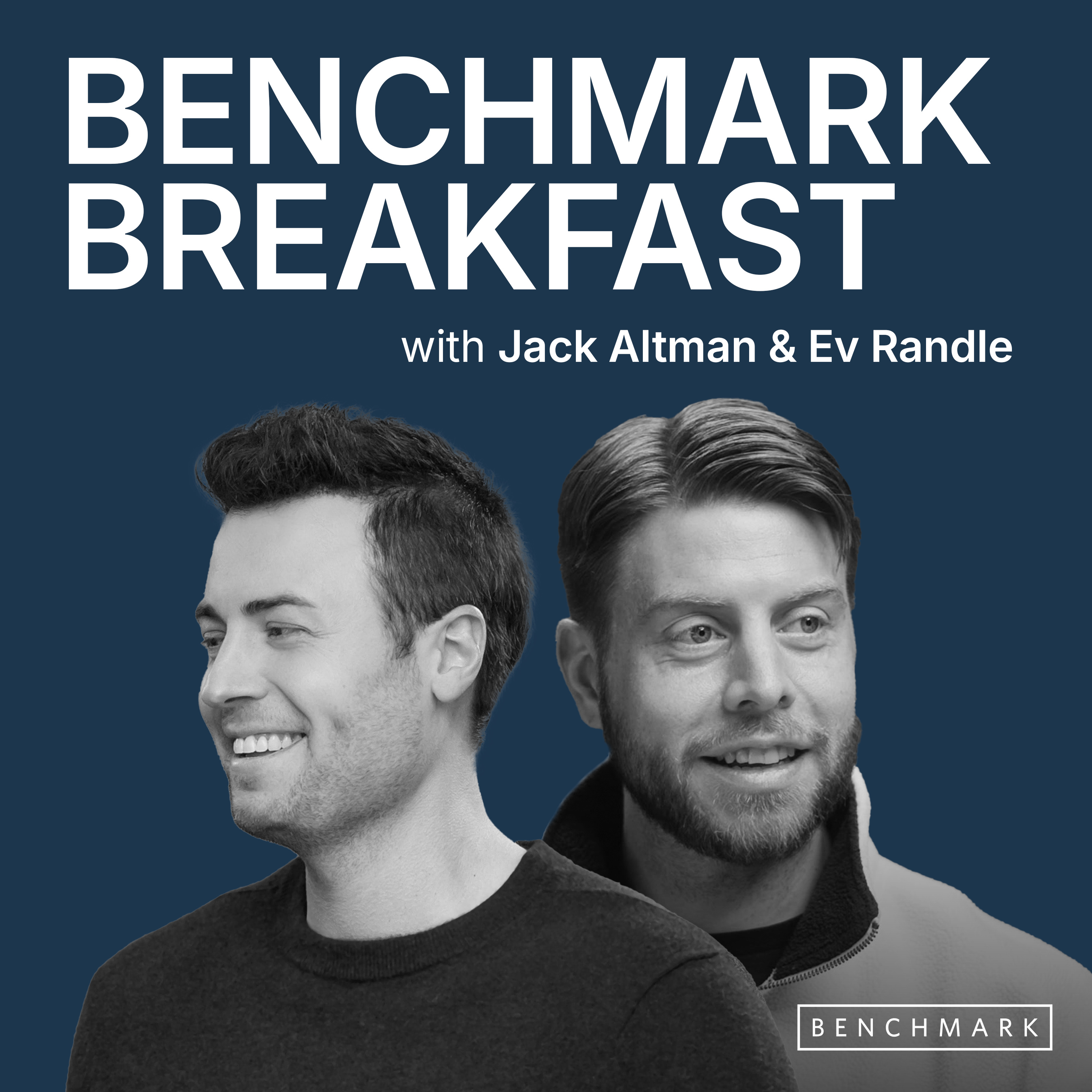
Let them eat pancakes! Jack and Ev give updates on the Anthropic IPO: the initial price range, the amended S-1 showing $81B run rate at the end of October, and what it means for how the stock actually trades. They get into the Jensen Huang spy allegations, what it costs the open source ecosystem if Nvidia’s most important advocate goes quiet, and why American open source just became a lot more strategically critical. They run through the AI trade unwind, the CapEx math behind it, and why the revenues from the AI ecosystem aren’t yet big enough to justify the buildout being contemplated. From the midterms: a Gallup poll showing the US at 36% AI optimism against China’s 93%, the Amazon HQ2 role reversal, and what the Metis, Louisiana data center deal shows about how that relationship can actually work. They close on the $60B VC fundraising wave hitting in the next 1–4 months from firms that raised just 12 months ago, reflexivity in private markets and why seed valuations may never fully reset, and what Sequoia’s restructure is really signaling about firm identity.
Timestamps:
(0:00) Intro
(0:42) Anthropic IPO pricing
(2:02) S-1 amended: $81B run rate
(4:08) Zooming out without Twitter
(5:10) Ev’s IPO prediction
(8:37) Structural volatility of AI labs
(10:31) Jensen Huang and the spy allegations
(13:22) Commoditize your complement
(15:31) Winners and losers from the Jensen news
(18:28) AI trade pulls back
(21:37) 70GW to 40–50GW
(23:00) Buyers of tokens and diffusion
(29:02) The RSI unlock
(30:37) Midterms: Democratic sweep
(31:47) America hates AI and data centers
(35:35) Amazon HQ2 role reversal
(38:13) Gallup poll: China vs. US on AI
(41:28) $60B in VC in the next 1–4 months
(43:08) Mega funds squeezing mid-size funds
(45:49) Reflexivity and the traffic wave
(51:03) Seeds are permanently expensive
(56:16) Sequoia’s restructure
(1:01:11) Product recs: Tesla YL and iPhone Duo
Links:
https://www.citriniresearch.com/p/state-of-the-themes-556
https://news.gallup.com/poll/714593/optimism-globally-widespread-despite-uneven.aspx