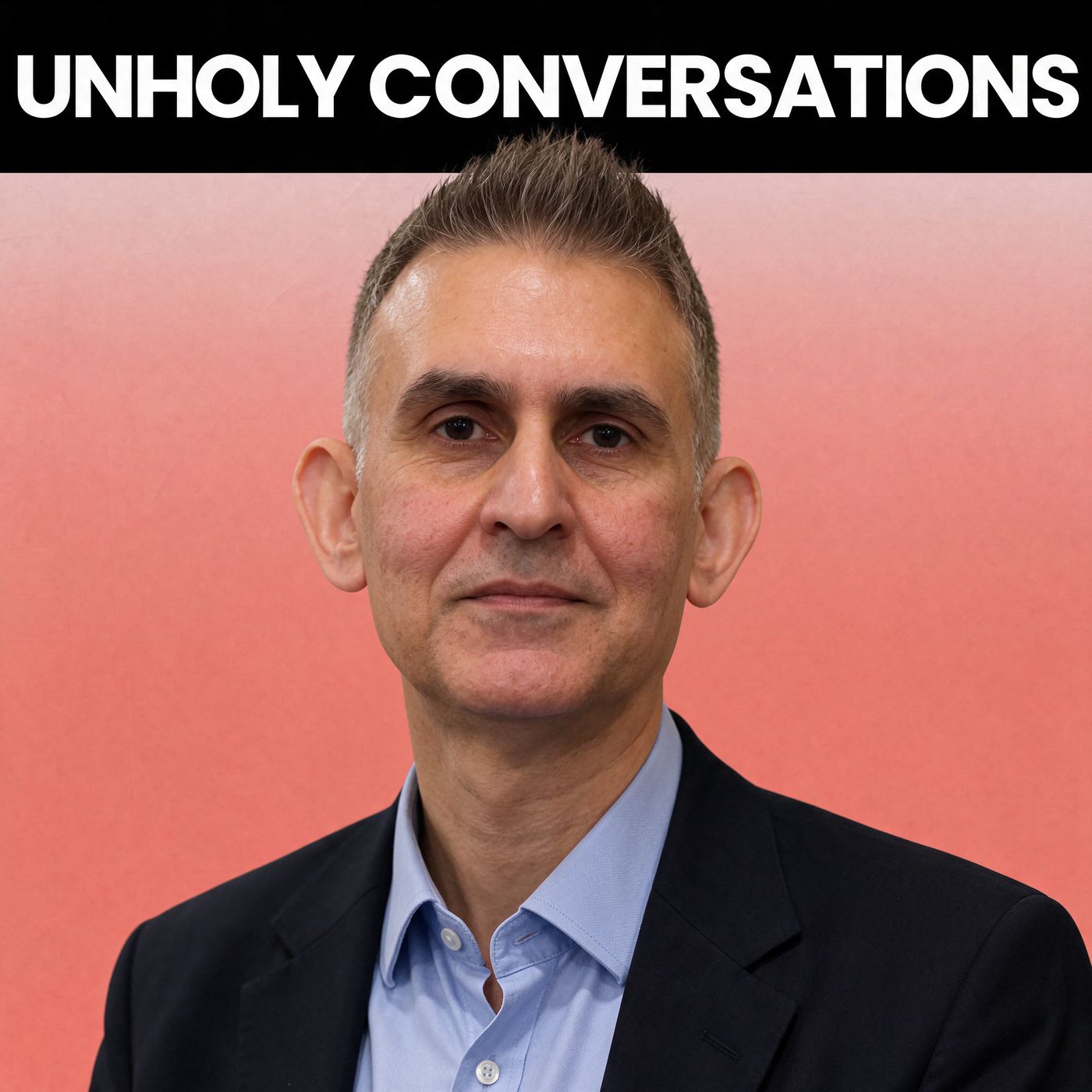
 Unholy: Two Jews on the News
5 Nov 2026 · 49m


 Add vo to ChatGPT or Claude to ask about everything you hear
vo listened to this episode to put together the overview and transcript, so there may be the odd mistake.
The episode links the US “blue tsunami” in midterms with Israel’s post-election stalemate, arguing the US election climate is shifting Israel–US politics toward pressure on Gaza policy and possible aid cuts. It also reviews Israel’s coalition-building urgency to replace Netanyahu and the democratic risks raised by Shin Bet chief David Zinni’s post-election actions.
Jonathan Friedland (London-based journalist/podcast co-host focused on US politics; previously covered US elections; also notes he balances Middle East news with American politics). Yonit Levi (Tel Aviv-based co-host; Israeli political analyst/journalist).
Gaza and settler violence became more central in US campaigns than in Israel’s; voters largely punished Trump over prices and “forever war” promises, not only Gaza. Democrats’ House majority reduces “blackmail” by progressives, but the Overton window has moved. Netanyahu’s ties to Trump are portrayed as damaging; US officials have floated earlier aid cutoffs. In Israel, opposition aims to form a Netanyahu-free government quickly; Zinni’s alleged push to question Arab lawmakers without evidence is framed as authoritarian intimidation.
J.D. Vance’s “four reasons” including Israel ties; Trump’s Fox News claim about a deal to give Israel $4B/year; Michigan Senate race (Abdulaziz El-Sayed underperformed); US Democrats’ Gaza language (e.g., James Tallarico); Israel’s potential coalition arithmetic (United Torah Judaism, Ra’am, without Joint List); Haaretz report on Zinni seeking to question four Arab lawmakers; masked police arrest of journalist Abed Abu Shahada.
0:00A blue tsunami hits the United States as Democrats sweep to victory in the midterm elections. The fallout of that intersecting with the fallout of Israel's own rather less decisive election. It's unholy. I'm Jonathan Friedland in London.
0:18Yonit Levi: And I'm Yonit Levi in Tel Aviv.
0:31Yonit Levi: unholy two Jews on the news so that is what a decisive victory looks like you should have said now you know now you know um it's so funny because obviously as listeners know I could only be in one of these two places and uh was not present on the ground for the American election but found myself looking at it and thinking you know come on that's how to do it where you get a clear, unambiguous outcome where you don't have to spend three quarters of an hour explaining who winners and losers to people, the sheer clarity of it and the contrast. And listen to that live cast on election night. You sounded like you enjoyed yourself.
1:08Yonit Levi: But yes, for sure. I think between these two elections just a week apart, the opposition Israel would have loved to have a night like the Democrats had on Tuesday. I think we'll be talking a lot in this episode about where these two elections intersect. But definitely, I think many who support the opposition bloc in Israel. We're looking at what happened, this blue tsunami in the US with green eye jealousy. I think that's safe to say. Yeah, I think so. And it does make sense. I felt it myself. There is so much to sort of unpack about these elections in themselves. The number of people who made Israel and the war in Gaza an issue in their campaign.
1:49I think it's fair to say that in terms of Israel's conduct in Gaza, that was more of an issue in the American midterm elections than it was in the Israeli elections. I'm not talking about October 7th or the hostages I'm talking about specifically. The IDF's conduct in Gaza, a really live issue in, for example, the Michigan Senate race and elsewhere. A couple of New York primary congressional races, you know, barely talked about in the Israeli campaign. That's one aspect. but then you look at the fallout and we're going to get into all of this but you know the statement from jd vance in which he says okay there's four things we've got to do to put this right right these are the the priority issues or the four reasons why people didn't vote for us says the vice president and four of the you know number four of that list of four is the american relationship with israel and so it you know i think when we started the podcast we would often joke that we were being like one of those sort of self-obsessed people, you know, and that well enough about me talking about me, why don't you talk about me?
2:52Now it is something which we don't, you don't have to force it. It is a central issue in the politics of all these places around the world. So huge number of implications, a lot of fallout for us to pick through. Just as we sit now, Thursday morning in London, Thursday lunchtime in Tel Aviv, dawn really in on the East Coast of the United States as we pick through the fallout from this tsunami.
3:20Yonit Levi: We should tell our listeners, if they don't know, that Jonathan Freelintaman maintain a healthy balance in life. One cannot live on the diet of Middle East news alone. You have a podcast about American politics, which I listened to closely on the night between Tuesday and Wednesday. You went through the whole blue wave. And really, there's not a superlative that can capture this. There There are states that were so red that last time a Democrat was elected, my grandmother was a teenager. And today, I mean, there is just the word is is tsunami. As you said, Israelis follow this rather closely. I think they were focused very much on the sort of anti-Israel Democrats, of course, particularly Abdul El Saeed.
4:00Yonit Levi: We will get to talking about him. But just to zoom out for a moment, I hear a lot of voices here that are saying this is actually not bad news for Israel in two ways. One is that the sort of elected officials in the most dramatic states, in the places where the state flipped, are actually moderate Democrats, we should say that. And also, when there's this kind of majority, particularly in the House of Representatives, then you are not subject to any sort of blackmail from any sort of, you know, more radical faction of the Democratic Party. You can, that is diluted by a whole lot of moderates. I think the worrying headlines in those 24 hours actually came from the Republican Party.
4:40Yonit Levi: And we'll get to that in a minute. J.D. Vance and Trump himself talking about cutting off aid to Israel earlier than Israel, particularly the defense echelon and the financial part of this country expected. So we'll get to that in a moment. But even the Abdul Saeed win in Michigan, of course, you know, his views on Israel. I don't want to be extreme here and say that he makes Mamdani sound like Theodor Herzl, But I mean, his views on Israel, obviously, incredibly, incredibly disquieting and disconcerting for many Israelis. We should say Abdulaziz Saeed underperformed in this wave. He is in a purple state the last time.
5:19Yonit Levi: I see your face. We'll talk about that in a minute. I mean, he's in a purple state. The last time a Republican was elected to the Senate seat was 1994. Of course, Alyssa Slotkin narrowly won from the same Mike Rogers he was running against. But we should say, I think, that he underperformed in this wave. There are, as I said, states in which the margins were huge, red states in which the margins were huge. And I think that is something to say about him. I would say that the voters did not vote on Gaza. They voted on high prices. They voted on, perhaps in certain places, the aggressiveness of ICE.
5:56Yonit Levi: And probably what is the detestation of Donald Trump, the repudiation of him, essentially. I don't think they voted over the Gaza issue, but it is important to say in the same breath that what changed the tide and became an anti-Israel tide generally in the United States, not only in the Democratic Party, of course has to do with the war in Gaza. It has to do with settler violence. It has to do with Netanyahu himself and perhaps with other things that are happening, undercurrents that are happening in the political parties themselves. It is a repudiation of the Trump administration, nothing less than that.
6:28And that was the word I was looking for a week ago in Israel, saying that those who wanted the Israeli verdict to be a repudiation of Benjamin Netanyahu, they didn't quite get that. It wasn't that decisive result. This was a repudiation of Donald Trump. I think central to it was prices, just the cost of living, affordability, however you want to put it. But that was intertwined with the other big issue, which is the war on Iran. Massively unpopular. in a couple of ways. One is, if you think about his own base, and there's good evidence that Republicans actually didn't just stay home, some of them in places, and J.D.
7:06Vance talked about this in his long post on X, they switched. They actually went from Republican to Democrat. Why? Because they went for Trump because he said, I'm going to bring an end to forever wars. There'll be no more of those. And then he launched into a Middle Eastern war that has dragged on. And second, his promise was, I'm going to bring down prices. And prices have gone up, including crucially for groceries and gas, petrol at the pumps. Though the Iran war brings both of those two things together, that's why it's so powerful, because it's the broken promise on war, and it has driven up prices, particularly of gas and diesel and so on.
7:49So I think that's the absolute core of the turn. I mean, I think he would have had a rough midterms anyway. But in terms of why it was this, you know, blue tsunami, I think that's central to it. That is where the Israel peace kicks in. Because you're right, probably in most races, you know, Abdul El-Sahid to one side, they weren't voting about Gaza. But they were voting about a war. And the narrative pushed by J.D. Vance, the Tucker Carlson wing, and so on, is that it was Israel that was central to this war. It's a US-Israeli war. Netanyahu pressed the arguments to Trump. You know my view. I've said it a few times here.
8:32Trump is a grown-up. He can make his own decisions. So I don't buy this idea that it's all the, you know, that he was sort of hypnotized, mesmerized by Netanyahu. But it's a powerful line of argument, and it's where you get this pincer movement from left and right. So you've got an Abdel al-Sayed on the left, denouncing Israel's conduct in Gaza. And then you've got J.D. Vance and his wing on the right saying, we were dragged to this horrible war by Israel. Either way, it means you have on both sides of the aisle, you have people who are very agitated and exercised by the role of Israel, one way or another.
9:11The sanguine points you make are right. The overall climate is still changed by this. You are right that it would have been very different if it had been a smaller blue wave, Hakeem Jeffries, the incoming speaker, would then be captive to one faction or another. It could have been the moderates, could have been the progressives. Instead, he's got, if it goes to the 250s, 260 seats in Congress, in the House, he can move without one of those groups. That's really important. I think the estimate for sort of hardcore anti-Israel leftists, as it were, in the Democratic caucus is around 25 people. So, you know, it's a, he can ignore that number with these sorts of tallies they're racking up in the house.
9:55So that's significant. But nevertheless, I think people would be unwise, advocates, defenders of Israel, would be unwise to draw too much comfort from this because the mood music has changed, even among those people who are not the hardcore. You know, yes, it's true that they, you know, you don't want to exaggerate the sort of Mamdani, El Saeed wing in terms of numbers. but they do set a tone and the Overton window has been dragged sort of leftward on this subject. So you now have people who are quite mainstream friends of Israel of old, who nevertheless are talking the language, yes, of ending aid to Israel.
10:34Trump weirdly did that the morning of election day, saying no more. We'll come to that too. But I think therefore, you know, there's a pressure now to think, okay, so what's the next position? And the next position is we shouldn't even sell arms that will be pushed by outside and others but i think you'll find others being dragged there even people who all ordinarily would be more moderate so and then the reason i was making the face is i just think plus seven in a state michigan which trump won it's not so narrow you know after when it was that absolute squeaker with hayley stevens the primary more or less 50 50 i think some people did think okay if outside wins it he'll win it by a point or less or, you know, 2.7 is a pretty clear margin.
11:19And so in a state that Trump won just two years ago, there's been a change. It's not as bad as some might have feared if they're judging it purely in terms of support for Israel. But the climate of opinion has changed.
11:33Yonit Levi: Taking lemons, I'm trying to make lemonade. You're, you know, you're in my way. But okay, I'll just say, you know, James Tallarico in Texas had a double-digit margin. John Ossoff had in Georgia a double-digit margin. Abdul Saeed did not. But I'm putting that aside for a moment. It's definitely you're right about the music changing, because even when I said most of the people who want are moderate Democrats, what does it mean to be a moderate Democrat today? Even James Tallarico, in an interview that came out recently, said about Gaza, he said, our country's role in, this is his words, in the slaughter makes me feel complicit.
12:06Yonit Levi: I support banning offensive weapons to Israel. He says, I mean, that is the music even from the Democrats, the moderate Democrats. So obviously, you know, we are in a different world and we're also in a different world when it comes to the Republican Party. Look, when the vice president of the United States says we lost for four reasons and the fourth reason that needs to be looked at is our relationship with Israel. That is a scary thought. And when on the morning of the election, the president of the United States goes out on Fox News and says, right, Bibi Netanyahu and I made a deal. We're giving Israel four billion years.
12:42Yonit Levi: Now we're stopping, by the way, again, to the surprise of many in Israel. This is what Donald Trump had to say to get his people out to vote. So this is, of course, quite a dangerous place to be at for the state of Israel that once used to be a completely bipartisan issue. I would want to just mention that things have changed in Israel as well. And it is true that the victory over Netanyahu is more complicated. There is not a blue tsunami, but you can't overlook the important fact that Israelis voted against the far right government that Netanyahu set up. and that that government will no longer be in charge very soon.
13:20Yonit Levi: Definitely that Knesset will not be in charge from next week. And I think that is a point which is perhaps slightly missed by a lot of the Democrats. By the way, indicative of this is this ex-exchange between Yeri Lapid, who's actually writing internally to Israelis, trying to say, look, this can be fixed, is not as bad as you think. Netanyahu has to go, right? That is what he's trying to say from his political perspective. and Brad Lander, who was elected to New York's 10th district, he's considered a progressive, he's Jewish, he does say that he supports Israel and cares about Israel. And his response to...
13:53Yonit Levi: Calls himself a Zionist as well, actually. Yes, and his response to Yair Lapid was, he says, Minister Lapid, Lapid is not a minister, but he says, as someone who sat, who won a seat in Congress last night, who cares about Israel, you're not listening to what American voters, Jewish and non-Jewish, are saying. We aren't starving for a barnstorming tour. We're hungry to see respect for international law. and human rights. The problem I have with this response is Lapid was actually trying to say something, I think fundamentally more broad, which is you have the means to talk to us now. We are a different Israel than we were.
14:29Yonit Levi: And let's pick up that opportunity. There are chances here. There are things that we can discuss. I think this is more a, you know, I don't want to call it a progressive explaining, but I understand where he's coming from. I think that is exactly what I would kind of put a pin in and say, but notice what is happening in Israel as well. Yeah. Everything about this exchange is really worth looking at. It's completely fascinating how this plays out because you read the Yair Lapid long post on X, and I found myself thinking this is very, very smart here. for his own domestic calculations. He is taking the results of the midterm elections and making them a tool for the coalition wrangling that's going on in Israel.
15:19How? Because he's saying to other politicians, as well as the Israeli public, Netanyahu is now toxic. And he uses that word in the United States. It's no longer his number one asset, the fluent English, the familiarity on TV studios in America. On the contrary, he is toxic and we are suffering by association, we in Israel, Yair Lapid is saying. And therefore, it's actually a very good thing for Israel's strategic interest if we form a new Netanyahu-free government that in the light of where power has shifted in Washington, Israel needs to present a new face that is more Democrat-friendly. And that is really, I think, smart.
16:03and you could imagine you know some of the people who are making some decisions thinking actually there's logic to that um you know i don't i don't know whether it ever brings over defectors from the right that's perhaps too much to ask for but it just gives us some coherence and glue for say a lieberman who's thinking about which where he moves and so on it gives coherence to the coalition of change um it gives them a story to tell all very smart then brad lander comes in, who is not a kind, you know, he's an ally of Mamdani, but he calls himself a liberal Zionist. He's somewhere in between. And I thought it was so interesting because he's saying there, look, you guys thought that as long as you get rid of Netanyahu, America will go back to being pro-Israel again, which is how it used to be in the past.
16:49That, you know, if you show the world a Shimon Peres face, not a Yitzhak Shamir face, everyone will be a bit more pro-Israel. That, you know somebody's ready to talk and be a more emollient that will be fine here's brad lander saying no the the whole climate has changed it's not enough just to be to speak with you know more gently and put a human face on more or less you know pretty unchanged policies you're going to have to go much further so i read into that dealing with settler violence which um real addresses, good, but nowhere near enough. You're going to have to go much further into actually the area you don't want to go into.
17:29If you're going to placate the newly powerful Democrats, you're going to have to address Israel's very presence in the West Bank and Gaza. So the old fixes are no longer enough. And just as actually in the broader left around the world, I'm noticing that the old message, which was of the Zionist left, which was, okay, we'll end the occupation since 1967, that would be fine. And now actually you get a response which says, no, we want you to address the whole existence of the state of Israel, say the far left. This is like that in a different version of that, where the traditional moderate posture won't be enough.
18:05You're going to have to go further. So I get Lapid internally, I think very smart politics internally. But in terms of the relationship with America, Israelis are going to have to go even further than the moderate sort of liberal left think?
18:18Yonit Levi: Yeah, well, I'm not sure that Brad Lander is the sort of sign of where Israelis have to go. Definitely, there is a lot of damage to repair. There's a seasoned diplomat who said to me yesterday, he said Netanyahu succeeded in uniting America. The Democrats can't stand him, the Republicans will never forgive him. I don't think, as you know, I've said many times, it's only Netanyahu's fault. I think there are also internal trends and shifts happening both in the Democratic Party and the Republican Party that are detached from who the leader of Israel is. And in fact, Brad Lander is proof of that, right?
18:51Yonit Levi: He's saying whoever the leader may be, there's still work. I think we are on page one of this, turning the page from the Netanyahu era here in Israel. So perhaps some caution and perhaps patience might be required of new congressmen and others. I would just want to point out that we are still in a world in which Iran is holding a stockpile, a huge stockpile of enriched uranium. That issue has not been resolved. I think that the blue tsunami distances us from an option that the president of the United States would attempt another attack on Iran. There was that kind of scenario right after the elections that might happen.
19:33Yonit Levi: And it is worrying in a way that when the chief negotiator, who is the vice president, says to Iran, essentially, we ain't doing that, right, because we just realized that's a huge political mistake for us. I'm not sure that's a great, you know, bargaining tool. But that is where we are on the Iranian issue, which has not been resolved. And it's a very, I mean, if we try and disentangle the actual issue from politics, I think that's also a worrying thing to just know. yeah i think if you're being rational um you're completely right that that should should now by by any logic be if not off the table further away and down the table we're not wholly in the realm of the rational though um i remember speaking with a long time washington hand who said if trump loses big in these midterm elections said this a couple of weeks ago don't and he loses all power.
20:24Don't assume that will be a tamed Donald Trump. On the contrary, he will be a cornered
20:29Yonit Levi: animal. That was the memorable phrase and may well lash out. And here, in order, two reasons why he might do that. One is legacy. He's really fixed on the idea of now he could go down as a loser. Regime change was achieved. It was achieved on Capitol Hill rather than in Tehran. He doesn't want that to be his epitaph. Therefore, the idea of him finishing the job, I can imagine him wanting to do that. Remember, he has the power over that foreign policy. He doesn't have to get sign off. You know, he should, but he doesn't have to from Congress. But also the attention economy. Donald Trump craves attention.
21:10Incredibly revealing that on the day after the election results, yes, he's still talking about the ballroom and all that but he puts out a post which says PSA public service announcement Donald Trump is still your president in other words pay attention to me look at me I don't want all this fuss about Tallarico and El Sain I want people to talk about me and the the sheer narcissism of that makes it possible to me that he will wrench back the agenda rest back the agenda and so I wouldn't I wouldn't I'm not myself I'm not ruling out a resumption of militarek hostilities, even though absolutely rationally, it makes no sense, especially when his vice president has publicly denounced the war.
21:55I was just going to do one sort of footnote, because it's really about how, you know, you said we may be turning the page on the Netanyahu era. If we're assessing that, just think of this. On the morning of midterm election day, Donald Trump announces an end by the end of this year within six weeks to US or two months USA to Israel a huge thing that will however you slice it deprive Israel of two years of aid that were promised under a 10-year plan that was agreed by and passed by Barack Obama now Barack Obama was characterized by Benjamin Netanyahu as a threat and danger to Israel and he's a net Netanyahu supporters framed him as, you know, hostile to Israel.
22:43He was the guy who passed a 10-year-long,$38 billion pipeline of aid to Israel. Donald Trump, who Netanyahu in his circle would have you believe is the greatest friend Israel's ever had in its history, is the guy who ends it. You know, funny old world we live in, where Obama's the generous benefactor of Israel, and Trump is the guy who cuts off Israel. It says to me, it's just another example of how incredibly bad Benjamin Netanyahu's judgment was, even on the areas where he claimed to be the world authority. His read of American politics was so flawless. Absolutely, no, it wasn't. He got it woefully wrong, picking a side, becoming the Republicans' ally rather than America's ally, speaking to Congress, taking John Boehner's invitation to speak, on Capitol Hill in defiance of Obama.
23:38He made this a partisan issue. It's taken 10 years to work through the system. But now we're looking at the legacy, the wreckage of Netanyahu's strategy on the United States, which was to take Israel's number one strategic asset, its relationship with America, and trash it. That's what he's done. And I think the bookending of Obama and Trump characterizes or captures that perfectly.
24:01Yonit Levi: I think we can agree that Benjamin Netanyahu will not be showing up in front of the U.S. Congress anytime soon, like he did in 2015 at the invitation of John Boehner. I'll make two nerdy remarks at the end of our conversation about American politics, because we are kind of segwaying into Israeli politics. One is the power of charisma. I mean, we look at people like Ossoff, like Tallarica, like Josh Shapiro. I mean, these people are spellbinding. When you look at Gadi Eisenkot with all of his really trajectory, life story, everything was great. He is not a spellbinding candidate. The power of charisma still works in politics.
24:39Yonit Levi: It works. It takes you a long way. Just the American history nerd here that really enjoyed the slogan, has nothing to do with Israel or Jews at all, but the slogan, Texas is not for sale, that was said because Elon Musk, of course, poured a few truckloads of money and failed there. So the historian nerd living inside my body thought to myself, yes, Texas is just for annexation. It's Louisiana. That's for sale. I'm just making that small point, which I would have made if you would have me on your American podcast, but you didn't. So, Israeli podcast. Yes, Politics Weekly America is the brand there.
25:12We'll give that a, it's first ever push and promotion here. God, I was doing that from the beginning of the conversation. Other outlets are available. Just on your point about charisma, I think it's so interesting, and you've named some of those really charismatic politicians, and, you know, we won't love him, our listeners necessarily, but Abdel al-Said is also quite the performer, quite the political athlete.
25:37Yonit Levi: And quite has a temper, if I saw his exchange with the Sky News correspondent, but that's another issue. Yes. It's another issue and something, let's put a little flag in that. I think we'll hear more about that. He has a bullying manner and he showed it with that reporter and that was, people can find that exchange with a British reporter from Sky News. And, you know, I covered elections once, asked a question of Bob Dole, who immediately on hearing my accent said, no votes in Liverpool. He wasn't going to answer my question because, you know, he thought I was speaking from Liverpool. His point was, why would I talk to a Brit?
26:11But Al Saeed did that, but he did it much more intimidatingly to this British reporter. It was caught on film. So I think we might hear more about that. No, I was going to say about charisma. The dangers of it are always worth being alert to as well. Donald Trump has a dark charisma. It got him elected twice. It got him to the Republican nomination three times. Underneath that sort of sizzle and flash is deep incompetence and a whole lot more. I think if you're Eisenhower, you can offer that. And I think other politicians around the world can offer that as a cautionary tale, which is I think the failure of the Trump presidency because that's I think what we're looking at now will be useful for those people fighting liberal nationalist populists around the world.
27:00They can say I know person X is charismatic so was Donald Trump. So Eisencock can use to his advantage the fact that he's a straight up kind of unflashy guy. You can make a virtue of that.
27:17Yonit Levi: so we've been talking a lot about other people's politics can we talk about israeli politics because i'm getting itch okay thank you so a few headlines uh from this week we are merely nine days after the elections i know it feels like nine weeks it's just been nine days so let's just go through headlines and what has been uh going on um and of course the american election plays into as you were saying, for the opposition. It underscores how kind of urgent it is to perhaps form a government without Benjamin Netanyahu. At the end of this block, I will give you a spoiler. I will try and explain how that might happen.
27:50Yonit Levi: But first to the headlines of this week. So first of all, election results certified. That is not to be taken for granted. We'll get to that in a moment as well. President Herzog, as we speak, is conducting his second day here on Thursday, a final formal consultations with all of the faction heads. He needs to see how many of them will recommend Gadie Eizenkot and how many will recommend Benjamin Netanyahu. I think it's safe to say that there will be more recommendations for Gadie Eizenkot and he will probably receive the mandate first to try and form a government. Crucially, I think this is very important, United Torah Judaism, one of the two main ultra-Orthodox parties, decided not to recommend Benjamin Netanyahu.
28:32Yonit Levi: I think we heard a hint of that when we interviewed Yitzhak Pindlus of United toward Judaism and said, we're not in anybody's pocket. This is very important for the Eisenkot side. We'll get into that in a moment. The next big date on the calendar is November 10th, next week, on Tuesday, the swearing in of the new Knesset and essentially the opposition taking control. What they can do immediately is to replace the Speaker of the House, Amir O 'Chana, all kinds of names floating around, including of Yaira Lapid, the head of opposition today, even of Gadi Eisenkot, but that will be the first thing that this coalition does.
29:10Yonit Levi: And also, importantly, Benjamin Netanyahu, after not being seen publicly for a week after the election, this of course fueled some speculation, released a video statement on Wednesday saying two important things. One is that he is the person to lead a broad national government. Earlier in the campaign, he said he'd set up the same coalition, but saying, I am the person to lead Israel, and also saying the public in Israel does not want a government that depends on Rahm and the joint list, the two Arab parties that support, he said, terrorism and reject the existence of the Jewish state. In terms of the United Tory Judaism, it's so fascinating.
29:51I'm reminded of something a friend of the podcast, Anshul Fefe, likes to say, which is Israel doesn't have two Haredi parties, it has three is just one of them is Muslim. And he describes Ra 'am as a kind of another ultra-Orthodox party because it's an Islamist party. The idea of Ra 'am and, you know, Yahadut HaTorah, United Torah Judaism, this Ashkenazi Orthodox party in one coalition is just a sort of mind boggler. But the arithmetic is there. If they did get both of those on side, you add the numbers up together, that takes them over the magic number that gets them to be a government. They wouldn't even need the joint list, who are the more, as we heard from our unholy conversation this week with Haaretz's Naham Zbidat, analysing the Arab vote and the Arab-led political parties.
30:45The joint list is the more sort of radical, as it were, of the two. You wouldn't even need them on the outside. So if you managed to get both of them in the coalition, you would have the numbers. I would love to know from you or from anyone who can explain how exactly they would get round what was a signature issue for a lot of the opposition parties, which was that the ultra-Orthodox have to be eligible and conscripted for the military draft. And that's the existential issue for the ultra-orthodox party. Look, everyone can fudge anything, but I'd be fascinated to know how they managed to pick their way through that.
31:24But it would give them the numbers to be in government.
31:27Yonit Levi: So first of all, I'm pushing the David Zini story aside then, and I will tell you how I think this could be resolved. And you said one of the options. One of them is to say, okay, we have 48, right? The opposition bloc clearly has 48 seats out of 120. That's not 61. It's pretty far from 61. It's the Eisenkot Yashar party. It's the Bennett and Lapid party. It's the Irgolan's party and it's Lieberman's party. And one of the options that has been floating indeed is the option of saying, okay, let's take in United Torah Judaism and Ra 'am and form a coalition. It is in the numbers. I think it is fair to say that is quasi-impossible.
32:04Yonit Levi: I wouldn't say anything is impossible in Israeli politics. There have been so many. First of all, when you look at United Torah Judaism inside the coalition, The one main promise that this bloc made to the voters, apart from we're getting Netanyahu out, was what is called in Hebrew, the alliance of the people who serve. We have to have, they said, everyone taking part in serving their nation in the military and national service and suddenly to bring in united Torah Judaism with their conditions to have some sort of law that exempts large parts of the ultra -Orthodox community. problematic. To bring in Ram as well, which is the United Arab List, of course, with Mansour Abbas, who already in a revolutionary way sat with a Zionist coalition.
32:50Yonit Levi: But remember, most of these parties in the bloc already said they would not sit with this party for their own reasons. We went through that pretty extensively in the lead up to elections and right after. What can happen, Jonathan, what would be an interesting twist here? I think that, and one of the ideas that is floating around, I'm not, you know, voicing what I've heard from the Eisenkot camp, but rather from people who are, you know, advising the Eisenkot camp. I would say this. What if Guy the Eisenkot, right after the Knesset takes a hold and the opposition takes hold of power in the Knesset, says, in two days, I am swearing in my government.
33:25Yonit Levi: We're not going to do it in the usual Israeli way in which this coalition haggling takes weeks and all of the parties say what they demand. No, no, I am going into the Knesset plenum, and I'm swearing in 48 members of Knesset. Of course, the backstory here is that they will ask, in fact, beg or demand from both United Torah Judaism and from Rahm not to vote, not to vote for this government, not to even be in Jerusalem that day, not abstain, just don't vote. And then Gadi Eisenkot has a 48-46 majority over Benjamin Netanyahu, and he has a minority government. This, of course, is very treacherous.
34:03Yonit Levi: The advantage here is you're not promising them anything, right? You don't have to promise either Ram or United Torah Judaism anything. The disadvantage is pretty unstable government and that United Torah Judaism, you know, how much can you trust them to not turn around and then vote for Netanyahu in the very last minute? There have been stories like that in Israeli politics as well. But I think the twist here is to actually say, no, no, I just need a majority. And I will swear in this government, the guidelines, the policy will be something like setting up a commission of inquiry, getting Netanyahu out, finding some way to incorporate the ultra-Orthodox in a national service.
34:42Yonit Levi: But all of that will be to say, I am, even if Israel goes to elections, I will, Gadia Ezenkot will be the head of a caretaker government and not Benjamin Netanyahu. No, no, I get the procedure of that, but in a way that it doesn't avoid the political challenge. It's still there. In order to get United Torah Judaism to stay away and to find that they have, you know, a particular Talmudic passage to study in B 'nai B 'rach that day that keeps them away from the Knesset. You're getting it. But they're going to have to be, there's going to have to be a carrot for that, an incentive. Otherwise, why would they do it?
35:18So you're going to have to do a deal with them. I get the procedural point, but either way, the political challenge remains. You have to give them something. Otherwise, they won't stay away that day on their vote against you. They're going to want to, they're going to extract a price is really important.
35:32Yonit Levi: Right. It's a different price from voting for the government. And I think that the end of the story can be that on the day that Gadiez, in quotes, whereas in this minority government, he will say, Israel is going to elections. And I am not caving into any of the demands, but I am the head of the government. Of course, there are all kinds of people who will have to, even Avigdor Lieberman, who set so many conditions, right? He said, I'm not going to sit with Netanyahu. I'm not going to sit with ultra-Orthodox. I'm not going to sit with Arabs. And I'm not going to form a minority government. We'll have to at least break one of those promises in this scenario.
36:04Yonit Levi: Look, it is still far-fetched. The numbers are difficult here. But what I'm saying is that I think that both the American elections and the blue tsunami and the story we will get on to talk about, the David Zini thing, underscored and brought home the urgency inside the bloc to do everything possible, even in a scenario that sounds quite, I don't want to say slightly insane, like the one I just described, but, you know, pretty darn difficult. Even that would be better, they think, than trying to form a government with Benjamin Netanyahu. Yeah, no, it certainly would be better than that. Again, I think to secure United Torah Judaism's support, even for that move, they're going to want to know what they get out of it.
36:48Otherwise, I think the worry would be that they would go with the devil they do know and they've worked with a long time. So I think Isaac would have to be, there would have to be some kind of promise to them that they felt made it worth their while putting him in there. But I agree. I think the change in Washington has concentrated minds. They are people who understand now that it's not just a party interest, but a strategic interest for Israel to not have a prime minister who is tied so closely to Donald Trump, but rather a prime minister who can speak Democrat, as it were. And that has to mean someone other than Netanyahu.
37:25So it's fascinating how these two things intersect. We have put aside for too long the David Zinni affair. We should explain who he is, what he's done, and I think just how serious this could be.
37:39Yonit Levi: So David Zinni is the head of the Shin Bet, the Israel Security Agency. He was appointed by Netanyahu a year ago, actually. Shin Bet is Israel's, is responsible for domestic intelligence, counterterrorism, And also, importantly, I think for Israel, entrusted with safeguarding the democratic regime. Now, this is what happened. And I'm going a little bit granular here, but I think it's quite important. Following the elections last week, Shin Bet director David Zini was briefing the Central Elections Committee about suspected foreign funding from Qatar and Turkey aimed at boosting the Arab vote. This was on Thursday.
38:21Yonit Levi: day. Of course, a big story broke out and Netanyahu and Likud were kind of amplifying this to claim that the elections were stolen, that there was some sort of question over the legitimacy of the outcome, etc. Now, what happened on Sunday was a joint statement by David Zini, the head of the Central Elections Committee, Chief Justice Noam Solberg, and the Attorney General, all sitting in front of the camera and saying the election process was conducted lawfully, properly, in full compliance with democratic standards. That should have been the end of it. But on Tuesday, Haaretz reported Tuesday evening that David Zini wanted to question four Arab lawmakers, but is refusing to relay any foundational evidence on why they are supposed to be questioned, any connection between them and foreign influence.
39:12Yonit Levi: Now, at that point, the attorney general said, I can, you know, we can investigate, this is important to investigate, but you're not giving me any kind of evidence. Now, what is happening? Again, we should say no suspicion that the elections were rigged, tamper with in that regard. As I said, the elections were certified and that is important. But there continues to be this shadow and this investigation that David Zinni wants to conduct. By the way, a lot of question marks on this, because there's a full force of the Internal Security Service put on lawmakers. That is what he wants. And this investigation that can be ongoing, can continue, but the whole thing gives a climate of something is wrong with these elections.
39:57Yonit Levi: That is where we stand. And that was a really serious story and grave concern here in Israel this week. Yeah, great relief that the Attorney General called this out and said, you've asked me to essentially arrest or detain in some way four politicians. In three of the four cases, you've offered no evidence. Apparently, I think there is some evidence for the fourth, but not for the other three. This seems to me a sort of seven alarm fire situation. This is an authoritarian move. this is a Putin style move to arrest or seek the arrest of opposition politicians without evidence just describe it like that that's the sort of thing you read about in a place like Putin's Russia it is not how democracy conducts itself yes to cast a doubt over the election to intimidate the opposition but we've seen that movie before where there are elections that don't go the way of the autocrat and he starts arresting the politicians he's beginning it seems to me I'm saying he meaning Netanyahu because he's Zinni's patron.
41:08He's beginning with those around whom he thinks Israelis would be prepared to accept that there may be suspicion, namely leaders of Arab parties. He's playing on that prejudice. But if this were to go ahead, you could imagine the next move is to say, Ya 'eh Golan, we're going to arrest him, the leader of an opposition party. The Attorney General has rightly drawn a line here and said this is not how democratic countries behave. The fact that David Zinni, who, as you absolutely rightly enumerated in his list of tasks, as well as running an intelligence agency, he is meant to safeguard the democratic machinery of the state.
41:49The fact that he went along with this confirms all the fears people had about him being appointed, which is instead of being somebody who will speak truth to power, will be a counterweight, a check on the power of the executive, is a creature of it, is a puppet of it. He's just a loyalist in a job where previously there'd been sort of career officials who had a degree of independence. This is really, really troubling. I mean, I think it's a red alert and that it should be sounded here. And I worry that with all the attention on midterms, etc., this may get overshadowed. It really shouldn't. If you're arresting politicians, that's a very bad thing for a democracy of any kind to be doing.
42:32In the same vein, actually, I have to say that as a journalist noting the arrest by 15 masked Israeli police and Shimbet officers of fellow journalist Abed Abu Shahada, who is a Palestinian citizen of Israel in Jaffa, That also happened just this week, not good and attracting attention, I think, rightly from journalists around the world. Just of a piece with the dangers that there are in this suddenly febrile atmosphere to basic democratic norms.
43:02Yonit Levi: On Wednesday, Yoram Cohen, who was head of the Shin Bet and is now number two in Eisenkot's party. So a newly minted politician was on the news in my studio and he said, look, David Zinni is under, it looks like he's under massive pressure from Benjamin Netanyahu. What he's doing is unprofessional. He didn't go farther than saying unprofessional. Even the generous reading here is concerning. The final kind of, and the kind of flip-flopping here, on the one hand, sitting in front of the cameras and saying, you know, elections are running smoothly. On the other hand, saying this has to be investigated.
43:37Yonit Levi: By the way, no one is saying it shouldn't be investigated. The attorney general is not saying we shouldn't check if there is foreign money coming in from Qatar to certain Arab lawmakers before the elections. For sure. She's just saying, please show me the evidence before you use the full force and tools of the shin bet against lawmakers. The final kind of quote from him on Thursday from Zini was him saying to the Central Elections Committee, I will do whatever the attorney general tells me. I will not move an inch from her directive. If we are in that mode, I think things will calm down. But indeed, it did kind of raise a lot of concerns that existed around him ever since Netanyahu appointed him.
44:19Yonit Levi: if a changed government will be formed in Israel by Gaddi Eisenkot. I think it's safe to say that he will be looked at very, very closely and perhaps not be someone who will hold on to his job for a very long. They're saying it, and not me. Finally, just to say that the sort of slogan the Shin Bet has in Hebrew is the unseen shield. He has been very seen this week, and I think that doesn't, great, neither for the organization he leads or for Israeli society. That has been a lot of news, sir. Maybe we should just lighten the mood with a little bit of awards. Have we arrived at that point? I think we have.
44:59I was just going to say that if the exchange government arrives and it's stable, they are going to have a big job clearing out a lot of these cronies and placemen and loyalists. Because if you have a prime minister who's in for 20 of the last 30 years, they appoint a lot of people and there's going to be a big job there. But let's get to our awards. We have a pleasantly crowded field in the mensch category. But before we get there, I just thought for sheer chutzpah, for the sort of Marie Antoinette of it all, you've had an election, Donald Trump, serial winner of this award, you've had an election in which the public have said you are not dealing with the things that concern us, which is the affordability of the basics of life.
45:42We demand that, you know, the bread and butter of our lives is made more affordable, and that you listen to that and you didn't listen to it. The next day, Donald Trump dons the hard hat and goes down to the building site of his ballroom and talks for ages about the fact that it's a 50 foot high ceiling, which is like a five story building. And he's talking about the marble and how it's veined. It is a 2026 version of Marie Antoinette, as if she was after the, you know, sans-culotte demanding bread outside the palace. She is sort of asking them to admire the chandeliers. You know, it's an amazing gesture by him.
46:24Just shows how incredibly out of touch he was, why he was defeated. But it takes a brazen kind of chutzpah to double down and actually go on a tour of the ballroom the day after you have just taken a electoral beating of the kind he did. So I thought it's a reward for our old friend, the still American president.
46:43Yonit Levi: Indeed, and for another two years, we should say. But let's add, if we're doing the US Politics Edition of our awards, you have a bench nominee that I quite like. I really do. This is John Rosenthal, not a household name. He was running for Texas Railroad Commissioner. Now, again, not a post that would normally garner international media attention. He was up against a Republican incumbent who got national attention, actually, for making comments that were widely deemed to be racist about South Asians in Texas. He then said a whole lot of stuff online about Muslims and Jews and whether they were real Americans and so on.
47:29a lot of people just marked this guy down as basically a bigot. His opponent was John Rosenthal, a Jewish engineer who was running for the job of railroad commissioner. It turns out you have nothing to do with railroads in that job, but you are - I was going to say that. I was giving my
47:47Yonit Levi: point. It has nothing to do with train regulation, of course. It has to do a lot with oil, gas, and energy. It's actually a very important economic job. So that's why it's a big, big job and gets attention because you oversee the oil and gas industry in Texas, which is obviously a big deal. So he won. John Rosenthal, in a blue wave that swept Texas, James Tallarica, of course, at the top of the ticket, but they won the governorship as well. Democrats won the Texas Railroad Commissioner, which means John Rosenthal is now the Railroad Commissioner. he posted online a statement saying tonight this jewish engineer sent that mother beep home i'm not going to get the full word because i know that your own mother takes a dim view of swearing on the podcast but i loved the idea that john rose i mean it sort of can't you know it runs counter to lots of stereotypes that the railroad commissioner is a jew that an engineer is a jew but he leaned into it our facing an opponent many branded anti-Semitic he said tonight this Jewish engineer sent that guy home good for John Rosenthal as our MENCH nominee indeed very nice we're winding up our very extensive conversation there was a lot to go through and we will say a big thank you to Michal Porat and meet next week as usual see you then you'll need
Two elections, a week apart — one a blue tsunami, the other far less decisive. Two days after the Democrats swept the midterms, Yonit and Jonathan ask what the result means for an Israel that voted against Netanyahu's government without quite repudiating him. JD Vance names the US relationship with Israel as one of four reasons his party lost, Trump announces an end to aid on election morning, and Yair Lapid and newly-elected Democratic congressman Brad Lander argue it out on X — so is a Netanyahu-free government now a strategic necessity and would a friendlier face even be enough? At home: Herzog's consultations, the 48-seat minority government spoken of in whispers around Gadi Eisenkot, and the Shin Bet chief's bid to question Arab lawmakers without evidence. Plus a Chutzpah award for a serial winner in a hard hat, and a Mensch nominee whose new job has nothing to do with trains.
00:00:00 Intro: two elections, one week apart
00:01:28 The blue tsunami and Israel: a repudiation of Trump, not of Netanyahu
00:11:43 What a moderate Democrat means now: Talarico, Vance's four reasons
00:13:10 Yair Lapid versus Brad Lander on X
00:19:07 Trump as a cornered animal: the Iran question
00:21:56 Obama's aid and Trump's cut: the Netanyahu bookends
00:24:26 Charisma: Ossoff, Talarico, Shapiro and Eisenkot
00:27:41 Israeli headlines: certification, Herzog's consultations, UTJ
00:31:51 The 48-seat minority government scenario
00:37:58 David Zini, the Shin Bet and the Attorney General; the Abu Shehadeh arrest
00:45:27 Chutzpah and Mensch of the Week
🌐 Our website: https://unholy-podcast.com
💛 Become a friend of the pod:
Patreon: https://bit.ly/UnholyPatreon
📺 FOLLOW UNHOLY
YouTube: https://www.youtube.com/channel/UCGlvtS7As7WHh7YtmU5SMUQ
Instagram: https://www.instagram.com/unholypodcast/
X: https://x.com/unholypod
Bluesky: https://bsky.app/profile/unholypod.bsky.social
🎧 LISTEN TO UNHOLY
Apple Podcasts: https://podcasts.apple.com/il/podcast/unholy-two-jews-on-the-news/id1548441108
Spotify: https://open.spotify.com/show/2m2UnLfiAyOehtF1bsv98W
🎙️ THE HOSTS
Yonit Levi
Instagram: https://www.instagram.com/yonitleviofficial/
X: https://x.com/LeviYonit
LinkedIn: https://www.linkedin.com/in/yonit-levi/
Jonathan Freedland
Instagram: https://www.instagram.com/jonathanfreedland/
Bluesky: https://bsky.app/profile/jonathanfreedland.bsky.social
📩 Contact: unholy@unholy-media.com
🔗 All links: https://linktr.ee/unholypod
Hosted by Simplecast, an AdsWizz company. See pcm.adswizz.com for information about our collection and use of personal data for advertising.
Scan the code with your iPhone camera
Listen in the app.