 Unholy: Two Jews on the News
17 Nov 2026 · 43m

 Add vo to ChatGPT or Claude to ask about everything you hear
vo listened to this episode to put together the overview and transcript, so there may be the odd mistake.
A philosophical critique of public discourse on the Israel-Gaza war, focusing on Quassim Cassam’s argument that negotiated “peace” with Hamas is unrealistic, his claims about “horrorism” and genocidal intent, and the controversy sparked by his journal article and an open letter condemning him.
Quassim Cassam, Professor of Philosophy at the University of Warwick; co-author of How to Think About Terrorism (with Richard English). Background: Ismaili Muslim born in Kenya; PhD and teaching at Oxford; shifted from traditional “applied-free” philosophy to terrorism/extremism after reading the 9/11 Commission report.
Hamas is beyond negotiation because it seeks Israel’s non-existence and committed “horrorism” (mutilation and gross sexual violence) on Oct 7. Cassam argues Israel’s objective should be to “degrade and destroy Hamas,” comparing it to Obama’s ISIS framing. He criticizes “genocide” accusations as often lacking legal evidence of intent and discusses proportionality as non-mathematical.
IRA negotiation as comparator; Oct 7 atrocities (mutilation/rape); 9/11 Commission; London 7/7; ISIS; Darfur/Syria/Iran civilian deaths as cases he says elites ignore.
0:00Quassim Cassam: All of you guys who are so concerned about civilian deaths and genocide and so on, I want you to tell me why you focus on this one case. Why don't these other cases interest you? And the answer had better not be, yeah, because, you know, Israelis are Jews, right? I guess there's a kind of lack of seriousness in the discussion of these issues, which is really, really disappointing, especially when the people carrying out these discussions are highly educated.
0:39Jonathan Sacerdoti: It's the latest of our unholy conversations. I'm Jonathan Friedland in London.
0:45Yonit Levi: And I'm Yuneet Levy in Tel Aviv. We're still waiting and watching the political situation here in this country. What kind of government will be formed? We will, of course, update you on all the politics on a regular episode on Thursday. But today, for our Unholy Conversations, we wanted to steer back to the war, Gaza and Israel, you know, really sort of look at it from the intellectual, philosophical perspective.
1:11Jonathan Sacerdoti: Absolutely. We have been wanting to have that kind of conversation, partly because just the noise that this debate churns up. There is so much on social media. There's demonstrations. There's people throwing slogans at each other, chanting at each other, you know, posts in 20 words. Rather to go really deep into it with somebody who's wrestling with the kind of underlying issues. We've done that a little bit on the podcast with historians and so on. I think on the podcast we've only actually had a philosopher on once before in the form of Michael Waltz. talking about just war early on in the conflict between Hamas and Israel.
1:48Jonathan Sacerdoti: But it's that sort of conversation we thought we've been, you know, really crying out for for a while.
1:54Yonit Levi: And even in the realms of this intellectual debate and in the quarters of universities, obviously this conversation spills over and becomes incredibly emotional and charged. And our guest this week pays a price for speaking out.
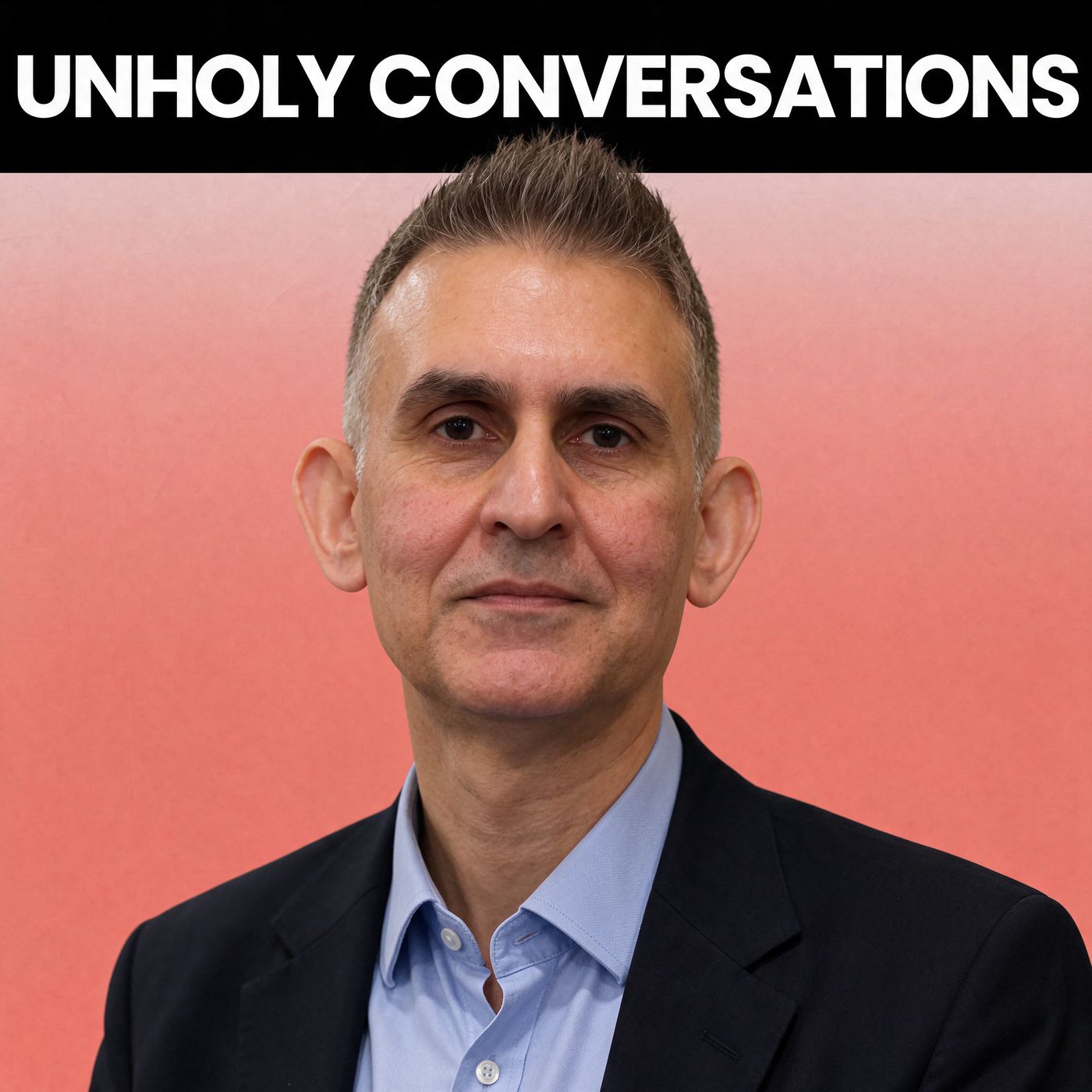
2:15Jonathan Sacerdoti: Kasim Kassam is Professor of Philosophy at the University of Warwick in England, the co-author most recently of How to Think About Terrorism, Reflections on Philosophy, History and Politics, which he co-wrote with the politics scholar Richard English. He is also, full disclosure, the man who was unlucky enough to teach me philosophy at university several long decades ago. That is a whole different podcast, Jonathan. It's a whole, it's a spin-off, it will do well. Professor Kasim Kassam, welcome to Unholy. Oh, it's great to be on the show, finally. Because I know you are a devoted listener, which we are honoured by.
2:53Jonathan Sacerdoti: So you didn't begin, I know this firsthand, specialising in this area. But in recent years, you have studied extremism, taught a very blockbuster course at the University of Warwick, standing room only teaching about extremism and terrorism. I think it's worth explaining for our listeners something of your own personal background, but also your intellectual background, how you got into the subject and in a way how your views on the area we're going to be talking about evolved over time. Yeah.
3:27Quassim Cassam: Well, so I was a student at Oxford. I did a PhD in philosophy and taught at Oxford. And I was a very traditional type of Oxford philosopher working on, you know, the classic questions of philosophy. No interest in anything that was applied at all. And I got to my, I guess, my early 50s and started to think that actually I want to engage with the world a bit more, not just do abstract philosophy and only write for other professional philosophers. So I started to work on terrorism. I mean, I'd been interested in terrorism from 9-11 onwards, but the thing that was a turning point for me was actually reading the report of the 9-11 Commission, which I thought was a stunning piece of work, I have to say.
4:14Quassim Cassam: And as I read it, I thought, there's a whole mass of questions about terrorism, which sound to me as if they're philosophical questions, but they were questions that had rarely been addressed by philosophers. So to put it crudely, I saw a gap in the market, and it was a market that I actually very much wanted to be in. So that was really the start. And I've actually spent the last 10 years, basically, working on philosophical questions about extremism and terrorism.
4:43Yonit Levi: I think Jonathan was also alluding in his question to how you were brought up and your thoughts on Israeli-Palestinian conflict. But also, I'm interested in that you said the gap in the market.
4:54Quassim Cassam: Yeah.
4:54Yonit Levi: How does philosophy look at these questions different than, for instance, social sciences? I mean, what can we learn when we look at it through a philosophical lens?
5:05Quassim Cassam: Yeah. Okay. So just on the personal stuff first. So I'm an Ismaili Muslim born in Kenya. My father was a Marxist dentist, if I could call him that, who decided that the thing was to bring me up as a little Marxist as well. You know, part of his ideology was pro-Palestinian, anti-Israeli. And I kind of just absorbed that point of view. And I remember in the 1970s, you know, being hugely enthused by the early successes of the Arab side in the 1973 war, thinking the PLO were the good guys. But when I think back to it, I mean, none of that was based on any knowledge, whatever. I mean, it was completely, completely kind of tribal.
5:45Quassim Cassam: It's a bit like, you know, if your dad is an Arsenal fan, you kind of just grew up to be an Arsenal fan. It's just not like a question. And it was a bit like that. There wasn't really kind of a question. That was the source. But my views have, of course, changed dramatically over the years, particularly since I started working on terrorism and extremism. And October the 7th is a really, you know, a transformational moment for me, which we can talk about in a minute. But I haven't answered Yannit's question about, well, what can philosophy tell us about these things? So let me just give you a couple of very quick examples.
6:18Quassim Cassam: After 9-11, Martin Amish wrote a very famous article in The Guardian, in which he basically starts off by saying the problem with organizations like al-Qaeda is that they're irrational. So one question is, well, okay, is that true? And if it's true, what's the relevance of that? But you can't even begin to answer those questions unless you say, what do you mean by rational? Now, the questions about how you understand rationality and how it applies in these cases, they are classic philosophical questions, right? Second example, UK defines terrorism as having the purpose of advancing a political, religious, racial, or ideological cause.
6:55Quassim Cassam: Okay, well, what's that? I mean, so think about the Columbine High School massacre. I mean, did those two boys, did they have a cause? If they did, was it an ideological cause? Well, it depends on what you think an ideology is, and it depends on what you think a cause is. Those are not questions that a social scientist can answer. They're partly philosophical questions and partly legal questions. And my main collaborators in the last few years have actually been lawyers, in fact.
7:21Jonathan Sacerdoti: So there's that extra dimension that you bring as a philosopher, joining up with political scientists, with lawyers, grappling with extremism. And you'd been doing that in this post-911 sort of war on terror era. But as you said, sort of October 7 is a sort of transformational point. I want to sort of get to that. Because you recently have been at the centre of quite a fierce exchange. I mean, people imagine that the world of philosophy is terribly sort of gentle and serene and disputes about the knowability of a table in front of us and so on. But actually, this is, it can get very fiery. And this has.
7:59Jonathan Sacerdoti: It began with a paper you wrote called Peace in Gaza, question mark, that, you know, and I hesitate to summarize your work, but you argued that the notion that the war between Hamas and Israel might be settled with a peace agreement was fanciful, really, that that was something we couldn't really imagine, because the five conditions that would be required for such a deal was just simply not there. And therefore, the logic of that was actually more or less continued military action time. So just walk us through that argument about the conditions that are just not met, and then we'll get on to what the implications of that are and why it caused this row.
8:38Yeah.
8:38Quassim Cassam: So just a bit of background. So the UK's national security advisors, a guy called Jonathan Powell, published a book in 2014 called Talking to Terrorists. One of Powell's very striking claims is that it's always right to talk to terrorists, though it might not always be the right time to do so. And he thought that included even ISIS. And by talking to, he meant negotiating with. Now, for Powell, the model was the British government's negotiation with the IRA. That was a successful negotiation that brought an end to the conflict. So a question for me is, why wouldn't that model be applicable in the Israel-Palestine case?
9:18Quassim Cassam: So that led me to think more broadly about what are the conditions for settling a peace agreement by negotiation? So here are the five conditions. First of all, each side must be willing to negotiate and have the authority to negotiate. That's one. Each side must recognize the other as a legitimate interlocutor in a negotiation. There must be some element of mutual trust. There must be a willingness to compromise. That's the kind of fundamental. And there must be some possibility of third-party enforcement. Now, a couple of points there. First of all, on the issue of compromise, if you think about Hamas's ideology, I mean, the whole ideology is the ideology of no compromise, right?
10:04Quassim Cassam: Their covenant says that peace conferences and discussions, we reject all of that, and that the only way to settle this is by jihad, right? So So it's a maximalist organization in the sense that it, unlike the IRA, which actually did compromise. So that's one condition. I mean, the question of whether the Israeli side is willing to compromise or not, that's also an important question. On the question of mutual recognition, the IRA, although it fought a terrorist campaign against the British government, the IRA did not question the United Kingdom's right to exist. I mean, they were not campaigning for the non-existence of Great Britain.
10:45Quassim Cassam: And indeed, the FLN in Algeria were not campaigning for the non-existence of France. Whereas Hamas, what they want is the non-existence, the obliteration, as they call it, of the state of Israel. So this is an absolutely fundamental difference. So if somebody says, well, you should be negotiating with these guys, negotiating over what? They want you to die. They want you not to exist. Okay, so what exactly is the negotiation supposed to be about? So my thought is the IRA case is a fantastic comparator, because if you compare that case with this case, you see that there are really vital differences between the two cases.
11:25Quassim Cassam: And the Powell optimism about negotiations with terrorists, which is rooted in his own experience of the IRA negotiation, I think is not applicable in this case.
11:35Yonit Levi: And you do say that, you know, some enemies put themselves beyond the pale. Can you go into what, I mean, for Israelis, it's very clear, I think, what puts Hamas beyond the pale when they look at October 7th. But can you go into that? What is the difference, another difference between, you know, Hamas or the IRA, for instance?
11:54Quassim Cassam: Yeah, so I really like this expression that some terrorists are beyond the pale of dialogue and negotiation. So my view is that some terrorists are and some terrorists aren't. The thing about Hamas is that what it did on October the 7th was not just terrorism. it was also something that I would call horrorism. Now, horrorism is a concept that was introduced by an Italian philosopher called Adriana Cavarero 20 years ago. She defined it as a type of violence that goes beyond death itself. So the horrorist isn't merely content to kill because they think that killing would be too little. So what they're interested in is to bring about the dismantling, the demolition, the dismembering of their opponent by hands-on violence.
12:41Quassim Cassam: If you think about, you know, the preoccupation of ISIS with beheading, that's a kind of classic example of, you know, they didn't just kill their hostages, they beheaded them. And so what's really striking about Hamas is that it engaged in acts of mutilation and gross sexual violence, absolutely repellent sexual violence. And I think that is the sort of conduct that places it beyond the pale. I mean, even if you thought that the people who did that were not ordered to do it, even then, I think it would place Hamas beyond the pale. But there's actually quite a lot of evidence that they were encouraged as a tactic to commit the grossest atrocities on October the 7th.
13:27Quassim Cassam: And actually, this goes back to the thing about rationality that I started out with. because if Hamas actually wanted and indeed ordered its personnel to carry out these acts of mutilation and rape, an interesting question is, well, what would the rationale have been for that? Why would they have done that? What were they hoping to achieve by doing that? So the short answer to the question, you know, what's different about Hamas, what places it beyond the pale is look at what it did on October the 7th, leaving aside stuff that you'd done previously, October the 7th, in and of itself, placed it beyond the pale of dialogue and negotiation, in my view.
14:05Jonathan Sacerdoti: So you have that, this move from terrorism to horrorism. You have the fact that it isn't just about asking for a withdrawal from this or that territory, but its goal is the non-existence of its opponent. Both these things, in your view, separate it from previous examples, like Algeria, like Northern Ireland. and therefore you come to this conclusion in the light of those facts that negotiation or agreement is not possible and therefore you say, and this is important in terms of why there has a controversy has arisen, with what you then advise or say that Israel, almost the only route left open to Israel.
14:42Jonathan Sacerdoti: What is that?
14:43Quassim Cassam: If you remember in 2014, President Obama made a very famous statement where he said, our mission is to degrade and ultimately destroy ISIL by means of a counterterrorism strategy. I mean, nobody batted an eyelid when Obama said that. Maybe we thought, well, that's fine, right? Obviously, our mission should be to degrade and destroy ISIL, which the Americans did to a great extent. My view would be that the appropriate objective of the Israeli side should be to, to quote Obama, degrade and destroy Hamas. And I don't see actually what the moral difference is between degrading and destroying Hamas and degrading and destroying ISIL, not least because the methods that Hamas uses are identical to, or indeed in some respects, worse than the methods that are used by ISIS.
15:33Quassim Cassam: Now, of course, you then run into a whole bunch of questions, right? So, what about the impact of the civilian population of Gaza, right? We should obviously talk about that in a second. But just as a kind of a framing of the objective, I want to say that if you didn't object to Obama's formulation, and very few progressives did, as far as I can remember, why are you objecting to a similar formulation in this case? In both cases, lots and lots and lots of civilians died. I actually think that the reason that people find it objectionable in this case is that people have somehow convinced themselves that Hamas isn't as bad as ISIS, and therefore these measures are not justified in their case.
16:14Quassim Cassam: And I think that that's just that's just stupid, right? I mean, they obviously are as bad as ISIS, right? And you only have to look at what they did on October the 7th to see that.
16:22Jonathan Sacerdoti: Isn't the reason why some make a distinction is that ISIS weren't fighting, championing a cause about freeing territory from occupation, whereas Hamas say, obviously, it's just what they say. But their stated purpose, their stated causes, freeing occupied territory, there is no equivalent in the ISIS case. Therefore, people who oppose the occupation of Gaza, West Bank or whatever, think the cause is legitimate and therefore they'd be prepared to sort of look more benignly on the means than they otherwise would. Isn't it about the cause of the two different movements?
16:54Quassim Cassam: Well, I agree that there's a question of the means and there's a question of the ends. It seems to be that establishing a Palestinian state for Hamas is an interim objective in any case. I think they do have the wider objectives of ISIS in terms of a broader Islamic state or movement. So I agree that if you think of what Hamas is up to as simply a matter of liberating occupied territory, that gives it a kind of veneer of respectability, which, as you say, in the ISIS case, doesn't have. But that doesn't excuse the means that they use. I mean, one of the things I really try to do in my articles is to really highlight the sexual and gender-based violence.
17:33Quassim Cassam: A lot of people who are sort of somewhat sympathetic to the Palestinian cause have this incredible ability to avert their eyes from the evidence. You really need to kind of confront it and really think about what they did, particularly to their female victims. And that places it in a particular moral category that is different from other terrorist groups. I mean, of course, in the end, when I talk about continued military operations, I just mean the only option here is to get to the point where Hamas is, as I say, rendered politically and militarily impotent. So I'm not talking about total annihilation.
18:15Quassim Cassam: I'm just talking about making it the case that they no longer pose a threat either to Israel or equally relevantly to their own people who they oppress quite viciously, in my view.
18:29Yonit Levi: I couldn't agree more how some people in the world could avert their eyes from the sexual violence. And it's not, I think, only the fact that people think that ISIS is worse than Hamas. People think that Israel's actions in Gaza are worse than what Hamas did. And you write about that as well. And I do want to get into that controversy and that argument, quite a public argument that you had with the moral philosopher Jeff McMahon. Could you talk about that? What kind of happened? You wrote your paper. He wrote his. and could you walk us through that?
19:00Quassim Cassam: Well, you know, there's this old joke about academic debates being so vicious because the stakes are so low. I mean, this is not such a case. So I received an invitation completely out of the blue from this journal. I asked if I'd be willing to write an article about the prospects for a negotiated peace in Gaza. Now, I submitted my draft and I had a certain amount of pushback from the editor who I don't think entirely agreed with my line. But to his credit and to the journal's credit, they published it, which I think was quite courageous on their part. But what they also did without telling me was to share my draft with Geoff McMahon and to publish, along with my article, his response.
19:44Quassim Cassam: Now, Jeff McMahon is a very distinguished and very able philosopher of war, whose work I've cited in the past. I have no personal animus towards him. I think he's a serious philosopher. But I was really kind of taken aback by his response. He says, I mean, this is the central claim of his response, that everything horrendous that Hamas has done, Israel has also done, usually to a much greater extent. When I read that sentence, I almost fell out of my chair. I kind of thought, you must be kidding. I mean, you must be kidding, right? This is just nuts. And then, of course, the article kind of runs through.
20:25Quassim Cassam: Basically, the line is that, well, Hamas did some bad stuff, but it wasn't planned. It was just stuff getting out of hand. That was on the one side. And on the other hand, he seems to want to argue that Israel has committed acts of genocide and sexual and gender-based violence and terrorism that are far worse than anything that Tomás has done. I found this astonishing. I contacted the journal and asked if they would be open to a response, which they said they were. And again, I mean, this time it was harder. I think the editor had a tougher time accepting my response. But But reading between the lines, I think they are also under pressure.
21:07Quassim Cassam: But again, to their enormous credit, they didn't require huge changes to my argument. They required some changes. And they published the response. I've no idea what's going to happen next, whether there's going to be a response to the response, whether the debate will continue. But for my own part, I mean, I actually just reread those two papers of mine this morning. And I have to say, I stand by my arguments. I think on the other side, two issues that keep on coming up. One is the issue of genocide, which obviously is a fundamental question. And the other is the issue of proportionality. The question of whether the civilian deaths caused by Israeli military action, whether they're proportional, is one that keeps on coming up.
21:55Quassim Cassam: for most readers, they're going to be the two key issues, even after they've read all the stuff about sexual and gender-based violence.
22:02Jonathan Sacerdoti: Both your paper and Professor McMahon, you get quite empirical.
22:06Quassim Cassam: You get into what exactly did happen on October 7th, what is proven,
22:10Jonathan Sacerdoti: what was just, as it were, spontaneous eruption of individual violence and what was planned. It's not at some sort of very abstract plane. It's really quite tangible about what happened, as I say empirically. But just two things I'm going to put together. One is, you say, what is missing from McMahon's discussion is any attempt to empathize with Israelis or understand what it was like to be an Israeli on and after October the 7th. And empathy strikes me as an interesting sort of quality to demand in philosophy, because we imagine often philosophy to be this quite sort of bloodless abstract reasoning, where you just are actually almost taking out and stripping out emotion and compassion and actually just assessing things in a very cool, rational, intellectual way.
22:57Jonathan Sacerdoti: So I'm very interested in why empathy might be part of the equipment a philosopher should be bringing to this. But also, and I think it relates to what you said right at the beginning of our conversation about your own journey and your reaction to what happened after October 7th, and particularly the, quote, progressive response to it. Do you sense that the lack of empathy you identified in Professor McMahon towards Israelis and what they experienced on October 7th. Do you sense that goes much wider than him?
23:27Quassim Cassam: Oh, God, yeah, absolutely. Absolutely. I mean, just going back a step on the relevance of empathy. I mean, it seems to me that, you know, if you're interested in understanding other human beings, you need to make an effort to try to see the world through their eyes. I mean, even if you think that they're repellent and mistaken in all sorts of ways, you still need to try to work out why do they do what they do? And that means understanding how they see the world. As I see it, empathy is part of the project of human understanding. There's a big debate in social sciences, actually, between people who think the social sciences are just like the natural sciences, that it's just observation from the outside.
24:06Quassim Cassam: You're just trying to come up with empirical laws about the way that human beings behave. And then there's this whole other approach within the social sciences that talks about what they call festehen, which is a particular kind of trying to understand somebody from the inside to really engage with their subjectivity. In my work generally, I think that even when it comes to terrorists, I mean, even with something like Dr. Kroger VII, it's actually quite important to try somehow to get into the head of Yachiy Asinwa and try to work out what was he thinking, right? What was he thinking? Why did he order the attack in the way that he ordered it?
24:43Quassim Cassam: These are crucial questions. Now, in terms of the lack of empathy, I mean, look, I was in London on 7-7, right? For me, that day still lives on in my memory. It's just an absolutely unreal day, you know, such a vivid day.
24:59Jonathan Sacerdoti: You're referring here to the terror attacks in London on the 7th of July 2005. 2005, yeah.
25:05Quassim Cassam: Now, if you think about, well, supposing I was living in a country where 7-7s happened kind of regularly, you know, so thinking about the second intifada, so-called, where there were lots of suicide bombings, what would that be like? What would it feel like to be the citizen of a country that was subject to that kind of attack? Or then wind the clock forward to October the 7th. What were Israelis feeling that morning as they heard what was happening and suddenly realized that there was seemingly the possibility of the country being overrun by these terrorists? When you look at it that way, a lot of political discourse in Israel and a lot of the way that Israelis respond to the Palestinian problem start to kind of make some sort of sense, right?
25:53Quassim Cassam: Because you can think, well, yeah, I mean, if this was my daily experience, if there was this constant threat of terrorism, that's going to have a major impact. And what I thought was lacking from McMahon's work, and indeed was lacking from progressive responses to Seven Simpsons, any willing to just step back and just let Park all this stuff about the two-state, one-state, the resistance, and blah, blah, blah, right? Just put that to one side. Just look at this from a kind of human angle, right? And just look at this as something that was happening in real time to completely innocent people, many of whom were actually very sympathetic to the Palestinian cause and lived close to the border and did their best to maintain good relations with their neighbors.
26:38Quassim Cassam: And suddenly, they're massacred. I couldn't and in a way still can't get my mind around the failure of imagination, not just failure of imagination, but almost the policy of not trying to imagine what that felt like. Whereas when it comes to the sufferings of Palestinians, of course, there's huge imaginative resources that are devoted to what that would feel like. And I think that actually a lot of Israelis feel that too. I mean, it's not at all the case that Israelis don't think about it or don't care about it. I mean, I have Israeli and Jewish friends who are in agony about the impact on Palestinian civilians off the wall.
27:22Jonathan Sacerdoti: That's a kind of fundamental point, right?
27:24Quassim Cassam: That each side has got to be willing to see the world through the other side's eyes and to feel, in some sense, feel the other side's pain. If you can't do that, you have no hope of really understanding what's going on. And it also, it shows that you lack a certain kind of humanity. This isn't just a philosophical point I'm making. I think it's a kind of moral point I'm making.
27:48Yonit Levi: I mean, there's so many things to continue this conversation from what you're saying. I do want to kind of take that thread that says this spilled over beyond this conversation in a journal because it did hit your own position and the fact that colleagues, PhD students actually in your department wrote an open letter condemning you and calling your colleagues to sign that. Could you talk a little bit about that?
28:11Quassim Cassam: I have to say, I mean, I've been I sort of been expecting something like this to happen for the last two or three years. And if you ask my friends, they will tell you that I've been saying that I've always had this concern at the back of my mind. Well, it finally happened when I was when I was informed that three teaching assistants in my department had written an open letter condemning me. And it's very clear that this is a moral condemnation. So it's a letter that's impugning my moral character as well as my academic judgment. And they circulated this letter to all my colleagues, inviting them to sign it and so to endorse their condemnation of me.
28:50Quassim Cassam: And they are threatening to publish this letter in an unspecified venue. Now, I mean, obviously, it's kind of pretty unpleasant, right, in a workplace, you know, to know that people are actually your colleagues. I mean, there's a teaching assistant. They're not just students. They're teachers who are embarking on what I regard as a kind of campaign of intimidation. I mean, that's what, you know, that's what this is all about. and in other places of work, I mean, if employees in, you know, Channel 12 or whatever it is, suddenly decided to write a letter denouncing one of their colleagues as effectively a wicked person and then circulated it to everyone asking them to sign it.
29:32Quassim Cassam: I mean, I would hope that the management would think this wasn't really, this wasn't proper behavior, but this is a sort of thing that one has to contend with. And the thing that's so striking about The Open Letter is that it doesn't actually engage with any of my arguments. I mean, it's emoting, you know, and condemning. It's a lot of, we don't wish to be associated with this person. We condemn his arguments, which are incompatible with principles of dignity and humanity and so on and so forth. As things stand, it's not really clear how the university is going to respond to this. I mean, they're considering how to deal with this.
30:08Quassim Cassam: But on a personal level, oh, of course, it's unpleasant, right?
30:11Jonathan Sacerdoti: What do you think this move, this open letter denouncing you, tells us about the way Israel is seen by elites, especially younger ones, the next generation of graduate students and would-be philosophers around the world? Does it tell us something wider? And here I'm going to link it to something which was almost an aside in one of your papers, because I think they're linked, and I just want to see if you think they're linked too. You're comparing the reaction to the war in Gaza with, for example, the suppression of the Tamil Tigers in Sri Lanka. And you say, very boldly, international opinion cared little about civilian deaths in Sri Lanka, but cares a great deal about civilian deaths in Gaza.
31:01Jonathan Sacerdoti: You state it there quite boldly, that essentially some lives matter and some lives don't, is another way of putting it. I wonder if that links a little bit to what this open letter about you tells us about the next generation of, or even just elite opinion in general.
31:17Quassim Cassam: Well, I think what it reveals is that there's a kind of perception of Israel as somehow uniquely evil, uniquely diabolical. Here's my evidence. So, I think you've had Simon Sebag Montefiore on Unholy. Yes. I've just read his book, The Cauldron. it's an astonishing book because it's sort of the history of the Middle East roughly from 1900 to now. There are just accounts of the most appalling massacres and genocides, some of them very, very recent. So in January this year, the Iranian regime murdered up to 40 ,000 protesters in a very short space of time. In Darfur, you've had the murder of 300 ,000, 400 ,000 black Africans as part of a genocide.
32:08Quassim Cassam: Going further back, you had 40 ,000 people killed in Syria by the Assad regime, which the cauldron described as an abattoir state in Syria and Assad. And my question is, okay, where were you guys, this is addressed to the young, right? Where were you guys when this was happening? They weren't around with Syria. But what about Iran? That was recent. So it's very, very striking that of all the civilian deaths that get their attention, it's civilian deaths that are caused by Israeli military action. They are the ones that they focus on. And they have no interest in other civilian deaths that are on an equally large or larger scale.
32:54Quassim Cassam: They're concerned by genocide. Well, okay, there's an actual genocide in Darfur. Why are you not talking about that? Then the issue is, okay, so obviously it can't just be kind of coincidence. Israel is being singled out. There are two possible reasons for it being singled out. One is it's a Jewish state, so that may well be part of the explanation. But I think it's more than that. I think it's also that Israel, in the eyes of many young people, is a symbol. It symbolizes things that they disapprove of. So it's a kind of scapegoat. The philosopher René Girard has this whole theory about scapegoating.
33:35Quassim Cassam: Scapegoating is where you place your sins, you project your sins onto the scapegoat. And I think in the case of Israel, it's colonialism, in the form of settler colonialism. You have genocide. You have apartheid. These are seen as the historic sins of the West. The result is a kind of collective self-loathing. And then you kind of see, you kind of think of Israel as embodying or exemplifying the sins of the West. And I think this idea of the scapegoating of a particular country, which then becomes a kind of lightning rod for all these sins, I think that's a very interesting idea, but I would want to note all of you guys who are so concerned about civilian deaths and genocide and so on.
34:22Quassim Cassam: I want you to tell me why you focus on this one case to the exclusion of the others. Why don't these other cases interest you? And the answer had better not be, yeah, because, you know, Israelis are Jews, right?
34:36Yonit Levi: That's disappointing intellectually if that would be the answer.
34:38Quassim Cassam: Yeah, yeah, right. So what, you know, so what, I don't get it, right? This is my problem. At some deep level, it's all appalling. They should all sit down and read the cauldron for a start, just to get a sense what has happened and what is happening throughout the region. Then explain to me why they've singled out this one case.
34:58Yonit Levi: I'm going to try and do something presumptuous, which is take my hard drive of studying philosophy and connect what you have been doing for most of your life. The question of how we know what we know, which is very relevant, I think, to the case of Gaza, which people can look at the same picture and see completely different narratives. And maybe that speaks about the issue of genocide. People have been using it and throwing it around as if it is true. And, you know, obviously media outlets have. Do you think this is a breakdown of moral values? Is it a breakdown of philosophical values? What is happening here?
35:31Quassim Cassam: Certainly a breakdown of moral values insofar as people are unwilling to actually contemplate what it feels like to be on the wrong side of this situation. Philosophically, it's interesting, too. I mean, so take the word genocide. The charge of genocide, this is a really serious charge. I wonder how many people who accuse Israel of genocide actually know what the definition of genocide is in a legal sense. How is it defined? What would the evidence need to be for it to be genocide? Often the answer you get is, well, never mind about all that. 73 ,000 Palestinians died. It's got to be genocide.
36:05Quassim Cassam: But then the obvious thing to say about that is, well, by that measure, all wars are genocidal, right? I mean, if it's just how many people were killed or even how many civilians are killed, then of course, pretty much every 20th century war, at least since the Second World War, has involved a large-scale killing of civilians. So for this to really be genocide, I mean, if you're serious, let's just look at what genocide needs, right? So if you think about the concept of genocide, it's acts committed with the intent to destroy in whole or in part a national, ethnic, racial, religious group. So in other words, it's not enough to be genocide that you kill 100 Irish people and they're all Irish.
36:48Quassim Cassam: You've got to be killing them because they're Irish. That's what genocide is. And of course, one of the most difficult kind of legal challenges is to demonstrate intent. So genocide is all about intent. So there's this thing called the dolus specialis, which is the intent that distinguishes genocide from other crimes. The question to ask is, okay, so where is the evidence of genocidal intent in this case? And the only answer one usually gets is, well, there are all these extremists, far-right extremists in Israel who make genocidal pronouncements.
37:25Jonathan Sacerdoti: But they're not the government.
37:26Quassim Cassam: And they certainly were not the people who were in charge of the IDF in the Gaza war. Look, I'm not foreclosing the issue of genocide. All I'm saying is that if you're going to accuse anyone of genocide, you need to produce evidence of genocidal intent. And the difference between Israel and Hamas is that in the case of Hamas, there is evidence of genocidal intent, which is their repeated statements, starting with their covenant, but up to the present day, that we are going to slaughter you. we are going to obliterate you. So you have strong evidence of genocidal intent. So going back to Yorinid's question, I mean, I guess there's a kind of lack of seriousness in the discussion of these issues, which is really, really disappointing, especially when the people carrying out these discussions are highly educated, right, and ought to sort of ought to know better.
38:15Quassim Cassam: Another example is proportionality. In my lectures, one of the lectures is about the operation against ISIS. So I start off by saying to my students, okay, so what do you think proportionality is? Now, at that point, there's usually kind of stunned silence. So I say to them, okay, supposing that someone comes and kills a thousand of your civilians. Okay. So does that mean that it's proportional if I go and kill a thousand of theirs? Is that what you mean? So most of them can kind of see there's something a bit, that doesn't sound quite right. right so you then kind of think okay so well what what do you mean by proportionality right and then i kind of go through how proportionality is understood in the laws of war uh how it's understood even by philosophers like jeff mcmahon and then you start to see that actually it's you know it's kind of complicated right and the proportionate what is or is not proportional actually is always a matter of of judgment so for jeff mcmahon the bad effects of war must not be excessive in relation to its good effects.
39:19Quassim Cassam: Well, what do you mean by excessive? What do you mean by bad effects? What do you mean by good effects? I'm not criticizing his definition. I'm just saying proportionality is not a mathematical concept. This is what I try to convey. It's not you killed X, they kill X, where X is the same number, and then it's proportional. That is just not how it's defined. And I think that the way these questions get discussed very often betrays a lack of understanding of key concepts, like genocide proportionality, real lack of even interest in trying to understand these concepts. And as a result, discussions and debates that are just kind of profoundly unserious, and it's the unseriousness of the debate that strikes me as really worrying, particularly when the people engaging in these debates are supposed to be educated I mean, isn't it your job, right, to engage in serious analytical thought about kind of complex questions?
40:20Quassim Cassam: I mean, it's not good enough to say, well, you know, we don't have to get into all the ins and outs of all this. Just look at the number of people who died. Well, we do have to get into the ins and outs of all this.
40:29Jonathan Sacerdoti: Hearing you say the words, it's not good enough, gives me flashbacks to sitting opposite you, having read my essay to you in a tutorial. But then as now, I always felt at the end of a session that I had 20 more questions. I feel exactly that now. We could keep going. Time is though against us. Professor Kasim Kassam, thank you so much for talking to us for Unholy. It's been a pleasure. Thanks, Jonathan. Thanks, Junit.
40:58Yonit Levi: I'm so glad we finally had him on. Of course, I was left lacking in the what kind of student you were department. I'm going to be waiting for that. But I think the conversation about the lens through which he sees the term genocide, or how, you know, these terms, the way that he sees them from, again, from a philosophical perspective, and how he speaks about people who are supposed to be educated and aren't. And this debate, and again, we said it, he's paying a price for speaking out on these issues.
41:28Jonathan Sacerdoti: I was really as well fascinated. Yes, he really is. And the fact that he was talking candidly about that. But also the appeal he makes for qualities that you wouldn't automatically associate with philosophy. We have this exchange about that, but, you know, saying empathy, see this through the eyes of other human beings. How would they feel? How would you feel if you were in these positions? This is not some sort of detached engagement with this conflict, but rather saying the way to actually gain a deep, insightful, philosophical grasp of what's at stake here isn't just, you know, mugging up on the ancient philosophers about just war theory, it's actually just being human about it and putting yourself in their shoes.
42:12Jonathan Sacerdoti: And if you did that, you would then see this very differently. Also, and I don't know whether I knew this about him when I was taught by him, but his own upbringing, you know, he is from a very particular sort of branch of Islam. His father was a Marxist. He thought that, as he said, and I've written on this quite a bit that you people have allegiances in this akin to football loyalties where they're your team and you're happy when they do well and you're sad and you're happy when the other side does badly it's such a wrong way to look at this conflict you know which often i've said it's not clash of right and wrong it's a clash of right and right the clash between israelis and palestinians it doesn't help when people just you know want to chant slogans and wave their scarves as if they're at a football match.
42:56Jonathan Sacerdoti: It doesn't get to the tragedy. And that message of just try and feel the pain of everyone involved, as I said, wasn't what you'd automatically associate, in my mind, with philosophy, but really insightful. And we are grateful to Professor Kasim Kassam for that conversation.
43:13Yonit Levi: We are indeed. And we will say a big thank you to Nir Lai Stan, Michal Porat, and we will meet at the end of the week, Jonathan, as usual.
43:20Jonathan Sacerdoti: I'll see you then, Yonit.
43:25Thank you.
Yonit and Jonathan sit down with the eminent philosopher Prof Quassim Cassam, to discuss his journey from being the son of a Marxist radical, supporting the PLO the way a child supports their parent's football team, to a thinker for whom 7 October changed everything. He explains why he believes hope of a peace agreement for Gaza is fanciful, what progressive opinion misses about Israel, what the word genocide really means -- and the one essential quality for any real philosopher and for any true human being.
🌐 Our website: https://unholy-podcast.com
💛 Become a friend of the pod:
Patreon: https://bit.ly/UnholyPatreon
📺 FOLLOW UNHOLY
YouTube: https://www.youtube.com/channel/UCGlvtS7As7WHh7YtmU5SMUQ
Instagram: https://www.instagram.com/unholypodcast/
X: https://x.com/unholypod
Bluesky: https://bsky.app/profile/unholypod.bsky.social
🎧 LISTEN TO UNHOLY
Apple Podcasts: https://podcasts.apple.com/il/podcast/unholy-two-jews-on-the-news/id1548441108
Spotify: https://open.spotify.com/show/2m2UnLfiAyOehtF1bsv98W
🎙️ THE HOSTS
Yonit Levi
Instagram: https://www.instagram.com/yonitleviofficial/
X: https://x.com/LeviYonit
LinkedIn: https://www.linkedin.com/in/yonit-levi/
Jonathan Freedland
Instagram: https://www.instagram.com/jonathanfreedland/
Bluesky: https://bsky.app/profile/jonathanfreedland.bsky.social
📩 Contact: unholy@unholy-media.com
🔗 All links: https://linktr.ee/unholypod
Hosted by Simplecast, an AdsWizz company. See pcm.adswizz.com for information about our collection and use of personal data for advertising.
Scan the code with your iPhone camera
Listen in the app.