 unPAUSED with Dr. Mary Claire Haver
30 Oct 2026 · 37m

 Add vo to ChatGPT or Claude to ask about everything you hear
vo listened to this episode to put together the overview and transcript, so there may be the odd mistake.
Breast cancer risk assessment and screening (family history, genetic testing, dense breasts, mammogram radiation), plus menopause and hormone therapy for “previvors,” and survivorship issues (bone health, chemo brain, heart/cardiovascular risk, mental health, body image).
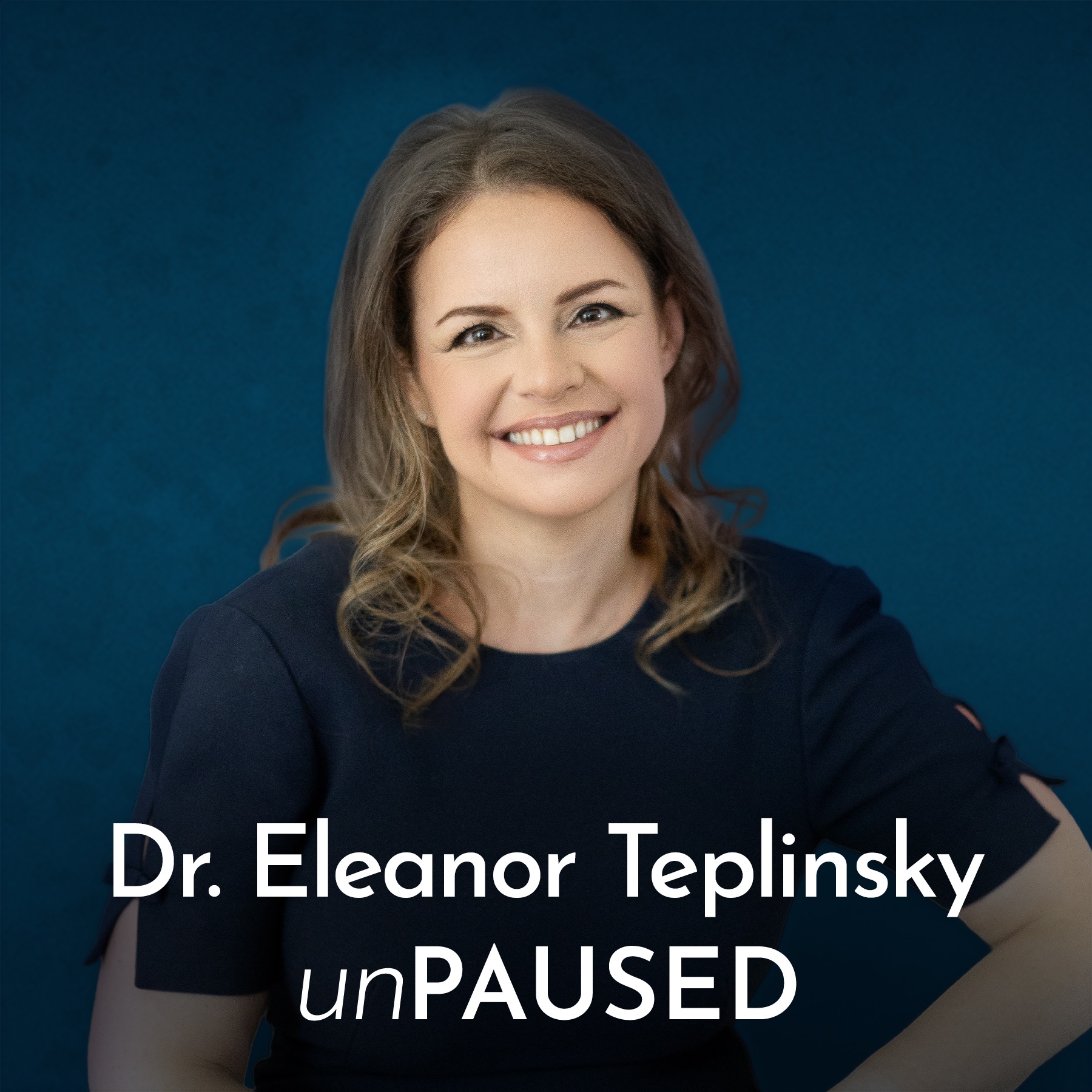
Dr. Eleonora Teplinsky (breast cancer/high-risk counseling; discusses models like Tyrer-Cuzick, genetic mutations, screening escalation, and menopause care). Host: Dr. Mary Claire (leads Q&A; mentions her own family testing experience and midlife/fitness platform).
Family history is often misunderstood; multiple young diagnoses suggest hereditary syndromes (about 5–10% of breast cancers are hereditary). Risk assessment should start around age 25; Tyrer-Cuzick can flag lifetime risk ≥20% for supplemental MRI/ultrasound. Dense breasts both can be harder to see and may increase risk; category D (extremely dense) often warrants MRI. Mammogram radiation is low (compared to weeks of background). BRCA carriers have up to ~80% breast cancer risk; hormone replacement can be used in BRCA previvors after ovary removal, with data suggesting estrogen-only may be protective.
BRCA1/BRCA2 counseling; direct-to-consumer tests (full-body MRI, blood “signal” tests) shouldn’t replace evidence-based screening. Premature menopause increases cardiovascular/cognitive/musculoskeletal risks; bone density baseline after chemo/endocrine therapy; exercise/strength training and fall prevention. Support groups and “mirror program” for body image.
0:03Dr. Mary Claire Haver: The views and opinions expressed on Unpaused are those of the talent and guests alone and are provided for informational and entertainment purposes only. No part of this podcast or any related materials are intended to be a substitute for professional medical advice, diagnosis, or treatment. There was so much ground to cover with Dr. Eleonora Teplinsky that we decided to split the episode into two parts. If you missed part one, I hope you'll go back and listen. But for now, here's the rest of our conversation.
0:41Dr. Mary Claire Haver: Let's talk about family history. There's just so much misunderstanding there. A woman with a family history of breast cancer is told she can never touch estrogen. Why? All the time. And again, it feeds into that fear, right? It comes back to that 26 % headline. And so we really have to break down family history. To me, family history is a prime time to understand your breast cancer risk. So first of all, family history is very different. Grandma at 85 with breast cancer is very different than five women in your family under 50 get diagnosed with breast cancer. Help our listeners understand this.
1:16Because to me, many relatives at a younger age is really suggestive of a genetic mutation or a hereditary cancer syndrome that increases cancer risk. Now, it's not to say that if you have a genetic mutation, you can't have hormones, but it's an opportunity to genetic testing to understand your breast cancer risk to make the right screening protocol and everything.
1:41Dr. Mary Claire Haver: So I have patients who over the years have not been aggressive about getting their mammograms because they're like, I don't have a family history. It's really not going to. Is that a mistake? 100%. Most breast cancers are not hereditary. So what percentage are? But 5 to 10 of breast cancers are hereditary. 5 to 10 %? Mm-hmm. Percent. And so the majority of patients will not have a family history. And so it's a common misconception that I can't get breast cancer if I didn't have, you know, a family history or a genetic mutation. And so I think as we're thinking about starting hormones, we do want to make sure that someone is up to date with their breast cancer screening, because certainly if there's something there, we don't want to give it then hormones, right, that could fuel the growth.
2:26And so family history, I think, is a great time to think about, okay, what is your breast cancer risk? Are you up to date with screening? have you, and, you know, if you're at higher risk, then maybe we should be adding supplemental imaging to your screening. And we use all of that to make decisions and, you know, and recommendations about hormone therapy. So who should be having genetic testing? Well, really it starts with having a breast cancer risk assessment. And this really should begin at 25. It's not happening, but it should start at age 25. And - Okay. What does that look like? Is this one of the like computer things you go online?
2:59Some of them, yes. So there are a number of different ways to assess breast cancer risk. The most publicly kind of available and talked about is the Tyra Cusick model. This is free and publicly available. Anyone can Google it, log on, and you start inputting your, you know, the questions that it asks you. When did you start getting your periods, your family history? Some of the questions are a little bit outdated, but, you know, dense breasts, it goes through all of this to really try to understand your breast cancer risk. It's not perfect by any means. It misses people. It doesn't take into account lifestyle, but it does at least identify those that are at higher risk.
3:40Again, it misses people, but if it picks up that you have a lifetime risk of 20 % or greater for being diagnosed with breast cancer, then you're considered higher risk. And what that really means is that we should be thinking about your screening a little bit differently. So maybe mammogram alone is not sufficient. Maybe we're going to add MRI or ultrasound to that.
4:02Dr. Mary Claire Haver: Who makes that decision? I don't make that decision in OBGYN. It's generally going to be a high-risk breast surgery program. So if you are sitting with the patient, they do a risk assessment. And again, Tyra Cusick is one of them. There are many available. And Tyra Cusick isn't really for that 25-year-old woman. For that 25-year-old woman, we're thinking of, is there a very strong family history for patients who had childhood radiation for lymphoma, for example, they may be at higher risk. So we're kind of thinking through a little bit and then we reassess that risk. So if you're sitting with a patient and you have determined that they are at higher risk of breast cancer, we recommend referring them to a high-risk breast cancer program.
4:45Where would you find one of those? Most institutions will have them. Like a big academic center? Not even. Most places that have a cancer center will have a high-risk program. But if you are not sure, if you're listening to this and you're a patient and you say, well, I just went online and did my risk and it's 20 % and I don't know who to turn, easiest place is to call, you know, ask for a referral to the breast surgeon in the practice and in the group. And then the breast surgeon can help take it from there.
5:12Dr. Mary Claire Haver: So what are the, just for our listeners, what are, I know, BRCA, what are the big genetic risks? So BRCA mutation is going to be the most common, but there are other genetic mutations that increase cancer risk. Some of them include CHECK2, ATM, PALB2, among others. This is not a comprehensive list. But the goal is, so if you go, you know, first of all is, do you need genetic testing? And that really is, what does your family history look like? And thinking about family history more than just your mom and your sister, because some will say, oh, my mom didn't have breast cancer, I'm good. But maybe there are men on her side of the family that had prostate cancer at an early age could suggest a hereditary cancer syndrome.
6:01So when we think about family history, both mom and dad side, multiple generations, multiple degrees of relatives. And if there is a concern, we go for genetic testing, which would look to identify if you've inherited a mutation that increases your breast cancer risk or other cancer risk. Based on that mutation, each mutation carries its own cancer risk. You'll be guided on what do you do from here? Do you need to have a conversation about risk-reducing surgery? Do you need to have a conversation about high-risk screening? Do you need to talk about other screening for other cancers like ovarian or melanoma or pancreatic?
6:39And so think of all of this as information gathering to help you make an individualized plan for yourself.
6:46Dr. Mary Claire Haver: So you talked about the most common, the BRCA gene. How would you counsel a patient who has this gene? Like, what does that conversation look like? So depending on there's BRCA1 mutations, BRCA2 mutations, depending on which one, you know, there's going to be a slightly differing risk of cancer risk. But carrying a BRCA mutation has an up to 80 % risk of being diagnosed with breast cancer. And because that risk is very high, we do recommend a risk-reducing mastectomy or at least a discussion of that. For women over 65, that benefit of mastectomy is not as strong. So for some patients, we don't do it.
7:23We'll do high-risk screening with mammogram alternating with MRI, but it's a conversation. So everyone needs to have a conversation of what your breast cancer risk is, and then how can we lower that risk, whether through risk-reducing surgery or higher-risk screening. And everyone makes different choices based on that. Now, not all genetic mutations are going to have such high risk. So not all genetic mutations require a bilateral mastectomy. Some people listening to this will say, oh, I have a mutation, but it was never discussed with me. And that may be because you don't have one of these very high risk genetic mutations where it would be recommended.
8:02Dr. Mary Claire Haver: I got an advertisement for Function Health. Seems like a great program. Specifically, they talked about ordering a the Pernuvo scan, which is a full body MRI, not ordered by a doctor, you know, just for screening purposes, and something called the gallery test. And given my family history, I'm curious, right? And how do you, where does that fit into breast and gynecologic cancers? Yeah, great question. These, you know, advertisements and direct to consumer marketing is everywhere. So we have, you know, full body MRI, and then we have blood tests like Gallerate, and there are others that kind of promise to detect a cancer signal with a drop of blood or, you know, a vial of blood.
8:45And these are very interesting technologies, you know, and I get it, right? You want to know, like, why wouldn't you want to know, right? I want to know. But I think we have to be really cautious with it. So for the blood test, they are really looking for a signal that there could be something there. There can be false positives, there can be false negatives. They don't often detect a very early stage breast cancer or early stage cancer that may not be in the blood that's just confined to the breast. And they should not replace screening. So if you take, let's say, do a gallery, and I've not done it, but if you do one of these tests and it shows a signal, then you kind of have to go hunting.
9:18Well, where, you know, you have to get additional imaging, you might need biopsies. So we really have to understand the limitations, the risks, and the benefits, and the same thing with full body MRI. But I think the bottom line is that they should not replace proven, you know, evidence-based cancer screening, like mammograms, colonoscopies, pap smears, and so forth.
9:40Dr. Mary Claire Haver: Yeah. I had upper and lower GIs for my brother with esophageal cancer. And I did do the gallery test. And for me, I knew the limitations. Of course, I'm a physician. But I have to say, it just, I slept a little better, you know. And I know it only tells you what's in your blood right now, but it's always a fear in the back of my head. And if it relieves some of that anxiety, and I could afford it, right? Exactly. I don't think there's anything wrong with doing the test. I think I'm more worried that we're doing it and that some people are relying heavily on that without doing - And then skipping their screening.
10:18Skipping their screening. And then I think we still have questions before we can recommend it to everybody, right? Cost and how often should we do it? But I think for the right person, you know, it could be really helpful. And then also, I think what you kind of said, well, you have a very strong family history, right? That's different. And so I think it's something we should be discussing individually, but we're not there yet where we're recommending it to across the board. So let's go back to breast cancer prediction models, Tyler Kuzik, which I've gone online
10:44Dr. Mary Claire Haver: and done my own. But there's also the Gale model. What do you use in clinic? And are there some that are really only should be used by oncologists? Yeah, there's not a perfect model. So we used to use Gale for a long time, and then we kind of switched to Tyra Cusick, because Tyra Cusick also includes breast density, which is important because if you have dense breasts, which you can only tell on a mammogram, but if you have dense breasts, that does increase breast cancer risk. Tyra Cusick may overestimate, you know, and so there's no perfect model. The one I use is Tyra Cusick, but there are a lot in development.
11:19And here is where AI actually may be very helpful. There's some new technology. One is called Clarity, where they're using AI image-based risk assessment to predict your breast cancer risk from a mammogram. So Clarity will be able to give you, they're piloting it right now in Massachusetts, will be able to give you your five-year risk of breast cancer from one mammogram. From an image. From an image. Wow. And the guidelines just changed to say that they would consider, you know, they would cover this, or the guidelines would recommend it starting at age 35.
11:54Dr. Mary Claire Haver: Eleanor, you just said something that I was like, wait, that I was under the assumption, and maybe I read this or just assumed it, so correct me, that dense breast made it more likely for your breast cancer to be missed because it was harder to see on mammogram rather than a dense breast increasing your risk of breast cancer. Both. Wow. And we don't entirely know how dense breasts increase breast cancer risk. There's a lot of research going on, but it's both. So not only does it - So should I be getting an MRI? Well, if you have dense breasts - I do. 50 % of the population does, then you want to talk to your team about whether you should be getting an ultrasound or an MRI, because then we're going to look into your lifetime risk.
12:40If your lifetime risk is 20 % or higher, we might go with MRI. Because again, also for everyone listening, it really depends on coverage and everything. The guidelines currently say there's not enough data to broadly recommend an MRI or an ultrasound if you have dense breasts. But I will tell you, we know that they can miss things. You know, mammogram is not perfect if you have dense breasts. So I do really encourage people to have that conversation with their doctor about, I have dense breasts. And the category of dense breasts matter. So if you are category C, Heterogenously dense, that's about 40 % of the population.
13:18Category D is extremely dense, which is about 10%. And for category D, we really do recommend that MRI. Category C is going to be, you know, user dependent.
13:31Dr. Mary Claire Haver: I've definitely bought my share of makeup products that I was sure I use all the time and then barely touched again. The Jones Road Miracle Balm is different. It's one of those products I find myself reaching for when I want my skin to look fresh, healthy, and glowy without having to do a whole makeup routine. Every formula is packed with skin-nourishing ingredients, and I'm so excited to share that Jones Road has launched the Bobbi Kit 6.0. Curated by makeup legend Bobbi Brown, this exclusive edit takes all the guesswork out of your routine. It includes the new Silky Highlighting Powder with a highlight brush, the new Lip Crayon, Mini Miracle Balm, and the Statement Mascara.
14:16Dr. Mary Claire Haver: Every single bobby kit over the last five years has completely sold out, so you definitely want to grab yours now. Modern makeup that's clean, strategic, and multifunctional for effortless routines. For a limited time, our listeners are getting a free full-size mascara on their first purchase when they use the code UNHAUSED at checkout. Just head to jonesroadbeauty.com and use code UNHAUSED at checkout. After you purchase, they will ask you where you heard about them. Please support our show and tell them our show sent you. Get into a fall state of mind with Pura. Start the season with a free Pura Plus Home Diffuser when you subscribe to Two Cents for six months.
15:00Dr. Mary Claire Haver: Choose from seasonal and best-selling fall fragrances. Swap your scents anytime and set a custom schedule so your home always feels like a crisp, cozy autumn day. Bring the scents of fall like pumpkin, apple, and vanilla home with this exclusive offer only at Pura.com.
15:21Dr. Mary Claire Haver: What about concerns, I see this online, about radiation from mammograms? Yes, very, very common. and lots of misinformation about that. And I think that's why there is such an interest in like alternative, you know, test to mammogram. But it's really the equivalent of walking, the radiation from a mammogram is the equivalent to about six or seven weeks of the background radiation you get exposed to just from walking around the street, the neighborhood. So it's there, it's not, you know, but it's low. And we think about what you get, the benefit, right? We do feel generally that the benefit outweighs the risks.
16:02Dr. Mary Claire Haver: So for the previvor, so a previvor, let's define that for our audience, because I don't know if everybody understands. It's a carrier who's never had cancer. Yeah. So it's really, it's either for somebody who's, they've never been diagnosed. They either carry a mutation or they have a very strong family history of cancer. So she has elected to remove her ovaries at 38, right? Everybody agreed this is your best course. What are the real options for managing her menopause now? Yeah. Because we have put her into surgical menopause prematurely, which is a very high risk condition. And I will tell you that so many women delay their life-saving, risk-reducing surgery or avoid it because they're afraid of this very thing.
16:50But here's the thing, previvors can absolutely use hormone replacement therapy.
16:56Dr. Mary Claire Haver: Explain that. I don't think women understand this. Yeah. When Corinne Men told me that she was going, you know, like, I just assume once a breast cancer patient, always a breast cancer patient, no hormone therapy. Like this is me five years ago. And that she had gone on hormone therapy. And I was like, what? So previvors, and we have data, this actually very new study. Let's say you have a BRCA mutation, okay? We'll just kind of highlight the wounds. We have a 38-year-old woman. She has a BRCA mutation. Her breasts are still intact. She has not had a mastectomy. And she goes and has her ovaries removed to reduce her ovarian cancer risk.
17:34And she's plunged into menopause. We can absolutely use hormone therapy. There was a recent study by Joanne Katsopoulos, I believe, that they had over 600 women who, these were all, you know, previvors, hybride mutation carriers, BRCA mutation carriers who had this very same thing. They were in menopause because it's always removed. They had their breast tissue intact. So they had not had a mastectomy and they had about over 600 women who were given hormones. And then they had over 600 women who were not. And the ones who used hormones had, if they were on estrogen alone, they actually had a lower risk of breast cancer.
18:11But if they were on estrogen and a progestogen, they did not have a higher risk. So that's a little bit different than what we've seen with - Yeah, so it was equal risk versus protective. Exactly.
18:23Dr. Mary Claire Haver: Why would a woman take out her ovaries and not her breasts? Great question. I think we generally do recommend having the discussion for both, but everyone is different. And some people say, think about how much goes into risk surgery, right? Being a previvor is so hard. We don't talk about this nearly enough. You have to make these crazy decisions, these hard decisions about surgeries. Fertility. Fertility, menopause, cost, insurance. And then there's always this voice. People get told, why are you doing this? You don't even have cancer. There's so many people that get told that. So these are hard decisions to make.
19:05And a mastectomy is not, you know, it's a hard surgery. Reconstruction is hard. And so it's very common to kind of say, maybe I'm going to do this and I'm going to do the mastectomy in a few years. But the point being is that that study really showed us that you can be at higher risk for breast cancer due to a genetic mutation and - Keep your breasts. Keep your breasts and not have a higher risk of breast cancer. And so these women also kept their uteruses. So we don't know, but the ones that, presumably the ones that had estrogen alone had their uterus removed. And we don't know about the ones that were on progestogen.
19:43We also don't know what kind of progestogen they were on.
19:47Dr. Mary Claire Haver: What do you think an IUD, the progestin-containing IUDs, have a place here? Well, I think, you know, what's interesting is that the conversations also around risk-reducing surgery are changing. So it used to be everyone had their ovaries and fallopian tubes removed, and that was it. And I think there's much more of a conversation now about, is there a role for hysterectomy? You know, because there's some data, it's very early, it's very observational. But for some BRCA mutations, there could be a higher risk for uterine cancer. Again, very premature. But it's something that - For an endometrial.
20:19For endometrial. So we should be thinking about that or at least having the conversation. But yes, a progesterone, you know, an IUD could be an option as well. So I think the point though is that women need to have counseling about these options before they have the surgery, right? Have a very clear plan of you're going to have your ovaries removed. What are we doing when you come out of the OR?
20:40Dr. Mary Claire Haver: Yeah. Okay. And they're not getting that. Just quickly, and I don't want to scare our listeners, but if she doesn't get that conversation and she is sent off into the world in premature menopause, what is she at increased risk for outside of recurrence? Absolutely. I mean, there are going to be impacts on both short and long-term health. We know that if you go into premature menopause, especially before the age of 45, there are higher risks of cardiovascular and cognitive and musculoskeletal health. But I always say this message. And so for that previvor, even if you weren't put on hormones, you can go on them later.
21:16It's never too late. But for our listeners who maybe have decided with their team that hormones are not the best option, I always want to stress that you're not doomed if you can't go on hormones because hormones are just one part of comprehensive menopause care.
21:29Dr. Mary Claire Haver: So she can protect her bones, you know, through weightlifting. There's other medication, you know, like, but that, but it needs to be addressed, right? Exactly. And you need to have a preventive plan. You know, are we doing our bone density? How are we screening for the heart? How are we addressing brain health? That comprehensive plan for everybody, hormones or not, needs to be discussed. Okay. Let's talk about women of color. Are genetic testing outcomes different for them? Do they deserve the same tests? Well, what's interesting is that access and conversations about genetic testing differ for women of color.
22:05And they're often not being offered it when they qualify and are eligible. And then the other part is that most of the databases from which the genetic testing is based on are Eastern European ancestries. ancestries. And so women of color have historically not been well represented in the databases that, you know, the genetic testing is based on. And so we can have more what are called variants of uncertain significance, meaning where you sequence the gene and there's a change in it. But we don't know if that change is actually responsible for, you know, increasing cancer risk or not. And so you may see more VUS reports.
22:46And it's really, it's so important that we are really thinking about access and eligibility for everybody.
22:54Dr. Mary Claire Haver: So a woman tested negative, but her mother and her sister had breast cancer. And the negative test does not, she's still not average risk. Exactly. This is based on a new study where they actually showed that. And we've known this for a long time. But if your mother had a genetic mutation, so let's say she had a BRCA mutation and she didn't pass it on to you and you're negative, that's different. But if mom was negative, her mom was never tested, which is often what we see, and you're negative, it does not mean that your risk is back to that of the average woman because having a family history, even in the absence of a genetic mutation, still increases risk.
23:33And so these are things that go into our risk assessment predictions. Okay.
23:37Dr. Mary Claire Haver: Let's talk about bone health and cancer treatment together. I guess Shapiro had published in 2001 that chemotherapy-induced ovarian failure. drops lumbar spine density 4 % in six months. And robotase inhibitors then are gonna run an additional 2 % a year on top of that. Are women being adequately counseled about this? I don't think so. Really, every single person who's getting cancer treatment is going to be eligible for a baseline bone density scan. Yeah. So you would get it on a 35-year-old with breast cancer before she started treatment? Well, I will say I usually actually get it after they're done with chemo to get a baseline because we won't get coverage to do a pre and post.
24:25Dr. Mary Claire Haver: It's$99. So I usually do it after, although we're applying for a grant now that would allow us to get really much better, like granular level about bone density and body composition. But let's say, you know, forever. So she finishes chemo because for 35 year olds, we're going to give, you know, chemo is going to be important if recommended. So we get that baseline bone density. I always get a baseline bone density before starting any sort of endocrine therapy, before tamoxifen, before aromatase inhibitors, before, you know, Lupron for ovarian suppression. And where I see a little bit of a gap is in people who are hormone receptor negative that don't need hormone blocking medications.
25:07They often don't get that bone density, but chemotherapy can cause skeletal muscle atrophy. and even if you only had chemo in the absence of hormone, you know, blocking meds, really, if you've had chemo, you should also be getting a baseline bone density. And that's anybody receiving chemo. Yeah. Yeah. That's not just limited to breast or GYN cancer. Okay. And get that baseline bone density. I mean, bone densities are only one part of the story, but it's a starting point and that can help us figure out, you know, it also can help us kind of predict where we go from here. and what your trajectory might look like.
25:45Dr. Mary Claire Haver: What can she do about her bones that cost nothing? Go for a walk. Yeah. You know, put on a pair of sneakers, go outside, go for a walk. Movement is really foundational. And then we add, you know, when we think about, okay, let's break down that movement, right? Are we doing weightlifting and strength training? Are we getting cardio? Are we doing balance and flexibility, right? I think what's really important is that we're having a movement plan that encompasses all of these, because where is the risk in poor bone density? The fall. And if you lose, so now it's a perfect storm. You've had, let's say we have a 60-year-old woman, 65-year-old woman who's had chemotherapy.
26:22She's suffering from neuropathy. So impact to the nerves in her hands and feet. And so her gait's a little off, balances off. She has osteoporosis and she goes for a walk and she trips on a curb. And now she sustains a fracture because of that. It's this perfect storm. And so thinking about being proactive rather than reactive, knowing the bone density, knowing what we're at risk for, recommending exercise that's going to think through that, calcium, vitamin D. And then, you know, for some people, bone medications.
26:55Dr. Mary Claire Haver: Yeah, bone building meds. What is chemo brain? So chemo brain is really part of the category of cancer-related cognitive impairment or CRCI. And many treatments, not just chemotherapy, we call it chemo brain kind of colloquially, but a lot of our cancer treatments can impact our cognitive health. And it can present in all sorts of different ways. For some people, it's memory issues or word finding difficulties. Same as menopause brain. Same as menopause brain. And it's really compounded also by all the other side effects. So you have a lot of, you know, you have fear of recurrence and you have anxiety from diagnosis.
27:35You're having trouble sleeping. And then when you do finally fall asleep, you've, you know, woken up by your night sweats that are not controlled yet. And you're waking up, you've gotten poor sleep, right? And that worsens chemo brain. And the same thing that we see in the menopause, in the menopause world. And maybe now you have estrogen deprivation on top of it, right? So it can present in all sorts of different ways. And the challenge with this, and we see this a lot, is that when people go for testing, you know, on formal cognitive testing, they don't have any abnormalities. and they're told you're fine.
28:06Dr. Mary Claire Haver: It's just fine. Well, Moscone explained it to me. We have tests for dementia. Yes. But we don't test for someone who has a PhD, you know, like someone who is high functioning, it doesn't matter what degree she has, who now can't do her job. But she's not, she's not qualified for dementia. Exactly. We don't test for this. We don't even have an ICD-9 code. Well, I think that's the problem is that because we don't test for it, we don't know what to do with it. People, again, it's like - We don't test baseline cognitive function. Yeah. And we don't really, in the oncology world, we don't really have a good test for that.
28:40That's also part of the problem. And so a lot of it is really thinking through what are the contributing factors and can we make some of those better? And thinking about exercising our brain, just like we do all other muscles, but it's hard. And our patients really, think about it, they finish chemo, they're expected to go back to work and function and they're suffering with all of these things. And there's no expectations like you're fine now, right?
29:09Dr. Mary Claire Haver: Yeah. Congratulations. You don't have cancer. You ring the bell. Let's talk about heart disease and cancer treatment specifically. Their New England Journal published in 2013, Darby, I think, found major coronary events rose about seven and a half percent after radiation? You know, what's going on there? Well, a number of cancer treatments. But again, does your breasts sit right in front of your heart? Right in front of the heart. Exactly. So radiation is one of the treatments that can impact cardiovascular risk. The radiation oncologists have really been very cognizant of this for a long time.
29:46And there are ways. So if you do need left-sided radiation, because you have a left-sided breast cancer, there are ways that they have you breathe in position during radiation. One of them is called the deep inspiratory breath hold kind of moves the heart out of the way a little bit with radiation. So there are ways that we can protect the heart. But radiation is only one impact of cancer treatment on your heart. Chemotherapy can impact the heart depending on which agent you're getting. Premature menopause can impact the heart. Aromatase inhibitors. LDL, cholesterol, cholesterol. And I will say for a long time, we only thought of the impact of the heart on the impact of the ejection fraction, right?
30:23How effectively does the heart beat? Like heart failure. Heart failure. We weren't thinking about the impact on cardiometabolic health and your cholesterol and our aromatase inhibitors and premature menopause 100 % can impact cholesterol. And so that's something where we really need to be monitoring and have a very clear plan of what are we doing and what are the targets that we should be setting. And so this is where for anyone listening, I would urge you to ask your medical team, did the treatment I receive or will receive in the future impact my cardiovascular health from either a functioning perspective or a metabolic perspective?
30:58And what should I be doing? Should I be seeing a cardio-oncologist? How often should I be getting my cholesterol monitored? And how often do I need other additional cardiac tests, but really be proactive with your heart?
31:12Dr. Mary Claire Haver: A beautifully designed Squarespace website is the difference between thinking about photography school and selling your portraits online. It's the difference between giving away those cookies you just made for free and running your cookie empire. A beautifully designed Squarespace website is the difference between having a movie reviewing hobby and a movie reviewing career. Squarespace, because no matter what you're into, a website makes it real. Use offer code DIFFERENCE for 50 % off select plans. Terms and conditions apply.
31:46Dr. Mary Claire Haver: Let's talk about the mind. So how can support groups and breast cancer communities really help with the mental health component of breast and gynecologic cancers? I mean, this is, you know, mental health is so impacted with anyone who's navigating any cancer diagnosis, treatment, and fear of cancer recurrence is real. You know, studies say 50%, I don't, you know, I think it's everybody has some fear. I mean, there's normal vigilance. Yes. And then there's something that's becoming pathologic. How do you know the difference? And I think, is it paralyzing you? Is it something where you can't stop thinking about it, right?
32:22Everything that you do is really kind of, you know, impacted by that fear. It's normal to have the scansiety. You know, you're about to have a scan and you're nervous. It's normal to have those triggers. I have it before a mammogram. Everyone does, right? And that's - What if? What if, right? You're worried about that. There's triggers of it's, you know, the anniversary of your diagnosis, or you see someone online diagnosed or facing a recurrence, right? It's very normal to have those triggers. But if it's really impacting your everyday functioning, then that's a different level. So really understanding what are the symptoms that you have and that you face and how do that fear show up in you because it looks different in everybody.
33:05And then really, how do we address that? And I think that looks different for each person. For some people, it's journaling, it's meditation, it's positive self-talk, it's watching a funny movie it's community which can be amazing um you know it's therapy it's medication so it looks different for each person but really building your toolkit community is something that i think really has is transformative especially for our younger women who often may not know somebody close to them that's been diagnosed yeah they're the youngest ones in the exam room people are telling them you're too young to be here and they're like well here i am So now what?
33:44So finding a good community. And there's so many incredible support groups out there. You have to find your people. Not all support groups will be right for you. So test them out. See, but don't be afraid to start to reach out.
33:56Dr. Mary Claire Haver: Engage. You tell a story, and this actually happened to one of my very best friends. After her double mastectomy, she really struggled with her body image. And how do you counsel patients about that? Yeah, I think, you know, it's so impacted, you know, people are not prepared for what's going to happen with that first look, you know, after the bandages, you have bruises, you have strains, it's swollen, it's discolored, and that is really hard. And so I think being prepared for all the different steps of the recovery and the impact of cancer treatment and body image as a whole, you know, and for some people it's really, there was a study looking at something called the mirror program where you kind of look at smaller mirror, you know, you look at a really small mirror, small part, and then you kind of, you know, slowly increase because it can be very traumatic to kind of look at a full length mirror, look at yourself.
34:50I have some patients who say I walk by mirrors and I don't look, you know, I've gotten rid of mirrors in my bedroom because I don't want to look at it. So I think, again, understanding a lot of, I think, the challenges come from not being prepared. And it's not on the patient, right? It is on the medical teams for us to adequately prepare our patients about what to expect, what do things look like, and asking for photos. You know, you can ask your plastic surgeon, your breast surgeon, do you have photos of different steps of the recovery process? at least I think knowing what to expect. If you know, I'm gonna have really drains and bruises and scars, and this is gonna last for five days, whatever it is, right?
35:32I think that helps a lot.
35:35Dr. Mary Claire Haver: Okay, so what is the one thing or many things about estrogen cancer and family history that you want the listener to understand? We covered so much, but I would say really is that one is everyone deserves a conversation. And I say this in the book as well. You deserve a conversation about your treatment, about your side effects, about your options. Everyone has options. And it should not be a blanket no. It should be having a conversation, a discussion about what is right for each person. And if a woman listening does two things before her next appointment, what should she do? I would say really, one, make a list of the side effects that you are experiencing.
36:17and the side effects were systems that you were worried about for long-term, right? So go into that appointment with, these are the concerns that I have, prioritize them. And then two, I think, start to think about what you are already doing for lifestyle or hormonal, you know, whatever you're already doing to address those side effects so that you can make a plan about how do we optimize going forward.
36:39Dr. Mary Claire Haver: So we're going to do some lightning round stuff. Are you down for that? I'm down. So hyper hope, right? All right. Number one, a randomized trial of hormone therapy after breast cancer ever being run again. HOPE. HOPE. Polygenic risk scores, and we may have to explain what that is, replacing, do you have a family history? Yeah, so HOPE, but polygenic risk scores are really looking at individual gene changes and then trying to combine them together to get a better sense of risk. And we're seeing some studies ongoing, so I'm very hopeful. Yay. Vaginal DHEA becoming default for survivors instead of a workaround?
37:18Dr. Mary Claire Haver: Hope. Hope. Yeah. We have to get the cost down. Yeah. I would literally prescribe it for everyone. Oh, yeah. It's great. If they can afford it. They have to pay for it. Menopause care written into every survivorship care plan. I mean, I'm going to say hope because I would love to see that happen. I think we have work to do. Okay. Oncology and gynecology sharing one chart on the patient? Oh, massive hope. Massive hope. Yeah. They're like, bye, you have cancer. See you later. See ya. Come back for your pap smear. Okay, yes or no. And this is usually for social. Okay, a breast cancer history means you can never use any form of estrogen.
37:53No.
37:54Dr. Mary Claire Haver: Low dose vaginal estrogen is safe for survivors. Yes. Family history of breast cancer by itself rules out hormone therapy. Nope. A BRCA carrier can at least have a conversation about menopause hormone therapy. Yes. Soy is dangerous for women with breast cancer. No. Most breast cancer is hereditary. No. Chemo brain is real. Yes. Everyone affected by breast cancer deserves a conversation about their options. Yes. What is the best place to start that conversation? Read Beyond the Pink. I wrote the book really to put everything into a comprehensive resource that people can take. My hope is that they feel seen, they feel heard, and they can bring that book to their medical team with studies, with evidence to say, I'd like to start the conversation.
38:43Dr. Mary Claire Haver: Where can our listeners find you? You can find me at Dr. Joplinski on all social media platforms and check out Beyond the Pink, navigating life, health, and breast cancer, which is really everything we talked about today in a comprehensive one-stop guide for everybody. And thank you so much for sharing all of your wisdom and knowledge with our listeners today. I think you've made a huge impact. Thank you for having me. You can find full episodes of Unpaused on YouTube at Dr. Mary Claire. Also, you can find me on Instagram at Dr. Mary Claire and get honest and accurate information on health, fitness, and navigating midlife at thepawselife.com.
39:21Dr. Mary Claire Haver: Unpaused is presented by Odyssey in conjunction with Good Roommate Media and Longwave Digital.
39:31you
In part two, Dr. Mary Claire Haver and breast oncologist Dr. Eleonora Teplinsky shift to breast cancer risk, prevention, and early detection: dense breasts, family history myths (only 5–10% of breast cancers are hereditary), risk assessment from age 25, who needs genetic testing, and why previvors in surgical menopause can use hormone therapy without raising their breast cancer risk. Plus life after treatment — bone density, chemo brain, heart health, fear of recurrence, and body image after mastectomy.
Guest links:
Dr. Eleonora Teplinsky (Website) https://interludecancerstories.com/
Dr. Eleonora Teplinsky (Instagram) https://www.instagram.com/drteplinsky/
Dr. Eleonora Teplinsky (Substack) https://drteplinsky.substack.com/
Dr. Eleonora Teplinsky (TikTok) https://www.tiktok.com/@drteplinsky
Dr. Eleonora Teplinsky (Facebook) https://www.facebook.com/drteplinsky/
Dr. Eleonora Teplinsky (LinkedIn) https://www.linkedin.com/in/eleonora-teplinsky-md-fasco-220aa02
Dr. Eleonora Teplinsky (YouTube) https://www.youtube.com/@drteplinsky
Dr. Eleonora Teplinsky (X) https://x.com/drteplinsky
INTERLUDE: Cancer Stories with Dr. Teplinsky (Apple Podcasts) https://podcasts.apple.com/us/podcast/interlude-cancer-stories-with-dr-teplinsky/id1451816690
Living Beyond Breast Cancer https://www.lbbc.org/
Books:
“Beyond the Pink: Navigating Life, Health, and Breast Cancer,” by Dr. Eleonora Teplinsky https://www.hachettebookgroup.com/titles/dr-eleonora-teplinsky-m-d/beyond-the-pink/9781538777145/
“The New Perimenopause,” by Dr. Mary Claire Haver https://thepauselife.com/pages/the-new-perimenopause-book
“The New Menopause,” by Dr. Mary Claire Haver https://www.amazon.com/dp/B0CKBZ4K1Z
Never miss an episode—sign up for The ‘Pause Life Newsletter: https://thepauselife.com/pages/newsletter
Medical Disclaimer: The information, including opinions and recommendations, on this platform is meant for informational and educational purposes only. Mary Claire Media, LLC, the unPAUSED podcast, and The ‘Pause Life are not medical organizations. Medical advice or medical diagnosis cannot be provided to you through the platform, any associated website, or customer portals. Using this platform does not establish a patient-physician relationship.
Scan the code with your iPhone camera
Listen in the app.