
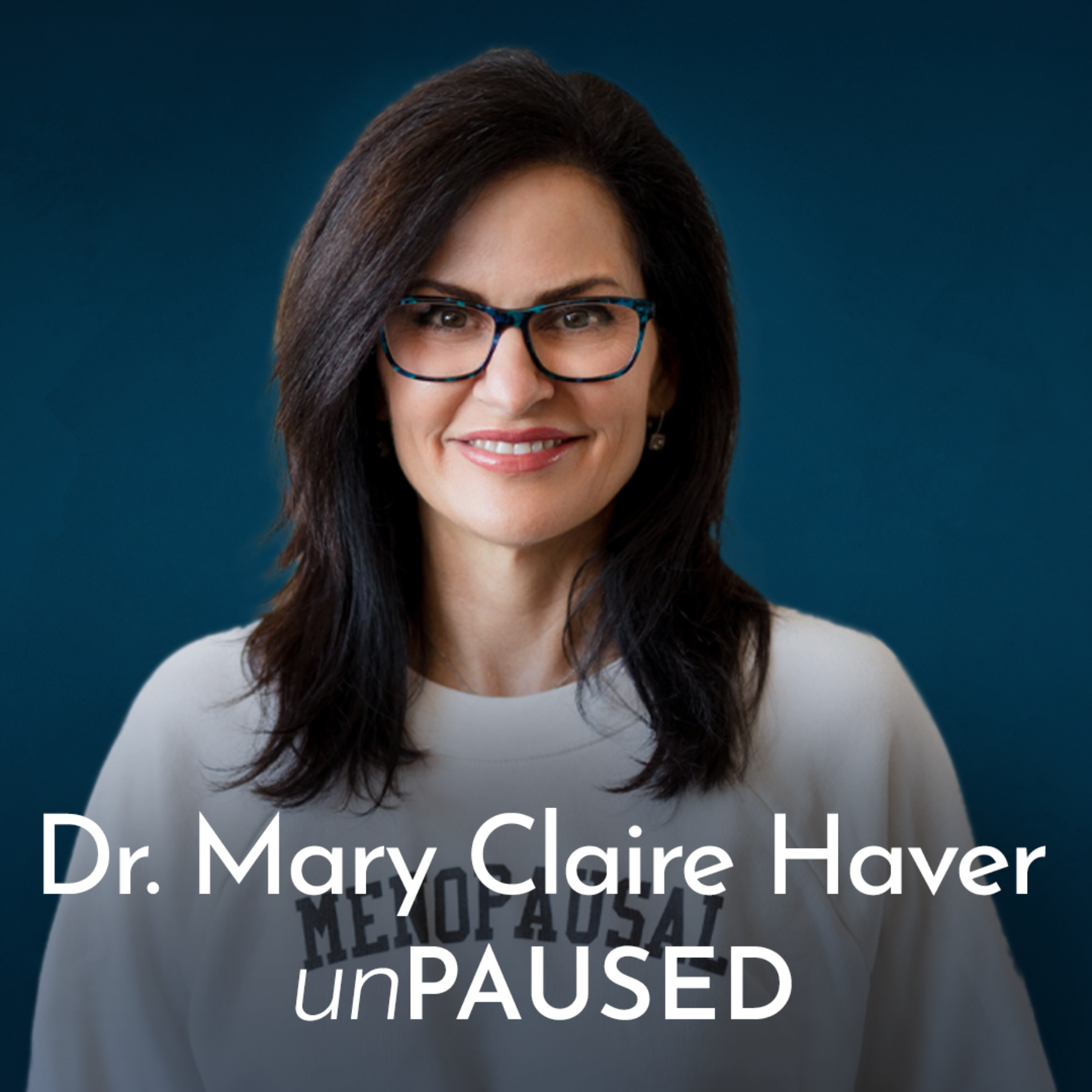
 unPAUSED with Dr. Mary Claire Haver
13 Nov 2026 · 41m

 Add vo to ChatGPT or Claude to ask about everything you hear
vo listened to this episode to put together the overview and transcript, so there may be the odd mistake.
Perimenopause and menopause care, focusing on abnormal bleeding workups, postpartum overlap, contraception during the transition, hormone therapy options (estrogen/progestin and testosterone), non-hormonal alternatives, GLP-1s for PCOS, and correcting common misinformation.
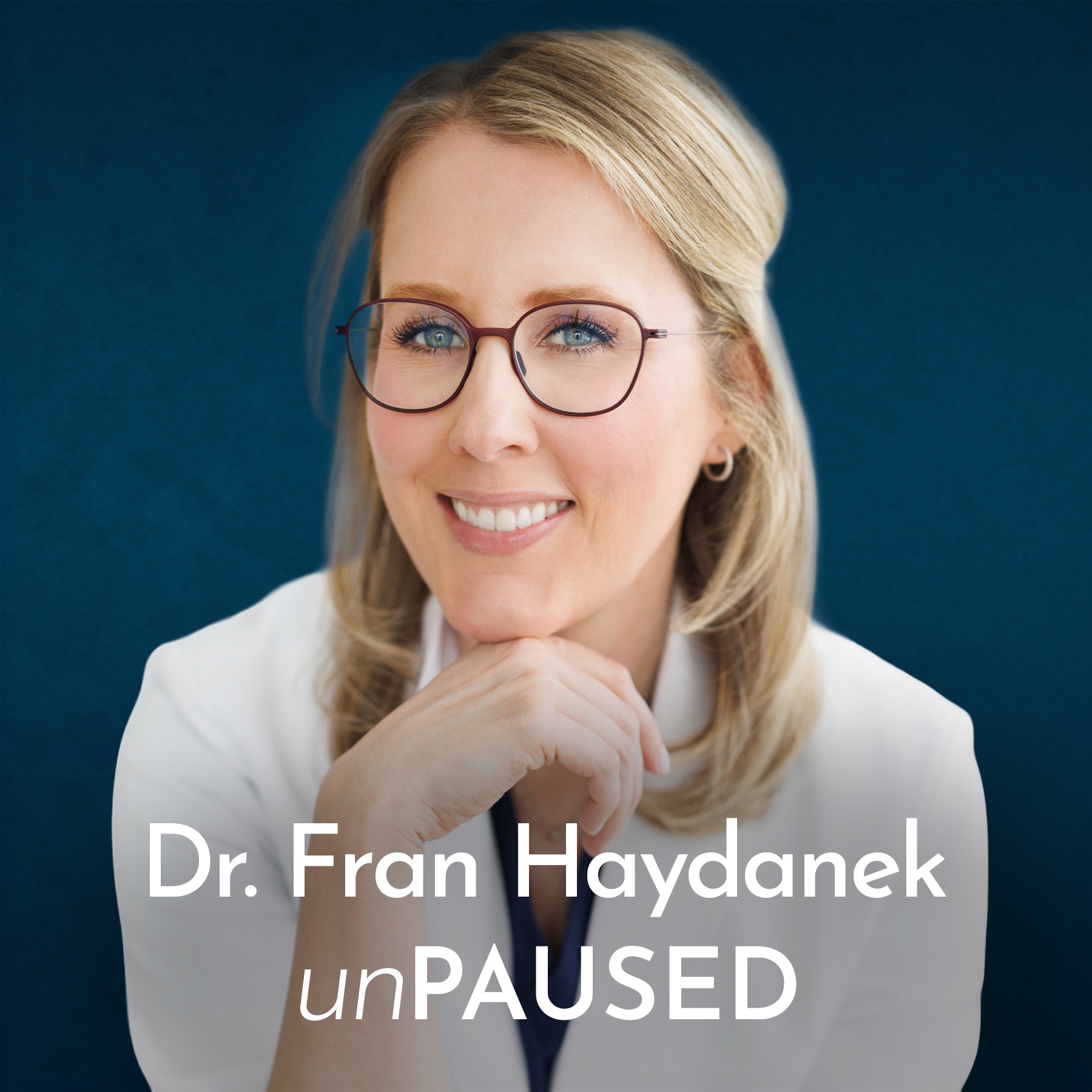
Dr. Fran Haydanek, a gynecologist and menopause/PMOS referral specialist in her city; she also prescribes testosterone (started in the last 2–3 years) and emphasizes menopause-educated, patient-centered counseling.
Heavy/changed bleeding, post-coital bleeding, bleeding after 12 months without periods, and menopausal bleeding require prompt evaluation (ultrasound and often biopsy/D&C). PMOS/PCOS increases endometrial cancer risk about 5x, including before menopause. Estrogen levels fluctuate in perimenopause; “normal” labs don’t end the conversation. Menopause hormone therapy isn’t birth control; contraception is needed until 12 months after the final period. IUDs can provide cycle control, uterine protection during estrogen therapy, and contraception.
She describes an endometrial biopsy/D&C pathway, postpartum vs perimenopause symptom overlap (e.g., vaginal dryness treated with vaginal estrogen cream), and hormone counseling around the 2002 black box warning using specific risk numbers. She also discusses estrogen patch shortages and workarounds, and pain-management advances for IUD insertion driven by patient experiences.
0:03Dr. Mary Claire Haver: The views and opinions expressed on Unpaused are those of the talent and guests alone and are provided for informational and entertainment purposes only. No part of this podcast or any related materials are intended to be a substitute for professional medical advice, diagnosis, or treatment. Welcome back. There was so much ground to cover with Dr. Fran Haydanek that we decided to split the episode into two parts. If you missed part one, I hope you'll go back and listen. But for now, here's the rest of our conversation.
0:58Dr. Mary Claire Haver: here squarespace because no matter what you're into a website makes it real use offer code difference for 50 off select plans terms and conditions apply
1:11Dr. Mary Claire Haver: let's talk about periods okay uh because you're still managing them like me oh yeah not my own i have an iud she's doing good because this is where many women kind of are forced to notice that perimenopause is knocking on their door. What is normal for perimenopause with your periods? I mean, for the patient population who doesn't have any other conditions, we expect you to get a period every 28 days. As we go into perimenopause, what I expect for most women is that that time, the 28 days is gonna change. It's either gonna get longer or it's gonna get shorter. It may get heavier, but that's when I wanna do a little bit more digging.
1:47Dr. Mary Claire Haver: So what would that look like? So tell me, if you are someone who says, I've been very regular, I get my period every 28 days. And I used to get my period for three days, and I use like three tampons a day. And if all of a sudden that has changed to, well, now I bleed for seven days, and it's much heavier than before. And I now have to use super tampons, and I change them every hour. That is a signal to me that that is different. This isn't just your hormones are starting to space out, and you're not ovulating, and that's a problem. This is when I want to look for other things, most notably, usually anatomic differences, like fibroids, polyps, those kind of things.
2:22But also cancer, right? And this is especially for my patients who have PMOS, as a fellow patient with PMOS, that we have a five times higher rate of endometrial cancer. Wait, wait, wait, wait, wait,
2:35Dr. Mary Claire Haver: how high? Five times higher. If you have PMOS or PCOS, your chance of endometrial cancer is five times higher than the patient who doesn't, which is important for us to know. And importantly, premenopausally. So a lot of endometrial cancer, as we know, is diagnosed in postmenopause. But if you have PMOS and you have this chronic and ovulatory state, you have a higher risk of having endometrial cancer prior to going to menopause. And that's why if you tell me, especially if you have that history, well, my periods are so much heavier than they were before, I need to rule out cancer. Yeah. And how do we rule out cancer?
3:10So this would be an endometrial biopsy most often in the office or we go to the operating room for a DNC.
3:14Dr. Mary Claire Haver: What bleeding pattern means that you should go get checked? You know, somebody's at home listening with a diaper on. Yeah. Yeah. Or when can you just wait to your next well woman exam? Yeah. So if you are that person who they're just starting to space out, but you're not noticing any other changes other than the spacing out and you're over the age of 45, like, OK, that's fine. We'll see you when you come for your annual. We'll talk about it. But if you are now bleeding much, much heavier than before, if you are having post-coital bleeding, and especially if you're menopausal, if you have gone through 12 months of not having a period and all of a sudden you're bleeding, like that is a 100 percent of reason to make a problem visit with your gynecologist and it deserves at a minimum an ultrasound, but very likely some kind of way to get tissue.
3:57Dr. Mary Claire Haver: Okay. Like a biopsy. Like a biopsy. Okay. How would you advise a patient to push back a little bit if they get a normal lab result, but it was used to dismiss her? Right. So her problem is still not addressed. Right. I mean, I think that's important for patients to understand that that's not always going to help us anyway. And it's important for clinicians to understand that. So no one should be ordering blood tests that they don't know how to interpret, right? Right. So for any clinician, if your patient's like pushing. Like I have no reason to order a D-dimer. Yes. Like. Yes, exactly. I'm not in the ICU.
4:30Right. So if you are not someone who treats perimenopause and menopause and hasn't received the training, please don't order an estrogen level just to appease someone. This is just causing more problems. I think it's important for people. And I think this is, you know, where you've done such a nice job online is to educate patients on what that means so that they know what the next steps are. Because if a doctor who isn't trained in menopause medicine orders a blood test because you asked them to without either really understanding why we did it, and then them saying, well, your estrogen is level, so you should feel fine, the answer can't be like, okay, I accept that.
5:02That's when we go to people who are trained in menopause medicine who have a special interest in this because everyone in medicine has special interests. I don't treat a lot of endometriosis. That's not my special interest. But I am the referral person in my city for PMOS because that's what I'm good at. Same with menopause. So if your practitioner doesn't do a lot of this, you go to someone who does. And that's okay. And that's okay. It's okay to have different people who do it. I have patients who see me for their gynecologic care and then see someone else for menopause care because they like click better with them.
5:32I love that. Let's work together and make you feel good. And I have it go the other direction too. So I don't want people to take a blood test and be like, well, I was told I was normal and therefore there's no other options. A second opinion is always valid in any condition.
5:45Dr. Mary Claire Haver: Good. I like that you give them power. Okay, so the birth rate for women is 40 to 44. Okay, so older moms, more women are having babies over 40 than are having them under 20, which we celebrate. I love that. Not everyone celebrates that, but I certainly do. I celebrate that. Yeah, as a mother of two 20-year-olds. So it is now 12.7 per thousand, the highest since 1965. five. One in 24 American births is to a woman in that age band. A very real number of women are postpartum and rolling right into perimenopause. Yeah. Which is a huge topic on social media right now. How do I know if this is postpartum or perimenopause?
6:30Dr. Mary Claire Haver: I'm like, it's both. It's both. So what happens when these two overlap? Yeah. Well, first of all, shout out to like sex education and birth control because we are allowing people to make these decisions about their reproductive lives. So amazing. It's hard, right? If you are going into your late 30s, into your 40s, and you're having a baby, and now you are tired, and your hair is falling out, and you're breastfeeding, you have vaginal dryness, and your libido is low. Is this perimenopause or is this postpartum? And it's very likely both. Does it make a difference in how we treat it? Yes and no, right?
7:04Because if we're talking about if you're perimenopausal and want hormones, we can talk about that conversation, but we also have to understand what that means for your postpartum state and your breastfeeding state if you're lactating.
7:13Dr. Mary Claire Haver: Let's go there. Yeah. So unfortunately, we don't have a lot of data on perimenopausal women who are lactating and hormone replacement therapy. What we have data on is patients. We have birth control. And we also have patients who are infertility patients who are lactating because they had a baby and then they want to do hormones to have another baby. So that's where we have some information about how estrogen therapy affects lactation and affects babies. So you could say, we know that if you are lactating and you go on a transdermal estrogen, this is unlikely to enter your breast milk. And from studies that weighed babies and looked to see if they were still gaining weight, that your breast milk was likely fine.
7:56We don't have big comprehensive studies that guide this management. But it's a conversation to have that if you are in that position and you want to try treatment, how does this affect your baby? It's also like, when is this happening in your postpartum state, right? Are you 11 months postpartum and you stop breastfeeding and your periods are still weird? That tells me something different than if you were six weeks postpartum, right? So it just kind of depends on where you are in that continuum and how we treat it and manage it.
8:22Dr. Mary Claire Haver: Okay. What if she is eight months postpartum and still really symptomatic and she stopped nursing two months ago? Yeah. I mean, it kind of depends on what are your symptoms. Are you having hot flashes and night sweats or is this vaginal dryness? Vaginal dryness, anyone can have vaginal estrogen cream. I took vaginal estrogen cream when I was postpartum because I had that problem. And in fact, probably all of our patients need that. If you are someone who is now dealing with mood changes, is this postpartum depression? Is this perimenopausal depression? Is this just depression? Do we talk about that?
8:55Do we talk about if we want to start hormones or do we want to talk about if we start an SSRI? If you also have hot flashes and depression and you don't want to affect your milk supply, then maybe we talk about an SSRI instead. until we get you to a point where those aren't concerns anymore. And part of this is playing around with it and understanding that this is a phase and a transition. Yes, technically, we are postpartum the rest of our lives, right? My youngest baby is three, I'm still postpartum. Your youngest baby is 20, you're still postpartum too, right? But how our body is reacting, especially if we're still breastfeeding, that will eventually change.
9:27And then maybe the management will change at that point too.
9:29Dr. Mary Claire Haver: Okay. The just tired bomb trap. When a woman in her 40s is exhausted, anxious, not sleeping, and everyone, including her, blames the kids and the schedule. Are you seeing that delay the diagnosis? Oh, absolutely. Yeah, right. Everyone's very busy at this point in their life, but they also are humans outside of their life too. So could this be perimenopause? Yes. Can we talk about how we treat that? Yes. But could it also be sleep apnea? Could this also be a low ferritin level? And this is again, where we have that comprehensive discussion and talking about like, well, when you say you're really tired in the morning.
10:04Tell me about how you're sleeping. Does your partner tell you that you snored all night? Do you have to like sit propped up to sleep? Maybe we should go get a sleep study, right? Or is all your hair falling out and your legs are really restless and you have really heavy periods right now? Well, your ferritin could be three, right? And also you could be really busy and you could just be tired. So it can be all of those things. And I would hate for anyone to feel like it can't be addressed and then they just have to like power through it. Like, again, we don't want you to wait until you fall off that cliff.
10:35Let's talk about it now.
10:36Dr. Mary Claire Haver: Say the labs are normal and she is exhausted. You need help. You need help. You know, you need help at home. You need help. You know, you should, you know, your period should always be painless, able to manage with over-the-counter products, you know, and not disrupt your life at all. You should sleep every night and wake up feeling refreshed. Like these are the things that should happen. And when it's not happening consistently, it's okay to ask for help. Yeah. And I think it's, you know, we have a hard time asking for help. Yes. We feel like we're a burden. Same. We don't want to like bother anyone with this.
11:07But you know, like Dr. Karen Tain said that on your podcast with her, right? Your period should not be disrupting your life. And if they are, it's a problem. And if you are waking up feeling like you didn't even sleep an hour, although you laid in bed for eight hours, apparently asleep, that's a problem. So let's talk about it.
11:23Dr. Mary Claire Haver: Okay. There's no published misdiagnosis rate for all this stuff, right? Perimenopause versus thyroid, ADHD, depression, all the things. What is a well woman exam? Yeah. Your well woman exam is for preventative care determined by your insurance company, cancer screening, vaccines, a menstrual history, your family history, urinary incontinence, basic birth control counseling. And that's kind of it. Not menopause. So you can mention that you might be in perimenopause. And I can say like any menopausal symptoms. Okay, noted. But anything past that, any ordering of tests, any prescribing of medications makes it now a problem.
12:02And so I can either tack that onto the visit really quick if I have time, but I still have to charge you for it. So sometimes people also forget that this isn't like a free visit where I can cover everything. If I start doing a workup in that visit, we are by law supposed to be charging you for it. And that's why I like to have a conversation of, I'll start this with you, but I want you to come back so we can really have a comprehensive discussion about next steps so that you feel like you really got all the time with me and all the information you needed to make a good choice for yourself rather than, let me do your pap smear and here's some estrogen patches.
12:34Dr. Mary Claire Haver: Okay. So the CDC eligibility criteria says that combined hormonal contraceptives, basically what we call birth control pills in layman's terms, can be used until menopause absent other conditions. And the Menopause Society says that contraception is needed until 12 months after the final menstrual period. So when can she actually stop? When do you have your patient stop? So if you are still ovulating, if you're perimenopausal, you're still ovulating, you can still get pregnant. So number one, do not use... Remember, women are getting pregnant a lot over 40. Yes. Do not use perimenopause as birth control, okay?
13:12Dr. Mary Claire Haver: And menopause hormone therapy is not birth control. It is not a high enough dose to suppress ovulation. Exactly. So two things are important with that. So I guess my question is, how much do we care if you are perimenopausal or menopausal? Because the treatment, for the most part, is the same. At some point, by age 55, like 90 to 95 % of women will have gone through menopause. So if you get to 55, we can probably come off of birth control at that point. But it's also an interesting point that we can say, like, not everything is a hormone, is a OCP, right? A combined oral contraceptive pill. We can use other forms of birth, things that control birth, like, say, an IUD, as a form of our endometrial protection in hormone replacement therapy.
13:55So you can be getting both, which is also interesting in that time.
13:57Dr. Mary Claire Haver: Let's talk about that. Because, you know, Heather Hirsch, huge fan of the IUD through perimenopause because of the potential problems with oral progesterone with some patients. and you get the cycle control, which 80 % of patients are going to have issues with. So how do you kind of manage that? Do you talk about that with your patients? I just referred a patient back to her gynecologist to go get that IUD. Oh, I mean, this is like, that's my number one. Because I don't do them anymore. I'm like, go get the IUD, come back. Exactly. I love an IUD for my perimenopausal patients. Because what it's going to do, it's going to thin your uterine lining.
14:30So one, your previously annoying, heavy, painful periods that you were having in this transition have lessened or gone away. It's protecting your uterus when you're getting the estrogen therapy. We need some way to protect your uterus. And it's providing contraception. So it's like a three for one. It's a very convenient instrument for this perimenopausal transition. And for some of my patients as they go into menopause as well. So I love an IUD.
14:56Dr. Mary Claire Haver: I'm a big fan. All right, let's go over treatments. So for perimenopausal symptoms specifically, how do you go through the options? with the patients. Yeah. So we, I mean, we start with the pathophysiology of how we got here, right? These are what, this is what your hormones are doing. Here's what your estrogen level is doing. I think that's the other misunderstanding that people kind of think like, oh, estrogen levels are just like a slow, steady decline. And what your estrogen levels are doing is they're all over the place. Right. So we talk about what is the goal here with treatment, what's happening in your body and why is it happening?
15:27So then we talk about, well, hormone replacement therapy, menopausal hormone therapy, are these two to three things. We're going to have estrogen, a form of progestin, and then testosterone in addition to this conversation. So we start there and we talk about, you know, there are different forms of estrogen. I like this one, most often the patch, right? Then we talk about if I only were to give you estrogen, I would be basically giving you endometrial cancer. So we have to talk about a way that would protect your uterus, whether it's micronized progesterone, whether it's the IUD, whether it's a different form of progestin and perimenopause.
15:59And then we have the conversation, but what else do we have? Because there's going to be patients who don't want hormones. who can't have hormones. So what other things do we have to manage the symptoms that you have? If you have hot flashes and then maybe also a little depression, an SSRI can help with those things. We know that SSRIs, and we even have FDA-approved SSRIs for hot flashes. We have gabapentin, which can help. We have non-hormonal medications just for hot flashes now, like Vioza. We also can talk about, well, if your symptom is vaginal dryness, vaginal estrogen cream should be everyone's best friend, right?
16:33Very few contraindications to that medication. So it just kind of depends on what symptom you're having. Is it hot flashes? Is it depression? Is it vaginal dryness? That kind of tailors some of that conversation.
16:46Dr. Mary Claire Haver: As the seasons change and calendars fill with plans, there are so many reasons to get out and enjoy life. But for many women, the worry of bladder leaks can make everyday activities feel a little more complicated. From staying active to taking a spontaneous road trip or enjoying a night out with friends the fear of a leak can make you think twice about doing the things you love. And without realizing it, you might be letting the fear of a leak make decisions for you. But what if you could stop worrying about leaks and start saying yes to more of what you love? One in three women live with stress urinary incontinence, and the real cost isn't just the leak itself.
17:22Dr. Mary Claire Haver: It's everything they stop saying yes to because of it. Uresta was invented by a urogynecologist and is clinically proven to prevent leaks. It's a reusable device inserted vaginally that supports your bladder from within, preventing leaks before they happen instead of just absorbing them after the fact. It's a small device that does something big. It gives you your yes back. No surgery, no prescription, and no need to remove it to use the bathroom. The all-new Uresta 2.0. The newest Uresta also includes a new handle design with a finger hole as well as an optional removal string and all develop directly from feedback from the women who use it.
18:04Dr. Mary Claire Haver: 97 % of women see a reduction in leaks and 90 % are still using Uresta a year later. So the workout class, the trip, the night out, go ahead and say yes. Discover Uresta, trusted by more than 70 ,000 women at Uresta.com. That's U-R-E-S-T-A.com. As women, we're so good at building lives around other people, aren't we? Their dreams, their values, their expectations of who we should be. And then one day we wake up and we think, is this it? Is this it? I'm Susie Welch, the host of Becoming You. There is a way to figure out exactly who you are and build a life that is actually yours. This isn't a pep talk.
18:48Dr. Mary Claire Haver: It's not platitudes. This is a methodology. Listen to Becoming You wherever you get your podcasts.
18:59Dr. Mary Claire Haver: in perimenopause do you have a role for a birth control pill or combined yeah oh yeah i mean i think what i was taught in residency was that this is basically the magic cure for everyone yes and it is and pick a pill any pill yeah take the pill any pill there are some patients who will do really great on a hormonal birth control pill with the synthetic form of estrogen some people respond really well to that and it carries them into menopause and that's wonderful. I think what's important to remember as a clinician is that not everyone will respond that way though, right? There's going to be some people are like, well, I was on the pill, but I didn't feel any better.
19:33That's the patient where you now have the different conversation is like, okay, that's not working for you. Let's talk about what maybe something like slind, which is giving you progestin and contraception technically and an estrogen patch might do for you, right? So birth control pills are a great place to start. And I think it's going to be interesting to see how medications like Nextelis will impact the perimenopausal patient because this is a more like bioidentical estrogen and but also provides contraception. So I'm interested to see there's no studies that I could find that show like the benefit of that.
20:04But the theory behind that, I think is really interesting. And I think, you know, with time, we might have some more data for that.
20:09Dr. Mary Claire Haver: We have a, you know, group chat with a bunch of clinicians across the world, and they have different access to different medications, right, especially in Europe and in the UK. So it's interesting to see like slend, which I never really think of, you know, in combination, you know, I'm like, oh yeah, I'm kind of out of the birth control game, you know, I do use it. Especially if the patient needs contraception or her cycles are out of control and she doesn't want an IUD. So that may be a good option for them. But it was, you know, I don't know if you listened to the Tammy Rowan episode where she went through all of the physiology around the different progestins.
20:48Dr. Mary Claire Haver: And I was like, no one taught me this. And like, this one breaks down to actually an estrogen. And this is why they stop having hot flashes or this gets better. They have migraines. And I was just like, oh my God. It was very, very basic when I was in training of, oh, she has acne. Give her this. If she has, yeah. Do you treat perimenopause different than menopause? Yes and no. So if we're talking about hormone therapy, it's kind of similar, right? I think post is way easier. Oh, it's so much easier. Oh, my God. So much easier because we're not managing contraception and we're not managing, for the most part, abnormal bleeding.
21:23So I find perimenopause a little harder to manage, but also in many ways more rewarding when we figure it out. Right. When we get to the point where all of a sudden it's like figured out. So yes and no, because we need a little bit other things in perimenopause to manage. But when it comes to the concept, not really. Right. It's still estrogen. It's a form of uterine protection.
21:45Dr. Mary Claire Haver: How does PCOS, PMOS affect menopause? PMOS, I want people to remember, is a lifelong condition. It presents, for the most part, especially to us as gynecologists, as abnormal bleeding. So when the bleeding stops, when you get to menopause, that doesn't mean it went away. Because this is really an endocrine and metabolic condition that affects our ovaries. I always tell my patients, like, your ovaries are actually the innocent bystander in all of this. And I just get like stuck managing it because no one else has figured out the metabolic and endocrine problems. So those metabolic and endocrine problems, your insulin resistance doesn't go away just because your ovaries are no longer ovulating.
22:21You're not like shutting a lining. Those are still there. And so you're still going to have all those conditions as you go into menopause. And so it's important to forget that part. Like we were talking about like checking your A1C because patients with PMS have an increased risk of diabetes. We should still be checking that. We should still be getting a lipid panel. We should still be checking your blood pressure. All those things that can affect your whole body, not just your ovaries, still need to be looked after as you go into menopause.
22:47Dr. Mary Claire Haver: Talk to me about GLP-1s and the treatment of PMOS. I mean, I think, so I want everyone, this fact makes me so crazy. Anywhere from 10 to 20 % of women have PMOS. Okay, so like one in five. How many FDA-approved medications do we have for a PMOS? Zero. Zero. Zero medications. Zero. for what up to 20 % of women have this, right? And people with ovaries. So not a single medication for this condition that affects one in five women. Like that makes me so angry. I'm so mad on behalf of like myself, for you, for everyone, that this is like, no one is focusing on this. So we piece it together. And that's why patients with PMOS historically have not gotten great care because like everyone's trying to piece it together.
23:28I don't have a medication that's like, this is for you. I can help you with this. I mean, I was on birth control.
23:31Dr. Mary Claire Haver: I was on metformin. I had to have fertility treatments, you know, all the things. Right. Now we have supplements and we have other medications and GLP-1s make sense that these help a lot of patients with PMOS because it's going to help them with their eating. It's going to help them with their inflammation. It's going to help them with the weight loss that they couldn't achieve in any other way. So I think we're really going to see an amazing outpouring of research in the coming years that support how helpful these medications are. But again, is it indicated for PMOS? Is your insurance company going to pay for it?
24:07Time will tell, but I'm not too optimistic.
24:09Dr. Mary Claire Haver: Can you continue taking it when you're pregnant? Can you continue taking it when you're pregnant? Right now, again, we're saying, really, you should stop it two months before you start trying to conceive. And yes, we don't have any major malformations in pregnancy, but that doesn't mean it's safe. Those are two different things. And does it improve pregnancy outcomes? Time will tell. So it's a very exciting time. I'm very, very excited for this group of medications. I've shared recently, I take a GLP-1. It has been life-changing for me, but I have the privilege of being able to afford it. Many of my patients do not.
24:41And until those patients can have access to it, that's not really changing the game for everyone.
24:46Dr. Mary Claire Haver: I'm going to read the Menopause Society's 2023 non-hormone position statement. And, you know, because it's really not what the internet says as far as like what women are experiencing. And on the recommended list for the treatment of menopause, which really is limited to vasomolibus, motor symptoms right um is cognitive behavioral therapy clinical hypnosis ssris and snris so they're cousins um gabapentin as you talked about uh fezley in it which is vioza and weight loss yeah of course weight loss is always makes the list um on the not recommended list yeah for for hot flashes exercise yoga mindfulness relaxation pace respiration cooling techniques of Whitting Triggers, Dietary Modification Supplements, soy, and acupuncture.
25:34Dr. Mary Claire Haver: What do we do with all this? Well, first of all, I mean, the question is, will this help menopause symptoms or hot flashes? So I think it's helpful that they're saying, okay, we don't have data that supports these things. Yeah. So we shouldn't use this as our treatment option. The problem going back to how trained are you in menopause care, though, is if you don't know how to manage it, you're trying to give your patient anything. Well, you should just go get some acupuncture and see if that helps because I personally don't know how to manage menopause, right? So I think that's kind of how we got to the point where some people recommend these things because they may not know how to treat it and are like, well, I need to give you something, right?
26:10So like, go work out more. That's an answer for many things, right? So it's hard because the question is, is this going to help with hot flashes? I appreciate the clinical information to know. There's no studies that support it. but what that means for clinicians is that we need to know what does help and know how to
26:28Dr. Mary Claire Haver: prescribe those things so it's probably a little bit of a red flag if if they're not saying the gold standard of treatment is menopause hormone therapy you know running a second is going to be these other medications if they're just telling you to you know do yoga which i love yoga you know yeah shout out to yoga but not for this yeah not for this um but that's exactly when you say okay i hear you i would like to talk to someone who does prescribe hormone replacement therapy do you have someone locally that you recommend right and i think like i find this as a clinician if i can't give the patient what they need it's my job to like guide them to the next person so i talk about this with like endometriosis and fibroids i don't do those surgeries my partner a minimally invasive gynecologic surgeon does only those and so i say let me get you scheduled with my partner for this consultation same with a glp1 conversations you want to be on a glp1 let me get you to the people who prescribe that for you, right?
27:21So if you are someone who doesn't yet feel comfortable with hormone replacement therapy prescribing, you should know who is locally so you can send your patients there because your patients are going to appreciate that. If you just say, listen, I want you to talk to someone who's really well versed in this. Let me send you to my friend so-and-so. That goes so much further than just do some yoga.
27:40Dr. Mary Claire Haver: Yeah. How have you seen this black box warning affecting your patient's ability to get their estrogen patches? Are you seeing the shortage on your end? Oh my God. All I see is a shortage. My poor patients are calling every single pharmacy and trying to find these medications. And it's a struggle because all of a sudden they feel better, right? We finally got them to the dose that they like. And then they're like, I can't get it. I can't get it. So what are your workarounds for that? I mean, we generally try to go a dose up or down. For me, a lot of the 0.05 patches are the ones, because a lot of patients are on those, tend to be the one that they can't get.
28:14So we go up and down a little bit. We try the twice a week instead of the once a week. I truly try not to, we do a little bit of the gel, but that's also been on a shortage. Like I've had patients who were able to financially transition to a gel because the most time insurance company isn't covering it.
28:29Dr. Mary Claire Haver: Because there's no generic for the gel or the spray. And now they can't get that either. So every patient's kind of doing different things. Are you doing oral for anybody? There's a couple patients who are low risk. I'm very. We start transdermally usually. Right. Because almost all my patients do well on transdermal and because of the increased risk with the VTE, I really try not to have patients. That's blood clot, guys. Thank you. Yeah. So blood clots in your lungs, your legs, right? But there are going to be some patients or patients who've been on it their whole lives. I've been on my oral estrogen for the last 30 years.
29:03There's no way that you're making me switch right now. And I'm going to keep taking it. OK. We'll have the risk benefits conversation. You're a person. you've been doing it for 30 years and like at 30 years your risk is low so um there are a couple
29:13Dr. Mary Claire Haver: patients who are on the pills as well okay the internet said you have the funnest podcast called i did my own research okay which is a phrase that usually means the opposite yeah um what menopause or perimenopause claim is circulating on social media right now that you would like to correct oh gosh i mean i think it's one that the hormones are the fix for everything right and i think it's important to have the access to have the option of hormones but i also don't want people to feel like hormones are the answer to everything right and it seems like we're pushing a little too far in that direction especially when patients are like taking it above like super therapeutic levels i think that's especially especially with the testosterone conversation that's where i just want everyone to like be a little bit more mindful of like what we're talking about online and you We do have guidelines for a reason.
30:04And the physiology behind it makes sense, too. So that's where I get a little concerned when people are on super therapeutic doses and talking about that. Especially testosterone. Especially testosterone.
30:12Dr. Mary Claire Haver: Are you comfortable prescribing testosterone? I've started prescribing testosterone in the last probably two to three years. Again, was not trained in it. Same. Didn't know who to send it to. Do I get it compounded? Do I send? I started compounding. Right. So do I send it to get the male version, but I have to write it? And then the pharmacy calls me and goes, like, what does this mean? Right. So it is a struggle for my patients. but we are, I do prescribe it. And for the most part, patients have been happy with it.
30:38Dr. Mary Claire Haver: I'm in New York right now recording podcast episodes with guests. And one of the things I love about being here this time of year is getting to pull out my favorite Mongolian cashmere sweaters from Quince. Coming from Texas, I definitely appreciate having those cozy layers when the temperature drops. They're so soft, versatile, and easy to dress up or down. And the best part, Quince's 100 % Mongolian Cashmere Sweaters start at just$50. You get that luxurious feel at 50 % to 80 % less than similar brands. I love finding beautiful, timeless pieces that feel luxurious without the luxury price tag.
31:16Dr. Mary Claire Haver: My daughter has their luggage set and packing cubes, and I have a couple of their candles at home that I absolutely love. And they have so much more to choose from. From leather tote bags and five-star luggage to chef-grade cookware and hotel-quality bedding, there's something for just about everyone on your holiday list. So if you're looking for thoughtful gifts that feel elevated without overspending, Quince is a great place to start. I know I'll be shopping there for my family this holiday season. Give the gift of quality this holiday season. Download the Quince app for app-exclusive offers or go to Quince.com.
31:49Dr. Mary Claire Haver: Get free shipping on your order and 365-day returns. Now available in Canada and the UK too. And when Quince asks where you heard about them, Let them know it was unpaused. It's the best way to support the show. This year, I've decided to get more from my holiday shopping by heading to Bob's Discount Furniture. Every week this month, Bob's is unboxing more of their best-selling styles, which means you can get more design in your dining room, more lounging in your living room, more rest and relaxation in your bedroom, and feel more right at home in your home. Stop in or shop online and unbox more of what you value only at Bob's.
32:55Head to Sierra or Sierra.com for the brands they want at the prices that let you gift them all. From athletic to athletic, Sierra's got it.
33:06Dr. Mary Claire Haver: So many women are still, I see it in my DMs, it's getting better, but are still terrified of hormone therapy because of one headline from 2002 that just got propagated for 20 years. um so in the estrogen plus progestin arm so we had two arms right estrogen only plus versus placebo and then the estrogen plus progestin and our listeners like if you haven't gotten this part yet it was a very specific regimen yes it was primarin which is conjugated equine estrogen plus a synthetic progestin versus just the conjugated equine estrogen alone okay so prim Pro versus Premarin versus placebo on each arm.
33:44Dr. Mary Claire Haver: The estrogen plus progestin arm showed about nine extra breast cancers per 10 ,000 women per year. It approached statistical significance. It was very, very close with no difference in breast cancer mortality. In the estrogen only arm, people had less breast cancer. Incidents went down 30 cases versus 37 per 10 ,000. So again, when you think about for 10 ,000, these are tiny, tiny numbers. And the breast cancer mortality was lower. Are you still seeing it in your clinic where they're frightened? I mean, I think so, especially if they were not like my age. So I'm 39. Right. If they are within like 10 years of me, they probably don't remember 2001 very well.
34:27Right.
34:28Dr. Mary Claire Haver: So I was a chief resident when this broke. So it defined the end of my residency. Yes. And I, 17 years later, this was like the mainstay at that point. So for younger patients, they don't remember what happened back then. And so they don't have that historical context of what they were told for 20 years, right? They heard that the black box warning got taken off and that things are changing. And now they're probably, you know, Gen X and spending a lot of time on social media and are seeing their friends talking about it. And they're a lot more knowledgeable. I think where I see it is patients who are older, who did go through that transition, who got pulled off of their hormones maybe now are upset because now we're out of the window boomers are upset the boomers i would be upset too i would be upset too if i was on a medication that i really helped me and then my doctor told me you're gonna get cancer and you have to stop and then 20 years later i'm still suffering and now i'm told i can't be on it anymore because i'm too old or it's been too long i would be upset too i would be really distraught over that so um i think it's important for people to understand that number and i think it's an important part of counseling, just talk about like, is there, because I get that asked all the time, does it increase my risk of cancer?
35:33Well, let's talk about what kind of cancer we're talking about. Is it breast cancer? Is it endometrial cancer? When we're talking about endometrial cancer, then you explain like how this works or colon cancer. Then we talk about the different arms and where they fall and what the actual risk is, because it's, it's one thing to say this increases your risk of cancer. Okay. But like by how much is it five times? Is it 0.1 times? What's the number? So I think it's helpful to have those, you know, as a clinician when you're counseling someone. I think that's where it's hard as a clinician when you're learning something new, especially outside of residency.
36:03How do you counsel someone? Well, you tell them those numbers, right? Those are two numbers to remember. And it's a way to give people information. And if a woman hears that and goes, okay, but this is going to make my life dramatically improved and I take that small risk on, that's giving them the information to make choices over their own life rather than saying, no, no, this is going to cause cancer and you can't have it.
36:23Dr. Mary Claire Haver: Do you think that, you know, I've reflected a lot over the bias built into the system and what I train with and what I actually taught residents, you know, and taught medical students that more female, and again, I've only taken care of female patients and tiny baby boys that I just hand off, you know, immediately after crisis. The second they touch air. The minute I get the cord clamped and cut. And that we tend to have more bias built into the system as far as how she's presenting with her symptoms. And how we are limiting her ability to make a decision for herself. Yeah. And that's hard until someone points it out to you.
37:03Right? Until someone says, how you counsel that patient, put your feelings onto the patient. And I see this, like, for example, in sterilization. Right? So I talk a lot about sterilization. and what surgeons have said to patients. And I've had to address my own bias with that. I, as a mother of three, did not want to be sterilized as a 22-year-old. That wasn't my life path. So I had to remove myself from the conversation and remove my personal bias about my future when I talk to my 22-year-olds who want to be sterilized. And same with hormones, right? You have to understand where your beliefs are, where they come from, and if they have to be addressed.
37:40Dr. Mary Claire Haver: Is there something the internet gets right? Oh, my gosh. I mean, I would say we're talking about IUD, pain management for IUDs, right? I think really the conversation of - Yeah, that one. That was hard, but it happened. You know, I think it's really hard to be told by patients, like, you failed me. I deserve better than this. And social media really brought to the forefront that there is a percentage of patients who will experience gynecologic procedures, endometrial biopsies, IUD insertions, very poorly. It is an extremely painful procedure for them. And I have many theories in my head about how we got to this point, right?
38:16Historically, we placed IUDs in women who already had a baby, usually recently. And that experience for most patients is nothing. I had an IUD placed seven weeks postpartum. I felt nothing. I recorded it. I have a TikTok. You can go watch me get an IUD placed. I'm sitting there, and then it's done. Over time, when we started using IUDs in patients who hadn't had babies, those patients, uteruses and cervixes, feel things differently. And I wish I could explain it why. But they feel every part of it. But we were like, no, like everyone else didn't feel it. Like you must not be telling me the truth or exaggerating or something.
38:48And the more people talked about it and were like, no, I didn't like fake experience you putting a tenaculum on my cervix. I've had, like I said, when I had my IUD place, I had a tenaculum used. I didn't feel it. But I know my patients who've received it can feel it. You have to see it in front of you. So all to say, patients who shared their experiences loudly and over time did drive a change. We now have recommendations from ACOG. We didn't until I think last year or the year before. ACOG didn't tell us anything. They said, studies don't really support any of it.
39:21Dr. Mary Claire Haver: Well, and the other thing is we got, you know, I talked about it. And I had had an IUI, which was horrifically painful. And I was, you know, begging to be pregnant, going through this fertility workup. I asked for this procedure. And I just didn't see it coming, how painful it was going to be. And so I was kind of using that experience. You know, it was done by a radiologist, you know, who had probably put in 10 speculums in his life. And he gave me the big Bertha and the giant speculum, the snowman. We also call it the snowman. And because that's what he knew how to use, you know, and I'm just here like begging to like have my uterus injected with dye so we can see if the tubes were open.
39:58Dr. Mary Claire Haver: And so I have a very painful gynecologic experience. And the pushback I got initially from the system was you're scaring patients. They're going to stop coming in for their gynecologic procedures. And I'm like, you're minimizing her experience. And I think that's a conversation we were never allowed to have. No, even I feel like I wasn't allowed to have that either in person or online because I also was not trained in managing pain in my residency. And it wasn't until I was on social media in 2020 and 2021. And I was seeing other gynecologists be like, this is what I do for a paracervical block.
40:29This is what I do for IUD insertion. And I'm like, oh, I should do that. And so when I started working in 2021, from the first day, I said, I'm doing this. Even though I had just graduated, no one had taught me that. I learned it on social media.
40:42Dr. Mary Claire Haver: I kind of developed the recipe as I had more and more patients who were passing out on me and screaming. I was like, this isn't going to work. So it was the paracervical block. And basically, I was throwing everything at it at the end just to get them, especially the younger patients. Especially the younger patients. I'll take you to the operating room, right? again this is where insurance plays a part but like we I'll do it I'm happy to do that for you so I think that's where the internet got it right they really sharing your personal stories made clinicians have to listen to all of it because although 95 percent of people were fine five percent weren't and that five percent was loud and we heard it I think that the menopause message this tidal wave groundswell was the internet and the water cooler of people just sharing their experiences and i you and i happen to be there at the beginning and talking about things and um i don't know if we without the internet allowing people to share yeah we would be where we are with i don't think so i don't think so it was like the perfect crossroads like all these social media accounts being available the generation who grew up on the internet is now speaking on the internet clinicians who also grew up on the internet are speaking on the internet, you know, we have so many well versed clinicians who are speaking online now that the internet of five to 10 years ago, I mean, I would say 10 years ago, when people were like, what was happening on the internet is not the internet today.
42:04No, the internet today is full of like very trained clinicians, physicians, surgeons, midwives, PTs, I'm learning all these people who share sharing their expertise that the internet is really making people educated in a way that they've never been before.
42:18Dr. Mary Claire Haver: I mean, women are by and large getting their medical information from social media, good and bad. And we have the studies that support that. 50 % of Americans get their medical information from social media. So, I mean, that's why I always argue about physicians being content creators. Like, if you have an interest in this, please join us because your patients are coming here. So you might as well be here to tell them about it rather than someone else. Exactly. So if you could get every woman in her late 30s and 40s to do three things right now, what would they be for her health? I want you to get a pap smear.
42:47Okay. Okay. I don't want you to wait just because you had a baby 10 years ago to see me for another 10 years when you start having a hot flash. So I want you to do that. I want you to talk to your mom about, and your dad, about your medical history. So many patients come to me and they don't know anything about their family history. Oh, they didn't talk about it. Oh, I've never asked. Your family history is very important to like your risk factors. Things might change for you. You might have to answer questions differently on a survey and now you have a higher risk of breast cancer and now we have to do something differently for that.
43:14Dr. Mary Claire Haver: So about half of my patients, especially older, do not know why they had a hysterectomy. They cannot tell me. That's hard, right? Because sometimes patients don't know or they don't remember, and sometimes surgeons don't tell them either. And it's both, right? So also know your own medical history. Also know your own. It's okay to call the hospital and get your operative report. What organs did I have removed, right? That's, again, going to the sterilization conversation. I had a tubal. Well, what did they remove? What does that mean? Do you have your fallopian tubes? Did you have a clip put on?
43:42Is it just a small portion? Like knowing your own surgical history is very important. And I would say if you have periods that are weird in any way, if they're not happening every around 28 days, if they are disruptive to your life, that you talk to someone about that and start the workup. Because it's not just here's some birth control. It's let's do an ultrasound. Let's do some blood work. If this is debilitating, let's get you to a complex benign gynecologist who can do laparoscopic surgery and help you with that. So if your periods are in any way outside of what we consider normal, which is every 28 days, not majorly disruptive and not to the point where you're hemorrhaging and switching a tampon every hour, please come see us.
44:23Awesome. During a problem visit.
44:24Dr. Mary Claire Haver: So for the woman who's already in it and has already been dismissed, what is the one move that could save her? Yeah. Get a second opinion. Yeah. Find a menopause educated. Find a menopause educated clinician who will at least give you the conversation. It may not mean that they prescribe it. You may not qualify, right? You may have a contraindication that most people would agree with. But at least get a second opinion. Have someone else sit down and talk to you about it. And any last things you want to tell our listeners? I mean, I'm really proud of everyone who's listening because they're really taking the education into their own hands.
44:56They want to be educated. So keep being curious and asking the questions. And know that it's okay if you don't feel comfortable with your clinician that you find a new one.
45:04Dr. Mary Claire Haver: And then how can our listeners find you? So you can find me on all social media at paging Dr. Fran. And then my podcast, which is called I Did My Own Research, is on all major podcast websites as well. All right, Dr. Fran, thank you so much for joining Unpaused. Thank you for having me. You can find full episodes of Unpaused on YouTube at Dr. Mary Claire. Also, you can find me on Instagram at Dr. Mary Claire and get honest and accurate information on health, fitness, and navigating midlife at thepausedlife.com. Unpaused is presented by Odyssey in conjunction with Good Roommate Media and Longwave Digital.
45:46Dr. Mary Claire Haver: There are a lot of reasons Chicago homeowners have chosen four seasons since 1971. An A-plus rating with the Better Business Bureau. That's one. Two, BBB Torch Awards for Ethics. That's another. And service around the clock every day of the year. That's a big one. For all your heating, plumbing, and electrical needs, you know who to call. For all the right reasons, call 866-4-SEASONS.
Dr. Mary Claire Haver sits down with Dr. Fran Haydanek — board-certified OB/GYN and the voice behind Paging Dr. Fran — to get practical about perimenopause. They break down what’s normal when your periods change, the bleeding patterns that mean you should get checked — including why PMOS carries a five-times-higher risk of endometrial cancer — the growing overlap of postpartum and perimenopause, and the “just a tired mom” trap that delays diagnosis.
Then it’s treatment: birth control vs hormone therapy through the transition (and why Dr. Fran calls the IUD “a three-for-one”), what the guidelines actually recommend, workarounds for the estrogen patch shortage, GLP-1s and PMOS, and the real Women’s Health Initiative numbers behind two decades of fear. They close with the three things every woman in her late 30s and 40s should do for her health right now.
Guest links:
Dr. Fran Haydanek (Website): https://www.pagingdrfran.com/
Dr. Fran Haydanek (YouTube): https://www.youtube.com/@PagingDrFran
Dr. Fran Haydanek (Instagram): https://www.instagram.com/pagingdrfran
Dr. Fran Haydanek (TikTok): https://www.tiktok.com/@pagingdrfran
Dr. Fran Haydanek (Threads): https://www.threads.com/@pagingdrfran
Dr. Fran Haydanek (Facebook): https://www.facebook.com/pagingdrfran/
I Did My Own Research (Apple Podcasts): https://podcasts.apple.com/us/podcast/i-did-my-own-research/id1879906055
Books:
The New Perimenopause: https://thepauselife.com/pages/the-new-perimenopause-book
The New Menopause: https://www.amazon.com/dp/B0CKBZ4K1Z
Never miss an episode—sign up for The ‘Pause Life Newsletter: https://thepauselife.com/pages/newsletter
Medical Disclaimer: The information, including opinions and recommendations, on this platform is meant for informational and educational purposes only. Mary Claire Media, LLC, the unPAUSED podcast, and The ‘Pause Life are not medical organizations. Medical advice or medical diagnosis cannot be provided to you through the platform, any associated website, or customer portals. Using this platform does not establish a patient-physician relationship.
Scan the code with your iPhone camera
Listen in the app.