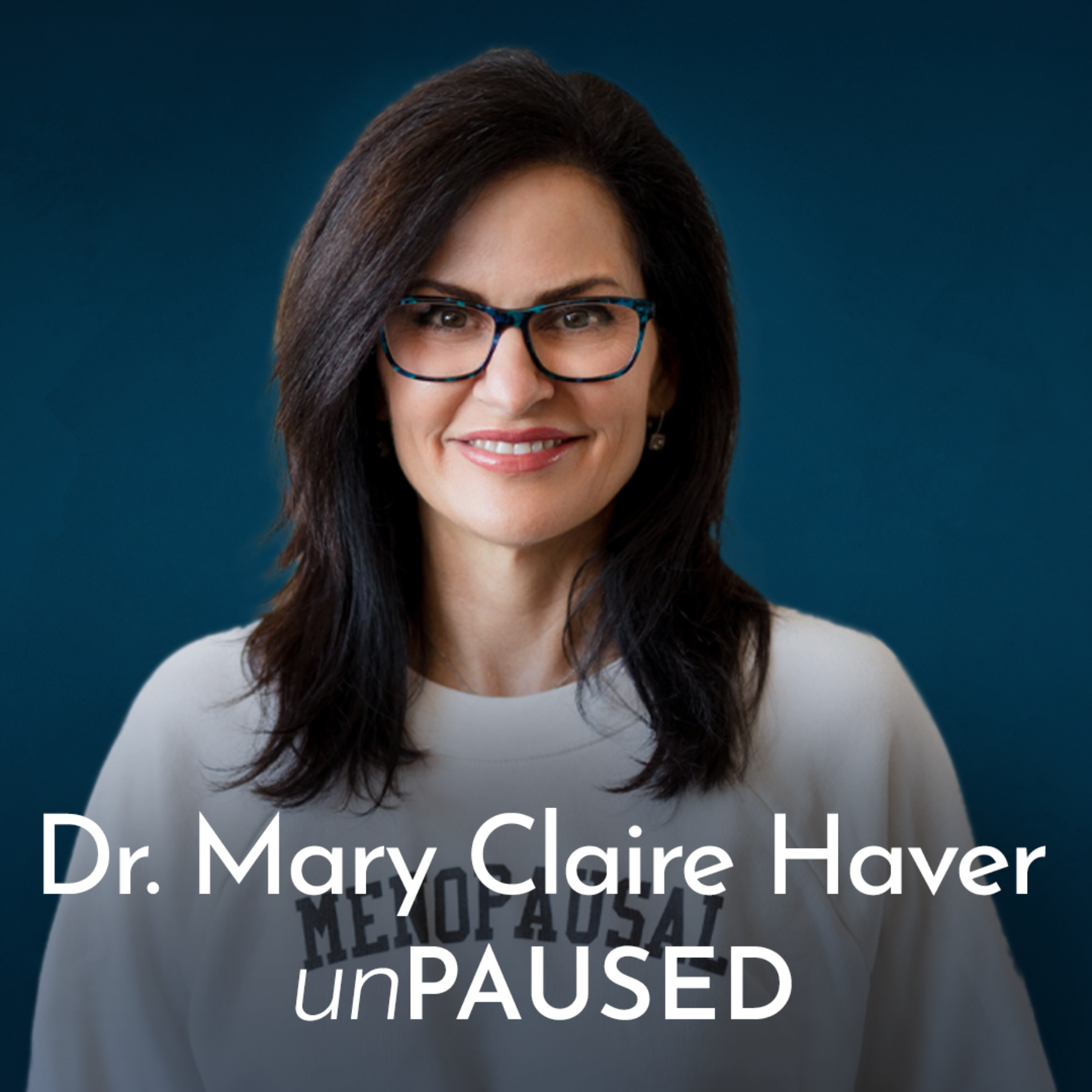
 unPAUSED with Dr. Mary Claire Haver
3 Nov 2026 · 45m

 Add vo to ChatGPT or Claude to ask about everything you hear
vo listened to this episode to put together the overview and transcript, so there may be the odd mistake.
Menopause Masterclass on Genitourinary Syndrome of Menopause (GSM), including recurrent UTIs, urinary urgency/frequency, genital pain, and sexual dysfunction; argues GSM is undertreated but highly treatable, mainly with low-dose vaginal estrogen.
No guest is named in the transcript. Host is Dr. Mary Claire Haver, board-certified OB-GYN, certified menopause practitioner, adjunct professor at UTMB. Mentions other clinicians (e.g., Dr. Rachel Rubin; Dr. Jim Simon) as references, not as on-air guests.
GSM is a hormone-loss driven “constellation” affecting vulva, vagina, clitoris, urethra, and bladder; systemic hormone therapy often isn’t enough—many need added topical vaginal estrogen. Lubricants/moisturizers mask symptoms and don’t prevent UTIs. Recurrent UTIs in older women can lead to hospitalization/sepsis. FDA removed the boxed warning for low-dose vaginal estrogen (Nov 10, 2025).
Haver’s own delayed orgasm improved quickly after starting vaginal estrogen (and adding vaginal DHEA). She describes vestibule pain missed by standard speculum exams and recommends a Q-tip test.
0:00Dr. Mary Claire Haver: If you wouldn't put it in your eye or put it in your mouth, don't put it in your vagina. And we're going to save somebody's life with this podcast. Infections that in older women genuinely land people in the hospital and are fatal. What the general urinary syndrome of menopause is, why it is so dangerous for so many women, and what we could actually do to treat it.
0:30Dr. Mary Claire Haver: The views and opinions expressed on Unpaused are those of the talent and guests alone and are provided for informational and entertainment purposes only. No part of this podcast or any related materials are intended to be a substitute for professional medical advice, diagnosis, or treatment. This is the episode I wish every woman could hear at 45 and again at 65. Genital urinary syndrome of menopause, otherwise known as GSM, is the single most undertreated condition of midlife and is also the easiest to treat. The treatment is cheap, safe, and for most women, life-changing. By the end of this episode, I want you to, one, recognize the symptoms in yourself, even the ones you'd never connect to your hormones.
1:19Dr. Mary Claire Haver: Two, understand exactly why they happen. Three, know your treatment options and how to ask for them. And four, walk away believing you never have to just live with this. Common doesn't mean normal. And it's not anyone's fault. It's biology. I'm Dr. Mary Claire Haver, a board-certified obstetrician and gynecologist and certified menopause practitioner and adjunct professor at the University of Texas Medical Branch. Welcome to Unpaused, where we cut through the silence and talk about what it really takes for women to thrive in the second half of life.
2:01Dr. Mary Claire Haver: This episode of Unpaused with me, Dr. Mary Claire Haver, is brought to you by Alloy Health. Have you noticed your skin changing in midlife? Maybe it's feeling drier, looking thinner, or you're seeing dark spots that weren't there before. Here's the thing. Declining estrogen can play a major role in those changes. And no, it's not just about finding a better moisturizer. It's about understanding what your skin actually needs. That's why I'm excited to share Alloy's estrogen-focused skincare. They now offer two new prescription treatments. Copper Peptide Cream Rx, designed to help firm and smooth thinning skin on the face and neck while calming redness.
2:39Dr. Mary Claire Haver: and Hyperpigmentation Treatment Rx, which helps fade dark spots on the face and chest without affecting your natural skin tone. Getting started is simple. Complete a quick online intake, connect with a doctor who specializes in menopause, and have your prescription delivered right to your door. Try Alloy's new prescription treatments, Copper Peptide Cream Rx, and Hyperpigmentation Treatment Rx, or add them to your N4 routine. Head to myalloy.com and use code MCH20 to get 20 % off your first order. Your menopause specialized doctor will help you build a skincare plan for your needs. Plus, you get$0 unlimited messaging with your doctor.
3:20Dr. Mary Claire Haver: This code is valid on products only. These are compounded products not subject to FDA approval. If you work in healthcare, you know how demanding your days can be, especially during the holiday season. Between long shifts, caring for your patients, and everything going on outside of work, the last thing you need is uncomfortable scrubs distracting you. That's why I wear figs. I've worn figs for years because they're made for the demands of long clinical days. The fabric is incredibly soft, breathable, and has just the right amount of stretch so you can stay comfortable whether you're in clinic, on your feet all day, or running between patients.
3:57Dr. Mary Claire Haver: My oldest daughter is in medical school, and she loves figs too. It's fun that we share that love, and with so many styles and colors to choose from, there's always something new to try. And just in time for the holidays, Figs has launched its new holiday collection featuring festive colors, fresh styles, and accessories. Because when you wear scrubs day after day, it's nice to switch things up a little, and the holidays are the perfect excuse to find a new favorite. So whether you're looking to refresh your own work wardrobe or find a gift for someone in healthcare, Figs has plenty of options to love.
4:30Dr. Mary Claire Haver: You can get 15 % off your first order at wearfigs.com with the code FIGSRX. That's wearfigs.com, code FIGSRX.
4:43Dr. Mary Claire Haver: So first I want to talk about what exactly GSM is and why the name keeps changing. So we used to call this condition atrophic vaginitis, which is a terrible sounding word. But before that, before my time, there was a medical term for this called the senile vagina. And I'm not kidding. These names are awful. And every one of them made a woman feel like she was shriveled up and dying. And I have to tell you, the attitude that I was given, the attitude that I developed in my residency was that menopause and GSM were terrible things and associated with decline and decay and aging. And now that I'm deep into this myself and actually living my best life, I realize what a mistake that is.
5:41Dr. Mary Claire Haver: So in 2014, a group of specialists renamed the condition the genital urinary syndrome of menopause. That's a mouthful, but it is a huge upgrade. One, because the key word is genital urinary. For the first time in history, we included urinary in the name. So the GSM is an entire constellation of changes that happen when hormone levels drop. And let me be clear about this. The healthiest vagina, bladder, general urinary system that you can have needs estrogen. And I'd like to say all vaginas need estrogen. And if you can't make it anymore, we have got to put it there some other way. So when hormone levels drop, this affects our vulva, our vagina, our clitoris, our urethra, and our bladder.
6:32Dr. Mary Claire Haver: And all of those tissues sit very tightly compacted together inside of the pelvis. And it's not just one symptom. It is a syndrome. So most of GSM is a blood flow and a tissue health problem driven by hormone loss. That's why I describe vaginal estrogen as a blood flow drug. It's doing for the female pelvis kind of what the little blue pill does for men. So I want to talk about the symptom checklist to make sure we're all on board with what might be going on because many women don't connect these dots. I, okay, full disclosure, I wasn't able to diagnose general urinary syndrome of menopause in myself.
7:16Dr. Mary Claire Haver: Absolutely true. I blamed stress, I blamed medications, and I blamed aging. So I was having delayed orgasm and was very, very frustrated. And I just thought, oh, I'm getting older. Oh, it's this. Oh, it's that. And I was sharing it with Dr. Rachel Rubin, who is a dear friend. And we were just texting back and forth. And we're in a group chat with Kelly Kasperson. She says to me, well, how much vaginal estrogen are you on? I wasn't on any. I had a very short time period between, you know, recognizing when I was in menopause, full menopause, and starting hormone therapy. And I just assumed my general urinary system was getting treated.
7:58Dr. Mary Claire Haver: This is how little I actually understood the GSM at the time. And this was probably five, six years ago. Many of my patients who were on systemic hormone therapy required vaginal estrogen as well to keep their genital urinary system healthy. So here's one thing I want you to understand. Systemic hormone therapy is a microdose compared to what your body used to make on its own. Systemic hormone therapy was developed to stop a hot flash. It was not developed to protect your bones at the highest level. It was not developed to protect your genital urinary system at the highest level. Many, many patients, most patients, myself included, need to add topical vaginal estrogen on top of their systemic estrogen.
8:42Dr. Mary Claire Haver: But I hadn't done that yet. And I was thinking, oh, if I get dryness, if I get, you know, pain with intercourse, I didn't have that. What I had was delayed orgasm, which was causing severe frustration. Anyway, so when my friend said, how much vaginal estrogen are you on? And I said, none. And she said, Mary Claire, what the hell? Why aren't you on this? And I just didn't connect delayed orgasm with GSM. I had no idea. It makes sense biologically. It makes sense from the pathophysiologic basis of it, but like literally I wasn't able to recognize it in myself. And I share this story not to embarrass myself, but to realize that if I didn't understand it, I don't expect most people to understand it.
9:34Dr. Mary Claire Haver: And you have to advocate for yourself in your doctor's office. So quickly I got on vaginal estrogen. Things got better very quickly. And I also added a DHEA product to help with the androgen issue. So when we get into treatment, which is coming, I will cover all of the different ways to treat GSM, and I will talk about the difference between androgen treatment and estrogen treatment in the vaginal tissues and how both of those can be helpful. Okay, so let's go back to what are the symptoms? Vaginal dryness, burning, and itching. Okay, most people recognize that. Pain with sex, especially pain at the entry, are a tight, raw spot at the opening of the vagina.
10:24Dr. Mary Claire Haver: Reduced arousal. Okay, remember arousal is, when we talk about the female desire, we have arousal, which is the physiologic response to a stimulus, meaning blood flow. So if we have extra blood flow pumping into the pelvis in a woman, just like in a man, a man will have, and most of us recognize this who have male partners, an erect penis. So our clitoral hood, our clitoral tissue, all of the clitoris is the biological equivalent to the glands of the penis, the head of the penis. So we will see arousal. That clitoral hood will become engorged. That's the part you can see. There's other clitoral tissue buried underneath you can't see.
11:02Dr. Mary Claire Haver: So we will have increased blood flow, increased mucus production. All right, so reduced arousal, reduced lubrication, and then a harder or absent orgasm. Tampons are pelvic exams that suddenly hurt when you used to be able to tolerate them. Urinary urgency and frequency, especially that gotta go right now feeling, getting up at night to pee. If your sleep is disrupted because you are having to go to the bathroom more than once at night, you can't get through the night with your sleep being disrupted then going to empty your bladder and you've cut back on liquids at night you've done all the things you were told to do you deserve to be evaluated for gsm and get started on vaginal estrogen so you can sleep through the night recurrent urinary tract infections recurrent utis the prevention of UTIs in a menopausal patient for prevention should never be antibiotics, ever.
12:04Dr. Mary Claire Haver: It should be vaginal estrogen. And we're going to save somebody's life with this podcast. And a vulva that looks and feels different than it used to. So there's two big misconceptions I think we need to correct right away. It is not just dryness, okay? Vaginal dryness. It's not just dryness and painful sex and loss of arousal and urinary urgency and frequency and getting up at night to pee and recurrent UTIs. Infections that in older women genuinely land people in the hospital and are fatal in some cases. And it's also another big misconception is that this is only a menopause thing. You can have low estrogenic states at any age as a woman.
12:49Dr. Mary Claire Haver: You can have them postpartum, which is very, very common. We see general urinary syndrome postpartum. We see genitourinary syndrome in women who have hypothalamic suppression from a lot of exercise, from being low weight. There are multiple times in a woman's life that she can have low estrogen, including on chronic use of oral contraceptive in the form of birth control pills. Very, very common to see frequent UTIs, and vaginal dryness and this constellation of symptoms in these patients. Another common time is in breastfeeding. We have very low estrogen levels during breastfeeding because ovulation is suppressed as nature's way to help us space out children at least 18 months apart, which is safer.
13:32Dr. Mary Claire Haver: So it's really a low hormone problem and not strictly a menopause problem. So studies show that 50 % to 80 % postmenopausal women have GSM. And I venture to say that the 20 % of women who are left out just hadn't made it to the doctor yet to be diagnosed. All general urinary symptoms will suffer from the lack of estrogen. This is the God's honest truth. Some estimates as high as 90%. Listen, if you live long enough, it's effectively 100%. And the only question is whether or not you're symptomatic and whether or not anyone has bothered to give you treatment for it. So before I get into it, I want to share a little history.
14:18Dr. Mary Claire Haver: In the early 2000s, when the Women's Health Initiative headlines hit, and remember, we're talking about 2002 when the results were released and there was a media frenzy around estrogen causes breast cancer, which was never, never true. Before that, roughly 30 % to 40 % of menopausal women were given some form of systemic hormone therapy. Afterward, it collapsed to single digits, and as close as 2023, it was down to about 4 % of women who were eligible receiving FDA-approved prescriptions for systemic. Remember that the FDA, because of that announcement, put a sweeping box warning on all estrogen product.
15:03Dr. Mary Claire Haver: Stroke, clots, heart attack, probable dementia, with no distinction between a systemic pill and a trace dose vaginal estrogen. Now, to be clear, when we're talking about hormone replacement therapy, in general, we are talking about systemic, treating your brain, your bones, your risk of heart disease, all of the things, and your hot flashes, okay? When we're talking about local therapy, vaginal estrogen, it is a literal microdose compared to what we're giving you systemically. Very, very, very different. But in their wisdom, the FDA decided back in 2002 to put anything with estrogen in it, estradiol, premarin, et cetera, with this sweeping black box warning, basically saying it was going to kill you.
15:53Dr. Mary Claire Haver: There was no reason, no data at the time. It just got looped in with everything else, and women were scared to death. In the two decades following, generations of clinicians, me included, trained and practiced in fear, unfounded fears. Women were handed lubricants and told to come back when they failed. The old guidelines literally required failing lubrication, which is not treating the root cause, before hormones could even be considered. We're going to just treat you symptomatically, knowing that your tissue is going to continue you to deteriorate until it's so bad that you feel you have no other option before we're going to fix the actual problem.
16:39Dr. Mary Claire Haver: Even the lubricants don't prevent a single urinary tract infection. Meanwhile, and this should make everyone furious, and I can't help but talk about this when we talk about sex-based differences in disease and how we treat them, the little blue pill, Viagra, was FDA approved in 1998 with fast track status. Vaginal estrogen carried a scare label for more than 27 years. In July of 2025, an FDA expert panel publicly calls for the warning's removal. Now, to be clear, the FDA had been approached by different medical specialties to have the vaginal estrogen black box warning removed. And they said, yeah, yeah, yeah, yeah, we'll get to it.
17:25Dr. Mary Claire Haver: And they never did. So in July 2025, we had this FDA panel called for the warnings removal. Lots and lots of grassroots, me included. Pressure through social media, through emails, through letter writing campaigns by the tens of thousands was building before this meeting. And on November 10th in 2025, the FDA announced removal of the boxed warning from low-dose vaginal estrogen. The data didn't change. The data had been there for decades. But the willingness to look at it, listen to clinicians, listen to patients, understand the suffering that women were unnecessarily going through, finally broke through.
18:07Dr. Mary Claire Haver: So here's the kicker. The label has changed, though your doctor's comfort and willingness to prescribe this may have not. Now, I don't want to blame an individual clinician. They are busy and maybe they haven't had a chance to read the new guidelines with. Remember, this just went through in November of 2025. So one of the things that you can do is print out the new guidelines, which are, we will link in the show notes here, and you can take them to your doctor to get your vaginal estrogen that you deserve.
18:43Dr. Mary Claire Haver: There's something I've learned about getting dressed. You don't need more options. You need a few things that just work. And I think jewelry is a perfect example of that because the right pair of earrings or the right necklace can completely change how you feel in an outfit and it doesn't have to be complicated. That's one of the things I really like about Jenny Bird. Their jewelry is modern, wearable, and designed to become part of your everyday routine. You can put on a pair of earrings in the morning and forget about them. And they have everything from everyday hoops and necklaces to bracelets and statement pieces so you can keep it simple or add a little more when you feel like it.
19:17Dr. Mary Claire Haver: What I love most is that these are pieces you can actually live in. They're lightweight, comfortable, and easy to mix together. Because honestly, I don't want jewelry that sits in a box waiting for the right occasion. I want the pieces I reach for on a Tuesday morning. You can get 10 % off your first order with Jenny Bird by visiting Jenny-Bird.com and using code HelloJB at checkout. Can we talk about bras for a minute? because something we wear every single day shouldn't be something we can't wait to take off the second we get home. The straps dig, the band shifts, and finding something that's both comfortable and supportive can feel almost impossible.
19:56Dr. Mary Claire Haver: That's why I want to tell you about the Honey Love X Balance Bra. It's designed to give you the best of both worlds, the comfort of a wireless bra with the lift and shape you still want. The Signature X design provides natural separation and the molded cups create a smooth silhouette under your clothes. No underwire required. And as women, our bodies change throughout our lives. Having things that fit well, feel good, and support us matters. I love that Honey Love is a female-founded brand creating thoughtfully designed essentials for real bodies, including bras, bodysuits, and tanks. Because getting dressed shouldn't have to be a struggle, especially when it comes to something as basic as a bra.
20:37Dr. Mary Claire Haver: treat yourself to the most advanced bras and shapewear on the market use our exclusive link to save 20 off honey love at honey love.com slash unpaused that's honey love.com slash unpaused after you check out they'll ask you where you heard about them please support our show and tell them we sent you experience the new standard and comfort and support with honey love
21:04so let's talk about biology here's an analogy i really want our listeners to hold on to
21:11Dr. Mary Claire Haver: hormones are like water to a plant for your genital and urinary tissues i think about this developmentally a baby's genital tissue looks nothing like an adult's at puberty estrogen and testosterone literally flood the tissues and the tissues blossom. The labia develop, the clitoris grows, the vaginal lining becomes thick, pink folded, and lubricated, and a healthy microbiome takes hold. If you've ever changed a baby's diaper, you know exactly what I'm, a female baby's diaper, you know exactly what I'm talking about. When we lose these hormones, the plant stops getting water and the process partially runs in reverse.
21:52Dr. Mary Claire Haver: So you may have seen, and we'll link it in the show notes, Dr. Rachel Rubin on social media went mega viral talking about how the labia minora become resorbed through the menopause process. We actually lose the labia. Now, the video really went viral because the comment section was hysterical talking about do they fall off? Where do they go? What happens to them? But the good news about that video, it really opened up a huge dynamic social media conversation, which then filtered down to clinical offices on what the general urinary syndrome of menopause is, why it is so dangerous for so many women, and what we could actually do to treat it.
22:32Dr. Mary Claire Haver: Let's talk about the vagina first. So the vaginal lining, the vagina, the tissues in the vagina, in a healthy, younger vagina with estrogen on board is what we call rugated, which basically means folded. The tissue is so thick and healthy and juicy that it folds in on itself. So over time, those rugae will thin out. It will become very pale and very flat. The vaginal opening itself actually can narrow, and there's less ability to create natural lubrication. The goblet cells that produce mucus basically atrophy and go away. The tissue becomes very fragile and very, very easy to disrupt the microbiome and even tear the tissue with regular sexual activity that never used to bother you before you went through menopause.
23:22Dr. Mary Claire Haver: The vulva and the labia. The labia minora can resorb, basically shrink back over time. And this is a gradual, very gradual process. The labia, you don't just wake up and they fall off. They don't detach. This is really just a viral myth, but I wanted to make sure everyone understand. But over the course of 5, 10, 15, 20 years, the labia minora will shrink back. And I've seen this clinically all the time. The clitoris. Okay, let's talk about the clitoris. The clitoris is heavily androgen, testosterone driven. And as our testosterone and androgens decline with age, remember, our testosterone levels do not fall off a cliff like our hormone levels do at the transition into postmenopause.
24:09Dr. Mary Claire Haver: This is more of an age-related decline, just like men. So testosterone decline in women begins in our 30s, well before menopause happens for most women. And the clitoris will shrink, lose blood flow, and the nerve endings become less responsive. And so what happens clinically to patients is those who were orgasmic before, suddenly it takes longer, it's harder to achieve, and a lot of patients come in really frustrated. Like I'm doing all the things and I'm not getting the same response that I used to. This has a name, it's called clitoral atrophy that most women have never heard of. So if you are having delayed orgasm or secondary anorgasmia, meaning you used to have orgasms and now you just can't despite your best efforts that used to work, this is likely what's going on and we need to get some hormones to that tissue so that you can have the responses that you used to.
25:04Dr. Mary Claire Haver: And then there's the vulvar vestibule. And in my podcast with Dr. Rachel Rubin, which I encourage you highly to go back and watch, this is what urologists call, who take care of women, call the ring of fire or the rim of fire. This is the strip of tissue that surrounds the urethra. The urethra is the tube that drains the bladder. So if you think about the anatomy, and those of you on video will fly up an anatomic picture, We have the clitoral hood, which sits above the urethra, the exit of urine coming out. And so that tissue around the urethra is called the vestibule. It's not vaginal tissue, so it doesn't really respond.
25:43Dr. Mary Claire Haver: It's more like the inside of your cheek, inside of your mouth. And it's the same embryology as the male urethra. It's packed with both estrogen and androgen testosterone receptors. and that's why it's so often the source of pain with entry, entry of a tampon, of a speculum, and of a penis. The standard speculum exam bypasses it completely on a regular speculum exam so it gets missed. You don't realize that that is the source of your pain and we usually diagnose it by doing a Q-tip test of kind of touching different areas around the vulva to see where the pain is coming from. And then finally, the bladder and the urethra itself.
26:26Dr. Mary Claire Haver: The bladder and the urethra share a wall, okay, if you think about it. And again, an anatomic picture will pop up on video that are loaded with hormone receptors too. So low estrogen changes the urinary microbiome and the tissues. So now we have urgency. All of a sudden, you have this sudden urge to go to the bathroom where instead of that kind of gradual, oh, I really think, oh, you know, I'm at DEF CON 3, you need to go to the bathroom. All of a sudden, you're like, I've got to go right now. or frequency. Suddenly you're getting up at night multiple times, right? You're having to urinate more frequently and not much is coming out.
27:00Dr. Mary Claire Haver: And that's because your brain is reading the irritation as a need to go to the bathroom. And then of course, what will try to kill most of us as we age is recurrent urinary tract infections, which in an older patient, remember, who is so atrophic, so thin, so prone to injury, and she's having, you know, she's older, having hygiene issues. Perhaps she's more sedentary, sitting a lot. Maybe she's wearing a diaper. These are the patients that are so vulnerable to these once kind of, you know, easy to treat UTIs now becoming septic. And they theorize that these patients become delirious from the UTI, delirious from early sepsis, try to get out of bed, to go to the bathroom, and fall.
27:48Dr. Mary Claire Haver: And that's what leads to their hip fracture. But the inciting issue was really an untreated UTI from the untreated genital urinary syndrome of menopause. You know, I've said on social media, and I don't want this to come out the wrong way, but more than looking at her skin, more than looking at her hair, I can look at a person's vulva and kind of tell where they are in the menopause process. I don't mean to make a joke about it, but these changes are real, they are visible, and they are predictable. Treatment. This is very good news, and it's enormous. It's enormous. We are so much better at understanding the condition now, and we're so much better at offering treatment options.
28:34Dr. Mary Claire Haver: So frontline treatment for GSM is no longer lubricants. And if someone is offering you lubricants first, they are not following the latest updated guidelines from the American Urological Association. Again, we're going to have these linked in our show notes readily available to you. The frontline treatment for GSM is vaginal estrogen. It's cheap, it's generic, and it is one of the safest medications I prescribe. It is safer than aspirin. It is safer than Tylenol. To be clear, there is, in my reading, not a single study showing harm from low-dose vaginal estrogen if taken as directed. And as of November 10, 2025, the FDA removed the box warning from low-dose vaginal estrogen products, that warning that was based on old systemic hormone data and never, ever, ever should have been applied to these local products in the first place.
29:36Dr. Mary Claire Haver: What is vaginal estrogen? And it comes in many forms. This is great, right? It comes in a cream, a tablet, an insert, a suppository, or a ring. Now, in our clinic, we tend to favor the cream because it's really the cheapest in price and readily available. and you can also apply it really precisely to the vulva, the vestibule, the clitoris, and not just inside. So what I tell my patients is this. We go from the knuckle, you know, from here down for those of you watching on video and we put the vaginal estrogen cream on our fingers. Then we insert the finger about halfway up the vagina and swirl it around, okay?
30:15Dr. Mary Claire Haver: Then we pull some more out. We're gonna start at the clitoris and work our way down the labia minora and in that vaginal vestibule as well. We want to get the entire, you know, vulva from labia minora to clitoris down all the way to the vagina completely covered. And you do that twice a week. The tablets are tablets that go inside of the vagina. And we hope that enough will kind of leak out in the vaginal discharge that will make its way to the vulva. But we can't, you know, that's not a guarantee, which is why a lot of us prefer cream or topical formulation. There is a vaginal ring that you can use for three months at a time.
30:56Dr. Mary Claire Haver: There's a high-dose systemic vaginal ring, and there's a low-dose. So there's E-string and FemRing. And so you can talk to your doctor. Those are three-month supplies. The problem with those is they're not generic and can be very, very pricey. So the cost for the generic cream, the last time we checked, the cheapest one that we could find was from Cost Plus, and it was$13 to$20 a tube, depending on your geographic location. and that tube should last you weeks. So very, very, very inexpensive and easy to use. Now, can everyone use the vaginal cream? It is alcohol-based and the alcohol in that base of the cream can be irritating for some people.
31:35Dr. Mary Claire Haver: Some people don't like the mess. They would prefer a ring or the inserts or the pills. So lots of options available. We usually start with cream, but fortunately we have several options available. So the typical dosing is a 10-microgram estradiol tablet for the tablets twice weekly or the 0.01 % estradiol cream, one gram twice weekly, rubbed into the vaginal walls. And then again, best practice from the clitoris to the labia minora all around. Here's another thing I tell my patients. If they're having any pain with sexual activity or any dryness, you need about six weeks to grow that lining back.
32:16Dr. Mary Claire Haver: You need six weeks to allow this tissue to heal. There's micro abrasions going on. You know, you've lost the ability to make mucus to be on pelvic rest. I'm like, talk to your partner. You need a break. You need to allow this medicine to work and do its job. And it's going to take about six weeks. And at the end of six weeks, give it a try. And most of my patients come back and say, this is a MFN miracle. Everything's great. Let's, you know, and they're totally, totally happy with the results. So possible side effects. Occasionally, a patient might see a temporary yeast infection as the microbiome shifts.
32:53Dr. Mary Claire Haver: Remember, we are trying to shift the microbiome away. You know, when we are in postmenopause with low estrogen, the vaginal microbiome is more likely to be pathologic than the premenopausal because that estrogen helps to acidify the vagina a bit so that the tissue is healthier. And so you may see a little flare of a yeast infection. I always warn patients and tell them to just give us a call. They can try something over the counter. We can call in something for that yeast infection. And again, I can't stress this enough. Treat the entire neighborhood, not just one block. Apply inside, at the opening, at the vestibule, true north of the labia, into the clitoris, around to the labia minora.
33:38Dr. Mary Claire Haver: Trust me, you will thank you. If you only treat the inside, you might leave the most pain-prone tissue untreated. So that's estrogen. Let's talk about how we can get androgens there. So there's a FDA-approved product called Prasterone. It is vaginal DHEA. So DHEA is a precursor that converts in the tissues to both estrogen and androgens and testosterone, which is useful because the vulva, the clitoris, the vestibule, and the bladder all have androgen receptors too and tend to be healthier when those receptors are working with active, you know, DHT or testosterone on board. So vaginal DHEA was studied.
34:24Dr. Mary Claire Haver: It absolutely helps with dryness, painful sex, and the same microbiome UTI picture that we see with vaginal estrogen. So when our patients are having pain and the pain is not completely resolved with vaginal estrogen and they're using it correctly, I will suggest adding in the vaginal DHEA to see if by binding those testosterone receptors or the androgen receptors in the vulvar tissues that we can get a better response. And quite often we can, especially if she's having delayed orgasm. There are tons of androgen receptors in the clitoris. And this is becoming a go-to for our patients. Vaginal DHEA, you know, might be of particular interest for some breast cancer survivors on aromatase inhibitors.
35:13Dr. Mary Claire Haver: Again, you need to talk to your oncologist about this. This is an area that needs some more research. But for those of you who have been warned, who are on AIs and have been told no vaginal estrogen, that this prasterone may be a really good option for you and worth discussing with your clinician. So downsides to this vaginal DEHEA, we don't have a generic yet. It can be a lot pricier. And sometimes if you can't find it, you might need compounding. But really getting insurance coverage does seem to be the main barrier to patients getting it. And then I don't want to leave out the FDA approved option.
35:49Dr. Mary Claire Haver: There's ospimathine, which is an oral CIRM. So a CIRM is a selective estrogen receptor modulator. And it is FDA approved for GSM and an option for women who truly can't or won't use a vaginal product. So I think one of the biggest applications here, you know, my mother has been in assisted living. She's been in a memory care unit and now has reached the point where she can't transfer herself. So she had to go to a higher level of care. For someone who is bed bound, who vaginal estrogen, a lot of people who are working in these facilities are not comfortable applying anything to the vagina vulva.
36:27Dr. Mary Claire Haver: And I really like this option for patients who don't want to touch themselves, can't touch themselves, and don't have the right caretaker who knows how to apply the medication. An oral pill might go a long way for these patients. Now, there is, you know, again, everything comes with risks and benefits. This particular form as an oral agent does carry a small increase in clotting risk. So really, really the risk benefits with age and history should be discussed with the patient and her clinician. But let's talk about the vestibule. Even on vaginal hormones, that vestibule, that rimifier can still stay tender.
37:02Dr. Mary Claire Haver: So a low-dose compounded topical estrogen and sometimes testosterone applied right to the vestibule can be the missing piece for pain with penetration. Now, this typically is prescribed in someone who has extra training in sexual medicine. So someone who is ISHWISH certified or like Dr. Rachel Rubin has gone through, you know, sexual medicine or Dr. Jim Simon, really is an expert in sexual health and wellness. This is not something that's taught in like a basic OBGYN program. But fortunately, you can go to the ISHWISH website. Dr. Jim Simon has a, and Dr. Rachel Rubin have great resources on their websites.
37:44Dr. Mary Claire Haver: And we'll put all of this in the show notes for you. Remember that this is targeted treatment for pain. This is not a libido treatment. Libido is in the brain. Libido is desire, right? And everything we're talking about here is treating pain, treating dryness, which might make libido better if things don't hurt anymore. But do not forget the clitoris and the pelvic floor. Okay. So if arousal and orgasm is a concern, a dab of estrogen cream worked into the... I just tell patients to do it anyway. Treat everything. Treat the whole neighborhood, not just the block. You need to take your time and rub it into the clitoris for a couple of minutes, okay?
38:23Dr. Mary Claire Haver: Make sure it is getting where you need it to go and directly address this clitoral atrophy. And then, of course, of course, of course, pelvic floor PT. I cannot stress how important this is. For pain with sex, vaginismus, which is protective muscle clenching, or urinary symptoms, a pelvic floor PT, physical therapist, is gold. Pain can create a clench and hurt, you know, clench, hurt, clench cycle. And these specialists just know how to give you therapy to break it. But telling a patient to just relax or have a glass of wine are not treatment plans. That's a cop-out and you deserve better.
39:08Dr. Mary Claire Haver: If you're in midlife, you've probably noticed that your skin can change right along with everything else. During menopause, declining estrogen can affect your skin's hydration and elasticity, and you may find that the products you've used for years don't work quite the same way anymore. That's one reason I love Jones Road Beauty's Miracle Balm. It gives my skin a fresh, healthy-looking glow and helps it look more hydrated without feeling like I'm wearing a lot of makeup. At this stage of life, I think it's about finding what works for you and makes you feel good in your own skin. I want products that fit into my real life, are easy to use, and help me feel refreshed without adding a dozen steps to my routine.
39:48Dr. Mary Claire Haver: I also love Bobbi Brown's approach to Jones Road Beauty. It's about keeping makeup simple and enhancing what's already there. And with the holidays coming up, Miracle Balm is an easy addition to your everyday routine and a lovely gift for someone who could use a little glow. This holiday season, Jones Road is giving you a free full-size mascara with your first purchase when you use code UNPAUSED at checkout. Just head to jonesroadbeauty.com and use code UNPAUSED to get yours. After you purchase, they'll ask you where you heard about them. Please support our show and tell them we sent you. Get into a fall state of mind with Pura.
40:25Dr. Mary Claire Haver: Start the season with a free Pura Plus Home Diffuser when you subscribe to Two Cents for six months. Choose from seasonal and best-selling fall fragrances. Swap your scents anytime and set a custom schedule so your home always feels like a crisp, cozy autumn day. Bring the scents of fall like pumpkin, apple, and vanilla home with this exclusive offer only at pura.com. This podcast is sponsored by MidiHealth. You've heard me talk about my menopause toolkit. It consists of nutrition, exercise, hormone therapy, and other medications, stress reduction, sleep quality, and community connection. When you put those pieces together, they don't just ease symptoms, they support your long-term health.
41:10Dr. Mary Claire Haver: That's why I recommend MidiHealth. They put your toolkit to work for you. Midi is a virtual clinic built by leaders in women's health with clinicians who understand the science of female aging and who take the time to understand you. Through one-on-one visits, they listen to your symptoms, your goals, and your concerns, then create a personalized care plan tailored specifically to you. And best of all, MIDI is covered by most major insurance plans, making expert, high-quality care accessible and affordable for every woman. All of which is why MIDI should be part of every woman's menopause toolkit.
41:51Dr. Mary Claire Haver: Book your virtual visit today at joinmidi.com. That's joinmidi.com. Insurance coverage varies. Check with your plan for coverage.
42:04Dr. Mary Claire Haver: So lubricants and moisturizers. I'll tell you about the difference. I love them. I love them, love them, love them. But they are not treatment for GSM. Lubricants are not treatment for GSM. They are masking symptoms. That is not treatment. They don't fix the underlying tissue. And critically, they do nothing for urinary tract infections. Nothing. Probably make them worse. They take pain from, say, an 8 to 10 to a 4 out of 10. The goal is to get the pain to close to zero with hormones, not to just mask the pain enough where you can tolerate sex. That's where I think we are doing women a huge disservice.
42:47Dr. Mary Claire Haver: And then, but I, you know, I'm like, I never have any relations without lubrication, ever. You know, I just think it makes everything better. And I recommend it to all of my patients for activity. Now, moisturizers are different. Moisturizers are basically hyaluronic-based. And remember, hyaluronic is this magical compound. We use it in skin. We find it naturally in the body. That pulls about 100 times its weight in water. It gets moisture to an area. So for my patients who are having daily dryness, who just feel kind of chafed all the time and irritated, a daily vaginal moisturizer can go a very, very long way.
43:33Dr. Mary Claire Haver: And they're over the counter. Lubricants are providing, decreasing the friction coefficient, basically. Something that is going to allow some slipping and sliding and less wear and tear on the tissue. So vaginal estrogen to treat the problem, lubrication for every sexual encounter, and daily moisture if you need it. Again, moisturizers and lubricants are over the counter. And I have seen some lubricant products that have a lot of additives to it, things to make them smell better or make them smell a certain way, things to make warming. That's basically peppermint oil. Ladies, do not put peppermint oil on a vagina.
44:11Dr. Mary Claire Haver: That is compromised. You will never know pain and discomfort like you know then. The only products you should be using are fragrance-free, are unscented, and with as little in it as possible, that is not medicinal. You don't need a lot of extra stuff there, okay? Because it might make the problem worse in the long run. If you wouldn't put it in your eye or put it in your mouth, don't put it in your vagina. That's your rule of thumb. So let's talk about why almost no one gets treated. It's the saddest thing I've ever seen. So why would something where the treatment is cheap, safe, and almost 100 % effective, and yet in a Medicare analysis among women who actually got the GSM diagnosis, only about 7 % were prescribed vaginal estrogen?
45:10Dr. Mary Claire Haver: This is outrageous. And those were the women with insurance who made it to a doctor who got correctly diagnosed, not including, that's just who picked up the prescription. I can't tell you how many calls we get or got when the black box warning, they'd open their box of their precious, precious, life-saving vaginal estrogen and were terrified to use it because of the erroneous black box warning. And they were too scared to use it. So actual use was probably less than half of that 7%. So those women just went on with broken vaginas. So cost savings research, there was a study done by a whole bunch of really smart people that estimated that, actually one of them was Rachel Rubin, who you just hear me talk about all the time because she deserves it.
46:03Dr. Mary Claire Haver: Okay, so cost savings research estimated that broad use of vaginal estrogen could save Medicare on the order of$6 to$22 billion a year, largely by prevention of UTIs, which in older women leads to delirium, hip fracture, hospitalizations, and urosepsis. Why are we not doing this? Vaginal estrogen reduces recurrent UTIs by half. If you have not been recommended, vaginal estrogen and you have a history of recurrent UTIs, more than two in six months, you need to go right now to the show notes, click on the AUA updated guidelines, American Urological Association updated general urinary syndrome guidelines, print them out, and take them to your doctor.
46:57Dr. Mary Claire Haver: Matter of fact, you can just go into MyChart and make a message, attach that file and demand that you get your vaginal estrogen prescription immediately. So why the gap? Two dirty words, vagina and estrogen. Say it with me. Vagina and estrogen. Decades of fear from the old systemic hormone therapy guidelines. A black box warning that never, ever, ever belonged on these products. Clinicians never trained to look at the vestibule, and women just taught to accept that this is just part of getting older. A society that shames us for wanting a healthy vagina, all combined together to what has become absolutely something that is unacceptable because it is cheap, easy, effectively treated.
47:51Dr. Mary Claire Haver: I don't think any woman should develop GSM. We recommend vaginal estrogen to almost 100 % of our patients who are postmenopausal, simply for prophylaxis. We, in our clinic, are not willing to wait until she breaks. We're going to make sure she has that prescription and can get started on it right away. I think that this should be common prophylaxis for 100 % of women who are postmenopausal. So we have some listener questions. So when patients come to see me with GSM, they have a lot of the same questions. So before we end, I'm going to go through some of them right now. Is vaginal estrogen safe?
48:28Dr. Mary Claire Haver: I'm scared of hormones. Okay. Local vaginal estrogen in the form of a cream, the pill, the ring, the insert, is extremely low dose, stays almost 100 % local, and now has no boxed warning. It's a very different conversation than the one I have with patients about systemic hormone therapy. Number two, will it get on my partner and affect him? No. Move on. No, they've done studies. No. Doesn't affect him. He won't grow breasts. Nothing bad will happen. Okay, number three, surgical early menopause. So those of you who have surgical menopause, meaning your ovaries were surgically removed for whatever reason, or early menopause, this is critical for you.
49:17Dr. Mary Claire Haver: Absolutely critical. You lose estrogen abruptly and young. So GSM plus the bone, the brain, and the heart effects can hit hard, and early treatment is especially important for you. I'm on systemic hormone therapy. Do I still need vaginal estrogen? Often, yes. Most of the time, yes. Systemic therapy is a microdose compared to what your ovaries made. And for many women, it is not fully enough to protect the general urinary tissue. Treating both is absolutely reasonable and safe. What about the laser treatments? I keep seeing advertised. Be cautious. They're expensive, they're cash pay, and the evidence isn't great.
49:59Dr. Mary Claire Haver: I wouldn't do it. You wanna start with the cheap, proven, boring vaginal estrogen first before investing. I really think women are victimized by these kinds of procedures. If you haven't been offered vaginal estrogen first, I would never let anyone come near me with any energy, with any laser. with any heat? 100 % no. My mother is in her 80s in assisted living. My mom's, well, she's 90. Is it too late for her? It is not. It is not too late for any of us. This is exactly the population where recurrent UTIs cause the delirium, cause the falls, and cause the septus. Prevention matters most here. And it is difficult.
50:45Dr. Mary Claire Haver: We're not training these providers, these healthcare providers, in the assisted living, in these long-term care facilities to help our patients with this. So it's going to take some advocating on our parts and some retraining because we just can make patients, we can relieve so much misery, so much suffering by just knowing where and how to put the vaginal estrogen on the patients at the right time. So the janitoral urinary syndrome of menopause, GSM, is one of the most undertreated, most treatable things that I see. You are not broken, you're not shriveling away, and you're not too old, and it's not too late.
51:29Dr. Mary Claire Haver: The script to take to your doctor is simple. I think I have genital urinary syndrome of menopause. I'd like to try low-dose vaginal estrogen. Will you prescribe it? Actually, you can send a note on my chart and ask ahead of time. Now, if they want to see you for an appointment, sure. But ask ahead of time. Are they comfortable prescribing it? They may not have been trained. Don't waste your time. Most providers, though, happily will say yes. I think the message is getting out there. I'm seeing the guidelines being updated. But if yours won't even look at it or talk to you about it, that tells you, let's go find you someone else who will.
52:08Dr. Mary Claire Haver: All right, last question. how do I find vaginal estrogen? Can I get it over the counter? No. This is something that is by prescription only. So you are going to need to find a clinician who understands it and can get the prescription for you. You can find full episodes of Unpaused on YouTube at Dr. Mary Claire. Also, you can find me on Instagram at Dr. Mary Claire and get honest and accurate information on health, fitness, and navigating midlife at thepawselife.com. Unpaused is presented by Odyssey in conjunction with Good Roommate Media and Long Wave Digital.
52:53The first freezing night is the worst time to find out something's wrong with your furnace. Get peace of mind with a Four Seasons 35-point safety inspection and tune-up for just$89.95. That's right,$89.95. Backed by a one-year, no-breakdown guarantee from the team with over 35 ,000 five-star reviews. For all your heating, plumbing, and electrical needs, you know who to call. For all the right reasons, call 866-4-SEASONS.
Genitourinary syndrome of menopause (GSM) is the most undertreated condition of midlife — and one of the easiest to treat. In this solo episode, Dr. Mary Claire Haver breaks down the symptoms most women never connect to their hormones: vaginal dryness, painful sex, urinary urgency, getting up at night to pee, delayed orgasm, and recurrent UTIs — infections that, in older women, can lead to sepsis, falls, and hospitalization. Affecting 50–80% of postmenopausal women (and effectively all of us if we live long enough), GSM can also strike at any low-estrogen stage of life, from postpartum to breastfeeding.
Dr. Haver shares her own story of missing the diagnosis in herself, then walks through exactly how to treat it: why vaginal estrogen — not lubricants — is now the frontline treatment, how the FDA’s November 2025 removal of the black box warning changes the conversation, how to apply it (“treat the whole neighborhood, not just the block”), and the options beyond estrogen, from vaginal DHEA to pelvic floor PT. It’s never too late to start — and you never have to just live with this.
Books:
The New Perimenopause: https://thepauselife.com/pages/the-new-perimenopause-book
The New Menopause: https://www.amazon.com/dp/B0CKBZ4K1Z
Never miss an episode—sign up for The ‘Pause Life Newsletter: https://thepauselife.com/pages/newsletter
Medical Disclaimer: The information, including opinions and recommendations, on this platform is meant for informational and educational purposes only. Mary Claire Media, LLC, the unPAUSED podcast, and The ‘Pause Life are not medical organizations. Medical advice or medical diagnosis cannot be provided to you through the platform, any associated website, or customer portals. Using this platform does not establish a patient-physician relationship.
Scan the code with your iPhone camera
Listen in the app.