 unPAUSED with Dr. Mary Claire Haver
2 Oct 2026 · 35m

 Add vo to ChatGPT or Claude to ask about everything you hear
vo listened to this episode to put together the overview and transcript, so there may be the odd mistake.
This episode focuses on menopause-era skin and wellness, especially sun protection, skincare routines, and professional aesthetic treatments (Botox, fillers, lasers), plus body changes like vaginal dryness and hair loss. The guest, Dr. Kelly (a dermatologist based in Galveston), explains that hormones affect gums and skin, but emphasizes that UV exposure drives skin cancer and premature aging.
wear sunscreen daily (prefer physical/mineral zinc oxide/titanium dioxide for sensitive skin and lower absorption; “endocrine disruption” evidence is unclear), use a simple AM routine (cleanse → antioxidant serum → moisturizer → sunscreen) and PM routine (cleanse → retinoid/retinol → moisturizer). She frames procedures via the “four R’s”: relax (Botox), refill (fillers), resurface (peels/lasers/microneedling), re-drape (surgery).
adjusting laser depth in postmenopause; being conservative with forehead Botox; red flags include no physician on site and poor adverse-effect planning; arterial occlusion risk with fillers. She also covers vaginal estrogen vs lubricants/moisturizers (hyaluronic acid), glycation from sugar, sleep/cortisol effects, red light therapy for hair, and minoxidil/finasteride options for female pattern hair loss.
0:00Did you know that your oral health is directly connected to your overall health, especially as you navigate the different stages of womanhood? Whether you're going through puberty, planning a family, or navigating menopause, your body goes through constant changes, and your oral health changes right along with it. We hear a lot about tracking our hormones for our general health, but did you know those same hormones can affect your gums, teeth, and saliva? It's true. Oral health is whole body health, which is why preventative dental care is such a vital part of your wellness routine. Don't wait for symptoms to appear.
0:34Many oral health issues begin quietly, so regular visits help you detect changes early. Your dentist is a crucial partner in your health journey, often the one you didn't know you needed. To learn more about the connection between oral health and overall wellness, visit smilegeneration.com slash unpaused. That's smilegeneration.com slash unpaused to learn more about the Mouthbody Connection and find a trusted provider near you.
1:01Dr. Mary Claire Haver: A beautifully designed Squarespace website is the difference between thinking about photography school and selling your portraits online. It's the difference between giving away those cookies you just made for free and running your cookie empire. A beautifully designed Squarespace website is the difference between having a movie reviewing hobby and a movie reviewing career. Squarespace, because no matter what you're into, a website makes it real. Use offer code DIFFERENCE for 50 % off select plans. Terms and conditions apply.
1:35Dr. Mary Claire Haver: The views and opinions expressed on Unpaused are those of the talent and guests alone and are provided for informational and entertainment purposes only. No part of this podcast or any related materials are intended to be a substitute for professional medical advice, diagnosis, or treatment. So we'll get into skincare routine, but let's start with sunscreen. Okay. That's my true number one. Chemical, mineral, is it endocrine disrupting? Why are things banned in the U.S. and not in Europe? This is what fills my feed. Yes. Okay. So, yes, this is truly my number one skincare ingredient. But sunscreen in general, there are chemical and physical sunscreens, or you could call that organic and inorganic.
2:18And sometimes people call it the physical one mineral because they're titanium or zinc. But the way they work is chemical sunscreens absorb into the skin. And then they, you know, take ultraviolet radiation and convert it to heat. So that's the sunscreens that you need to apply 30 minutes before you go out because it has to penetrate and get into the skin to work. The physical sunscreens or mineral sunscreens like zinc oxide, titanium dioxide, they basically lay on the surface. They lay on top and they scatter and reflect the ultraviolet light. The problem is chemical sunscreens are much more elegant.
2:57You know, they absorb. They feel better. They're not, you know, so white and sticky. But I think the physical sunscreens are getting a lot better. They're more micronized. They're tinted now. So they don't have such a white cast. And, you know, in general, the physical are just they're better probably for sensitive skin. They're better for the environment. They have negligible percutaneous absorption. So the absorption from the skin into the bloodstream. So those are probably, you know, we recommend those more. But the bottom line is I recommend the one you will use. So if I recommend some sticky sunscreen that you hate and you're not going to apply it, I'd much rather you apply one that you like and not burn, you know.
3:39So that's the main thing. That's my number one sunscreen tip is just wear the one that you will wear.
3:47Dr. Mary Claire Haver: And then what about the endocrine disruption worry? Is that real? So I don't know that that – I don't think that there's been studies that really elucidate that. There are studies that show we absorb the chemicals in our sunscreen. But there are studies that show we absorb the chemicals from everything. We're just like – I mean it's funny because it's hard to get some things through the skin that you want to get through. But those things seem to make it in, things in your shampoo and things in the environment. So I don't know that it's been that there is enough evidence to prove endocrine disruption.
4:21But what I always say is just cover what you can and apply the smallest amount of sunscreen. And I usually use a physical on face, hands, and then I just cover everything else. Also, don't forget scalp. Scalp. I think we see a lot of skin cancers on the scalp, a lot of skin cancers on the ears, the lower lip. Don't forget about these things. And one of the things, if you're in a place where it's too windy, like here in Calveston to keep on a hat, you know, you can use a spray. Or I actually have a translucent powder that I use on my part. So just don't forget those areas. How can we convince our children to wear sunscreen?
5:00It's a good question. Mine were oh so good until they became teenagers. But they're pretty good, again, I have to say. The thing is, we don't want you to be a hermit. We want you to go out and be active and be in nature. I mean, you hike more than any human I've ever met in my life. Yeah, you know, with my big hat and my long sleeves. But yes, I know. Your beekeeper outfit. Yes. But I feel like, you know, it's the evidence that ultraviolet light causes skin cancer is definitive. There's no arguing it. And ultraviolet light is officially classified as a carcinogen, so cancer-causing. And it basically causes mutations in the DNA.
5:41In our cells, there's a signature mutation. You see these pyrimidine dimers. And it causes reactive oxygen species. And I sometimes explain it this way. There is a genetic condition that these patients have one mutation in one enzyme. And this is called xerodermopigmentosum. This one enzyme is the enzyme that repairs ultraviolet damage in our DNA. And they have a 10 ,000-fold increase in non-melanoma skin cancers and a 2 ,000-fold increase in melanoma with the one mutation. And so just to drive home the point that we know it causes skin cancer and premature aging, but we don't want you to stay inside.
6:23You know, just don't get burned. Just go outside. You know, be active, but just don't get burned. Do we need sunscreen every day? I mean, I wear sunscreen every day. That's one of my tips is always don't look at the weather. Just make it a habit. Put it on. I mean, I just put it on my face and neck every day. I really don't put it on my arms. You know, I get it. It's sticky. It's gross. I don't like it either. But I keep a sun shirt in my car. And when I get in the car, I just slip on my shirt backwards and cover my hands and up to my neck. So I'm probably a little more cautious than most just because all day, every day, I'm finding skin cancer.
6:58And, you know, looking at me.
7:01Dr. Mary Claire Haver: So, yeah. Hello. Here's my confession. I was recently diagnosed with squamous cell carcinoma on my nose and you took it off for me and it's going to be fine. But, yeah. So, I mean, it's just I think I'm probably a little more, you know, conservative with sun exposure than most. Okay. The skin cancer that I had was cumulative and mostly probably related to sun exposure I had years ago. Yes. Yes, that's true. And the skin cancer I have at 80 is what I'm doing right now. Yes, are probably also still what you did because you're probably good now. It still kind of catches up with you. I'm just hoping we've had more years where we're aware than not.
7:42My poor patients in their 80s and 90s, they didn't even have sunscreen when they were kids. And I mean, we just see so many skin cancers here in the South. And I have all these fishermen and golfers. And so it's just a big part of my practice.
7:59Dr. Mary Claire Haver: Well, let's go through a skincare routine. Let's do morning and let's do night. So what are the non-negotiables? I wake up in the morning. What's my morning skincare routine? So I think a basic skincare routine that everyone could be doing is in the morning, you cleanse, then you apply your antioxidant serum, then you apply your moisturizer and your sunscreen. And honestly, you could combine those. There's some great sunscreens that are in moisturizer. And I kind of think of morning as more your protect. You know, you're protecting with your antioxidant and your sunscreen. So in the evening, I think of it more as your treat.
8:37So you start with a cleanser. You apply your retinoid or retinol or whichever active you're using. And then you put your moisturizer on top of that. So I think that's kind of a basic skincare regimen that just about anybody can be doing. So what do you do? So this is embarrassing.
8:54Dr. Mary Claire Haver: They want to know. They want to know. And don't be afraid. Look, Erica is purely academic. She does not support any brands. She has no affiliates. So like, and she has access to the best in the world. What do you use? And she tries everything. Yeah. So I always, I'm generally a very low maintenance person, except for when it comes to skincare. I mean, I could pack for a two week trip and a carry on, but I have to decant all my lations and potions into little jars. So currently what I'm doing in the morning, cleanse. So I have a variety of, I don't know if you know, CeraVe, LaRouche-Posay. You don't have to spend a – that's what you taught me.
9:30Dr. Mary Claire Haver: You don't have to spend a lot of money on a cleanser. On a cleanser, for sure. Sometimes I just use the micellar or micellar water. Then right now, currently, I am using an exosome product in the morning called Plated. So exosomes are little nano-sized vesicles that basically all cells secrete, and they're used for intracellular communication. And so there's been – there's small studies on this. I think the ones that have the most robust-ish are the platelet-derived ones. And they've been shown to upregulate gene expression for collagen and elastin. So I'm currently using an exosome in the morning.
10:10Let that dry. Then – it's supposed to go first. So then I apply my antioxidant serum. Then I apply my estriol. Then I use an anti-glycation eye cream, Age Interrupter by SkinCeuticals. And then my lotion, right? It depends. Moisturizer, I often use CeraVe PM. Sometimes I use the TNS Ceramide lotion by Skinematica. I really like that one too. And then my sunscreen, which is my favorite, is the Istin Tinted. So I skip one step because it's tinted, so it dubs as my makeup. So that's my morning right now. Then my evening, I currently am using a product, very first thing after I cleanse, called Riku.
11:00This is a brand new thing. I don't even have much evidence. I don't have any of the white papers yet. But the way they market themselves is as a skin longevity topical. And it works somehow on the mTOR pathway, kind of like rapamycin. and it's supposed to like wake up your tired fibroblasts. I don't even know if my fibroblasts are tired yet. I just went through menopause last year, but I'm currently trying the RQ. And then I use my Tazeratine, which is my retinoid, every other night. So on the other night, I use the TNS Advanced Growth Factor Serum. And then I cut in my eye cream and then my moisturizer.
11:41And sometimes I use a thicker moisturizer at night and something really thick on my lips.
11:46Dr. Mary Claire Haver: Do you take any supplements specifically for skin? I take a ton of supplements. I'm not really taking any of them specifically for my skin, I guess. But, you know, there's, you know, definitely evidence that, well, we need vitamin C. You know, that is a cofactor in the production of collagen. So we do need vitamin C. The studies have shown you actually get higher concentrations of it topically. Also, omega-3s have been shown to help with inflammatory skin conditions, inflammation in the skin, and also help with hydration. So, yes. What about collagen? So collagen, this is one thing that I think I have changed my mind on over the past couple years.
12:28So I used to be like, I mean, it's a huge molecule. It's not going to make it across the stomach and get to your skin or it's going to be broken into just all of its amino acids. So you might as well just eat protein. But it turns out that there are studies that show benefit, like significant improvement. And it turns out that there are dye and tripeptides that do make it across the gut and that have been found in the skin. So, you know, there was a large meta-analysis. It came out this week.
12:57Dr. Mary Claire Haver: Oh, really? I didn't see that one. Yeah. I didn't see that one. I'll send it to you. Okay. But one in 2023, kind of when I, you know, first really started to say, hmm, I should probably be doing this. But that was a meta-analysis of like 26 different randomized controlled trials, like over 700 women. And no, it was more than that. It was like 1 ,700 that, you know, basically showed significant, statistically significant improvements in all parameters, mostly hydration and collagen. This study showed the same exact thing. And it was like 16, but they had like 7 ,000 patients. Yes. So, you know, then there was another meta-analysis in 2025 that sort of questioned some of the studies that were included.
13:42So were the, you know, they considered some lower quality or industry funded. And so they said when they removed those that the improvement was removed. I think overall, I mean, I can't say definitively with the evidence we have now, but I think that the body of evidence we have does trend towards benefits. You know, my thing is that I only drink water, like anything in it, no flavorings whatsoever. So I'm like, somebody please put it in a capsule. It'd probably be 15 capsules, but I'm okay with that.
14:15Dr. Mary Claire Haver: I've seen your supplement stack. We travel together. But yeah, you have thyroid and other stuff. Okay, let's talk about treatments. Lots of questions coming in from my followers wanting to know about professional treatments versus using just skincare. So I think it depends on your concerns. You know, it depends on your concerns. It depends on your appetite for downtime or your tolerance of downtime and finances. Because, I mean, a lot of this stuff is expensive. So I think everyone could be using at least a good skin care regimen. And then we just kind of take it on a case-by-case basis, you know, from there.
14:54So say someone comes in for an aesthetic consultation. One of the first things I do is just to hand her a mirror and say, what's bothering you? What do you notice? So we start there. And then we talk about the, I would say the four R's. So that's relax, like you would do with a neuromodulator like Botox for, you know, muscle, you know, overactive contractions of muscles. Refill. So that's when you have volume loss and we're using fillers. Then there's resurface. So that's kind of more superficial on the skin surface, like that could be anywhere from skin care to maybe peels, lasers, microneedling.
15:32And then there's re-drape, and that's surgical. So that's when I refer to my plastic surgery colleagues.
15:39Dr. Mary Claire Haver: Where do lasers fit into all this? So say someone comes in and their main complaint is superficial discoloration, unevenness. They're getting brown spots. They're getting dilated blood vessels. That's sort of a perfect scenario for maybe a package of IPLs or BBLs. And we can talk about laser types. Or someone comes in more with etched in lines on the surface, you might want to use a resurfacing laser. Or you may come in with volume loss and then we talk about fillers. Or some of my, you know, darker skin types that may hyperpigment from energy-based devices, then we can offer microneedling. Or, you know, if it's muscles of facial expression that are causing the dynamic lines, then we talk about neuromodulators, Botox.
16:24So you can think about lasers in kind of maybe simplistically like three broad categories.
16:30Dr. Mary Claire Haver: How aggressive can you be in menopause with these things? So a couple of things I adjust in menopause. One would be, since we're talking about lasers, one would be the depth of penetration of the laser. So, for instance, if you're using a non-ablative laser like Fraxel, the fluence, basically the joules per centimeter squared, is what dictates the depth of penetration. So I may just dial that down a bit because the skin is thinner and I want to target like the upper and mid dermis. That's one thing I just – one of the important things to adjust in postmenopause is the delivery of toxins or neuromodulators.
17:11Oh, really? Yes. So you only have one, this is the main thing, I think, you only have one muscle, the frontalis muscle here in your forehead that elevates your brows. So as we age, we get a little laxity, you know, there's a little, the brows get a little lower, the upper lids get a little lower. You only have that one muscle that raises your brows. So this is also a time period where people will start to notice more of these horizontal lines on the forehead. And it's for a reason. It's so you can see better. So you're trying to open up your eyes more and you're activating that frontalis muscle.
17:47If you walk into the van that's doing Botox, they'll Botox it for you, but then you won't be able to see for a while. So you have to be very careful with the forehead. It can be done by very advanced injectors, but you have to be very conservative. What I do like to make sure I include are all the brow depressors. So the proseris and the corrugators and the depressor supracilii. And then over here, I guess people can't really, some people can see, but over here, the crow's feet area, that's the orbicularis oculi. All of those muscles pull the brows down. So I do like to weaken those so they basically kind of float up a little bit.
18:23I use the analogy of like a helium balloon and I just let out a couple millimeters and they float up. So I think you have to adjust your Botox with time.
18:32Dr. Mary Claire Haver: So you mentioned the Botox in a van. You know, if someone is listening to this and interested in these procedures or the lasers, what should they look for? Like, you know, do you want to go to the guy on the corner who has one laser? You know, do you want to go to a big multi-specialty practice that has 10 lasers? Like, how do you ensure that you're going to have the best results possible as safely as possible? Right. I think that's really hard to figure out. I feel like it ends up being word of mouth more than anything. Like people that have had, you know, successful treatments. What are red flags to look for?
19:06Well, I think it's, you know, most of these are best done in the hands of dermatologists and plastic surgeons. You know, I know that some plastic surgeons, maybe even some derms delegate. But as long as they're, you know, supervised by a physician, I think a lot of, you know, med spas, there's no one on site. And even if they have a physician supervisor, it might not even be a specialty that is trained in these things, you know. yeah, I think it's tough. It's really tough for the consumer because it's kind of the Wild West out there. Like anybody can do a weekend course and then buy a device and it's hard to know, you know.
19:45So what are big red flags though? I mean, I think a red flag is if you have no physician involved, you know, I would want to know credentials. I would want to know numbers. And, you know, do they know what to do if there is an adverse effect, you know, because we get all of those.
20:02Dr. Mary Claire Haver: Yeah. So how often do you see complications from other people's procedures? We do a bit. I mean, you know, Galveston is a small area, probably not as many, you know, places around here. But within our dermatology groups, you know, we all see a lot of these adverse effects. I mean, the worst thing that can happen with Botox, you know, you might make someone look funny for a bit, you know, they'll have the spocked brows or, you know, heavy lids or something that looks unnatural. But what I really worry about are fillers because fillers, I mean, there are deleterious effects. If you don't know anatomy and what you're doing, I mean, the worst possible outcome with a filler is you get an arterial occlusion.
20:40So that I worry much more about. I'm like definitely do fillers with, you know, in a qualified practice with board certified dermatologist or plastic surgeon.
20:50Dr. Mary Claire Haver: Let's talk about Botox. When is the right time to start? So what is baby Botox? So if you're going to start at all, I think the right time is probably before you have the etched in lines. I think you can have some depressions. Like sometimes in between the brows, you know, people will start to develop a little bit of a little gully. That can go away, you know, when you start to do Botox on a regular basis because that's more, you know, muscle hypertrophy. And as it atrophies, that can smooth out. But it's much harder to get those little etched in on the surface lines once they're etched. So I would say before that is probably a good time.
21:27Baby Botox, I don't like to call it that because it sounds like we're doing Botox on babies. But I call it micro Botox. But it's honestly how I do mine. This is a couple of different things. It's either just lower doses or some people call micro Botox when you're just doing really diffuse like intradermal injections for skin texture and oil production. And that's not a very common way to do it. I think usually what people are talking about is lower doses. So where you still have movement in your face and you have facial expressions, but, you know, you're not. I think when we very first started doing Botox, like back in the 2000, it was higher doses and people looked more frozen.
22:11And I think we've really, you know, our technique has really come a long way in the past, you know, 26 years. A lot has changed since Bob's Discount Furniture opened its first store 35 years ago. Car phones have become cell phones, grunge band hits have become oldies, and you can order furniture online. But what hasn't changed is the way they do business, aka the Bob's way. Doing things the Bob's way means that when I shop at Bob's, I know I'll find the latest top-rated styles like the Aspen sofa for just$3.99, bedrooms with great features like storage and charging, consumer reports recommended mattresses, and real marble dining sets, all at 90s-era prices, with financing to fit any budget and lightning-fast shipping.
22:58Plus, Bob's still makes furniture shopping fun, with friendly associates and cafes full of free treats and ice cream. Want to see for yourself? Stop into your local Bob's store or shop mybobs.com to celebrate 35 Five years of the best values in the furniture biz. Only at Bob's Discount Furniture. You must remember this presents The Bisexuals. Libby Holman was a sexually fluid blues singer who became famous in the 1920s, and then infamous when she was indicted for her husband's murder. Later, Libby began an affair with movie star Montgomery Clift, who had to keep his own bisexuality secret in Hollywood in the 1950s.
23:38Also featuring Elizabeth Taylor, Josephine Baker, drugs, orgies, and, of course, movies. Follow and listen to You Must Remember This wherever you get your podcasts. Now that fall is in full swing and October report cards are right around the corner, keeping up with classroom lessons can feel like a challenge. That's why I love IXL. IXL is an award-winning online learning platform that helps kids truly understand what they're learning, from math and reading to science. It gives kids personalized practice, aligned directly with what they're covering in class, offering instant feedback and clear explanations that build lasting confidence.
24:17Whether your child needs a boost in a tricky subject or is ready to move ahead, IXL adapts to their exact level and pace. Plus, one subscription covers all your kids from pre-K through 12th grade, and an entire month of IXL costs less than just one hour of tutoring. Make an impact on your child's learning. Get IXL now. And listeners can get an exclusive 20 % off IXL membership when they sign up today at IXLlearning.com slash audio. Visit IXLlearning.com slash audio to get the most effective learning program out there at the best price. Is it ever too late to start Botox? um hmm there probably is a time that's too late if i'm picturing i'm picturing some consultations i mean if you have a lot of laxity you know sometimes there's just so much laxity that the skin just sort of bunches up here you know in the crow's feet area and in the glabellar area that area between your brows and you're not going to get enough lift from the botox to make that much of a difference.
25:26So I do think there is a time period that sometimes it just doesn't really do very much for you anymore. But you kind of have to take it on a case by case basis. I mean, I have some patients that, you know, they're in their 80s, and they look like they're 60 or, you know, so it just depends on each individual patient. That's actually saying that reminded me one thing that I notice in my practice, and this is just anecdotally what I I notice in my practice, if I have a woman that comes in to see me who is in their 70s, 80s, 90s, that looks – her skin looks really good for her age and there's like not a lot of sagging, I always ask and usually discover that she was placed on hormones at menopause.
26:08And I can notice a difference. And then maintain them or at least was on them for years. And, you know, you notice a difference in clinical practice between it because I see a lot of patients that went through menopause before 2002 when, you know, prescriptions really dropped off.
26:25Dr. Mary Claire Haver: Yeah, when we dropped the prescription percentages off. With everything we've talked about, does this apply to the body as well? All of these same things are happening. I think with the body, the difference is the photo protected sites often show a more pure, like intrinsic aging pattern, like the thinness, kind of the crepey tissue paper, the easy tearing, easy bruising, dryness, as opposed to the exposed sites that also have all the dyschromia. So the brown spots and the deeper wrinkles and the pebbly elastosis that you see kind of on the photo damaged skin of the face. But it's happening everywhere, and it's most pronounced actually in the vulva vaginal area.
27:08Dr. Mary Claire Haver: That was my next question. You use a lot of topical estrogen. Thank you for your service, by the way. You're not scared to look at the vagina, the vulva. No. What about hyaluronic acid, moisturizers? Do you ever recommend those, prescribe those? So the vaginal moisturizers were new to me. I don't know if you remember. Earlier this year, I listened to a podcast on female sexual health, and then I texted you, and I was like, wait, are we supposed to be moisturizing our vagina? I'm like, no idea. I think this is not on most dermatologist radars. I mean, I texted all the females in my department, and they were like, what?
27:45So this is not something that we learn. Do you think that you should?
27:50Dr. Mary Claire Haver: So I, you know, vaginal estrogen first and foremost, right? But I think every woman should consider a lubricant in menopause, even with vaginal estrogen. You know, vaginal estrogen is not a lubricant. And like it's just the friction coefficient just changes so much. And you can never replace your 25-year-old vagina. You're still aging. Right? So I love a lubricant. Lubricants are oil or silicone-based and just are for friction, to decrease friction with activity. Okay? Whatever that is for you. But a moisturizer is basically hyaluronic acid for the vagina that just pulls water in. And for patients who are just chronically dry outside of intercourse or within, but for that everyday dryness, and it lasts a long time.
28:35Dr. Mary Claire Haver: So you can put a hyaluronic acid in whatever form and you will get protection like for 24 hours. And so they just are much more comfortable. They have less chafing. And so, you know, if that's what your patient's complaining of, I am recommending it. Okay. Good to know. Good to know. Yeah. I'll share that with people. So lubricant's different than a moisturizer. Yeah. Okay. Is it ever too late to start protecting your skin? No, I said it's never too late. I mean, you might not be able to reverse the damage you already have, but you can at least stop accumulating more because that's the problem is the accumulation.
29:08So whenever you can stop, and you may be able to reverse some, but at least stop accumulating more. Does what you eat impact your skin? Yes. And unfortunately, sugar is a big one because you know how I love it. So sugars, refined sugars can cause glycation. So they will bind to the proteins in our skin and make them more stiff. That's the Maillard reaction. That's like when you brown a piece of meat or when you apply yourself tanner and it turns brown. It's that same reaction. And it makes the collagen fibrils more stiff. So they can't form their triple helix like they should. And so it stiffens elastin and collagen and it kind of causes a yellowing of the skin and just kind of more that sallowness.
29:52And, you know, diabetics are sort of the prototype of this. In fact, for years, the skin aging model in studies was to use diabetics. Although my mom looks fantastic and she's done. But anyway. So, yes, for sure, sugars can. What's the best diet for your skin? I mean, you know, just in general, a healthy life. I don't know if there's a best diet, but I think exercise and prioritizing sleep and eating right and whatever supplements you may need do show through on the surface. But I don't know that there's a specific diet. How important is sleep? Sleep is very important. I mean, sleep is important for so many reasons, but even for the skin.
30:33So probably one of the most obvious reasons is when your sleep is disrupted, your cortisol increases. And when cortisol increases, you produce less collagen. You have more inflammation in the skin. It actually can alter your barrier. So I think that's probably the most obvious. There's also less well-known, but we actually have a circadian rhythm in our skin. Really? Yeah. So they've recently discovered opsin cells in our skin, which are like the ones in our retina that set our circadian rhythm. I don't think we know yet exactly what they do, but it's pretty fascinating.
31:06Dr. Mary Claire Haver: Well, on that topic, do you think there's any benefit of red light therapy for skin? I think so. I think that there is benefit there. The most benefit is for hair growth, actually. Yeah. So there's a lot of studies for hair growth and more and more that come out all the time. So I actually do recommend that on a regular basis for people with androgenetic alopecia, which was the female pattern hair loss. And I think that there's also pretty good evidence for wound healing and a little bit less so, but still so for kind of skin rejuvenation and somewhat for acne. It's a little more short-lived for acne because it targets the bacteria and they just come right back.
31:49But there's science behind it. I mean, it's called photobiomodulation. And what happens is light in the red wavelength and the near infrared wavelength stimulates the cytochrome C oxidase in the mitochondria and just basically makes you produce more ATP. So I think about it like adds a little energy to your cell's battery. Also causes vasodilation, so brings more blood flow to the area and decreases inflammation too. So sometimes people use red light after another laser. That causes a lot of inflammation that you can kind of calm it down faster with red light. Do you have red light at home? I don't.
32:27You know, I probably will get one, but I do have one. And I have the HairMax laser band from my hair. And I've had that for years. What do you do for your hair? I think a lot of questions on hair loss. Yes, we see a lot of hair loss. Just happens, you know, can happen way before menopause, but accelerates after menopause. In fact, after menopause, so at 50, studies show that 50 % of women have some degree of androgenetic alopecia. At 70, 70%. And over 80, virtually everyone. So, you know, we don't die with the same amount of hair we had when we were 20. No one does. But, you know, what I do typically you can use.
33:08So one of the reasons for that is estrogen stimulates aromatase activity in the hair follicle. And that converts testosterone to estradiol. Well, when there's estrogen's not there anymore, there's more testosterone available to be converted to DHT, which is the stronger testosterone. And that DHT causes miniaturization of the follicles. So there's three growth phases of hair. The antigen phase is the one you want to prolong because it's the growth phase. And so hair grows longer and of a bigger diameter. And testosterone shortens antigen phase. So that's one of the reasons this is happening. So one of the ways you can treat it is with a 5-alpha reductase inhibitor, which is like finasteride or dutasteride.
33:56But really what's becoming the favorite is low-dose or minoxidil. I'm taking it. I'm taking it too. So it's basically this was an antihypertensive, a medicine for blood pressure, and, you know, at a lot higher doses. And everyone who was taking it was getting really hairy. And so some smart person said, hey, why don't we put this in a liquid and apply it to the scalp? And that's how Rogaine was born, which Rogaine works if you apply it. And the hair math is a lot. Yes. Yes. So it's effective in studies, but the efficacy is not as good because in the real world, people aren't applying it twice a day.
34:33I applied it one day and I was like, no, that's it. So I think that it can work. But we have come full circle basically. And now we use minoxidil orally again in low doses, enough to stimulate hair production, but not so much to lower your blood pressure and make you really hairy. Now, you will get some unwanted hair that shows you it's working. You get a couple on the chin, around the hairline or eyebrows. People notice, yeah, nose, forearms. So you do get some unwanted hair growth, but you just have to be okay with that and just pluck them. And, you know, you will get a shed. This concerns people a lot of times.
35:10In the first couple months, you will shed hair excessively. And that's actually a good sign. So wait it out because that means it is transitioning the hair to the antigen cycle. So the telogen hairs are the resting phase. It's going to kind of urge the telogen and then transition over to antigen. So wait and, you know, don't stop. It's going to stop after about two months or so. And then you'll start to notice some improvement maybe around six months or so.
35:38Dr. Mary Claire Haver: Okay. So you have to be in it for the long game. You do. Anything that you do for hair, you have to do forever. I'm like, do it as long as you care. And so back to what do I do? I have the laser helmet. It's not a helmet. It's really a band that has teeth in it. So it kind of gets through your hair. And then I'm taking oral minoxidil. And I occasionally inject deutasteride. Okay. Oh, I didn't know you could do that. I know they have it topically. Yes. You had actually like tried something and like gave it to me. Yes. And it was minoxidil or finasteride and one other ingredient. Yes, because I don't like applying anything to my scalp.
36:13Dr. Mary Claire Haver: So I couldn't stand the stickiness and whatever. I would rather have 50 shots. Injections. Okay. So what is the number one thing we should all start doing for our skin? I mean, if I can only pick one, I have to go with sunscreen. Okay. Nothing touches that. What's the number one thing we really should avoid for our skin? I mean, keeping in the vein of sun protection, I would probably say, you know, unprotected sun. you know we want you to get sun but just don't burn you know just kind of maybe avoid the hottest times of the day or when your shadow is shorter than you are and just throw on a hat but it's okay to get a little bit of sun just don't burn you know that thing where you get an amazing pair of shoes at a really great price and want to tell everyone about it yeah so do we here at designer shoe warehouse we'll give you something to brag about like the latest styles from brands you love or the trends everyone's obsessing over or shoes that make you feel like, well, you.
37:14So go ahead, show off a little. Find shoes that get you at prices that get your budget. Head to your DSW store or dsw.com today. DSW, let us surprise you.
37:28Dr. Mary Claire Haver: All right, walk me through the Walgreens here in Galveston. Like what products would you pick out? What would be a good cleanser, your vitamin C, like in your regimen? So what do I recommend the most? and I write things down all day, every day. So I oftentimes start with a cleanser. I recommend CeraVe. I love CeraVe in general. You know, the face products, the body products. I love La Roche-Posay. By the way, there's even better La Roche-Posay, you know, sunscreens in Europe when you're there and pick up some of those. But so often, you know, either of those cleansers, sometimes just the Mesa-Lure water.
38:01I use the CeraVe PM for my moisturizer. Neutrogena makes a lot of great sunscreens. I often recommend to my dry patients that just sort of aren't – the skin's not turning over well anymore. They're super scaly and dry. I recommend a lotion called Amlactin that has lactic acid in it. That is basically – helps to chemically exfoliate those cells. But I usually want you to apply that and then apply another moisturizer on top as your barrier. That will kind of, you know, create – reseal that brick wall. So oftentimes I'll have patients do two steps when it comes to that. Another thing I recommend a lot for the body, you know, all day, every day, I have patients asking me about bruising.
38:48Everyone starts to bruise so easily. And usually, you know, there's not a ton you can do. But what I typically recommend is either a retinol body cream so you can kind of start to try to build some collagen there. And one I typically recommend is Dermend Fragile Skin Formula. There's a couple of others that have, you know, retinols and or maybe Bacucciol or something. And then another thing I recommend to those patients is there's a supplement back on supplements or a couple of other niche ones that I recommend. And one is citrus bioflavonoids. So specifically the rutin in citrus bioflavonoids has been shown to strengthen your capillary walls.
39:28So a combination of maybe using a retinol and the oral citrus bioflavonoids can help with the bruising somewhat.
39:38Dr. Mary Claire Haver: Well, Dr. Kelly, thank you so much for coming out on PAUSED. Thanks for having me. I've enjoyed it. I love the new studio. You can watch full episodes of this podcast on YouTube at Dr. Mary Claire. You can also find me on Instagram at Dr. Mary Claire and get honest and accurate information on health, fitness, and navigating midlife at thepAUSEDlife.com. Unpaused is presented by Odyssey in conjunction with Good Roommate Media and Longwave Digital.
Nothing needed cutting. The full description comes to 3,601 characters, so it's under the 4,000 limit:
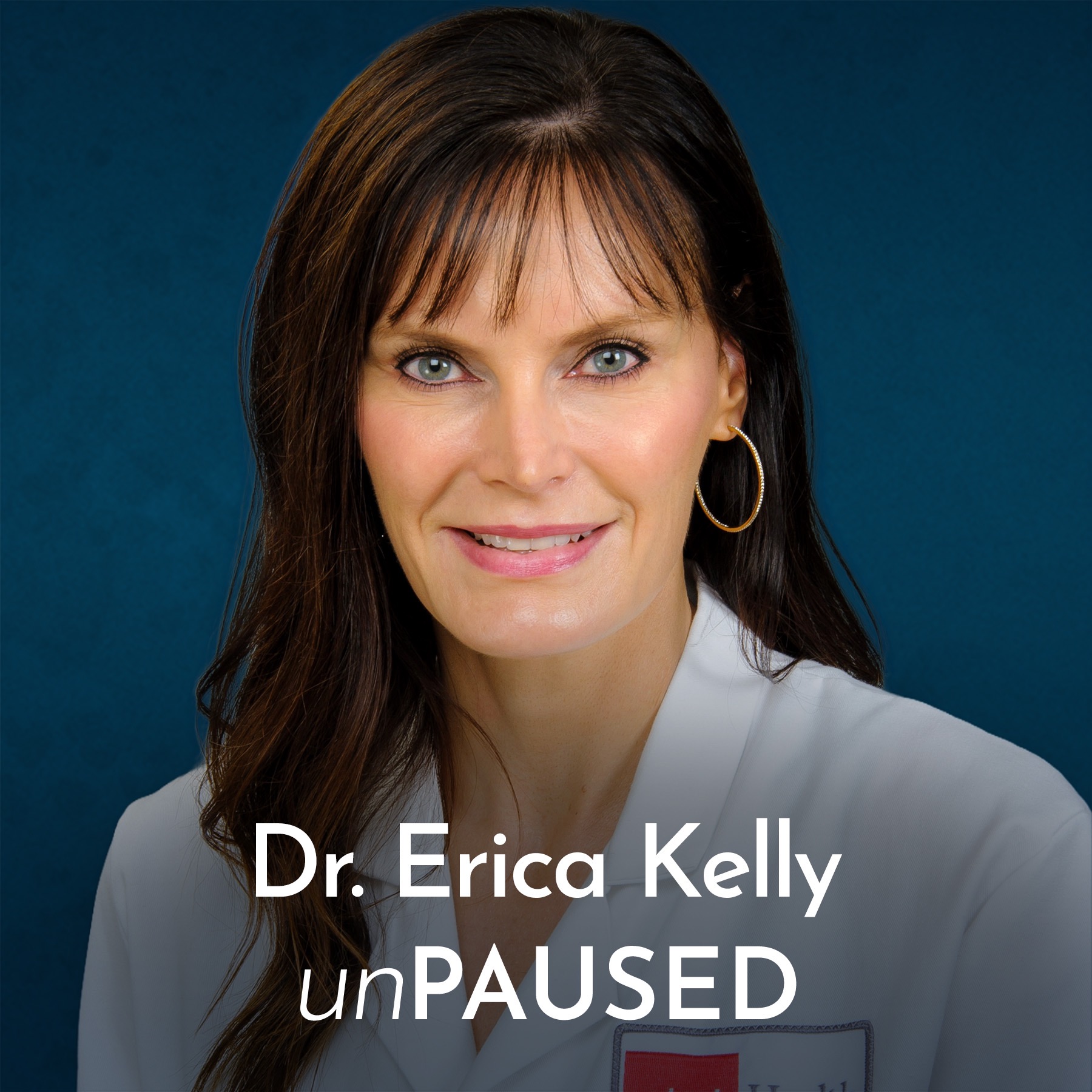
In this episode of unPAUSED, Dr. Mary Claire Haver continues her conversation with Dr. Erica Kelly, board-certified dermatologist, Clinical Professor at the University of Texas Medical Branch, and founder and director of UTMB's Cosmetic Dermatology Division and this time it's the practical half: sunscreen, routines, treatments, and hair. Dr. Kelly settles the questions filling everyone's feed — chemical vs. mineral sunscreen, whether the endocrine-disruption fears are backed by evidence, why some filters are banned in the US but not Europe — and explains why the best sunscreen is simply the one you'll actually wear, every day, including the spots everyone forgets: scalp, ears, and lower lip. Mary Claire also shares her own recent diagnosis: a squamous cell carcinoma on her nose — which Dr. Kelly removed.
Guest links:
- Dr. Erica Kelly at UTMB Health Aesthetics https://utmbhealth.com/aesthetics/about/erica-kelly
- Dr. Erica Kelly (UTMB Health) https://doctors.utmbhealth.com/profile/005428
Recommended Books:
- "The New Perimenopause," by Dr. Mary Claire Haver https://thepauselife.com/pages/the-new-perimenopause-book
- "The New Menopause," by Dr. Mary Claire Haver https://www.amazon.com/New-Menopause-Navigating-Through-Hormonal/dp/B0CKBZ4K1Z
00:00:00 – Mineral vs chemical sunscreen
00:02:16 – Are sunscreens endocrine disrupting?
00:04:56 – Do you need sunscreen every day?
00:06:28 – The ideal morning and evening skincare routine
00:07:19 – What a dermatologist actually uses on her skin
00:10:17 – Supplements and the evidence for collagen
00:12:43 – When professional skin treatments make sense
00:13:22 – The four approaches to cosmetic treatment
00:15:02 – How menopause changes lasers and Botox
00:17:01 – How to choose a safe cosmetic provider
00:19:18 – When to start Botox
00:22:22 – Menopause changes across the whole body
00:24:49 – Diet, sleep and skin aging
00:27:02 – Does red light therapy work?
00:28:25 – What actually helps menopausal hair loss
00:32:16 – The number one thing to do for your skin
00:32:46 – Drugstore skincare Dr. Kelly recommends
Never miss an episode—sign up for The 'Pause Life Newsletter:
https://thepauselife.com/pages/newsletter Medical Disclaimer: The information, including opinions and recommendations, on this platform is meant for informational and educational purposes only. Mary Claire Media, LLC, the unPAUSED podcast, and The 'Pause Life are not medical organizations. Medical advice or medical diagnosis cannot be provided to you through the platform, any associated website, or customer portals. Using this platform does not establish a patient-physician relationship.
Scan the code with your iPhone camera
Listen in the app.