Ask ChatGPT


 UNTAPPED with Spencer Matthews
29 Oct 2026 · 38m · 12 chapters
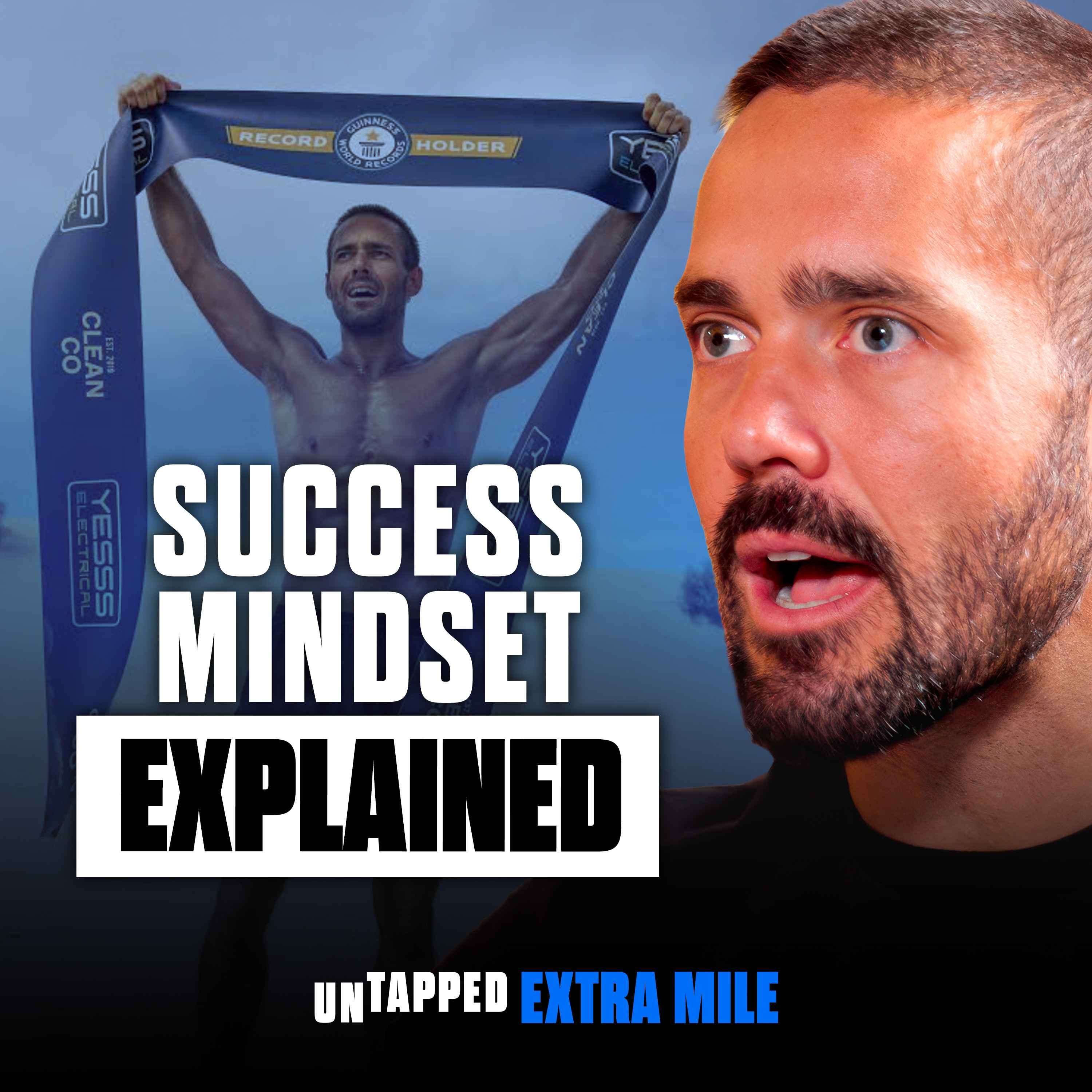
Whether visualizing “success” (manifestation/mental rehearsal) improves real-world performance, especially endurance sports. The hosts argue visualization works when it’s tied to a clear, tangible goal, deliberate practice, and accountability—not wishful thinking or “vision boards” alone. They cite sports psychology and a Cleveland Clinic study (~22% performance increase from mental rehearsal), plus neuroplasticity (rehearsing coping scenarios builds neural pathways).
picture the process and pain signals, not just the finish; anticipate difficult moments to reduce surprise and improve grit; gratitude reinforces mindset and goal pursuit; outcome is less controllable than influencing the process.
Berlin marathons—2025 (much harder, “306” time) vs a later Berlin (249) where they respected the pain, visualized coping, and maintained steadier pacing; golf visualization before shots; a first marathon run “on zero training” after a nightclub.
No guest is interviewed; only hosts Spencer Matthews and Oli Patrick (with references to Stephen Scullion, Chris Taylor, and Tim Noakes).
Written by AI. May contain mistakes.
The hosts discuss the concept of visualization and its impact on performance.
“There was a study years ago, I think, by the Cleveland Clinic that showed people who mentally rehearsed what they were going to do, had an increase of around 22 % in physical performance.”
The conversation shifts to the reality of manifesting goals and the importance of effort.
“We're not talking about laying in bed going, I want to run a 2.30 marathon and then suddenly being able to run a 2.30 marathon.”
The hosts share personal marathon experiences, emphasizing mindset during races.
“So it's, I've never put the word manifesting into that, right?”
Learn how visualization and neuroplasticity impact athletic performance.
“manifesting, you know, how do I how do I break free of the pain?”
Discover how experience influences pain perception during a marathon.
“And it's kind of, you're then able to work in stronger pace, better form.”
Explore the complexities and misconceptions surrounding marathon running.
“Yeah, it's the same as kind of trying to set a PB in a faster, smaller distance, right?”
Understand the importance of mental preparation and visualization for racing.
“And it's receiving that signal super early.”
Explore the challenges and mindset needed to improve marathon times.
Understanding how gratitude impacts mindset and goal achievement.
“when we do hard things we go up a level and we go up a level and that that's sort of the progress of the human experience.”
Discussing the importance of setting achievable yet challenging goals.
“Would we negative split it, build into it?”
How past accomplishments shape future expectations and performance.
“And I look at some, you know, people who set targets and I just go, why would you set yourself that target?”
Applying sports achievement strategies to personal and professional goals.
“Again, if that's a yacht, I would suggest setting yourself a more positive kind of goal.”

Get the gist, explore an idea or ask about something said.
 Claude
On UNTAPPED with Spencer Matthews, what are the key points of this episode?
Searching your listeningAutomatic transcript. May contain errors.
0:00Welcome to Untap the Extra Mile with me, Spencer Matthews. And me, Oli Patrick. We're here again. We're here again for another episode of what can only be described as potentially the best physiological show in all of the world. And this is how I feel about it anyway. I'm not sure, you know, it's just an opinion. My opinion, which I'm entitled to. I can only speak on behalf of myself and say I love these conversations. Because I don't know where they're going to go. I don't know. I've got a sense where they could go, but they don't always go where I sense they could go. Today's discussion is, can you actually manifest a better performance?
0:36Can you create a better result, a better run, a better race in your mind? I think it's interesting. It's pulling from lots of different spheres, like mental rehearsal. There was a study years ago, I think, by the Cleveland Clinic that showed people who mentally rehearsed what they were going to do, had an increase of around 22 % in physical performance. There are lots of studies that show if I visualize the process, not the outcome, or if I mentally prepare for what I'm about to do, there'll be an uplift in performance. So it's pretty clean in the sports psychology field, but we're seeing manifesting, dancing across into mainstream behaviors.
1:13As people say, if I am able to truly picture this thing happening and then build the steps towards it, there's an increased likelihood of it happening. We've got a cushion in our house, which says, if I believe I can or believe I can't, I'm probably right. And that in itself, that's a woo-woo cushion, but it pulls from good quality data. Well, one thing is for sure, if you flip it the other way around and you go, I can't do this, then there's no chance of you achieving it. I think for once, I could probably add to this conversation with a fair amount of relevant experience. I've done a fair few things over the world, the world record racing and stuff.
1:55And, you know, there have been times where I've absolutely pulled myself out of hell because ultimately I think, you know, when your body feels like it's giving up, it's your brain sending you a signal to stop because it feels like you might be doing this hard thing all day. Whereas actually if you can rationalize the position you're in, the pain that you're currently feeling and somehow kind of pull yourself out of it, then that is entirely possible. It takes us, I mean, there are lots of different tranches within here. We've got all this idea of visualization, me picturing myself doing something.
2:29It will take us into self-talk, some of the tools that you've got. Sorry, yeah, and just to be clear, this conversation is not about, you know, writing, I want a yacht on a mirror and hopefully ending up with a yacht. I can tell you that probably won't happen unless you go out and put in the work and, you know, make enough money to buy the yachts that you want to buy. Poor investment as well, in my opinion. But, you know, it's kind of, that's not what we're talking about here. We're not talking about laying in bed going, I want to run a 2.30 marathon and then suddenly being able to run a 2.30 marathon.
3:00You know, nothing, nothing happens without the training, without the work. I think we're talking about, can it be beneficial? And are there tricks that we can play in order to give ourselves a better performance on the day? agree and actually that example of that that's when you're talking about truly manifesting so you know the first point of manifesting is to have a very clear tangible goal so you know what you've got is if someone says the question of that goal then being logical or illogical i'm not going to put that i want to manifest a 245 marathon because it's so illogical that i've got to overcome so many psychological barriers to get there as would be me potentially putting um i I want a yacht.
3:40And I could theoretically end up with a yacht, but it's not something I actually want. So the first point about manifesting, which is this idea, not because it's a bad investment, I can't see any logic why I'd have a yacht in Oxfordshire. I feel absolute legend on the Thames. Legend. Yeah. I mean, you can have it elsewhere. You can have it. You've got to want it. Lock it in Monaco, for example. But manifesting gets a bad press because people think it's people lying in bed going, I want to run a 2.30 marathon. Can I picture myself to that, turn up on the day and execute it? And you've already raised a sort of really interesting point about manifesting, that it doesn't exist without work.
4:14But manifesting has moved from being a sort of whimsical, I've got a vision board at home, and I want to have my own TV show, or I want to run a sub-four-hour marathon, to now being quite a recognized neuroscience technique. Which is effectively a series of steps that make it more likely something will happen for you. and I was very much manifesting came from sort of spiritual you know whimsical place where you know the universe will serve me what I deserve or serve me what I wish for you deserve everything well that's very kind just great well I've been blessed with lots of great things and the question is have those great things happened because I visualized them into my life or have they taken place because they just naturally occurred out of nowhere and I think manifesting starts to give us a structure where where wishes can have an increased likelihood of becoming reality.
5:10And it's probably got four key stages. I want to apply this to you because I'm really interested in your relationship with the 245, but any of the world record attempts. Manifesting is having a really clear goal. So that's point number one. Then two, it's looking for opportunities to move yourself towards that goal. Point number three on manifesting is you've actually got to do the things. So I've got a clear goal. I have, again, set myself out that that's something I'm going to deliberately target. Then I'm going to do those things. and four, which is very relevant for you in the 245, I will then share some degree of accountability.
5:39Now there's lots of different sort of spheres of manifesting. There's seven steps if you follow Roxy Nafusi. There would be a very different approach to that if you follow Dr. Tara Swart and the source. But the science seems to show you need a really clear goal. You need to be looking to take the opportunities you can to move towards that goal. You need to be making sure that there is, again, deliberate practice. You've got to do the work itself. and there needs to be some degree of accountability. Yeah, so it's... How does that sound? That sounds to me like I'm going to set a target, whether that be a business target, a personal target, or an athletic target.
6:15Then I'm going to create a plan, whether that be a business plan or a training plan or a personal plan. And then I'm going to execute that plan, you know, in order to give myself the best chance of achieving the goal. So I think we're kind of all saying the same thing. You know, I personally wouldn't put, But say I want to run a 249.50 in Valencia. That's the target. I'm going to create what we deem to be a near perfect plan with Stephen Scullion. We're then going to execute on that plan about as well as we can. And I'm taking accountability for it by making it public. And I'm putting it out there in the world.
6:54I'm going to run this time on this day. And you can follow along the journey. And, you know, whenever I miss a session or I go to the pub and I mess up the juju of the plan, that's on me. And I try and take accountability for it.
7:28affordable GLP-1 options. HERS makes it simple to find an approach that fits your needs and your budget. If eligible, you'll get a treatment plan personalized to you and unlimited dosage changes as needed. It's weight loss designed to work with your life. Ready to reach your goals? Visit forhers.com slash eligible to get personalized affordable care that gets you. That's F-O-R-H-E-R-S dot com slash eligible. Forhers.com slash eligible. Weight loss by HERS is not available in all 50 states. WeGovi is the registered trademark of Novo Nordisk AS. To get started and learn more, including important safety information, WeGovi clinical study information and restrictions, visit ForHers.com.
8:15So it's, I've never put the word manifesting into that, right? But have I lay in bed thinking of myself crossing the Valencia Marathon, you know, finish line, you know, and celebrating. Yeah, of course, I think that's a naturally occurring human thought to think of the things that you want. Maybe it's not, but it certainly is to me, right? I will envisage, I've thought many times about this podcast and where it's going to be in five years time. And, you know, I'll just be sat in a cab or on a line bike daydreaming about how the show will look and feel. I don't know if that's manifesting or if it's just me thinking about the things that I want right I guess they're the same thing but it depends how how fleeting those thoughts are so I think with manifesting you've got a definitive goal that you've you've aimed towards you know having a nice image of of this and that a flitting thought doesn't then mean you build the ecosystem that you've clearly built underneath the 245 which you might not have had the same level of granular you know spotting opportunities putting the work in and that that becomes really interesting and And sport is a much cleaner example of this than any other world.
9:23We can stick to sport, I think, for the purpose of this conversation, because I think people that listen to this are sporty and stuff. So we can... It is interesting, though. The more conscious you are of the potential pain, I think the more likely you are to respond well to it. Like, I think if you take... Love it. If you take 2025 Berlin, which some listeners will know was one of the worst experiences of my life, the hardest marathon i've ever run by miles an awful day on all counts thing went wrong probably eight or nine k in i had 33k of just agonizing pain with no music in boiling heat you know throwing up on myself you know just just a shit hard crap day yeah right all to run a 306 yeah Which I thought was hellish.
10:15So compare that to this recent experience in Berlin, 249. Obviously, I'm better prepared. I've done more work. But I was also very conscious that the marathon is going to get very hard at times. So I didn't think that way the year before. I thought, oh, I've ran a 207 in London. I felt really good. I'm going to do a bit more training and just go and run a sub three in Berlin. And I took it incredibly casually and I didn't take it very seriously. And it came back to bite me really hard straight away. And, you know, marathons can be incredibly punishing. And that was one of those days where it just took me when, nah, not having you take the piss out of me in this way.
10:56And it just had its wicked way with me and I absolutely hated it. This time, you know, hotel room the night before, instead of visualizing a successful race like at the 249 that i wanted that was plan a right 249 yeah chris taylor and i gave ourselves about five percent chance of running that race that day because there was a few things that just uh meant that it we weren't as well prepared as we could have possibly been on that day yeah um but one thing we did take very seriously was that it was definitely you're going to get very difficult, right? And I thought more about that. It's like, when the pain arrives, what are you going to do with it?
11:40And how are you going to feel about it? And how are you going to dispatch it? And I kind of persuaded myself that that is the challenge, right? It's not the race. It's not the time. It's not the marathon. It's how do you deal with and dispatch the dark, bad, painful feelings when your legs start to feel heavy and you feel lactic acid build up and you start to slow down and you look at your watch and you're not hitting the splits that you thought you were going to split how do you how do you turn things around yes and that was kind of how i went into that race with extreme levels of respect to berlin for having you know violated me the year before um and and and uh you know i said my little prayer on the start line and i set off with um like modestly i set off modestly with respect to the race you know And I just took it very, very seriously.
12:31And as soon as those feelings began to creep in, and they crept in at 16K, 22K, 28K, 33K, you know, they happen. They happen. Like a marathon is the furthest thing when you're pushing yourself from being, you know, a straightforward race. It's obviously, you've got nearly three hours of time. Yeah, right. Where alone with your mind and your physicality to ponder your ability to do what you think you can do. And it can be a bit of a mindfuck, obviously. So I don't know. I spent more time persuading myself that the work has been done, that the feelings of pain are fleeting, that, you know, glory will be mine if I can just push through the pain and sure enough it it comes and goes and like and you feel it go as well yeah like you know you'll be you'll be running you'll go fuck i feel like i'm slowing down oh god like i need to get my legs moving again and then you go wait i'm in berlin i'm with my mate chris we're running a great race the weather's nice it's not as hot as last year look at this kid with the with a sign that says you know smack this for power isn't that fun and all of a sudden you just get this kind of second boost and this energy.
13:54And the idea is just to try and work through that. So I guess, I don't know, I spent less time manifesting that result, more time manifesting, you know, how do I how do I break free of the pain? That is such a great visual, fantastic example. And again, there to be picked and unpicked. But I think that that ties into some of the science around manifesting or goal visualization, which moved away from, I picture myself crossing the line in 249 to I'm picturing myself in the process. You know, the process, you have predicted what is going to be the biological feedback from your body. You have anticipated what some of those signals are going to feel like and sound like and the way in which you're going to overcome them.
14:38And I think, you know, what we saw in visualization and manifesting is, like with most things, you know, the outcome is much harder to control, but you can influence the process. and in in doing that in advance of it you know what what became really interesting was this idea of neuroplasticity which is that the brain can build new structures um at almost any stage of life so you know you you have a wonderful new addition to your brood and his brain will be you know building new neural pathways so that you know every day there's a new skill there's a new language there's a new expression and we sort of build these incredible pathways it's about the age of probably to 25 and then we sort of slow down but we can build new pathways if we imagine new scenarios and actually neuroplasticity and manifesting of sort of tied in hand in hand with the idea being if i regularly mentally rehearse something taking place and i always remember this when i when i played very rudimental golf but i played with a good golfer and he before every shot stood behind it and visualized the shot he was going to hit and he would when he wasn't playing golf was visualizing the shot he was going to hit and he fundamentally said every time he hits his shot it's the second time he's hit it and that's the way the brain works to a certain extent so every time you were met on that run with that biological signal of distress it wasn't the first time you'd encountered it because you'd almost built the neural pathways of how to cope with a scenario that was happening to you live but also the the best thing about it is when When you get slightly more comfortable in the pain with running, it's no longer that surprising to you.
16:18And it's kind of, you're then able to work in stronger pace, better form. Like I've found since Berlin, the confidence is just sky high. Because you kind of feel like, well, I don't need to slow down over 42.2k. You know, like before that, every single marathon I'd ever ran in history, all 56 of them or whatever it is, I'd slow down towards the end. You set off strong. There's a middle bit, you know, which is kind of painful and hard. And then the end bit is the wheels come off a bit and you fall off your pace and you kind of cross the line, sometimes quite well and sometimes not in crazy agony, but not as fast as you set off.
17:07and Berlin was the first experience where the second half was broadly speaking exactly the same time as the first half and it was a great experience for me now on a long run you know when my legs begin to hurt yeah I just go well that's bollocks I know that I can run you know the full distance on at full pace basically and it's kind of you start to go I'm just going to take this pain and just chuck it out the window because it's just my brain well that that's that That is, I mean, again, you could just define that as simply that is experience. There's two parts to that. Obviously, you've become a better athlete.
17:41There's increased running economy. There'll be increased fitness. But that sort of pulls you into another mindset strategy, which is this idea of grit, which is your ability to persevere to long-term goals of passion. But ultimately, in that marathon, you've realized that you can weather that storm and come out the other end of it. Whereas until you had done that, that was an unknown unknown. Yeah, it's the same as kind of trying to set a PB in a faster, smaller distance, right? So like in a 5k or a 10k, it's actually, it's almost a bit harder to do it in those shorter distances, because it's sort of the pace at which you're traveling is inherently more intense than marathon pace.
18:22It's harder to rationalize the pain. because it's more painful earlier, right? And I don't mean pain that you might feel in the 35th K when your body is literally breaking down. I mean holding a pace that, by all accounts, you can't hold for more than 16 to 20 minutes. You know, you're just, you're kind of flat out. You're 80 % jets, you know. And the pain is different. It's like, it's an attack on your lungs. It's a lactic acid attack on your legs. everything about it is is kind of comes on harder and it's harder to rationalize the reason the marathon i think is is a phenomenal distance is because even when you're racing it so like you know when i'm racing for my 244 or whatever it is going to be in valencia um you're going you're going fast but you're not going so fast that you can't think properly yes or you know you're not going so fast that you can't breathe for example like in the 5k your breath can get the better of you lose your ability to breathe properly yeah whereas when you're racing a marathon you know in my experience that doesn't happen it's fast but it's kind of controlled yeah so you get the opportunity to to fight with your your thoughts whereas you know in a 5k gone wrong when it gets dark it gets dark real fast you know and you suddenly realize i'm out of this i can't i can't keep my legs ticking over and you literally just can drop off a cliff.
19:48Do you have a different, because you do still run lots of fast 5Ks, do you have a different internal voice? So this is super interesting that obviously you've got certain things you're talking to yourself about during a marathon. I want to dive into what those are. But are you saying that the white noise of the pain in a 5K is so overwhelming that those internal voices don't help? I'm talking about if I set off to run a 5K at like a 315 pace or a 320 pace, you know, like you're looking to kind of Beyond your current, yes. Yeah, yeah. Beyond what you can do. And that's, you know, in that, you probably manage a K 1500 meters, something like that, before you go, well, I've got three and a half K left.
20:26And that's a real crushing feeling as you realize that you're not going to be able to hold the pace. And then, you know, it's quite a long battle actually after that point, you know, to finish those three and a half K, particularly if you feel a bit spent. In my experience of marathon running, it's not quite the same. Of course, the wheels can come off. The less prepared you are, the harder it's going to feel, of course. My very first marathon that I ever ran in my life was on zero training, fresh out of a nightclub in New York. I think I was 19 or 20 years old. It was to prove a point to my brother that I can also run a marathon, right?
21:02And he was very well prepared and, you know, was running kind of 3.15 at the time or something like that. And it was the most painful experience of my life but bar none it was absolutely horrendous i hated every single second past 15k of it yeah um you know pretty slow but just very very painful you know like ankles messed up knees messed up lower back mess i was a little kid as well and i'm getting all this pain because you've just got no preparation you can cover the distance yeah because of grit and mentality and whatever else but it's painful painful hard hard dark you know i was in bed for days afterwards horrid experience yeah the more experienced you are the more time you put in the more effort you put in the easier it's going to feel you also you also finished that marathon because you wanted to prove your brother wrong of course yeah which again because actually a lot of people wouldn't run a marathon cold and again it's still an enormously difficult task to run a marathon although some of the other day said a marathon was easy i didn't actually that was um in fact let's let's let's let's talk about it i did i did say the words running a marathon is easy that wasn't the context of what i said no no i know uh if anyone had bothered to actually listen to the interview or even the whole clip that was posted yeah it was actually supposed to be an encouraging message to people that if you believe you can't run a marathon in my opinion you can that's all i'm saying which comes back i probably shouldn't have used the word easy some of the hardest days of my life have been running a marathon just to be clear right so like i'm aware how hard a marathon can be hopefully everyone listening to this knows on the record that i have spoken about the deep pain i've experienced whilst running marathons um but i was making the point that pushing yourself to to to your whatever your human capacity might be your human limit um over that distance is obviously going to feel harder than covering the distance, you know, in an easier manner, I should have said.
23:04Yes. You know, it's my personal opinion, and I could be wrong, that lots of people, if they wanted to, could cover 42.2K, whether that be walking, jogging, jogging and walking, stopping, hugging, high-fiving. Yeah, I've done all of those. You can cover the distance, in my humble opinion. If you put the training in. I think if that same person then tried to suddenly run a, you know, sub four hour or a 330 marathon, they're going to experience all kinds of pain that they've perhaps really unfamiliar with. But that wasn't my point. My point is, I think that if you had to cover 42.2K, even if you're not an experienced runner, I think you could do it with pals and a bit of support and a couple of water stops, coffee stops along the way, maybe even a beer at halfway, whatever.
23:55Like, I think you can probably cover the distance. was the only point I was trying to make. People latched on. People did not like the abbreviated version. They did not like it. And just to be clear, I would never ever detract from the incredible experience of somebody training to run their first marathon, often for charity. I absolutely thrive off and love when people go out of their comfort zones and do difficult things. So it's absolutely not in my nature to make, to even suggest that something like a marathon could be easy and straightforward for everyone. That is not how I intended that to come across.
24:42Hot flashes. Rage crying. Forgetting words mid-sentence. Yeah, we know. Menopause is a lot. Midi Health gets it. That's why Midi offers virtual healthcare specially tailored to women's needs. Built for women, by women. Every symptom, every stage, every question. Visit joinmidi.com to get started today. That's joinmidi.com. Individual results and coverage varies. Check with your plan for coverage.
25:16And I think that was the point. And that brings that great discussion together in terms of an individual who is about to commence a marathon probably needs to do some form of manifestation some form of visualization because they want to be prepared for what's going to go on and go wrong in that race in the exact same way as you will be for valencia and i think this mental preparation piece when we consider that most people when they are fatiguing in these events are fatiguing not through pure physiological means but through psychophysiological means which is you know your brain is receiving a signal to stop.
25:51And it's receiving that signal super early. It's receiving it, you know, 10 strides into a 5k potentially. And it's how we can overwhelm that signal to stop with these psychological techniques that will be the defining feature of most people who are running at a higher intensity. That higher intensity piece matters enormously. Well, yes, it is broadly speaking, you know, a lot of it comes down to heart rate and borrowed time. you know when your heart rate is in a certain zone by definition you can only be there for a certain amount of time you'll be fatigued before your body gives up yeah but if you're in the if you're in that zone two zone three when you're fatiguing it's whether you can ignore and again the work of professor tim noakes and central governor theory legend tim noakes legend that all being said that the role of psychological preparation is is pretty massive and i think it's interesting how much of this has already gone into your preparation without you sitting down and doing a deliberate vision board and execution you've got those four fundamental steps to building accountability there when we do visualization we can sometimes visualize the best thing going wrong some people visualize the worst thing going wrong do you ever go if i don't do this that awful berlin experience will happen again or are you naturally visualizing that glorious feeling of crossing the tape and feeling good, feeling in a stride?
27:16Are you running away from something or running towards something? There's very unlikely to be any tape at the finish line by the time I get there in Berlin. I think Kajeltsch will have probably smashed through it 44 minutes before I will get there. There's a virtual emotional tape that you will shatter. Yeah, listen, I envisage the thing going right. Nice. I'm naturally a confident person, particularly when I put a lot of work into something. There really has been, you know, no substitute for the many kilometers that I've ran since meeting Stephen and, you know, the training that we've implemented.
27:55You know, 245 was a pretty good taste of the progress so far. Massive confidence boost. So, yeah, of course, look, finding four minutes in the next seven weeks is very tough. it sounds I think to a layman but you just ran 249 so 245 is easy now that's definitely not the case there's you know 7 seconds per kilometre to find it's quite a lot it's not an extraordinary amount of time when we first took on when we first took on the challenge I had to find something like 23 seconds a kilometre so everyone's went you're not finding that in six months yeah now it's more like seven you know so it's kind of it's doable and also was there a bit more in the tank you know in the first half of berlin yeah of course there was you know i was kind of smiling and we're having the time of our lives and it was a great a really great day yeah but would that have a really negative impact on the end of the race only god knows yeah um so we'll have to see doable is a word because you you've you know past experiences inform future events right so yeah you have built confidence in yourself to then take yourself to the next level and that's where again we get the pushback against manifesting you're not lying there going i'm definitely gonna be able to run a 244 in in valencia you're saying my past experience of berlin is now informing my future prediction of events and that's where you know ultimately when we do hard things we go up a level and we go up a level and that that's sort of the progress of the human experience.
29:30The better you become, the less painful it's going to be. Like when you look at Sebastian Saway and Kjeltscher and Kipchoge, they're not in miserable agony when they're running these marathons. They are conditioned. They've done it many times. They're very well prepared. In many ways, it's much harder to slog through a five and a half hour marathon than it is to run a 2.45 because by the very definition of running a five and a half hour marathon, you're less prepared and less able than the 245 marathoner who's out there for half the time. One thing we noticed with lots of those top marathoners, quite an uplifting personality, actually, quite positive thinkers.
30:13That's an interesting phrase. Before I get into why that might tie into this, is there anything you're looking to buy at the moment without oversharing? Is there anything I'm looking to buy? Yeah, like changing a car, changing sofa. I mean, we're building the new house currently. So I suppose we're buying all kinds of stuff. So are you seeing now more adverts for furniture or for interior design than you might have done previously? Where are you going with it? Yes, I suppose. Is this because your mobile listens to your chat? No, it's because we see what we set out to see. right so we sort of call this and it leads in there's crossover into manifestation that one of the things you'll see often is gratitude linked in with manifestation which is being really grateful for things and and the rise of gratitude as a really robust neuroscience technique because if i'm telling my brain that three amazing things happen to me today it will notice those three things happening tomorrow and that sort of success leaves clues piece is really relevant that when people have a higher propensity for gratitude it can help them take the steps towards their goal and so in traditional manifestation having some form of regular gratitude to change your mindset from these are all the things that seem to be going wrong to these are all things that are going right can enable individuals to have a better chance of achieving the goal thereafter and i don't know if that's something you've ever consciously used or noticed because you do strike me as quite a grateful person i'm very grateful yeah i say gratitude is something that you have super grateful i feel very privileged obviously because i am but i'm very grateful as well yeah uh for lots of things um i'm in running you know would you reflect back on berlin and sort of and reinforce with gratitude how many things you're pleased with berlin was was one of was arguably the greatest sporting moment of my life right like chris taylor and i at the finish line uh hugged and kissed and couldn't couldn't believe what just we just didn't expect that on that day yes right we had our reasons for that as well but i won't share those but you manifested it yeah i suppose so yeah well the night before we were talking about a sub 250 like 249 what do we need to do for that what pace do we need to run at what how long would we hold it would we set off a little harder would we set off a little slower?
32:37Would we negative split it, build into it? So we did discuss it and we were talking about it. And of course, like I went to bed thinking like a sub 250 is, I called it rock star shit on the vlog. I was like, this rock star shit. I said a prayer to Mike when I went to bed, I said a prayer to Mike on the start line. I was like all over the 249 thing, despite it having a a small percent chance because I knew I could hold four minute Ks for a long time. But I just assumed as history would have, you know, be shown that at some point, you know, 30K, 35K, I was going to slow down to four 10s or four 15s or four 20s, or if things got really bad, you know, four 30s, four 40s.
33:20And, you know, that would have a knock on effect on the time and you'd miss the time. That's what's happened to me every single marathon I've ever ran in my entire life. So the fact that didn't happen has completely changed the way I look at things now. And obviously there was a lot of doubt heading into 245 just generally, because I set myself, going back to the very beginning of the conversation, the target, I set myself a very difficult target on purpose, right? So like we've spoken before about people with platform setting themselves crazy, unrealistic targets and how frustrating that can be when you already know that they're not going to do it.
33:55Absolutely right. And I look at some, you know, people who set targets and I just go, why would you set yourself that target? Like it's similar to what you said about yourself. You wouldn't set yourself 245 just because it doesn't make sense at this stage. And so I look at some people's targets and I think the same thing. I just go, well, that's just, frankly, it's annoying. And I was being accused of that, but I was quite careful with my target. So I looked at where I needed to be and the time that I had. And I thought, if I dedicate an hour a day to this with a proper plan, I think that's more than achievable.
34:28But you have to do the work, right? You need to do the hundreds of kilometers of work in the buildup to this thing. I wanted it to be really difficult, but achievable. I think those are the best kind of goals. Something that you set yourself that you know you can achieve, but also way to miss it. There'll be good learnings in it and you can adjust it and move forward and change it. And, you know, if I run a 246 in Valencia, I'll go for, I'd probably, if I was that close, I'd probably readjust to a 240 or something like that in a few months time. And we'll keep the whole thing going. I'm loving the journey of becoming a better runner, right?
35:06And the target is just part of it. It's something to aim for. It's not the be all and end all, you know? And similarly speaking, if I run a 2.43, I'll readjust to a 2.39 and we'll go again in Seville or whatever. You know, like this is not going to end in Valencia, regardless of whether it succeeds or not. So for me, it has a really net positive effect on the rest of my life, like this pursuit of a faster marathon time. But that's not necessarily the overall goal. You know, Valencia may feel like the finish line, but it's part of a much bigger story. And to answer your question, yeah, I go into it thinking that, you know, we can pull it off and we can do it.
35:54But obviously, it's a difficult target and there's no guarantee that there'll be any success in Valencia. But providing I put in all the work that I am doing, I should have the best chance of succeeding. I think that's, again, an actual, you've picked the key scientific elements, which is a really defined goal, giving yourself the opportunity, doing the work, the accountability. You've used positive reflections on past experiences to build your increased likelihood of predicting this future event. you've developed grit which again along the way has meant you're able to persevere that signal of pain despite that pain potentially being less as you've actually become fitter so much of this is you know above and beyond the miles that you do and and this does transfer outside of sporting performances someone who wants to get married and have a baby someone who wants to get a promotion at work those steps which is what's really interesting about manifesting seem to translate outside of sport and it's one of the reasons we find sports people speaking at organizations or becoming motivational speakers that this template that really works to help you achieve this goal is not a bad method to stick up the yacht on the board at home and say what are the steps for me to get there but the most important thing about it are the steps the steps right like the thinking of the yacht and the getting the yacht is beyond stupid right it's kind of like it's the what are the three things in between agree those things happening identifying what you want is the vital The most important thing.
37:21Again, if that's a yacht, I would suggest setting yourself a more positive kind of goal. You know, maybe something a little more personal. And then, you know, it's how you do it to get there. But I don't know, it's just interesting. I said this to Jamie Lang the other day. We were talking about marathon running. And I, you know, this year's Berlin 249 was infinitely easier, right, than 2025 Berlin 306. 17 minutes faster, right, and way easier. Just like the whole race, broadly speaking, was much easier. Better preparation, better visualization, better everything, better company, better everything.
38:09just like just more respect you know and um despite being difficult it was easier you know there's always going to be a layer of difficulty to the marathon what's beautiful about this discussion um is the fact that you do so many of these things and you've done them you know partly unconsciously you know you set yourself a really definitive goal you gave yourself the opportunity you did the work you made yourself accountable you've used again positive reaffirmation from And the fact that you're grateful for previous experiences, that's feeding forward. I hope to a bias that you're applying that lens of, well, if that was true, what else is true?
38:46You've got some fantastic internal narrative to instill more grit. So you're resisting that sense of fatigue. Grit is wonderful. Grit is a phenomenal thing. But that's such a wonderful series of things that does meet the science of neuroplasticity and manifestation. So I think that's a lovely toolkit for how you achieve a sporting target that lots of people could transfer to achieving their life target. So I think you are and have manifested. And I'm excited to see the fruits of that labour in Valencia. Well, Valencia, it's just a part of it. It's a goal. We have many others. We have many other goals and we shall continue in our quest to achieve everything that we can achieve in our lifetime.
39:33Thank you very much for listening to this week's episode of Untap the Extra Mile, all about manifestation and the power of the mind. We'll catch you next week for a brand new episode. Lots of love.
Can manifesting actually help you run faster? Spencer Matthews and Oli Patrick strip away the woo-woo to explore how setting clear goals, visualising the hard parts and changing your self-talk can influence performance.
Using Spencer’s marathon journey as an example, they reveal how to prepare mentally for race-day pain, build confidence when things get tough, and turn ambitious goals into reality with practical techniques you can start using in your own training.
Spencer also reflects on his recent comments about marathon running, clarifying what he really meant when he said that “running a marathon is easy.”
Heights 👉 Get 20% off your first month of any subscription at https://highpfrmc.com/UT_Heights_YT and use untappedpod at checkout
Whether you’re chasing a PB or pushing towards a personal goal, discover how to train your mind to go that extra mile.
Hosted on Acast. See acast.com/privacy for more information.