Ask ChatGPT
 UNTAPPED with Spencer Matthews
12 Nov 2026 · 36m · 16 chapters
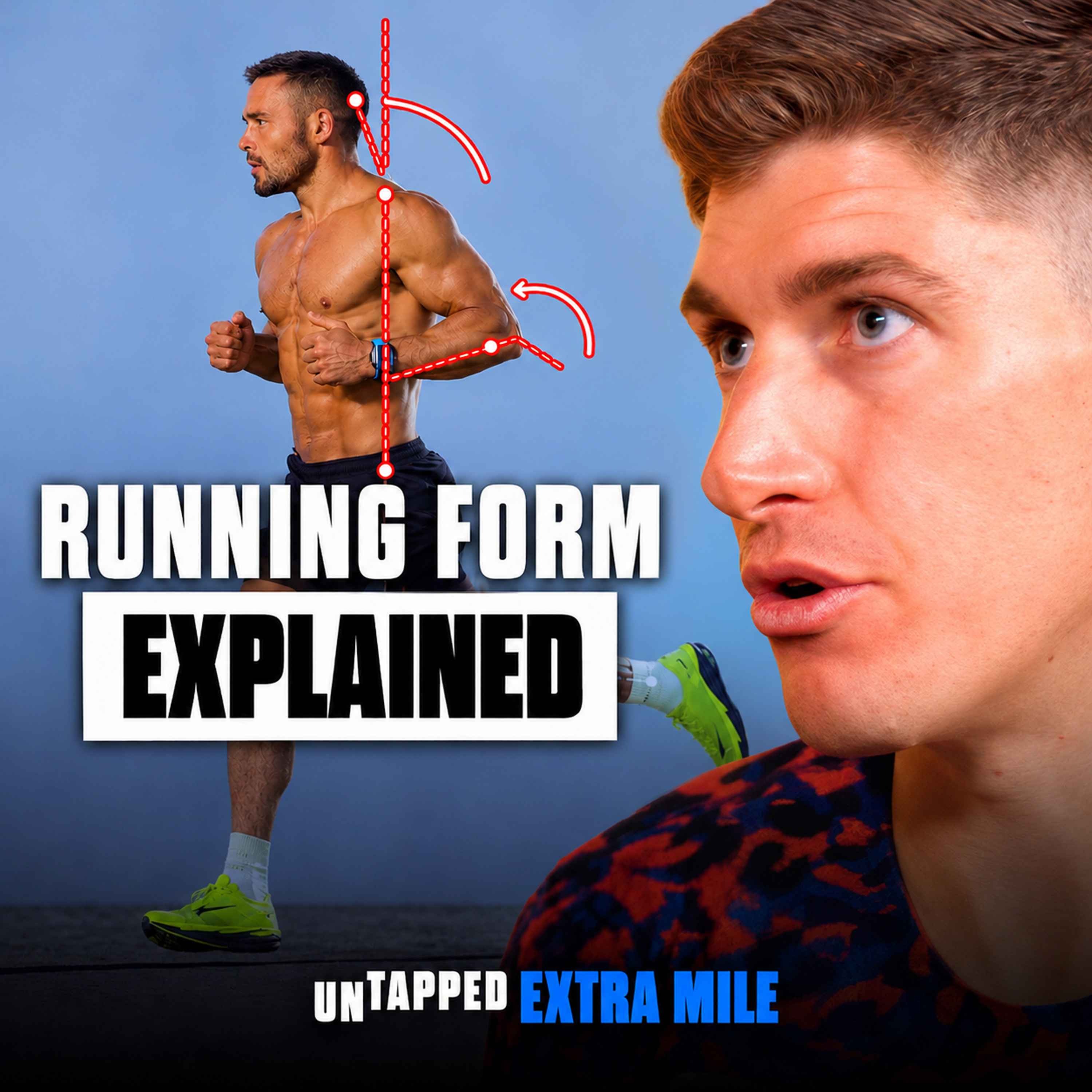
Running form and running economy—why “perfect gait” doesn’t exist, how form changes with fatigue, and what to fix using drills, strength/conditioning, cadence, and technique cues.
Nick Bester (Sub220 marathoner; coach; discusses his own form issues like slouching and arm swing when fatigued; references working with physio Gemma). Hosts also appear: Spencer Matthews and Oli Patrick (they introduce Nick and discuss examples).
Form is individual and often looks worse at slower speeds; improving fitness, strength and conditioning, and nutrition drives better economy. Don’t over-fixate on pronation/foot strike; address upstream causes (hips/core/glute med). Biggest energy leak is landing with the leg in front of the body; raise cadence (aim ~175–180 for marathon) to land under the body. Vertical oscillation/bobbing should be minimized.
Kipchoge (smooth, minimal head bounce), Joshua Chepsega (extreme pronation yet elite 10k), Josh Kerr (fluid mile form), Stephen Scullion (compact “shuffler” style), Valencia late-race fatigue, and a “bar-carb guy” clip used to contrast arm energy vs leg mechanics.
Written by AI. May contain mistakes.
Discussion about the significance of running form and economy.
“Nick gets a round of applause every time.”
Nick shares personal challenges and observations about running form.
“Like, I think when you do strides at the end of your runs, let's say, you know, five times 20 seconds strides, which are a valuable piece that can go a very long way.”
Discussion on different running styles and energy expenditure.
“I think that's a good place to look at where you start slipping and you need to strengthen up those areas.”
Exploring biomechanics and factors affecting running form.
“Hey, we're Nick and Jack hosts of the best one yet behind every episode.”
Exploring biomechanics and factors affecting running form.
“A bit like Bronson Hearn-Smith, who you had on recently.”
Learn how stride length and cadence interact to improve running speed.
“kind of mold a shape around what you're doing, doesn't it?”
Discover how muscle stability and mobility exercises enhance running performance.
“I think the genuine challenge there is lots of people look at the pronation of the foot but they don't look upstream.”
Understand how biomechanics affect running form and energy consumption.
Explore the significance of foot position and pronation in running efficiency.
“If you look at this running video over here, so first and foremost, I think like let's just, let's start with your foot position.”
Learn tips to enhance energy efficiency and reduce fatigue while running.
“I think whether you heel strike, forefoot strike, pronate, whatever the case is, I don't think that's very important at all.”
Gain practical advice on how to optimize your running form for better performance.
“you're cushioning it, it's then coming underneath your body and then you're pushing off.”
Learn key adjustments to enhance your running technique.
“Yeah, so if you look at your video, you see your head's bouncing up and down.”
Explore how body mechanics affect running performance.
“I point them out sometimes lovingly, of course, in the park to my wife because obviously who doesn't enjoy seeing a T-Rex in the wild?”
Discover the significance of cadence and stride length in running.
“they do this beautifully where their knees don't drive forward at all.”
Receive actionable advice on how to improve running efficiency.
“in a marathon or in a race, let's say, is about 182.”
Summarize the key techniques discussed for better running form.
“I'm going to get you a 175 playlist for your next.”

Get the gist, explore an idea or ask about something said.
 Claude
On UNTAPPED with Spencer Matthews, what are the key points of this episode?
Searching your listeningAutomatic transcript. May contain errors.
0:00Hey, we're Nick and Jack, hosts of The Best One Yet. Behind every episode, there's research, email, spreadsheets, and our shared Google Doc, the Headline Hammer. With Google Workspace with Gemini, Google's AI is built right into the premium versions of tools we already use, like Gmail, Docs, and Sheets. No new tools or extra logins, just personalized AI for the way we work. That means less time on the work around the work and more time finding the stories worth talking about. Get AI tools for work. Upgrade to Google Workspace with Gemini at goo.gle slash workspace with Gemini. That's G-O-O dot G-L-E slash workspace with Gemini.
1:02If you felt stuck trying to lose weight, you're not alone. Enter Weight Loss by HERS. It's designed to support you in reaching your goals. And HERS now offers access to an affordable range of FDA-approved GLP-1 medications, including the WeGovi pill and the WeGovi pen. Even better, with a range of affordable GLP-1 options, HERS makes it simple to find an approach that fits your needs and your budget, if eligible. You'll get a treatment plan personalized to you and unlimited dosage changes as needed. It's weight loss designed to work with your life. Ready to reach your goals? Visit ForHers.com slash eligible to get personalized, affordable care that gets you.
1:40That's F-O-R-H-E-R-S dot com slash eligible. ForHers.com slash eligible. Weight loss by HERS is not available in all 50 states. Wegovi is the registered trademark of Novo Nordisk AS. To get started and learn more, including important safety information, Wigovi clinical study information and restrictions, visit ForHers.com. Bonjour et bienvenue at Untapped, the extra mile with me, Spencer Matthews. And me, Oli Patrick. And guess what? Today we are again joined by the legendary Sub220 marathoner, friend of the show, Nick Bester. He gets another round of applause. Let's go. Nick gets a round of applause every time.
2:22Pleasure to be here, guys. We will be discussing running form and running economy. I think we all feel like we don't look great when we run. Even I feel that I look. You're very much looking left there, Robin, looking right. You were looking at the right person. Yeah, no, no. But even I see myself and I go, oh, God, there's a lot to fix there. So interesting. And I think it's interesting. I think we all have this idea that running form should be, you know, Sawe, Kajelcha, Kipchoge, you know, these legends of the game that are just floating marathons at kind of, you know, in two hours or slightly less, as we now know.
3:03You know, what is running form and what's more important, Nick? Form or your running economy? Or are they the same thing, really? So, you know what? I think like when we look at marathon majors on TV, we see the front runners and automatically like their form is going to be unreal. You know, running sub three minute Ks. They're beautiful. When you're running faster, your form looks better. At running five minutes a K, very seldomly does your form look good. So when it comes to running form, I think it's very individual. First and foremost, like 99 % of us, including myself, don't like our running form.
3:35We see the world's best. You see a video of yourself or you run past a window and you look and you think like, oh my word, is that really how I look like? I don't feel like that, but you know, that's how I look. So it's important that you own your running form, but there's also a lot you can do in order to improve your running form. Like there's lots of different drills and stuff, which we'll get onto shortly. So, you know, your form is your form. And I think, you know, often when you're running fast, that looks better. But focusing purely on running form and not focusing on the other areas of running that will improve you, like the training, the SNC, the nutrition, those are - What's SNC?
4:11Strength and conditioning. Okay, all right. Obviously I know that. I'm just kind of making sure that - I'm just speaking on behalf of the listener who perhaps didn't know what you were talking about. Yeah, sure, sure, sure. So by focusing on getting fitter and faster, that's like 99 % of your training. Focusing on better form and better running economy, like that almost happens naturally by doing drills. So it's important to sort of watch yourself back, see areas you can improve on, and then incorporate drills to try and improve on that stuff. But, you know, often as a coach, I'll get asked a lot of questions on running form, like what do you think of my running form?
4:46And people freak out about it a lot. But it's like, you've just got to own it and it's not going to change too much. When you get fast, it might look better. And just know that, you know, often our perception of running form is skewed because we watch the world's best. It's important. Like, I think when you do strides at the end of your runs, let's say, you know, five times 20 seconds strides, which are a valuable piece that can go a very long way. That's when you can focus on people like Kip Choge or Josh Kerr. We need to do one mile effort. His form was incredible. God, it's so beautiful. I literally, I watched that back.
5:17Like when I'm lying in bed sometimes and I'm a bit bored and Vogue's asleep and I can't sleep, I'll pull up the Josh Kerr world record mile. Like I just love it. It's fluid poetry in motion. So good, hey? So good. Like he just, he showed up in shape and his running form was just unbelievable that one mile. What don't you like about your running style? It's so interesting, Nick, because you're such a good runner. To me, what is it you're seeing when you see a video of yourself that you don't like about your form? So it's, yeah, it is interesting. Like, I think almost all runners, like I said, don't like their form.
5:51Do you know what? I'm a bigger boy compared to those I compete against. So I weigh at the moment 77 kilograms. When I broke sub to 20, I was about 75. When I run most of my PBs, I've been around sort of 76. So I've been grateful to have like elite starts at Berlin Marathon for quite a few years and other bigger races. And the average weight of those around me are probably between 50 to 55, sometimes 60, right? Yeah. So at 75 kilograms, I'm 10 to 20 kilograms heavier than those around me. Now, naturally, when you're heavier and bigger, your running form doesn't look as good as like, let's say like a super light, skinny, bouncy, 50 kilogram person.
6:29And I think that's a mistake that a lot of people make as well. You compare yourself to those. But if you see me running in a pack, like even at Tokyo, for example, I'm like a behemoth compared to them. I'm a giant. Like it's obviously running's power to weight ratio. I feel you, I feel you. Yeah, yeah, yeah. I mean, you're a big boy. And like it's, obviously your legs and your core and stuff are strong, but it's all about like getting the most out of your power to weight ratio, let's say. And, you know, if you can maintain your power and get lighter, then you might get a little bit more. Your form might look a bit better.
7:00But yeah, I think when I run and I start fatiguing, I think that's a good place to look at where you start slipping and you need to strengthen up those areas. I definitely like, I start nice and upright, but when I start fatiguing, I tend to crouch over a little bit and my arms, instead of coming straight back and through, start swinging around my body quite a lot more. So we'll get onto what the perfect, well, there is no such thing as almost perfect running form, but areas you can work on. But I definitely start slouching and swinging my arms around when I get tired. I've just remembered a video from the big half where Stephen Scullion is running and there's somebody else running with him who you probably know.
7:38This dude's form is... He's the bar-carb guy. I cannot wait for you to see that. But I think he came second in the big half. Yeah. He runs, and I'm sure he won't mind me saying this because I'm probably not the first, incredibly just in passing, but like Desperate Dan. It's remarkable the energy expenditure that goes into this guy's stride. It's like it would be difficult to do, right? And I'm going to show you a video now. I want you to see it. And in the background, you've got Stephen Scullion, who on all counts is like a shuffler. He shuffles. He's like, his hands are up here. It's very compact.
8:15Yeah, and he shuffles. It's, you know, it's a shuffler.
8:25Good news for anyone who's bad at waiting. Black Friday deals at Lowe's are already on. Get up to three free select DeWalt, Craftsman, or Cobalt power tools with the purchase of a select battery kit. three for free. You better believe it. Plus select ladders are up to 50 % off. So go ahead, get in there early shop black Friday deals in store or online. Now at Lowe's valid through 1118 while supplies last free tools vary based on battery kit purchase and location. Hey, we're Nick and Jack hosts of the best one yet behind every episode. There's research, email spreadsheets and our shared Google doc, the headline hammer with Google workspace with Gemini Google's AI is built right into the premium versions of tools we already use, like Gmail, Docs, and Sheets.
9:08No new tools or extra logins, just personalized AI for the way we work. That means less time on the work around the work and more time finding the stories worth talking about. Get AI tools for work. Upgrade to Google Workspace with Gemini at goo.gle slash workspace with Gemini. That's goo.gle slash workspace with Gemini. Flowing ad budget on metrics that look great till the CFO sees them. That's bull spend. and marketers are calling it out in dashboard confessions. I remember telling my boss, it'll be good for the brand when leads were slow. Yeah, it wasn't. Cut the bull spend. LinkedIn lets you target by company, job title, and more.
9:48Advertise on LinkedIn. Spend$250 on your first campaign and get a$250 credit. Go to linkedin.com slash campaign terms and conditions apply.
10:01I can't wait for you to see this. Here it is. Here it is. It's an incredible difference. It's so uniquely different. A bit like Bronson Hearn-Smith, who you had on recently. Yeah, but surely that... It's completely different. Listen, this guy's a better runner than I will ever be, but surely that's just a tremendous waste of energy, isn't it? Like flinging your arms around like... This is the great challenge, that you would work backwards from functionality. Because, you know, you said it right at the beginning, Nick. There's no perfect gait. And here is one of the greatest examples of all time that you can have almost the polar opposite of each other generating the same outcome.
10:41So he looks like he's expending a lot more energy than Steven is. Steven's relaxed upper body. But I would love to see a clip of just their legs. And you'll probably find that it's probably fairly similar, just their legs. And like often when you start fatiguing in a race, one of the things people talk about is like swing your arms, drive your arms because your legs will always keep up. and bear this in mind you know last 5k's of Valencia when the body's fatiguing a little bit like really drive your arms because it's a rhythm like you're in rhythm so your legs will keep up that example over there is like an extreme example that guy's literally driving his arms everyone everyone I mean the OG of unique running style was Michael Johnson of course where he completely who's coming onto the show by the way which is amazing because you know and the great danger is correcting a functional style to a predetermined version of what might be better.
11:29Oh God, just to be completely clear, I'm in no way suggesting that this guy changes his running style. I mean, it's clearly working for him. I think he might've ran like a 62 or a 63 that day or something like that. He came second, I think. I've seen him at quite a few races, like 5K, he runs sub 14 minute 5K. It's super, super quick. It's insane. It's fabulous. It's fabulous. I love it. I love the fact that this challenges the idea of a perfect gate as is there to be challenged. In lots of years of clinical practice, or lots of people going for gait analysis who weren't dysfunctional. So there's always that question of, you know, am I getting a recurring knee injury?
12:04Or I'm getting, you know, a bursitis, or I'm getting Achilles tendinopathy or tendinitis. And then you go, is there something in the way that I'm moving that is potentially to be addressed, which is causing a wear and tear injury? And then even then, would you look at the, and it's an interesting piece, would you look at the biomechanics, you know, the sort of the rhythms and patterns of movement, or would you look at the musculature that drives that if someone's got really really tight or short hamstrings they will have a different stride length and that will ripple downstream into how their ankle hits the ground and one of the great dangers here is a starting without dysfunction and saying that could be better and and you know the science of that says there isn't necessarily a perfect running style to make you a better runner but equally the great danger is correcting biomechanics without correcting the reason for the biomechanics which is you know under what musculoskeletal, you know, so muscles and bones, you know, under what conditions.
12:58I knew what you meant. Well, I'm speaking to the listeners because they weren't so familiar on S &C earlier, so I thought I'd top them up. Nice. Très intéressant. So that case again of we've just got to be in awe of that and go there are so many different ways to do this thing. And I just find that so beautiful that there's not one road to perfection. And I think it's important to mention that running form will change in a block depending on kind of physio and stretching and recovery as well. Like I noticed that my form becomes kind of tighter and I pronate more and you become more sort of mechanical the longer you go without physio.
13:38You know, I go and see Stephen's incredible physio Gemma and she really kind of, she needles you and she loosens you up and all of a sudden you go for a run and you just feel completely kind of open and loose again. because obviously, you know, when you put, call it 100Ks through your legs, you know, every week and you don't stretch properly or you don't recover as well as you could, then your body starts to kind of mold a shape around what you're doing, doesn't it? Exactly. So let's look at the foundations of running. So speed equals stride length times cadence, right? So if you can keep your stride length the same and increase your cadence, you'll get faster.
14:14And if you can increase your cadence and keep your stride length the same, you'll get faster. And if you can increase both, like, even better, you know? I mean, that guy, not to dwell on this guy, this guy's, like, jumping. Right, so his stride length must be twice that of a normal person. Like, it genuinely looks like he's playing hopscotch. That's the beauty about it, though. It's like, you know, we're all so different, is that if you take two people and you say, touch your toes, one person will go down further than the other person. If you take two people... Stephen's the least flexible person in the world.
14:43Isn't it amazing? It's like, so Stephen doesn't warm up or cool down, really. He will after a session, he'll do a bit of jogging, but he doesn't stretch at all really. And he's quite kind of oak tree, like plank of wood in nature. Not personality-wise, because of course that would mean that he really said nothing at all. But he's... Like I'd be amazed if Stephen could touch his toes properly. No, I don't think he can. And I think I've seen videos of him going at least like, you know, 20 centimeters off touching your toes. And when you put a lot of load through your body, your hamstrings tighten up.
15:21And when your hamstrings tighten up, you know, unfortunately like that your range of motion goes. But the answer to that is not just stretching. So stretching, it can help, but it's also like a little bit controversial. Some people's, like some physios will advise against no stretching at all. I think certain things definitely help like increasing your mobility and like doing things in a loaded way that'll increase your range of motion. So like banded work, let's say, you know, putting bands over your legs, driving one leg up, maybe box jumps, step ups, drop jumps. Those funny little things like fire hydrants when you put a band between your legs and your knees move out.
15:59Balancing with all holding a kettlebell. All this little stuff, like getting that hip stability, getting these little muscles around here a lot stronger that can often, like if you slow down someone's running videos, they're collapsing at the hips and they're losing energy. And by doing those funny little exercises we just spoke about, you're increasing your stability, you're increasing your running economy, and you're able to sort of like improve. It's like MOTing a car, basically. It's like when you rag a supercar, call it the RS6, into the ground and you drive and drive and drive and drive and you're low on fuel and you're low on oil and the thing's kind of just like not handling as well as it can because you're just not looking after the thing.
16:40and then all of a sudden you give it some lush MOT and you fill it full of delicious fuel and oil and give it a real seeing to and then it purrs just like the beast that it's supposed to be. It's a perfect analogy. Isn't it? It's another not bad one. I think the genuine challenge there is lots of people look at the pronation of the foot but they don't look upstream. A good biomechanist or sports performance physiotherapist will always be absolutely fixated on core and hips because from there, you know, the sort of the downstream effects often ripple in. And I can't think, you know, when I've worked again in preventative medicine and physios have done a preventative evaluation of someone, they're looking at their injury risk through things like when they do a basic single leg squat, whether they valgus or whether the knees come closer together or whether you have the strength, particularly in like the glute medius, you know, the muscle that allows you to sort of pull your legs apart from each other.
17:38that muscle is so critical to stabilizing your hips and is so underworked as we sit here now on chairs doing nothing and live a very linear existence one of the major reasons we're seeing things like pilates become a major fuel to you know to quality performance running and all sport because that ability to take my body through movement patterns that i wouldn't do much in my day-to-day existence but are critical to securing my biomechanics particularly as i fatigue and And that's where things like the marathon are unique. Because if there is a small weakness in a Formula One car, if I've got a dodgy nut in my car.
18:12Which of course you do. I told you that in confidence. Thankfully you got another one, so we're all good. If I've got a dodgy wheel nut or wing nut, whatever it is, in my car, me toodling around at 30 miles an hour, you probably won't notice it. If I drove that car on the limit, that nut becomes a limiting factor and then the wheel pops off. So the marathon is going to find, and those ultra endurance are going to find that musculoskeletal weakness, which is going to translate into a biomechanical weakness. But you wouldn't necessarily change that person in the absence of that dysfunction would be a key point.
18:46It's also just kind of a waste of energy expenditure over time, right? So it's like if you're running, and this isn't so much a form question, it's more kind of when you get tired, as you mentioned earlier, your form changes. obviously you might go from toe striking to heel striking you know if you're a forward if you lean you know into your stride and you know for example you're wearing the puma fast r3s which encourage you to kind of you know toe strike and you're racing in that way and you get very very tired you may find that your body comes back kind of more into a neutral position you start to heel strike a bit more and things change and in that event you know your your hips may dip or your knee might whatever you called it yeah val what valgus valgus yeah or you might you may begin to to hyper pronate even more or you know all this stuff adds up and if your hip is dipping you know or your knee is valgusing i don't know if that is i don't know if valgusing it becomes an adjective it's not it's not it's well it would be a verb bending in it would be a verb well played would be a verb the language king is here but also and again and pronation that that foot rolling in it becomes really interesting i think that that fatigue changing biomechanics and that leading to increased load and strain through certain pinch points is absolutely valid but yeah and to finish the point it all has to come back you know so like if you're if you're running and your hip is dipping you then have to in your next stride bring your hip back up you know in order to try it again so obviously it's um feels an obvious point but all of that adds up you're spending more energy to bring your hip back to neutral before heading into next stride so what was making you tired before with you know call it your perfect form uh it is the reason that people get more and more tired because it you're lugging your body weight around the last 10k of a marathon becomes biomechanically harder as the race goes on i'm interested in the fact that if if you're coaching someone what level of biomechanical dysfunction would you say look that does need addressing and i think also within that spencer's already mentioned sort of where i strike whether i'm striker i'm a four foot striker that creates an awful lot of interest and the shoe alongside that so as a coach when you're responsible for some of this form yeah when would you intervene and what are the sort of the biggest issues that you would see what do we think about this running for i actually had to ask if this was you in the video i know i had this nick earlier and he went he's this it's me nick whose form is this and then as soon as it was him i was like oh amazing yeah Let's analyze it.
21:14If you look at this running video over here, so first and foremost, I think like let's just, let's start with your foot position. And you were saying earlier, you were a pronator and maybe still are a bit of a pronator. I think whether you heel strike, forefoot strike, pronate, whatever the case is, I don't think that's very important at all. Often runners get fixated on this point and we'll look at a video back and say, look at this pronation. If you look at the world 10 ,000 meter record holder, Chepsega, Joshua Chepsega from Uganda, He ran 2611 for 10 ,000 meters on a track, I think, in 2020.
21:45There's pictures of him. If you slow it down, his ankle is nearly touching the track. Like, his pronation is so, so, so bad. I don't know if you've seen that. It's incredible. It looks like he's running on broken feet. Yeah, it is. When you look at that, you think, how can a human do this? That is the fastest human to ever run 10 kilometers. That's insane. So surely there's enough proof in that to be like, he doesn't care about pronation. It's great reference. But that's why strength work is super important. He's obviously getting in massive heels in Uganda and he's getting so much load through the body that his body can handle that position, come up and still break the world record.
22:19Like it's a really good idea now to go into a running shop and they do a shoe gait analysis. So you run on their, you know, treadmill and it analyzes exactly how you land and then it'll give you like recommendations from each different brand because certain shoes are better for heel strikers per nation. Is it not true that if, and again, biomechanically, it sort of makes sense. If you're a heel striker, are you not in essence slowing yourself down with every stride? Like if your foot's out in front of you and you're leaning into your stride and you plant your heel first, surely there is some resistance there.
22:55Whereas if you're leaning forward and you're toe striking or forefoot striking, you're more in swing with the stride. There's less kind of resistance piling back into your body. Definitely. If you look at it from an energy point of view, I think if you're landing neutral, of course you're expending, you're losing less energy than if you're breaking with your heel a tiny bit, every stride. But like I said, that stuff is so natural to someone that it's actually difficult to change. If someone strikes the ground like that, like when you run a little bit faster, you might heel strike less, but there's professionals at like the top end that still have a slight heel strike.
23:32So it's almost like it's not worth, it's good to be mindful of it, good to do drills, but it's not just going to change overnight. So just getting back to your video over here. So if we look at your running form, I think a big point to note here, and this is where you'll lose the most energy and probably one of the most important things for running is that when you're landing, your leg isn't directly beneath your body. Your leg's in front of your body, right? And I would say in my experience, 85 % of runners do this. Once you realize this, and often it can be because your cadence is a little bit lower.
24:05So a nice quick fix to this is to run to a cadence metronome and try and get your cadence around 175, 180, for example. And this will almost shorten your stride a little bit, but you'll land directly beneath your body and lose less energy. So what you're doing in here is you're landing in front of your body, you're cushioning it, it's then coming underneath your body and then you're pushing off. So you want to avoid that cushion. You just want to land directly underneath your body. And also like one thing I'm noticing, I'm running very like muscularly on top, right? So using upper body, even at a slow pace, you know, I think at the pace that I'm going there, which looks like a, I don't know, 5 '10 or something like that per K, there's really no need for that level of movement.
24:47I'm also traveling up and down about as much as I'm going forward. I think in terms of good running economy, you'd want to be like a kind of joystick that's leaning forward and kind of keeping your feet beneath you, like hopping, turning over instead of reaching out with your foot. Obviously, when you're running fast, it feels like you're striding out in front. It's kind of not what I mean. I mean, like in order to just lean into a good, solid, fast-ish zone two, low zone three, you want to kind of feel like the hips are square and straight. The back is almost semi-arched a little bit, forward slightly, and that all of the motion is happening kind of directly beneath your bassin, you would say in French.
25:31This here, the hips, the bassin, the bassin. And then basically, you would want to you'd want to basically limit your arm movement. Look, listen, obviously, examples like we've spoken about today of, you know, wild arm movement working well for some, I think in terms of running economy, you know, were you to suddenly start running, or you're learning how to run, preserving energy is quite important. If you're looking to run, you know, your first marathon, wasting lots of energy with your arms and like you know going left and right instead of forward uh it is you're expending energy unnecessarily you know you want to be leaning forward into your stride and you want to be keeping your arms really doing the bare minimum use them obviously for momentum i try like now my running economy is a lot better than it was there it's kind of the elbows are slightly further forward the hands are kind of i've sort of adapted a similar-ish style to Stephen.
26:28Obviously, he's a, you know, legend of the game. But when we run together, we kind of try not to move too wildly at the top, you know, keep it all kind of nice, compact, succinct and forward moving. Yeah, often you adapt from runners that you run with and around you. So run with as much of Stephen as you can because, yeah, boy, you'll be a sub-210 marathoner in future episodes. Let's go. But honestly, you covered off, like, it's amazing to know that you know exactly what good running form entails, right? So it's good that you're mindful of this. So it's good to be mindful of this. If we look at this video, once again, you're obviously a lot more muscular there.
27:04I'm not saying you're not still muscular, but you're shredding for your race. So naturally, it's gonna, you're rocking from side to side a lot more. You've got more upper body muscle to get past. So you're expending energy from that point of view. Once again, you are bouncing up and down a lot. And if you run with a Garmin or other watches, they can give you your step speed loss, so how much you're losing in each step. and also your, I don't know exactly what it's called, but it tells you like how much bounce you're getting off the ground. I think like if you look at someone like Kipchoge, he's, and we'll come back to like Kipchoge, let's say, you know, the closest to perfect running form, his head's almost near still and his legs are just doing the thing.
27:40Is there a good number for that to aim for next? That's not a parameter I've ever used or been aware of whether I would be, you know, bobbing. It's a bobbing index. I think it's called vertical osculation. Does that sound right to you? Sounds perfect to me. So in my garment connects, I think mine's about 8.3 centimeters. And it's like... The stride, your head moves 8.3 centimeters. Really? Yeah, so if you look at your video, you see your head's bouncing up and down. The highest point to the lowest point is 8.3. So you want that to be as minimal as possible. Yeah, yeah. And what would be the first fix?
28:14Let's imagine I've got a 12 centimeter bobbing index. What would be your first sort of adaptation? So I think there's a few things. I'm going to give a few tips you can be mindful of in order to improve your running form. So you've got to own your running form. And this is what they teach you when you do your coaching qualification at English Lettics. And some of the stuff's actually stuck with me. And some of the stuff I've learned from runners that I met in Kenya. Some of the stuff's just following elite mentality, following elite YouTubers and what they think of. So first and foremost, and you're doing it pretty good in this, is you've got to think of a helium balloon holding you up.
28:48So nice and upright, right? Spencer said it right with a slightly forward lean. But if you think of just a balloon holding you up, often that opens up your chest, happy days. Now you said your arms don't really mean too much. They actually do mean quite a lot. So the perfect running form is 90 degrees. This is what they teach you, right? Mine's actually, I snapped mine a little bit. But your arms are 90 degrees and your pocket to your shoulders. So side of your pockets all the way through to your shoulder. So there. Pocket to shoulder. Pocket to shoulder. So if you look at yours and maybe Steven's, your arms a little bit more bent and they sort of relaxed.
29:19It's not too much of an issue at this point because I've seen Kenyans fly. And going back to our example earlier of Jack Gray, phenomenal athlete. And obviously, you know, his arms are doing T-Rex kind of things. But if you're looking for the perfect running form. Have you seen actual T-Rexes? So like not real T-Rexes, of course. They've been extinct for a while. But I mean, like some people, and again, each to their own with running form. Some people literally run with the bent elbows and the hands like this. I point them out sometimes lovingly, of course, in the park to my wife because obviously who doesn't enjoy seeing a T-Rex in the wild?
29:59But there's loads of them in Butsy Park. And a couple of other tips to help. So one is, and this comes to the vertical oscillation point that we're saying, like your head bounce. What I try and think of, and I heard this a while back and it stuck with me, is always try to think of running in smooth circles. So on your easy runs, you want to be like drawing smooth circles with your legs. And that can often like, you're just finding rhythm. You're not jolting. It's like smooth circles all the way through. So just that thought helps a lot. I've got a helium balloon. I've got the 90 degrees pocket to shoulder and smooth circles.
30:35Smooth circles. I love these internal narratives. These are really helpful. Instead of like, I think most people are more familiar with sprinting than proper form running, really. Because you run at school, you play football, you play rugby, you're kind of sprinting. Unless you did athletics, this could feel completely new to someone. But it's almost like when you're sprinting, of course, you drive your knee forward, right? And then your feet hit the ground. So it's kind of completely different, right? to running, you know, good form of the marathon. This for me, like I kind of feel like it's sort of like a pendulum.
31:17Like if you can imagine like the pendulum on a grandfather clock or whatever they're called, that when your foot is coming back through, it's swinging down. So it's kind of like, and if you watch elite runners, they do this beautifully where their knees don't drive forward at all. Like it's all happening at the back. so like their their heel and chris taylor who first taught me how to stride this is years ago now when when teaching me how to stride he just said keep every lean forward don't don't bring your knees forward at all and and kick your heel up into your your ass yeah right and your body will kind of do the rest right because you're almost but but your knee will bend almost underneath you and then the the shoe will have to swing back down and then you're in another stride so it's kind of all happening behind your body which is kind of interesting because obviously it goes sort of against running forward you know you're you're normally driving your knee forward and that in many ways is is applying brakes if you're not if you're not sprinting so like because you're you're too far ahead of your body so you almost want to keep all of the work happening um i just had an image of of that uh that road runner thing you know it all goes on behind its body and then the coyote gets screwed every time.
32:38Every time. So a circular motion. Yeah, yeah. Behind the body. And then two more things to add to that that can help a lot. So what is your current cadence? I don't know. Should we check? Have a look on what you run with the Garmin. Because you mentioned 175 to 180 earlier. I always heard 180 was the absolute sweet spot. Is that marathon specific? What would you run in a 5k? So if you look at the fastest 5k runners and their cadence is a lot quicker, obviously. Their leg turnover is a bit quicker than that. If you're looking at the sweet spot for a marathoner, it might be anywhere from sort of 165 to 180.
33:15Okay. It's pretty good. Maybe even 185, it depends. But often what you'll find - Would yours be less because you're - So would you accept to be at the lower end of that spectrum because of your height or - Not really. So people often say like, because you're tall, it helps you. You've got a big stride length and stuff like that. No, my cadence is probably about in a marathon or in a race, let's say, is about 182. Okay. So it's big, but my stride length is shorter than I would like Adili. So I think a lot comes down to, once again, naturally, the way you run. But someone like Sawe, all right, and he's in a different world to me, breaking two hours for the marathon, his stride length will be a lot bigger than mine, even though I'm taller than him.
33:52Just because his running form is better, his mobility is better, he's probably stronger, power to weight ratio is better, stuff like that. Fascinating. So if you're looking at cadence and spensable, fine. Do you want to find that on like a decent maybe workout you've done recently? Average was 170. Max was 182. Okay, so your average was 170. So does that mean that is the max when you're going faster? Yeah. So the max is the most, the highest it got to throughout your run. So that means that that would be when you were going faster then. So that'll be in the best K, the fastest K. Most likely. Not necessarily, but most likely, yeah.
34:25So you could have fatigued and your straddle and shortened, but your cadence would have increased. But most likely it was your fastest K. So just to explain to people what cadence is. So cadence is the amount of steps you take within a minute. So in your run there, you're taking on average 170 steps per minute of your run. 182 when traveling at pace. In that sprint finish. But now let's say ideally we want to get your cadence to 175, right? Or 180. So if you can keep your stride length the same and your cadence gets to 175, 180, PB city. You are smiling, okay? Now, a good way to do that is you can run…
35:03Sorry, my average cadence should be 175 to 180 for the marathon. I'll tell you what. Let's find the marathon. Predictions? What do you reckon, Nick? If he's running over-unders at 170 to 182, what do you reckon? You go first. What do you think? Well, I have no… I'm just going to hedge the bet 175. 175. Look at that lovely. I reckon 173. And the cadence was average. What did you say? 173. 173! That's why. that's why Nick Fester's in the office Nick Fester's come to work you can see through your mind that's crazy then have a look at what your stride length was max 186 max cadence 186 stride length average 145 145 so now you've got two options right or three options one you can increase your stride length two you can increase your cadence three you can increase both I know which door I want door three both I think I have it all So to increase your stride length, better power to weight ratio, right?
36:04So you want to get stronger and you said you sort of, you know, you want to get a bit leaner as well. There's less energy going, like there's less downforce with the same ones of power. Automatically, that stride length is going to increase. You're going to be doing mobility drills. You're going to get stronger and that stride length increases. Then from a cadence point of view, the best way to go about this is there's cadence metronomes out there. So you love listening to music. You can play your cadence metronome and listen to music. at the same time and it's going and all you're doing is you're running to the rhythm of the cadence metronome.
36:35There's actually songs out there, playlists out there that you can say I want a 175 playlist for cadence. 180, 185, whatever the case is. And automatically you'll notice your body will start getting into that rhythm. So when people first get into running, when people first get into running, often their cadence might be 150 or 160. They don't realize it, right? You landing in front of your body, you're cushioning it. As soon as you start increasing, this is probably one of the biggest quick fixes early on. You're not necessarily focusing on running form. All you're focusing on is steps per minute and you're getting a much better outcome.
37:10So yeah, something to focus on. I'm going to get you a 175 playlist for your next. I'm going to bang the life out of that in Valencia. That's great though. And then so, again, that's so good that we're not trying to change a biomechanical pattern. It's very adaptable. And again, in terms of that, vertical oscillation element again that would tie in if I've got that slightly shorter stride potentially a slightly faster cadence that could correct two or three things that people might have trying to be solved elsewhere as isolated issues but actually if we just get that pace up we solve lots of the challenges I guarantee you if Spencer's pace goes from 350 per K or let's just say we looked at his stats from a five minute per K run and then he got his sort of marathon pace down to 340 per K all the stats are going to look so much better at 340 per k.
37:59His step speed loss is going to be a lot better. Vertical oscillation is going to be better. So you can't just focus on vertical oscillation and step speed loss because that's not going to help. Absolutely. Focus on getting your cadence right, getting fitter, getting stronger, and all that stuff will feed through. But be mindful of keeping upright, slight lean forward, what your cadence should be, how ideally you want to land, how kipchoge looks. When you do your strides, envision like the perfect running form. and just by doing those little bits day in day out, like your body adapts and molds to something.
38:32So, you know, when you're - You're going to podium in Valencia. I think I'm going to podium in Valencia after this. What a wonderful conversation. It's so good. So we've got the, let me just stick through. So you've got the helium. Helium balloon pulling you up. The fake helium balloon. Yeah. Number two was - Slightly forward, let's say. Slightly forward. 40 in the circles. 90 degree angle. 90 degree angle. Yep. Pocket to shoulder. Pocket to shoulder. Okay, just be mindful. it's not going to be that but by thinking of it it's going to help a lot cadence getting your cadence right even if you run to music within a race you can get that cadence going all the way through and then very very important analyse when things went wrong where were you losing was it in your hips was it in your back kick where were you losing it focus on that do strength work on that and it'll help your body stay together for a longer period of the race strength strength strength love it delicious circles like James Blunt's new single haven't had the chance Oh, it's great.
39:26I listened to it three times yesterday. Is it potentially at 177 beats per minute? It's not, I'm afraid. In fact, hardly any of his music is. I wouldn't have fitted the genre. It's recovery run only, I'm afraid. Right, thanks very much for listening to this week's episode of Untapped with me and the lads talking about running form. Hope you enjoyed it as much as we did. We will catch you next week for a brand spanking new episode of Untapped the Extra Mile. Lots of love.
39:58Hey, we're Nick and Jack, hosts of The Best One Yet. Behind every episode, there's research, email, spreadsheets, and our shared Google Doc, the headline hammer. With Google Workspace with Gemini, Google's AI is built right into the premium versions of tools we already use, like Gmail, Docs, and Sheets. No new tools or extra logins, just personalized AI for the way we work. That means less time on the work, around the work, and more time finding the stories worth talking about. Get AI tools for work. Upgrade to Google Workspace with Gemini at go.gle slash workspace with Gemini. That's go.gle slash workspace with Gemini.
40:53deals in store or online now at Lowe's. Valid through 1118 while supplies last. Free tools vary based on battery kit purchase and location. Flowing ad budget on metrics that look great till the CFO sees them. That's bull spend and marketers are calling it out in dashboard confessions. I remember telling my boss, it'll be good for the brand when leads were slow. Yeah, it wasn't. Cut the bull spend. LinkedIn lets you target by company, job title, and more. Advertise on LinkedIn. Spend$250 on your first campaign and get a$250 credit. Go to linkedin.com slash campaign. Terms and conditions apply.
You could be ruining your running by trying to fix something that isn't broken. Spencer Matthews, Oli Patrick and running coach Nick Bester challenge some of the biggest running technique myths, explaining why there’s no such thing as perfect running form and why copying someone else’s stride could do more harm than good.
From heel striking and pronation to the 180 cadence rule, they separate fact from fiction and reveal what really makes you a more efficient runner. Discover why overstriding, strength training and mobility matter more than how your running looks, when you should consider changing your technique, and how getting fitter and stronger can naturally improve your form.
Nomio 👉 Head to https://drinknomio.com/en-gb to find out more, and use code UNTAPPED15 for 15% off
Heights 👉 Get 20% off your first month of any subscription at https://highpfrmc.com/UT_Heights_AU and use untappedpod at checkout
Hosted on Acast. See acast.com/privacy for more information.